Technology (IJRASET)
©IJRASET 2015: All Rights are Reserved
247
Performance of PAPR Reduction in MIMO-OFDM
Based Wireless Communication System
Pankaj Jaiswal1, Prof. Pallavi Pahadiya2, Saurabh Dongre3, Hemant Khobragade4
1,3,4
Department of Electronics and Communication, Truba College of Engg. and Technology
Abstract— The MIMO-OFDM techniques are now become very popular in wireless communication. One of the challenging issues for Orthogonal Frequency Division Multiplexing (OFDM) system is its high Peak-to-Average Power Ratio. The antenna design has become complex with the high PAPR. In this paper, we review and analysis different MIMO-OFDM PAPR reduction techniques, based on computational complexity. The effect of this on BER is also discussed in this paper.
Keywords- Orthogonal Frequency Division Multiplexing (OFDM), SLM, PTS, Peak to Average Power Ratio, etc.
I. INTRODUCTION
Orthogonal frequency division multiplexing (OFDM) technology is one of the most attractive techniques for fourth generation (4G) wireless communication system. It effectively combats the multipath fading channel and improves the bandwidth efficiency. The same time, it also increases system capacity so as to provide a reliable transmission. An OFDM uses the principles of Frequency Division Multiplexing (FDM) but in much more controlled manner, allowing an improved spectral efficiency [1].
OFDM faces several challenges. The key challenges are ISI due to multipath-use guard interval, large peak to average ratio due to non linearity’s of amplifier; phase noise problems of oscillator, and need frequency offset correction in the receiver side. Nonlinear component in transmitter produce distortion in signal due to large peak-to-average power ratio. Here in this paper we focus on PAPR problem in OFDM and reduction technique of PAPR using Signal scrambling techniques. There are many different scrambling techniques from with we use block coding techniques for reduce peak to average power ratio [2].
II. ORTHOGONALFREQUENCYDIVISIONMULTIPLEXING(OFDM)
OFDM is a special form of multicarrier (MC) that dates back to 1960s [3]. The concept of MC transmission was first explicitly
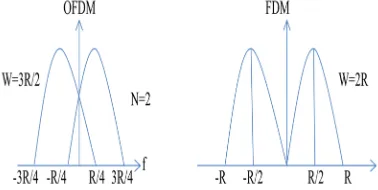
[image:2.612.215.404.506.601.2]proposed by Chang in 1966. Orthogonal Frequency Division Multiplexing (OFDM) is a multicarrier transmission technique, in which divides the bandwidth into many carriers; each one is modulated by a low rate data stream. OFDM is similar to FDMA, in that the multiple user access is achieved by subdividing the available bandwidth into multiple channels that are then allocated to users. OFDM uses the spectrum much more efficiently by spacing the channels much closer together. Pictorially it can be represented as shown in the figure1.
Fig . 1 Frequency Efficiency of OFDM over FDM for Two and Three Sub channels
Orthogonal set can be represented as such
[0, ] (1)
With = + ; = 0,1, … . , −1
Technology (IJRASET)
©IJRASET 2015: All Rights are Reserved
248
III.MULTIPLEINPUTMULTIPLEOUTPUT(MIMO)SYSTEMMODEL
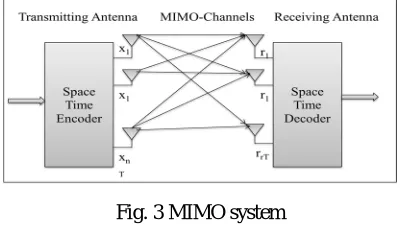
In Multi-antenna systems can be classified into three main categories. The Multiple antennas at the transmitter side are usually applicable for beam forming. In Transmitter or receiver side multiple antennas for realizing different diversity schemes. For the third class includes systems with multiple transmitter and receiver antennas realizing spatial multiplexing (often referred as MIMO by itself).
[image:3.612.206.406.254.367.2]In Multipath propagation is assumed in order to ensure the correct operation of spatial multiplexing and since MIMO is performing better in terms of channel capacity in a rich scatter multipath environment than in case of environment with LOS. In achieves this by higher spectral efficiency (more bits per second per hertz of bandwidth) and link reliability or diversity (reduced the effect of fading). The properties of MIMO are an important part of modern wireless communication such as IEEE 802.16. The main feature of MIMO systems is space-time processing. The Space-Time Codes (STCs) are the codes designed for the use in MIMO system. A Space-Time Block Codes signals are coded in both temporal and spatial domains communication. The different types of STCs, the orthogonal Space-Time Block Codes (STBCs) possess a number of advantages over other types of STCs and are considered in this book.
Fig. 3 MIMO system
IV.PEAKTOAVERAGEPOWERRATIO
PAPR is defined as the maximum power occurring in the OFDM transmission to the average power of the OFDM transmission. In a mathematical representation has been given below [2] and [1].
(PAPR)= = 10 [| | ] [| | ] (2)
Where, = peak power of the OFDM system = in average power of the OFDM system
V. PAPRREDUCTIONTECHNIQUES
Several PAPR reduction techniques have been proposed they are mainly divided in two categories, in which are as follows. Signal scrambling techniques.
Signal distortion techniques.
A. Signal Scrambling Techniques:
Different types of signal scrambling techniques are explained below.
1) Block Coding Techniques: This technique is used to reduce PAPR using different block coding technique & set of code words communication. This scheme is widely used to reduce the peak to average power ratio. The during selecting a suitable code word many things must be considered like M-ray phase modulation scheme, and type of coding rate, suitable for encoding – decoding [2]. In this method designed block code not only minimize the PAPR system, but also give error correcting capability schemes. A k bit data block is encoded by a (n, k) block code with a generator matrix „G‟ in the transmitter side. Followed by
the phase rotator vector b to produce the encoded output,
x= a.G+b(mod 2) (3)
After that generator matrix „G‟ and the phase rotator vector „b‟ are produced; which are used for mapping between G and b
Technology (IJRASET)
©IJRASET 2015: All Rights are Reserved
249
is removed from calculations of syndromes.
2) Sub Block Coding Techniques: In sub block coding techniques we can reduce PAPR more than 3db signal. But to achieve this
we have to use code rate. Sub block coding technique is based on code rate systematically with adding last odd parity
checking bit, develop lowest peak envelope power system. This coding scheme is termed as systematic odd parity checking coding (SOPC) method. By using this technique we can achieve large reduction in PAPR by divided large frame into sub block encoded with SOPC [2].
3) Selected Mapping (SLM): Main idea of selected mapping is that each OFDM frame is mapped to a number of U (independent) candidates representing the same information process. From these that one with the lowest PAR (or any other criteria) is selected [4]. In SLM technique whole set of signal represent the same signal but form it most favorable signal is chosen related to PAPR transition. The side information must be transmitted with the chosen signal. In this technique is probabilistic based will not remove the peaks but prevent it from frequently generation scheme. This scheme is very reliable but main drawback that is side information must be transmitted along with chosen signal [2].
4) Partial transmit sequence (PTS): The Main concept of this technique is that the data block divide into non overlapping sub block with independent rotation factor. It is rotation factor generates time domain data with lowest amplitude. There is no need to transmit side information in partial transmit sequence due to the use of different modulation. This is modified technique of SLM scheme and gives better performance than SLM. The objective of the PTS system approach is to form a weighted combination of the M blocks,
=∑ (4)
Where , = 1,2 … , are weighting factors
The Inverse Fast Fourier Transform (IFFT) of cm is called Partial Transmit sequence [8].
5) Linear Block Codes: Linear block codes technique is also known as standard array linear block codes system. In Linear block coding technique different U signal is transmitted along with transmitted sequence. The help of proper co-set words U distinct signal is constructed. Due to the use of scrambling codes receiver signal can easily decoded without using side information process. To reduce the PAPR we have to select standard array codes. Using scrambling codes, signal can be transmitted with minimum PAPR. Linear block code technique is also modification of the SLM techniques. Technique has better performance than SLM technique.
B. Signal Distortion Techniques
Different types of signal distortion techniques are explain below.
1) Clipping & Filtering: Clipping is the nonlinear processes which increase the band noise distortion, also increase the bit error rate and decrease the spectral efficiency. The performance of clipping and filtering techniques can be improved with the help of filter. The out of band radiation can be improved by passing clipped signal from filter. Here if the OFDM signal is over sampled then the scheme of correction is suitable with the clipping so that each subcarrier generated with the interference [1]. The oversampling factor is defined as
L = N0=N. (5)
The method of Clipping and Filtering can be described with modulation technique, QAM. OFDM signal contains high peaks so it is transferred from the clipping. This when amplitude is greater than the threshold value, and the amplitude is clipped off shown in fig 2, while saving the phase [1], [5] and [6]. The clipped sample is given by:
Technology (IJRASET)
[image:5.612.192.448.551.700.2]©IJRASET 2015: All Rights are Reserved
250
Fig. 4 Clipping Method
2) Peak Windowing: With the help of this technique we can reduce PAPR up to 4db per subcarrier; here in peak windowing technique SNR is limited to 0.3db due to signal distortion. In this peak windowing technique we multiply different windows with large signal peaks like Gaussian shaped window, cosine, Kaiser and Hamming window. In this technique window size as narrow as possible. The resulting spectrum is the convolution of the original OFDM spectrum with the spectrum of the applied window. As compare to the clipping technique peak windowing technique give better performance with adding some self interference and increase in BER (bit error rate) [1] and [7].
Window function
( ) = ( ). ( ) (7)
Where ( ) = | ( )|
( ) = 1− ∑ . ( − ́) (8)
( ): Is the window function
VI.RESULTSANDDISCUSSION
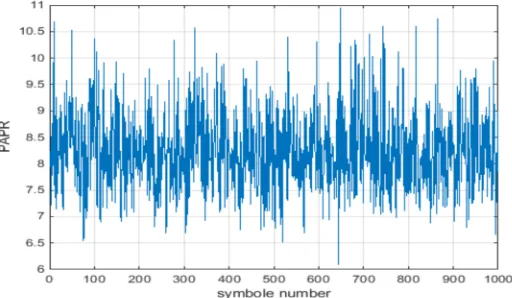
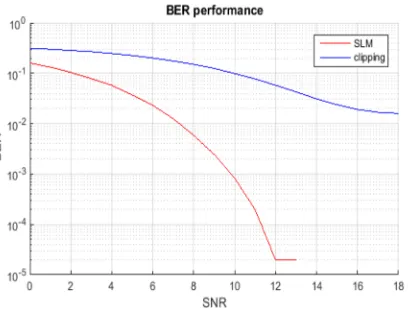
There are various simulation has been carried out for MIMO-OFDM system. The various results are as follows, The BER performance graphs for the simulated MIMO-OFDM and PAPR with the implementation of channel coding. The PAPR reduction in the Complementary Cumulative Density Function (CCDF) of the PAPR of the STBC MIMO-OFDM signals. This confirms that the STBC coding helps in ways beneficial to reduce fluctuations in the envelope of the MIMO-OFDM with association generally block codes space-system; it takes advantage of the spatial diversity obtained by spatially separated antennas.
Parameters
Number of Symbol: 100 Modulation technique : QAM FFT: 512
Technology (IJRASET)
[image:6.612.217.424.88.253.2]©IJRASET 2015: All Rights are Reserved
251
[image:6.612.208.432.290.475.2]Fig. 7 BER performance of CCDF Vs PAPR
Fig. 8 Performance of BER Vs SNR
[image:6.612.190.450.515.676.2]Technology (IJRASET)
[image:7.612.211.435.88.251.2]©IJRASET 2015: All Rights are Reserved
252
Fig. 10 Performance of CCDF Vs PAPR
Fig. 11 Performance of BER Vs SNR
VII. CONCLUSION
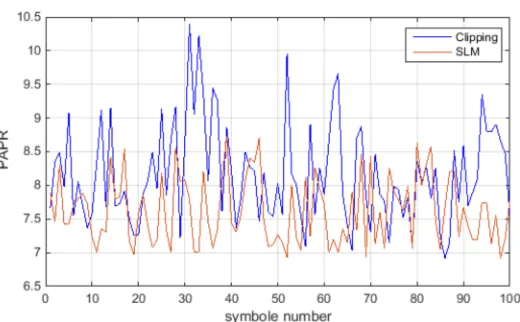
In this paper, performance enhancement of MIMO-OFDM system is done with PAPR. we present in the first part an analysis of the PAPR reduction method which are clipping and filtering, SLM in STBC MIMO-OFDM system. Simulation results have shown that clipping and filtering technique gives a better reduction PAPR compared to the others methods. In the second part a result represent by curves CCDF of PAPR of signal received into different methods exhibit a conservation of the PAPR reduction in SLM technique.
REFERENCES
[1] Comparative Study of PAPR Reduction Techniques in OFDM 1Md. Ibrahim Abdullah, 2Md. Zulfiker Mahmud,3Md. Shamim Hossain, 4Md. Nurul Islam [2] Different Techniques to Reduce the PAPR in OFDM System *Malhar Chauhan, **Saurabh patel, ***Hardik patel
[3] OFDM and Its Wireless Applications: A SurveyTaewon Hwang, Chenyang Yang, Senior Member, IEEE, Gang Wu, Member, IEEE, Shaoqian Li, and Geoffrey Ye Li, Fellow, IEEE
[4] Power Savings Comparison of Clipping and Selected Mapping for Peak Reduction in Multicarrier Systems by Arun K. Gurung1, Fawaz S. Al-Qahtani1, and Zahir M. Hussain1, SMIEEE, FEBRUARY 15-18, 2009
[5] Peak-to-Average Power Ratio Reduction Techniques for OFDM Signals by Tao Jiang, Member, IEEE, and Yiyan Wu, Fellow, IEEE TRANSACTIONS ON BROADCASTING, VOL. 54, NO. 2, JUNE 2008.
[6] A. Tarighat and A. H. Sayed, “MIMO OFDM receivers for systems with IQ imbalances,” IEEE Transactions on Signal Processing, Vol. 53, Issue 9, pp. 3583– 3596, September 2005.
[image:7.612.208.412.285.442.2]