Core Genome Multilocus Sequence Typing and Single
Nucleotide Polymorphism Analysis in the Epidemiology of
Brucella melitensis
Infections
Anna Janowicz,aFabrizio De Massis,aMassimo Ancora,aCesare Cammà,aClaudio Patavino,a Antonio Battisti,bKarola Prior,c
Dag Harmsen,cHolger Scholz,dKatiuscia Zilli,aLorena Sacchini,aElisabetta Di Giannatale,aGiuliano Garofoloa
aNational and OIE Reference Laboratory for Brucellosis, Istituto Zooprofilattico Sperimentale dell'Abruzzo e del
Molise G. Caporale, Teramo, Italy
bIstituto Zooprofilattico Sperimentale del Lazio e della Toscana M. Aleandri, Rome, Italy
cDepartment of Periodontology and Restorative Dentistry, Muenster University Hospital, Muenster, Germany
dBundeswehr Institute of Microbiology, Munich, Germany
ABSTRACT The use of whole-genome sequencing (WGS) using next-generation
sequencing (NGS) technology has become a widely accepted method for micro-biology laboratories in the application of molecular typing for outbreak tracing and genomic epidemiology. Several studies demonstrated the usefulness of WGS data analysis through single-nucleotide polymorphism (SNP) calling from a refer-ence sequrefer-ence analysis for Brucella melitensis, whereas gene-by-gene comparison through core-genome multilocus sequence typing (cgMLST) has not been ex-plored so far. The current study developed an allele-based cgMLST method and compared its performance to that of the genome-wide SNP approach and the traditional multilocus variable-number tandem repeat analysis (MLVA) on a de-fined sample collection. The data set was comprised of 37 epidemiologically linked animal cases of brucellosis as well as 71 isolates with unknown epidemio-logical status, composed of human and animal samples collected in Italy. The cg-MLST scheme generated in this study contained 2,704 targets of theB. melitensis
16M reference genome. We established the potential criteria necessary for inclu-sion of an isolate into a brucellosis outbreak cluster to beⱕ6 loci in the cgMLST
and ⱕ7 in WGS SNP analysis. Higher phylogenetic distance resolution was
achieved with cgMLST and SNP analysis than with MLVA, particularly for strains belonging to the same lineage, thereby allowing diverse and unrelated geno-types to be identified with greater confidence. The application of a cgMLST scheme to the characterization of B. melitensis strains provided insights into the epidemiology of this pathogen, and it is a candidate to be a benchmark tool for outbreak investigations in human and animal brucellosis.
KEYWORDS Brucella melitensis, MLVA, SNP analysis, cgMLST
B
rucellosis is one of the world’s most widespread zoonoses, and it is a leading cause of economic losses in production of domestic ruminants (1, 2). Humans can contract the disease by contact with infected animals or their products, with unpasteurized milk being the most common source of brucellosis in urban popu-lations (3, 4).Brucella melitensis, which infects primarily sheep and goats, is the most frequent agent of brucellosis in humans, and it leads to the most severe manifes-tation of the disease (5).Due to the high public health and economic burden of brucellosis, European countries have applied surveillance, control, and eradication programs for many years, and most of them have acquired the OfficiallyBrucella melitensis-Free (OBF) status. The
Received6 April 2018Returned for
modification6 May 2018Accepted9 June
2018
Accepted manuscript posted online20
June 2018
CitationJanowicz A, De Massis F, Ancora M,
Cammà C, Patavino C, Battisti A, Prior K, Harmsen D, Scholz H, Zilli K, Sacchini L, Di Giannatale E, Garofolo G. 2018. Core genome multilocus sequence typing and single nucleotide polymorphism analysis in the epidemiology ofBrucella melitensisinfections. J Clin Microbiol 56:e00517-18.https://doi.org/10 .1128/JCM.00517-18.
EditorDaniel J. Diekema, University of Iowa
College of Medicine
Copyright© 2018 Janowicz et al. This is an
open-access article distributed under the terms of theCreative Commons Attribution 4.0 International license.
Address correspondence to Fabrizio De Massis, [email protected], or Giuliano Garofolo, [email protected].
crossm
on May 16, 2020 by guest
http://jcm.asm.org/
disease, however, still persists in several countries in the Mediterranean area. In Italy, despite implementation of the brucellosis eradication program for over 50 years, ovine and caprine brucellosis remains endemic in several southern provinces, in Sicily in particular (6). To date, the regions of Italy still not classified as OBF cover approximately 35.5% of the national land surface, where 39.9% of all small ruminants are farmed (7, 8). The current brucellosis surveillance system in Italy involves regular serological testing and slaughtering of the positive animals from which a bacteriological isolation is performed for confirmation of the diagnosis. Control testing is performed less frequently in the OBF regions, where the goal is to control reintroductions of the disease, whereas it is continuous in the affected areas, where the main aim is eradica-tion of brucellosis.
Efficient and reliable surveillance programs are essential for detection and control of outbreaks and largely depend on collection and access to epidemiological data. Currently, epidemiological investigations rely on the availability of standardized and effective molecular typing methods and analysis tools that allow the public health laboratories to identify and trace an outbreak back to its source.
Identification and typing ofB. melitensisare still traditionally performed with the use of biotyping techniques. This methodology, however, suffers from inconsistencies and requires handling of the live bacteria. For this reason, PCR-based typing is now commonly used as an alternative to the culture-dependent typing methods (9–12). The results of the classical biotyping schemes categorizeB. melitensisinto three biovars that are of limited epidemiological value, as they do not provide sufficient resolution between the isolates. Moreover, an individual biotype often predominates in particular areas, as seen in Italy, where biovar 3 is almost exclusively isolated from the local animal populations (13). B. melitensis is a highly clonal, i.e., monomorphic pathogen, which renders its differentiation at the strain level very difficult (14). Pattern-based techniques such as pulsed field gel electrophoresis and amplified fragment length polymorphism have been applied in the past, but these techniques were not able to differentiate
Brucella at the subspecies level, which correlated with low intra- and interlaboratory reproducibility (15). In recent years, the typing methods have shifted toward genome-based approaches that finally allowed an accurate differentiation between Brucella
isolates and establishment of a common consensus for the subtyping schemes of this pathogen (6, 16–18).
To date, multilocus variable number of tandem repeats analysis (MLVA) has been considered the most efficient typing method forBrucellaspp. Several studies demon-strated that MLVA has a high discriminating resolution, in congruence with MLST, and is sufficient for in-depth study of either genome evolution or outbreak epidemiology (19). According to MLVA schemes, theB. melitensispopulation can be divided into West Mediterranean, East Mediterranean, and American lineages (20, 21). Moreover, with the development of an international repository, the MLVA data can be stored on web servers and shared between research institutes, thereby increasing MLVA utility as a tool used for analysis ofBrucellaepidemiology in the world (http://microbesgenotyping .i2bc.paris-saclay.fr/databases/view/907) (22). However, this typing method has several weaknesses, related both to the nature of variable-number tandem repeats (VNTRs) as well as to laboratory demands of the technique itself (12).
With advances in and decreased cost of whole-genome sequencing (WGS), new methods of pathogen typing, including gene-by-gene comparison using core genome multilocus sequence typing (cgMLST), as well as single-nucleotide polymorphism (SNP) calling based on a reference sequence analysis, are considered to be a suitable and more informative replacement of the gold standard typing schemes (23–26). cgMLST is performed by assigning specific alleles to a predefined set of core genes, i.e., genes present in all strains of a given bacterial species. Validated schemes for several pathogens are publicly available and can be shared to ensure reproducibility and comparability of the results across laboratories (23).
The aims of our study were to develop a cgMLST scheme forB. melitensisand to assess the performance of cgMLST and a whole-genome SNP-based approach against
on May 16, 2020 by guest
http://jcm.asm.org/
the traditional MLVA-16 typing method using a set of animal outbreak-associated isolates and a set of isolates with unknown epidemiological status.
MATERIALS AND METHODS
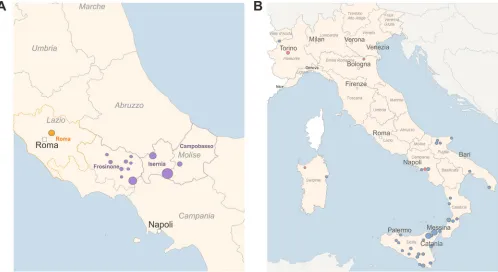
Study design andB. melitensisstrains.To evaluate the WGS/NGS approach, we analyzed two different panels of isolates, and we compared the results with those from MLVA-16. The first panel consisted of 37 epidemiologically linkedB. melitensisstrains isolated during a single outbreak in 21 farms from the provinces of Frosinone, Rome, Isernia, and Campobasso in central Italy (Fig. 1A). The second panel was comprised of 64 isolates ofB. melitensiswith unknown epidemiological status, collected in Italy from infected livestock between 2011 and 2017 during national eradication program activities, and two related and five unrelated B. melitensis strains isolated from human cases. Figure 1B shows the geographical origin of these samples.
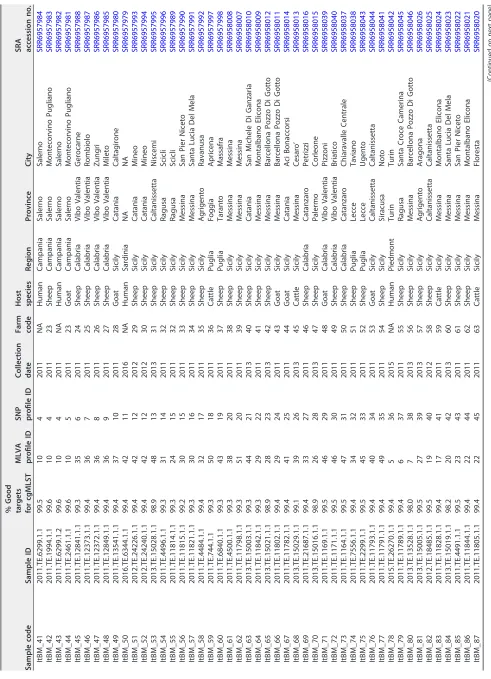
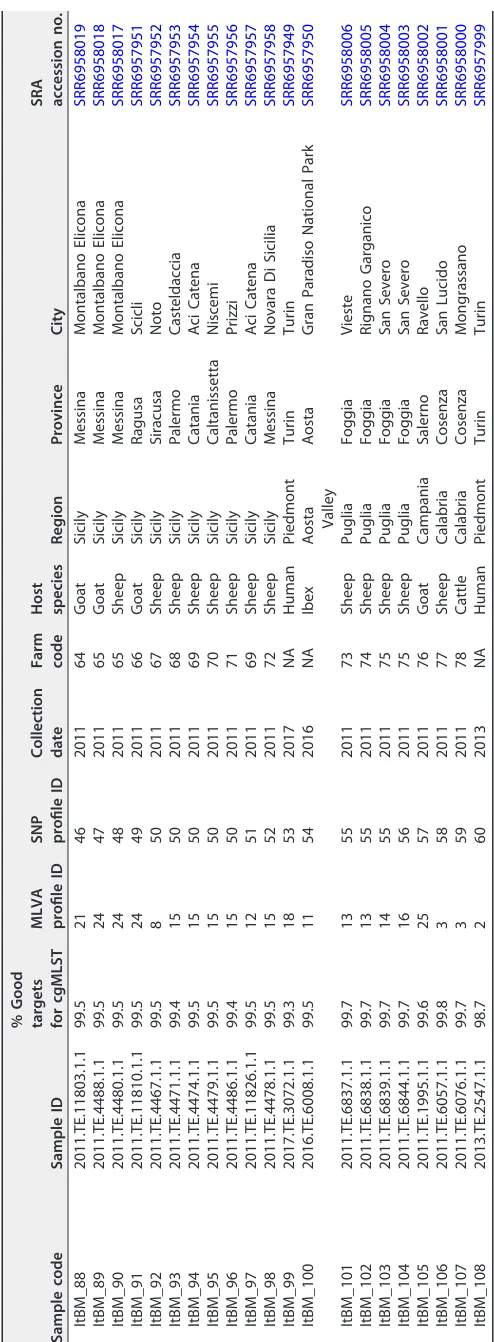
B. melitensiswas isolated by following the OIE standard protocol (27). Briefly, animal samples were collected from lymphatic glands (i.e., mandibular, supramammary, and genital lymph nodes), spleen, uterus, or udder, whereas human isolates were obtained directly from blood culture. The isolates were cultured on serum dextrose agar, and the phenotype of the colonies was confirmed using a standard Gram stain and catalase, oxidase, and urease tests. We assigned theBrucellaspecies by PCR, traditional biochemical testing, and serotyping as previously described (13). DNA from theB. melitensisstrains was extracted using the Maxwell 16 tissue DNA purification kit (Promega Corporation, Madison, WI) according to the manufacturer’s instructions. All isolates were stored at⫺80°C. Epidemiological data are reported in Table 1.
MLVA.Samples were genotyped using the MLVA-16 panel described by Le Flèche et al. (16). Briefly, to assign specific alleles, DNA extracted from each isolate was amplified by multiplex PCR using primers specific for each MLVA-16 locus as described before (12, 16). The amplicons were then separated by capillary electrophoresis using an ABI 3500 instrument with POP 7 polymer, and the allele types were assigned using Genemapper 4.1 (Applied Biosystems, Carlsbad, CA).
Whole-genome sequencing.Total genomic DNA was quantified with the Qubit fluorometer (QubitTM DNA HS assay; Life Technologies, Thermo Fisher Scientific, Inc.), and library preparation was performed using the Nextera XT library preparation kit (Illumina Inc., San Diego, CA) or Kapa high-throughput library preparation kit (Kapa Biosystems, Wilmington, MA) according to the manufacturers’ instructions. The libraries were sequenced using the Illumina NextSeq 500 platform, producing 150-bp paired-end reads, or Illumina MiSeq, producing 250-bp paired-end reads. After demultiplexing and removal of adapters, reads were trimmed from 5=and 3=ends to discard the nucleotides with quality scores of less than 20. Reads shorter than 70 bp and average Phred mean quality of⬍24 were automatically discarded. Read
FIG 1Geographical map forB. melitensiscases studied. (A) epidemiologically related isolates. (B) Isolates with unknown epidemiological status. (A) Separate epidemiological clusters are marked with different colors respective to the provinces of isolation (purple, Frosinone, Isernia, and Campobasso; orange, Rome). (B) The red circles correspond to human isolates and the blue circles to animal isolates.
on May 16, 2020 by guest
http://jcm.asm.org/
[image:3.585.45.543.72.344.2]TABLE 1 Brucella melitensis isolates analyzed in this study a Sample code Sample ID % Good targets for cgMLST MLVA profile ID SNP profile ID Collection date Farm code Host species Region Province City SRA accession no. Epidemiologically linked isolates ItBM_1 2015.IS.2566.1.9 99.4 5 1 14.04.2015 1 Sheep Molise Isernia Rionero Sannitico SRR6958031 ItBM_2 2015.IS.2547.1.11 99.4 5 2 14.04.2015 1 Sheep Molise Isernia Rionero Sannitico SRR6958032 ItBM_3 2015.IS.3088.1.42 99.4 1 4 29.04.2015 2 Sheep Molise Isernia Roccamandolfi SRR6958033 ItBM_4 2015.IS.5088.1.8 99.2 13 5 06.05.2015 3 Sheep Molise Campobasso Bojano SRR6958034 ItBM_5 2015.TE.21824.1.1 99.3 5 6 16.06.2015 4 Sheep Lazio Frosinone Atina SRR6958027 ItBM_6 2015.CB.2220.1.19 99.4 3 7 22.03.2015 5 Sheep Molise Campobasso Castropignano SRR6958028 ItBM_7 2016.TE.17271.1.1 99.4 5 8 06.07.2016 6 Cattle Lazio Frosinone Terelle SRR6958029 ItBM_8 2015.CB.3742.1.20 99.4 2 9 21.05.2015 5 Sheep Molise Campobasso Castropignano SRR6958030 ItBM_9 2015.IS.2533.1.11 99.4 5 9 14.04.2015 1 Sheep Molise Isernia Rionero Sannitico SRR6958035 ItBM_10 2015.IS.3088.1.36 99.4 5 9 29.04.2015 2 Sheep Molise Isernia Roccamandolfi SRR6958036 ItBM_11 2015.IS.3413.1.7 99.4 5 9 30.04.2015 2 Sheep Molise Isernia Roccamandolfi SRR6957939 ItBM_12 2015.TE.16173.1.1 99.4 3 9 24.04.2015 7 Goat Lazio Frosinone Sant’apollinare SRR6957940 ItBM_13 2015.TE.16200.1.1 99.3 3 9 01.06.2015 8 Sheep Lazio Frosinone Frosinone SRR6957941 ItBM_14 2016.TE.705.1.1 99.4 5 9 22.12.2015 9 Sheep Lazio Frosinone Monte San Giovanni Campano SRR6957942 ItBM_15 2015.TE.21825.1.1 99.4 5 10 07.07.2015 10 Sheep Lazio Frosinone Casalvieri SRR6957943 ItBM_16 2015.IS.2529.1.14 99.4 5 11 14.04.2015 1 Goat Molise Isernia Rionero Sannitico SRR6957944 ItBM_17 2015.TE.16181.1.1 99.4 5 12 24.04.2015 7 Goat Lazio Frosinone Sant’apollinare SRR6957945 ItBM_18 2014.TE.16510.1.2 99.4 8 13 09.07.2014 11 Goat Lazio Frosinone Roccasecca SRR6957946 ItBM_19 2015.TE.16142.1.1 99.4 5 14 24.04.2015 12 Sheep Lazio Frosinone Sant’apollinare SRR6957947 ItBM_20 2015.TE.11849.1.3 99.4 6 15 28.04.2015 13 Sheep Lazio Frosinone Sant’apollinare SRR6957948 ItBM_21 2015.CB.3742.1.27 99.4 4 16 21.05.2015 5 Sheep Molise Campobasso Castropignano SRR6957966 ItBM_22 2015.IS.3088.1.30 99.3 7 16 29.04.2015 2 Sheep Molise Isernia Roccamandolfi SRR6957965 ItBM_23 2015.IS.3681.1.8 99.4 5 16 30.04.2015 2 Sheep Molise Isernia Roccamandolfi SRR6957968 ItBM_24 2015.TE.16142.1.2 99.4 5 16 24.04.2015 12 Sheep Lazio Frosinone Sant’apollinare SRR6957967 ItBM_25 2015.TE.16165.1.2 99.4 5 16 24.04.2015 7 Sheep Lazio Frosinone Sant’apollinare SRR6957962 ItBM_26 2015.TE.16189.1.1 99.4 5 16 05.05.2015 14 Sheep Lazio Frosinone San Donato Val Di Comino SRR6957961 ItBM_27 2015.TE.16194.1.1 99.4 3 16 05.05.2015 15 Sheep Lazio Frosinone Atina SRR6957964 ItBM_28 2016.TE.703.1.2 99.4 5 16 22.12.2015 16 Sheep Lazio Frosinone Monte San Giovanni Campano SRR6957963 ItBM_29 2014.TE.16510.1.7 99.4 9 17 09.07.2014 11 Goat Lazio Frosinone Roccasecca SRR6957960 ItBM_30 2016.CB.1265.1.7 99.4 5 18 23.02.2016 17 Cattle Molise Campobasso San Massimo SRR6957959 ItBM_31 2015.IS.6043.1.8 99.4 5 19 24.07.2015 18 Cattle Molise Isernia Cantalupo Nel Sannio SRR6957977 ItBM_32 2015.IS.5947.1.7 99.4 5 20 22.07.2015 18 Cattle Molise Isernia Cantalupo Nel Sannio SRR6957978 ItBM_33 2016.TE.17270.1.1 99.3 5 21 16.06.2016 19 Sheep Lazio Frosinone Pontecorvo SRR6957975 ItBM_34 2015.TE.11843.1.1 99.4 11 22 28.04.2015 20 NA Lazio Rome Rome SRR6957976 ItBM_35 2015.TE.11845.1.1 99.5 10 22 28.04.2015 21 NA Lazio Rome Rome SRR6957973 ItBM_36 2015.TE.11847.1.2 99.5 11 22 28.04.2015 20 NA Lazio Rome Rome SRR6957974 ItBM_37 2015.TE.11847.1.1 99.5 12 23 28.04.2015 20 NA Lazio Rome Rome SRR6957971 Isolates with unknown epidemiological status ItBM_38 2011.TE.19513.1.1 99.4 1 1 2011 NA Human Emilia Romagna Ferrara Ferrara SRR6957972 ItBM_39 2011.TE.21031.1.1 99.9 4 2 2011 22 Goat Sardinia Nuoro Orosei SRR6957969 ItBM_40 2011.TE.3922.1.1 99.6 9 3 2011 23 Goat Campania Salerno Montecorvino Pugliano SRR6957970 (Continued on next page)
on May 16, 2020 by guest
http://jcm.asm.org/
TABLE 1 (Continued) Sample code Sample ID % Good targets for cgMLST MLVA profile ID SNP profile ID Collection date Farm code Host species Region Province City SRA accession no. ItBM_41 2011.TE.6299.1.1 99.5 10 4 2011 NA Human Campania Salerno Salerno SRR6957984 ItBM_42 2011.TE.1994.1.1 99.6 10 4 2011 23 Sheep Campania Salerno Montecorvino Pugliano SRR6957983 ItBM_43 2011.TE.6299.1.2 99.6 10 4 2011 NA Human Campania Salerno Salerno SRR6957982 ItBM_44 2011.TE.2461.1.1 99.6 10 5 2011 23 Goat Campania Salerno Montecorvino Pugliano SRR6957981 ItBM_45 2011.TE.12841.1.1 99.3 35 6 2011 24 Sheep Calabria Vibo Valentia Gerocarne SRR6957988 ItBM_46 2011.TE.12373.1.1 99.4 36 7 2011 25 Sheep Calabria Vibo Valentia Rombiolo SRR6957987 ItBM_47 2011.TE.12372.1.1 99.4 36 8 2011 26 Sheep Calabria Vibo Valentia Zungri SRR6957986 ItBM_48 2011.TE.12849.1.1 99.4 36 9 2011 27 Sheep Calabria Vibo Valentia Mileto SRR6957985 ItBM_49 2011.TE.13541.1.1 99.4 37 10 2011 28 Goat Sicily Catania Caltagirone SRR6957980 ItBM_50 2016.TE.6344.1.1 99.4 42 11 2016 NA Human Sardinia NA NA SRR6957979 ItBM_51 2012.TE.24226.1.1 99.4 42 12 2012 29 Sheep Sicily Catania Mineo SRR6957993 ItBM_52 2012.TE.24240.1.1 99.4 42 12 2012 30 Sheep Sicily Catania Mineo SRR6957994 ItBM_53 2013.TE.15028.1.1 98.9 48 13 2013 31 Sheep Sicily Caltanissetta Niscemi SRR6957995 ItBM_54 2011.TE.4496.1.1 99.3 31 14 2011 32 Sheep Sicily Ragusa Scicli SRR6957996 ItBM_55 2011.TE.11814.1.1 99.3 24 15 2011 32 Sheep Sicily Ragusa Scicli SRR6957989 ItBM_56 2011.TE.11815.1.1 99.2 30 15 2011 33 Sheep Sicily Messina San Pier Niceto SRR6957990 ItBM_57 2011.TE.11821.1.1 99.3 30 16 2011 34 Sheep Sicily Messina Santa Lucia Del Mela SRR6957991 ItBM_58 2011.TE.4484.1.1 99.4 32 17 2011 35 Sheep Sicily Agrigento Ravanusa SRR6957992 ItBM_59 2011.TE.744.1.1 99.3 50 18 2011 36 Cattle Puglia Foggia Apricena SRR6957997 ItBM_60 2011.TE.6840.1.1 99.3 43 19 2011 37 Sheep Puglia Taranto Massafra SRR6957998 ItBM_61 2011.TE.4500.1.1 99.3 38 20 2011 38 Sheep Sicily Messina Messina SRR6958008 ItBM_62 2011.TE.11798.1.1 99.3 51 20 2011 39 Sheep Sicily Messina Messina SRR6958007 ItBM_63 2013.TE.15003.1.1 99.3 44 21 2013 40 Sheep Sicily Catania San Michele Di Ganzaria SRR6958010 ItBM_64 2011.TE.11842.1.1 99.3 29 22 2011 41 Sheep Sicily Messina Montalbano Elicona SRR6958009 ItBM_65 2013.TE.15021.1.1 98.9 28 23 2013 42 Sheep Sicily Messina Barcellona Pozzo Di Gotto SRR6958012 ItBM_66 2011.TE.11802.1.1 99.4 29 24 2011 43 Goat Sicily Messina Barcellona Pozzo Di Gotto SRR6958011 ItBM_67 2011.TE.11782.1.1 99.4 41 25 2011 44 Goat Sicily Catania Aci Bonaccorsi SRR6958014 ItBM_68 2013.TE.15029.1.1 99.1 39 26 2013 45 Cattle Sicily Messina Cesaro’ SRR6958013 ItBM_69 2011.TE.21687.1.1 99.4 33 27 2011 46 Sheep Calabria Catanzaro Petrizzi SRR6958016 ItBM_70 2013.TE.15016.1.1 98.9 26 28 2013 47 Sheep Sicily Palermo Corleone SRR6958015 ItBM_71 2011.TE.1169.1.1 99.5 46 29 2011 48 Goat Calabria Vibo Valentia Pizzoni SRR6958039 ItBM_72 2011.TE.1171.1.1 99.5 46 30 2011 49 Sheep Calabria Vibo Valentia Briatico SRR6958040 ItBM_73 2011.TE.1164.1.1 99.5 47 31 2011 50 Sheep Calabria Catanzaro Chiaravalle Centrale SRR6958037 ItBM_74 2011.TE.7556.1.1 99.4 34 32 2011 51 Sheep Puglia Lecce Taviano SRR6958038 ItBM_75 2011.TE.2299.1.1 99.5 45 33 2011 52 Sheep Puglia Lecce Ugento SRR6958043 ItBM_76 2011.TE.11793.1.1 99.4 40 34 2011 53 Goat Sicily Caltanissetta Caltanissetta SRR6958044 ItBM_77 2011.TE.11791.1.1 99.4 49 35 2011 54 Sheep Sicily Siracusa Noto SRR6958041 ItBM_78 2015.TE.26270.1.1 99.4 5 36 2015 NA Human Piedmont Turin Turin SRR6958042 ItBM_79 2011.TE.11789.1.1 99.4 6 37 2011 55 Sheep Sicily Ragusa Santa Croce Camerina SRR6958045 ItBM_80 2013.TE.13528.1.1 98.0 7 38 2013 56 Sheep Sicily Messina Barcellona Pozzo Di Gotto SRR6958046 ItBM_81 2013.TE.15005.1.1 99.5 27 39 2013 57 Sheep Sicily Agrigento Aragona SRR6958026 ItBM_82 2012.TE.18485.1.1 99.5 19 40 2012 58 Sheep Sicily Caltanissetta Caltanissetta SRR6958025 ItBM_83 2011.TE.11828.1.1 99.4 17 41 2011 59 Cattle Sicily Messina Montalbano Elicona SRR6958024 ItBM_84 2013.TE.15019.1.1 98.2 20 42 2013 60 Sheep Sicily Messina Santa Lucia Del Mela SRR6958023 ItBM_85 2011.TE.4491.1.1 99.5 23 43 2011 61 Sheep Sicily Messina San Pier Niceto SRR6958022 ItBM_86 2011.TE.11844.1.1 99.4 22 44 2011 62 Sheep Sicily Messina Montalbano Elicona SRR6958021 ItBM_87 2011.TE.11805.1.1 99.4 22 45 2011 63 Cattle Sicily Messina Floresta SRR6958020 (Continued on next page)
on May 16, 2020 by guest
http://jcm.asm.org/
[image:5.585.51.542.68.747.2]TABLE 1 (Continued) Sample code Sample ID % Good targets for cgMLST MLVA profile ID SNP profile ID Collection date Farm code Host species Region Province City SRA accession no. ItBM_88 2011.TE.11803.1.1 99.5 21 46 2011 64 Goat Sicily Messina Montalbano Elicona SRR6958019 ItBM_89 2011.TE.4488.1.1 99.5 24 47 2011 65 Goat Sicily Messina Montalbano Elicona SRR6958018 ItBM_90 2011.TE.4480.1.1 99.5 24 48 2011 65 Sheep Sicily Messina Montalbano Elicona SRR6958017 ItBM_91 2011.TE.11810.1.1 99.5 24 49 2011 66 Goat Sicily Ragusa Scicli SRR6957951 ItBM_92 2011.TE.4467.1.1 99.5 8 50 2011 67 Sheep Sicily Siracusa Noto SRR6957952 ItBM_93 2011.TE.4471.1.1 99.4 15 50 2011 68 Sheep Sicily Palermo Casteldaccia SRR6957953 ItBM_94 2011.TE.4474.1.1 99.5 15 50 2011 69 Sheep Sicily Catania Aci Catena SRR6957954 ItBM_95 2011.TE.4479.1.1 99.5 15 50 2011 70 Sheep Sicily Caltanissetta Niscemi SRR6957955 ItBM_96 2011.TE.4486.1.1 99.4 15 50 2011 71 Sheep Sicily Palermo Prizzi SRR6957956 ItBM_97 2011.TE.11826.1.1 99.5 12 51 2011 69 Sheep Sicily Catania Aci Catena SRR6957957 ItBM_98 2011.TE.4478.1.1 99.5 15 52 2011 72 Sheep Sicily Messina Novara Di Sicilia SRR6957958 ItBM_99 2017.TE.3072.1.1 99.3 18 53 2017 NA Human Piedmont Turin Turin SRR6957949 ItBM_100 2016.TE.6008.1.1 99.5 11 54 2016 NA Ibex Aosta Valley Aosta Gran Paradiso National Park SRR6957950 ItBM_101 2011.TE.6837.1.1 99.7 13 55 2011 73 Sheep Puglia Foggia Vieste SRR6958006 ItBM_102 2011.TE.6838.1.1 99.7 13 55 2011 74 Sheep Puglia Foggia Rignano Garganico SRR6958005 ItBM_103 2011.TE.6839.1.1 99.7 14 55 2011 75 Sheep Puglia Foggia San Severo SRR6958004 ItBM_104 2011.TE.6844.1.1 99.7 16 56 2011 75 Sheep Puglia Foggia San Severo SRR6958003 ItBM_105 2011.TE.1995.1.1 99.6 25 57 2011 76 Goat Campania Salerno Ravello SRR6958002 ItBM_106 2011.TE.6057.1.1 99.8 3 58 2011 77 Sheep Calabria Cosenza San Lucido SRR6958001 ItBM_107 2011.TE.6076.1.1 99.7 3 59 2011 78 Cattle Calabria Cosenza Mongrassano SRR6958000 ItBM_108 2013.TE.2547.1.1 98.7 2 60 2013 NA Human Piedmont Turin Turin SRR6957999 aNA, not available.
on May 16, 2020 by guest
http://jcm.asm.org/
[image:6.585.83.330.67.738.2]coverage ranged from 18⫻to 356⫻, with an average of 155⫻. All scaffolds were assembled with SPAdes version 3.11.1 with the – careful option selected (28, 29).
cgMLST target definition. To determine the cgMLST gene set, we performed a genome-wide gene-by-gene comparison using the cgMLST Target Definer (version 1.4) function of the SeqSphere⫹ software, v5.0.90 (Ridom GmbH, Münster, Germany), with default parameters. These parameters com-prised the following filters to exclude certain genes of theB. melitensisbv. 1 strain 16M reference genome (NC_003317.1andNC_003318.1) from the cgMLST scheme: a minimum length filter that discards all genes shorter than 50 bp, a start codon filter that discards all genes that contain no start codon at the beginning of the gene, a stop codon filter that discards all genes that contain no stop codon or more than one stop codon or if the stop codon is not at the end of the gene, a homologous gene filter that discards all genes with fragments that occur in multiple copies within a genome (with identity of 90% and more than 100-bp overlap), and a gene overlap filter that discards the shorter gene from the cgMLST scheme if the two genes affected overlap by⬎4 bp. The remaining genes were then used in a pairwise comparison using BLAST, version 2.2.12 (parameters used were the following: word size, 11; mismatch penalty,⫺1; match reward, 1; gap open costs, 5; gap extension costs, 2), with the query chromosomes of one representative for each of the other twoB. melitensisbiovars (B. melitensisbv. 2 strain 63/9 [NZ_CP007788.1 and NZ_CP007789.1] and B. melitensis bv. 3 strain Ether [NZ_CP007761.1 and
NZ_CP007760.1]) (30). Using all genes of the reference genome that were common in all query genomes, with a sequence identity ofⱖ90% and 100% overlap and with the genome filters start codon filter, stop codon filter, and stop codon percentage filter turned on, the final cgMLST scheme was formed. Therefore, all genes having no start or stop codon in one of the query genomes, as well as genes that had internal stop codons in more than 20% of the query genomes, were discarded.
SNP analysis.SNPs were identified using In Silico Genotyper (ISG), version 0.16.10-3 (31). We used default filters to remove SNPs from duplicated regions, minimum quality was set to Phred 30, and the minimum allele frequency was set to 90% in all samples. We used the ISG pipeline with BWA-MEM (version 0.712-r1039) (32) as the aligner and GATK (version 3.9) (33) as the SNP caller. The SNPs were called based on alignment to the referenceBrucella melitensisbv. 1 strain 16M (GenBank accession numbersNC_003317.1andNC_003318.1). Clean unique variants used in further analysis are listed in Tables S1 and S2 in the supplemental material.
Clustering analyses and cluster definition. MLVA-16 allelic profiles and SNP matrix data were analyzed using the goeBURST algorithm implemented in PHYLOViZ, version 2.0 (34). Minimum spanning trees (MST) were created using default software settings. The cgMLST profiles were assigned usingB. melitensistask template in Ridom SeqSphere⫹(35, 36). MSTs were created by pairwise comparison of cgMLST target genes. Missing values were ignored in the calculation of distance between pairs of sample profiles. The links between the MST nodes represented the distance between the genotypes. The cluster cutoff value was defined as the maximum pairwise distance found between epidemiologically linked isolates. The maps in Fig. 1A and B were drawn with SeqSphere⫹by using GeoNames (http://www .geonames.org) for geocoding and Natural Earth (http://www.naturalearthdata.com) for drawing vector maps.
Comparison of MLVA, cgMLST, and SNP typing results was performed using Simpson’s index of diversity (SDI) and adjusted Wallace (AW) test of congruence using an online tool available athttp:// www.comparingpartitions.info/?link⫽Tool(37, 38).
Accession number(s). All generated data (Table 1) were submitted to the National Center for Biotechnology Information (NCBI) under the BioProject accession numberPRJNA448825(https://www .ncbi.nlm.nih.gov/bioproject/PRJNA448825).
RESULTS
Epidemiologically linkedB. melitensisisolates.The outbreak-related isolates were
detected in 21 different farms in three Italian provinces over a period of 1.5 years. The culture-positive samples belonged to 37 animals that were investigated as a part of the within- and among-farm epidemiological investigation (Fig. 1 and Table 1).
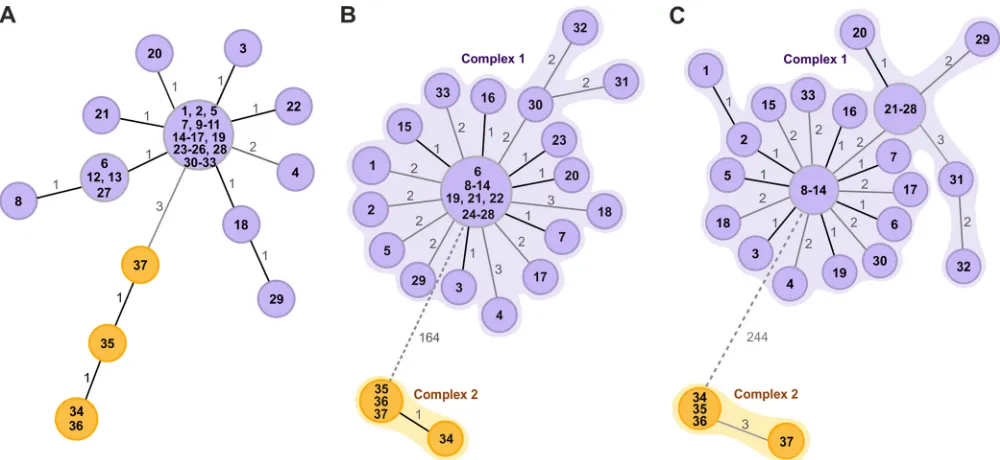
MLVA-16 revealed the presence of 13 different genotypes, divided into two groups formed by single-locus variants and one double-locus variant (Fig. 2A). MST showed that the groups were split by mutations in the three hypervariable loci bruce04, bruce09, and bruce16. One group included three genotypes of four isolates collected from farms located in the province of Rome, whereas in the remaining 33 strains from Isernia, Campobasso, and Frosinone provinces we identified 10 distinct genotypes.
We generated a cgMLST scheme comprised of 2,704 targets based on the B.
melitensis16M reference genome. The cgMLST clustering divided the isolates into two different genetic complexes, grouping the two farms from the province of Rome (complex 2) separately from the remaining 19 farms (complex 1). The genetic division measured with the cgMLST panel was for 164 different genes (Fig. 2B). The analysis using theB. melitensispanel found one prevalent genotype that was similar across the provinces of Frosinone, Campobasso, and Isernia and was found in 10 of the tested farms.
on May 16, 2020 by guest
http://jcm.asm.org/
Sixteen isolates in complex 1 shared identical core genome profiles, and the largest distance between any two neighboring isolates was not greater than three genes. In complex 2, one isolate was separated from the other three by one gene difference.
Removing 50 targets from the analysis where any value was missing decreased the distances between the nodes even further and classified all samples from Rome as identical (not shown). A within-farm genetic variation was also observed.
The SNP analysis identified 3,390 SNPs, of which 3,146 were classified as clean unique variants and included in further analysis. The tree split the samples into two genetic clusters with a distance of 244 SNPs between them (Fig. 2C). We observed a within-farm variation of 2 MLVA-16 loci, 3 cgMLST loci, and 4 SNPs. The maximum pairwise distance found in the two complexes was 6 cgMLST genes and 7 SNPs.
The comparison of discriminatory power of MLVA, cgMLST, and SNP typing showed that the SNP-based approach was superior to the other two methods, with an SDI of 0.922 and 95% confidence intervals (CI) of 0.866 to 0.978. SDI of cgMLST was calculated to be 0.815 (95% CI, 0.685 to 0.945), and SDI of MVLA-16 was 0.674 (95% CI, 0.505 to 0.843). SNP typing was a good predictor of cgMLST, with an AW of 0.788 (95% CI, 0.546 to 1.000). The correspondence of the typing results, however, was not bidirectional, as the cgMLST to SNP AW was 0.295 (95% CI, 0.136 to 0.453). Comparison of the remaining pairs of typing schemes showed that there was no congruence between clusters they predicted (the AW of each pair did not exceed 0.03).
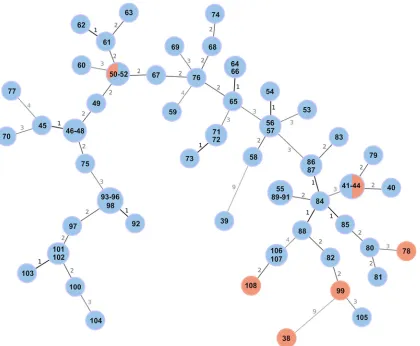
B. melitensis isolates with unknown epidemiological status. MST calculated using the MLVA-16 typing results showed a distance between directly linked nodes not exceeding 9 VNTR loci (Fig. 3). Fifty-one MLVA-16 profiles were assigned to the 71 strains, and diverse allele variants were identified in all loci apart from bruce45. Eleven profiles were shared by more than one isolate, which, with the exception of one human isolate, corresponded to the samples originating from the same geographical location (Table 1).
MLVA profiles tend to be conserved between epidemiologically linked strains; therefore, the strains from an outbreak are likely to have a similar MLVA profile. Three
FIG 2Minimum spanning trees (MST) generated for 37 epidemiologically related isolates. Separate epidemiological clusters are marked with different colors indicating the provinces of isolation (purple, Frosinone, Isernia, and Campobasso; orange, Rome). (A) MST based onB. melitensisMLVA-16 typing. The distance labels correspond to the number of discriminating alleles. (B) MST generated using the gene-by-gene approach. cgMLST profiles were assigned using theB. melitensistask template with 2,704 target genes. The MST was created by cgMLST target pairwise comparison, ignoring missing values, with distance representing the number of diverse alleles. Separate complexes are highlighted. (C) MST based on SNP analysis usingB. melitensisstrain 16M as a reference. The distance labels correspond to the number of discriminating SNPs between neighboring genotypes. The prefix ItBM was omitted from the isolates’ labels for simplicity.
on May 16, 2020 by guest
http://jcm.asm.org/
[image:8.585.42.542.70.300.2]MLVA-16 profiles, 10 (samples ItBM_41 to ItBM_44), 15 (samples ItBM_93 to ItBM_96 and ItBM_98), and 24 (ItBM_55 and ItBM_89 to ItBM_91), were identified in more than three strains, suggesting close relatedness of samples within these profiles. The method also allowed identification of two clear outliers. Samples ItBM_38 and ItBM_39 showed a distance of 9 alleles from the nearestB. melitensisisolate and no relatedness to one another.
According to our MLVA-16 data, only three out of six human cases could be linked to a specific animal source analyzed in our study. Human samples ItBM_41 and ItBM_43, isolated from two patients in the city of Salerno, shared the same MLVA-16 profile as two animal isolates from a farm in Salerno province (samples ItBM_42 and ItBM_44), all collected in 2011. Human isolate ItBM_50 and two animal isolates (ItBM_51 and ItBM_52) were assigned MLVA-16 profile 42, but interestingly, ItBM_50 was isolated 4 years later than the animal strains. The other three human samples did not show sufficient relatedness to any of the animal isolates to reliably trace the source of infection. The number of variable loci, in these cases, ranged from 2 to 9 in relation to the closest neighboring MLVA-16 profile.
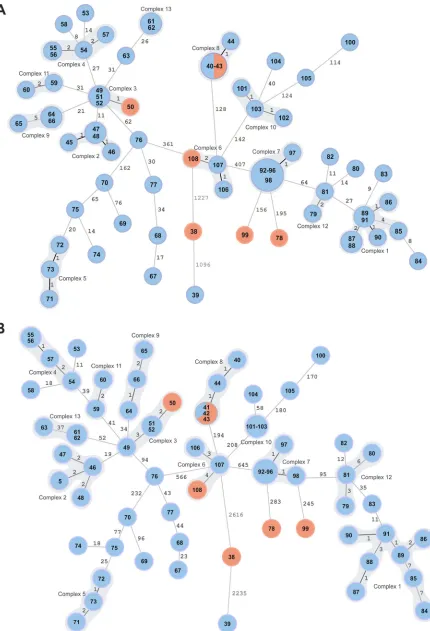
To increase the discriminatory power of the investigation, we analyzed 71 assem-blies using a cgMLST scheme. The genome assemassem-blies exceeded 98% of good targets (with a mean of 99.4%). Isolates ItBM_38 and ItBM_39 were clear outliers, separated from the closest neighbor by 1,227 genes, and 1,096 loci from one another (Fig. 4A).
Based on the analysis of epidemiologically related isolates, we used 6-gene differ-ence as a threshold for a potential complex of related cases. Thirteen complexes were
FIG 3Minimum spanning tree (MST) based onB. melitensis MLVA-16 typing results generated for 71 isolates with unknown epidemiological status. The tree was generated using the goeBURST algorithm in PHYLOViZ software. The distance labels correspond to the number of discriminating alleles. The red nodes correspond to human isolates and the blue nodes to animal isolates. The prefix ItBM was omitted from the isolates’ labels for simplicity.
on May 16, 2020 by guest
http://jcm.asm.org/
[image:9.585.45.465.71.417.2]FIG 4Minimum spanning trees (MST) based on WGS analysis results generated for 71 isolates with unknown epidemiological status. (A) MST generated using gene-by-gene approach. cgMLST profiles were assigned usingB. melitensistask template with 2,704 target genes. The MST (Continued on next page)
on May 16, 2020 by guest
http://jcm.asm.org/
[image:10.585.46.476.70.701.2]assigned in the MST data analysis. Gene-by-gene analysis confirmed relatedness of genotypes with MLVA-16 profiles 10 and 15; however, according to cgMLST two other isolates were at a distance of 0 to 1 gene away from the samples of MLVA-16 profile 15, as was one other isolate of profile 10. ItBM_55, classified as MLVA-16 profile 24, was shown not to be closely linked to other isolates with the same MLVA-16 alleles when examined with a gene-by-gene approach.
Using cgMLST, four of the human isolates (ItBM_41, ItBM_43, ItBM_50, and ItBM_108) were found in the distance not exceeding 2 alleles to the closest animal strain. Two of the human samples originating in Piedmont (ItBM_99 and ItBM_78) were genetically different from the animal samples, with 156 and 195 allele differences from the closest isolate, and could be identified as outliers, although they were distantly related to other Italian genotypes. Divergence of these two samples was not evident in MLVA-16 typing (distance of 2 to 3 alleles to other isolates).
A total of 6,540 SNPs were discovered by mapping 71 genomes to theB. melitensis
16M reference strain. Out of these, 6,027 were considered high-quality discriminatory SNPs and were used to infer the relationship between the strains. We applied the threshold of 7 SNPs to detect the clusters of closely related cases, and in accordance with cgMLST analysis, we identified 13 complexes (Fig. 4B). The highest distances observed between two adjoining isolates were 2,616 and 2,235, belonging to the SNP profiles of ItBM_38 and ItBM_39, which also were marked as outliers by MLVA-16 and cgMLST analyses.
In agreement with cgMLST, two human cases (ItBM_78 and ItBM_99) could not be traced to any of the analyzed animal strains ofB. melitensis, and both differed by more than 200 SNPs from the nearest SNP profile. Close genetic relationship to at least one isolate from an animal host was confirmed for ItBM_41, ItBM_43, ItBM_108, and ItBM_50.
The SDI for the three typing schemes were calculated to be 0.986 (95% CI, 0.978 to 0.995) for MLVA-16, 0.988 (95% CI, 0.978 to 0.998) for cgMLST, and 0.992 (95% CI, of 0.985 to 1.000) for SNP typing. AW test showed the highest congruence between SNP-and cgMLST-based clusters when the SNP method was used as a primary typing method (AW of 0.840; 95% CI, 0.753 to 0.927). When we used cgMLST as the primary method, however, the AW value dropped to 0.573 (95% CI, 0.290 to 0.856). MLVA-16 was a poor predictor of SNP (AW of 0.318; 95% CI, 0.112 to 0.524) and of cgMLST (AW of 0.494; 95% CI, 0.333 to 0.655).
DISCUSSION
Our study compared the performance of two WGS-based typing methods, SNP analysis and cgMLST, with the gold standard MLVA-16 in an analysis of the phyloge-netic relationship between isolates ofB. melitensisdetected in the context of a national surveillance program.
We found that all three typing schemes generally performed equally, and although SNP analysis had the highest resolving power in terms of differences detected between the isolates, the number of predicted genotypes in the surveillance scenario was comparable for all examined methods (51 MLVA-16 types, 55 cgMLST types, and 60 SNP types), and the SDI were similar. However, SDI test applied to samples from epidemi-ologically linked sets showed that SNP analysis was superior in differentiating between closely related samples. This suggests that while WGS-based approaches could be used as standalone tools in establishing phylogenetic relationships, MLVA-16 optimally should be supported by either SNP or gene-by-gene typing results.
In our study, all three typing methods accurately predicted the presence of two
FIG 4Legend (Continued)
was created by cgMLST target pairwise comparison, ignoring missing values, with distance representing the number of diverse alleles. Separate complexes are highlighted. (B) MST based on SNP analysis usingB. melitensisstrain 16M as a reference. The distance labels correspond to the number of discriminating SNPs between neighboring genotypes. The red color nodes correspond to human isolates and the blue nodes to animal isolates. The prefix ItBM was omitted from the isolates’ labels for simplicity.
on May 16, 2020 by guest
http://jcm.asm.org/
genomes divergent from the rest of the Italian strains. Indeed, the majority of analyzed samples belonged to the West Mediterranean lineage ofB. melitensis, while the outliers were members of the East Mediterranean and American lineages (6). Epidemiological investigation showed that ItBM_38 was isolated from a Syrian patient with a history of frequent travel to his home country, where the same East Mediterranean lineage is thought to be prevalent (39). The strain ItBM_39, on the other hand, was isolated from a goat imported to Italy from Spain.
Two human isolates, ItBM_50 and ItBM_108, were found in the same SNP and cgMLST complexes as animal strains, but interestingly, the samples were collected a few years apart and in different geographical locations, suggesting that animal isolates could have been closely related (or ancestral) to the source of human infection but not directly involved in the transmission event. In these cases, observation based on WGS typing indicates that strains ofB. melitensiswere circulating in the affected regions of Italy for many years and the surveillance program failed to eradicate them.
For distantly related genomes from the same lineage, cgMLST as well as SNP analysis provided higher phylogenetic distance resolution than MLVA-16, and therefore spot-ting divergent genotypes unlikely to be connected to the other circulaspot-ting strains was possible with greater confidence. This was particularly apparent in the case of two clinical isolates (ItBM_99 and ItBM_78) and in the case ofB. melitensiscollected from an ibex (Capra ibexibex) in Gran Paradiso National Park, located in the Graian Alps in Italy (sample ItBM_100). This demonstrated that while all applied schemes could be used to identify very distant genomic outliers within the Brucella population, WGS-based schemes were superior in identifying unrelated cases belonging to the same lineage. Additionally, within the clusters of similar genotypes, cgMLST performed equally to the SNP analysis, but some discrepancies were observed in MLVA-16 analysis. For instance, seven isolates from Sicily had profiles differing by a maximum of two SNPs or one gene (samples ItBM_92-ItBM_98), suggesting that they were very closely related. However, while five of these isolates shared MLVA-16 profile 15, one belonged to type 8 (1 allele distant; bruce19) and another to type 12 (2 alleles distant; bruce4 and bruce7). The interpretation of WGS results therefore suggests that these were actually strains from the same complex, while MLVA-16 typing would not necessarily lead to the same conclusion. A similar observation was reported by Dallman et al. (40), who showed that using SNP analysis of E. coli O157 isolates identified linked cases with twice the sensitivity of the MLVA-16 scheme, while Georgi and colleagues (39) demonstrated that MLVA-16 had lower discriminatory power than the WGS-based SNP typing by analyzing a set of 63 humanB. melitensisisolates. Interestingly, in our cluster of outbreak-related cases, we identified several genotypes that differed by one, two, or three hypervariable alleles and belonged to an outbreak caused by a single epidemic clone. WGS-based analysis of these strains showed that they were very closely related (up to 6 genes or 7 SNPs of difference). Together, these observations show that MLVA-16 profiling might not provide enough resolution to accurately predict phylogenetic relationships be-tween isolates involved in an ongoing outbreak or strains that have been circulating over the years with no direct link to one another.
SNP analysis has successfully been used to discriminate betweenBrucella species and to map the geographic distribution and global spread ofB. melitensis(18, 39, 41). However, to date there is no official and validated cgMLST scheme for any of the
Brucella species. Consequently, the cluster types for specific data and particularly for closely related strains can only be assessed empirically and therefore are subject to variation between laboratories. In order to reliably interpret the results, cutoff values first should be established based on the analysis of a significant number of closely related strains and unrelated strains sharing common or closely related profiles as-signed using gold standard typing methods. The analysis of outbreak-related isolates suggested that two independent epidemic clones were circulating in central Italy at the same time. The maximum pairwise distance between isolates within complexes formed by these clones did not exceed 6 genes (cgMLST) or 7 SNPs. These findings highlight the potential criteria necessary for inclusion of an isolate into a brucellosis outbreak
on May 16, 2020 by guest
http://jcm.asm.org/
cluster that we would therefore suggest to beⱕ6 loci in the cgMLST andⱕ7 in WGS SNPs analysis.
Jackson et al. argued that a general cutoff value applied in SNPs or cgMLST could not always reliably predict whether samples were epidemiologically related and that isolates with SNP differences ranging from 10 to 30 were frequently linked (42). Thus, we believe that the proposed cutoff values should be taken as a guideline and interpreted in the context of available epidemiological information.
Using a typing approach that offers maximum resolution is particularly important for tracing the spread of a disease during an outbreak. SNP analysis potentially has the highest discriminatory power among the typing methods, as polymorphisms can be discovered in both coding and noncoding regions of the genome. However, the choice of a reference genome can significantly influence the number of identified SNPs and the accuracy of the reconstructed phylogenetic relationships (43). cgMLST relies on the availability of complete, accurately sequenced genomes for the generation of the typing schemes. Inclusion of coding sequences only decreases the number of sites typed in the analysis, but at the same time it facilitates standardization and reproduc-ibility of the analyses as it focuses on a predefined set of genes. In WGS analysis the quality of the reads as well as of the assembly plays a crucial role in achieving reliable cgMLST results. While in our study all samples reached at least 98% of good targets, low-quality assemblies are likely to have a reduced number of good targets and therefore lead to generation of inaccurate results in phylogenetic analysis. We therefore propose that the data with good targets of less than 97% should be taken with caution. In conclusion, WGS/NGS data can be used effectively to gain a better understanding of epidemiology and dynamics ofBrucella populations and to gather in-depth infor-mation which can be used for source tracing in case of outbreaks within animal holdings, zoonotic or foodborne infections, and illegal animal movements. Moreover, WGS data facilitate the assessment of the possible extent of an ongoing outbreak and the reliable prediction of the routes of its spread.
In accordance with the One Health approach, public health agencies can implement WGS to aid in disease control and eradication plans. In our study, both cgMLST and SNP analysis performed well despite the restricted level ofB. melitensisgenetic diversity, and we demonstrated that the performance of the gene-by-gene approach was comparable to that of the SNP analysis. On the basis of these results, we believe that MLVA-16 typing ofB. melitensisin Italy can now be successfully replaced by the more informative WGS analysis.
SUPPLEMENTAL MATERIAL
Supplemental material for this article may be found athttps://doi.org/10.1128/JCM .00517-18.
SUPPLEMENTAL FILE 1,XLSX file, 0.4 MB.
SUPPLEMENTAL FILE 2,XLSX file, 1.5 MB.
ACKNOWLEDGMENTS
This study has received funding from the European Union’s Seventh Framework Programme for Research, Technological Development and Demonstration under grant agreement no. 291815 and from the Italian Ministry of Health under project IZS AM 02/17 RC.
D.H. is one of the developers of the Ridom SeqSphere⫹software mentioned in the article, which is a development of the company Ridom GmbH (Muenster, Germany) that is partially owned by him. The other authors have declared no conflicts of interest.
REFERENCES
1. Seleem MN, Boyle SM, Sriranganathan N. 2010. Brucellosis: a re-emerging zoonosis. Vet Microbiol 140:392–398.https://doi.org/10.1016/ j.vetmic.2009.06.021.
2. Pappas G, Panagopoulou P, Christou L, Akritidis N. 2006. Brucella as a
biological weapon. Cell Mol Life Sci 63:2229 –2236.https://doi.org/10 .1007/s00018-006-6311-4.
3. Godfroid J, Cloeckaert A, Liautard JP, Kohler S, Fretin D, Walravens K, Garin-Bastuji B, Letesson JJ. 2005. From the discovery of the Malta fever’s
on May 16, 2020 by guest
http://jcm.asm.org/
agent to the discovery of a marine mammal reservoir, brucellosis has continuously been a re-emerging zoonosis. Vet Res 36:313–326.https:// doi.org/10.1051/vetres:2005003.
4. Moreno E. 2014. Retrospective and prospective perspectives on zoonotic brucellosis. Front Microbiol 5:213. https://doi.org/10.3389/fmicb.2014 .00213.
5. Corbel M. 2006. Brucellosis in humans and animals, WHO/CDS/EPR/ 2006.7. World Health Organization in collaboration with the Food and Agriculture Organization of the United Nations and World Organization for Animal Health. WHO Press, Geneva, Switzerland.
6. Garofolo G, Di Giannatale E, De Massis F, Zilli K, Ancora M, Camma C, Calistri P, Foster JT. 2013. Investigating genetic diversity of Brucella abortus and Brucella melitensis in Italy with MLVA-16. Infect Genet Evol 19:59 –70.https://doi.org/10.1016/j.meegid.2013.06.021.
7. Banca Dati Nazionale. 2018. Statistics on animal farming. Italian National Database for Identification and Registration of Animals.http://statistiche .izs.it/portal/page?_pageid⫽73,12918&_dad⫽portal&_schema⫽ PORTAL.
8. European Commission. 2016. Commission Decision 2016/1811/UE Com-mission implementing decision (EU) 2016/1811 of 11 October 2016 amending annex II to Decision 93/52/EEC as regards the recognition of the Province of Brindisi in the region Puglia of Italy as officially free of brucellosis (B. melitensis). European Commission, Brussels, Belgium. 9. Al Dahouk S, Nockler K, Scholz HC, Pfeffer M, Neubauer H, Tomaso H.
2007. Evaluation of genus-specific and species-specific real-time PCR assays for the identification of Brucella spp. Clin Chem Lab Med 45: 1464 –1470.https://doi.org/10.1515/CCLM.2007.305.
10. De Massis F, Ancora M, Atzeni M, Rolesu S, Bandino E, Danzetta ML, Zilli K, Di Giannatale E, Scacchia M. 2015. MLVA as an epidemiological tool to trace back Brucella melitensis biovar 1 re-emergence in Italy. Trans-bound Emerg Dis 62:463– 469.https://doi.org/10.1111/tbed.12397. 11. Hanot Mambres D, Boarbi S, Michel P, Bouker N, Escobar-Calle L,
Desqueper D, Fancello T, Van Esbroeck M, Godfroid J, Fretin D, Mori M. 2017. Imported human brucellosis in Belgium: bio and molecular typing of bacterial isolates, 1996-2015. PLoS One 12:e0174756.https://doi.org/ 10.1371/journal.pone.0174756.
12. Garofolo G, Ancora M, Di Giannatale E. 2013. MLVA-16 loci panel on Brucella spp. using multiplex PCR and multicolor capillary electropho-resis. J Microbiol Methods 92:103–107.https://doi.org/10.1016/j.mimet .2012.11.007.
13. Di Giannatale E, De Massis F, Ancora M, Zilli K, Alessiani A. 2008. Typing of Brucella field strains isolated from livestock populations in Italy between 2001 and 2006. Vet Ital 44:383–388.
14. Wattam AR, Foster JT, Mane SP, Sternberg SM, Beckstrom-Sternberg JM, Dickerman AW, Keim P, Pearson T, Shukla M, Ward DV, Williams KP, Sobral BW, Tsolis RM, Whatmore AM, O’Callaghan D. 2014. Comparative phylogenomics and evolution of the Brucellae reveal a path to virulence. J Bacteriol 196:920 –930.https://doi.org/10.1128/JB .01091-13.
15. Whatmore AM. 2009. Current understanding of the genetic diversity of Brucella, an expanding genus of zoonotic pathogens. Infect Genet Evol 9:1168 –1184.https://doi.org/10.1016/j.meegid.2009.07.001.
16. Le Fleche P, Jacques I, Grayon M, Al Dahouk S, Bouchon P, Denoeud F, Nockler K, Neubauer H, Guilloteau LA, Vergnaud G. 2006. Evaluation and selection of tandem repeat loci for a Brucella MLVA typing assay. BMC Microbiol 6:9.https://doi.org/10.1186/1471-2180-6-9.
17. Maquart M, Le Fleche P, Foster G, Tryland M, Ramisse F, Djonne B, Al Dahouk S, Jacques I, Neubauer H, Walravens K, Godfroid J, Cloeckaert A, Vergnaud G. 2009. MLVA-16 typing of 295 marine mammal Brucella isolates from different animal and geographic origins identifies 7 major groups within Brucella ceti and Brucella pinnipedialis. BMC Microbiol 9:145.https://doi.org/10.1186/1471-2180-9-145.
18. Tan KK, Tan YC, Chang LY, Lee KW, Nore SS, Yee WY, Mat Isa MN, Jafar FL, Hoh CC, AbuBakar S. 2015. Full genome SNP-based phylogenetic analysis reveals the origin and global spread of Brucella melitensis. BMC Genomics 16:93.https://doi.org/10.1186/s12864-015-1294-x.
19. Carrico JA, Sabat AJ, Friedrich AW, Ramirez M, ESCMID Study Group for Epidemiological Markers (ESGEM). 2013. Bioinformatics in bacterial mo-lecular epidemiology and public health: databases, tools and the next-generation sequencing revolution. Euro Surveill 18:20382. https://doi .org/10.2807/ese.18.04.20382-en.
20. Al Dahouk S, Fleche PL, Nockler K, Jacques I, Grayon M, Scholz HC, Tomaso H, Vergnaud G, Neubauer H. 2007. Evaluation of Brucella MLVA
typing for human brucellosis. J Microbiol Methods 69:137–145.https:// doi.org/10.1016/j.mimet.2006.12.015.
21. Whatmore AM, Koylass MS, Muchowski J, Edwards-Smallbone J, Gopaul KK, Perrett LL. 2016. Extended multilocus sequence analysis to describe the global population structure of the genus Brucella: phylogeography and relationship to biovars. Front Microbiol 7:2049.https://doi.org/10 .3389/fmicb.2016.02049.
22. Grissa I, Bouchon P, Pourcel C, Vergnaud G. 2008. On-line resources for bacterial micro-evolution studies using MLVA or CRISPR typing. Biochimie 90:660 – 668.https://doi.org/10.1016/j.biochi.2007.07.014. 23. Schurch AC, Arredondo-Alonso S, Willems RJL, Goering RV. 2018. Whole
genome sequencing options for bacterial strain typing and epidemio-logic analysis based on single nucleotide polymorphism versus gene-by-gene-based approaches. Clin Microbiol Infect 24:350 –354.https://doi .org/10.1016/j.cmi.2017.12.016.
24. Sabat AJ, Hermelijn SM, Akkerboom V, Juliana A, Degener JE, Grund-mann H, Friedrich AW. 2017. Complete-genome sequencing elucidates outbreak dynamics of CA-MRSA USA300 (ST8-spa t008) in an academic hospital of Paramaribo, Republic of Suriname. Sci Rep 7:41050.https:// doi.org/10.1038/srep41050.
25. Henri C, Leekitcharoenphon P, Carleton HA, Radomski N, Kaas RS, Mariet JF, Felten A, Aarestrup FM, Gerner Smidt P, Roussel S, Guillier L, Mistou MY, Hendriksen RS. 2017. An assessment of different genomic ap-proaches for inferring phylogeny of Listeria monocytogenes. Front Mi-crobiol 8:2351.https://doi.org/10.3389/fmicb.2017.02351.
26. Hyden P, Pietzka A, Lennkh A, Murer A, Springer B, Blaschitz M, Indra A, Huhulescu S, Allerberger F, Ruppitsch W, Sensen CW. 2016. Whole genome sequence-based serogrouping of Listeria monocytogenes iso-lates. J Biotechnol 235:181–186. https://doi.org/10.1016/j.jbiotec.2016 .06.005.
27. OIE. 2017. Terrestrial manual: brucellosis (Brucella abortus, B. melitensis and B. suis). Infection with B. abortus, B. melitensis and B. suis. Manual of diagnostic tests and vaccines for terrestrial animals. World Organiza-tion for Animal Health (OIE), Paris, France. Accessed 25 March 2018. 28. Bankevich A, Nurk S, Antipov D, Gurevich AA, Dvorkin M, Kulikov AS,
Lesin VM, Nikolenko SI, Pham S, Prjibelski AD, Pyshkin AV, Sirotkin AV, Vyahhi N, Tesler G, Alekseyev MA, Pevzner PA. 2012. SPAdes: a new genome assembly algorithm and its applications to single-cell sequenc-ing. J Comput Biol 19:455– 477.https://doi.org/10.1089/cmb.2012.0021. 29. Nurk S, Bankevich A, Antipov D, Gurevich AA, Korobeynikov A, Lapi-dus A, Prjibelski AD, Pyshkin A, Sirotkin A, Sirotkin Y, Stepanauskas R, Clingenpeel SR, Woyke T, McLean JS, Lasken R, Tesler G, Alekseyev MA, Pevzner PA. 2013. Assembling single-cell genomes and mini-metagenomes from chimeric MDA products. J Comput Biol 20: 714 –737.https://doi.org/10.1089/cmb.2013.0084.
30. Camacho C, Coulouris G, Avagyan V, Ma N, Papadopoulos J, Bealer K, Madden TL. 2009. BLAST⫹: architecture and applications. BMC Bioinfor-matics 10:421.https://doi.org/10.1186/1471-2105-10-421.
31. Sahl JW, Beckstrom-Sternberg SM, Babic-Sternberg J, Gillece JD, Hepp CM, Auerbach RK, Tembe W, Wagner DM, Keim PS, Pearson T. 2015. The In Silico Genotyper (ISG): an open-source pipeline to rapidly identify and annotate nucleotide variants for comparative genomics applications. bioRxivhttps://doi.org/10.1101/015578.
32. Li H. 2013. Aligning sequence reads, clone sequences, and assembly contigs with BWA-MEM. arXiv arXiv:13033997v1 [q-bio.GN].https://arxiv .org/abs/1303.3997.
33. Auwera GA, Carneiro MO, Hartl C, Poplin R, Levy-Moonshine A, Jordan T, Shakir K, Roazen D, Thibault J, Banks E, Garimella KV, Altshuler D, Gabriel S, DePristo MA. 2013. From FastQ data to high-confidence variant calls: the genome analysis toolkit best practices pipeline. Curr Protoc Bioin-formatics 43:11.10.1–11.10.33.
34. Nascimento M, Sousa A, Ramirez M, Francisco AP, Carrico JA, Vaz C. 2017. PHYLOViZ 2.0: providing scalable data integration and visualization for multiple phylogenetic inference methods. Bioinformatics 33:128 –129.
https://doi.org/10.1093/bioinformatics/btw582.
35. Junemann S, Sedlazeck FJ, Prior K, Albersmeier A, John U, Kalinowski J, Mellmann A, Goesmann A, von Haeseler A, Stoye J, Harmsen D. 2013. Updating benchtop sequencing performance comparison. Nat Biotech-nol 31:294 –296.https://doi.org/10.1038/nbt.2522.
36. Mellmann A, Harmsen D, Cummings CA, Zentz EB, Leopold SR, Rico A, Prior K, Szczepanowski R, Ji Y, Zhang W, McLaughlin SF, Henkhaus JK, Leopold B, Bielaszewska M, Prager R, Brzoska PM, Moore RL, Guenther S, Rothberg JM, Karch H. 2011. Prospective genomic characterization of the German enterohemorrhagic Escherichia coli O104:H4 outbreak by rapid
on May 16, 2020 by guest
http://jcm.asm.org/
next generation sequencing technology. PLoS One 6:e22751.https://doi .org/10.1371/journal.pone.0022751.
37. Carriço JA, Silva-Costa C, Melo-Cristino J, Pinto FR, de Lencastre H, Almeida JS, Ramirez M. 2006. Illustration of a common framework for relating multiple typing methods by application to macrolide-resistant Streptococcus pyogenes. J Clin Microbiol 44:2524 –2532.https://doi.org/ 10.1128/JCM.02536-05.
38. Severiano A, Pinto FR, Ramirez M, Carriço JA. 2011. Adjusted Wallace coefficient as a measure of congruence between typing methods. J Clin Microbiol 49:3997– 4000.https://doi.org/10.1128/JCM.00624-11. 39. Georgi E, Walter MC, Pfalzgraf MT, Northoff BH, Holdt LM, Scholz HC,
Zoeller L, Zange S, Antwerpen MH. 2017. Whole genome sequencing of Brucella melitensis isolated from 57 patients in Germany reveals high diversity in strains from Middle East. PLoS One 12:e0175425.https://doi .org/10.1371/journal.pone.0175425.
40. Dallman TJ, Ashton PM, Byrne L, Perry NT, Petrovska L, Ellis R, Allison L, Hanson M, Holmes A, Gunn GJ, Chase-Topping ME, Woolhouse ME, Grant KA, Gally DL, Wain J, Jenkins C. 2015. Applying phylogenomics to understand the emergence of Shiga-toxin-producing Escherichia coli
O157:H7 strains causing severe human disease in the UK. Microb Genom 1:e000029.
41. Foster JT, Beckstrom-Sternberg SM, Pearson T, Beckstrom-Sternberg JS, Chain PS, Roberto FF, Hnath J, Brettin T, Keim P. 2009. Whole-genome-based phylogeny and divergence of the genus Brucella. J Bacteriol 191:2864 –2870.https://doi.org/10.1128/JB.01581-08.
42. Jackson BR, Tarr C, Strain E, Jackson KA, Conrad A, Carleton H, Katz LS, Stroika S, Gould LH, Mody RK, Silk BJ, Beal J, Chen Y, Timme R, Doyle M, Fields A, Wise M, Tillman G, Defibaugh-Chavez S, Kucerova Z, Sabol A, Roache K, Trees E, Simmons M, Wasilenko J, Kubota K, Pouseele H, Klimke W, Besser J, Brown E, Allard M, Gerner-Smidt P. 2016. Implemen-tation of nationwide real-time whole-genome sequencing to enhance listeriosis outbreak detection and investigation. Clin Infect Dis 63: 380 –386.https://doi.org/10.1093/cid/ciw242.
43. Pightling AW, Petronella N, Pagotto F. 2014. Choice of reference se-quence and assembler for alignment of Listeria monocytogenes short-read sequence data greatly influences rates of error in SNP analyses. PLoS One 9:e104579.https://doi.org/10.1371/journal.pone.0104579.