www.impactjournals.com/oncotarget/ Oncotarget, Vol. 6, No. 37
Changes in microRNA (miRNA) expression during pancreatic
cancer development and progression in a genetically engineered
Kras
G12D;Pdx1-Cre mouse (KC) model
Satyanarayana Rachagani1, Muzafar A. Macha1,*, Melanie S. Menning1,*, Parama Dey1, Priya Pai1, Lynette M. Smith2, Yin-Yuan Mo5, Surinder K. Batra1,3,4
1 Department of Biochemistry and Molecular Biology, Fred & Pamela Buffett Cancer Center, University of Nebraska Medical Center, Omaha, NE, USA
2Department of Biostatistics, Fred & Pamela Buffett Cancer Center, University of Nebraska Medical Center, Omaha, NE, USA 3 Department of Pathology and Microbiology, Fred & Pamela Buffett Cancer Center, University of Nebraska Medical Center,
Omaha, NE, USA
4 Eppley Institute for Research in Cancer and Allied Diseases, Fred & Pamela Buffett Cancer Center, University of Nebraska Medical Center, Omaha, NE, USA
5Department of Pharmacology and Toxicology, University of Mississippi Medical center, Jackson, MS, USA *These authors have contributed equally to this work
Correspondence to:
Satyanarayana Rachagani, e-mail: [email protected] Surinder K. Batra, e-mail: [email protected]
Keywords: miRNA, pancreatic cancer, KC mouse model
Received: May 11, 2015 Accepted: October 09, 2015 Published: October 19, 2015
ABSTRACT
Differential expression of microRNAs (miRNAs) has been demonstrated in various cancers, including pancreatic cancer (PC). Due to the lack of tissue samples
from early-stages of PC, the stage-specific alteration of miRNAs during PC initiation
and progression is largely unknown. In this study, we investigated the global miRNA
expression profile and their processing machinery during PC progression using the
KrasG12D;Pdx1-Cre (KC) mouse model. At 25 weeks, the miRNA microarray analysis
revealed significant downregulation of 150, 494, 138, 148a, miR-216a, and miR-217 and upregulation of miR-146b, miR-205, miR-31, miR-192, and
miR-21 in KC mice compared to controls. Further, expression of miRNA biosynthetic machinery including Dicer, Exportin-5, TRKRA, and TARBP2 were downregulated,
while DGCR8 and Ago2 were upregulated in KC mice. In addition, from 10 to 50 weeks of age, stage-specific expression profiling of miRNA in KC mice revealed downregulation of 216, 217, 100, 345, 141, 483-3p, miR-26b, miR-150, miR-195, Let-7b and Let-96 and upregulation of miR-21, miR-205, miR-146b, miR-34c, miR-1273, miR-223 and miR-195 compared to control mice.
Interestingly, the differential expression of miRNA in mice also corroborated with the miRNA expression in human PC cell lines and tissue samples; ectopic expression
of Let-7b in CD18/HPAF and Capan1 cells resulted in the downregulation of KRAS
and MSST1 expression. Overall, the present study aids an understanding of miRNA
expression patterns during PC pathogenesis and helps to facilitate the identification
of promising and novel early diagnostic/prognostic markers and therapeutic targets.
INTRODUCTION
Cancer is a compendium of perturbed genome functions and is characterized by the deregulation of several genes and their regulatory molecules, including
are processed by Drosha, to form hairpin-like intermediates called pre-miRNAs, which are approximately 70–100 nucleotides long and have two nucleotide overhangs at their 3′ ends [5–8]. Exportin-5 transports pre-miRNAs out of the nucleus and into the cytoplasm for further processing by dicer [9, 10], which converts the pre-miRNA into a 19–24 nucleotide long, double-stranded, mature miRNA [11]. The guide strand of mature miRNA gets incorporated into a complex to form the RNA-induced silencing complex (RISC), which recognizes the specific target mRNA through complementary base pairing, and consequently, either degrades or inhibits translation of the target mRNA [6, 12]. Recent reports have shown that miRNAs can play an important role in diverse biological functions, such as development, normal cell physiology and pathological conditions, like abnormal cell proliferation [13–15] and cancer [16, 17] including pancreatic cancer (PC).
Pancreatic cancer (PC) is the 10th leading cause of cancer-related deaths worldwide and the fourth-leading cause of cancer-related deaths in the United States [18–21]. PC has a five-year survival rate of less than 6% [20]. This high mortality rate among PC patients is due to the lack of early symptoms, diagnostic and prognostic markers, metastatic disease at the time of clinical diagnosis, poor response to therapy, and a high rate of recurrence [22]. Thus, in order to identify suitable early diagnostic markers or therapeutic targets to combat this disease, there is an urgent need to understand the pathogenesis of PC. Several studies have shown the abnormal expression of miRNAs including 21, Let-7b, 100, 217, and miR-216 in PC and have proposed them as candidates for early diagnosis and potential molecular targets [23, 24]. However, due to unavailability of early stage PC biopsies from humans, the stage-specific deregulation of miRNA during PC progression is largely unknown.
In this study, we investigated the expression profile of miRNAs at various stages of PC progression using the KrasG12D;Pdx1-Cre mouse model. This model histopathologically recapitulates human PC [25] and enables one to monitor the progression of PC from the onset of precursor lesions to cancer development. Hence, understanding the role of miRNA in PC pathogenesis using this model will subsequently help to develop early detection markers, as well as therapeutic and preventive strategies for PC. Further, we also examined the expression of various components of the miRNA biosynthetic machinery and some of their selected target genes for differentially expressed miRNAs. Findings were extrapolated to human PC tissues and cell lines by investigating the expression of differentially expressed miRNAs as observed in the KrasG12D;Pdx1-Cre mouse model. The overall objective of this study was to establish a global differential expression profile of miRNAs during the course of initiation and progression of PC. Moving forward, the identified miRNAs can be used to create
novel biomarker(s) for validation studies and therapeutic targets to combat this lethal disease.
RESULTS
Pancreatic cancer progression model
Our previous study using the KrasG12D ;Pdx1-Cre (KC/floxed KrasG12D) PC mouse model showed the presence of pancreatic intraepithelial neoplasia (PanIN) lesions as early as 10 weeks of age; these lesions progressed to pancreatic ductal adenocarcinoma (PDAC) and metastasized to the liver, lungs, and intestines by 50 weeks of age [26]. We observed PanIN-I lesions at 10 weeks of age that progressed to PanIN I, II , III lesions at 25 weeks of age, replacing larger portions of the pancreatic parenchyma [26]. At 40 weeks of age, the majority of the parenchyma was replaced by PanIN III and extensive desmoplasia, whereas at 50 weeks of age, animals replaced the pancreatic parenchyma with full-blown PDAC, and metastatic spread involving the colon, liver, and lungs in 60–70% of the animals [26].
miRNA microarray
In order to identify the deregulated miRNAs during PC progression, we used affymetrix miRNA microarray to analyze the global miRNA expression in the pancreas of 25-week old KC animals (KrasG12D;Pdx1-Cre) and its age-matched littermate control mice (LSL KrasG12D). We chose 25-week old mice as the base line because, at this time point, the mice had only developed PanIN I, II, and III lesions but not PDAC. Hence, this age represented the stage prior to the onset of PC.
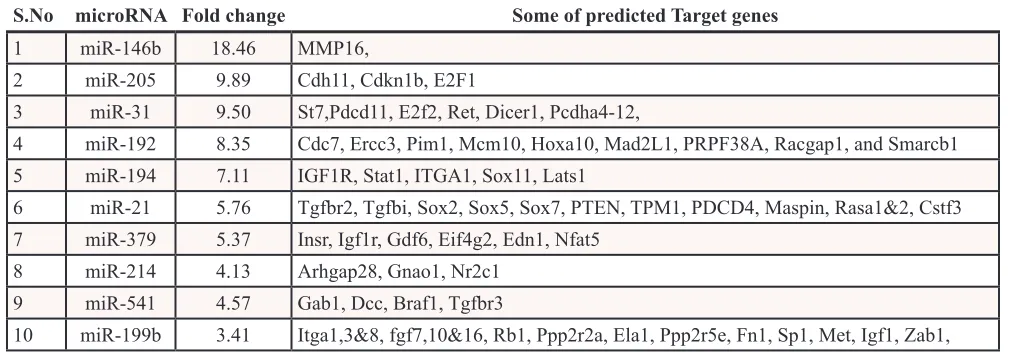
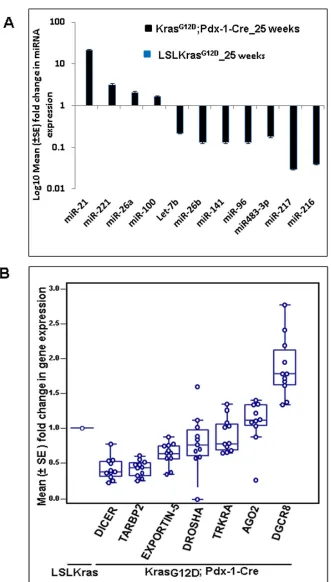
Differentially expressed miRNAs were identified using QC tool software. The miRNA microarray analysis for the KC animals compared to controls revealed that 150, 494, 138, 148a*, miR-216a, and miR-217 (p-value = 0.01) were significantly downregulated (Table 1), whereas, miR-146b, miR-205, miR-31, miR-192, and miR-21 (p-value = 0.01) were significantly upregulated (Table 2). A majority of the miRNAs were downregulated compared to the number of miRNAs that were upregulated in the KC animals (Supplementary Table S1). The panel of differentially expressed miRNAs were validated by real-time PCR using TaqMan assays, and the results were consistent with the miRNA microarray data that showed up-regulation of miR-21, miR-221, miR-100 and miR-26a and down-regulation of miR-26b, miR-141, miR-96, miR483-3p, miR-216, and miR-217 in the KC compared to control mice (Figure 1A).
the KC mouse model. Real-time PCR analysis revealed that expression of Dicer, Drosha, Exportin-5, TRKRA, and TARBP2 were downregulated, while expression of DGCR8 and Ago2 were upregulated in KC mice compared to control littermates (Figure 1B).
The top differentially deregulated miRNAs were further analyzed at 10, 30, 40, and 50 weeks of PC progression. At 10 weeks of age, expression of miR-141 and Let-7b were upregulated, but their expression was not statistically significant. On the other hand, 146b, miR-34c, miR-223, miR-195 (p-value = 0.031) and miR-216 (p-value = 0.063) were downregulated in KC mice compared to control littermates. However, no significant difference was observed in the expression of pancreas-specific miR-217 (Figure 2A). At 30 weeks of age, the expression of miR-216 (p-value = 0.016), miR-217 (p-value = 0.0078), miR-150 (p-value =0.023), Let-7b (p-value = 0.031,) and miR-96 were significantly downregulated, whereas the expression of miR-146b (p-value = 0.0078), miR-205, (p-value = 0.0078), miR-21, miR-195 (p-value = 0.031), and miR-34c (p-value = 0.063) were significantly upregulated
[image:3.612.59.557.61.250.2]in KC animals compared to control animals (Figure 2B). At 40 weeks of age, the expression of miR-216, miR-217, miR-223, miR-141, miR-483-3p (p-value = 0.031), miR-195, Let-7b (p-value = 0.063) and miR-96 were significantly downregulated; on the other hand, the expression of miR-21, miR-205, miR-146b (p-value = 0.031), and miR-34c (p-value = 0.063) were upregulated in KC mice compared to the control animals (Figure 2C). Further, at 50 weeks of age, the expression of 216, 217, 345, miR-141, miR-483-3p, miR-26b, miR-96, Let-7b (p-value = 0.01), miR-100, miR-26a and miR-150 (p-value = 0.094) were further downregulated in KC animals compared to control mice (Figure 2D). The expressions of miR-216 and miR-217 were also progressively reduced in KC mice, but the expressions of miR-21, miR-205, miR-146b, miR-34c, and miR-223 progressively increased (Figure 1A, 2A–2D). At 50 weeks of age, variation in expression of miR-221 was not statistically significant between the KC and control animals (Figure 2D). The overall trends of miRNA expression during the mouse PC progression model are shown in Figures 2E and 2F.
Table 1: Top/Significantly downregulated miRNAs in Kras
G12D;Pdx1-Cre mice
S.No microRNA Fold change predicted Target genes
1 miR-150 0.149 c-Myb, Eif4b&e, Ephb2, Elk1, Mcc
2 miR-494 0.293 Fgfr2, Cdk6, Nfat5, Ccnt2, IGF1R, Fgf7, Ccnd2, Socs6, Bmpr2, 3 miR-138 0.301 Sin3a, Rmnd5a, Thrb, Dek, Rhoc, Nfib, Hif1a, Tjp1
4 miR-148a* 0.351 Bcl2l11, fbn1, Itga5,9&11, Dgcr8, Snn, Dicer1, E2f3&7, Tgfbr1, wnt1, Itga1 5 miR-193 0.351 Kit, Tgfb2, Ets1, Etv6, Tgfbr3, Kras, Fgf1, Tcf4.
6 miR-451 0.365 Psmb8, Mex3c, Cab39, Fbxo33, Gpr77
7 miR-216a & b 0.406 & 0.447 Jnk2, Esr1, Sp4, Mmp16, Smad7, Tssc1, Tgfbr2, Sox6, Grb2,
8 miR-29b 0.409 Eln, Col3a1, Col4a5, Col5a1, Has3, Igf1, Dnmt3a, Camk4, Hdac4, Vcl, Ccnd2, Nkrf, Dicer1, Sp1, Ncoa3
9 miR-375 0.550 Max protein (Max)
10 miR-217 0.548 Kras, Esr1, Etv6, Dek,
Table 2: Top/Significantly up regulated miRNAs in Kras
G12D;Pdx1-Cre mice
S.No microRNA Fold change Some of predicted Target genes
1 miR-146b 18.46 MMP16,
2 miR-205 9.89 Cdh11, Cdkn1b, E2F1
3 miR-31 9.50 St7,Pdcd11, E2f2, Ret, Dicer1, Pcdha4-12,
4 miR-192 8.35 Cdc7, Ercc3, Pim1, Mcm10, Hoxa10, Mad2L1, PRPF38A, Racgap1, and Smarcb1 5 miR-194 7.11 IGF1R, Stat1, ITGA1, Sox11, Lats1
6 miR-21 5.76 Tgfbr2, Tgfbi, Sox2, Sox5, Sox7, PTEN, TPM1, PDCD4, Maspin, Rasa1&2, Cstf3 7 miR-379 5.37 Insr, Igf1r, Gdf6, Eif4g2, Edn1, Nfat5
8 miR-214 4.13 Arhgap28, Gnao1, Nr2c1
9 miR-541 4.57 Gab1, Dcc, Braf1, Tgfbr3
[image:3.612.55.563.281.457.2]Figure 1: The miRNA array revealed several upregulated and downregulated miRNAs in KrasG12D; Pdx-1-Cre mice at 25 weeks of age. A. Validation of a few upregulated and downregulated miRNAs was confirmed by real-time PCR analysis, using TaqMan assays specific for individual miRNAs. U6 snRNA was used as an internal control for normalization. B. Real-time PCR analysis of miRNA biosynthetic pathways in KrasG12D;Pdx1-Cre and LSL- KrasG12D animals at 25 weeks of age using specific primers. Mouse β-actin
Figure 2: Expression profiles of miRNAs during the mouse PC progression in KrasG12D; Pdx1-Cre mice and their
[image:5.612.77.536.50.665.2]Validation of miRNA target genes
In order to confirm the expression of genes targeted by the differentially expressed miRNAs in PC, first we performed in silico analysis using an online bioinformatics program, mirecords/miRDB, which utilizes miRanda, Target scan, Pic Tar, etc., to predict several potential targets genes (Table 1 and Table 2). A few of these target genes, that are important in PC development, were analyzed by Real time PCR at 50 weeks of age. The expression of Kras (5-fold), Galectin-3 (5-fold), EGFR (3.5-fold), TGFβ1 (3.5-fold), cMyc (2.8-fold), Fut8 (2.5-fold), and Bcl2 (2-fold) were significantly upregulated, while the expression of PTEN was significantly downregulated in KC animals compared to controls (Figure 2G).
Expression patterns of miRNAs in human
PC cell lines
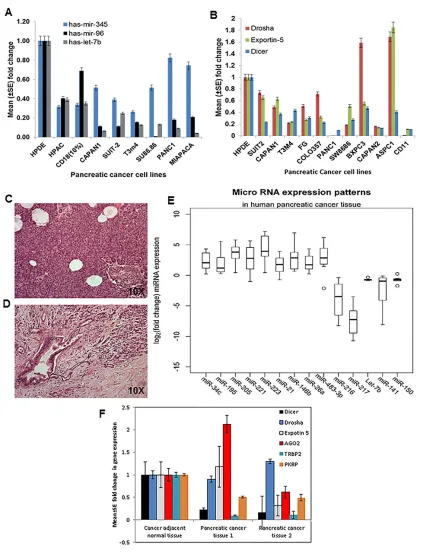
In order to extrapolate the mouse miRNA microarray data to human PC, we next checked the expressions of a few differentially expressed miRNAs in eight human PC cell lines, as well as in the immortalized normal pancreatic ductal cell line (HPDE). Results showed the downregulation of miR-345, miR-96, and Let-7b in the majority of the PC cell lines compared to the HPDE cells (Figure 3A), indicating that these miRNAs were expressed in ductal cells rather than in tumor stroma. Also, the expression analysis of miRNA biosynthetic machinery in PC cell lines showed significant downregulation of Drosha, Dicer, and Exportin-5 compared to the HPDE cell line (Figure 3B).
Expression patterns of miRNAs in human PC tissue
The differentially expressed miRNAs that were identified from mouse miRNA array data were further analyzed in eight samples of human PC tissues (Figure 3D) and their corresponding eight adjacent normal tissue (Figure 3C). The expression of miR-223, miR-483-3p (p-value = 0.01), miR-146b, miR-205 (p-value = 0.001), miR-221, miR-21 (p-value = 0.023), 195, miR-34c and miR-26a (p-value = 0.0078) were significantly upregulated, whereas the expression of 216, miR-141, miR-217, Let-7b (p-value = 0.001), and miR-150 (p-value = 0.01) were significantly downregulated in human PC tissues as compared to the cancer-adjacent normal tissues (Figure 3E). Additionally, the expression of proteins involved in miRNA biosynthesis, such as Drosha, Dicer, and Exportin-5, were analyzed and found to be significantly downregulated in human PC tissues as compared to the cancer-adjacent normal tissues (Figure 3F).
Ectopic overexpression of Let-7b in human PC
cell lines
The role of Let-7 family members and their target genes are well known in various cancer [27]. Previous studies have shown that restoration of Let-7 results in downregulation of oncogenic Kras, leading to inhibition of cell proliferation and activation of the mitogen-activated protein kinase [28]. Similarly, HMGA2 is a direct target of Let-7 family members [29–31]. Our results in the KC mouse model also showed downregulation of Let-7b during PC progression. Further, our in silico analysis of Let-7b revealed several target genes like MUC4, NCOA3, KRAS, HMGA2, which are critical in PC pathogenesis. Herein, we overexpressed Let-7b and its scramble vectors in two PC cell lines, CD18/HPAF and Capan1, by infection with a lenti-viral supernatant (collected after 48 and 72 hours post transfection of 293FT cells) after mixing with 4 μg/ ml of polybrene and analyzing its effect on downstream targets. The green fluorescent protein (GFP)-positive cells were sorted by Fluorescence Activated Cell Sorting (FACS) (Figure 4A); Let-7b overexpression was confirmed by TaqMan assays using real-time PCR (Figure 4B). We observed eight-fold and four-fold increase in the expression of Let-7b in Capan 1 and CD18/HPAF cells, respectively, compared to vector control cells (Figure 4B). Our results from western blot analysis revealed downregulation of MUC4, KRAS, MSST1, and Cyclin D1, and upregulation of caspase-9 in Let-7b overexpressing CD18/HPAF and Capan1 PC cells compared to vector transfected control cells (Figure 4C); β-actin was used as a loading control. These findings suggest that downregulation of Let-7b plays an important role in PC progression.
DISCUSSION
Due to unavailability of early stage samples from human PC patients, we utilized the well-characterized spontaneous mouse model (KC) of PC [32–36] to analyze the global miRNA expression profile. Notably, this model histopathologically recapitulates human PC. Using this PC model, we and others have observed PanIN lesions at as early as 10 weeks of age, as well as PDAC with metastasis (in 60–70% of KC animals) to distant organs by 50 weeks of age [26, 35]. Although high-grade PanINs (PanIN III) were rarely observed before 20 weeks of age, their frequency increased progressively with age (25–50 weeks); however, low- and high-grade PanINs were observed starting at 25 weeks of age. Therefore, the present study analyzed the global miRNA expression profile at 25 weeks of age, when the majority of acinar cells were replaced by high-grade PanINs and marked desmoplasia [26].
Figure 3: Expression patterns of miRNAs and components of the biosynthetic machinery in human PC tissues and
cell lines. A. Expression profiles of miRNA in human PC cell lines using TaqMan assays specific for individual miRNA based on real-time PCR analysis. RNU6B was used as an internal control for normalization. The fold change was calculated by using the ∆∆Ct method.
B. Components of the miRNA biosynthetic pathway in human PC cell lines by using specific primers for each gene by real-time PCR analysis. Human β-actin was used as an internal control for normalization. The fold change was calculated by using the ∆∆Ct method.
C. H & E staining of cancer-adjacent normal tissue. D. PC tissue and E. expression patterns of miRNA in human PC tissue and adjacent
normal tissue using real-time PCR using TaqMan assays specific for individual miRNA. RNU6B was used as an internal control for normalization. The fold change was calculated by using the ∆∆Ct method. F. Components of the miRNA biosynthetic pathway in human PC
having tumor suppressive functions (Tables 1 and 2). The microRNA microarray revealed significant downregulation of miR-494 at 25 weeks of PC progression in the KC mouse model. A recent study has also shown significant downregulation of miR-494 in human PC tissues compared to non-tumor tissues, correlating with PC metastasis and decrease free survival in patients. Furthermore, decreased expression of miR-494 is due to loss of SMAD4 in PC. Ectopic expression of miR-494 in PDAC cells resulted in downregulation of FOXM1, inhibition of β-catenin nuclear translocation, decreased cell proliferation, migration, invasion, and greater sensitivity to gemcitabine [37]. The expression of pancreas-specific tumor suppressors miR-217 and miR-216 were unaltered at 10 weeks of age (presence of PanIN-Ia and Ib), but progressively decreased from 25 – 50 weeks of age as PanIN lesions progressed to PDAC. (Figure 1A, 2A–2D).
In addition to KC mice, we also observed a significant downregulation of miR-216 and miR-217
[image:8.612.71.543.51.389.2]in human PC tissue (Figure 3E); these results are in agreement with earlier studies on human PC [38–43] that show downregulation of miR-217 in 76.2% (16/21) of PC tissue as well as cell lines [43]. Similarly, the expression of miR-216 is significantly downregulated in PC [44]. Our in silico analysis revealed that 216 and miR-217 potentially target many important genes that play critical roles during the pathogenesis of PC (Table 1); and the downregulation of miR-217 [45] and miR-216 [44] suggests their potential as tumor suppressors in PC by targeting downstream targets, particularly the Kras oncogene [43] and Janus kinase 2 [44]. In addition to pancreas-specific miRNAs, we observed significant downregulation of miR-141 and Let-7b in human PDAC and in KC mice from 25–50 weeks of age compared to controls (Figure 1A, 2B–2D, 3E). Our human PDAC results were in agreement with earlier reports showing loss of Let-7b and miR-141 expression in PC samples compared to cancer-adjacent normal tissue [46, 47].
In vitro analysis of Let-7b overexpressed HPAF/ CD18 and Capan1 PC cell lines showed significant downregulation of MUC4, Kras, MSST1, and Cyclin D1, and upregulation of cleaved caspase-9 (Figure 4C). Although the functional analysis of this Let-7b overexpression remains to be determined using our in vitro system, however previous studies have shown that overexpression of Let-7b in Capan1 cells resulted in decreased cell proliferation by downregulating Kras, Myc, and HMGA2, and activating mitogen-activated protein kinase [28–31, 46, 47]. In addition to affecting proliferation, the increased expression of cleaved caspase-9 in both HPAF/CD18 and Capan1 cells suggests its pro-apoptotic role that remains to be determined. Further, Kent et al. (2009) reported downregulation of miRNA-200 family members, including miRNA-141, in PC cell lines [48] and observed a positive correlation between the expression of miR-200 family members and E-cadherin expression, as well as a negative correlation with the zinc-finger E-box-binding homeobox 1 (ZEB1) [48, 49]. The transcription of miR-200 family members (miR-141 and miR-200c) is suppressed by ZEB1, which activates epithelial differentiation in PC, colorectal, and breast cancer cells. Epithelial-mesenchymal transformation (EMT) activators, such as transforming growth factor beta 2 and ZEB1, have 3′ UTR binding sites for miR-200 family members. Therefore, existence of a feedback loop between ZEB1 and miR-141 serves to stabilize the EMT process and regulate the invasion of cancer cells [49].
The present study also revealed significant downregulation of miR-150 during the progression of PC in both mice and humans (Figure 2A–2D, 3E). These results contradict a previous study on human PC [40], possibly attributable to species and/or PC stage variation. Similarly, the expression of miR-345 and miR-96 were significantly downregulated during the progression of PC in the mouse model (Figure 2D), which is consistent with previous reports [39, 40, 50]. However, a recent report in colorectal cancer patient tissues has shown significantly methylated mir-345 promoter region compared to the non-cancerous, adenoma, and normal colon tissues; further, ectopic over-expression of mir-345 in colorectal cancer cells significantly reduced cell proliferation by inhibiting the translation of anti-apoptotic BAG3 gene [51]. These studies suggest a pro-apoptotic function of miR-345; its downregulation during PC progression may be associated with promoter methylation.
The miR-26a miRNA inhibits the expression of c-myc, Cyclin D3 and E2, and cyclin-dependent kinases such as CDK4 and CDK6. Also, it stimulates CDK-inhibitors p14(ARF) and p21(CIP1) expression in an EZH2-dependent manner, suggesting an anti-proliferative role [52]. Accordingly, we observed significant downregulation of miR-26a in KC mice at 50 weeks of age, although it was upregulated at 25
weeks in KC mice and in human PC tissues compared to normal tissues (Figure 2B, 2D and 3E). Recently, significant downregulation of miR-26a was also reported in nasopharyngeal carcinoma tissues and cell lines (53); its ectopic expression has been shown to downregulate EZH2 expression, thereby inducing G1 -phase cell-cycle arrest to decrease cell proliferation and colony formation (53). A decreased expression of miR-483-3p was observed during the progression of mouse PC, whereas it is overexpressed in human PC (Figure 2A–2D and 3E). These results are in agreement with previous reports that showed miR-483-3p upregulation in PC tissue compared to the cancer adjacent normal tissue [53, 54]. Furthermore, they showed that ectopic expression of miR-483-3p significantly inhibited the expression of DPC4/Smad4 protein in PC cell lines, leading to increased cell proliferation and colony formation in vitro [53, 54]. The miRNA microarray also revealed a decreased expression of 148a and miR-451 in mouse PC, an observation consistent with other reports [40, 41, 55–58]. Similarly, another study showed that the expression of miR-148a/b and miR-375 were significantly downregulated in the PC developed from p48Cre;KrasG12D transgenic animals compared to the normal controls [59].
expression of miR-21, miR-221, miR-222, and Let-7a increases with PanIN grade, with the strongest expression in the hyperplastic ducts with PanIN 2/3 lesions [69]. Similarly, the expression of miR-10, miR-21, miR-100 and miR-155 was shown to increase in p48-Cre/KrasG12D mice when compared to control animals [59]. We observed downregulation of miR-146b, miR-34c, and miR-223 at 10 weeks of age; however, their expression increased with the progression of PC in KC animals compared to control animals (Figure 2A–2D). We also observed upregulation of these miRNAs in the human PC samples (Figure 3E). Notably, the expression of miR-34c is activated by p53 following DNA damage and serves as an important regulator of c-Myc expression, acting downstream to the p38 MAPK/MK2 pathway [70].
Deregulation of the miRNA biosynthetic machinery results in differential expression of miRNAs and downstream target genes. Abnormal expression of this machinery is associated with hematological malignancies [71], ovarian cancer [72], and neuroblastoma [73]. In conjunction with these reports, our results also revealed significant downregulation of many miRNA biosynthetic pathway components, such as dicer, TARBP2, and exportin-5, both during the progression of PC in KC animals (Figure 1B) and in PC cell lines and tissues compared to normal tissues (Figure 3B and 3F). The predicted target genes for differentially expressed miRNAs (Table 1 and Table 2) such as Kras (5-fold), Galectin-3 (5-fold), EGFR (3.5-fold), TGFβ1 (3.5-fold), cMyc (2.8-fold), Fut8 (2.5-fold), and Bcl2 (2-fold) were upregulated. On the other hand, PTEN was observed to be downregulated in KC mice, which highlights the importance of deregulated miRNA expression in the pathology of PC (Figure 2G). Both miR-216 and miR-217 act as potential tumor suppressors for PC by targeting the Kras oncogene [43].
In conclusion, the present study reveals the stage-specific (PanIN to PC) unique expression patterns for miRNAs, as well as miRNA biosynthetic machinery, during progression of PC. We have shown that in tumor samples compared to normal samples, the majority of miRNAs (216, 217, 100, 345, miR-141, miR-483-3p, miR-26b, miR-150, Let-7b, Let-195 and miR-96) were downregulated, and few were upregulated (miR-146b, miR-205, miR-31, miR-192, miR-194 21, miR-379, miR-431, miR-541, and miR-199b). Future studies will focus on the analysis of stage-specific miRNA expression in the sera of mice collected during PC progression, as this is expected to provide the unique opportunity to develop early detection biomarkers for PC. Furthermore, restoring the expression of downregulated miRNAs in cancer cells may be performed to promote their de-differentiation and induce their reversion into a benign or normal cell. Overall, the current study offers the unique opportunity to develop early biomarkers for the diagnostic, prognostic and preventive management of PC.
MATERIALS AND METHODS
Experimental animals
The B6.129-Krastm4Tyj (01XJ6) and B6. FVB-Tg
(Ipf1-cre) 1Tuv (01XL5) mice were obtained from the National Cancer Institute (NCI) Mouse Models of Human Cancers Consortium (MMHCC, Frederick, MD, USA). In order to decipher miRNAs in early PC lesions, we obtained the PC progression model by crossing LSL-KrasG12D animals [74] with Pdx-1-Cre [35]. The animals positive for both Kras and Pdx Cre (Floxed KrasG12D) and their contemporary littermates unfloxed Kras (LSL KrasG12D) from the F1 litter were sacrificed at 10, 25, 30, 40, and 50 weeks of age (eight animals for each group at each time point). The pancreas was resected, and half of the pancreas was flash frozen in liquid nitrogen (total RNA and miRNA isolation); the other half was fixed in 10% buffered formalin and embedded in paraffin. Serial tissue sections were cut (4 μM) and stained with hematoxalin and eosin. Throughout the study, the animals were subjected to a 12 hours of dark/light cycle with food and water ad libitum. Animal studies were performed in accordance with the United States Public Health Service “Guidelines for the Care and Use of Laboratory Animals” under an approved protocol by the University of Nebraska Medical Center’s Institutional Animal Care and Use Committee (IACUC).
Isolation of total RNA and miRNAs
Total RNA and miRNA were isolated from the pancreas of floxed KrasG12D mice positive for Kras;Pdx-1-Cre and unfloxed LSLKrasG12D mice, human PC cell lines, tissues and their cancer-adjacent normal tissues (eight tissues each) using mirVana™ miRNA Isolation Kit (Applied Biosystems/Ambion, Austin, TX, USA). The RNA concentration was measured by Nanodrop Spectrophotometer (NanoDrop Technologies Inc., Wilmington, DE, USA), and the quality was analyzed using bioanalyzer (Agilent technologies, Waldbronn, Germany). Samples with good integrity were used for miRNA array, real-time PCR, and TaqMan assays.
Affymetrix microRNA microarray
washing, and scanning of the slides were done according to Affymetrix’s recommendations (Fluidics Protocol FS450_0003). Data was extracted from the images, quintile normalized, summarized (median polish) and log2-transformed with the miRNA QC tool software from Affymetrix.
Detection of mature miRNAs by TaqMan assays
The TaqMan miRNA assay kits purchased from Applied Biosystems were used for expression and validation analysis of miRNAs during the progression of PC in both mice as well as human tumor samples. In order to analyze the expression patterns, first, reverse transcription reactions for each miRNA was performed using 1.5 μl of 10X reverse transcription buffer, 1.0 μl of MultiScribe™reverse transcriptase (50 U/μl), 0.15 μl of 100 mM dNTPs (with dTTP), 0.19 μl of RNase inhibitor (20 U/μl) and 4.16 μl of nuclease-free water. Subsequently, 500 ng of miRNA and 3μl of 1X looped-primers were added (specific for each microRNA), mixed well and incubated for 30 min at 16oC followed by 30 min at 42oC and 5 minutes at 85oC. The resultant cDNA was diluted to a minimum of 1:15 with nuclease free water and 1.33 μl was used in real-time PCR.
Real-time PCR was performed on Light cycler 480 II PCR System (PCR System, Roche Applied Science, Indianapolis, IN, USA). During the target amplification step, the AmpliTaq® Gold DNA polymerase amplifies target cDNA synthesized from the RNA samples using sequence-specific primers from the TaqMan Assay. Real-time PCR reactions based on TaqMan® reagent chemistry were performed in triplicate, and template controls were run for each assay under the same conditions. End-point PCR was performed in 20 μl reaction that contained 10 μl TaqMan 2X Universal PCR Master Mix No AmpErase UNG, 7.67 μl of nuclease free water, 1.33 μl diluted RT product (Minimum1:15) and 1 μl miRNA-specific PCR probe. The cycling conditions were as follows: 95°C for 10 minutes followed by 40 cycles consisting of 95°C for 15 seconds followed by 60°C for 60 seconds. The miRNA expression levels were normalized to the level of RNU6B for human samples and U6 snRNA for mouse samples to correct for differential cDNA content.
Synthesis of cDNA and real-time PCR
Total RNA was isolated, and the cDNA was synthesized by reverse transcription as previously described [26]. Briefly, reverse transcription of RNA was performed by adding 10 μl of (2 μg) total RNA, 1 μl of Oligo (dT)12–18 (500 μg/ml), and 1 μl of 10 mM dNTP (Invitrogen, Carlsbad, CA), incubating at 650C for 5 minutes and immediately chilling on ice. Then, the master mix containing 4 μl of (5X) first strand RT buffer, 1 μl
of 0.1 M DTT, and 1 μl of RNaseOUT (RNase Inhibitor) was incubated at 42°C for 2 min. Finally, 1 μl (50 units) of SuperScript II RT was added to each tube and incubated at 42°C for 50 minutes followed by 70°C for 15 minutes in order to destroy the superscript II RT.
The real-time primers for all the genes (human and mouse) were designed using Primer 3 software (Supplementary Table S2). Real-time PCR was performed on Light cycler 480 II PCR System, (Roche Applied Science, Indianapolis, IN, USA). Real-time PCR reactions were performed in triplicate; non-template controls (NTCs) and a standard curve was run for each assay under similar conditions. Real-time PCR was performed in a 10 μl reaction containing 5 μl 2X SBYR green Master mix, 3.6 μl of nuclease free water, 1 μl diluted RT product (1:10), and 0.2 μl each of forward and reverse primer (5 pmol/μl). The cycling conditions used were as follows: 95°C for 10 minutes, followed by 40 cycles of 95°C for 15 seconds and 60°C for 1 minute. Gene expression levels were normalized to the level of β-actin expression and were reported relative to the expression level in RNA from corresponding normal controls.
Generation of Let-7b overexpressing human
PC cell lines
The 293FT cells were transfected with (2 μg) either with Let-7b over-expressing lentiviral pCDH-CMV-MCS-EF1-copGFP-Let-7b vector or with vector control and along with 10 μg of pPACKH1 Packaging Plasmid Mix (System Bioscience, CA, USA) using lipofectamine-2000 plus reagents (Invitrogen). The viral supernatant, collected after 48 and 72 hours post-transfection, was filtered and used to infect human PC cells (CD18/HPAF and Capan1) after mixing with 4 μg/ml of polybrene. The GFP+ cells were sorted by FACS, and Let-7b overexpression was analyzed by TaqMan assay.
Immunoblot assay
4oC. Then, the membrane was washed (4X 10 min) with phosphate buffered saline and 0.1% Tween 20 (PBST) and probed with 1:5000 diluted horseradish peroxidase-conjugated anti-mouse or anti-rabbit secondary antibodies for 1 hour at room temperature. After washing the blots, the signal was detected with an ECL chemiluminescence kit (Amersham Bioscience, UK).
Statistical analyses
The fold change in the miRNA expression was calculated by ΔΔCt method as a 2−ΔΔCt. U6 and RNU6B
were used for normalization in mouse and human samples, respectively. A change of two-fold or more (on a log scale of ≥ 0.3) was considered statistically significant. The miRNA ratios of experimental samples to controls were compared to one using the one-sample non-parametric Wilcoxon sign rank test. The p-value was not adjusted for multiple comparisons. SAS software (SAS Institute Inc., Cary, NC) was used for data analysis.
ACKNOWLEDGMENTS AND FUNDING
We thank Kavita Mallya for technical support and the Molecular Biology Core Facility, UNMC, for miRNA microarray analysis. We thank Melody A. Montgomery for editing this manuscript.
This work was supported, in parts, by the grants from National Institutes of Health (UO1 CA111294, P50 CA127297 and U54 CA163120) and State of Nebraska ((NE DHHS-LB506).
CONFLICTS OF INTEREST
The authors have no conflict of interest with any company or financial organization.
REFERENCES
1. Esquela-Kerscher A, Slack FJ. Oncomirs - microRNAs with a role in cancer. Nat Rev Cancer. 2006; 6:259–269.
2. Macha MA, Seshacharyulu P, Krishn SR, Pai P, Rachagani S, Jain M, Batra SK. MicroRNAs (miRNAs) as biomarker(s) for prognosis and diagnosis of gastrointestinal
(GI) cancers. Curr Pharm Des. 2014; 20:5287–5297.
3. Lewis BP, Burge CB, Bartel DP. Conserved seed
pair-ing, often flanked by adenosines, indicates that thou
-sands of human genes are microRNA targets. Cell. 2005; 120:15–20.
4. Xie X, Lu J, Kulbokas EJ, Golub TR, Mootha V, Lindblad-Toh K, Lander ES, Kellis M. Systematic discovery of regulatory motifs in human promoters and 3′ UTRs by com
-parison of several mammals. Nature. 2005; 434:338–345.
5. Berezikov E, Cuppen E, Plasterk RH. Approaches to microRNA discovery. Nat Genet. 2006; 38:S2–S7.
6. Garzon R, Marcucci G, Croce CM. Targeting microRNAs in cancer: rationale, strategies and challenges. Nat Rev
Drug Discov. 2010; 9:775–789.
7. Kim VN. MicroRNA biogenesis: coordinated cropping and dicing. Nat Rev Mol Cell Biol. 2005; 6:376–385.
8. Rana TM. Illuminating the silence: understanding the struc-ture and function of small RNAs. Nat Rev Mol Cell Biol.
2007; 8:23–36.
9. Bohnsack MT, Czaplinski K, Gorlich D. Exportin 5 is a
RanGTP-dependent dsRNA-binding protein that mediates
nuclear export of pre-miRNAs. RNA. 2004; 10:185–191.
10. Yi R, Qin Y, Macara IG, Cullen BR. Exportin-5 mediates
the nuclear export of pre-microRNAs and short hairpin RNAs. Genes Dev. 2003; 17:3011–3016.
11. Hammond SM, Bernstein E, Beach D, Hannon GJ. An
RNA-directed nuclease mediates post-transcriptional gene silencing in Drosophila cells. Nature. 2000; 404:293–296. 12. Bartel DP. MicroRNAs: target recognition and regulatory
functions. Cell. 2009; 136:215–233.
13. Ambros V, Horvitz HR. Heterochronic mutants of the nem
-atode Caenorhabditis elegans. Science. 1984; 226:409–416.
14. Lee RC, Feinbaum RL, Ambros V. The C. elegans heter -ochronic gene lin-4 encodes small RNAs with antisense
complementarity to lin-14. Cell. 1993; 75:843–854. 15. Reinhart BJ, Slack FJ, Basson M, Pasquinelli AE,
Bettinger JC, Rougvie AE, Horvitz HR, Ruvkun G.
The 21-nucleotide let-7 RNA regulates developmen-tal timing in Caenorhabditis elegans. Nature. 2000; 403:901–906.
16. Lu J, Getz G, Miska EA, Alvarez-Saavedra E, Lamb J, Peck D, Sweet-Cordero A, Ebert BL, Mak RH,
Ferrando AA, Downing JR, Jacks T, Horvitz HR,
Golub TR. MicroRNA expression profiles classify human cancers. Nature. 2005; 435:834–838.
17. Ventura A, Young AG, Winslow MM, Lintault L, Meissner A, Erkeland SJ, Newman J, Bronson RT,
Crowley D, Stone JR, Jaenisch R, Sharp PA, Jacks T. Targeted deletion reveals essential and overlapping func-tions of the miR-17 through 92 family of miRNA clusters.
Cell. 2008; 132:875–886.
18. American Cancer Society. Cancer Facts & Figures 2010.
Atlanta: American Cancer Society; 2010.
19. Jemal A, Siegel R, Ward E, Hao Y, Xu J, Thun MJ. Cancer statistics, 2009. CA Cancer J Clin. 2009; 59:225–249.
20. Jemal A, Siegel R, Xu J, Ward E. Cancer statistics, 2010.
CA Cancer J Clin. 2010; 60:277–300.
21. Siegel R, Naishadham D, Jemal A. Cancer statistics, 2012. CA Cancer J Clin. 2012; 62:10–29.
sporadic pancreatic cancer. Biochim Biophys Acta. 2011;
1815:44–64.
23. Rachagani S, Kumar S, Batra SK. MicroRNA in pancreatic cancer: pathological, diagnostic and therapeutic
implica-tions. Cancer Lett. 2010; 292:8–16.
24. Rachagani S, Macha MA, Heimann N, Seshacharyulu P, Haridas D, Chugh S, Batra SK. Clinical implications of miRNAs in the pathogenesis, diagnosis and
ther-apy of pancreatic cancer. Adv Drug Deliv Rev. 2015; 81:16–33.
25. Hezel AF, Kimmelman AC, Stanger BZ, Bardeesy N,
DePinho RA. Genetics and biology of pancreatic ductal
adenocarcinoma. Genes Dev. 2006; 20:1218–1249.
26. Rachagani S, Torres MP, Kumar S, Haridas D, Baine M, Macha MA, Kaur S, Ponnusamy MP, Dey P,
Seshacharyulu P, Johansson SL, Jain M, Wagner KU,
Batra SK. Mucin (Muc) expression during pancreatic cancer progression in spontaneous mouse model: potential impli-cations for diagnosis and therapy. J Hematol Oncol. 2012;
5:68.
27. Boyerinas B, Park SM, Hau A, Murmann AE, Peter ME. The role of let-7 in cell differentiation and cancer. Endocr
Relat Cancer. 2010; 17:F19–F36.
28. Torrisani J, Bournet B, du Rieu MC, Bouisson M,
Souque A, Escourrou J, Buscail L, Cordelier P. let-7
MicroRNA transfer in pancreatic cancer-derived cells inhib-its in vitro cell proliferation but fails to alter tumor
progres-sion. Hum Gene Ther. 2009; 20:831–844.
29. Lee YS, Dutta A. The tumor suppressor microRNA let-7
represses the HMGA2 oncogene. Genes Dev. 2007;
21:1025–1030.
30. Mayr C, Hemann MT, Bartel DP. Disrupting the pairing between let-7 and Hmga2 enhances oncogenic
transforma-tion. Science. 2007; 315:1576–1579.
31. Shell S, Park SM, Radjabi AR, Schickel R, Kistner EO, Jewell DA, Feig C, Lengyel E, Peter ME. Let-7 expression defines two differentiation stages of cancer. Proc Natl Acad Sci U S A. 2007; 104:11400–11405.
32. Aguirre AJ, Bardeesy N, Sinha M, Lopez L, Tuveson DA, Horner J, Redston MS, DePinho RA. Activated Kras and
Ink4a/Arf deficiency cooperate to produce metastatic
pancreatic ductal adenocarcinoma. Genes Dev. 2003; 17:3112–3126.
33. Bardeesy N, Aguirre AJ, Chu GC, Cheng KH, Lopez LV, Hezel AF, Feng B, Brennan C, Weissleder R, Mahmood U,
Hanahan D, Redston MS, Chin L, DePinho RA. Both
p16(Ink4a) and the p19(Arf)-p53 pathway constrain pro -gression of pancreatic adenocarcinoma in the mouse. Proc
Natl Acad Sci U S A. 2006; 103:5947–5952.
34. Carriere C, Seeley ES, Goetze T, Longnecker DS, Korc M.
The Nestin progenitor lineage is the compartment of origin for pancreatic intraepithelial neoplasia. Proc Natl Acad Sci U S A. 2007; 104:4437–4442.
35. Hingorani SR, Petricoin EF, Maitra A, Rajapakse V, King C, Jacobetz MA, Ross S, Conrads TP, Veenstra TD, Hitt BA, Kawaguchi Y, Johann D, Liotta LA, Crawford HC, Putt ME, Jacks T, Wright CV, Hruban RH, Lowy AM,
Tuveson DA. Preinvasive and invasive ductal pancreatic cancer and its early detection in the mouse. Cancer Cell.
2003; 4:437–450.
36. Hingorani SR, Wang L, Multani AS, Combs C,
Deramaudt TB, Hruban RH, Rustgi AK, Chang S,
Tuveson DA. Trp53R172H and KrasG12D cooperate to
promote chromosomal instability and widely metastatic pancreatic ductal adenocarcinoma in mice. Cancer Cell.
2005; 7:469–483.
37. Li L, Li Z, Kong X, Xie D, Jia Z, Jiang W, Cui J, Du Y, Wei D, Huang S, Xie K. Down-regulation of
microRNA-494 via loss of SMAD4 increases FOXM1 and beta-catenin signaling in pancreatic ductal adenocarcinoma
cells. Gastroenterology. 2014; 147:485–497.
38. Hou B, Jian Z, Chen S, Ou Y, Li S, Ou J. [Expression of miR-216a in pancreatic cancer and its clinical significance]. Nan Fang Yi Ke Da Xue Xue Bao. 2012; 32:1628–1631.
39. Park JY, Helm J, Coppola D, Kim D, Malafa M, Kim SJ. MicroRNAs in pancreatic ductal adenocarcinoma. World J Gastroenterol. 2011; 17:817–827.
40. Szafranska AE, Davison TS, John J, Cannon T, Sipos B, Maghnouj A, Labourier E, Hahn SA. MicroRNA expression
alterations are linked to tumorigenesis and non-neoplastic processes in pancreatic ductal adenocarcinoma. Oncogene.
2007; 26:4442–4452.
41. Szafranska AE, Doleshal M, Edmunds HS, Gordon S, Luttges J, Munding JB, Barth RJ Jr., Gutmann EJ,
Suriawinata AA, Marc PJ, Tannapfel A, Korc M, Hahn SA,
Labourier E, Tsongalis GJ. Analysis of microRNAs in pan
-creatic fine-needle aspirates can classify benign and malig
-nant tissues. Clin Chem. 2008; 54:1716–1724.
42. Zhang Y, Li M, Wang H, Fisher WE, Lin PH, Yao Q, Chen C. Profiling of 95 microRNAs in pancreatic cancer
cell lines and surgical specimens by real-time PCR analysis.
World J Surg. 2009; 33:698–709.
43. Zhao WG, Yu SN, Lu ZH, Ma YH, Gu YM, Chen J. The
miR-217 microRNA functions as a potential tumor sup-pressor in pancreatic ductal adenocarcinoma by targeting KRAS. Carcinogenesis. 2010; 31:1726–1733.
44. Wang S, Chen X, Tang M. MicroRNA-216a inhibits pan -creatic cancer by directly targeting Janus kinase 2. Oncol
Rep. 2014; 32:2824–2830.
45. Lee EJ, Baek M, Gusev Y, Brackett DJ, Nuovo GJ,
Schmittgen TD. Systematic evaluation of microRNA pro-cessing patterns in tissues, cell lines, and tumors. RNA.
2008; 14:35–42.
46. Johnson SM, Grosshans H, Shingara J, Byrom M, Jarvis R,
47. Torrisani J, Bournet B, du Rieu MC, Bouisson M,
Souque A, Escourrou J, Buscail L, Cordelier P. let-7
MicroRNA transfer in pancreatic cancer-derived cells inhib-its in vitro cell proliferation but fails to alter tumor
progres-sion. Hum Gene Ther. 2009; 20:831–844.
48. Kent OA, Mullendore M, Wentzel EA, Lopez-Romero P, Tan AC, Alvarez H, West K, Ochs MF, Hidalgo M, Arking DE, Maitra A, Mendell JT. A resource for analy -sis of microRNA expression and function in pancreatic ductal adenocarcinoma cells. Cancer Biol Ther. 2009;
8:2013–2024.
49. Burk U, Schubert J, Wellner U, Schmalhofer O, Vincan E,
Spaderna S, Brabletz T. A reciprocal repression between
ZEB1 and members of the miR-200 family promotes EMT and invasion in cancer cells. EMBO Rep. 2008; 9:582–589.
50. Lee EJ, Gusev Y, Jiang J, Nuovo GJ, Lerner MR, Frankel WL, Morgan DL, Postier RG, Brackett DJ, Schmittgen TD. Expression profiling identifies microRNA
signature in pancreatic cancer. Int J Cancer. 2007;
120:1046–1054.
51. Tang JT, Wang JL, Du W, Hong J, Zhao SL, Wang YC, Xiong H, Chen HM, Fang JY. MicroRNA 345, a methyl -ation-sensitive microRNA is involved in cell proliferation and invasion in human colorectal cancer. Carcinogenesis.
2011; 32:1207–1215.
52. Lu J, He ML, Wang L, Chen Y, Liu X, Dong Q, Chen YC, Peng Y, Yao KT, Kung HF, Li XP. MiR-26a inhibits
cell growth and tumorigenesis of nasopharyngeal
carci-noma through repression of EZH2. Cancer Res. 2011; 71:225–233.
53. Hao J, Zhang S, Zhou Y, Hu X, Shao C. MicroRNA
483-3p suppresses the expression of DPC4/Smad4 in pancreatic
cancer. FEBS Lett. 2011; 585:207–213.
54. Li W, Lebrun DG, Li M. The expression and functions of
microRNAs in pancreatic adenocarcinoma and
hepatocel-lular carcinoma. Chin J Cancer. 2011; 30:540–550. 55. Bloomston M, Frankel WL, Petrocca F, Volinia S, Alder H,
Hagan JP, Liu CG, Bhatt D, Taccioli C, Croce CM. MicroRNA expression patterns to differentiate pancreatic adenocarcinoma from normal pancreas and chronic
pancre-atitis. JAMA. 2007; 297:1901–1908.
56. Duursma AM, Kedde M, Schrier M, le SC, Agami R.
miR-148 targets human DNMT3b protein coding region. RNA. 2008; 14:872–877.
57. Haflidadottir BS, Bergsteinsdottir K, Praetorius C, Steingrimsson E. miR-148 regulates Mitf in melanoma cells. PLoS One. 2010; 5:e11574.
58. Santarpia L, Nicoloso M, Calin GA. MicroRNAs: a com-plex regulatory network drives the acquisition of malignant
cell phenotype. Endocr Relat Cancer. 2010; 17:F51–F75. 59. Laconti JJ, Shivapurkar N, Preet A, Deslattes MA, Peran I,
Kim SE, Marshall JL, Riegel AT, Wellstein A. Tissue and
Serum microRNAs in the Kras Transgenic Animal Model and in Patients with Pancreatic Cancer. PLoS One. 2011;
6:e20687.
60. Dillhoff M, Liu J, Frankel W, Croce C, Bloomston M.
MicroRNA-21 is overexpressed in pancreatic cancer and
a potential predictor of survival. J Gastrointest Surg. 2008;
12:2171–2176.
61. Giovannetti E, Funel N, Peters GJ, Del CM, Erozenci LA, Vasile E, Leon LG, Pollina LE, Groen A, Falcone A, Danesi R, Campani D, Verheul HM, Boggi U.
MicroRNA-21 in pancreatic cancer: correlation with clini-cal outcome and pharmacologic aspects underlying its role in the modulation of gemcitabine activity. Cancer Res.
2010; 70:4528–4538.
62. Roldo C, Missiaglia E, Hagan JP, Falconi M, Capelli P, Bersani S, Calin GA, Volinia S, Liu CG, Scarpa A,
Croce CM. MicroRNA expression abnormalities in pancre-atic endocrine and acinar tumors are associated with distinc-tive pathologic features and clinical behavior. J Clin Oncol.
2006; 24:4677–4684.
63. Bhatti I, Lee A, James V, Hall RI, Lund JN, Tufarelli C,
Lobo DN, Larvin M. Knockdown of microRNA-21 inhib-its proliferation and increases cell death by targeting programmed cell death 4 (PDCD4) in pancreatic ductal
adenocarcinoma. J Gastrointest Surg. 2011; 15:199–208.
64. Zhu S, Wu H, Wu F, Nie D, Sheng S, Mo YY.
MicroRNA-21 targets tumor suppressor genes in invasion
and metastasis. Cell Res. 2008; 18:350–359.
65. Croce CM. Causes and consequences of microRNA dys-regulation in cancer. Nat Rev Genet. 2009; 10:704–714. 66. Hwang JH, Voortman J, Giovannetti E, Steinberg SM,
Leon LG, Kim YT, Funel N, Park JK, Kim MA, Kang GH, Kim SW, Del CM, Peters GJ, Giaccone G. Identification
of microRNA-21 as a biomarker for chemoresistance and clinical outcome following adjuvant therapy in resectable
pancreatic cancer. PLoS One. 2010; 5:e10630.
67. Mees ST, Mardin WA, Wendel C, Baeumer N, Willscher E,
Senninger N, Schleicher C, Colombo-Benkmann M,
Haier J. EP300—a miRNA-regulated metastasis suppres -sor gene in ductal adenocarcinomas of the pancreas. Int J Cancer. 2010; 126:114–124.
68. Moriyama T, Ohuchida K, Mizumoto K, Yu J, Sato N, Nabae T, Takahata S, Toma H, Nagai E, Tanaka M.
MicroRNA-21 modulates biological functions of pancre-atic cancer cells including their proliferation, invasion, and
chemoresistance. Mol Cancer Ther. 2009; 8:1067–1074.
69. du Rieu MC, Torrisani J, Selves J, Al ST, Souque A, Dufresne M, Tsongalis GJ, Suriawinata AA, Carrere N, Buscail L, Cordelier P. MicroRNA-21 is induced early in pancreatic ductal adenocarcinoma precursor lesions. Clin
Chem. 2010; 56:603–612.
Heery DM, Gaestel M, Eilers M, Willis AE, Bushell M. p38 MAPK/MK2-mediated induction of miR-34c following
DNA damage prevents Myc-dependent DNA replication.
Proc Natl Acad Sci U S A. 2010; 107:5375–5380.
71. Lawrie CH, Cooper CD, Ballabio E, Chi J, Tramonti
D, Hatton CS. Aberrant expression of microRNA bio-synthetic pathway components is a common feature of haematological malignancy. Br J Haematol. 2009;
145:545–548.
72. Pampalakis G, Diamandis EP, Katsaros D, Sotiropoulou G.
Down-regulation of dicer expression in ovarian cancer tis-sues. Clin Biochem. 2010; 43:324–327.
73. Lin RJ, Lin YC, Chen J, Kuo HH, Chen YY, Diccianni MB, London WB, Chang CH, Yu AL. microRNA signature and
expression of Dicer and Drosha can predict prognosis and delineate risk groups in neuroblastoma. Cancer Res. 2010;
70:7841–7850.
74. Jackson EL, Willis N, Mercer K, Bronson RT, Crowley D,
Montoya R, Jacks T, Tuveson DA. Analysis of lung tumor initiation and progression using conditional expression of