PERFORMANCE EVALUATION OF
KEY FOR WATERMARKING
USING 2-D WAVELET
TRANSFORMATIONS
D.MATHIVADHANI
Department of Computer Science Avinashilingam University For Women Coimbatore-641 043,Tamil Nadu, India
Dr.C.MEENA
Department of Computer centre Avinashilingam University For Women Coimbatore-641 043,Tamil Nadu, India
Abstract—
The digital watermark technology is now drawing attention as a useful method of protecting copyrights of digital contents such as audio, image, and video. Especially, efficient image watermarking methods have been developed in the DWT (discrete wavelet transform) domain. With the rapid development of e-commerce and internet technology, the applications of multimedia products (image, video and audio, etc.) are widely spread. Meanwhile the issue on the security of the copyright has been receiving more and more attention recently. Watermarking technology is an effective way to protect digital multimedia products by embedding a watermark into the target product to prove the owner’s right on the product. In this paper, the digital watermarking algorithm is explained. This algorithm uses images and different types of noise are also added. The PSNR for each image is used to measure the efficacy of the algorithm. This objective measure is also used to determine the influence of the better type of noise. In summary, the results support the concept that the simpler wavelet transforms and add noise to a signal. , e.g. the Haar wavelet and add white Gaussian noise to a signal. Consistently outperform the more complex ones when using a watermark.
Keywords: Digital Watermarking Wavelet Transformations, Different noise.
1. Introduction
The spreading of digital multimedia nowadays has made copyright protection a necessity. Authentication and information hiding have also become important issues. To achieve these issues watermarking technology is used. Several researchers have worked in the field of watermarking for its importance [1-11]. The work in this field has led to several watermarking techniques such as correlation-based techniques, frequency domain techniques, DFT based techniques and DWT based techniques [2].
Watermarking means embedding a piece of information into multimedia content, such as video, audio or images in such a way that it is imperceptible to a human observer, but easily detected by a computer or detector [1]. Before the emergence of digital image watermarking it was difficult to achieve copyright protection, authentication and data hiding but now it is easy to achieve these goals using watermarking techniques. Every watermarking algorithm consists of an embedding algorithm and a detection algorithm.
Watermarking has several properties such as robustness, fidelity, and tamper-resistance [1]. The robustness means that the watermark must be robust to transformations that
include common signal distortions such as digital-to-analogue, analogue-to-digital conversion, and lossy compression. Fidelity means that the watermark should be neither noticeable to the viewer nor degrading for the quality of the content. Tamper resistance means that watermark is often required to be resistant to signal processing algorithms. The existence of these properties depends on the application. The Watermark can be embedded in the spatial domain or in the transform domain [2].
Digital watermarking has many different techniques. Watermarking techniques are usually designed for specific applications and may not be applicable for other applications. We shall first review a list of possible applications [12].
1.1. Applications
• Copyright protection: Embedding the ownership of the information when the information is being duplicated or abused.
• Usage/copy tracking: Verify the usage and copy of the information by the embedded data.
• Metadata or additional information: Embedding data to describe the information, e.g., structure, indexing terms, etc.
• Multiple data embedding: Embedding smaller image in a larger image or multiple audio data in a video. • Post-processing of watermarked data: Some watermarked data are required to undergo some lossy signal-processing operations. For examples, images for storage and transmission may perform lossy coding operation in order to reduce bit rates and increase efficiency.
2. Existing Work
In this section we discuss some wavelet based watermarking algorithms. We classify these algorithms based on their decoder requirements as blind detection or non-blind detection. Most of the watermarking schemes surveyed in this section use a binary logo as a watermark. The size of the watermark is smaller compared to the host image.
In [15], Hsu and Wu present a wavelet based watermarking scheme which embeds a binary logo as a watermark. The watermark is embedded in the mid frequency components of the wavelet sub-bands. This scheme is resistant to common image processing attacks only. Its robustness against geometric distortions is not discussed. The main drawback of this algorithm is its non-blind nature i.e. the original image is required for detecting the presence of watermark.
Lu et al. [16] present a robust watermarking scheme based on image fusion. The algorithm is a non-blind watermarking algorithm which embeds grey-scale image and binary image as watermarks. The watermark strength is modulated based on Just Noticeable Distortion (JND) threshold. All the coefficients in the LL, HL, LH, and HH sub band at all the four levels are used to embed the watermark. The algorithm is shown
to be robust against the following attacks: Blurring, Median Filtering, Re-scaling, JPEG compression, EZW compression, Jitter Attacks, Collusion Attacks, Rotation, Stirmark Attacks, unZign Attack, a combination of above attacks were tested. However the main issue with this algorithm is its non-blind nature which limits its application.
Raval and Rege [17] present a non-blind watermarking scheme where two binary watermarks are embedded in LL2 and HH2 sub-band. All the coefficients in the LL2 and HH2 subband are used. After performing a two level decomposition of the host image (Ic), the binary watermark is embedded in the LL2 and HH2 subband by additive embedding. It has been shown that watermarks embedded in LL2 subbands are robust to one set of attacks (filtering, lossy compression, geometric distortions) while those embedded in HH2 subbands are robust to another set of attacks (histogram equalization, gamma correction, contrast and brightness adjustment and cropping). However the use of uniform scaling parameter results in some visible artifacts. It should have been a good idea to consider variable scaling factors for different sub-bands.
Tao and Eskicioglu [18] conduct a comparative study to find out the effects of embedding watermarks in the first and second level decomposition. The authors suggest that embedding in the first level is advantageous because it offers more coefficients for modification and the extracted watermarks are more textured and have better subjective visual quality. The technique uses variable scaling parameters for different subbands at different decomposition levels. Their main observations are LLl and LL2 bands are robust against JPEG compression, Blurring, Gaussian Noise, Scaling, Cropping, Pixilation and Sharpening. HHl and HH2 bands are robust against Histogram Equalization, Intensity Adjustment, and Gamma Correction. HLl, HL2 and LHl, LH2 also show similar robustness. As with the other techniques the main issue with this algorithm is the non-blind nature, original image is required for extracting the watermarks.
Ganic and Eskicioglu [19] inspired by Raval and Rege [17] propose another watermarking scheme based on DWT and Singular Value Decomposition (SVD). They argue that the watermark embedded by using [17] scheme is visible in some parts of the image especially in the low frequency areas, which reduces the commercial value of the image. Hence they generalize their technique by using all the four sub-bands and embedding the watermark in SVD domain All the algorithms discussed so far require the original image for detecting the presence of watermark which is a major drawback and is not feasible in all scenarios. Hence we now discuss some blind watermarking algorithms which embed an image logo as a watermark.
the watermark in the middle and low frequency components of the wavelet sub-bands i.e. all sub-bands except LL sub band. All the selected coefficients are quantized by a constant factor which is a main issue with this algorithm because certain high texture rich regions within an image can tolerate large modifications (quantization step sizes) because of their inherent high texture masking capacity and hence can be strongly watermarked. At the same time smooth regions have a comparatively lower masking capacity and hence should be quantized using smaller step sizes. This algorithm shows robustness against JPEG compression only. It’s robustness against geometric attacks and other image processing attacks is not discussed.
In [20] Barni et al. present wavelet based watermarking scheme which incorporates HVS to modulate the strength of the watermark according to the local characteristics. The watermark is not a binary logo but it is a binary PRGS. The watermark is embedded in HHl, HLl and LHl sub bands. This scheme is robust against JPEG compression, cropping and morphing. In [21] Meerwald present a quantization based watermarking scheme in the JPEG2000 coding pipeline. The watermarks are embedded in all the sub bands prior to the entropy coding stage. The scheme is only robust against a small set of attacks like JPEG, JPEG2000, Blur and Sharpening. In [14] Chen et al. present another quantization based watermarking scheme which improves on the algorithm proposed in [13] by incorporating variable quantization based on HVS similar to [20]. They embed the watermark in the approximate sub band of the fourth level wavelet decomposition i.e. the LL4. Based on the survey we identified the following issues with the existing watermarking schemes are:
1. Do not offer subjective and objective detection simultaneously in one watermarking scheme. 2. Binary logo watermarking schemes do not offer objective detection.
3. Existing solutions do not provide an alternative detection mechanism in case the objective detection fails or is considered incorrect.
3. Wavelet
The transform of a signal is just another form of representing the signal. It does not change the information content present in the signal. The Wavelet Transform provides a time-frequency representation of the signal. It was developed to overcome the short coming of the Short Time Fourier Transform (STFT), which can also be used to analyze non-stationary signals. While STFT gives a constant resolution at all frequencies, the Wavelet Transform uses multi-resolution technique by which different frequencies are analyzed with different resolutions.
A wave is an oscillating function of time or space and is periodic. In contrast, wavelets are localized waves. They have their energy concentrated in time or space and are suited to analysis of transient signals. While Fourier Transform and STFT use waves to analyze signals, the Wavelet Transform uses wavelets of finite energy. Figure.1 shows Demonstration of a Wave and a Wavelet.
(a)
(b)
Figure.1 Demonstration of (a) a Wave and (b) a Wavelet.
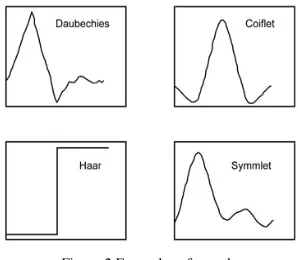
Figure.2 Examples of wavelet
4. 2-Dimensional wavelet transform
The 2-Dimensional wavelet transform can be done in a separable fashion, meaning that we can use a 1- Dimensional DWT and apply it horizontally, then vertically. To accomplish the 1-D DWT, we split a 1-D input signal into two streams, and filter each. We have a low pass filter (h) and a high-pass filter (g), corresponding to the scaling and wavelet functions, respectively. Filtering is a basic operation in digital signal processing where the input signal (i.e. a row or column from an image) is convolved with a set of coefficients. As the reader will notice, this can be computed with multiplication and additions (summation). The DWT separates an image into a lower resolution approximation image (LL) as well as horizontal (HL), vertical (LH) and diagonal (HH) detail components.
For example, HL means that we used a high-pass filter along the rows, and a low-pass filter along the columns. Figure 3 illustrates this concept. In figure 4 the high pass filter is denoted by g while the low pass filter is denoted by h. These details are the upper right hand quadrant, and both lower quadrants. The low-pass and high-pass filters of the wavelet transform naturally break a signal into similar (low-high-pass) and discontinuous/rapidly changing (high-pass) sub-signals. The slow changing aspects of a signal are preserved in the channel with the low-pass filter and the quickly changing parts are kept in the high-pass filter’s channel. Therefore we can embed high energy watermarks in the regions that human vision is less sensitive to, such as the high resolution detail bands (LH, HL, and HH). Embedding watermarks in these regions allows us to increase the robustness of our watermark, at little to no additional impact on image quality [23].
For a 2-D transform, we can filter along the rows, producing two sub-images each about half the size of the original. The heights are the same as the original, but the sub-images have half the width. We then filter these sub images with low and high-pass filters along the columns. This produces two more sub-images each, for a total of four sub-images. This process is called decomposition or analysis. We label the resulting sub-images from an octave of the DWT as LL (the approximation), LH (horizontal details), HL (vertical details), and HH (diagonal details), according to the filters used to generate the sub-image. Why not use this approximation as an image and recursively apply the DWT a second or third time? Multi-resolution is the process of taking one octave’s LL output and putting this sub-image through another set of analysis filters. We can iterate this with LL again and again. The details at each succeeding octave are one-fourth the size of the previous octave. See figure 4.
Figure 3. 2-D DWT decomposition or analysis tree
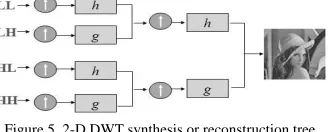
The fact that the DWT is a multi-scale analysis can be used to the watermarking algorithm’s benefit. The first approximation will be used as a “seed” image and recursively apply the DWT a second and third time (or however many times it is necessary to perform to find all of the areas of interest) [22]. As shown, the DWT can be used to analyze, or decompose, signals and images. On the flip side, since none of these pieces are lost, these components can be assembled back into the original signal without loss of information. This process is called reconstruction, or synthesis. The finite impulse response filters used are related to each other such that their coefficients satisfy perfect reconstruction criteria. That is, these filters effectively cancel aliasing, and no scaling is needed. This is important to satisfy the criteria of embedding a watermark, then having the capability to (almost) perfectly reconstruct the original image, except in the locations the watermark is inserted. Therefore, the signal can be reconstructed by undoing the transform. The approximation looks a lot like the original. When we add in the high frequency content, we get back to where we started (filling in the details). This mathematical operation is called the inverse discrete wavelet transform (IDWT). This manipulation is shown in figure 5, for one octave only.
Figure 5. 2-D DWT synthesis or reconstruction tree
When using the discrete wavelet transform, there are many wavelets to choose from. We change the wavelet simply by changing the filter coefficients. The focus of this paper is to discover if there is a best way to choose a wavelet family when using the DWT for watermarking. See [24] for more background on wavelets, and [25] for wavelet history.
5. Watermark Embedding and Extracting
A watermarking method that embeds authentication information into images based on discrete wavelet transforms. This is done by first acquiring the gray values matrix from the color image, then identifying low and high frequency coefficients by using a two-dimensional discrete wavelet transform. The authentication information is embedded into the low coefficients by modifying the low coefficients’ mean values. Experimental results have shown this algorithm to produce a robust and imperceptible watermark.
Inputs: Image
Output Watermarked Image
The detail approach is described as follows: Step 1. Get the input image
Step 2. Convert to grayscale image
Step 3. Initialize the weight of Watermarking Step 4. Generate the key
Step 5. Obtain the filters associated with haar Step 6. Compute 2D wavelet transform Step 7. Produce the watermarked image
To extract the watermark, we apply the 2-D inverse DWT to the possibly corrupted watermarked image.
6. Experimental result
Watermark is embedded in the original image. No noise is introduced into the image. To simulate effects of such innocent problems such as transmission errors, or perhaps alterations of the image for other more predatory reasons, three types of noise are then independently applied to the image to simulate image corruption. The Gaussian white noise added had a zero mean noise with 0.01 variance. The salt and pepper noise had noise density of 0.02, affecting approximately 2% of the pixels. Lastly, the speckle added multiplicative noise that is uniformly distributed random noise with mean 0 and variance 0.04. Then the watermark is extracted from the noisy image. The results are shown in the following figure. Calculate the PSNR for the original image and the manipulated image with the watermark embedded. Extract the watermark. The results are shown in the tables(Table.1)
Three types of noise were individually applied to generate a key. • Gaussian white noise with a zero means noise and 0.01 variance.
B) To specify the power of X to be 0 dB W, set RANDN to the 1234th state and add noise to produce an SNR of 10dB, Y = AWGN(X, 10, 0, 1234);
t:
C) To specify the power of X to be 3 Watts and add noise to Produce a linear SNR of 4, Y = AWGN(X, 4, 3,'linear');
D) To cause AWGN to measure the power of X, set RANDN to the 1234th state and add noise to produce a linear SNR of 4,Y = AWGN(X,4,'measured',1234,'linear');
• Salt and pepper noise with a noise density of 0.02.
• Speckle noise with a mean of 0 and variance 0.04.
Different Noise
MSE( Mean Square Error )
PSNR(peak signal-to-noise ratio)
Gaussian white noise with a zero means noise and 0.01 variance(A) 1.5817e+004 6.1394 Gaussian white noise with a zero means noise and 0.01 variance(B) 7.4959e+003 9.3826 Gaussian white noise with a zero means noise and 0.01 variance(C) 1.5817e+004 6.1367 Gaussian white noise with a zero means noise and 0.01 variance(D) 6.3064e+003 10.1330 Salt and Pepper 7.4830e+003 9.3901
Speckle 7.4914e+003 9.3852
7. Conclusion
The results prove that fact that all the three noise attacks, namely, Gaussian, speckled and salt and pepper, does not alter the quality of the image. The results further indicate that the visual quality of the image is not changed, which is reflected by the high PSNR values obtained. Thus, in conclusion, it can be inferred that the proposed method is robust against noise addition. Future research is planned in the direction of evaluating the system with additional attacks.
Reference
[1] M. L. Miller, I. J. Cox, J. M. G. Linnartz and T. Kalker, 1997, “ A review of watermarking principles and practices”, IEEE International Conference on image processing.
[2] C. Shoemaker, Rudko, 2002 ,“Hidden Bits: A Survey of Techniques for Digital Watermarking” Independent StudyEER-290 Prof Rudko, Spring2002.
[3] R. liu and T. tan, March 2002, “An SVD-Based Watermarking Scheme for protecting rightful ownership”, IEEE Trans. On multimedia, Vol. 4, no. 1.
[4] Y. H. Wang, T. N. Tan and Y. Zhu, “Face Verification Based on Singular Value Decomposition and Radial Basis Function Neural Network”, National Laboratory of Pattern Recognition (NLPR), Institute of Automation, Chinese Academy of Sciences.
[5] E. Ganic and A. M. Eskicioglu, “A DFT-BASED Semi-Blind multiple watermarking scheme images”, CUNY Brooklyn College, 2900 Bedford Avenue, Brooklyn, NY 11210, USA.
[6] A. H. Tewfik, September 2000, “Watermarking digital image and video data ”, IEEE Signal processing magazine.
[7] A. Sverdlov, S. Dexter, A. M. Eskicioglu, “Robust DCT-SVD domain image watermarking for copyright protection: embedding data in all frequencies”
[8] F. A. P. Petitcolas, R. J. Anderson and M. G. Kuhn,July 1999 ,“Information hiding—A survey”, Proceeding of the IEEE, Vol. 87, No. 7.
[9] C. Y. Lin, M. Wu, J. A. Bloom, I. J. Cox, M. L. Miller, and Y. M. Lui, May 2001 “Rotation, Scaling, and Translation Resilient Watermarking for Images”, IEEE Transactions on image processing, Vol.10,No.5.
[10] J. M. Shieh, D. C. Lou, and M. C. Chang, (2006) ,“A semi-blind watermarking scheme based on singular value decomposition”, computer standards & interface 28 ,428-440.
[11] W.Jinwel, L.Guanglle, D.Yuewel, W.Zhiquan, “Correlation detection system of watermarking based on HVS” [12] M. Swanson, M. Kobayashi, and A. Tewfik, , June 1998 ,“Multimedia Data-Embedding and
[14] M. J. Tsai, K. Y. Yu, and Y. Z. Chen, , 2000,"Joint Wavelet and spatial transformation for digital watermarking," IEEE Transactions on Consumer Electronics, vol. 46, pp. 241-245.
[15] T. Z. Chen, G. Horng, and S. H. Wang, 2003 "A Robust Wavelet Based Watermarking Scheme using Quantization and Human Visual System Model," Proceedings of the Pakistan Journal of Information and Technology, vol. 2, pp. 212-230.
[16] C. T. Hsu and J. L. Wu, , 1998, "Multi-resolution Watermarking for Digital Images," IEEE Transactions on Circuits and System—II Analog and Digital Signal Processing, vol. 45, pp. 1097-1101.
[17] C. S. Lu, S.-K. Huang, C.-J. Sze, and H.-Y. Liao, 2001 ,"A new watermarking technique for multimedia protection," presented at Multimedia Image and Video Processing, Boca Raton, FL.
[18] M. S. Raval and P. P. Rege, "Discrete wavelet transform based multiple watermarking scheme," Proceedinsg of the Convergent Technologies for the Asia-Pacific Region, Bangalore, India, 2003.
[19] E. Ganic and A. M. Eskicioglu,2004,"Robust digital watermarking: Robust DWT-SVD domain image watermarking: embedding data in all frequencies," Proceedings of the 2004 Multimedia and Security Workshop on Multimedia and Security.
[20] M. Barni, F. Bartolini, and A. Piva,2001 "Improved Wavelet based Watermarking Through Pixel-Wise Masking," IEEE Transactions on Image Processing, vol. 10, pp. 783-791.
[21] P. Meerwald, 2001,"Digital Image Watermarking in the Wavelet Transform Domain," University of Salzburg.
[22] A. S. Lewis and G. Knowles,1992,"Image Compression using 2-D Wavelet Transform," IEEE Transactions on Image Processing, vol. 1, pp. 244-250.
[23] M. Weeks, Digital Signal Processing Using MATLAB and Wavelets. Infinity Science Press, 2007.
[24] G. Langelaar, I. Setyawan, and R. L. Lagendijk, , September 2000 ,“Watermarking Digital Image and Video Data,” IEEE Signal Processing Magazine, vol. 17, pp. 20–43.
[25] S. Mallat, , 1989 ,“A theory for multiresolution signal decomposition: The wavelet representation,” IEEE Pattern Analysis and Machine Intelligence, vol. 11, no. 7, pp. 674–693.