
Technology (IJRASET)
Review of Developments in Pin-On-Disc
Tribometer for Environment Control
Tejas S. Dol1, Aishwarya B. Dhole2, Tejashri M. Mahamuni3, Namrata A. Kumbhar4 1
Assistant professor, 2,3,4Diploma Engineering students, Mechanical Engineering Department, Government Polytechnic, Karad, Maharashtra-415124, India.
Abstract: The design of earlier pin-on-disc tribometer mainly focuses on normal pressure and environmental conditions and aim
to measure the effect of load and speed on material performance. The effect of gas pressure and environmental condition on the performance of materials is usually not considered. Thus, data from friction tests are not accurate. New atmosphere tribometers are developed to study the tribological behavior of materials under severe, rugged atmosphere are discussed in this paper. A fail safe analysis is performed through reproducibility, comparability and sensitivity tests. The tribometer allows tests to be performed in pin on disc line contact at controlled atmosphere, high temperature and gas pressure. When pin-on-disc test is conducted, the test results indicate that the proposed design is efficient. The designed atmosphere tribometer consistently simulates the friction test under various conditions, enhances the ability of material tribological properties test and ensures accuracy of the tribological data.
Keywords: Fail Safe Analysis, Pin-On-Disc Test, Reproducibility, Tribological Properties, Tribometer.
I. INTRODUCTION
The word tribology means "the science of rubbing'' is derived from a Greek word "Tribos." Surface interactions in a tribological interface are highly intricate, and their understanding requires knowledge of various disciplines including solid mechanics, fluid mechanics, thermodynamics, heat transfer, materials science, rheology, lubrication, machine design, performance and reliability. In sliding and rolling surfaces of modern machinery, tribology is very essential. There are some examples of productive friction, such as brakes, clutches, driving wheels on trains and automobiles, writing with pencil, machining, polishing, and shaving. Unproductive friction and wear are seen in the case of internal combustion and aircraft engines, gears, cams, bearings, and seals. According to some estimates, losses resulting from ignorance of tribology amount to about 6% of its gross national product in the United States and approximately one-third of the world's energy resources in present use appear as friction in one form or another. The main purpose of this research is the minimization and elimination of losses occurring because friction and wear. Research in tribology results in greater plant efficiency, significant saving, fewer breakdowns and improved performance [1].
A tribometer is a machine or device used to perform tests and simulations of wear, friction and lubrication which are the subjects of
the study of tribology. Most tribometers impose only mechanical conditions, i.e., load and speed on the surfaces in contact.
Tribometers with an effective control of the thermal and physico-chemical aspects (i.e., atmosphere and/or temperature) are not so abundant because of their technological intricacy. Tribometers are often classified on the basis of specific contact arrangement they simulate or by the original equipment developer. Some of such arrangements are Four ball, Pin on disc, Block on ring, Bouncing ball, Twin disc and Schwingungs, Reibungs and Verschleiss (SRV) test machine. The tribological challenge is to develop and investigate the materials as well as surface modification techniques which allows the friction pairs of technical mechanisms like bearings, clutches etc., to function under vacuum in a highly stable manner. A high temperature controlled tribometer can help in testing the tribological properties of materials under high temperature, vacuum and other atmospheric conditions. A vacuum tribometer can help in testing the effect of gas pressure on tribological properties and tribo-mechanical reactions. [1,4]
II. LITERATUREREVIEW
N. Marjanovic et al. [1], discussed on the design of modern concept tribometer with circular and reciprocating movement. This paper considers the construction and advantage of modern tribometer conception. In this paper, measure system and software for data acquisition system and processing results are focused. It is discussed that tribometer is robust design and can accomplish a very broad range of velocities and loads, so it can be used for a variety of test conditions. From this paper, it is found that Modular design allows using this tribometer for other types of tribological experiments by its upgrade with new, specific units.
Technology (IJRASET)
atmospheric pressure, primary vacuum, and secondary vacuum. The instrumentation of the tribometer enables continuous measurement of the normal and tangential forces, vertical displacement of the contacting samples, temperature in the vicinity of the contact zone, partial pressure and gas composition in the test chamber and electrical contact resistance. A test has been carried out to
validate the tribological device is presented in this article. The tests performed on a nickel-base alloy at 650 ◦C under various
environmental conditions of air pressure and its effects on the specimen in the form of SEM images are shown in this document. Peter J. Blau [3], researched on the tribology of different materials at elevated temperature as well as the effects of elevated temperature on the properties of different materials. According to this paper, it is shown that, the rate of wear at high temperatures can either be enhanced or reduced, depending on contact conditions and nature of the oxide layer formation. The function of deformation, oxidation, and tribo-corrosion in the elevated-temperature tribology of metallic alloys will be represented here by three examples involving sliding wear, single-point abrasion, and repetitive impact plus slip. It is concluded that as temperature increases for metals in tribo-contact with air, changes in their mechanical properties, coupled with the role of oxidation can change the partitioning of frictional work into wear and surface damage. The same magnitude of friction force can result in different demonstrations of wear depending on the temperature.
Mikhail Kosinskiy et al. [4], reports on a newly developed reciprocating microtribometer for evaluating the tribological behavior of materials and coatings in vacuum and controllable atmospheres on the micro and milli-Newton scale. Friction experiments involving Si–Si tribopairs in ambient and vacuum conditions to validate the microtribometer are discussed in this paper. With the compact vacuum microtribometer it is possible to study the tribological behavior such as adhesion, friction and wear of material and coatings on a microscale in wide range of the applied normal loads and sliding speeds. From the performed tribotests on silicon self-mated tribopairs, it is observed that results collected using the new vacuum microtribometer are more reliable than other conventional type tribometers.
III.SIMPLEPIN-ON-DISCTRIBOMETER
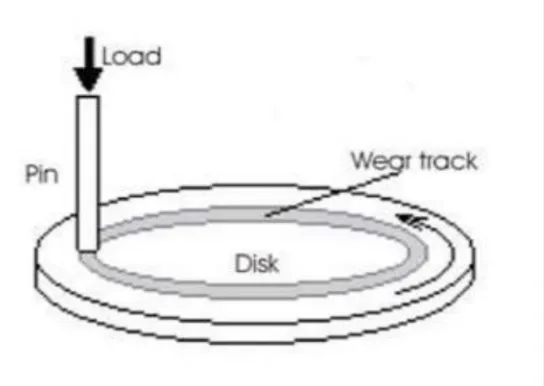
[image:3.612.195.467.499.692.2]In the pin-on-disc test, a pin subjected to definite load is pressed onto a rotating disc and wear is determined as shown in Fig. 1. The end of pin, which is in contact with the disc, is provided with a radius. These results in a point contact between pin and disk at the beginning of the test which results into an increasing area during the test. The pin can also be replaced by a ball (ball-on-disk). The loading condition in the pin-on-disc test is defined by the parameters such as the normal load, the sliding velocity, the initial temperature of the test medium and the sliding distance between the wear couplings. In the pin-on-disc test, the wear volume can either be determined by the changed geometry of the specimen, i.e., shortening of the pin and determination of the wear track volume of the disc or by the mass reduction of the specimens. Its purpose is to record friction and wear in sliding contact of different materials under dry, lubricated, controlled environment and partial vacuum. It finds applications in many fields such as Fundamental wear studies, Friction and wear testing of metals, ceramics, soft and hard coatings, plastics, polymers and composites, lubricants, cutting fluids, heat processed samples [1,2].
Technology (IJRASET)
IV.NEEDOFENVIRONMENTCONTROL
A. Effect of Temperature Condition
The friction and wear behavior of metals and alloys at elevated temperatures is an important consideration in the effective performance of certain moving parts in internal combustion engines, bearings in aerospace propulsion systems, cutting tools, and metal working processes and many other such applications. Sometimes the interfacial temperature is derived from external sources of heat, and at other times, as in vehicle brakes, the temperature results from frictional contact. At high temperatures, changes occur in bulk mechanical properties, bulk thermo-physical properties, and surface reactivity of metals and alloys. The yield strength of metals and alloy usually tends to decrease at elevated temperatures. It is experimentally found that the strength of most metals decreases with temperature. Hence, eventually there would be a reduced resistance to deformation and abrasion as temperature increases. The modulus of elasticity also changes as a function of temperature and that affects the elastic behavior of metals. [2,3].
B. Effect of Vacuum Condition
Several studies have discovered that in contrast to their performance under atmospheric conditions, machine parts working under
non-atmospheric conditions lose most of their properties.For example, while graphite has excellent lubrication properties in normal
atmosphere, a vacuum environment adversely affects its tribological properties. While MoS2 exhibits effective lubrication properties under a vacuum environment, it loses this property when used under air conditions. Sliding parts exhibit strong adhesive bonds and high coefficients of friction under vacuum environments. Miyoshi indicated that when brought into contact in a vacuum environment, clean solids automatically exhibit a strong adhesive bond and high coefficients of friction. It is also known that vacuum decreases the melting and softening point of elements. [2,3]
V. NEWTRIBOMETERDESIGN
A. General Description
Some technical specifications of the device discussed by A. S. Adamau [2] are as presented here. The contact has a pin-on-disc arrangement as shown in Fig. 2 and works in air or in vacuum conditions. During the test, the pin remains fixed while the disc moves at a constant rotating speed. The applied loads for this tribometer vary from 1 to 100N and the sliding velocities range from 0.1 to 1.5 m/s. Tests can be performed from room temperature to 900 °C while air pressure ranges from atmospheric conditions to
10-6 mbar. The apparatus is divided into three parts: the upper part, the central part and the lower part. These parts are separated by
two horizontal plates. The lower plate is fixed to the frame and is considered as the reference plane. For allowing the setting of the samples, the upper plate can be lifted up and down along four driving shafts. The heating system, the vacuum enclosure and the cooling elements surround the test chamber made of a Wasp alloy cylindrical sheet. The apparatus frame is constituted of square welded tubes to firm the structure [2].
1) The Upper Part: It is dedicated to the loading system and measuring sensors i.e., torque, normal force and vertical displacement. Different sensors are located inside the vacuum chamber. The load is applied by gravity using a lever arm out of the test chamber and then transmitted to the loading shaft through an air-proof metal bellow. As the load is transmitted entirely by rigid components (the flexible bellow only ensures a tightness function around the loading shaft), the actual applied load sustained by the samples remains free from the atmospheric pressure [2].
2) The Lower Part: It ensures the rotation of the lower shaft using an electrical motor (1.55 kW) associated to a frequency converter. A magnetic junction transmits the rotating movement without contact to the lower shaft through a non-magnetic sheet. The lower driving shaft is free in rotation and stopped in translation in contrast to the upper loading shaft [2].
3) The Middle Part: It is organised around the test chamber shown in Fig. 2, where the pin and disc are in contact. The pin is carried by the upper loading shaft and the disc is driven by a lower rotating shaft. These two coaxial shafts are guided by two pairs of polymeric plain bearings which are able to work under vacuum conditions without lubrication [2].
B. Environmental controlling aspects
Technology (IJRASET)
reaching the temperature of study. The heated surface of furnace and lamp connections is cooled by the arrangement of the water circulation network.
The air-resistant zone of the apparatus contains the test chamber, the two satellite-crowns situated above and below the test chamber and the two bells as shown in fig. 4 closing the device on the top and at the bottom. Vacuum rings ensure the rigidity of the whole
system. A first vane pump linked to a second turbo-molecular pump, reaches a residual pressure of 10-6 mbar (secondary vacuum) in
almost 5 h. In this study, Pressure measurements were performed for primary pumping and secondary pumping in two different places of the device: in the lower satellite-crown just at the level of the pump, and in the upper satellite-crown beyond the test chamber. Specific gasses such as oxygen, argon can be injected into the test chamber during the test with the help of gas analyzer.
C. Samples and Instrumentation for experimentation
A large number of measures are possible with this new designed tribometer. A. S. Adamou [2] discussed on the specimen and instrumentation before reaching to test. Specifications for pin and disc are given by A. S. Adamou [2]. The pin has a cylindrical
shape of 6mm in diameter. The disc is 37mm in diameter and the surface of contact is then 28 mm2. The samples are positioned on
[image:5.612.55.571.266.443.2]sample-holders made of nickel base alloy. Different sensors are introduced in this new design for measurement purpose. The friction torque (and hence the coefficient of friction) and the applied load are recorded concurrently with a single combined sensor.
Fig. 2 View of the central part of the tribometer showing the test chamber surrounded by the radiative furnace and the two satellite-crowns containing the driving and loading shafts and the water jackets [2].
[image:5.612.117.488.469.708.2]Technology (IJRASET)
This sensor is situated in the upper bell at the top of the loading shaft between the loading system and the plain bearings [2]. Several thermocouples are placed in the furnace and in the test chamber. One thermocouple is for the furnace ruling and two thermocouples are used for measuring the temperature of the samples to be tested. In lower satellite crown, the vacuum level in sample vicinity is controlled by a pressure sensor. All the connections are distributed around the two satellite crowns. Wear measurements are obtained by profilometry of samples [2].
VI.EXPERIMENTATIONANDOUTCOMES
A. S. Adamou [2], described the test which is conducted on the samples of nickel base alloy (INCONEL 718) in new environmental
tribometer. The test is conducted at atmospheric pressure, primary vacuum (0.13 mbar) and secondary vacuum (7.2×10⁻⁵ mbar) in a
homogeneous configuration at a sliding speed of 0.75 m/s, an applied load of 15N and a temperature of 6500C. Prior testing, the
specimens were polished (mirror polishing) and ultrasound cleaned in detergent and in ethanol for 10 min. Experiment period was 20 min. The coefficients of friction recorded in different environmental conditions recommend different performance at elevated
temperature. From the tests conducted at various environments, it is clear that fromFig. 4, at atmospheric pressure, the coefficients
of friction are rather low (μ≈0.5) which slowly reduces with time after a very short time of a few seconds where the coefficient of
friction was very high (μ≈1.5). ). In primary vacuum, the coefficient of friction remains high (μ≈1) but very constant throughout the
entire test. In case of secondary vacuum, it is observed that the coefficient of friction is high, less steady and increases with time.
The wear rates measured in vacuum are estimated to be 0.002 and 0.05 μm/mm3, which is less as compared to atmospheric pressure
Technology (IJRASET)
[image:7.612.156.490.95.345.2]
Fig. 4 Friction behaviour of Inconel 718 in homogenous contact at 650 °C, 15N and 0.75m/s, (a) at atmospheric pressure, (b) in primary vacuum, (c) in secondary vacuum [2].
As per the SEM observations as shown in Fig. 5 (a, b, c), harsh scratching and grooving occurred on the sliding surfaces at different atmospheres. For the atmospheric pressure, the particles undergoing wear were compacted onto the worn surfaces. This created the
Technology (IJRASET)
Fig. 5 Scanning electron micrographs of the wear scars on the disc (Inconel 718,650 ˚C, 15 N, 0.75 m/s) (a) at atmospheric pressure,
(b) in primary vacuum, (c) in secondary vacuum (same magnification) [2].
In case of vacuum pressure from Fig. 5 (a) and Fig. 5 (b) , the worn surfaces are smoother smearing and layer deformation is higher. It is discussed here from the several studies that, these changes are associated with the establishment of compacted layers made of a mixture of oxidised films and partially oxidised particles on the sliding surfaces [2].
Some researchers worked on the Plasma Nitride (PN) coatings. Tribological tests under dry conditions are carried out on PN coated specimens at various temperatures of 25, 200, 400, and 500°C in high vacuum are discussed by Ayyannan Devaraju [5]. It is observed that friction and wear were low at lower temperatures and it removed adhesion between contacting surfaces until the coating was completely eliminated from the pin surface. Austenitic stainless steels coated with PN coatings show good results in corrosion, vacuum, CO2 and argon environments. These tests are possible only with the help of new environmental tribometer design [5].
VII. CONCLUSION
Technology (IJRASET)
A. The idea about surface behavior of different materials is not totally clear from the testing on simple pin on disc tribometer. This
is accomplished with the help of new tribometer design discussed in this review.
B. New atmosphere tribometers are developed to study the tribological behaviour of materials under severe rugged atmosphere and
also in vacuum. Different sensors used to study the behaviour of materials at different conditions. The performance of the specimen under different gaseous environment can be analyzed.
C. It is observed that the mechanics of contact, material properties, the interfacial temperature, and the surrounding environment is
responsible to influence the wear of metals and alloys in different forms.
D. The tests performed on a nickel-base alloy at 650oC under various environmental conditions of air pressure (ambient
atmosphere, primary and secondary vacuum) and their reproducibility permitted to validate the performances of the device. The results show satisfactory behavior of material under this new tribometer design.
E. The control of high temperature friction and wear is important for applications like internal combustion engines, aerospace
propulsion systems, and metal-working equipment.
F. With the help of this new tribometer design, the errors in experiments are much decreased and reliability of the outcome is
increased. So the use of these tribometers plays an important role in material selection, as well as for studying the mechanical and thermal interactions and their influences on durability of materials.
REFERENCES
[1] N. Marjanovic, B. Tadic, B. Ivkovic, S. Mitrovic, “Design of Modern Concept Tribometer with Circular and Reciprocating Movement.”, Tribology in industry, vol. 28, pp.3-4 , 2006.
[2] A.S. Adamou, J. Denape , J.-Y. Paris, E. Andrieu, “An environmental tribometer for the study of rubbing surface reactivity”, Wear, vol. 261, pp.311–317, 2006.
[3] Peter J. Blau, “Elevated-temperature tribology of metallic materials”, Tribology International, vol. 43, pp.1203-1208, 2010.
[4] Mikhail Kosinskiy, SyedImad-UddinAhmed, YongheLiu, Juergen A. Schaefer, “A compact reciprocating vacuum microtribometer”, Tribology International, vol. 56, pp.81–88, 2012.
[5] Ayyannan Devaraju1, Ayyasamy Elayaperumal, Srinivasan Venugopal, Satish V. Kailas, Joseph Alphonsa, “Investigation on the High Vacuum Tribological Characteristics of Surface Treated Nuclear Grade Stainless Steel Type AISI 316 LN at 25 to 500 °C”, Journal of Mechanical engineering, vol. 57, pp. 927-935, 2011.
![Fig. 2 View of the central part of the tribometer showing the test chamber surrounded by the radiative furnace and the two satellite-crowns containing the driving and loading shafts and the water jackets [2]](https://thumb-us.123doks.com/thumbv2/123dok_us/8578736.860196/5.612.117.488.469.708/central-tribometer-showing-surrounded-radiative-furnace-satellite-containing.webp)
![Fig. 4 Friction behaviour of Inconel 718 in homogenous contact at 650 °C, 15N and 0.75m/s, (a) at atmospheric pressure, (b) in primary vacuum, (c) in secondary vacuum [2]](https://thumb-us.123doks.com/thumbv2/123dok_us/8578736.860196/7.612.156.490.95.345/friction-behaviour-inconel-homogenous-contact-atmospheric-pressure-secondary.webp)
![Fig. 5 Scanning electron micrographs of the wear scars on the disc (Inconel 718,650 ˚C, 15 N, 0.75 m/s) (a) at atmospheric pressure, (b) in primary vacuum, (c) in secondary vacuum (same magnification) [2]](https://thumb-us.123doks.com/thumbv2/123dok_us/8578736.860196/8.612.170.454.75.527/scanning-electron-micrographs-inconel-atmospheric-pressure-secondary-magnification.webp)
