Technology (IJRASET)
Performance Evaluation of Forced FED Micro
Channels for High Heat Flux Cooling Applications
K. Supriya 1, Dr. P Sekhar Babu 2
1
Post graduate student of M.Tech (Thermal Engineering)
Vijaya Krishna institute of technology and science, Palamakula, Shamshabad, Hyderabad -509325
2
Principal, Vijaya Krishna institute of technology and science, Palamakula, Shamshabad, Hyderabad-509325
Abstract— High heat flux cooling is required in many applications such as power electronics, plasma-facing components, high heat-load optical components, laser diode arrays, X-ray medical devices, and power electronics in hybrid vehicles. In general, the exposed area that needs to be cooled for these systems is limited, and the amount of heat that needs to be removed is extremely high, thus requiring cooling of high heat fluxes. While high heat flux cooling is essential for creating an efficient cooling system, there are usually also other system requirements, such as low thermal resistance, surface temperature uniformity, low pumping power, compact design, suitability for large area cooling, and compatibility for use with dielectric fluids.
In this thesis, thermal performance of the force-fed micro channel (micro-grooved) heat exchangers (FFMHX) in single-phase and two-phase heat transfer modes using different refrigerants will be analyzed using Ansys.
Different models will be modelled by varying tube length over the tube hydraulic diameter ratio and compared by analysis. Models will be done in Pro/Engineer, Thermal and fluent analysis will be done in Ansys.
Keywords— High heat flux, thermal performance, force-fed micro channel, heat exchangers, Pro/Engineer, Fluent Analysis
I. INTRODUCTION
A. Introduction to Micro channels
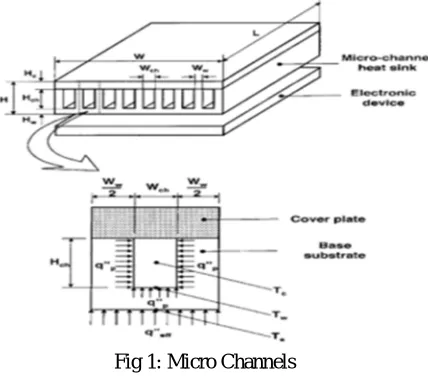
[image:2.612.204.418.481.669.2]Thermal engineers in the electronics industry are facing unprecedented challenges of removing enormous amounts of heat from devices and packages, which are brought about by aggressive circuit integration and miniaturization. Among only a handful of available high-performance cooling techniques, micro-channel heat sinks have recently emerged as a highly effective thermal solution for next generation high-power-density electronics. Micro-channel heat sinks utilize a series of small parallel channels as liquid flow passages and are especially suited for applications involving the dissipation of large amounts of heat from a small area. Key merits of these heat sinks are low thermal resistance, small coolant inventory, and small heat sink mass and volume
Fig 1: Micro Channels
high heat fluxes. Heat transfer methods such as heat pipes, vapor chambers, nonmaterial’s, liquid cooling and miniature refrigeration systems have been attracting more interest. Liquid-cooled micro channel heat sinks and coolers have been shown to be a very effective way to remove high heat load. A large heat transfer coefficient can be achieved by reducing the channel hydraulic diameter. In a confined geometry the small flow rate within micro channels produces laminar (smooth) flow, which results in a heat transfer coefficient inversely proportional to the hydraulic diameter. In other words, the narrower the channels in the heat sink, the higher the heat transfer coefficient.
While using micro channels to cool electronics is attractive because of their very high heat transfer coefficient, their use and implementation is very challenging. Factors such as cost, manufacturing, pump selection, filtering requirements to prevent channel clogging, and space constraints must be evaluated before one commits to using micro channels in a system. The research in this area is ongoing and the implementation of this concept will become more widespread once the practical difficulties mentioned above are resolved.
B. Objectives of the Work
The main objective of the project design and analysis of Micro channels of various sizes to dissipate heat from the source. For this purpose 3 different micro channels of different size by keeping width constant and increasing height analysed by three different fluids like Air, Methane and Propane. by selecting two different materials like aluminium and copper.
C. Review of Papers
A 3D numerical study of heat transfer in a single-phase micro-channel heat sink using graphene, aluminum and silicon as substrates by ahmed jassim shkarah, describes numerical simulations conducted on micro-channel heat sinks [1]. Experimental study on cooling performance of minichannel heat sink using water-based mepcm particles by ching-jenq ho, wei-chen Chen experimental study was performed to investigate the cooling performance of a minichannel heat sink (mini-chs) with microencapsulated phase change material (mepcm) particles/water as the coolants [2]. Fluid flow and heat transfer investigations on enhanced microchannel heat sink using oblique fins with parametric study by yong jiun lee enhanced microchannel heat sink with sectional oblique fin is used to modulate the flow in contrast to continuous straight fin [3]. Analysis of three-dimensional heat transfer in micro-channel heat sinks by weilin qu, in this paper by, the three-dimensional fluid flow and heat transfer in a rectangular micro-channel heat sink are analyzed numerically using water as the cooling fluid [4]. Experimental and numerical study of pressure drop and heat transfer in a single-phase channel heat sink by weilin qu the pressure drop and heat transfer characteristics of a single-phase micro-channel heat sink were investigated both experimentally and numerically [5]. Numerical investigation of flow dynamics and heat transfer characteristics in a microchannel heat sink by md. Emran a three-dimensional numerical simulation is performed in order to investigate the flow dynamics and heat transfer characteristics in a microchannel heat sink [6]. Experimental investigation of heat transfer performance for a novel microchannel heat sink by y wang demonstrated a novel microchannel heat sink with a high local heat transfer efficiency contributed by a complicated microchannel system, which comprises parallel longitudinal microchannels etched in a silicon substrate and transverse microchannels electroplated on a copper heat spreader.
II. DESIGNING 3D MODELS OF MICROCHANNELS
To design for the micro channel there are several factors to be considered with reference to its function. The care should be taken while designing of micro channel for flow should be fully developed laminar flow, compact design and suitability for large area cooling
By keeping tube length and width as constant, varying height 50 µm to 150 µm
TABLE -1: DIMESIONS OF MICRO CHANNELS Width (µm) Height(µm) Length(µm)
50 50 10
50 100 10
Technology (IJRASET)
Fig 2: Micro Channel 3D Model
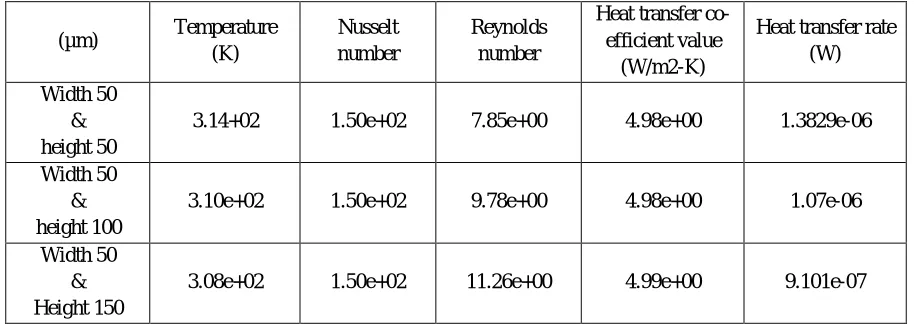
[image:4.612.77.537.316.495.2]The objective of the project work is to design and analysis of a micro channel by using three different fluids like air, methane and propane.Further to determine temperature distribution, Reynolds number, Nusselt number, Heat transfer coefficient and heat transfer rate
TABLE -2 SHOWS THE FLUENT ANALYSIS VALUE FOR 10MM MICRO CHANNEL USING AIR AS FLUID
(µm) Temperature
(K) Nusselt number
Reynolds number
Heat transfer co-efficient
value (W/m2-K)
Heat transfer rate (W)
Width 50 & height 50
3.17e+02 2.05e+02 8.64e+00 4.95e+00 7.3476 e-07
Width 50 & height 100
3.12e+02 2.05e+02 1.09e+01 4.96e+00 5.795 e-07
Width 50 & Height 150
3.10e+02 2.05e+02 1.25e+01 4.97e+00 5.102 e-07
TABLE –3 SHOWS THE FLUENT ANALYSIS VALUE FOR 10MM MICRO CHANNEL USING METHANE AS FLUID
(µm) Temperature (K)
Nusselt number
Reynolds number
Heat transfer co-efficient value
(W/m2-K)
Heat transfer rate (W)
Width 50 & height 50
3.14+02 1.50e+02 7.85e+00 4.98e+00 1.3829e-06
Width 50 & height 100
3.10e+02 1.50e+02 9.78e+00 4.98e+00 1.07e-06
Width 50 & Height 150
[image:4.612.78.535.531.696.2](µm) Temperature (K) Nusselt number Reynolds number
Heat transfer co-efficient value
(W/m2-K)
Heat transfer rate (W)
Width 50 &
height 50 3.05e+02
2.82e+02 3.48e+01 4.99e+00 4.6447872e-07
Width 50 &
height 100 3.03e+02
2.82e+02 3.84e+01 5.00e+00 3.3280823-07
Width 50 & Height 150
3.02e+02
2.82e+02 4.39e+01 5.01e+00 2.2219592e-07
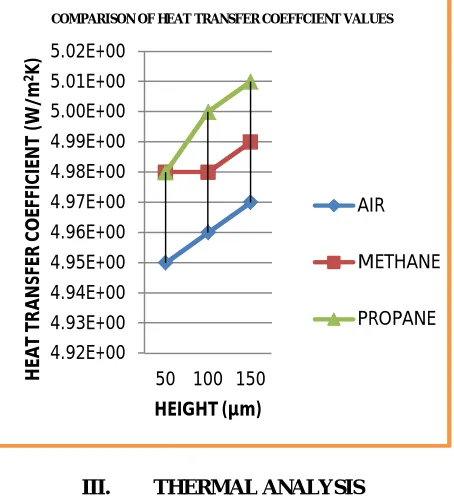
Graphs COMPARISON GRAPHS BETWEEN FLUIDS – Air, Methane, Propane FOR 10mm LENGTH TUBE
2.90E+02 2.95E+02 3.00E+02 3.05E+02 3.10E+02 3.15E+02 3.20E+02
50 100 150
TE M PE RA TU RE ( K) HEIGHT (µm)
COMPARISON OF TEMPERATURE VALUES
AIR METHANE PROPANE 0.00E+00 5.00E+01 1.00E+02 1.50E+02 2.00E+02 2.50E+02 3.00E+02
50 100 150
N U SS ELT N U M BE R HEIGHT (µm)
COMPARISON OF NUSSELT NUMBER VALUES
AIR METHANE PROPANE 0.00E+00 1.00E+01 2.00E+01 3.00E+01 4.00E+01 5.00E+01
50 100 150
R EY N O LD S N U M B ER HEIGHT (µm)
COMPARISON OF REYNOLDS NUMBER VALUES
AIR
METHANE
Technology (IJRASET)
[image:6.612.195.422.91.342.2]III. THERMAL ANALYSIS
TABLE -5 THERMAL ANALYSES
4.92E+00 4.93E+00 4.94E+00 4.95E+00 4.96E+00 4.97E+00 4.98E+00 4.99E+00 5.00E+00 5.01E+00 5.02E+00
50 100 150
H EA T TR A N SF ER C O EF FI C IE N T (W /m 2K) HEIGHT (µm)
COMPARISON OF HEAT TRANSFER COEFFCIENT VALUES
AIR
METHANE
PROPANE
MATERIAL SIZE(µm) Heat flux ( W/mm2 )
COPPER
Width 50 &
height 50 0.254 Width 50 & height 100 0.209 Width 50 & Height 150 0.153 ALUMINUM Width 50 &
IV. CONCLUSION
Different refrigerants Air, Methane and Propane are analyzed for thermal performance in micro channel (micro-grooved) heat exchangers using Ansys. Models are done in Pro/Engineer; Different models are modeled by varying tube height and compared by analysis. The tube lengths taken are 10mm the width is kept constant at 50µm and the height is varied by 50µm, 100µm and 150µm. Fluent and Thermal analysis are done in Ansys. By observing the fluent analysis results, Nusselt number is varying with the refrigerants. Reynolds number increased by increasing of height and heat transfer coefficient is increasing by increase of height.By comparing the analysis of 50*150 fluid propane has shown high Nusselt number, Reynolds number and heat transfer coefficient By observing the thermal analysis results, the heat flux is more for Copper than Aluminum
REFERENCES
[1] A 3D numerical study of heat transfer in a single-phase micro-channel heat sink using graphene, aluminum and silicon as substrates by Ahmed Jassim
Shkarah, Mohd Yusoff Bin Sulaiman, Md Razali Bin Hj Ayob, Hussein Togun, International Communications in Heat and Mass Transfer 48 (2013) 108–115
[2] Experimental study on cooling performance of minichannel heat sink using water-based MEPCM particles by Ching-Jenq Ho, Wei-Chen Chen, Wei-Mon Yan,
International Communications in Heat and Mass Transfer 48 (2013) 67–72
[3] Fluid flow and heat transfer investigations on enhanced microchannel heat sink using oblique fins with parametric study by Yong Jiun Lee, Pawan K. Singh,
Poh Seng Lee, International Journal of Heat and Mass Transfer 81 (2015) 325–336
[4] Analysis of three-dimensional heat transfer in micro-channel heat sinks by Weilin Qu, Issam Mudawar, International Journal of Heat and Mass Transfer 45
(2002) 3973–3985
[5] Experimental and numerical study of pressure drop and heat transfer in a single-phase micro-channel heat sink by Weilin Qu, Issam Mudawar, International
Journal of Heat and Mass Transfer 45 (2002) 2549–2565
[6] Numerical Investigation of Flow Dynamics and Heat Transfer Characteristics in a Microchannel Heat Sink by Md. Emran, Mohammad Ariful Islam,
International Conference on Mechanical Engineering, Volume 90, 2014, Pages 563–568
[7] Experimental investigation of heat transfer performance for a novel microchannel heat sink by Y Wang and G-F Ding, Journal of Micromechanics and
Microengineering, 2008 J. Micromech. Microeng. 18 035021 doi:10.1088/0960-1317/18/3/035021
[8] Flow Boiling Heat Transfer in Micro-Channel Heat Sinks under Sub-Atmospheric Pressures by X. Hu, G. Lin, X. Bu, Y. Caia & D. Wen, A Journal of Thermal
Energy Generation, Transport, Storage, and Conversion, pages 85-113
S.No Author Particulars
1 k.Supriya
(M.Tech) Thermal Engineering
Post graduate student in Thermal engineering and completed course at Vijaya Krishna institute of technology and science, Palamakula, Shamshabad, Hyderabad -509325
Email- [email protected] 2 Dr.P Sekhar Babu
Principal
Principal
Vijaya Krishna institute of technology and science, Palamakula, Shamshabad, Hyderabad -509325
0 0.05 0.1 0.15 0.2 0.25 0.3
50*50 50*100 50*150
H
EA
T
FL
U
X
(
W
/m
m
2)
LENGTH (mm)
COPPER