Optimization of Dry Turning Process Parameters
using Taguchi and ANOVA Technique for MRR of
EN8 Steel
Devendra Singh Chauhan1, A. S Verma2, Avdesh Dixit3
1M. Tech Scholar, Mechanical Engineering Department, KIT Kanpur, AKTU, India 2Associate Professor, Mechanical Engineering Department, KIT Kanpur, AKTU, India
3Assistant Professor, Mechanical Engineering Department, BIT Kanpur, AKTU, India
Abstract: Turning operation is a material removal process generally used to remove the material from the surfaces to achieve the desired dimension of the product. An L9 orthogonal array, S/N ratio and ANOVA are employed for analysis the MRR characteristic for turning operations. In the present study, Taguchi method or Design of experiments has been used to optimize the effect of turning parameters such as cutting speed (m/min), feed (mm/rev) and depth of cut (mm) on the Material Removal Rate of EN8 steel. Material removal rate measurements were carried out during the machining process on the work piece. EN8 is generally known medium strength steel has good tensile strength and consists of higher machinability. It has several industrial applications in manufacturing of shafts, stressed pins, studs, keys etc. The results indicated that feed rate and depth of cut and cutting speed were the significant factors for the material removal rate. The optimized parameters for material removal rate are cutting speed 200 m/min, feed 25 mm/rev. and depth of cut 14 mm.
Keywords: Turning, Taguchi method, EN8 steel, Orthogonal Array, ANOVA, MRR
I. INTRODUCTION
The challenge of modern machining industries is mainly focused on the achievement of high quality, in terms of work piece dimensional accuracy, surface finish, high production rate, less wear on the cutting tools, economy of machining in terms of cost saving and increase the performance of the product with reduced environmental impact [1].
In many industrial applications such as bearings, transmission shafts, axels, and engine components, flap gears, landing struts and aerospace engine components, the replacement of slow and cost intensive grinding process with the finish hard turning have been implemented [2]. In comparison between grinding and hard turning, turning can machine complex work piece in just one set up. Besides, turning cycle time is three times faster than grinding. It consumes less energy per unit volume of metal removed than grinding and remains friendlier to the environment due to dry cutting. For successful implementation in hard turning, the machining criteria of material removal rate are studied in this paper & optimized the controlled parameters for its effectiveness application [3]. Taguchi and ANOVA can conveniently optimize the input cutting parameters with several experimental runs well designed. ANOVA was employed to find out significance of the different parameters on MRR [4].
II. WORKMATERIALANDMETHODS
Turning operation was performed on centre lathe machine made by OSWAL MACHINERY & TOOLS CORP LUDHIANA PUNJAB at Rajat Engineering Works, Panki Industrial Area Kanpur.
A. Work Piece Material
EN8 which is also known as medium carbon mild steel was used as work piece. A rod of 200 mm in length and the diameter was 50 mm.
TABLEI
CHEMICAL COMPOSITION OF EN8 STEEL
Standard Grade C Mn P S Si
TABLEII
PHYSICAL PROPERTIES OF EN8 STEEL
Physical Properties Value
Melting point 1450 - 1510°C
Density 7850kg/m3
Tensile strength 850 MPa
Yield strength 465 n/mm2
Impact (Izod) 25 ft.lb
Hardness (Brinell) 201 - 255
Fig. 1 After turning operation EN8 material piece
B. Cutting Tool
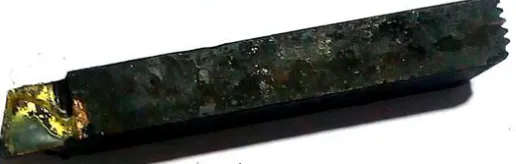
Carbide tool (Single point) was used for turning operation. The Cutting tool used was coated and having combination of Al2O3 + TiC with tin coating (Golden) manufactured by PRIME PRECISIONS PVT LTD.
[image:3.612.178.436.520.602.2]The insert was rigidly mounted on a tool holder
Fig. 2 A single point carbide cutting tool
C. Digital Weighing Machine
Material removal rate (MRR) of work piece was calculated by weighing the work piece after machining period. For this, DJ 300S model weighing machine was used with an accuracy of 0.001 gram. That machine capacity was 300 gram and accuracy is 0.001 gram. Weighing machine was manufactured by SHINKO DENSHI Co. LTD, JAPAN
D. Process Parameters
TABLEIII
PROCESS PARAMETERS OF TURNING OPERATION
Factors Level A Level B Level C
Cutting Speed 20 40 60
Feed Rate 0.1 0.2 0.3
Depth of Cut 0.3 0.6 0.9
III.DESIGNOFEXPERIMENTANDMEASUREMENT
A. Taguchi Method
It is a powerful tool for the design of high quality systems. It provides simple, efficient and systematic approach to optimize designs for performance, quality and cost. Taguchi method is efficient method for designing process that operates consistently and optimally over a variety of conditions [5]. Steps of Taguchi method are as follows:
1) Identify the main function, side effects and failure mode.
2) Identify the noise factor, testing condition and quality characteristics.
3) Identify the main function to be optimized.
4) Identify the control factor and their levels.
5) Proper selection of orthogonal array and matrix experiment.
6) Carefully conducting the matrix experiment.
7) Analysing the data, prediction of the optimum level and performance.
8) Performing the verification experiment and planning the future action. [6]
B. Design of Experiments
The study of most important variables affecting quality characteristics and a plan for conducting such experiments is called the Design of Experiments [7].
C. Taguchi Orthogonal Array
If there is an experiment having 3 factors which have three values, then total number of experiment is 27. Then results of all experiment will give 100 accurate results. In comparison to above method the Taguchi orthogonal array make list of nine experiments in a particular order which cover all factors. These nine experiments will give 99.96% accurate result. By using this method number of experiments reduced to 9 instead of 27 with almost same accuracy [8].
TABLEIV
TAGUCHI L9ORTHOGONAL ARRAY
Sr. No. Cutting speed Feed Rate Depth of Cut Unit (m/min) (mm/rev) (mm)
1 1 1 1
2 1 2 2
3 1 3 3
4 2 1 3
5 2 2 1
6 2 3 2
7 3 1 2
8 3 2 3
9 3 3 1
D. Optimization by Taguchi Method
1) Smaller the Better
2) Nominal the Better and,
3) Larger the Better [9]
For MRR Larger the Better is used
S/N LTB= ―10log10 ……… (1)
Where yi is the performance response to the ith setting of the parameter combination, and n is the number of samples.
IV.RESULTANDDISCUSSIONS
After performing the experiments, the output responses (MRR) values were calculated by equation 2, and the results were tabulated for carbide tool.
MRR (mm3/min) = …… (2)
The density of the mild steel is taken as 7.87 x 10⁻³ gm/mm3 [10]
TABLEV
EXPERIMENTAL TABLE WITH S/N RATIO
S. no. Cutting Speed
Feed Rate
Depth of Cut
MRR S/N
Ratio Unit (m/min) (mm/rev) (mm) gm/mm3 db
1 20 0.1 0.3 86173.25 98.707
2 20 0.2 0.6 74500.64 97.443
3 20 0.3 0.9 93011.46 99.371
4 40 0.1 0.9 114649.68 101.187
5 40 0.2 0.3 18048.41 85.129
6 40 0.3 0.6 21569.43 86.677
7 60 0.1 0.6 83731.72 98.458
8 60 0.2 0.9 52738.85 94.443
9 60 0.3 0.3 5847.13 75.339
TABLEVI
RESPONSE TABLE FORS/N RATIO
Level Cutting speed
Feed Rate
Depth of Cut 1 98.51 99.45 98.33
2 91.00 92.34 86.39
3 89.41 87.13 94.19
Delta 9.09 12.32 11.94
TABLEVII
RESPONSE TABLE OF MEAN
Level Cutting speed
Feed Rate
Depth of Cut 1 84562 94852 86800
2 51423 48429 36690
3 47439 40143 59934
Delta 37123 54709 50110
Rank 3 1 2
TABLEVIII ANOVA TABLE
Source DF Seq SS Adj MS F P % of Contribution
Cutting
speed 2 141.60 70.802 10.20 0.089 23.38
Feed Rate 2 229.56 114.782 16.54 0.057 37.90
Depth of Cut 2 220.61 110.305 15.90 0.059 36.43
Residual
Error 2 13.88 6.938 2.29
Total 8 605.65 100
60 40
20 1 00.0
97.5
95.0
92.5
90.0
87.5
85.0
0.3 0.2
0.1 0.3 0.6 0.9
Cutting Speed
M
e
a
n
o
f
S
N
r
a
ti
o
s
Feed Rate Depth of Cut
Main Effects Plot for SN ratios
Data Means
Signal-to-noise: Larger is better
Fig. 3 Main effects plot for SN ratio
60 40 20 1 00000 90000 80000 70000 60000 50000 40000 30000 0.3 0.2
0.1 0.3 0.6 0.9
Cutting Speed M e a n o f M e a n s
Feed Rate Depth of Cut
[image:7.612.98.523.78.332.2]Main Effects Plot for Means Data Means
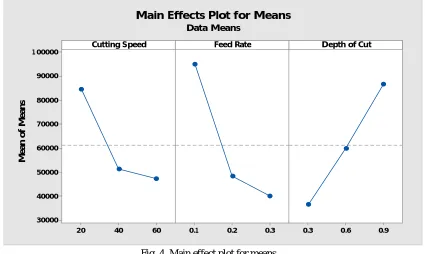
Fig. 4 Main effect plot for means
Above graph is between the means of MRR and three levels (A1, B2, C3) of input parameters i.e. cutting speed, feed rate, and depth of cut. This graph shows that maximum value of the means results in maximum material removal rate. Hence, first level of cutting speed, first level of feed rate and third level of depth of cut results in maximum material removal rate.
40000 20000 0 -20000 -40000 99 90 50 10 1 Residual P e r c e n t 100000 75000 50000 25000 0 20000 10000 0 -10000 -20000
Fitted V alue
R e s id u a l 1500 0 1000 0 5000 0 -500 0 -100 00 -150 00 -200 00 3 2 1 0 Residual F r e q u e n c y 9 8 7 6 5 4 3 2 1 20000 10000 0 -10000 -20000
O bser vation O r der
R e s id u a l
No rmal Pro b ab ilit y Plo t Versu s Fit s
Hist o g ram Versu s Ord er
R esidual Plots for MRR
Fig. 5 Residual plot for MRR
[image:7.612.97.528.385.650.2]V. CONCLUSIONS
The experimental study has focused on application of the Taguchi method for the optimization of input process parameters of dry turning operations. As discussed earlier, the parameter design of the Taguchi method provides a simple, systematic, and efficient methodology for the optimization of the cutting parameters. Except machining time, cutting parameters such as cutting speed, feed rate, and Depth of cut mainly influenced the MRR of EN8 steel rod. The optimal combination of turning parameters and their levels for the MRR of the turning process are A1B1C3 (i.e. cutting speed- 20 m/min, feed rate- 0.10 mm/rev and depth of cut- 0.9 mm). The percentage contributions of cutting speed, feed rate and depth of cut for carbide tool are 23.28%, 37.90% and 36.43% respectively.
Hence, significant improvements in MRR can be obtained using this approach. Finally, it can be a very useful technique for use to the industries to optimize the machining performance with minimum cost and loss of time.
VI.ACKNOWLEDGMENT
I am thankful to my Research Guide Mr. A.S Verma (Associate Professor) for his valuable ideas and moral support. I would like to thanks to all my friends who support me during my work.
REFERENCES
[1] S. Thamizhmanii, S. Hasan, Analyses of roughness, forces and wear in turning gray cast iron, Journal of achievement in Materials and Manufacturing
Engineering, 17, 2006.
[2] Rech, T and Moisan, A., Surface Integrity in Finish Hard Turning of Case Hardened Steels. Int. J. Mach. Tool Manuf.,Vol. 43, ((2003)) 543-550.
[3] A. K. Sahoo, K. Orra, A. K. Rout & B. C. Routra:” multi-response optimization in machining hardened steel using grey-based taguchi method" international
journal of manufacturing technology and industrial engineering (ijmtie) Vol. 1, no. 1, january-june 2011, pp. 7-12
[4] Vishal Francis, Ravi.S.Singh, Nikita Singh, Ali.R.Rizvi, Santosh Kumar “application of taguchi method and anova in optimization of cutting parameters for
material removal rate and surface roughness in turning operation” ISSN 0976 – 6340 (Print) ISSN 0976 – 6359 (Online) Volume 4, Issue 3, May - June (2013), pp. 47-53 © IAEME
[5] T. Sreenivasa Murthy, R.K.Suresh, G. Krishnaiah, V. Diwakar Reddy, Optimization Of Process Parameters In Dry Turning Operation Of EN 41B Alloy Steels
With Cermet Tool Based On The Taguchi Method, International Journal of Engineering Research and Applications (IJERA) ISSN: 2248-9622, Vol. 3, Issue 2, March -April 2013, pp.1144-1148.
[6] Verma Jitendra, Agrawal Pankaj, Bajpai Lokesh, Turning Parameter Optimization For Surface Roughness Of Astm A242 Type-1 Alloys Steel By Taguchi
Method, International Journal of Advances in Engineering & Technology, ISSN: 2231-1963 March 2012, Vol. 3, Issue 1, pp. 255-261.
[7] Dr. M. Naga Phani Sastry, K. Devaki Devi, Dr, K. Madhava Reddy” Analysis and Optimization of Machining Process Parameters Using Design of
Experiments” Industrial Engineering Letters ISSN 2224-6096 (Paper) ISSN 2225-0581 (online) Vol 2, No.9, 2012
[8] Krishankant, Jatin Taneja, Mohit Bector, Rajesh Kumar “ Application of Taguchi Method for Optimizing Turning Process by the effects of Machining
Parameters” International Journal of Engineering and Advanced Technology (IJEAT) ISSN: 2249 – 8958, Volume-2, Issue-1, October 2012
[9] Sahil Pahda Sanjay Mohan Sharma & 3Navdeep Malhotra “analysis of variance and optimization of surface roughness in cnc turning of en-8 by taguchi
method” International Journal of Advanced Engineering Technology IJAET/Vol.III/ Issue I/January-March, 2012/264-267
[10] A.S Verma, Devendra Singh Chauhan, Avdesh Dixit “Optimize Process Parameters for Comparative Study of MRR on Turning using HSS and Carbide Tool