5
IV
April 2017
Technology (IJRASET)
©IJRASET: All Rights are Reserved
1465
Experimental Study on the Behavior of
Copper Slag as Partial Replacement of Fine
Aggregate in Concrete
Abhinav Shyam1, Abdullah Anwar2, Syed Aqeel Ahmad3
1
M. Tech (Research Scholar), 2Assistant Professor, 3Associate Professor and Head, Department of Civil Engineering, Integral University, Lucknow (UP), India
Abstract: In present arena, rapid urbanization has created a huge demand for natural sand hence made it even more expensive. Alternative materials in all forms of constructions are introduced to reduce the pressure on natural materials, which will balance the economical purpose of the project while also taking care of the surrounding environment. Waste Materials like Stone dust,
Copper Slag, Fly Ash, Carbonate Sand etc. having silica composition (SiO2) could be used as a replacement for Fine aggregate
in concrete mix. Copper slag is an industrial by product material produced from the process of manufacturing copper. Copper slag is glassy granular material with high specific gravity. Copper slag Particle sizes are of the order of sand and have a potential for use as fine aggregate in concrete. The present investigation is carried out for M-40 grade of concrete mixes with partial replacement of Fine Aggregate (Sand) by Copper Slag in proportions of 0%, 10%, 20%, 30%, 40% and 50%. Compressive Strength, Split Tensile Strength and Flexural Strength at the ages of 28 days for various combinations of Copper Slag and Sand were investigated.
Keywords: Copper slag, Fine aggregate, Compressive Strength, Split Tensile Strength, Flexure Strength.
I. INTRODUCTION
Concrete is generally made of aggregates glued by a cementitious materials paste, which is made of cementitious materials and water. It composed of coarse granular material (the aggregate) embedded in a hard matrix of material (the cement) that fills the space between the aggregate particle and glues them together. Concrete is generally considered as a composite material that consists essentially of a binding medium within which are embedded particles or aggregates. The simplest representation of concrete is:
A. Concrete = Filler + Binder
According to the type of binder used, there can be different kinds of concrete. For example, Portland cement concrete, asphalt concrete and epoxy concrete etc. In concrete construction the Portland concrete is used the most. Thus in our course, the term concrete usually refers to Portland cement concrete. For this kind of concrete, the composition can be presented as follows
B. Coarse aggregate + Fine aggregate + Cement + Water + Admixture = Concrete
Aggregates occupy about 60 to 75% of the total volume of concrete. Fine aggregate used in concrete is generally river sand. In present scenario, a growing prominence of introducing alternative materials in all forms of constructions to reduce the pressure on good quality natural materials have been noted, which will balance the economical purpose of the project while also taking care of the environment. So the huge amount of by-product or wastes such as fly-ash, copper slag, silica fume generated, are put to use as
sustainable construction materialsUtilization of industrial waste in concretereduces the consumption of natural resources. Several
studies have shown promising result in terms of strength properties of concrete by using copper slag as a partial replacement of river sand. Copper Slag, which is a by-product (having Silica (SiO2) as a major chemical composition) obtained during matte smelting and refining process of copper production, is abundantly available and even possesses a low risk to health and the environment and could be considered as an alternative to river sand. Utilizing these waste slags in Concrete also helps in resolving the dumping or disposal problem of the industrial waste which is a major concern today.
Technology (IJRASET)
©IJRASET: All Rights are Reserved
1466
the energy production and transportation industries. As of 2011 it contributes 7% to global anthropogenic CO2 emissions, largely
due to sintering of limestone and clay at 1500 ̊C. Concrete is used to create hard surfaces that contributes to the surface runoff, which can cause heavy soil erosion, water pollution and flooding, but conversely can be used to divert, dam and control flooding. Concrete is a primary contributor to the urban heat island effect, though less so than asphalt. People who cut, grind or polish concrete are at risk of inhaling airborne silica, which can lead to silicosis. Concrete dust released by building demolition and natural disasters can be a major source of dangerous air pollution. Due to presence of some substances in concrete, including useful and unwanted additives, can cause health concerns due to toxicity and radioactivity. Wet concrete is highly alkaline and must be handled with proper protective equipment.
C. Copper Slag
Copper slag is the material which is considered as a waste material, which can have a bright future in construction industry as partial or full replacement of either cement or aggregates. It is a by- product obtained during the matte smelting and refining of copper. In production of every ton of copper, approximately 2.2–3.0 tons’ copper slag is generated as a by-product material. Currently, about 2600 tons of Copper slag is produced per day and a total accumulation of around 1.5 million tons. [1] If we are able to use the copper slag in place of natural sand then we can successively obtain a material to replace the sand, which is eco-friendly and cost effective.
II. LITERATURE REVIEW
Leema Rose & Suganya examined the Performance of Copper Slag on Strength and Durability Properties as Partial Replacement of Fine Aggregate in Concrete. The main aim of this study is to find the strength and durability properties of concrete in which fine aggregate replaced with Copper slag partially by 10%, 20%, 30%, 40%. They concluded that the addition of copper slag in concrete increases the density of the concrete. The results of compressive tests show that the strength of the concrete increases with respect to the percentage of copper slag added by weight of fine aggregate up to 30% of replacement of copper slag strength was found to be 45.42 N/mm2 for a design mix 1: 1.4: 2.6 keeping w/c ratio as 0.4[2]
Srinivasu, Kranti, Nagasai & Saikumar studied on compressive strength properties and effects of copper slag as partial replacement of fine aggregate in concrete. The Two different types of concrete grades M30 & M40 were used with different percentage of copper slag replacement from 0 to 100 percentage. The percentage replacement of sand was 0%, 10%, 20%, 30%, 40%, 50%, 60%, 80% & 100%. The concrete was tested for 7 days & 28days compressive strength after casting the mounds. Increased compressive strengths for the above grade of concretes Were observed. For M30 grade concrete, the highest compressive strength was achieved at 7days by 50% replacement of copper slag is39.105Mpa and the maximum compressive strength was achieved at 28days by 10% replacement of copper slag and which was found about 44.66MPa, compared with nominal mix (29.87N/mm2 and 41.65N/mm2) and for M40 grade concrete, the maximum compressive strength was achieved at 7days by 20% replacement of copper slag is 44.44MPa and the highest compressive strength was achieved at 28days by 50% replacement of copper slag and which was found about 53.105MPa, compared with nominal mix (32.33N/mm2 and 47.11N/mm2).[3]
Zerdi conducted an Experimental Investigation on Properties of Concrete by Replacement Copper Slag for Fine Aggregate. The fine aggregates were replaced with percentages 0% (for the control mix), 20%, 40%, and 60% of Copper Slag by weight. Tests were performed for properties of fresh concrete and Hardened Concrete. Compressive strength was determined at 3, 7,14 and 28 days. Properties like workability and density were increased with the use of copper slag in concrete. Improvement in the strength properties of plain concrete by the inclusion of up to 40% Copper slag as replacement of fine aggregate was observed as 25.58 N/mm2at 28 days for M20 concrete. [4]
Singh &Bath in their paper studied the use of copper slag as fine aggregate ‐ a case study. Dependence on natural aggregates as the
main source of aggregate in concrete can be replaced by artificially manufactured aggregates or artificial aggregates generated from industrial wastes and has provided an alternative for the construction industry. The results indicate that the use of copper slag in concrete increases the flexural strength of about 17% with that of control mixture. It is recommended that up to 40% of copper slag can be used as replacement of fine aggregates. Maximum flexural strength (6.67 N/mm2) was observed for 40% replacement after that flexural strength trend decrease for further replacement. [5]
Technology (IJRASET)
©IJRASET: All Rights are Reserved
1467
strength of concrete increased by 34 % at 20% replacement of fine aggregate with copper slag, and up to 80% replacement of copper slag, concrete gain more strength than normal concrete strength. The flexural strength of concrete found to be increased by 14% with 30% replacement of copper slag. [6]
Arivalagan carried an Experimental Study on the Flexural Behavior of Reinforced Concrete Beams as Replacement of Copper Slag as Fine Aggregate. The test results of concrete were obtained by adding copper slag to sand in various percentages ranging from 0%, 20%. 40% 60%, 80% and 100%. All specimens were cured for 28 days before compression strength test, splitting tensile test and flexural strength. The highest compressive strength obtained was 35.11MPa (for 40% replacement) and the corresponding strength for control mix was 30MPa [7].
Velumani & Maheswari studied on Mechanical and Durability Properties of RC Beams Using Copper Slag as Fine Aggregate in Concrete. Copper slag has physical properties similar to the fine aggregate, so it can be used as a replacement for fine aggregate in concrete. Copper slag has lower absorption and higher strength properties than fine aggregate. Replacement of copper slag increases the self-weight of concrete specimens to the maximum of 15% to 20%. [8]
Madhavi, Pavan Kumar &Jothilingam studied on Effect of Copper Slag on the Mechanical Strengths of Concrete. Experimental investigations are carried out by replacing the sand with copper slag in proportions of 10%, 20%, 30%, 40%, 50%, 60% and 100% keeping all other ingredients constant. It was seen that the optimum content of copper slag is 40% beyond which the strength starts decreasing. [9]
Nataraja, Chandan & Rajeeth studied on concrete mix design using copper slag as fine aggregate. This paper presents the experimental results of an on-going project to produce concrete with copper slag as a fine aggregate. The effect of replacing fine aggregate with copper slag on the compressive, flexural and split tensile strength of concrete are studied in this work. It was seen that for design mix (1:1.66:3.76) with w/c = 0.45 and 0 to 60% replacement 7- days compressive strength (MPa)was found to be 36.00(equivalent volume) 37.26(equivalent weight) for 100% replacement of copper slag [10]
Shia, Meyer & Behnood studied on Utilization of copper slag in cement and concrete. The cement, mortar and concrete containing different forms of copper slag have good performance in compressive strength with ordinary Portland cement having normal and even higher strength. [11]
Abhinav Shyam, Abdullah Anwar & Syed Aqeel Ahmad studied on Effect of Copper Slag as Partial Replacement of Fine Aggregate in Concrete. Partial replacement of fine aggregate with copper slag reveals that there is a significant change in the strength properties of concrete such as compressive strength, flexural strength, split tensile strength. They observed the improvement in the strength of concrete in terms of Compressive Strength, Flexural Strength and Tensile Strength on partial replacement of fine aggregate with copper slag.[12]
III. EXPERIMENT DETAILS
A. Material used and their Properties
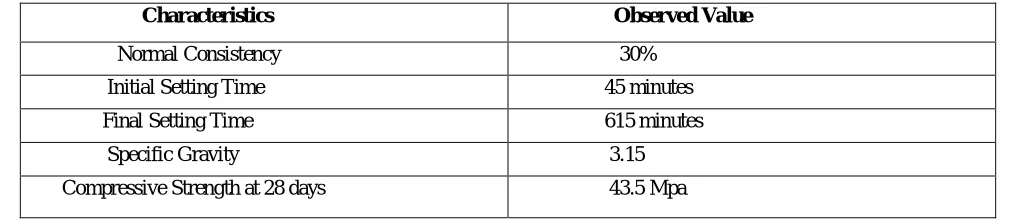
1) Cement: Ordinary Portland Cement of 43 grades manufactured by Shree Ultratech Cement was used throughout the Experimental investigation. The quality of the cement was confirmed as per IS 4031-1988 and all the quality tests were
[image:4.612.52.558.560.672.2]conducted conforming to the specifications of 12269-1987.Results of the various test are Tabulated in Table 1
Table 1: Physical Properties of Ordinary Portland cement:
Characteristics Observed Value
Normal Consistency 30%
Initial Setting Time 45 minutes
Final Setting Time 615 minutes
Specific Gravity 3.15
Compressive Strength at 28 days 43.5 Mpa
B. Fine Aggregate
The Fine Aggregate used was locally available coarse Sand. The test procedure as per IS 383: 1970 was carried out to determine the
Technology (IJRASET)
[image:5.612.55.559.89.173.2]©IJRASET: All Rights are Reserved
1468
Table 2: Physical Properties of Fine Aggregate:
Characteristics Observed Value
Grade Zone III
Fineness Modulus 2.26
Specific Gravity 2.62
Silt Content 1.67%
C. Coarse Aggregate
The Coarse Aggregate used was locally available. The test procedure as per IS 383: 1970 was carried out to determine the properties
[image:5.612.159.455.392.541.2]of Coarse aggregate. The Results of the various test are tabulated in Table 3
Table 3: Physical Properties of Coarse Aggregate:
Characteristics Observed Value
Fineness modulus 6.916
Specific Gravity 2.637
Water Absorption 0.408%
D. Copper Slag
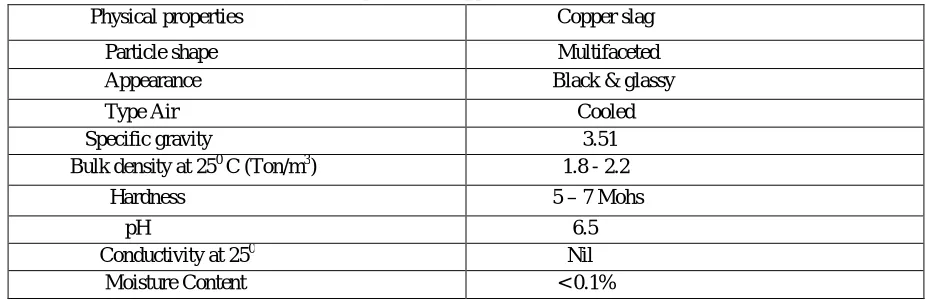
Copper slag used in this study was brought from Taj Abrasive Industries. Physical and Chemical Properties of copper slag Used in
the Study Are Tabulated in Table 4 and 5.Copper Slag used in the Experiment is shown in Figure 1
Figure 1: Copper slag Used in Experiment
Table 4: Physical Properties of Copper Slag (Source: Taj Abrasive Industries)
Physical properties Copper slag
Particle shape Multifaceted
Appearance Black & glassy
Type Air Cooled
Specific gravity 3.51
Bulk density at 250 C (Ton/m3) 1.8 - 2.2
Hardness 5 – 7 Mohs
pH 6.5
Conductivity at 250 Nil
[image:5.612.73.536.565.715.2]Technology (IJRASET)
[image:6.612.98.513.256.332.2]©IJRASET: All Rights are Reserved
1469
Table 5: Chemical Properties of Copper Slag Source: (Taj Abrasive Industries)
Chemical component % of Chemical component
SiO2 33-35 %
Fe2O3 40-44%
Al2O3 4-6%
CaO 0.8-1.5%
MgO 1-2%
E. Chemical Admixture
Chemical Admixtures (CICO PLAST SUPER-HS @1.5%) are materials in the form of fluids that are added to the concrete to give it
[image:6.612.61.547.408.480.2]certain characteristics not obtainable with plain concrete mixes. Properties of CICO PLAST SUPER-HS are Tabulated in Table 6
Table 6: Properties of admixture
Characteristics CICO PLAST SUPER-HS
Specific Gravity 1.14
Role in Concrete Improves workability & flow properties,
Produces concrete of very high strength
F. Mix Design
As per the Code Book IS: 10262 -2009, the mix design was done for M40 grade mix and the amount of materials was calculated. Table 7 gives the quantities required for M40 grade of concrete Mix.
Table 7: Mix design and proportion of M40 grade concrete.
Grade Cement
(Kg/m3)
F. A (kg/m3) C. A (kg/m3) Water
(Kg/m3)
W/C Ratio Admixture
(kg/m3)
Mix Proportion
M40 431.17 625.2 1121.05 172.46 0.4 6.46 1:1.45:2.6
G. Mixes
In this study, various mixes were prepared by adding Copper Slag in different volume fraction (0%, 10%, 20%, 30%, 40% and 50%). Table-8 gives the quantity required for various mixes.
Table 8: Concrete mix details. % Replacement Cement (Kg) Fine Aggregate (kg) Copper slag (Kg) Coarse Aggregate (Kg) Water (W/C = 0.4) (kg) Admixture(gm)
0 23.76 34.45 0 61.78 9.5 356
10 23.76 31 3.45 61.78 9.5 356
20 23.76 27.56 6.89 61.78 9.5 356
30 23.76 24.12 10.33 61.78 9.5 356
40 23.76 20.67 13.78 61.78 9.5 356
[image:6.612.59.552.555.718.2]Technology (IJRASET)
©IJRASET: All Rights are Reserved
1470
IV. DISCUSSION OF RESULT
A. Compressive Strength Test Results
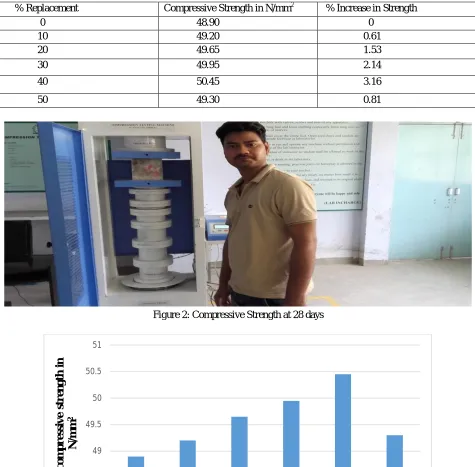
The results in Table-9 show the compressive strength of M40 grade concrete with varying Copper slag at 28 days. The percentage change in strength with respect to normal concrete at 28 days is graphically plotted. Figure 2 shows the testing various Samples of copper slag.
Table 9: Compressive Strength of concrete at 28 days
% Replacement Compressive Strength in N/mm2 % Increase in Strength
0 48.90 0
10 49.20 0.61
20 49.65 1.53
30 49.95 2.14
40 50.45 3.16
[image:7.612.68.543.166.633.2]50 49.30 0.81
Figure 2: Compressive Strength at 28 days
48 48.5 49 49.5 50 50.5 51
0 10 20 30 40 50
28
d
a
ys
c
om
p
re
ss
ive
s
tr
en
gt
h
i
n
N
/m
m
2
Technology (IJRASET)
©IJRASET: All Rights are Reserved
1471
B. Split Tensile Strength Test Results
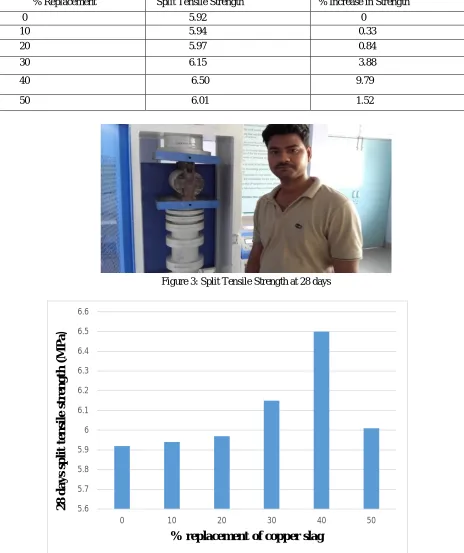
[image:8.612.78.542.159.712.2]The results in Table-10 show the split tensile strength of M40 grade concrete with varying percentage of copper slag at 28 days Along with split tensile strength, the percentage change in split tensile strength with respect to normal concrete is plotted. Figure 3 shows the testing Various Samples for Split Tensile Strength.
Table 10: Split Tensile Strength of concrete at 28 days
% Replacement Split Tensile Strength % Increase in Strength
0 5.92 0
10 5.94 0.33
20 5.97 0.84
30 6.15 3.88
40 6.50 9.79
[image:8.612.124.486.444.713.2]50 6.01 1.52
Figure 3: Split Tensile Strength at 28 days
5.6 5.7 5.8 5.9 6 6.1 6.2 6.3 6.4 6.5 6.6
0 10 20 30 40 50
28
d
ays
s
p
li
t
te
n
si
le
s
tr
en
gt
h
(
M
P
a
)
Technology (IJRASET)
©IJRASET: All Rights are Reserved
1472
C. Flexural Strength Test Results
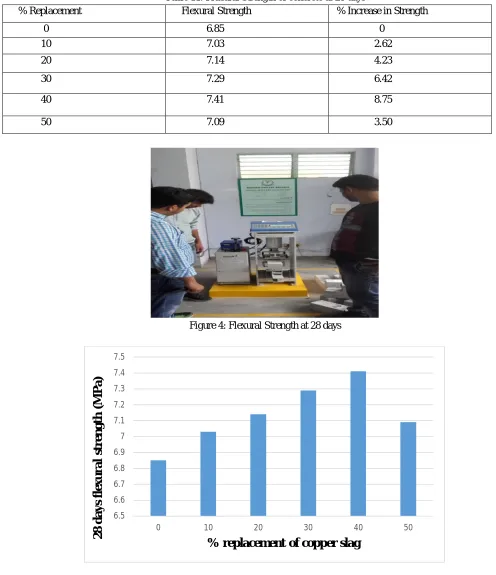
[image:9.612.59.555.150.725.2]The results in Table-11 show the Flexural strength of M40 grade concrete with varying percentage of copper slag at 28 days Along with Flexural strength, the percentage change in Flexural strength with respect to normal concrete is plotted. Figure 4 shows the testing of flexural strength.
Table 11: Flexural Strength of concrete at 28 days
% Replacement Flexural Strength % Increase in Strength
0 6.85 0
10 7.03 2.62
20 7.14 4.23
30 7.29 6.42
40 7.41 8.75
[image:9.612.145.503.491.710.2]50 7.09 3.50
Figure 4: Flexural Strength at 28 days
6.5 6.6 6.7 6.8 6.9 7 7.1 7.2 7.3 7.4 7.5
0 10 20 30 40 50
28
d
ays
f
le
x
u
ral
s
tr
en
gt
h
(
M
P
a)
Technology (IJRASET)
©IJRASET: All Rights are Reserved
1473
Combined graph of Copper Slag Replacement
V. CONCLUSION
From the experimental investigations conducted, the following are the conclusions drawn.
A. Copper slag is a suitable material for replacement of fine aggregate in concrete.
B. Copper slag concrete showed considerable increase in strength when used with in permissible quantities.
C. The maximum strength was achieved for 40 % replacement of fine aggregate with copper slag. Further addition of copper slag
reduces the strength.
D. Compressive Strength was increased by 3.16% when compared to Nominal mix for 40% replacement of fine aggregate with
Copper Slag.
E. Split tensile Strength was increased by 9.79% when compared to Nominal mix for 40% replacement of Copper Slag.
F. Flexural Strength was increased by 8.75% when Compared to Nominal mix for 40% Replacement of Copper Slag,
G. Copper Slag has a potential to provide as an alternative to fine aggregate up to 40% and helps in maintaining the environmental
as well as economical balance.
REFERENCES
[1] Naganur, B. A. Effect of Copper Slag as a Partial Replacement of Fine Aggregate on the Properties of Cement Concrete. International Journal of Research (IJR) Vol-1, Issue-8, September 2014.
[2] Rose, D. A. Performance of Copper Slag on Strength and Durability Properties as Partial Replacement of Fine Aggregate in Concrete. International Journal of Emerging Technology and Advanced Engineering, 5(1), 434-437, 2015.
[3] Srinivasu, K. A study on compressive strength properties and effects of copper slag as partial replacement of fine aggregate in concrete. ELK Asia Pacific Journals.
[4] Zerdi, T. A. Experimental Investigation on Properties of Concrete by Replacement Copper Slag for Fine Aggregate. Global journal for research analysis, 5(5), 67-69, 2016.
[5] Singh, H. Use of copper slag as fine aggregate ‐ A case study. International journal of innovations in engineering research and technology,2(5), 1-7, 2015. [6] Patil, M. V. Performance of Copper Slag as Sand Replacement in Concrete. International Journal of Applied Engineering Research, 11(6),4349-4353, 2016. [7] Arivalagan.S. (2013). Experimental Study on the Flexural Behavior of Reinforced Concrete Beams as Replacement of Copper Slag as Fine
Aggregate. Journal of Civil Engineering and Urbanism, 3(4), .176-182
[8] M.Maheswari, M. (2016). Mechanical and Durability Properties of RC Beams Using Copper Slag as Fine Aggregate in Concrete. International Research Journal of Engineering and Technology, 3(3)
[9] Madhavi,T.C. Effect of Copper Slag on the Mechanical Strengths of Concrete. International Journal of ChemTech Research, 8(12), 442-449,2015. [10] Nataraja, M. C. Concrete mix design using copper slag as fine aggregate. International journal of civil engineering, 5(9), 90-99, 2014.
[11] Shi, C. Utilization of copper slag in cement and concrete. Resources, Conservation and Recycling, 52, 1115–1120, 2008
[12] Shyam, Abdullah, Aqeel Ahmad, Effect of Copper Slag as Partial Replacement of Fine Aggregate in Concrete: A Literature Review. International Journal of Innovative Research in Science, Engineering and Technology. Vol. 5, Issue 12, 20786-20789, December 2016.
[13] IS 8112 (1989): Specification for 43 grade Ordinary Portland cement [ CED 2: Cement and Concrete] [14] IS 383 (1970): Specification for Coarse and fine Aggregate from Natural Sources for Concrete [ CED 2: Cement and Concrete]
0 10 20 30 40 50 60
0 10 20 30 40 50
Chart Title
Technology (IJRASET)
©IJRASET: All Rights are Reserved
1474
[15] IS 9103 (1999): Specifications for concrete for admixtures - [ CED 2: Cement and Concrete] [16] IS 456 (2000): Plain and Reinforced Concrete – Code of practice [ CED 2: Cement and Concrete]
[17] IS 2386-1 (1963): Methods of Test of Aggregates for Concrete, Part I: Particle Size and Shape [ CED 2: Cement and Concrete] [18] IS 10262 (2009) Indian Recommended guidelines for concrete mix design.
BIOGRAPHY
Abhinav Shyam Was born in 1992 in Lucknow City, U.P. India. He received his Bachelor of Technology degree in Civil Engineering from Integral University, Lucknow, in 2014. Currently he is pursuing Master’s Degree in Structural
Engineering from Integral University, Lucknow. He was formerly working as an Assistant Professor in GNITM Barabanki U.P.He
has authored numerous research papers in National and International Journals/Conferences
Abdullah Anwar was born in 1988 in Gorakhpur city, Uttar Pradesh. He received his Bachelor of Technology degree in Civil Engineering from U.P.T.U, Lucknow, in 2012. In 2016 he received his Master's Degree in Structural Engineering from Integral University, Lucknow. Presently he is Assistant Professor, in Department of Civil Engineering at Integral University, Lucknow. He has authored numerous research papers in National and International Journals/Conferences. He has also presented research papers in Conferences/Seminars. He has also been awarded the “Research Excellence Award-2017” for his work in the area of Soil Liquefaction. He is also an Associate Member of Institution of Engineer’s (AM-IE), American Society of Civil Engineer’s (AM-ASCE) and Indian Geotechnical Society-Delhi Chapter (AM-IGC).