
M E T H O D
Open Access
Effectively identifying regulatory hotspots
while capturing expression heterogeneity in
gene expression studies
Jong Wha J Joo
1, Jae Hoon Sul
2, Buhm Han
3,4, Chun Ye
5and Eleazar Eskin
1,2,6*Abstract
Expression quantitative trait loci (eQTL) mapping is a tool that can systematically identify genetic variation affecting gene expression. eQTL mapping studies have shown that certain genomic locations, referred to as regulatory hotspots, may affect the expression levels of many genes. Recently, studies have shown that various confounding factors may induce spurious regulatory hotspots. Here, we introduce a novel statistical method that effectively eliminates spurious hotspots while retaining genuine hotspots. Applied to simulated and real datasets, we validate that our method achieves greater sensitivity while retaining low false discovery rates compared to previous methods.
Background
Expression quantitative trait loci (eQTL) mapping is an approach linking genetic variation to gene expression to identify genomic loci containing gene expression modula-tors. An interesting observation in previous eQTL studies is that expression levels of thousands of genes may be affected by genetic variation at a single location called a regulatory hotspot. Although some of the identified reg-ulatory hotspots correspond to genetic variants that truly govern expression of many genes, it has been recently reported that spurious hotspots that do not have genetic effects on genes may appear due to confounding fac-tors such as batch effects. In this paper, we introduce a novel statistical method that effectively eliminates spuri-ous regulatory hotspots while retaining genuine hotspots resulting from true genetic effects.
Understanding the relationship between genetic varia-tion and gene regulavaria-tion has recently received significant interest. The most common approach for studying this relationship is through eQTL, where both genetic varia-tion and expression levels are collected from a set of indi-viduals and associations between genetic variation and expression are estimated [1-9]. Any identified association,
*Correspondence: [email protected]
1Bioinformatics IDP, University of California, Los Angeles, CA, USA
2Computer Science Department, University of California, Los Angeles, CA, USA Full list of author information is available at the end of the article
or eQTL, suggests the presence of a region harboring genetic variation that affects expression levels.
In eQTL mapping, two types of eQTLs are analyzed: cis-eQTLs that are in close proximity to the gene locus
and trans-eQTLs that occur at greater distances from
the gene locus [10]. Previous eQTL studies for multiple organisms [2-4,6] have shown that many genes are trans-regulated by a small number of genomic regions, known as ‘regulatory hotspots’. Although several eQTL studies have successfully identified regulatory hotspots [11-13], it has been reported in studies of recombinant inbred mice that regulatory hotspots replicate poorly [14]. Previ-ous studies have discovered that these regulatory hotspots are spurious associations caused by various confounding factors, such as batch effects or other technical artifacts, which induce noise during sample preparation or expres-sion measurements [15-17]. Confounding factors create heterogeneity in expression data and may induce spurious associations between SNPs and gene expressions, leading to the identification of ‘spurious regulatory hotspots’ [18]. In these spurious hotspots, SNPs appear to be associated with gene expression levels, although they do not have genetic effects on the genes.
Several computational methods have been developed to correct for confounding effects using various statistical methods such as singular value decomposition or linear mixed models [18-21]. The main assumption behind most of these methods is that the confounding factors influence
Jooet al. Genome Biology2014,15:r61 Page 2 of 15 http://genomebiology.com/2014/15/4/r61
the global correlation structure between the gene expres-sion values. Hence, the methods, such as Intersample Correlation Emended (ICE) [18] and SVA [19], attempt to estimate the global correlation structure and use it as a covariate in the association to remove confound-ing effects from the association statistic. Although these methods effectively remove spurious regulatory hotspots, they may also remove true hotspots caused by genetic factors. This is because the global correlation structure contains genetic effects, so by correcting for the global structure, genetic effects are removed as well. For exam-ple, in a well-studied yeast dataset, several hotspots are known to be true genetic effects since they have been val-idated by additional data such as protein measurements [22,23]. Unfortunately, these hotspots are removed in addition to the spurious ones. Other methods [20,21] also do not explicitly remove true genetic signals and either eliminated true hotspots or failed to remove spurious hotspots in our experiments.
In this paper, we introduce a new method called Next-generation Intersample Correlation Emended (NICE) eQTL mapping, which attempts to eliminate spurious regulatory hotspots while retaining hotspots caused by genetic effects by utilizing a novel statistical framework. Our method leverages an insight that confounding fac-tors affect the majority of genes, while genetic effects only affect a subset. This insight allows us to distin-guish between confounding and genetic effects. We used a recently developed statistic [24] to differentiate between genes that are affected by both genetic effects and con-founding effects versus genes that are affected by only confounding effects. Using genes only affected by con-founding, we are able to correct for the confounding effects but preserve the genetic effects. We first show by simulations that NICE successfully eliminates spurious regulatory hotspots while preserving regulatory hotspots corresponding to real genetic effects. On the other hand, previous methods either fail to eliminate confounding effects or fail to retain the genetic effects.
We demonstrated the utility of NICE with a yeast dataset. Versions of a yeast dataset were generated in 2005 [2] and 2008 [25]. Since they were generated 3 years apart in different locations, the hotspots that are shared between the datasets are likely to be the real genetic effects, while hotspots that are different between the datasets are likely to be spurious hotspots. We used our method on only the first dataset to see if we could discriminate between which hotspots are real and spu-rious as determined by the second dataset. Applied to the yeast dataset, NICE identified 83% (sensitivity) of the putative regulatory hotspots that are consistent between the two versions of the yeast dataset. Previous methods applied to this dataset either eliminated many of the puta-tive hotspots or predicted many spurious hotspots. In
addition, NICE eQTL mapping identified either more or a comparable number ofcisassociations relative to pre-vious methods. Furthermore, applied to a yeast dataset grown in different conditions, NICE identified genes that are related to gene–environment interactions and discov-ered novel yeast regulatory hotspots that are likely to have a true biological mechanism.
Results
NICE eQTL mapping
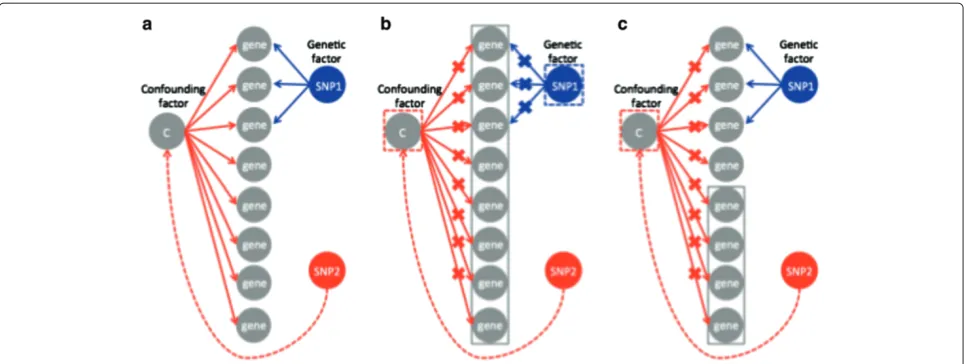
Our goal was to identify true genetic associations in an eQTL mapping study without predicting spurious associ-ations due to confounding factors. Consistent with previ-ous approaches that correct for the confounding factors based on singular value decomposition or linear mixed models, we assumed that the confounding factors affect the global correlation structure of expressions. That is, we assumed that confounding factors affect the expres-sion levels of most of the genes. On the other hand, we assumed that genetic factors only affect the expression levels of a subset of the genes related to the regulatory pathways. Figure 1(a) shows a graphical model that con-tains both genetic and spurious associations due to a confounding factor. SNP 1 has a genetic effect on multiple genes and thus, is a regulatory hotspot. Unlike SNP 1, SNP 2 has no direct genetic effects on any of the genes. How-ever, SNP 2 has spurious associations with many of the genes because, by chance, it happens to be correlated with the confounder and this results in a spurious regulatory hotspot.
To eliminate spurious associations, ICE [18] models the confounding effects by estimating the global correlation structure of the expression levels of all genes and uses this structure as a covariate in the association statistic. This has the same effect as if the confounding factor itself is included as a covariate in the association statistic, remov-ing its effect. Unfortunately, any regulatory hotspots, as in the case of the first three genes of Figure 1(b), will also be captured in the global correlation structure and be eliminated. For this reason, ICE [18] tends to elimi-nate true regulatory hotspots in addition to confounding effects.
Figure 1GraphicalFigures: format model of ICE and NICE with correction for confounding effects.(a)Genetic and spurious associations. SNP 1 has a genetic effect on the first three genes (blue arrows). SNP 2 has no genetic effect on any of the genes; however, it has spurious associations with many of the genes, because, by chance, it happens to be correlated with a confounding factor (red arrows).(b)ICE [18] models the confounding effects by estimating the global correlation structure of the expression levels of all genes (gray block). However, this eliminates genetic associations in addition to confounding effects since any regulatory hotspots, such as the first three genes, will also be captured in the global correlation structure and be eliminated.(c)NICE uses only a subset of genes to model the global correlation structure between expression levels used to correct for confounding factors. Since any subset of genes will capture the confounding effects, by using the bottom four genes (gray block) we can eliminate the confounding effects but preserve the genetic effects.
SNP, single nucleotide polymorphism.
the regulatory hotspots, which complicates the choice of which genes to use to correct for the confounding. Practi-cally, almost all genes are affected by confounding effects while only some genes have both confounding and genetic effects. We expect this second group of genes to show stronger associations than the others. Thus we use the weakly associated genes to model the confounding factors. For example, in Figure 1(c), by using the four most weakly associated genes, we can correct for the confounding effects but preserve the genetic effects.
NICE eliminates spurious regulatory hotspots while preserving true genetic effects
To validate that our method eliminates spurious regula-tory hotspots while preserving regularegula-tory hotspots corre-sponding to real genetic effects, we generated a simulated dataset with both true regulatory hotspots and a batch effect that creates spurious hotspots. We created a dataset that has 100 samples with 1,000 SNPs and 1,000 gene expression levels. We added fivetrans-regulatory hotspots andciseffects. For each of thetrans-regulatory hotspots, 20% of the genes havetranseffects. SNPs were randomly generated with minor allele frequencies of 30%. A batch effect was simulated where expression levels in the first half of the samples were correlated with each other, but not correlated with the second half of the samples, and vice versa.
We visualized the results of the eQTL study with an eQTL plot such as those shown in Figure 2. Thex-axis
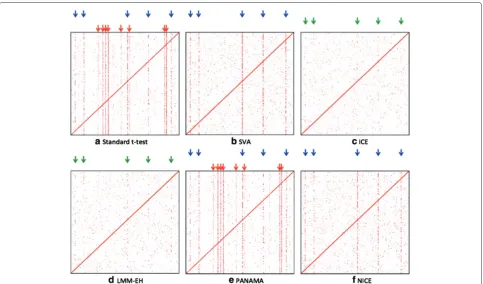
corresponds to SNP positions and they-axis corresponds to the gene positions. The intensity of a point on the plot represents the significance of the association. The diagonal band represents the cis effects and the verti-cal bands represent hotspots. On the eQTL plot, we mark successfully identified regulatory hotspots with blue arrows, missed regulatory hotspot with green arrows and spurious hotspots with red arrows. In the simu-lated data, the eQTL plot has five regulatory hotspots (Figure 2(a), blue arrows) and eight spurious hotspots (Figure 2(a), red arrows) induced by the batch effect we simulated.
Jooet al. Genome Biology2014,15:r61 Page 4 of 15 http://genomebiology.com/2014/15/4/r61
Figure 2eQTL maps for different methods applied to the simulated data.Thex-axis corresponds to SNP positions and they-axis corresponds to the gene positions. The intensity of a point on the plot represents the significance of the association. The diagonal band represents theciseffects and the vertical bands represent hotspots. Blue arrows show the locations of real genetic regulatory hotspots, green arrows indicate missing hotspots and red arrows show spurious hotspots. The eQTL map for the standardt-test(a), SVA(b), ICE(c), LMM-EH(d), PANAMA(e)and NICE(f)are shown.
results are summarized in Table 1. Given the number of real (R), missing (M) and spurious (S) hotspots iden-tified, we calculated the sensitivity and false discovery rate (FDR) as R/(R + M) and S/(R + S), respectively. All methods successfully identified cis effects. We fur-ther studied the test statistics of P values by estimating the genomic control inflation factorλ[26] to check if the P values are either inflated (λ > 1 ) or deflated (λ <
1). Figure 3 shows λ, which is defined as 1 −λ. The
λ values of SVA and NICE are close to zero. On the other hand, the standardt-test and PANAMA show infla-tion (λ > 0) and ICE and LMM-EH show deflation (λ <0).
NICE eliminates spurious hotspots while preserving genetic hotspots for a yeast dataset
We took advantage of a unique dataset consisting of two versions of a yeast dataset generated in 2005 [2] and 2008 [25] to validate our method. The two datasets contain sim-ilar strains, but were generated 3 years apart in different locations. For this reason, the hotspots that are shared between the datasets are likely real genetic effects, while hotspots that are different between the datasets may be spurious hotspots caused by technical confounding fac-tors present at the time of generation of the datasets. In addition, some of these hotspots were further validated by other experimental data such as protein levels [22,23].
Table 1 Number of real, missing and spurious hotspots identified by different methods applied to simulated data
Method Real hotspots Missing hotspots Spurious hotspots Sensitivity False discovery rate
t-test 5 0 8 1.0 0.62
SVA 5 0 0 1.0 0
ICE 0 5 0 0 N/A
LMM-EH 0 5 0 0 N/A
PANAMA 5 0 8 1.0 0.62
NICE 5 0 0 1.0 0
[image:4.595.57.539.622.724.2]Figure 3Inflation factors for different methods for simulated data.λis defined as 1−λ.
To determine which hotspots in the two datasets are regulatory hotspots due to genetic effects, we used the fol-lowing approach. We first computed a P value for each gene-SNP pair in both datasets using the standardt-test (Figure 4(a),(b)). We then merged thePvalues of the two datasets by taking a maximumP value between the two (Figure 4(c)). The idea is that associations due to true genetic effects are likely to have significant P values in both datasets while associations due to the confound-ing effects tend to have a significantP value in only one of the datasets. Thus, by taking the maximum P value, we can identify the associations that are significant in both datasets. From the merged P values of the two datasets, we identified the top 12 hotspots in terms of their association strength, and considered them as ‘puta-tive hotspots’. We are interested in the number of hotspots each method recovers from these putative hotspots. The 2008 dataset is of higher quality than the 2005 dataset
since it uses a newer version of the array technology. We verified the relative quality of the datasets by compar-ing the number ofcis-eQTLs identified in each dataset, which demonstrates that the 2008 dataset is of higher quality. For this reason, we expected that all hotspots orig-inally found in the 2005 dataset that are true effects will be found in the 2008 dataset. Thus hotspots identified in the 2005 dataset but not in the 2008 dataset are likely spurious.
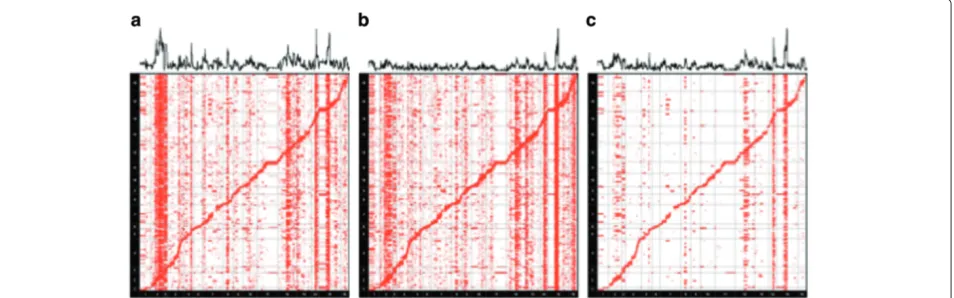
We measured the presence of a hotspot by computing the sum of the logPvalues of all of associations of a sin-gle marker with the expression level of each gene. This measure, called the hotspot level, identifies hotspots since it captures which SNPs are associated with many gene expression levels. We visualize the hotspot level at the top of our eQTL plots (Figure 4). We used the hotspot level to identify the putative hotspots from the mergedPvalues of the two datasets (blue asterisks in Figure 5(a)).
Figure 4eQTL maps of two versions of a yeast dataset that were generated 3 years apart in different locations.The standardt-test was used to generate thePvalues.(a)eQTL map of the yeast dataset generated in 2005 [2].(b)eQTL map of the yeast dataset generated in 2008 [25].
[image:5.595.64.541.534.683.2]Jooet al. Genome Biology2014,15:r61 Page 6 of 15 http://genomebiology.com/2014/15/4/r61
Figure 5Putative, missing and spurious hotspots for the methods applied to the yeast dataset generated in 2005 [2].(a)The average over all genes of the−log of the maximumPvalue of the two yeast datasets for each SNP.(b)-(g)The average over all genes of the−logPvalue for each SNP for several methods: the standardt-test, SVA, ICE, LMM-EH, PANAMA and NICE. Blue asterisks show putative genetic regulatory hotspots predicted from the merged dataset, green arrows show missing hotspots and red arrows show spurious hotspots identified by each method. Red horizontal lines show thresholds used to select significant peaks, which are two standard deviations above the mean. Note that thet-test has a distinct advantage in this evaluation becausePvalues from thet-test were used to determine the putative regulatory hotspots.
Our goal in this experiment was to identify the true regulatory hotspots and eliminate the spurious hotspots using the 2005 yeast dataset [2]. We applied each approach to the 2005 data and evaluated the results using knowl-edge of which hotspots are true hotspots obtained using both the 2005 and the 2008 datasets [2,25]. We computed the hotspot levels for the following methods: the
stan-dard t-test, SVA, ICE, LMM-EH, PANAMA and NICE
(Figure 5). We have annotated the results for each method with blue asterisks, and green and red arrows, which indi-cate putative genetic regulatory hotspots predicted from the P values of merged datasets, missing hotspots and false positive hotspots, respectively. The results show that our method identified all but two of the putative hotspots while only predicting one spurious hotspot (Figure 5(g)). ICE and LMM-EH made several false positive predictions
and SVA, LMM-EH and PANAMA missed many hotspots (Figure 5(c) to (f )). We note that the t-test has a dis-tinct advantage in this evaluation becausePvalues from
the t-test were used to determine the gold standard
(Figure 5(b)) and it is inappropriate to evaluate thet-test in terms of sensitivity and FDR estimated from the gold standard. Table 2 summarizes the results.
Table 2 The number of putative, missing and spurious hotspots for the 2005 yeast data [2]
Method Putative hotspots Missing hotspots Spurious hotspots Sensitivity False discovery rate
t-test 9 3 0 0.75 0
SVA 5 7 0 0.42 0
ICE 8 4 3 0.67 0.27
LMM-EH 2 10 5 0.17 0.71
PANAMA 5 7 0 0.42 0
NICE 10 2 1 0.83 0.09
curve, showing the sensitivity and the number of spuri-ous hotspots for different thresholds. The x-axis shows the number of spurious hotspots and they-axis shows the sensitivity. For different thresholds, NICE performed the best.
Figure 7 shows the inflation factors for the methods. The standardt-test, SVA and PANAMA show inflation. NICE shows deflation but not as much as ICE and is comparable to LMM-EH. Additional file 1: Figure S1 and Additional file 2: Table S1 show the results of the same analysis from the point of view of analyzing the 2008 data and comparing the hotspots found in the intersec-tion of the 2005 and 2008 datasets. We note that NICE discovered several additional hotspots not identified in the 2005 data, which is expected because the 2008 data is of higher quality in general. Below we show that sev-eral of these additional hotspots are likely real genetic effects.
Consistent with previous analyses [18,20,21], to com-pare the statistical power of the methods, we comcom-pared the number of cis associations reported by the differ-ent methods (Figure 8). NICE was able to iddiffer-entify more cisassociations than thet-test, SVA, ICE or PANAMA, and identified a comparable number ofcis associations as LMM-EH. This suggest that NICE is not only able to
identify true regulatory hotspots but also increases the general sensitivity of the eQTL detection.
NICE discovered novel yeast regulatory hotspots
We reanalyzed the 2008 yeast dataset described above using NICE to demonstrate the utility of our approach. The dataset contains expression levels for yeast strains grown in both glucose and ethanol media. In our exper-iments above, we compared the consistency between the 2005 data and the 2008 data both for yeast grown in glucose. Here we analyzed both conditions in the 2008 data to identify both hotspots in each condition as well as hotspots involved in gene–environment interactions consistent with the previous analyses of this data [25]. To be consistent with the previous analyses, we utilized the method for determining the presence of a hotspot defined in Smith and Kruglyak instead of the metric we used above [25]. We began by dividing the yeast genome into 611 20-kb bins. For each bin, we counted the num-ber of significant trans linkages in the bin. Assuming a Poisson process, the number of expected linkages in each bin is the ratio between the number of trans linkages and the number of bins. For simplicity, we used the top 3,000transassociations identified by each method yield-ingλ= 4.9. After adjusting for the number of bins using
Figure 6Sensitivity and the number of spurious hotspots for different thresholds applied to the yeast dataset generated in 2005 [2].The
[image:7.595.59.541.531.693.2]Jooet al. Genome Biology2014,15:r61 Page 8 of 15 http://genomebiology.com/2014/15/4/r61
Figure 7Inflation factors for different methods for the yeast dataset generated in 2005 [2].λis defined as 1−λ. FDR, false discovery rate; kb, kilobase.
a Bonferroni correction, a bin was considered to have sta-tistically significance (P < 0.05) if it has>13 linkages. When we identified significant linkages using a P value cutoff (P < 5 × 10⁻⁵), we achieved almost the same result.
To compare the regulatory hotspots found by various methods, we first defined 11 putative regulatory hotspots from a collection of independent experiments using the same parental strains grown in glucose [1,27] (Additional file 3: Table S2). Some of these hotspots were expected because of deletions in one of the strains including a hotspot at Chr3:90000 for LEU2 and a hotspot at chr5:110000 for URA3.
We first analyzed the glucose data from Smith and Kruglyak [25]. Table 3 shows the number of known hotspots captured by each method. We see that both the t-test and NICE captured nine of the putative regula-tory hotspots while ICE captured only eight. Both NICE
and ICE captured many more hotspots than the t-test and we wanted to know whether these were spurious or real. We analyzed the 2005 dataset using the same defini-tion of regulatory hotspots as in Smith and Kruglyak [25] and found that 2 / 5, 5 / 14 and 8 / 17 of the additional hotspots found by thet-test, ICE and NICE, respectively, were replicated. Those additional hotspots that do not overlap with the 2005 dataset could be specific to the 2008 experiment so we further compared them to the ethanol dataset. We found that 3 / 5, 13 / 14 and 15 / 17 of the additional hotspots found by the t-test, ICE and NICE, respectively, were replicated in the ethanol experiment. These two results suggest that not only does NICE control for spurious regulatory hotspots, it also discovers more regulatory hotspots that are likely to have a true biological mechanism.
One of the additional hotspots NICE found to be shared between ethanol and glucose is at Chr7:380000. However,
[image:8.595.57.542.541.710.2]Table 3 The number of putative, missing and additional hotspots for the 2008 yeast dataset grown in glucose media [25]
Method Putative Missing Additional Glucose shared Ethanol shared
t-test 9 2 5 2 3
ICE 8 3 14 5 13
NICE 9 2 17 8 15
The last two columns show the number of glucose-shared and ethanol-shared hotspots for the additional hotspots compared to the glucose dataset generated in 2005 [2] and the ethanol dataset generated in 2008 [25].
from thet-test results, this hotspot appears to be ethanol specific. We further confirmed that this hotspot was also found by NICE for the 2005 data, suggesting that it is likely to be a real hotspot that is not condition specific. The two possible candidate genes are RPB9 and MNP1 since the regulatory hotspot is linked incisto the expres-sion of both of these genes at P values of 6.8 × 10⁻⁶ and 2.2×10⁻⁴, respectively. RPB9 is a RNA polymerase II subunit that is crucial for transcription fidelity while MNP1 is a putative mitochondrial ribosomal protein that is required for respiratory growth. NICE also found an additional hotspot at Chr14:1360000 for the glucose data from both 2005 and 2008, but which is absent from the ethanol data suggesting that it is a glucose-specific hotspot. The t-test did not find this hotspot for either glucose dataset. The closest gene is APT2, which is an apparent pseudogene that is not expressed in normal con-ditions. Interestingly, with our data, we found a strong association between Chr14:1360000 and APT2 in cisat P = 2.3 × 10⁻¹⁷, suggesting that this gene might be functional in a glucose-dependent way.
Discussion
In this paper, we present a novel approach, NICE, for iden-tifying true genetic regulatory hotspots while eliminating spurious hotspots caused by confounding factors. We leveraged the insight that confounding factors are likely to affect the majority of genes, while genetic effects are likely to affect only a smaller subset. This insight allowed our approach to distinguish between true and spurious regulatory hotspots. Our approach is related to previous methods that correct for confounding factors, such as ICE or SVA, which model the global correlation structure and use this structure to correct the association statistics to eliminate the effect of any confounding factors affecting the association statistic. NICE uses only a subset of genes predicted not to be part of the true genetic hotspot to model the global correlation structure between expression levels to correct for confounding factors, which eliminates the confounding factors but preserves true hotspots. We compared several previous approaches [18-21] with both simulated and real datasets, and demonstrated that our method achieved higher or comparable statistical power when identifying associations while correcting for con-founding factors.
While our approach, NICE, extends the mixed model approach that ICE [18] used, in principle, the basic idea behind our approach can be applied to other approaches for correcting for expression heterogeneity such as the SVA approach based on singular value decomposition [19]. In this method, for each SNP, a separate singular value decomposition would be computed only taking into account genes that are predicted not to be part of a genetic hotspot. Similarly, the techniques used in LMM-EH [20] can also be adapted in this framework to incorporate multiple variance components to correct for population structure and also correct for bias in estimating the global correlation structure in the presence of population struc-ture.
Our method is based on the assumption that confound-ing factors are likely to affect the majority of genes, while genetic effects are likely to affect only a subset of the genes. While our approach is an improvement over cur-rent methods, in some cases this assumption may be vio-lated, for example, slightly different growth temperatures between batches may result in a specific subset of genes being differentially expressed (e.g. heat shock, cell cycle regulators, etc.). In these cases, our approach would be unable to distinguish those confounding effects from real genetic effects. An additional challenge in eQTL studies is correcting for multiple testing. Possible approaches for multiple testing correction are applying permutation tests or FDRs. Unfortunately, when confounding is present, the confounding causes a violation of the basic assump-tion necessary for these approaches, which is that the individuals in the sample are independent and identically distributed. Shared confounding factors induces complex dependencies among the gene expression patterns of indi-viduals and complicates multiple testing. How to correct for multiple testing in the presence of confounding is a fundamental problem and a promising avenue of future work, which is beyond the scope of this paper.
Conclusions
Jooet al. Genome Biology2014,15:r61 Page 10 of 15 http://genomebiology.com/2014/15/4/r61
data where the locations of true genetic hotspots are known through concordance between replicated datasets. Our method achieves greater sensitivity (83%) in detect-ing concordant hotspots compared to previous methods while retaining a low false discovery rate. In addition to detecting regulatory hotspots, our method identi-fies more or a comparable number of cis-eQTLs than other methods. We further apply our method to yeast data grown in different conditions to identify gene-by-environment interactions and show that our method dis-covers novel yeast regulatory hotspots that are likely to have a true biological mechanism.
Materials and methods Generative model
We assume the following linear mixed model as the gen-erative model of the expression levels,
Y=μ+Xβ+u+e (1)
Letnbe the number of individuals,mthe number of genes andlthe number of SNPs.Y is ann×mmatrix of the gene expression values,μis ann×lmatrix of the means of expression levels of individuals,Xis ann×lmatrix with SNPs encoded by 0 and 1 for haploid and 0, 1 and 2 for diploid,βis anl×mmatrix for their coefficients, andu andearen×mmatrices with multivariate normal random variables sampled fromN(0,σg2H)andN(0,σe2I) account-ing for the confoundaccount-ing effects and random errors. Here, His ann×ncovariance matrix that explains the intersam-ple correlation structure induced by confounders andIis ann×nidentity matrix.σg2andσe2are coefficients of the two variance components.
eQTL mapping
Based on our generative model, equation (1), we map eQTL as follows. To test the effect of SNP j on the expression level of genei, we assume the model
yi=μi+xjβij+ui+ij (2)
whereyiis a sizenvector denoting gene expression lev-els of individuals,μiis a sizenvector denoting the mean of expression levels of individuals, xj is a size n binary vector denoting SNPs of individuals, ui ∼ N(0,σg2H) are confounding effects, and ij ∼ N(0,σe2I) are resid-ual errors. The null hypothesis that we want to test is
βij = 0. Typically,H is defined or estimated before the eQTL mapping. Given an estimated H, we use the effi-cient mixed-model association (EMMA) C package [28] to estimate efficiently the variance components (σg2and
σe2). We use the F test as previously suggested on the basis of REML (Restricted Maximum Likelihood) estimates of variance components [28-30]. The challenge in this model is how to estimateHthat is close to the true covariance structure of confounding,H.
ICE eQTL mapping
The ICE eQTL mapping approach [18] utilizes a global intersample correlation generated from all genes to esti-mateH. The global intersample correlation matrix for an expression dataset is generated as follows. Let Y be an m×nexpression matrix withnindividuals formgenes. Let
μi,σi be the mean and standard deviation of expression values of theith genes(Yi1,Yi2, ...,Yin). LetZbe anm×n matrix with each elementZij = (Yij−μi)/σi. The inter-sample correlation matrix is defined as the covariance matrix ofZ,H=Cov(Z). The estimated intersample cor-relation matrixHis then used in the linear mixed model in equation (2) to correct for the confounding effects.
NICE eQTL mapping
We propose a new eQTL mapping approach called NICE eQTL mapping. NICE builds upon the framework of ICE eQTL mapping but uses a more refined strategy to
esti-mate H, the covariance matrix of confounding effects.
The primary limitation of ICE is that it uses the global intersample correlation generated from all genes. If there exists a regulatory hotspot that affects many genes, ICE will over-correct for the confounding and remove the associations to the regulatory hotspot. To overcome this challenge, we must use the genes that are only affected by the confounding but not by the regulatory hotspots to estimateH. It turns out that segregating these two groups of genes is a highly challenging computational problem.
Assumptions
We assume that confounding affects the global correla-tion structure of the gene expressions thereby affecting most of the genes. This is a standard assumption consis-tent with previous approaches. We then assume that true regulatory hotspots affect only a subset of the genes. This assumption will be invalid only if a hotspot affects most of the genes, which will be unlikely in practice. Our goal is to separate the genes affected by the true genetic effects from the genes affected only by the confounding. If we can successfully separate them, we will be able to estimate H more accurately using the genes affected only by the confounding.
upregulating many genes, in which case the mean of the effect will be nonzero. Ideally, we would want to use such structures to discriminate the true genetic effects from confounding.
Bayesian framework
A Bayesian framework fits well with our purpose of sep-arating the genes with true genetic effects from the genes with only confounding effects, because it gives each gene a posterior probability that the genetic effect will exist or not. Given an SNP that we want to test, we first apply the standardt-test between the SNP and all genes to obtain the effect sizes and standard errors of the SNP effect with respect to all genes. Letβibe the estimated effect size of the SNP to gene i and let Vi be the variance of it. We assume a model that
P(βi|no genetic effect)=N(βi; 0,Vi)
and
P(βi|genetic effect)=N(βi;μ,Vi)
Note that a few simplifications are employed in this model. First, based on our assumption that the confound-ing effects are sufficiently smaller than the genetic effects, we approximated the confounding effects as zero. Second, to capture the possible structure within genetic effects, we employed the mean termμ. Although this is a simplified model, we found that this approach can capture the major-ity of the genes affected by the genetic effects, which turns out to be sufficient for our purpose of finding an accurate H.
We assume a prior for the effect size
μ∼N(0,σ2)
Let Ti be a random variable, which is 1 if gene i is affected by the genetic effect of the SNP of interest and 0 otherwise. Letπbe the prior probability that each gene is affected by the genetic effect such that
P(Ti=1)=π, i=1, ...,m
Then we assume a beta prior onπ
π ∼Beta(α1,α2)
LetT = (T1, ...,Tm) be the vector indicating the exis-tence of a genetic effect in all genes. Letβ=(β1,. . .,βm). Our goal is to estimate the posterior probability that the genetic effect exists for each genei, namely
P(Ti=1| β)
Notice thatT can have 2m different values. Let U =
{t1,. . .,t2m}be the set of those values. By Bayes’ theorem,
P(Ti=1| β)=
P(β|Ti=1)P(Ti=1)
P(β|Ti=0)P(Ti=0)+P(β|Ti=1)P(Ti=1)
=
t∈UiP(β|T=t)P(T=t)
t∈UP(β|T=t)P(T=t)
(3)
where Ui is a subset of U whose elements’ ith value is 1. Thus, we should calculate for each t the posterior probability ofT,
g(t)=P(β|T=t)P(T =t)∝P(T =t| β)
consisting of the probability ofβgivenT and the prior probability ofT.
Connection to meta-analytic approach
It turns out that our Bayesian model for eQTL map-ping is equivalent to a meta-analysis model although their contexts are different. In a meta-analysis of genetic associ-ation studies that combines multiple independent studies, if there exists heterogeneity, which refers to the differ-ences in effect sizes of studies [31], it is challenging to predict which study has an effect and which study does not. Thus, the problem of finding studies with an effect is essentially equivalent to the problem of finding genes having genetic effects in our context. Recently, we have developed an efficient method to solve this problem in the context of meta-analysis [24]. Here we adapt this approach to calculate the posterior probability of T. We briefly describe below how we can calculateg(t).
g(t)consists of the prior probability ofTand the proba-bility ofβgivenT. The prior probability ofTis
P(T=t)= ∞
−∞P(T=t|π )p(π )dπ
= ∞
−∞π
|t|(1−π )m−|t|p(π )dπ
= ∞
−∞π
|t|(1−π)m−|t| 1
B(α1,α2)
πα1−1(1−π)α2−1dπ
=B(|t| +α1,m− |t| +α2) B(α1,α2)
where |t| is the number of 1’s in t and B is the beta function.
The probability ofβgivenTis
P(β|T=t)= ∞
−∞
i∈t0
N(βi; 0,Vi)
i∈t1
N(βi;μ,Vi)p(μ)dμ
=
i∈t0
N(βi; 0,Vi)
∞
−∞
i∈t1
N(βi;μ,Vi)p(μ)dμ
Jooet al. Genome Biology2014,15:r61 Page 12 of 15 http://genomebiology.com/2014/15/4/r61
wheret0are the indices of 0 intandt1are the indices of 1
int. We can analytically work out the integration to obtain
∞
−∞
i∈t1
N(βi;μ,Vi)p(μ)dμ= ¯C·N(β¯; 0,V¯ +σ2)
where
¯ β=
iWiβi
iWi
and V¯ = 1
iWi
whereWi=Vi−1is the inverse variance or precision. The summations are all with respect toi ∈ t1.C¯ is a scaling
factor such that
¯
C= 1
(√2π )m−1
iWi
iWi
exp −1 2 i
Wiβi2−
iWiβi2
iWi
See Han and Eskin [24] for the details of the derivation. As a result, we can calculateg(t)for everyt.
Markov chain Monte Carlo
Although we calculateg(t)for eacht, it is impractical to perform an exact calculation ofP(Ti = 1| β)in equation (3) since we have a large number of genes. Thus, we use the following Markov chain Monte Carlo (MCMC) method [24]:
1. Start from a randomt.
2. Choose a nextt,t, based on the moves defined below. 3. Ifg(t) <g(t), move tot. Otherwise, move totwith
probabilityg(t)/g(t). 4. Repeat from step 2.
The set of moves we use for choosingt is{M1,M2,. . .,
Mm} ∪ {Mshuffle}. Mi is a simple flipping move of Ti between 0 and 1.Mshuffle is a move that shuffles the
val-ues ofT. At each step, we randomly choose a move from this set assuming a uniform distribution. Other moves can also be used, such as moves based on Bayes’ factors. We allow nB burn-in and sample nS times. After sampling, nSsamples gives us an approximation of the distribution over g(t), which subsequently gives the approximations of equation (3). Calculating the posterior probability is the most computationally intensive part of NICE relative to ICE [18] with respect to the running time. By using MCMC, we make dramatic reductions in computational cost, which allows NICE to scale to large datasets.
NICE intersample correlation matrix
After we calculate the posterior probability that a gene is affected by the true genetic effect of the SNP, we select genes with a probability less than a threshold η = 0.5. This set of genes represents the genes that are putatively affected only by the confounding. Thus, we use this set of genes to build the intersample correlation matrixHNICE.
Then we apply HNICE to the linear mixed model (2) to
correct for the confounding in our eQTL mapping. The
reason why we chooseη = 0.5 as a threshold is because we want to find a subset of genes approximately with-out genetic effects. Although it is ideal to select all the genes without genetic effects, any subset of those genes is likely to capture the global correlation structure as shown in Figure 1(c), and is enough to correct for confounding effects. We choose genes that have an effect with less than 50% chance to select genes that are putatively affected only by the confounding effect. However, we find that unless the threshold is extreme (e.g. η ≤ 0.1 or η ≥ 0.9), all thresholds yield similar results and the result is robust to the parameter (Additional file 4: Figure S2). We count the number of genes selected by NICE using the posterior probability with thresholdη = 0.5 applied to the yeast data generated in 2005 [2] (blue dots in Additional file 5: Figure S3). Except for the putative hotspots, mostly, NICE uses the majority of the genes to build the intersample correlation matrixHNICEsimilar to ICE [18].
Implementation
To calculate the posterior probability in equation (3), we used METASOFT [31] with prior parameters,σ = 0.05,
α1 = 1 and α2 = 5. We used σ = 0.05 by
assum-ing a small effect size. However, an effect size of up to 0.4, which is a possible choice as a large effect size in a genome-wide association study [32,33], did not affect the results significantly (Additional file 6: Figure S4). We assume that confounding affects most of the genes while true regulatory hotspots affect only a subset of the genes. Based on the assumption, we assume that 20% of the genes havetrans effects for our prior (α1/α2 = 0.2). We used α1=1 andα2=5 to give a diffuse distribution. In prac-tice, changing theα1andα2priors gives similar results as changing the thresholdη(data not shown). As shown in Additional file 4: Figure S2, the results are robust unless the threshold/priors are too extreme. If one does not have prior information about a dataset, we suggest using these default priors as they are based on our model assumption. We usednB=1,000 burn-in andnS=1,000,000 sampling in MCMC. We selected genes with posterior probability less thanη=0.5. If less than 1% of the genes were selected to calculate the covariance matrix, we used the standard t-test instead of NICE.
Pvalue based approach
[image:12.595.55.286.106.302.2]the largestP value andgm is the gene with the smallest Pvalue when there aremgenes. Then we select the first x% of the ordered genes {g1,g2,. . .,gxm/100} as the genes
without genetic effects and use the expression levels of those genes to estimateH. The following processes are the same as those used for NICE. Let us sayαis the percent-age of genes that havetranseffects on atrans-regulatory hotspot. When we apply this approach for various sim-ulated datasets with differentα,x = 100− α gives the best estimation of H for correcting for the confounding effects but retaining the true genetic effects (here we show only the case whenα=20). However, when we use fewer (x < 100−α) or more (x > 100− α) genes, we fail to remove confounding effects or fail to retain the true genetic effects, respectively. Additional file 7: Figure S5 shows eQTL maps for when this approach was applied to our simulated data. Our simulated data hastranseffects on 20% of the genes (α = 20), in other words, 80% of genes do not havetranseffects. Therefore, when we use 80% (x= 80) of the genes to build the intersample corre-lation matrixH, we are able to correct for the confounding effects but retain the genetic effects. However, when we use fewer of the genes, e.g. 60% (x=60), or more of them, e.g. 99% (x = 99), we either fail to remove confounding effects or fail to retain the true genetic effects, respec-tively. Unfortunately, we do not know how many genes havetranseffects for each marker in advance. Moreover, we note that this approach creates many spurious associa-tions other than the ones induced by confounding effects. For example, many horizontal lines appear in the eQTL map (Additional file 7: Figure S5(a)). This is because when we selectx% of genes with the largestP values, some of the selected genes are shared between many SNPs and this creates spurious associations between the shared genes and the SNPs.
We also applied this approach to the yeast dataset gener-ated in 2005 [2] using 10%, 30%, 50%, 70% and 90% of the genes. As a result, it missed many putative hotspots and made many false positive predictions (Additional file 8: Figure S6). Thus, we conclude that the P value is inef-fective for selecting genes without genetic effects. On the other hand, the posterior probability that we use for NICE is robust as the value ofηneither has a significant influence on the results nor is specific to the datasets.
Simulated dataset
We generated a simulated dataset for 1,000 genes, 1,000 SNPs, and 100 samples based on our generative model, equation (1), withσg = 0.9 andσe =0.1. Assuming hap-loidy, the SNPs were encoded by 0 and 1 and randomly generated with a minor allele frequency of 30%. A batch effect was simulated as a confounding effect where expres-sion levels in the first half of the samples were correlated with each other, but not correlated with the second half of
the samples, and vice versa. Five randomly selected trans-regulatory hotspots were simulated and for each of them, 20% of the genes hadtrans effects of size 0.4 where half had positive effects and the other half had negative effects. Theciseffect was simulated with a size of 0.5.
Yeast datasets
We evaluated our method using replicate gene expres-sion datasets. We used two verexpres-sions of a yeast dataset produced 3 years apart at different locations using different microarray platforms. The first dataset [2] was generated in 2005, of which 6,138 probes and 2,956 genotyped loci in 112 segregants were used. The second dataset [25] was generated in 2008, of which 6,138 probes and 2,956 genotyped loci in 109 segregants were used. We classified the eQTL ascis-acting when the location of an SNP and the location of a probe were within 50 kb. We calculated the number ofcis-eQTLs for different FDRs where the FDRs were calculated using theqvalue function of R.
Running previous methods
For running previous methods, SVA [19], ICE [18], LMM-EH [20] and PANAMA [21], we downloaded the program available from the authors and ran it using default options. For running SVA, the ‘two-step’ method was used. For running LMM-EH, eLMM v1.2 was used for generating the covariance matrix KEH and FaST-LMM v2.05 [34] was used for calculating the associations. For running eLMM, the ICE covariance matrix was used for the ini-tial KEH. The EM (Expectation Maximization) steps for each full iteration was set to 3 and 10 ∼ 20 number of total iterations was applied. eLMM includes LMM-EH-PS, which corrects for confounding factors as well as population structure. We used LMM-EH instead of LMM-EH-PS because neither our simulated nor yeast dataset contained a population structure. In addition, LMM-EH-PS failed to run on our Windows machine with 1.73 GHz Intel Core i7 CPU and 4 GB RAM. Nicolo Fusi, the author of PANAMA, helped with running this program.
Additional file
Additional file 1: Figure S1.Putative, missing and additional hotspots for the standardt-test, SVA, ICE, LMM-EH, PANAMA and NICE applied to the yeast dataset generated in 2008 [25].(a)The average over all genes of the−log of the maximumPvalue of the two yeast datasets for each SNP.
Jooet al. Genome Biology2014,15:r61 Page 14 of 15 http://genomebiology.com/2014/15/4/r61
Additional file 2: Table S1.The number of putative, missing and additional hotspots identified by the different methods applied to the yeast data generated in 2008 [25].
Additional file 3: Table S2.List of putative hotspots. We defined 11 putative regulatory hotspots from a collection of independent experiments using the same parental strains grown in glucose [1,27].
Additional file 4: Figure S2.eQTL maps for NICE using different thresholds for simulated data.(a)-(c)Thresholds ofη=0.3,η=0.5 and
η=0.7, respectively. Blue arrows show the locations of real genetic regulatory hotspots.
Additional file 5: Figure S3.Number of genes used to buildHNICEfor
the yeast dataset generated in 2005 [2]. The bottom plot shows hotspot levels for NICE as in Figure 5(g). The blue dots above the hotspot levels show the number of genes selected by NICE using a posterior probability less than a thresholdη=0.5.
Additional file 6: Figure S4.eQTL maps of NICE using differentσvalues applied to simulated data.(a)-(c)σ=0.05,σ=0.2 andσ=0.4, respectively. Blue arrows show the locations of real genetic regulatory hotspots. The results from NICE are robust to the priorσ.
Additional file 7: Figure S5.eQTL maps whenPvalues are used for selecting genes without genetic effects to buildHfor simulated data.
(a),(b),(c)eQTL maps when 60% (x=60), 80% (x=80) and 99% (x=99) of the genes with the largestPvalues were selected, respectively. The simulated data hastranseffects for 20% of the genes for each trans-regulatory hotspot. Blue arrows show the locations of real genetic regulatory hotspots.
Additional file 8: Figure S6.Putative, missing and spurious hotspots whenPvalues are used to buildHfor the yeast dataset from 2005 [2].(a)
Putative hotspots as in Figure 5(a).(b) to (f)eQTL maps when 10% (x=10), 30% (x=30), 50% (x=50), 70% (x=70) and 90% (x=90) of the genes with the largestPvalues are selected, respectively.
Abbreviations
eQTL, expression quantitative trait loci; FDR, false discovery rate; ICE, Intersample Correlation Emended; kb, kilobase; MCMC, Markov chain Monte Carlo; NICE, Next-generation Intersample Correlation Emended; SNP, single nucleotide polymorphism.
Competing interests
The authors declare that they have no competing interests.
Authors’ contributions
All authors designed the methods and experiments, and jointly performed the analysis. JWJJ implemented the methods. All authors discussed the results and contributed to the writing of the manuscript. All authors read and approved the final manuscript.
Acknowledgements
JWJJ, JHS, BH and EE are supported by National Science Foundation grants 0513612, 0731455, 0729049, 0916676, 1065276, 1302448 and 1320589, and National Institutes of Health grants K25-HL080079, U01-DA024417, P01-HL30568, P01-HL28481, R01-GM083198, R01-MH101782 and R01-ES022282. We acknowledge the support of the National Institute of Neurological Disorders and Stroke’s Informatics Center for Neurogenetics and Neurogenomics (P30 NS062691).
Author details
1Bioinformatics IDP, University of California, Los Angeles, CA, USA.2Computer Science Department, University of California, Los Angeles, CA, USA.3Division of Genetics, Brigham & Women’s Hospital, Harvard Medical School, Boston, MA, USA.4Program in Medical and Population Genetics, Broad Institute of Harvard and MIT, Cambridge, MA, USA.5Broad Institute, 7 Cambridge Center, Cambridge, MA, USA.6Department of Human Genetics, University of California, Los Angeles, CA, USA.
Received: 9 August 2013 Accepted: 7 April 2014 Published: 7 April 2014
References
1. Brem RB, Yvert G, Clinton R, Kruglyak L:Genetic dissection of transcriptional regulation in budding yeast.Science2002,
296:752–755. doi: 10.1126/science.1069516.
2. Brem RB, Kruglyak L:The landscape of genetic complexity across 5,700 gene expression traits in yeast.Proc Natl Acad Sci USA2005,
102:1572–1577. doi: 10.1073/pnas.0408709102.
3. Keurentjes JJB, Fu J, Terpstra IR, Garcia JM, van den Ackerveken G, Snoek LB, Peeters AJM, Vreugdenhil D, Koornneef M, Jansen RC:Regulatory network construction inArabidopsisby using genome-wide gene expression quantitative trait loci.Proc Natl Acad Sci USA2007,
104:1708–1713 doi: 10.1073/pnas.0610429104.
4. Chesler EJ, Lu L, Shou S, Qu Y, Gu J, Wang J, Hsu HC, Mountz JD, Baldwin NE, Langston MA, Threadgill DW, Manly KF, Williams RW:Complex trait analysis of gene expression uncovers polygenic and pleiotropic networks that modulate nervous system function.Nat Genet2005,
37:233–242. doi: 10.1038/ng1518.
5. Bystrykh L, Weersing E, Dontje B, Sutton S, Pletcher MT, Wiltshire T, Su AI, Vellenga E, Wang J, Manly KF, Lu L, Chesler EJ, Alberts R, Jansen RC, Williams RW, Cooke MP, de Haan G:Uncovering regulatory pathways that affect hematopoietic stem cell function using ‘genetical genomics’.Nat Genet2005,37:225–232. doi: 10.1038/ng1497. 6. Cheung VG, Spielman RS, Ewens KG, Weber TM, Morley M, Burdick JT:
Mapping determinants of human gene expression by regional and genome-wide association.Nature2005,437:1365–1369.
doi: 10.1038/nature04244.
7. Stranger BE, Nica AC, Forrest MS, Dimas A, Bird CP, Beazley C, Ingle CE, Dunning M, Flicek P, Koller D, Montgomery S, Tavaré S, Deloukas P, Dermitzakis E T:Population genomics of human gene expression.Nat Genet2007,39:1217–1224. doi: 10.1038/ng2142.
8. Emilsson V, Thorleifsson G, Zhang B, Leonardson AS, Zink F, Zhu J, Carlson S, Helgason A, Walters GB, Gunnarsdottir S, Mouy M, Steinthorsdottir V, Eiriksdottir GH, Bjornsdottir G, Reynisdottir I, Gudbjartsson D, Helgadottir A, Jonasdottir A, Jonasdottir A, Styrkarsdottir U, Gretarsdottir S, Magnusson KP, Stefansson H, Fossdal R, Kristjansson K, Gislason HG, Stefansson T, Leifsson BG, Thorsteinsdottir U, Lamb JR, et al.:Genetics of gene expression and its effect on disease.Nature2008,452:423–428. doi: 10.1038/nature06758.
9. Spielman RS, Bastone LA, Burdick JT, Morley M, Ewens WJ, Cheung VG:
Common genetic variants account for differences in gene expression among ethnic groups.Nat Genet2007,39:226–231. doi: 10.1038/ng1955.
10. Michaelson JJ, Loguercio S, Beyer A:Detection and interpretation of expression quantitative trait loci (eQTL).Methods2009,48:265–276. doi: 10.1016/j.ymeth.2009.03.004.
11. Cervino AC, Li G, Edwards S, Zhu J, Laurie C, Tokiwa G, Lum PY, Wang S, Castellani LW, Castellini LW, Lusis AJ, Carlson S, Sachs AB, Schadt EE:
Integrating QTL and high-density SNP analyses in mice to identify Insig2as a susceptibility gene for plasma cholesterol levels. Genomics2005,86:505–517. doi: 10.1016/j.ygeno.2005.07.010. 12. Hillebrandt S, Wasmuth HE, Weiskirchen R, Hellerbrand C, Keppeler H,
Werth A, Schirin-Sokhan R, Wilkens G, Geier A, Lorenzen J, Köhl J, Gressner AM, Matern S, Lammert F:Complement factor 5 is a quantitative trait gene that modifies liver fibrogenesis in mice and humans.Nat Genet 2005,37:835–843. doi: 10.1038/ng1599.
13. Wang X, Korstanje R, Higgins D, Paigen B:Haplotype analysis in multiple crosses to identify a QTL gene.Genome Res2004,
14:1767–1772. doi: 10.1101/gr.2668204.
14. Peirce JL, Li H, Wang J, Manly KF, Hitzemann RJ, Belknap JK, Rosen GD, Goodwin S, Sutter TR, Williams RW, Lu L:How replicable are mRNA expression QTL?.Mamm Genome2006,17:643–656. doi: 10.1007/s00335-005-0187-8.
15. Churchill GA:Fundamentals of experimental design for cDNA microarrays.Nat Genet2002,32 Suppl:490–495. doi: 10.1038/ng1031. 16. Fare TL, Coffey EM, Dai H, He YD, Kessler DA, Kilian KA, Koch JE, LeProust E,
Marton MJ, Meyer MR, Stoughton RB, Tokiwa GY, Wang Y:Effects of atmospheric ozone on microarray data quality.Anal Chem2003,
75:4672–4675.
17. Branham WS, Melvin CD, Han T, Desai VG, Moland CL, Scully AT, Fuscoe JC:Elimination of laboratory ozone leads to a dramatic
18. Kang HM, Ye C, Eskin E:Accurate discovery of expression quantitative trait loci under confounding from spurious and genuine regulatory hotspots.Genetics2008,180:1909–1925. doi:
10.1534/genetics.108.094201.
19. Leek JT, Storey JD:Capturing heterogeneity in gene expression studies by surrogate variable analysis.PLoS Genet2007,3:1724–1735. doi: 10.1371/journal.pgen.0030161.
20. Listgarten J, Kadie C, Schadt EE, Heckerman D:Correction for hidden confounders in the genetic analysis of gene expression.Proc Natl Acad Sci USA2010,107:16465–16470. doi: 10.1073/pnas.1002425107. 21. Fusi N, Stegle O, Lawrence ND:Joint modelling of confounding factors
and prominent genetic regulators provides increased accuracy in genetical genomics studies.PLoS Comput Biol2012,8:1002330. doi: 10.1371/journal.pcbi.1002330.
22. Foss EJ, Radulovic D, Shaffer SA, Ruderfer DM, Bedalov A, Goodlett DR, Kruglyak L:Genetic basis of proteome variation in yeast.Nat Genet 2007,39:1369–1375. doi: 10.1038/ng.2007.22.
23. Perlstein EO, Ruderfer DM, Roberts DC, Schreiber SL, Kruglyak L:Genetic basis of individual differences in the response to small-molecule drugs in yeast.Nat Genet2007,39:496–502. doi: 10.1038/ng1991. 24. Han B, Eskin E:Interpreting meta-analyses of genome-wide
association studies.PLoS Genet2012,8:1002555. doi: 10.1371/journal.pgen.1002555.
25. Smith EN, Kruglyak L:Gene–environment interaction in yeast gene expression.PLoS Biol2008,6:83. doi: 10.1371/journal.pbio.0060083. 26. Devlin B, Roeder K:Genomic control for association studies.Biometrics
1999,55:997–1004.
27. Yvert G, Brem RB, Whittle J, Akey JM, Foss E, Smith EN, Mackelprang R, Kruglyak L:Trans-acting regulatory variation inSaccharomyces cerevisiae, and the role of transcription factors.Nat Genet2003,
35:57–64.
28. Kang HM, Zaitlen NA, Wade CM, Kirby A, Heckerman D, Daly MJ, Eskin E:
Efficient control of population structure in model organism association mapping.Genetics2008,178:1709–1723. doi: 10.1534/genetics.107.080101.
29. Yu J, Pressoir G, Briggs WH, Vroh Bi I, Yamasaki M, Doebley JF, McMullen MD, Gaut BS, Nielsen DM, Holland JB, Kresovich S, Buckler ES:A unified mixed-model method for association mapping that accounts for multiple levels of relatedness.Nat Genet2006,38:203–208. doi: 10.1038/ng1702.
30. Zhao K, Aranzana MJ, Kim S, Lister C, Shindo C, Tang C, Toomajian C, Zheng H, Dean C, Marjoram P, Nordborg M:AnArabidopsisexample of association mapping in structured samples.PLoS Genet2007,3:4. doi: 10.1371/journal.pgen.0030004.
31. Han B, Eskin E:Random-effects model aimed at discovering associations in meta-analysis of genome-wide association studies. Am J Hum Genet2011,88:586–598. doi: 10.1016/j.ajhg.2011.04.014. 32. Stephens M, Balding DJ:Bayesian statistical methods for genetic
association studies.Nat Rev Genet2009,10:681–690. doi: 10.1038/nrg2615.
33. Marchini J, Howie B, Myers S, McVean G, Donnelly P:A new multipoint method for genome-wide association studies by imputation of genotypes.Nat Genet2007,39:906–913. doi: 10.1038/ng2088. 34. Lippert C, Listgarten J, Liu Y, Kadie CM, Davidson RI, Heckerman D:Fast
linear mixed models for genome-wide association studies.Nat Methods2011,8:833–835. doi: 10.1038/nmeth.1681.
doi:10.1186/gb-2014-15-4-r61
Cite this article as:Jooet al.:Effectively identifying regulatory hotspots while capturing expression heterogeneity in gene expression studies.
Genome Biology201415:r61.
Submit your next manuscript to BioMed Central and take full advantage of:
• Convenient online submission
• Thorough peer review
• No space constraints or color figure charges
• Immediate publication on acceptance
• Inclusion in PubMed, CAS, Scopus and Google Scholar
• Research which is freely available for redistribution
![Figure 5 Putative, missing and spurious hotspots for the methods applied to the yeast dataset generated in 2005 [2]](https://thumb-us.123doks.com/thumbv2/123dok_us/8649612.867282/6.595.56.541.86.445/figure-putative-missing-spurious-hotspots-methods-applied-generated.webp)
![Table 2 The number of putative, missing and spurious hotspots for the 2005 yeast data [2]](https://thumb-us.123doks.com/thumbv2/123dok_us/8649612.867282/7.595.59.541.531.693/table-number-putative-missing-spurious-hotspots-yeast-data.webp)
![Figure 7 Inflation factors for different methods for the yeast dataset generated in 2005 [2]](https://thumb-us.123doks.com/thumbv2/123dok_us/8649612.867282/8.595.57.542.541.710/figure-inflation-factors-different-methods-yeast-dataset-generated.webp)
![Table 3 The number of putative, missing and additional hotspots for the 2008 yeast dataset grown in glucose media [25]](https://thumb-us.123doks.com/thumbv2/123dok_us/8649612.867282/9.595.57.543.99.155/table-number-putative-missing-additional-hotspots-dataset-glucose.webp)
![Figure S3). Except for the putative hotspots, mostly, NICEuses the majority of the genes to build the intersamplecorrelation matrix H� similar to ICE [18].](https://thumb-us.123doks.com/thumbv2/123dok_us/8649612.867282/12.595.55.286.106.302/figure-putative-hotspots-niceuses-majority-intersamplecorrelation-matrix-similar.webp)
