Technology (IJRASET)
Radio Frequency Identification based Destocks
Management System using MATLAB
Prof. Mr. Vinod B Kumbhar1, Prof. Mr. Akhter I Nadaf 2 1
DKTE’S Textile & Engineering Institute, Electronics Dept, Ichalkaranji Dist: Kolhapur.
2,
Orchid College of Engineering & Technology E & TC Dept., Solapur.
Abstract— Radio frequency identification (RFID) is a term that issued to describe a system that transfers the identity of an object or person wirelessly, using radio waves. It falls under the category of automatic identification technologies. This paper proposes RFID Based Destocks Management System that would allow fast transaction flow and will easy to handle the information of equipment’s from the Destocks without much intervention of manual equipment keeping. The proposed system is based on RFID readers and passive RFID tags that are able to with the help of the RFID reader. All information about equipment’s stored in MATLB software using coding. This concept can be used in colleges, industries and library etc.
Keywords— RFID ,Deadstock Management System ,MATLAB
I. INTRODUCTION
Radio-frequency identification (RFID) is an automatic identification method, which can store RFID tags. The technology requires cooperation of RFID reader and RFID tag. The RFID based LMS facilitates the fast issuing, and will easy to identify equipment’s with the help of RFID enabled modules[1]. It directly provides the equipment information to the Destocks management system and does not need the manual typing. The RFID tag can contain identifying information of equipment such as model no or sr.no. Without having to be pointed to a separate database. For which utmost care has been taken to remove manual equipment keeping of records, reduce time consumption as line of sight and manual interaction are not needed for RFID-tag reading and improve utilization of resources like manpower, infrastructure etc. Briefly reviews the concept of RFID technology, components of RFID and operating principles of these systems; gives the details of the methodology used for implementing the system; about the robustness of the technology. Background and Related Work There is a boom in the industry to use RFID technology inthe recent years. Research and development in this field has made this technology to be used in supply chain management, attendance management, Destocks management, automated toll collection etc. There are multiple RFID standards being used in the industry, colleges. The existence of these multiple standards helps the users of this technology to choose between various standards and choose the approach which best s-units them and then implement it for communication between an interrogator (RFID reader) and the RFID tag. This RFID Reader connected to the computer or laptop through RS232 cable. Computer receives the data transmitted by RFID reader. This data or tag code is compared with the stored codes by using MATLAB software coding. After comparing code one code is matched with store code then display any information of equipment are stored under the any code through the MATLAB coding. RFID technology aimed at increasing the overall workflow in the Destocks to the maximum as possible and to make everything like equipment issuing to equipment returning automatic.
II. LOGICBEHINDTHESYSTEM
Figure 1: block diagram
A. Concept
The concept [3] [4] behind RFID is that it uses electronic barcode, to identify [5], track, or detect holdings in the daily maintenance of Destocks. This system, consist of smart RFID tags, that provides laboratories with more effective way of managing their collections. The technology works on small and thin tags, which allows it to be placed on the case of each equipment in a Destocks collection. The tag consists of an antenna and a small chip which stores small amount of data to identify each item. These tags are applied directly on Destocks equipment’s and can be read with a RFID Reader. Line of sight is not necessary for reading the tags
RFID tag RFID
Technology (IJRASET)
with the reader therefore that can be easily handled and processed by human. The information contained on microchips in the tags assigned to Destocks materials is read using radio signals. It does not required line of sight between tag and RFID reader. RFID tag’s listen for a radio query from the reader and respond by transmitting their unique ID code. When the data stored in the chip inside the tag is transmitted to the reader, the reader stores this data in MATLAB. When tag is read using RFID reader this code is compared with stored code, and if it matches then it will show total information about that equipment.[Fig: 1]
B. Components
RFID system consists of following three components [2]:
1) RFID tags
2) RFID readers
a) Antenna
3) MATLAB software
[image:3.612.222.402.248.430.2]1) RFID Tag: (internal structure of RFID tag)
Figure 2: Internal structure of RFID tag [7]
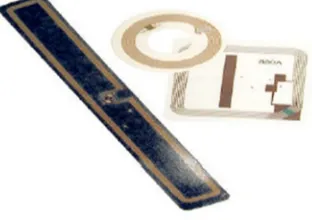
[image:3.612.234.390.482.592.2]Tags are thin labels which can be fixed inside a equipment's back cover. RFID tags are made up of carbonic structure which contains a magnetic strip or coil layer inside the tag which helps in sensing the tags. This magnetic layer reflect the magnetic field. The tag contains a unique serial number like “6B002FD780” which is used for the authentication of the user.
Figure 3: RFID tag
When we bring the tag in front of the reader or in a close proximity of the reader, the reader antenna senses the tag and checks for the unique serial number of the tag. If the tag is registered in the reader’s database then the reader authenticates the tag otherwise the reader shows an error and gives the message that the tag is not registered or the tag is not authenticated. There are two types of tags: active and passive. Extra power source is required for active tag and does not extra power source required for passive tag. The passive tags are used in this project.
Technology (IJRASET)
[image:4.612.199.410.146.258.2]an antenna to interrogate electronic tags via radio signals. The antenna inside the reader generates electromagnetic field. When a tag passes through the field, the information stored on the chip in the tag is interpreted by the reader and sent to the computer, which, in turn, stores or retrieves information about the equipment’s. Following shows the construction and pin out diagram [Fig: 4] of RFID Reader.
Figure 4: Pin diagram of RFID Reader [7]
3) Antenna: (internal part of RFID Reader): The antenna resides inside the reader. It generates electromagnetic field. Whenever a tag comes in close proximity of the electromagnetic field it gets activated and it is able to read and write data to the reader by producing radio signals. Antenna behaves like a communication media between the tag and the reader.
4) MATLAB:
Figure 5: GUI window
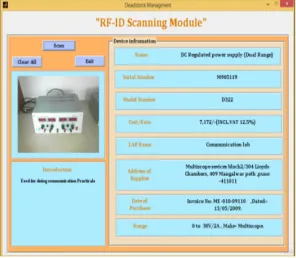
The particular code of each tags are stored with information about equipment in MATLAB software. This information shows on GUI format of MATLAB. Show in above [Fig: 5] RFID scanning module window. The information of equipment contains the name of equipment, model no, serial number cost, lab name, address of supplier, date of purchase and range etc. All this information will be display on GUI format of MATLAB software. [Fig: 6]
C. Steps
1) RFID reader read the tag no (ex: 6B002FD780) this number transmitted to MATLAB software.
2) In MATLAB software, received number is compared with stored number. The information of device is stored under this number.
[image:4.612.199.426.374.564.2]Technology (IJRASET)
Figure 6: GUI window with Result
III. CONCLUSION
Radio Frequency Identification (RFID) Systems used in laboratories for equipment identification, for self-checkout and for the sorting and conveying of Destocks equipment’s. These applications can lead to significant savings in labor costs, enhance customer service, and provide a constant record update of new collections of equipment’s. The efficiency of the system depends upon the information to be written in tag. For best performance, RFID readers and RFID tags to be used must be of good quality.
REFERENCES & NOTES
[1] Karen Coyle ““Management of RFID in Libraries,” ,Preprint version of article published in the Journal of Academic Librarianship, v. 31, n. 5, pp. 486-489 [2] Smart, Laura "Making Sense of RFID," Net connects (fall, 2004):4-14.
[3] Roadmap for RFID Implementation in Central Library,PEC University of Technology, By Seema Vasishta
[4] Bansode, S.Y. & Desale, S.K. (2009).Implementation of RFID technology in University of Pune Library. Program: electronic library and information systems, 43(2), 202-214.
[5] Radio Frequency Identification (RFID) Vs. Barcodes, Electro-Com (Australia) Pty Ltd Daniel McPherson and Vinod Chachra.
[6] Daniel McPherson and Vinod Chachra. “Personal privacy and use of RFID technology in LABORATORIES”. White Paper, VTLS Inc., October2003
www.vtls.com/documents/privacy.pdf.
[7] Ramesh chopra , Exciting 51 microcontroller based projects , EFY Enterprises pvt ltd. D-87\1, okhla industrial area , phase 1, new Delhi 110020. www.efyindia.com
AUTHOR PROFILE
Mr.V.B.Kumbhar received his M.E. degree in Electronics & Telecommunication from Shivaji University at ADCET Ashta. He has an Industrial experience of about 6 years. Currently he is working with DKTE’s Textile & Engineering Institute in Electronics Engg. Department, as Assistant Professor. His area of interest is Industrial Automation & embedded systems. He also writes articles on PLC, SCADA systems on blog entitled www.plc-scada-dcs.blogspot.com.
![Figure 4: Pin diagram of RFID Reader [7]](https://thumb-us.123doks.com/thumbv2/123dok_us/8580951.860878/4.612.199.426.374.564/figure-pin-diagram-of-rfid-reader.webp)