International Journal of Emerging Technology and Advanced Engineering
Website: www.ijetae.com (ISSN 2250-2459,ISO 9001:2008 Certified Journal, Volume 3, Issue 1, January 2013)
557
Speaker Identification Based Automation System Through
Speech Recognition
Prabhakar V. Mhadse
1, Amol C.Wani
2 1,2Electronics & Telecomm Engineering Department, SSBT’s COET, Bambhori, Maharashtra, India.
Abstract- This paper discusses the methodology for a project named “Speaker Identification based automation system through speech recognition”. Automation industry is growing rapidly; the central goal of design of speaker identification based automation is to provide an efficient and convenient integration and inter-operation among appliances in households and industry. Home automation systems must comply with the household standards and convenience of usage. This paper discusses the overall design of a wireless speaker identification based automation system which is built and implemented. Along with hardware, necessary software tools like MATLAB should present a comfortable user interface for security. The automation centers on recognition of voice commands stored in data base and it is matched with incoming voice command of user. It uses low-power RF ZigBee transceiver wireless communication modules which are relatively cheap. Speaker identification based automation system is intended to control lights and electrical appliances in a home or office using voice commands. Speech processing is carried by speech processor and MATLAB program is used to recognize speech processing for security purpose.
Keywords— Automation system, MATLAB coding
speaker identification, Speech processing, ZigBee
transceiver.
I. INTRODUCTION
The home evolutionary developments time from the era in which man became sedentary to stop living inside caves and start building their homes. These evolutionary trends of homes automation are focused on several main issues such as security, culture, leisure, comfort, energy savings, management and economic activities. Over the years much work has been done in the domain of automatic speech recognition. The progress made is significant for small, medium and even large vocabulary systems. Speaker Identification based automation is one of the major growing industries that can change the way people live with security in operation. Some of this home automation systems target those seeking luxury and sophisticated home automation platforms; others target those with special needs like the elderly and the disabled. The aim of such Automation System is to provide those with special needs with a system that can respond to voice commands and control the on/off status of electrical devices, such as lamps, fans, television etc, in the home and office.
The system should be reasonably cheap, easy to configure, and easy to run.
[image:1.595.338.522.334.491.2]There are housing developments that have some degree of automation in domestic processes, focused on domestic water pumping and lights control. However, they are isolated elements with a certain degree of difficult use. There have been several commercial and research projects on smart homes and voice recognition systems.
Figure 1: uControl Home Security, Monitoring and Automation (SMA)
Figure 1 [1] shows an integrated platform for home security, monitoring and automation (SMA) from micro control. The system is a 7-inch touch screen that can wirelessly be connected to security alarms and other home appliances. The home automation through this system requires holding and interacting with a large panel which constraints the physical movements of the user.
International Journal of Emerging Technology and Advanced Engineering
Website: www.ijetae.com (ISSN 2250-2459,ISO 9001:2008 Certified Journal, Volume 3, Issue 1, January 2013)
558
II. OBEJECTIVES AND GOALS
The main objective of this research is to develop an Speaker Identification based automation system capable of controlling many devices inside a home and office using speech commands with security of voice command of respective user only with speech commands transmitted and received wirelessly.
In order to achieve this objective, the following goals are defined and achieved:
To create speech database of users in order to characterize the speech signals to activate appliances.
To design Wireless transmission media using
ZIGBEE transceivers.
To evaluate and select the most appropriate speech processing method for converting audio signal to machine code instructions using speech processor HM2007 and security issue by MATLAB programming using MFCC algorithm.
III. REVIEW OF THE STATE OF THE ART
A speaker identification based automation system is integrated system to facilitate disabled, handicapped and elderly people at home and office with secure operation
using speech identification. New technology
discriminates elder and handicapped people because of the access to information barriers [8]. In this paper, the access barriers are grouped into three functional categories:
1) Barriers to provide input information to the computer, 2) Barriers because they cannot interpret the results displayed on screen,
3) Insecure activation of appliances by voice keyword.
For solving all this problems in [10] was proposed the use of speech as the best form of communication with the computer and bring together technologies used to work with voice to speech synthesis, speech recognition and
speaker recognition. For people with mobility
impairments are recommended to use speech technology as the optimal method of communication with their environment.
In reference [11] is described the development of various efforts to control housing through voice activation systems focused on needs of people with special needs. And special emphasis on the need to develop interfaces that can respond to commands without the need to remember specific commands (natural language) and feedback in audio for people with some kind of visual weakness.
Moreover in [10] recognizes the increase has been the development of technology to improve life quality and independence for elder people, by using alarms for elderly people that live alone, these alarms are connected to hospitals and send a message to relatives cellular phones. It also refers to use of biometric sensors for automatic detection of emergencies.
IV. JUSTIFICATION
The specialization of control systems for residential environments, focusing on needs of people with disabilities and the elderly, is very poor developed, reference literature is scarce and is focused on development and simulation of virtual agents, parameter identification and behavior in people with disabilities [9], and the development of artificial systems for generating control signals to homes [7].
In this systems security of functioning is considered, hence any user can not activate or deactivate the appliances. Furthermore, voice command matching is visually shown on screen, so that whether received input is matched with database, and hence is secure enough.
V. SYSTEM OVERVIEW
[image:2.595.331.529.480.701.2]A speaker identification based automation system is integrated system including separate transmitter and receiver module connected wirelessly and MATLAB software coding for Speaker Identification.
International Journal of Emerging Technology and Advanced Engineering
Website: www.ijetae.com (ISSN 2250-2459,ISO 9001:2008 Certified Journal, Volume 3, Issue 1, January 2013)
[image:3.595.54.260.283.457.2]559
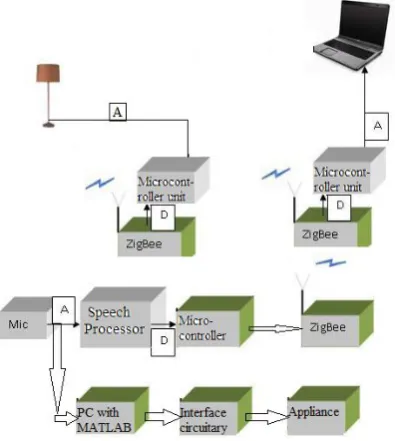
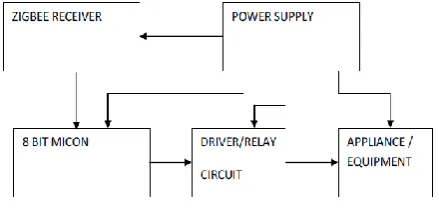
This project aims to develop an automated system capable of controlling operation of various devices placed inside the home or office using voice command, so that respective user can handle, simply, such devices with secure authentication. Figure 3 and Figure 4 shows the architecture used for transmitter and receiver module, for speech interpretation design an environmental microphone and communication interface, which captures and transmit voice more clearly. Microcontroller unit is used to control every operation of speech processor. Voice command is further given to MATLAB software to improve authentication of user commands.Figure 3: Transmitter module.
[image:3.595.52.272.564.671.2]Intelligent automation system is an integrated system to facilitate user with an easy-to-use home automation system that can be fully operated based on speech commands. The system is constructed in a way that is easy to install, configure, run, and maintain. The functional blocks of the transmitter module is shown in Figure 3.
Figure 4: Receiver module.
We have evaluated and selected the most appropriate speech recognition method using Processor HM2007 which will provide instructions for action the systems actuators. Here, speech signal is fed to speech processor for speech analysis and same signal is digitized to make it compatible for software processing by MATLAB using MFCC algorithm.
In this case the actuators will be switches or motors which control lighting, heating and other features inside the home and office.
A MATLAB application program, running on the PC, uses MATLAB library for the voice recognition. Upon recognition of the commands, control characters are sent to the specified appliance address. Consequently, appliances are turned ON or OFF depending on the control characters.
After the above we have selected the signal bus and
communication protocol between processor and
actuators. The most common are: dedicated wiring, twisted pair, ZigBee, coaxial cable, power supply installed.
VI. HARDWARE DESIGN
In this section we present the hardware description of the modules used for adaptation of speech processor HM 2007 [2].
A. Speech processor module
International Journal of Emerging Technology and Advanced Engineering
Website: www.ijetae.com (ISSN 2250-2459,ISO 9001:2008 Certified Journal, Volume 3, Issue 1, January 2013)
[image:4.595.59.277.144.453.2]560
Figure 5: Speech Processor Module.
This unit consists of two vital subsystems, Speech Processor and Microcontroller. The main element of the design consist of speech synthesizer/recognition ASIC and ZIGBEE transceiver module. The speech recognition IC needs to be programmed for various speech commands. This is done by using a MIC, analog speech signal from MIC are stored in the internal memory of the IC after being digitized using ADC blocks. This learning process need to be done for a number of speech
commands. Once the learning/programming is
completed. The IC is ready to accept the commands. A command issued by the user through MIC will be digitized and compared with the digitized commands already stored in the internal memory of IC. When a match is received, microcontroller status will be updated accordingly. The microcontroller in turn will generate a specific data pertaining to a given equipment/appliance and speech command which will transmitted through RF channel using ZIGBEE transmitter.
B. Microcontroller module
Figure 6: Microcontroller Module.
This module receives signal from speech processor and decision making regarding switching ON/OFF appliance is made here as shown in figure 6. Assembly program is used to do the same and burnt in microcontroller. Wireless module is connected to one of the port of microcontroller. Generally port 3 is used for transmission of signal.
C. Wireless (zigbee) module
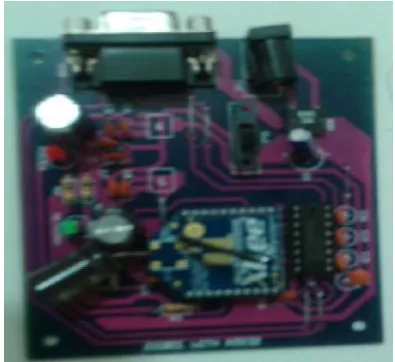
[image:4.595.332.530.578.759.2]Zigbee protocol is the communication protocol that is used in this system for wireless communication as shown in figure 7. Zigbee offers 250 kbps as maximum baud rate, however, 115200 bps was used for sending and receiving as this was the highest speed that the UART of the microcontroller could be programmed to operate at.
International Journal of Emerging Technology and Advanced Engineering
Website: www.ijetae.com (ISSN 2250-2459,ISO 9001:2008 Certified Journal, Volume 3, Issue 1, January 2013)
561
D. Appliance control module
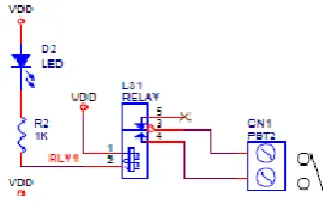
[image:5.595.326.536.135.320.2]Once the speech commands are recognized, control charterers are sent to the specified appliance address through ZigBee communication protocol. Each appliance that has to be controlled has a relay controlling circuit shown in Figure 8.
Figure 8: Appliance Control Module.
VII. SOFTWARE DESIGN
Software design for this project involves training for speech processor as HM 2007 is ASIC processor and assembly programming for microcontroller to work on incoming signals from speech processor. It receives control commands from processor and switches ON/OFF relay connected to the particular appliance. Our project simultaneously works with MATLAB code, where speech recognition will be carried out using MFCC algorithm. If voice command is matched with the corpus stored in system then and then only code will generate matched waveform and appliance will be activated.
A. MFCC algorithm
Mel frequency Cepstral Coefficient (MFCC) is used to extract the features from voice and Vector quantization technique to identify the speaker. Voice has an infinitive amount of information, we have to determine who is the person speaking based on the features of the person´s voice. An analysis for the voice in time domain will be very impartial. So an analysis in the frequency domain can be a more viable option. Extract the parametric representation of voice signals is a vital process for the recognition performance. MFCC is a technique based on
human hearing behavior that cannot recognize
frequencies over 1Khz. MFCC are base on the difference of frequencies that the human ear can distinguish. The signal is expressed in the MEL scale, this scale is based on the perception of the pitches in an equally spaced intervals judged by observers. This scale uses a filter that is spaced linearly at frequencies below 1000 Hz.
Figure 9: Plot of a voice signal in the domain of time.
B. FRAMING
Is the segmentation of the speech samples in boxes within the range of 20 ms to 40 ms. The voice signal is divide in frames of N samples. Adjacent frames are separated by M(M<N). Distinctive values used are M = 100 and N= 256.
In Pre-emphasis process we emphasize the higher frequencies; this will increase the energy in the signal at higher frequencies [12].
MFCC algorithm follows following steps:
1) Automatically detects an isolated word from your speech (input utterance). It does this by calculating energy and the number of zero crossings on a frame-by-frame basis, and compares these values to a threshold. 2) For each frame in a word, it applies a window function followed by a pre-emphasis filter. It then calculates Mel Frequency Cepstral Coefficients (MFCC) and their delta and delta-delta coefficients for each frame, and uses these as feature vectors.
3) For each word's training data, we estimate the parameters of a Gaussian Mixture Model to fit the distribution of training vectors. We therefore train a model to represent each word.
VIII. TESTS AND RESULTS
[image:5.595.83.245.215.319.2]International Journal of Emerging Technology and Advanced Engineering
Website: www.ijetae.com (ISSN 2250-2459,ISO 9001:2008 Certified Journal, Volume 3, Issue 1, January 2013)
[image:6.595.304.549.164.780.2]562
Figure 10: Result of speaker identification using speech
processor HM2007.
Table 1 shows the results observed for speaker identification using speech recognition using MFCC algorithm.
Table1
Result of speaker identification using MATLAB MFCC Algorithm.
Speaker Speaker
Identification(%)
Appliance activation
1 93 yes
2 87 yes
3 90 yes
4 96 yes
5 72 no
IX. CONCLUSIONS AND FUTURE WORK
A home automation system based on voice recognition was built and implemented. The prototype developed can control electrical devices in a home or office. The system implements Automatic Speech Recognition using speech processor and MATLAB coding. The system implements the wireless network using ZigBee RF modules for their efficiency and low power consumption.
After analyzing all the information we got from our project, we found that our algorithm improves the speaker recognition task. Because the MFCC uses the Mel scale, the approximation to the human voice behavior is good, it represent in a better way the voice. We improved the precision in the recognition task. We found that as long as the number of speakers increases, the number of errors increases; this is because the distance to each centroid of each speaker can be similar to another.
Future work will entail:
Adding confirmation commands to the voice
recognition system from appliance.
Integrating appliance control functions to improve the system versatility such as providing control commands other than ON/OFF commands such as slow down, Dim, etc.
Achieve speaker identification using speech
processor, by matching speech parameters instead of MATLAB.
REFERENCES
[1 ] Humaid AlShu’eili, Gourab Sen Gupta, Subhas Mukhopadhyay,
“Voice Recognition Based Wireless Home Automation System”, 4th International Conference on Mechatronics (ICOM), 17-19 May 2011, Kuala Lumpur, Malaysia, pp 1-6 ,2011.
[2 ] Datasheet HM 2007, speech processor.
[3 ] Home Automated Living website. [Cited 2010 14th Oct],(2010),
Available: http://www.homeautomatedliving.com/default.htm.
[4 ] Rojas-Rodríguez Rafael, Aceves-Pérez Rita1, Cortés-Aburto
Obed, García-Meneses Carlos1, Vela-Valdés Luis, “Development and integration of automated systems aimed to the comfort of seniors and people with disabilities” International Conference on Intelligent Environments, pp339-342,2012.
[5 ] Rabiner L. R. and Schafer R. W., Digital Processing of Speech
Signals,New Jersey, US: Prentice Hall Inc, 1978.
[6 ] Augusto J. C. and Nugent C. D., “Smart homes can be smarter”,
in Lecture Notes in Artificial Intelligence. Germany vol. 4008, pp 1-15, May 2006.
[7 ] “XBee-2.5-Manual,” ZigBee RF communication protocol.
(2008).
[8 ] Algimantas R., Ratkevicius K. and Rudzionis V, “Voice
interactive systems”, in The Engineering Handbook of Smart Technology for Aging, Disability and Independence USA, pp 281-296, 2008.
[9 ] Vovos A. Kladis B.and Fakotakis N.D., "Speech operated
smart-home control system for users with special needs", in Proc. INTERSPEECH, pp.193-196, 2005.
[10 ]Sixmith A., “Modeling the well being of older people” in The
Engineering Handbook of Smart Technology for Aging, Disability and Independence USA, pp 569-584, 2008.
[11 ]Muñoz C., Arellan D, Perales F. J. and Fontaner G. “Perceptual
and intelligent domotics system for disabled perople” in proceedings of Sixth IASTED International Conference, USA pp 70-75 September 2011.
[12 ]Jorge MARTINEZ*, Hector PEREZ, Enrique ESCAMILLA;
Masahisa Mabo SUZUKI; ’’Speaker recognition using Mel
Frequency Cepstral Coefficients (MFCC) and Vector
Quantization (VQ) Techniques” IEEE 2012.
[13 ]Shannon B.J., Paliwal K.K., “A comparative study of filter bank
spacing for speech recognition”,Proc. of Microelectronic engi- neering research conference, Brisbane, Australia, Nov. 2003.
[14 ]T. Hill and P. Lewicki, Statistics Methods and Applications.
Tulsa, OK: StatSoft Inc., 2006.
[15 ]S. Furui, Digital Speech Processing, Synthesis, and Recognition.
New York: Marcel Dekker, 2001.
[16 ]Fezari, M.; Khati, A.-E, “New speech processor and ultrasonic
sensors based embedded system to improve the control of a motorized wheelchair,” Design and Test Workshop, 2008. IDT 2008. 3rd International 20-22 Dec. 2008 Page(s):345- 349.
[17 ]A. Spanias, T. Painter and V. Atti Audio Signal Processing and
Coding. John Wiley & Sons, pp. 91-105, 2007.
[18 ]Mohd. Rihan, M. Salim Beg, Narayan Gehlot; “Developments in
Home Automation and Networking”, Proc. National Conference on “Computing for Nation Development”, Bharati Vidyapeeth Institute of Computer and Management, New Delhi, 23-24 Feb. , 2007, pp. 61-64.
[19 ]M. Salim Beg, Mohd. Fahad Imteyaz : “Development of Wireless
Sensor Networks using Bluetooth”, National Conference on Advancement of Technologies – Global Scenario (ADTECH – GLOS), Mathura, 25-26 Feb 2007, pp. 14-20.
[20 ]Yeon-Joo Oh, Eui-Hyun Paik, and Kwang-Roh Park, " Design of
[image:6.595.63.266.324.425.2]International Journal of Emerging Technology and Advanced Engineering
Website: www.ijetae.com (ISSN 2250-2459,ISO 9001:2008 Certified Journal, Volume 3, Issue 1, January 2013)
563
[21 ]D. Persson, T. Eriksson, and P. Hedelin, “Packet Video Error
Concealment with Gaussian Mixture Models,” IEEE Trans. on Image Processing, Vol. 17, No. 2, pp. 145-154, Feb. 2008.
[22 ]R. Gadalla, “Voice Recognition System for Massey University
Smart house,” M. Eng thesis, Massey University, Auckland, New Zealand, 2006.
[23 ]L. R. Rabiner and R. W. Schafer, Digital Processing of Speech
Signals, New Jersey, US: Prentice Hall Inc, 2001.
[24 ]Voice Recoder Reference Design (AN 278), Silicon Laboratories,
2006.
[25 ]hynek hermansky The johns hopkins university, baltimore, maryland, usa, Sa¯dhana¯ Vol. 36, Part 5, October 2011, pp. 729– 744.
[26 ]Peterson G E, Barney H L 1952 Control methods used in a study of the vowels. J. Acoust. Soc. Am. 24:175–184.
[27 ]Plahl C, Hoffmeister B, Heigold G, Loeoef J, Schlueter R, Ney H 2009 Development of the GALE 2008 Mandarin LVCSR System. Proc. Interspeech 2009, Brighton, UK, 2107–2111.
[28 ]Thomas S, Ganapathy S, Hermansky H 2008a Hilbert envelope based spectro-temporal features for phoneme recognition in telephone speech. Proc. Interspeech 2008, Brisbane.
[29 ]Wan-Ki Park, Chang-Sic Choi, Jinsoo Han and Intark Han,
”Design and Implementation of ZigBee based URC Applicable to Legacy Home Appliances”, IEEE International Symposium on Consumer Electronics (ISCE 2007), Irving, TX , June 20-23, 2007, pp.1-6.
[30 ]Maoheng Sun, Qian Liu and Min Jiang , “An implementation of