International Journal of Emerging Technology and Advanced Engineering
Website: www.ijetae.com (ISSN 2250-2459,ISO 9001:2008 Certified Journal, Volume 3, Issue 2, February 2013)
17
Determination of Structural Properties of Baked Clay as
Replacement of RCC
Dr. Abdul Aziz Ansari
1, Nawab Ali Lakho
21Professor, Department of Civil Engineering, Quaid-e-awam University College of Engineering Science & Technology,
Larkano, (Sindh)
2Ph.D Research Scholar, Department of Civil Engineering, Quaid-e-Awam University of Engineering Science & Technology,
Nawabshah, (Sindh), Pakistan
Abstract—Systematic research has been carried out over
past several years to check the suitability of baked clay as chief material of construction as replacement of Reinforced concrete, for low-cost housing without sacrificing elegance, strength and durability of multistory buildings. Initially soil was dug from 25 sites at a depth of 4 ft. in the vicinity of Quaid-e-Awam Engineering University, Nawabshah, (Sindh), Pakistan where the soil is furtile and fit for cultivation. Their physical properties were determined. The presence of various salts and their proportion were also found. From test results it was observed that the salts did not affect the structural properties of baked clay specimens. A very large number of cubes were cast with clay as major material and percentage of pit-sand (silica) as major parameter. The results of preliminary study in terms of shrinkage, specific gravity, crushing strength, tensile strength, poison’s ratio, and modulus of elasticity of baked clay specimen and the best possible combination of clay and pit-sand were obtained. The material was then compacted by applying compression and cube crushing strength as high as 27.61 N/mm2 (3950 psi) was achieved. Fifty one beams with 70% clay and 30% pit-sand, 20 percent water and 4.5 N/mm2 compacting force were cast, dried, baked, post-reinforced, grouted with cement and hill-sand slurry with the ratio of 1:1 for proper bond between steel bars and surrounding baked clay were tested with point load, UDL and various boundary conditions including roller support, plate support and complete end-fixity. 35 beams were singly reinforced and 8 contained compression steel as well, while 8 contained special types of vertical reinforcement to resist shear. All the beams failed in shear. Cubes were cut from the body of the beams after testing and structural properties were determined. The crushing strength as high as 42 N/mm2 (6100 psi) has been achieved. The results are encouraging and further research is being carried out.
Keywords—Low-Cost housing, Preliminary study, Specific
gravity, Shrinkage, Modulus of Elasticity,
I. INTRODUCTION
Research has been conducted on reinforced concrete since last almost two centuries. But it all depends upon the availability of industrially produced materials. These materials are very expensive. They are to be transported from distant place to the site. Cast of transportation is very high due to ever-increasing cast of transportation.
International Journal of Emerging Technology and Advanced Engineering
Website: www.ijetae.com (ISSN 2250-2459,ISO 9001:2008 Certified Journal, Volume 3, Issue 2, February 2013)
18 With lot of literature survey regarding housing pertaining to past several thousand years it has transpired that clay must be employed to play its due role as the shelter of human being on the face of this earth as a new material of construction in its new manifestation in present times. Reinforcement is the order of the clay. Multistory buildings are the most common form of present time. Let us mingle them together to produce new form of construction using clay for the sake of economy, elegance, durability and long life. It is a dilemma and irony of the fate that more than two third of the population of the world is still living in inhuman conditions and they are not able to meet their basic needs of life.
Although the modern trend in the field of construction is framed structure consisting of RCC beams and slabs;
attempt is being made to replace RCC with pre-perforated post-reinforced baked clay panels. It is more beneficial if the buildings are to be constructed on mass scale and the variation of sizes is kept to a minimum.
The plains of our country (Pakistan) where the soil is alluvial and there is shortage of fine as well as coarse aggregate, almost every single item i.e. cement, steel bars, fine & coarse aggregate are to be transported from very long distances. Being very heavy materials considerable amounts are to be paid as their cost of transportation. Thus it is beyond the reach of a common man to opt for RCC construction.
The universally available materials of construction in the plain areas are clay and pit sand. At present burnt clay bricks are being used for masonry construction and for lintels to span over small openings like those of doors and windows. If instead of bricks we can produce baked clay panels of beams, columns, slabs and footing etc. which are pre-perforated so that the reinforcement bars could later be placed and grouted with proper bond and if we can attain the strength properties resembling to those of cement concrete and if a reasonably good margin of reduction of prices could be achieved, then the dream of low-cost housing in its real sense could come true.
II. HISTORICAL BACKGROUND GROUND OF CLAY AS A
CHIEF MATERIAL OF CONSTRUCTION
Clay bricks have remained in use as major material of construction since the known history of mankind on the earth. Traditional clay architecture is thousands of years old and even today about one-third of world’s population lives in homes constructed from clay. Catal Huyuk (present time Turkey) was the place where glazed tiles were manufactured as early as 6000 B.C. [1]. Etruscans are known for their clay statues.
In the plains of various parts of the world where the soil is clayey in nature the baked clay bricks were used as early as 3000 B.C. in Moen-jo-Daro and Mesopotamia. The palace of Nebuchadnezzar, the Ishtar gate and the procession street along with the buildings on both its sides were constructed with bricks and adorned with glazed baked clay tile bricks as early as 600 B.C [2]. The hanging Gardens of Babylon, one of the seven wonders of world was made up of clay. European monasteries, castles and mansions were made up with clay and clay was used in the infill panels of traditional timber frame houses. Many of these buildings are hundreds of years old and still standing up proudly today. As building material, clay bricks have been used in construction since earliest times [3].
The earliest remaining examples of soil reinforcement are the Ziggurat of the ancient city of Dur-Kurigatzu, now known as Quf and the great wall of China. The Agar-Quf ziggurat, which stands five kilometers north of Baghadad was constructed of clay bricks varying in the thickness between 130-400 mm, reinforced with woven mats of reed laid horizontally on a layer of sand and gravel at vertical spacing varying between 0.5 and 2.0 meter. Reeds were also used to form plated ropes approximately 100 mm in diameter which pass through the structure and act as reinforcement. The Agar-Quf structure is now 45 m tall, originally it is believed to have been over 80 m high; it is thought to be over 3000 years old. The great wall of China, parts of whichwere completed in 200 B.C. contains examples of reinforced soil, in this case it was made of mixtures of clay and gravel reinforced with tamarisk branches. New materials like glass fibre and carbon fibre together with special binding materials are being employed to repair the damaged structures. But the people of third world countries can not afford this luxury of using highly expensive and industrially produced materials of construction which would have to be imported at the exorbitant prices. Therefore, these countries must resort to local materials with minimum possible industrial local materials with minimum possible industrial processing for the use of building, the infra-structure and the houses at a relatively lower cost without compromising on the durability, strength and elegance.
III. STRUCTURAL PROPERTIES OF CLAY
International Journal of Emerging Technology and Advanced Engineering
Website: www.ijetae.com (ISSN 2250-2459,ISO 9001:2008 Certified Journal, Volume 3, Issue 2, February 2013)
19 Polymer clay has been in use as man-made modeling materials just like ceramics. It is being supplied by various suppliers under the brand name as FIMO which is an easy to use as extremely versatile plastic based modeling clay [6]. Attempt has been made by [7] to assess new potential applications for the Bailen clays, traditionally used for manufacturing of bricks based on mineralogical, chemical, particle size, plasticity and firing results. Raw materials and mixtures used by the local factory were selected and tested with the addition of some diatomite, feldspar or kaolin. Based on their properties clay materials from Bailens might be suitable for making porous red wall tile, clinker, vitrified red floor tiles and porous light coloured wall tiles by pressing. The first could be manufactured from the raw materials and mixtures currently used by the local manufacturers. On the other hand, stone ware shaped by extrusion, such as pre-perforated bricks, facing bricks and roofing tiles also can be manufactured from the mixtures used at the factory. They must contain 20-25% carbonate and a small amount of iron oxides. Light-weight bricks require black and yellow clay with diatomite . Now-a-days Low Cost Housing (LCH) machinery is being used in western world to produce Stabilized Earth Brick Machine for low cost housing. Stabilized Earth Bricks (SEB) Machine is easily transported onto a construction site and can immediately produce high quality (as claimed) interlocking bricks made from the local soil. No mortar is required to hold the bricks together, made from soil treated with Road packer Ionic Soil Stabilizer product. The LCH stabilized Earth Bricks (SEB) can be used within a few days of production. It is claimed that the homes thus constructed of production. It is claimed that the homes thus constructed will be heat resistant, sound proof and completely stable. A new material of construction called Grancrete is being developed by scientists at Argonne and Casa Grande, that may lead to affordable housing (Low cost) for the world’s poorest, when innovation process completes up to industry development scale. Ceramic houses are also being built in USA. Since [8] a resident of California has remained continuously involved in the Geltaftan Earth-and Fire System known as Ceramic House, and of the Super block construction system. He is a U.N. (UNIDO) consultant for Earth Architecture.
IV. SIGNIFICANCES OF THE STUDY
Basically in third world countries the purchasing power of common man is very much limited. Therefore to construct a house using reinforced concrete is not within the reach of majority.
However, if local materials like clay and pit-sand (silica) can be utilized to construct the house with comparable structural properties of concrete, the low-cost housing objective could be achieved without sacrificing the elegance, durability and structural soundness. Therefore attempt has been made to study the fundamental structural properties as well as flexural and shear behaviour of beams manufactured from baked clay with post-reinforced using grouting as bonding material consisting of fine hill sand and cement sullery so that there could be mass scale production of pre-cast panels for rapid erection of structural frames along with brick masonry as dividing walls so that dream of low-cost housing could come true.
V. EQUIPMENTS AND INSTRUMENTATIONS
Since no attempt was made ever before to cast and test the clay beams, a large number of pieces of devices, equipment were not available in the market and could not be purchased. Therefore, all such items were devised according to specific needs of various operations. They were designed and fabricated within the premises of QUEST, Lab: However, standard equipment whatever was already available in the structures laboratory was employed. The details of all the device, equipment and machinery are presented in the following sections as listed below.
Stiff steel mould
Restraining system of mould
compaction system
Beam drying system
Trolley
Platform Lift
Grouting system
Mechanised Compacting Mould System
Mobile Lift
Pre-compression system
End Fixity Attachment
U.D.L simulator
Backed clay specimens cutter
Puller System
VI. MATERIALS
A. Clay and Pit-Sand
International Journal of Emerging Technology and Advanced Engineering
Website: www.ijetae.com (ISSN 2250-2459,ISO 9001:2008 Certified Journal, Volume 3, Issue 2, February 2013)
20 Clay shrinks during drying and firing. This creates many problems. Certain clay shrinks more than others. The finished products of clay crack during cooling.
The clay was obtained from 25 different sources at a depth of 100mm (4 ft) from the ground level at Quaid-e-Awam University of Engineering Science & Technology Nawabshah. It was dried at a temperature of 105 OC for 24 hours. Then all the samples were sent for chemical analysis to detect the presence and quantity of various salts. The clay was then pulverized and pit-sand was mixed with it. Initially the ratio of pit-sand was a variable to find the best composition.
The salts were also one of the parameters to determine their effect on the compressive strength and other material properties of baked clay specimens. The third parameter was the water content to get the best results and the fourth parameter was the pre-compression for compaction. For the best results it is recommended that the clay should be in a very fine state of division commonly known as colloidal state of particles. For a dense and compact mass of clay the free sand present in it should be graded from the finest particle of less than 0.002 mm to the coarsest size of 1 mm. Pit-sand used this study passing through standard sieve No. 3
B. Mixing Water
Potable water was mixed in the mixer of clay and pit- sand to the extent of 18 to 20%. In fact samples of under ground water from a large number of sites were tested for various properties and salts. It was found that presence of salts had no appreciable effect on the compressive strength of baked clay. However, underground water that was found fit for agricultural purpose by Fuji Fertilizers Company Nawabshah.
C. Cement Slurry
Ordinary Portland Cement and fine hill sand passing through standard sieve No 16 were mixed in the ratio 1:1 and the slurry was produced by adding water five times the weight of cement. This slurry was forced into the holes where steel bars had been housed by grouting system. The slurry was developed during this study based on experimentation in terms of proper flow, complete filling of the space in the holes and proper bond between steel and surrounding baked clay.
D. Concrete
Four concrete beams were cast, cured and tested for the sake of comparison of results. For this purpose concrete mix design in accordance with the recommendations of the Department of Environment, London, HMSO, 1975 were followed.
The concrete ingredients were mixed by weight for the characteristic strength of 20 N/mm2 (3000 psi) at 28 days. The size of coarse aggregates was 10 mm (0.375inch). Ordinary Portland cement manufactured by Zeal Pak Cement factory Hyderabad was used. The value of slump was in the range of 10-30mm.
E. Reinforcement
Tor steel bars of 9.53 mm (3/8 inch) diameter, 12.7 mm (½ inch) diameter and 15.87 mm (5/8 inch) diameter were used. In Pakistan for the sake of economy 74% of reinforcing steel bars are produced from scrap. The manufacturing processes also vary considerably. Therefore, their strength properties are not uniform. These bars showed limited ductitlty. The batch of steel bars procured for our research did not show distinct yield point therefore the average 0.2% proof stress was calculated for three bars and was found to be 554.2 N/mm2 (80360psi) and average ultimate stress was 652 N/mm2 (94540 psi). The percentage elongation was quite low when compared with the codal value, where as ACI suggests elongation of 12 %., it is to be mentioned here that the extensometer was removed at this point and the failure of bar occurred just one stage of loading after this point.
VII. METHODOLOGY
Initially pH value, Electric Conductivity, Exchangeable Sodium and Gypsm, Total salts content in solution (PPM), Moisture Contents, Specific Gravity, Liquid Limit, Plastic Limit, Flow Index, Liquidity Index, Plasticity Index, Consistency Index, Toughness Index, Density of wet and dry soil are to obtain from twenty five different sites is determined. Preliminary studies are performed in terms of shrinkage, specific gravity, compressive strength, tensile strength, Poisson’s ratio and modulus of elasticity of baked clay specimens consisting of hundreds of specimens including cubes, cylinders and briquettes.
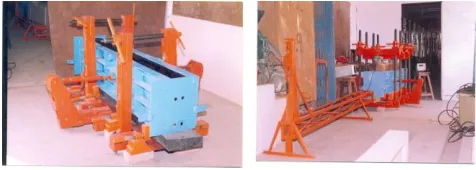
Fig. I & II: Photograph showing further strengthening of the system to top bulging and puller system that was designed for pulling the
[image:4.612.327.565.561.646.2]International Journal of Emerging Technology and Advanced Engineering
Website: www.ijetae.com (ISSN 2250-2459,ISO 9001:2008 Certified Journal, Volume 3, Issue 2, February 2013)
21 The major parameter is clay and pit-sand ratio. A large number of baked clay specimens is compacted by applying compacting force of 6 N/mm2 to improve the structural properties. Substantial equipment and testing arrangements required are also fabricated to like; Stiff steel mould are fabricated for casting the models of beam panels as shown in Fig I & II.
The design of these moulds is accomplished on the basis of stress analysis performed by using computer software using Finite Element Analysis. The analysis is particularly aimed at finding the lateral deformation of the mould due to applied compression for compaction. Elastic out-ward displacement is determined in order to ensure that bulging of the beam resulting in the expansion of the sections should not occur. Special arrangement for applying the pre-compression manually (so that density could be improved and compaction to the desired degree could be achieved), is designed.
VIII. BAKING SYSTEM
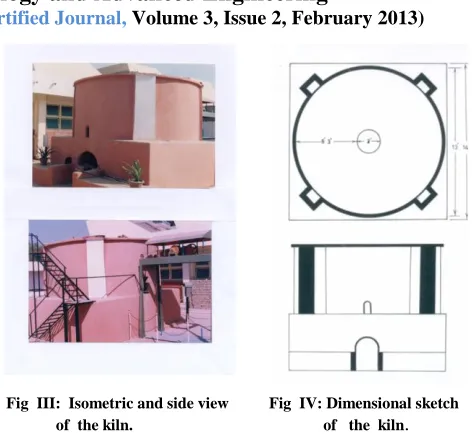
For baking the cubes, cylinders and beams during this experimental work, a kiln as shown in Fig. III, was constructed. Dimensional sketch of the kiln and its top view & front view are presented in Fig. IV. The kiln was heated by burning fire wood. Each time for complete cycle of burning, approximately 800 to 900 kg of fire wood is consumed.
[image:5.612.333.569.102.320.2]The temperature was controlled and maintained carefully by adding or abating the fire wood as per the requirement. Initially the lower temperature of 250 oC was maintained for six hours. The temperature was then raised gradually to 950 oC and was maintained at this level for 16 hours. Then the temperature was lowered slowly and the fire was stopped and the kiln was allowed to cool down over next two days. The temperature and time period were selected after preliminary study trying a large number of temperature and duration combinations to achieve the best possible results. The inner space of the kiln was enough to burn six beams at a time. The beams were placed inside through rectangular opening on the opposite side of the burning wood. There is an opening at the top which is covered at the time of burning.
Fig III: Isometric and side view Fig IV: Dimensional sketch of the kiln. of the kiln.
The cover itself is made up of clay. After the burning is over, the cover is partly removed for gradual cooling of the baked items. The temperature was maintained and measured with the help of thermo-couple. Four flues were provided opposite to each other to create draught.
IX. PRESENT STUDY
It may be re-iterated here that the total research work has been divided into two series i.e. Preliminary Test Series and Main Test Series. The latter is further sub-divided into five phases. The effective span of all the beams was 1670 mm (65.75 inch). Apart from baked clay beams four concrete beams were also cast, cured and tested for the sake of comparison.
International Journal of Emerging Technology and Advanced Engineering
Website: www.ijetae.com (ISSN 2250-2459,ISO 9001:2008 Certified Journal, Volume 3, Issue 2, February 2013)
22 Fig V & VI: Mechanized System of Compaction
[image:6.612.51.287.446.568.2]It may be mentioned here that all the work the details of which is presented here pertains only to the short term loading. However, the effect of long term loading and other related aspects is being taken care of by Nawab Ali Lakho as part of his own research programme, which is being carried out at Quaid-e-awam University of Engineering Science & Technology, Nawabshah, Sindh, pakistan. Whereas the compaction of baked clay moulds was accomplished by manual method of simple rectangular steel box where wing nuts were tightened to compact the mould as shown in Fig. I & II.
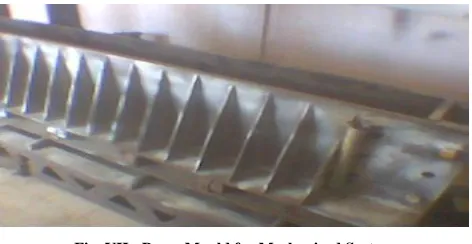
Fig VII: Beam Mould for Mechanized System
Further research of long term loading is being carried out by Nawab Ali lakho by employing mechanized system, the details of which will be presented elsewhere. The mechanized system devised, designed and manufactured by Nawab Ali Lakho is presented in figure V, VI & VII.
It was observed that mechanized system of Nawab Ali Lakho was more effective and produced better results regarding compaction than manual compaction.
X. EXPERIMENTAL RESULTS AND DISCUSSIONS
In this paper detailed discussion is presented regardingthe experimental results which have been obtained after testing a large number of specimens. Here the true picture of the structural behaviour of baked clay has been presented. It would be proved consequently that the baked clay is if not superior can’t be relegated as inferior material of construction.
A. Compressive Strength
Cubical strength as well as cylindrical strength of the specimens cut from the beams themselves was determined. the details of which are presented in Table I. From this tables it is apparent that the cubical strength as high as 37.6 N/mm2 is reached which is quite reasonable. Table II compares cubical strength of concrete with that of baked clay for respective beams. From this table it is obvious that the average cubical strength of baked clay is approximately 12% more than that of concrete. It may be mentioned here that the clay was compacted with a compressive force of 4.75 N/mm2. From this table it can be concluded that even with a very small compressive strength of baked clay is comparable with ordinary port-land cement concrete used for residential buildings can easily be achieved.
TABLEI
CUBICAL STRENGTH, MODULUS OF ELASTICITY AND POISSON'S RATIO
OF BAKED CLAY SPECIMENS
S. #. Description Cubical
Strength
Modulus of Elasticity
Poisson's Ratio
01. BCRRPE-1 35.8 34.90 0.165
02. BCRRPE-2 33.5 33.83 0.167
03. BCRRUDE-1 37.4 35.63 0.169
04. BCRRUDE-2 37.6 35.71 0.170
05. BCRPUDE-1 37.3 35.60 0.165
06. BCRPUDE-2 36.6 35.29 0.166
International Journal of Emerging Technology and Advanced Engineering
Website: www.ijetae.com (ISSN 2250-2459,ISO 9001:2008 Certified Journal, Volume 3, Issue 2, February 2013)
23 B. Poisson’s Ratio and Modulus of Elasticity
Table I, show the value of Poisson's ratio and the modulus of elasticity which were determined by adopting the procedure recommended by BS CP 1881-1970 [9] for different phase of experimental study separately.
TABLEII
COMPARISION OF COMPRESSIVE STRENGTH, MODULUS OF
ELASTICITY AND POISSON'S RATIO OF CONCRETE AND BAKED CLAY
SPECIMENS
Cube Crushing Strength
Modulud of Elasticity
Poisson's Ratio Concrete Backed
Clay
Concrete Backed Clay
Concrete Backed Clay 0.69 4.65 32.46 35.67 0.177 0.169 34.06 37.05 35.09 35.11 0.169 0.164 32.97 37.65 33.58 34.95 0.168 0.166 32.57 6.44 33.71 35.24 0.171 0.166
From this table it can be found that the average value of Poisson’s ratio for all the baked clay beams is 0.167. Few selected cases for which concrete beams were tested, comparison is shown in Table II. From this table it can be seen that the average value of Poisson’s ratio for all the three cases is 0.171, while the average value for the respective baked clay beams it is 0.166. The average difference is insignificant. Hence it can be concluded that the Poisson’s ratio of baked clay is also within the same range as that of concrete. It may be mentioned here that from literature it is apparent that the value of Poisson’s ratio of ordinary concrete ranges between 0.15 to 0.2. It can be observed that the Poisson’s ratio of baked clay also falls within this range.
The modulus of elasticity of ordinary concrete as reported in the literature ranges between 21 to 28 N/mm2. For High Strength Concrete it is as high as 40 N/mm2. The average value of modulus of elasticity for all baked clay beams is 35.24 N/mm2. From Table II, it is apparent that the average modulus of elasticity of concrete is 33.71 N/mm2 and for respective baked clay beams it is 35.24 kN/mm2 which is averagely 4.6% higher than that of concrete grade-20. It may be mentioned here that modulus of elasticity for concrete of grade-20 as given in [10] is 25 N/mm2.
It can therefore be inferred that the modulus of elasticity of baked clay is well within the range of that of concrete (grade-20).
C. Modulus of Rupture
Apart from the properties mentioned above experimental study was carried out to determine the modulus of rupture of baked clay by testing plain beams without reinforcement. The beams were 1000 mm long 143 mm wide and 286 mm deep subjected to two point loads at one thirds of the span with an effective span of 900 mm.
The loads were applied gradually and for every load increment displacement was measured. Universal Load Testing Machine of Forney from U.S.A. along with its two point load kit was used for this test. The failure was sudden, brittle and without impending warning. From ultimate load using the well known elastic equation the ultimate stress was found to be 3.3 N/mm2. This seems quite reasonable. From this result it can be concluded that this material, if not superior, cannot be considered as inferior than cement concrete.
XI. FLEXURE AND SHEAR BEHAVIOUR
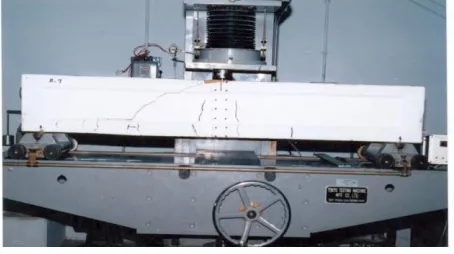
The flexural strength of the beams in terms of tension and compression was calculated by using the equations of BS CP 8110 [11] and ACI-318 [12] after removing all partial safety factors. The shear strength of the beams was also estimated in accordance with the above codes. For the phase-I of the Main Test Series. It was expected that the failure would be dominated by shear strength of the beams. The failure of the beams did occur due to shear. The failure occurred due to diagonal cracks as IXshown in Fig. VIII & IX.
International Journal of Emerging Technology and Advanced Engineering
Website: www.ijetae.com (ISSN 2250-2459,ISO 9001:2008 Certified Journal, Volume 3, Issue 2, February 2013)
[image:8.612.60.281.125.249.2]24 Fig VIII: Baked Clay Rectangular beam tested by applying point
load with roller supports.
However, due to practical difficulties and un-availability of required gadgets this system could not be developed / tried. After testing the beams the bottom cover of a few beams was removed to ensure that bond failure between steel and surrounding concrete did not occur.
Thus it can be deduced that if buildings are to be constructed in the rural areas where hill sand, coarse aggregate and cement are not available locally this material can also serve the local population well within affordable prices. This material could prove suitable for multistory buildings of reasonable height.
Fig IX: Baked Clay I-Section beam tested by applying point load with roller supports
Therefore we shall stick to the original idea of producing structural panels on large scale with minimum quantity of reinforcement, no cement, no aggregate of hill origin but clay and pit-sand, dune-sand and river bed sand; all available locally and cheaply.
XII. CONCLUSIONS
The conclusion of the work reported in this thesis can be summarized as under:
1) It was observed that the best results could be achieved when the clay is 70% and pit-sand 30%. 2) When cubes and cylinders were cut from the body of
the beams themselves after testing the Poisson’s ratio was found to be 0.167 as compared with that of concrete which ranges between 0.15 to 0.21. 3) The average value of modulus of elasticity for all
tested beams was found to be 35.24 KN/mm2 as compared with 25 KN/mm2 for concrete of grade-20.
4) Cubical strength as high as 37.4 N/mm2 was reached when cube were cut from the beam cost with a compacting force of 4.75 N/mm2. An average value was found to be 33.52 N/mm2.
5) The modulus of rupture of this baked clay material is also in good agreement with that of concrete of grade-20.
6) It is quite apparent that the failure of beams is dominated by shear rather than flexure, therefore, shear strength must be improved to ensure ductile failure due to yielding of steel in tensile zone. 7) Split of bottom cover, slipping of bars or
destruction of bond between steel and surrounding material did not take place, showing that the system of grouting worked well and was adequate.
8) The presence of vertical steel bars as shear reinforcement did not show any improvement of
strength rather it acted as an intruder.
9) Presence of longitudinal steel in compression zone proved to be beneficial causing substantial improvement of shear strength.
10) Beams subjected to Uniformly Distributed Load and fixed at both ends showed a very good strength which is averagely 5 times more than the calculated strength when estimated by using CP8110 recommendation for beams containing top and bottom steel without but no vertical steel. Where as it is 2.91 times when compared to the calculated value by using ACI-318.
11) Pre-perforated and post-reinforced system of construction consisting of pre-cast panels of baked clay holds promise as an alternative of cement concrete at a reduced cost without compromising on the quality, durability and elegance of multistory buildings.
[image:8.612.52.279.411.538.2]International Journal of Emerging Technology and Advanced Engineering
Website: www.ijetae.com (ISSN 2250-2459,ISO 9001:2008 Certified Journal, Volume 3, Issue 2, February 2013)
25 Acknowledgement
The authors wants to express the deepest sense of gratitude for the support of Quaid-e-Awam University of Engineering Science & Technology, Nawabshah and Higher Education Commission for providing Financial Assistance to carry out this research.
REFERENCES
[1] Herrmann, 1977. The Use of Clay for CMM in Ancient
Mesopotamia”, The tatile aspect of quipa production and J reading, 55-58, 94-100.
[2] Magnus, M. 1977. The Archaeology of the Bible land, 195-208,
[3] Encyclopaedia Britannica. Inc. 2006. Clay, Clay- Britannica
Concise.
[4] Kulkarni, G. J. 1980. A Book on Engineering Material, Eleventh
Edition, 55.
[5] Neil, M. 2002. Clay Plasters , Natural Building Technologies (NBT) Ltd, Hangar Worminghall Road, Oakley, Bucks, HP18 9UL. 1-5.
[6] Garic, S. 2005. Polymer Clay and Elastic Clay. Creative Clay for Creative People, 1-7.
[7] Gonzalez, I. Galan, E. Miras, A. & Paricio, P. A. 1998. New Use
for Brick-Making Clay Materials from the Bailen area (Southern Spain), Clay Minerals, GSW, Geo-Science World, Mineralogical Society of Great New Use for Brick-Making Clay Materials from the Britain and Ireland. Vol. 33, No. 3, 453-465
[8] Khalili, N. 1984. Alternative Building Materials for Pre- Fabricated
Low-Cost Housing”, U.N. (UNIDO), Consultant for Earth Architecture, California Council of the American Institute of Architectures (CCAIA).
[9] British Standard Code of Practice. 1970. B. S. 1881, Method of testing of Concrete, Part V, 1970
[10] Astill, A. W. & Martin, L. H. 1981. Materials and Load, Value of Modulus of Elasticity of Concrete, 1-8, Elementary Structural Design of Concrete to CP-110, Printed in Great Britian by the Pitman press, Bath. 7
[11] British Standard Institution. 1972. CP-110, The Structural use of Concrete, Part-I, Design Materials and Workmanship.
[12] ACI-318. 2001. Building Code Requirement for Reinforced
Concrete, American Concrete Institute.