International Journal of Emerging Technology and Advanced Engineering
Website: www.ijetae.com (ISSN 2250-2459,ISO 9001:2008 Certified Journal, Volume 3, Issue 8, August 2013)
489
An Optimistic Web Service Selection using Multi Colony –
Particle Swarm Optimization (MC – PSO) algorithm
T. Geetha
11
Assistant Professor, Department of CSE, A.R. Engineering College, Tamilnadu, India.
Abstract—Evolutionary algorithm and Swarm Intelligence algorithm (EA, SI), a part of Bio inspired optimization algorithm, have been widely used to solve numerous optimization problem in various science and engineering domains. This paper proposes a Multi Swarm Particle Swarm Optimization (MS-PSO) algorithm inspired by the animal collective behavior, the movement of the swarm and the intelligence of the swarm. The main concept of MS-PSO is to extend the single population PSO to the interacting multi-swarm model. Through this multi-multi-swarm cooperative approach, diversity in the whole swarm community can be maintained. Simultaneously, the swarm-to-swarm mechanism, drastically speeds up the swarm community to converge to the global optimum.MS-PSO algorithm solves the premature convergence problem. MS-PSO algorithm is tested by various benchmark functions.MS-PSO algorithm has competitive performance to other algorithms like Genetic algorithm (GA), Particle Swarm Optimization algorithm (PSO) in terms of accuracy and convergence speed.MS-PSO algorithm is specially designed to solve NP-Hard problems such as Optimization problem, Decision problem, Search problem, etc... The MS-PSO algorithm is also applied to Web Service Selection Problem (WSS). The WSS is an NP-Hard problem.
Keywords— Animal collective behavior, Optimization, Evolutionary algorithm, Swarm Intelligence, Benchmark functions.
I. INTRODUCTION
Bio inspired algorithms plays a vital role in solving complex real world problem. Among them the most successful algorithms are Evolutionary algorithms and Swarm Intelligence Algorithms.
Swarm Intelligence (SI) is an emerging field of biologically-inspired artificial intelligence, which is based on the behavioral models of social insects such as ants, bees, wasps and termites (Bonabeau, 1999). SI is mainly inspired by the animal collective behavior, population of boids interacting locally with one another and also with their environment. Swarm Behavior or Swarming is the collective behavior exhibited by the animals of similar size which aggregate together. It is particularly applied to insects but can also be applied to any other animals that exhibits swarm behavior. SI provides a framework to discover distributed problem solving [15].
Swarm behavior is one of the main characteristics of many species in the nature [16]. Millionars suggests the five basic principles of Swarm Intelligence [2] they are Proximity principle, Quality principle, Diverse Response, Stability and Adaptability. Proximity principle: the population should be able to carry out simple space and time computation. Quality principle: the population should respond to the quality factors in an environment. Diverse Response: the population should not commit its activities along excessively narrow channels. Stability: the population should not change its mode of behavior every time the environment changes. Adaptability: the population must be able to change behavior mode when it‘s worth the computational price.
Swarm Intelligence has the following principles: The swarm can solve complex problems that a single individual with simple abilities could not solve.
The swarm composed of several individuals some of which may be lost or mistake, but its performance is not affected.
The swarm has local sensory information and it performs simple actions and it has little or no memory and they do not know the global state of the swarm and they don‘t know their goal.
International Journal of Emerging Technology and Advanced Engineering
Website: www.ijetae.com (ISSN 2250-2459,ISO 9001:2008 Certified Journal, Volume 3, Issue 8, August 2013)
490 Evolutionary algorithms (EA‘s) form a family of algorithms inspired by the theory of evolution that solve various problems. They evolve a set of solutions to a given problem, in order to produce the best results. EA‘s are stochastic (generate and use random variables i.e random objective function and random constraints) algorithms, because they iteratively use random processes. Evolutionary algorithms have been developed to arrive at near-optimum solutions to solve large scale optimization problems, and may be also called as "meta-heuristics"(optimize a problem by iteratively trying to improve a candidate solution).Traditional techniques like Linear programming, dynamic programming and mixed linear integer programming failed to reach optimum solution and solving NP hard problems. Evolutionary Algorithms are suitable to solve NP hard optimization problems. Evolutionary algorithm works well with incomplete and noisy data. Evolutionary algorithms are easy to implement and it is cheap. Evolutionary algorithms are adaptable by simply modifying parameters. Evolutionary algorithms are efficiently parallelized.
Optimization is a process of finding best or optimal solution for a problem. The optimization problem concerns the three main factors. They are
An objective function which is to be maximized or minimized,
A set of unknowns or variables that affect the objective function,
A set of constraints that allow the unknowns to take on certain values but exclude others.
The commonly used evolutionary algorithms are Genetic Algorithm (GA) and Differential Evolution (DE) algorithm. GA and DE algorithms are used to solve various optimization problems. The commonly used Swarm Intelligence algorithms are Ant Colony Optimization (ACO) algorithm, Particle Swarm Optimization (PSO) algorithm and Firefly algorithm. These Bio inspired algorithms have the capability to solve NP-Hard problem. From [1] we analyzed that PSO is suitable for solving NP-Hard problem. In paper [1] the author had taken Web Service Selection as an NP-Hard problem, they had taken Genetic algorithm. In paper [1] the authors said Genetic Algorithm is not suitable because the web service selection efficiency is less when the number of candidate service is more. A novel optimization algorithm called Multi Colony Particle Swarm Optimization (MC-PSO) has been proposed, which incorporate the colony-to-colony communication strategy of multi swarm and it is proposed for solving NP- Hard problem.
MC-PSO is based on PSO, which is inspired by the animal collective behavior, the movement of the swarm and the intelligence of the swarm. By using the multi-swarm cooperative approach, diversity in the entire swarm community can be maintained. While at the mean time, the colony-to-colony communication mechanism speeds up the convergence rate of global optimum. That is, MC-PSO can accommodate distributed particle swarm optimization, and hence it is suitable for solving complex NP-Hard problem. For comparison purpose, we also implemented one evolutionary algorithm, namely Genetic Algorithm (GA) and one swarm intelligence algorithm, namely Particle Swarm Optimization Algorithm (PSO) on Web Service Selection (WSS) problem. The simulation results, which focusing on minimizing five benchmark functions, are reported in this project to show the qualities of the proposed algorithm. The proposed MC-PSO algorithm is applied to solve the web service selection (WSS) problem.
II.RELATED WORK
International Journal of Emerging Technology and Advanced Engineering
Website: www.ijetae.com (ISSN 2250-2459,ISO 9001:2008 Certified Journal, Volume 3, Issue 8, August 2013)
491 In order to reduce the iteration, the genetic operators such as crossover and mutation are combined with PSO to achieve a better solution. The main advantage of PSO is it is implemented very easily and it is computationally inexpensive since its memory and CPU speed requirements are very low [19]. The main drawback of PSO algorithm is premature convergence and it falls under local search problem. The local search problem is overcome by using small inertia weight factor. In [66] the authors proposed multi-colony bacteria foraging optimization algorithm with cell-to-cell communication for RFID network planning problem. In that paper, the authors proved that multi-colony approach maintaining the whole bacterial community as well as the cell-to-cell communication concepts speeds up the bacterial community to converge to the global optimum solution. In order to get the global optimum solution, the multi-colony approach is followed in the proposed algorithm.
A. Genetic Algorithm (GA)
GA was developed by John Holland in the year 1975.GA‘s are robust and adaptive heuristic search algorithm based on the evolutionary ideas of natural selection and genetics.GA follow the principles of Charles Darwin‘s ―Survival Of The Fittest‖. GA represents an intelligent exploitation of a random search which is used to solve optimization problems. GA uses simulated annealing, hill climbing techniques for local search.GA improved the fitness through evolution.GA is a powerful tool for solving non-linear optimization problems. In GA solution to a given problem is represented in the form of string called ―chromosome‖ which is having set of elements called ―genes‖. GA initially starts with a set of solutions (represented by chromosomes) called population. The fitness of each chromosome is determined by their objective function. GA employs three operators to propagate from one generation to another. The first operator is Selection which follows the principal of survival of the fittest. Selection (Reproduction) means extracting the subset of genes from an existing population. The various selection methods are Roulette Wheel Selection, Tournament Selection, Steady State Selection, Rank selection, etc. The Second operator is Crossover (Recombination) takes two parent chromosomes combined and produce one new offspring chromosome. The various crossover operators are one-point crossover, Two-point crossover, Uniform Crossover, etc. Finally the third one is Mutation it alters one or more gene in a chromosome and it results in adding new gene values in the gene pool. Mutation is used to maintain genetic diversity from one generation of population of chromosomes to the next.
Mutation helps to prevent the search falling into local optima. The various Mutation Operators are Flip bit, Uniform, Non-uniform and Gaussian, etc [65].Usually this process is carried out for a large number of generations to obtain a best-fit solution.GA search technique is blind because they require only an objective function. The performance of GA depends on the crossover and mutation operator.
B. Particle Swarm Optimization (PSO) Algorithm
PSO was developed by James Kennedy and Rusell Eberhart in the year 1995.PSO is inspired with social behavior of bird flocking and fish schooling.PSO is Robust and Stochastic optimization technique based on the movement and the intelligence of the swarms. PSO follows these basic principles. The first principle is that the population should respond to the quality factors pbest and gbest and the second principle describes the allocation of responses between pbest and gbest and it should ensures a diversity of response and the third principle is Stability describes that the population changes its state only when the gbest changes and the fourth principle Adaptive describes that the population is adaptive because it does change when gbest changes.PSO has the capability to solve continuous non-linear optimization problems and it is applied in various application areas like image processing, pattern recognition, game design, reactive power optimization and short term hydro electric system scheduling in a deregulated environment and it is also applied in the traffic and transportation engineering applications ,in the design of two dimensional zero phase Infinite Impulse Response (IIR) digital filters and it is applied to forecast the energy demand[1,15,16,17,19]. From [14, 18, and 20] analyzed that Swarm Intelligence especially PSO algorithm is suitable for solving optimization problems.
In [2], Kennedy and Eberhart originally proposed PSO algorithm without any inertia weight factor. In order to improve the performance of the PSO algorithm, Eberhart and XiaohuiHu uses inertia weight [3, 4, 5, 7, 8, and 9].Paper [5] proposes by including inertia weight, particles have a capability to enlarge the search space. Inertia weight provides a balance between local search as well as global search. From [3] we can conclude that the inertia weight place a major role in the PSO algorithm. Inertia weight can be computed by the formula [3, 4, 5, 6, 7, 8 ] inertia weight,
ω = [0.5 + (rand ( ) / 2.0)]
International Journal of Emerging Technology and Advanced Engineering
Website: www.ijetae.com (ISSN 2250-2459,ISO 9001:2008 Certified Journal, Volume 3, Issue 8, August 2013)
492 In [7, 8] the authors said that if we linearly decrease the inertia weight value from 0.9 to 0.4 we can achieve the optimal performance value.
In [13] the authors compute inertia weight by the formula,
ω = ωmax – (k / k max) (ωmax – ωmin)
where ωmax value is 0.9 and ωmin value is 0.9.
PSO is a population based cooperative search.PSO satisfies the local optimization but it is hard to express the robustness because of its iteration ability. In order to reduce the iteration, the operator such as crossover and mutation of GA are mix with PSO for a better solution.PSO is the only algorithm. The following example clearly describes the PSO algorithm. A group of birds are randomly searching some food in an area. There is only one piece of food in the area being searched. All the birds do not know where the food is, but they know how far the food is in each iteration. So the best way to find the food is follow the bird which is nearer to the food. In PSO, each single solution is a ‗bird‘ in the search space. Generally it is called as a ‗particle‘. All the particles are having some fitness value which
is evaluated by the fitness function and have velocities which direct the flying of the particles. In general PSO is initialized with a group of random particles (Solutions) and then searches for optima by updating generations. Each particle is having two properties position and velocity. In each iteration each particle is updated by two best values. The first one is the best solution (fitness) it has achieved so far.(the fitness value is stored).This value is called as pbest (personal best).Another best value is obtained so far any particle in the population, this best value is a gbest (global best).After finding the two best values, the particle updates its position and velocity. Large inertia weight describes the greater global search ability and the small inertia weight describes the greater local search ability. Velocity, v is given by the formula
Where v is the velocity,
rand () is the random number is generated in between 0 & 1
C1 and c2 are learning factors The current particle is given by
III. MULTI COLONY -PARTICLE SWARM OPTIMIZATION
(MC–PSO)ALGORITHM
The Multi Colony - Particle Swarm Optimization (MC-PSO) algorithm following the principle and it utilizes the concept of PSO algorithm. MC - PSO is a robust (it performs excellent in an unusual condition also), stochastic (selection is based on the random objective function) optimization technique based on the movement and the intelligence of swarms. MC-PSO algorithm follows the five basic principles of the swarm intelligence and it utilizes the concept of PSO algorithm. The five basic principles are Proximity principle (population should be able to carry out simple space and time computation), Quality principle (population should respond to the quality factors pbest and gbest), Diverse Response principle (allocation of responses between pbest and gbest should ensure the diversity of responses), Stability principle (the population should not change its behavioral mode every time when the environment changes) and Adaptability principle ( the population should adapt the changes when gbest changes).
MC - PSO is initialized by a group of random particles. Consider each particle as a bird. After initialization the particles are sorted in a descending order. Then the sorted particles are placed into the different colonies (i.e. the entire swarm or community is divided into several colonies).
Intra-Swarm-Communication is described as follows: The community consists of set of colonies. Each colony performs a local search and it finally gives one best solution. Within each colony, the individual birds having their own ideas they share their ideas with each other.
Inter-Swarm-Communication is described as follows: This can be evolved through a process of iterations. After a defined number of iterations, the information obtained is passed among the colonies and the knowledge among each colony is shared. These colonies coordinately and cooperatively work together and it provides the optimal solution.
With these intra and inter-birds communication mechanisms, the birds can jump out from local optima and it quickly fly through the neighborhood of the possible global optimum. Therefore a balance between local search and global search is attained. Through this, MC - PSO overcome the problem of Premature Convergence in the PSO algorithm.
International Journal of Emerging Technology and Advanced Engineering
Website: www.ijetae.com (ISSN 2250-2459,ISO 9001:2008 Certified Journal, Volume 3, Issue 8, August 2013)
493 In order to improve the performance of the PSO algorithm, some authors include inertia weight factor [16, 17, 18, 19, 20 and 21] and few of them include constriction factor [20, 22 and 23]. The proposed methodology includes constriction factor concept. By including the constriction factor the performance of the algorithm is improved.
The process is initialized with a group of random particles P. For S-dimensional problems (S variables), a bird i is represented as
Xi= (xi1, xi2, xis).
Then the birds are sorted in a descending order according to their fitness. Then the entire community is divided into m colonies, each containing n birds (i.e. P = m × n). In this process, the first bird goes to the first colony, the second bird goes to the second colony, bird m goes to the mth colony, and the bird m+1 goes back to the first colony. Within each colony, the birds with the best and the worst fitness are represented as and , and the bird with the global fitness is represented as Xg. Then, a process similar to PSO is applied to improve only the bird with the worst fitness not for all birds in each iteration. In each iteration, the communication is formulated as
--(1)
Where
is the velocity,
is the performance improvement factor,
is the best position found so far by the particle in the colony,
is the best position found so far by the multi-colony
community.
is the social learning rate between the particles within each colony,
is the social learning rate between different colonies, is a random number between 0 and 1.
The term
describes the cooperation between individuals of the same
colony and the term
describes the cooperation between different colonies in the community.
Then the position of the bird with the worst fitness is represented as follows
---(3)
,where is the
maximum allowed change in a bird‘s position.
If this process produces a better solution, it replaces the worst bird, else the calculations in this equation are repeated but with respect to the global best bird ( replaces ). If no updation is possible then a new solution is randomly generated to replace that bird.
Pseudocode of Multi Colony - Particle Swarm Optimization (MC - PSO) Algorithm
Begin; Initialization:
Generate random population of P solutions (i particles); For each individual i ϵ P;
Fitness Evaluation: Calculate fitness (i); Sorting:
Sort the population P in descending order of their fitness;
Divide the entire community P into m Colonies (Community);
Intra Colony Communication: For each colony;
Determine the best and worst particles;
Improve the worst particle by using equations 3 and 4; Repeat for a specific number of iterations;
Self- attraction within the colony is achieved by equation 1 in the 2nd term;
End;
Inter Colony Communication: Combine the evolved colonies;
Sorting: Sort the population P in descending order of their fitness;
Cooperation between different colonies is achieved by equation 1 in the 3rd term;
Termination:
Check if termination = true; End;
Advantages of MC - PSO Algorithm over PSO Algorithm It solves premature convergence and local search problem in PSO.
International Journal of Emerging Technology and Advanced Engineering
Website: www.ijetae.com (ISSN 2250-2459,ISO 9001:2008 Certified Journal, Volume 3, Issue 8, August 2013)
494 IV. CASE STUDY:WEB SERVICE SELECTION
A. Introduction To Web Service Selection
The definition of web service as per W3C consortium is ―a software system designed to support interoperable machine-to-machine interaction over a network‖. In this paper a new method for web service selection was introduced to do the web service composition. The proposed algorithm plays a major role in selecting the optimal web service. The web service selection is successful by the use of Quality of Service (Qos) for web services. The definition of Qos [13] as per the International quality standard ISO 8402, quality is described as ―The totality of features and characteristics of a product or service that bear on its ability to satisfy stated or implied needs‖. The QoS is used to evaluate the performance of the web service. The Web service selection is an NP- Hard (Non-Deterministic Polynomial Time Hard) problem. NP-Hard problem includes decision problem, optimization problem, search problem, etc. The web services are having same functional properties but different non-functional properties. QoS uses non-functional requirements in order to provide the optimal web service selection. QoS is having set of parameters it includes service execution time, response time, throughput, performance, availability, reliability and robustness, etc. Web services are stored in the registry in a static way but it has the ability to provide the solution for single functional problems, but it does not provide solution when user requesting a composite service. Composite service is having set of atomic services. Each atomic service is having large number of candidate services. The process of selecting abstract service from the composite service is called as web service selection. It should satisfy both the functional and non-functional requirements. The process of developing composite service is called as service composition [1].
The service selection mechanism has to find and locate the ‗n‘ number of composite services and the QoS factors have to be satisfied. The web service selection problem is carried out in two searches namely local search and global search.
Local search: whenever the user request for a service, the service selection mechanism has to find the appropriate services that should satisfy the user requests. In this methodology, the service selection mechanism selects the relevant services from the initial services and then the most appropriate service can be obtained from the global search. The QoS factors for local search are availability and reliability.
Global search: If the QoS factors such as availability and reliability are satisfied then the service response time and price can be calculated. Both these QoS factors will efficiently reduce the web service selection problem.
Quality of Service (QoS) Factors:
The concentration of this work is mainly focused on four QoS attributes. The response time comes under the performance dimension. The reliability and the availability come under dependability and the price comes under the dimension of cost.
Response time
Response time is the main factor for evaluating web service. In order to evaluate the service response time to a request, it includes the measurement of both the execution time and the waiting time.
Execution time is the time required to perform service functionality.
Waiting time is the seconds elapsed for other activities. The small example for this response time is the message exchange between the service provider and the service requestor [63].
Reliability
Reliability is the service provider‘s ability in order to successfully deliver the requested service functionality. This ability can be quantified by the probability of success in a service execution, but it is usually evaluated through the service failure rate. The service failure rate is calculated as the ratio of execution time and the mean time between failures (MTBF) [63].
Availability
International Journal of Emerging Technology and Advanced Engineering
Website: www.ijetae.com (ISSN 2250-2459,ISO 9001:2008 Certified Journal, Volume 3, Issue 8, August 2013)
495 Price
Price is the cost of service for a request. Price is always associated with the value of the services functionality. If the service cost is high means it provides a more complicated function [63].
Combined Measure
The combined measure is the combination of all the four QoS factors such as availability, reliability, response time and price. The combined measure is given by
B. Application of Multi Colony – Particle Swarm Optimization (MC - PSO) algorithm to Web Service Selection Problem
As we have proposed the MC-PSO algorithm for solving NP-Hard optimization problems, it is a realistic way to apply the MC-PSO algorithm to Web Service Selection problem. The Web Service Selection problem is a NP-Hard problem [1]. In order to evaluate the performance of the MC-PSO algorithm, a set of five benchmark functions are taken. These benchmark functions come under the category of Unconstrained Unimodal Polynomial family.
The web service selection problem is solved by applying the Multi Colony – Particle Swarm Optimization (MC-PSO) algorithm. From a service set it selects the initial population randomly and then divides the service set into various service groups (sub-swarms). Each service in the group is represented as x1, x2, ……. xn. MC-PSO algorithm performs the local and global search. In local search, it satisfies the QoS factors such as availability and reliability by applying the fitness function. The randomly selected services are evaluated and sorted in the form of descending order. After a number of iterations of local search, the evolution is carried out in order to determine the global optimal service. Improve or eliminate the non-qualified service based on the fitness function. The local search continues until convergence to an optimum service is reached or a user defined services are obtained.
C. Procedure of web service selection problem by using MC-PSO algorithm
1. Selection of random services: From a service set it selects the initial population randomly and then divides the service set into various service groups (sub-swarms). Each service in the group is represented as x1, x2, ……. xn. The service group may contain the related and different functionalities.
2. Fitness Evaluation and Sorting: The local search is carried out by evaluating fitness for each individual service. The fitness function is calculated based on the QoS factors such as availability and reliability. The four constraints (conditions) are assigned for the service in order to find the best and worst service. After the evaluation of fitness, the services are sorted in the descending order based on the following priority order.0 indicate the high priority and 1 indicates the middle priority. If the service got either 0 or 1 it indicate that the service is the best service. The best service is represented by xb. 2 indicate the low priority and 3 indicate the very low priority. If the service got either 2 or 3 it indicates that the service is the worst service. The worst service is represented by xw. The worst service contains only the irrelevant attributes and hence it decreases the performance by providing the very less optimal value. By using the equation (1) and (2) the local search can be improved.
3. Inter-communication: The limited number of iteration is carried out in the local search in order to find the optimal solution the global search is done by considering the QoS factors such as response time and price. The service which does not meet the user‘s request is improved or eliminated by using the equation (3) and (4).
4. Intra-communication: Combine the evolved group of services. The global search continues for a certain number of iterations in order to attain the optimal service.
5. Termination: If a global solution or a fixed number of iteration is reached, then stop otherwise return to step2.
V. EXPERIMENTAL SETTINGS AND EVALUATION
In order to evaluate the performance of the MC-PSO algorithm, qos factors are taken.
The common parameterSettings of GA, PSO and MC-PSO is as follows:
The number of runs taken is 10 and the maximum number of generations is 30000.
Parameter Settings of GA is as follows:
The population size is 100, mutation probability is 0.05 and the crossover probability is 0.8.
Parameter Settings of MC-PSO is as follows:
The number of sub-swarm is 10 and the number of particles in each sub-swarm is 10.
International Journal of Emerging Technology and Advanced Engineering
Website: www.ijetae.com (ISSN 2250-2459,ISO 9001:2008 Certified Journal, Volume 3, Issue 8, August 2013)
496 The performance of the proposed system is analyzed and evaluated by experimental evaluation.
Experimental Evaluation using the test bed
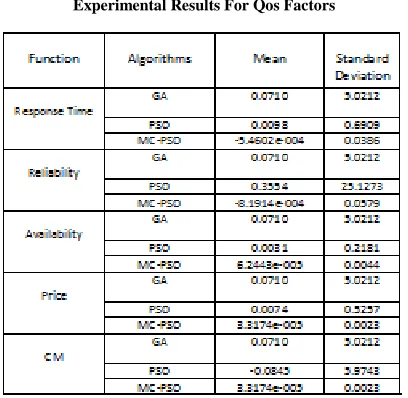
[image:8.612.66.270.256.455.2]An experimental evaluation is done by using MATLAB where the QoS factor checked by Multi Colony– Particle Swarm Optimization (MC-PSO) algorithm for Web service selection problem includes availability, reliability, response time and price. MC-PSO algorithm provides an optimal service selection which can be shown by the performance.
Table I
Experimental Results For Qos Factors
VI. CONCLUSION AND FUTURE ENHANCEMENT
The proposed novel optimization algorithm Multi Colony-Particle Swarm Optimization (MC-PSO) algorithm which is based on the animal search behavior and its movement as well as the intelligence of the swarm. MC-PSO algorithm is conceptually simple and it is very easy to implement. MC-PSO algorithm can handle a variety of optimization problem and it can also apply to various real world complex applications. A set of five benchmark functions have been used to test the MC-PSO algorithm in comparison with GA and PSO respectively.
In order to validate the applicability of the MC-PSO algorithm in real world complex problems, we applied Web Service Selection problem to solve NP-Hard optimization problem. From the experimental results, this methodology concludes that, among the three algorithms MC-PSO is better than other two algorithms. The PSO algorithm is better than the GA algorithm (MC-PSO<PSO<GA). The smaller the standard deviation (sd) value, the results are very optimal.
Future work is the enhancement of Multi Colony – Particle Swarm Optimization (MC-PSO) algorithm to work in any type of environment and adding the cooperativeness among the services increases robustness makes cost and time less than Multi Colony – Particle Swarm Optimization (MC-PSO) algorithm and also makes testing of proposed algorithm with the other algorithms with large number of test functions.
REFERENCES
[1] Xiao-Qin Fan a,b,*, Xian-Wen Fang b, Chang-Jun Jiang b, ―Research
on Web service selection based on cooperative evolution‖, Expert Systems with Applications xxx (2011) xxx–xxx.
[2] James Kennedy' and Russell Eberhart2 , ―Particle Swarm
Optimization‖.
[3] XiaohuiHu 1,2, Russell Eberhart 2,‖Solving Constrained Non-linear
Optimization Problems with Particle Swarm Optimization‖. [4] Xiaohui Hu 1, 2 and Russell C. Eberhart 2 , ―Adaptive Particle Swarm
Optimization: Detection and Response to Dynamic Systems‖. [5] Yuhui Shi and Russell Eberhart, ―A Modified Particle Swarm
Optimizer‖.
[6] Xiaohui Hu, Russell C. Eberhart' Yuhui Shi', ―Swarm Intelligence for Permutation Optimization:A Case Study of n-Queens Problem‖. [7] Russell Eberhart, Xiaohui Hu,‖ Human Tremor Analysis Using
Particle Swarm Optimization‖.
[8] Russell C. Eberhart, Yuhui Shi,‖ Particle Swarm Optimization: Development, Applications and Resources‖.
[9] Xiang Xiao, Ernst R. Dow, Russell Eberhart, Zina Ben Miled, Robert J. Oppelt, ―Gene Clustering Using Self-Organizing Maps and Particle Swarm Optimization‖.
[10] Russell C. Eberhart1, Yuhui Shi2,‖Empirical study of Particle Swarm
Optimization‖.
[11] Russell Eberhart, James Kennedy,‖A New Optimizer Using Particle Swarm Theory‖.
[12] James Kennedy, Rui Mendes, ‖Population Structure and Particle Swarm Performance‖.
[13] Kyriakos Kritikos and Dimitris Plexousakis, Member, IEEE,‖ Requirements for QoS-Based Web Service Description and
Discovery‖,IEEE TRANSACTIONS ON SERVICES
COMPUTING, VOL. 2, NO. 4, OCTOBER-DECEMBER 2009. [14] J. Izquierdo* , I. Montalvo, R. Pérez, V.S. Fuertes, ―Forecasting
pedestrian evacuation times by using swarm intelligence‖, Physica A 388 (2009) 1213_1220.
[15] Hongbo Liu a,c,d,,*, Ajith Abraham b,c, Maurice Clerc d,‖ Chaotic
dynamic characteristics in swarm intelligence‖, Applied Soft Computing 7 (2007) 1019–1026.
[16] Dušan Teodorovic´,‖ Swarm intelligence systems for transportation engineering:Principles and applications‖, Transportation Research Part C 16 (2008) 651–667.
[17] Swagatam Das*, Amit Konar,‖ A swarm intelligence approach to the synthesis of two-dimensional IIR filters‖, Engineering Applications of Artificial Intelligence 20 (2007) 1086–1096.
International Journal of Emerging Technology and Advanced Engineering
Website: www.ijetae.com (ISSN 2250-2459,ISO 9001:2008 Certified Journal, Volume 3, Issue 8, August 2013)
497 [19] Alper Unler*,‖ Improvement of energy demand forecasts using
swarm intelligence:The case of Turkey with projections to 2025‖, Energy Policy 36 (2008) 1937–1944.
[20] B. Denbya,*, S. Le Hegarat-Mascleb, ‖Swarm intelligence in
optimisation problems‖, Nuclear Instruments and Methods in Physics Research A 502 (2003) 364–368.
[21] S. He, Member, IEEE, Q. H. Wu, IEEE, Senior Member, and J. R. Saunders, ―Group Search Optimizer: An OptimizationAlgorithm Inspired by Animal Searching Behavior‖, IEEE TRANSACTIONS ON EVOLUTIONARY COMPUTATION, VOL. 13, NO. 5, OCTOBER 2009.
[22] Muhammad Saleem a,*, Gianni A. Di Caro b, Muddassar Farooq c,
Swarm intelligence based routing protocol for wireless sensor networks: Survey and future directions, Information Sciences 181 (2011) 4597–4624.
[23] Z.K.Silagadze, ―Finding Two-Dimensional Peaks‖.
[24] Marcin Molga, Czesław Smutnicki, ‖Test functions for optimization needs‖.
[25] M. MONTAZ ALI1, CHAROENCHAI KHOMPATRAPORN2 and
ZELDA B. ZABINSKY2,‖ A Numerical Evaluation of Several
Stochastic Algorithms on Selected Continuous Global Optimization Test Problems‖, Journal of Global Optimization (2005) 31: 635–672 _ Springer 2005,DOI 10.1007/s10898-004-9972-2.
[26] Ernesto P. Adorio,‖ MVF - Multivariate Test Functions Library in C for Unconstrained Global Optimization‖.
[27] Mishra, Sudhanshu, ―Some new test functions for global optimization and performance of Repulsive particle swarm method‖, Munich Personal RePEc Archive.
[28] Daniel Bratton, James Kennedy,―Defining a Standard for Particle Swarm Optimization‖, Proceedings of the 2007 IEEE Swarm Intelligence Symposium (SIS 2007).
[29] Maurice Clerc and James Kennedy, ‖The Particle Swarm— Explosion, Stability, and Convergence in a Multidimensional Complex Space‖, IEEE TRANSACTIONS ON EVOLUTIONARY COMPUTATION, VOL. 6, NO. 1, FEBRUARY 2002.
[30] Yong Zhang a,*, Dun-Wei Gong a, Zhonghai Ding b,‖ A bare-bones multi-objective particle swarm optimization algorithm for environmental/economic dispatch‖, Information Sciences 192 (2012) 213–227.
[31] T.C. Wong*, S.C. Ngan1,―A comparison of hybrid genetic algorithm and hybrid particle swarm optimization to minimize makespan for assembly job shop‖, Applied Soft Computing xxx (2012) xxx–xxx. [32] Yannis Marinakis *, Magdalene Marinaki, ‖A hybrid genetic –
Particle Swarm Optimization Algorithm for the vehiclerouting problem‖, Expert Systems with Applications 37 (2010) 1446–1455. [33] Yi-Tung Kaoa, Erwie Zaharab,*, ―A hybrid genetic algorithm and
particle swarm optimization for multimodal functions‖, Applied Soft Computing 8 (2008) 849–857.
[34] R.J. Kuo a,*, Y.S. Han b, ―A hybrid of genetic algorithm and particle
swarm optimization for solving bi-level linear programming problem – A case study on supply chain model‖, Applied Mathematical Modelling 35 (2011) 3905–3917.
[35] DongLi Jia a,b,*, GuoXin Zheng a, BoYang Qu c, Muhammad
Khurram Khan d, ―A hybrid particle swarm optimization algorithm
for high-dimensional problems ―, Computers & Industrial Engineering 61 (2011) 1117–1122.
[36] Peng-Yeng YinT, Shiuh-Sheng Yu, Pei-Pei Wang, Yi-Te Wang, ―A hybrid particle swarm optimization algorithm for optimal task assignment in distributed systems‖, Computer Standards & Interfaces 28 (2006) 441–450.
[37] Jing-Ru Zhang a,b,*, Jun Zhang a, Tat-Ming Lok c, Michael R. Lyu d,
―A hybrid particle swarm optimization–back-propagation algorithm for feedforward neural network training‖, Applied Mathematics and Computation 185 (2007) 1026–1037.
[38] Li-Chuan Lien a,*, Min-Yuan Cheng b, ―A hybrid swarm intelligence
based particle-bee algorithm for construction site layout optimization‖, Expert Systems with Applications 39 (2012) 9642– 9650.
[39] Taher Niknam n, EhsanAzadFarsani, ‖A hybrid self-adaptive particle swarm optimization and modified shuffled frog leaping algorithm for distribution feeder reconfiguration‖, Engineering Applications of Artificial Intelligence 23 (2010) 1340–1349. [40] Hongfeng Wang a,b,c,*, Ilkyeong Moon b,*, Shenxiang Yang c,d,
Dingwei Wanga,c, ―A memetic particle swarm optimization
algorithm for multimodal optimization problems‖, Information Sciences 197 (2012) 38–52.
[41] Ali T. Al-Awami a, Azzedine Zerguine b,*, Lahouari Cheded c,
Abdelmalek Zidouri b,Waleed Saif d, ―A new modified particle
swarm optimization algorithm for adaptive Equalization‖, Digital Signal Processing 21 (2011) 195–207.
[42] M. Senthil Arumugam *, M.V.C. Rao, Alan W.C. Tan,―A novel and
effective particle swarm optimization like algorithm with extrapolation technique‖, Applied Soft Computing 9 (2009) 308– 320.
[43] Jingli Wua,b, Jianxin Wanga,*, Jian‘er Chen a,c, ―A practical
algorithm based on particle swarm optimization for haplotype reconstruction‖ , Applied Mathematics and Computation 208 (2009) 363–372.
[44] Zhigang Lian a,*, Xingsheng Gu a, Bin Jiao a,b,‖ A similar particle
swarm optimization algorithm for permutation flowshop scheduling to minimize makespan‖, Applied Mathematics and Computation 175 (2006) 773–785.
[45] K.W. Chau*, ―A split-step particle swarm optimization algorithm in
river stage forecasting‖, Journal of Hydrology (2007) 346, 131– 135. [46] Cheng-Jian Lin*,‖An efficient immune-based symbiotic particle
swarm optimization learning algorithm for TSK-type neuro-fuzzy networks design‖,Fuzzy Sets and Systems 159 (2008) 2890 – 2909. [47] R.J. Kuoa,*, L.M. Lin b,‖Application of a hybrid of genetic algorithm
and particle swarm optimization algorithm for order clustering‖, Decision Support Systems 49 (2010) 451–462.
[48] Swagatam Das a,*, Ajith Abraham b, Amit Konar a,‖ Automatic
kernel clustering with a Multi-Elitist Particle Swarm Optimization Algorithm‖, Pattern Recognition Letters 29 (2008) 688–699. [49] Bo Li *, Koichi Wada,‖Communication latency tolerant parallel
algorithm for particle swarm optimization‖, Parallel Computing 37 (2011) 1–10.
[50] Wei-Bo Zhang, Guang-Yu Zhu *, ‖Comparison and application of
four versions of particle swarm optimization algorithms in the sequence optimization‖, Expert Systems with Applications 38 (2011) 8858–8864.
[51] Zhao Chenglin a,*, Sun Xuebin a, Sun Songlin b, Jiang Ting a,‖ Fault
International Journal of Emerging Technology and Advanced Engineering
Website: www.ijetae.com (ISSN 2250-2459,ISO 9001:2008 Certified Journal, Volume 3, Issue 8, August 2013)
498 [52] W.F. Abd-El-Waheda, A.A. Mousa,b,*, M.A. El-Shorbagy
b,‖Integrating particle swarm optimization with genetic algorithms
for solving nonlinear optimization problems‖, Journal of Computational and Applied Mathematics 235 (2011) 1446–1453. [53] R.J. Kuo a,*, Y.J. Syu b, Zhen-Yao Chen c, F.C. Tien d,‖ Integration
of particle swarm optimization and genetic algorithm for dynamic clustering‖, Information Sciences 195 (2012) 124–140.
[54] A.A. Mousaa,c,*, M.A. El-Shorbagy a, W.F. Abd-El-Wahedb,‖Local
search based hybrid particle swarm optimization algorithm for multiobjective optimization‖, Swarm and Evolutionary Computation 3 (2012) 1–14.
[55] Hsing-Chih Tsai*, Yong-Huang Lin, ―Modification of the fish swarm
algorithm with particle swarm optimization formulation and communication behavior‖, Applied Soft Computing 11 (2011) 5367– 5374.
[56] Jianzhou Wang, Suling Zhu *, Weigang Zhao, Wenjin Zhu, ‖
Optimal parameters estimation and input subset for grey model based on chaotic particle swarm optimization algorithm‖, Expert Systems with Applications 38 (2011) 8151–8158.
[57] X.H. Shi a, Y.C. Lianga,b,*, H.P. Leeb,c, C. Lub, Q.X. Wanga,
―Particle swarm optimization-based algorithms for TSP and generalized TSP‖, Information Processing Letters 103 (2007) 169– 176.
[58] Zhang Zhisheng,‖ Quantum-behaved particle swarm optimization algorithm for economic load dispatch of power system‖, Expert Systems with Applications 37 (2010) 1800–1803.
[59] Xiang Fua,*, Anqiang Li b, Liping Wangc, Changming Ji c,‖
Short-term scheduling of cascade reservoirs using an immune algorithm-based particle swarm optimization‖, Computers and Mathematics with Applications 62 (2011) 2463–2471.
[60] R.J. Kuoa,*, C.Y. Yangb,1,‖Simulation optimization using particle
swarm optimization algorithm with application to assembly line design‖, Applied Soft Computing 11 (2011) 605–613.
[61] Chia-Feng Lin a, Ruey-Kai Sheu b,*, Yue-Shan Chang c, Shyan-Ming
Yuan a, ―A relaxable service selection algorithm for QoS-based web
service composition‖, Information and Software Technology 53 (2011) 1370–1381.
[62] Angus F.M. Huang a, Ci-Wei Lan b, Stephen J.H. Yang a,*, ‖ An
optimal QoS-based Web service selection scheme‖, Information Sciences 179 (2009) 3309–3322.
[63] Xinchao Zhaoa,b,*, Boqian Songa, Panyu Huanga, Zichao Wena, Jialei Wengc, Yi Fana, ―An improved discrete immune optimization algorithm based on PSO for QoS-driven web service composition
*‖,Applied Soft Computing xxx (2012) xxx–xxx.
[64] Rania Hassan* ,Babak Cohanim† ,Olivier de Weck‡ ,―A comparison
of Particle Swarm Optimization and the Genetic Algorithm‖. [65] Hanning Chen *, Yunlong Zhu, Kunyuan Hu, ―Multi-colony bacteria