SAIZALMURSIDI BIN MD MUSTAM
SAIZALMURSIDI BIN MD MUSTAM
A thesis submitted in fulfilment of the requirements for the award of the degree of Doctor of Philosophy (Electrical Engineering)
Faculty of Electrical Engineering Universiti Teknologi Malaysia
ACKNOWLEDGEMENT
I would like to express my deepest gratitude to my supervisor, Associate Professor Dr. Sharifah Kamilah binti Syed Yusof for giving me an opportunity to work under her guidance, and for her trust, support and encouragement throughout the entire duration of my Ph.D study. I am also thankful for her unbounded energy and passion, which helped me to steadily advance towards the successful completion of this thesis.
I would also like to extend my appreciation to all staffs of the Faculty of Electrical Engineering, Universiti Teknologi Malaysia (UTM) Skudai, who have involved directly or indirectly throughout the period of my Ph.D study. In particular, I would like to sincerely thanks Professor Dr. Norshiela binti Fisal for her invaluable comments, advises and motivation which have helped me to achieve a solid research path towards this thesis. To all my colleagues and fellow researchers in the UTM-MIMOS Telecommunication Technology Research Group, thank you for the unique atmosphere, constant support and true friendship we have had during my research period.
I would also like to thank the Ministry of Higher Education, Malaysia, and the University Tun Hussein Onn Malaysia (UTHM) for the financial support provided in the form of a doctoral scholarship and monthly allowances.
Special thanks are due to my parents, Md Mustam bin Marzuki and Sa’emah binti Ngadi, my wife Fazlina binti Yunus and my sons Muhammad Sadiq and Muhammad Faqih, for their understanding, patience, encouragement, support and love.
ABSTRACT
ABSTRAK
TABLE OF CONTENTS
CHAPTER TITLE PAGE
DECLARATION ii
DEDICATION iii
ACKNOWLEDGEMENT iv
ABSTRACT v
ABSTRAK vi
TABLE OF CONTENTS vii
LIST OF TABLES xi
LIST OF FIGURES xii
LIST OF ABBREVIATIONS xvi
LIST OF SYMBOLS xvii
LIST OF APPENDICES xxi
1 INTRODUCTION 1
1.1 Background 1
1.2 Problem Statement 3
1.3 Research Objectives 4
1.4 Research Scopes 4
1.5 Research Contributions 6
1.6 Significance of Research 8
1.7 Thesis Outline 8
2 LITERATURE REVIEW 10
2.1 Introduction 10
2.2 Nanocommunication and Nanonetworks 11
2.2.1 Nano-electromagnetic Communication 13
2.2.2 Molecular Communication 13
2.3 Overview of Diffusion-Based Molecular
2.3.1 Encoding and Transmission of
Informa-tion Molecules 15
2.3.2 Propagation or Diffusion of Information
Molecules 16
2.3.3 Reception and Decoding of Information
Molecules 18
2.4 Related Research Works 18
2.4.1 The DBMC Channel Modeling 18
2.4.2 Multilayer Diffusion 21
2.5 Context of the Research 22
2.6 Summary 22
3 RESEARCH METHODOLOGY 24
3.1 Introduction 24
3.2 Research Procedures 25
3.2.1 Mathematical Modeling of Multilayer
DBMC Channel 27
3.2.1.1 Derivation of mean molecular
concentration at RN 28
3.2.1.2 Development of Simulation
Model using N3Sim Simulator 29 3.2.1.3 Formulation of Multilayer
DBMC Channel Impulse Response, Time Delay,
Attenuation and Delay Spread 30 3.2.1.4 Derivation of Multilayer
DBMC Channel Capacity 31
3.2.2 Performance Evaluation of Multilayer
DBMC Channel 31
3.2.2.1 Performance Metrics 31
3.2.2.2 A Multilayer Medium Under
Study 32
3.3 Analytical and Numerical Analysis Tools 34
3.4 Summary 34
4 MATHEMATICAL MODELING OF MULTILAYER
DBMC CHANNEL 35
4.2 Multilayer DBMC Channel Modeling 36 4.2.1 Mean Molecular Concentration over
n−Layer Channel 37
4.2.2 Mean Number of Received Molecules 43 4.3 Formulation of Multilayer DBMC Channel
Charac-teristics 44
4.3.1 Channel Impulse Response 44
4.3.2 Channel Time Delay 44
4.3.3 Channel Attenuation 45
4.3.4 Channel Delay Spread 46
4.3.4.1 Delay Spread of Impulse Trans-mission over Multilayer DBMC
Channel 46
4.3.4.2 Spreading of a Square Pulse Transmission over Multilayer
DBMC Channel 49
4.3.5 Channel Capacity 53
4.3.5.1 The Fick’s Diffusion Mutual
Information 54
4.3.5.2 The Capacity of Multilayer
DBMC Channel 56
4.4 Summary 57
5 PERFORMANCE ANALYSIS OF MULTILAYER
DBMC CHANNEL 58
5.1 Introduction 58
5.2 Channel Impulse Response,h(r, t) 61 5.3 Mean Molecular Concentration,c(r, t) 63 5.4 Mean Number of Received Molecules,s(r, t) 65
5.4.1 Effects of Layer Fraction, fi on the
Maximum Mean Number of Received
Molecules,s(r, t)max and Time Delay,td 66
5.4.2 Effects of Transmission Distance, r on the Maximum Mean Number of Received
Molecules,s(r, t)max and Time Delay,td 68
5.4.3 Effects of Total Number of Transmit-ted Molecules, Q0 on the Maximum
Mean Number of Received Molecules,
5.5 Analysis of Delay Spread in Multilayer DBMC
Channel 75
5.5.1 Effects of Multilayer Channel on the
Channel Delay Spread,τh 75
5.5.2 Effects of Transmission Distance,ron the
Channel Delay Spread,τh 78
5.5.3 Effects of Total Number of Transmitted Molecules, Q0 on the Channel Delay
Spread,τh 80
5.5.4 Effects of Data Rate of Transmitted Bit,
Rb = 1/Tb on the Pulse Spreading 82
5.6 Analysis of Capacity in Multilayer DBMC Channel 83 5.6.1 Transfer Function Fourier Transform of
Channel Impulse Response,h(r, f) 84 5.6.2 Capacity, C versus Bandwidth, W for
Different Values of Transmission
Dis-tance,r 85
5.6.3 Capacity, C versus Transmission Dis-tance, r for Different Values of
Band-width,W 86
5.6.4 Capacity, C versus Transmission Dis-tance, r for Different Values of Layer
Fraction,fi 88
5.6.5 Capacity, C versus Bandwidth, W for Different Values of the Average Power
Transmission,PH 89
5.7 Summary 90
6 CONCLUSIONS 91
6.1 Conclusions 91
6.2 Recommendations for Future Work 94
REFERENCES 95
LIST OF TABLES
TABLE NO. TITLE PAGE
2.1 Nano-electromagnetic versus molecular communications 13 2.2 Summary of related works on point-to-point DBMC channel
model 23
5.1 Simulation parameters 59
5.2 Effects of doubling and halving ofr = 45µm on s(r, t)max
andtd 69
5.3 Channel delay spread, τh and pulse spreading of a square
pulse transmission withTb = 5s 77
LIST OF FIGURES
FIGURE NO. TITLE PAGE
2.1 An overview of nanonetworks: (a) nano-electromagnetic
communication, and (b) molecular communication 12 2.2 Molecular communication with (a) active transport, and (b)
passive transport by diffusion 14
2.3 Diffusion-based molecular communication (DBMC) system 15 2.4 Multilayer structures: (a) an alveolar-blood capillary barrier,
and (b) the stomach-blood barrier 21
3.1 Flowchart of the research activities 26
3.2 Block diagram of the research framework 27
3.3 A multilayer diffusion-based molecular communication
(DBMC) system 28
3.4 Flowchart of simulation steps using N3Sim simulator 29 3.5 Multilayer DBMC channel over the air-water-blood plasma
medium (a) a physical system, and (b) the simplified
representation 33
4.1 (a) Ohm’s circuit law and (b) the equivalent relationship between the radial diffusive flux and the concentration
difference of molecules 39
4.2 Multilayer diffusion: (a) a thin interlayer between n thick
different mediums and (b) its equivalent circuit 40 4.3 (a) Impulse transmission sequence with symbol interval, Ts
and, (b) the response of mean molecular concentration due to
impulsive transmission 47
4.4 (a) A square pulse molecules transmission with pulse duration, Tb and average amplitude of Qave and, (b) output
response of mean molecular concentration due to a square
pulse molecules transmission 49
4.5 Information-theoretic diagram of multilayer DBMC system 53 4.6 Venn diagram of the mutual information between the input
5.1 Multilayer diffusion: (a) an alveolar-blood barrier and, (b) the
simplified multilayer representation 60
5.2 Channel impulse responses for air, water, blood plasma, water-blood plasma and air-water-blood plasma mediums
with a separation distance ofr= 45µm 61 5.3 Mean molecular concentration at the RN location, for a
pulse transmission of5×105 molecules through single layer
medium with diffusion coefficient, D of 1nm2/ns (ionic
calcium in the cytoplasm) and transmission distance of 3µm 63 5.4 Analytical and simulation results of mean molecular
concentration at the RN sensing volume, for the transmission of 2 × 10⁵ molecules through water-blood plasma and air-water-blood plasma mediums with the transmission distance
of 45µm 64
5.5 Analytical and simulation results of mean number of received molecules at the RN sensing volume, for the transmission of
2×10⁵molecules through water-blood plasma and
air-water-blood plasma propagation mediums with the transmission
distance of 45µm 66
5.6 Mean number of received molecules at the RN (r = 45 µm) over the water (Dwater), blood plasma (Dblood), and
water-blood plasma mediums with different fractions of layer
thicknesses (Dav,1,Dav,2, andDav,3) 67
5.7 Mean number of received molecules at the RN (r = 45µm) over the air (Dair), blood plasma (Dblood), and air-blood
plasma mediums with different fractions of layer thicknesses
(Dav,1,Dav,2, andDav,3) 67
5.8 Mean number of received molecules at the RN over the water-blood plasma medium(f1 =f2 = 0.5)when (a) doubling the
TN–RN distance from 45 µm to 90 µm and, (b) halving the
TN–RN distance from 45µm to 22.5µm 70
5.9 Mean number of received molecules at the RN over the air-blood plasma medium(f1 =f2 = 0.5)when (a) doubling the
TN–RN distance from 45 µm to 90 µm and, (b) halving the
TN–RN distance from 45µm to 22.5µm 71
5.10 Mean number of received molecules at the RN over the air-water-blood plasma medium(f1 =f2 =f3 = 1/3)when (a)
doubling the TN–RN distance from 45µm to 90µm and, (b)
5.11 Mean number of received molecules at the RN over the water-blood plasma medium (f1 = f2 = 0.5) for 45 µm of the
TN–RN distance when varying the number of transmitted
molecules from2×105 to4×105 and8×105molecules 73
5.12 Mean number of received molecules at the RN over the air-blood plasma medium (f1 = f2 = 0.5) for 45 µm of the
TN–RN distance when varying the number of transmitted
molecules from2×105 to4×105 and8×105molecules 74
5.13 Mean number of received molecules at the RN over the air-water-blood plasma medium (f1 = f2 = f3 = 1/3) for
45 µm of the TN–RN distance when varying the number of transmitted molecules from2×105 to 4×10⁵ and 8×10⁵
molecules 74
5.14 Normalized mean molecular concentration at the RN for 45 µm of the TN–RN distance, over the air-water-blood plasma (Dav,1), air-air-blood plasma (Dav,2), and air-air-water plasma
(Dav,3) mediums with layer fraction off1 = f2 = f3 = 1/3
due to (a) an impulsive transmission of molecules, and (b) a
square pulse transmission of molecules withTb = 5s 76
5.15 Normalized mean molecular concentration at the RN over the air-water-blood plasma medium with equal layer fraction
(f1 =f2 =f3 = 1/3)when increasing the TN–RN distance
from 22.5 µm to 30µm and 45µm due to (a) an impulsive transmission and, (b) a square pulse transmission with Tb =
5s 79
5.16 Normalized mean molecular concentration at the RN for 45 µm of the TN–RN distance, over the air-water-blood plasma medium with equal layer fraction (f1 = f2 = f3 = 1/3)
when increasing the number or transmitted molecules from
2 × 10⁵ to 4 × 10⁵ and 8 × 10⁵ due to (a) an impulsive transmission and, (b) a square pulse transmission with Tb =
5s 81
5.17 Normalized mean molecular concentration at the RN for 45 µm of the TN–RN distance, over the air-water-blood plasma medium with equal layer fraction(f1 = f2 = f3 = 1/3)for
a square pulse transmission with different pulse width,Tp of
5.18 Transfer function Fourier transform of channel impulse response over the air-water-blood plasma medium(f1 =f2 =
f3 = 1/3) for 30 µm, 50 µm and 100 µm of the TN–RN
distances 84
5.19 Capacity for various TN-RN distances as a function of bandwidth over the air-water-blood plasma medium (f1 =
f2 =f3 = 1/3) 86
5.20 Capacity for various transmission bandwidths as a function of TN-RN distance over the air-water-blood plasma medium
(f1 =f2 =f3 = 1/3) 87
5.21 Capacity for various layer fractions as a function of TN-RN
distance over the air-water-blood plasma medium 88 5.22 Capacity for various average transmitted powers as a function
of bandwidth over the air-water-blood plasma medium(f1 =
f2 =f3 = 1/3) 89
A.1 Steady-state diffusion in one dimensional 104
LIST OF ABBREVIATIONS
BANs - Body Area Nanonetworks
dB - Decibel
C - Celcius
CSK - Concentration Shift Keying
DBMC - Diffusion-Based Molecular Communication
Hz - Hertz
IoBNT - Internet of Bio-Nano Things
ISI - Inter-Symbol Interference
MoSK - Molecule Shift Keying
OOK - On-Off Keying
ODE - Ordinary Differential Equation
PAM - Pulse Amplitude Modulation
PDE - Partial Differential Equation
RN - Receiver Nanomachine
TN - Transmitter Nanomachine
LIST OF SYMBOLS
δ(r) - Dirac’s delta function of the source location δ(t) - Dirac’s delta function of the source time η - Dynamic viscosity of the fluidic medium ηair - Dynamic viscosity of air
ηwater - Dynamic viscosity of water
ηblood - Dynamic viscosity of blood plasma
τh - Channel delay spread
∗ - Convolution operation
v0−v1 - Voltage difference
∇2 - Laplacian operator
∂ ∂x
ˆi+ ∂ ∂y
ˆj+ ∂ ∂z
ˆ
k- Three-dimensional gradient operator ∂c(r, t)
∂r - Molecular concentration gradient ∂c(r, t)
∂t - Time rate changes in molecular concentration dc(r, t)
dt - First time derivative of mean molecular concentration ` - Total thickness of the propagation medium
`/D - Diffusive resistance of the medium `i/Di - Diffusive resistance of thei-layer
`i/` - Fraction of thei-layer
∆c - Cocentration difference of molecules
∆r - Membrane thickness
c(x, y, z, t) - Mean molecular concentration in three dimensional
space at time t
c(r, t) - Mean molecular concentration
c(r0+`, t) - Concentration of molecules at the location of RN
c(r, t)max - Channel attenuation, or maximum peak of mean
molecular concentration
cr(r, t) - First space derivative of mean molecular concentration
crr(r, t) - Second space derivative of mean molecular concentration
ct(r, t) - First time derivative of mean molecular concentration
ct(ω, t) - First time derivative of Laplace transforms ofC(ω, t)
erf c - Complementary error function
fi - Fraction of thei-layer
fx(x) - Probability density function of all the possible transmitted
signal X
h(r, f) - Transfer function Fourier transform of the channel impulse response
h(r, t) - Channel impulse response
i - An integer 1, 2, 3, ...
inverf c - Inverse operation of the complementary error function
k - Partition coefficient of membrane
kB - Boltzmann constant
n - Number of layers
r - Transmission distance or TN-RN distance
rm - Radius of molecules
rs - Radius of receiver sensing volume
s(r, t) - Mean number of received molecules
t - Time
td - Time delay
A - Area
C - Channel capacity
D - Diffusion coefficient
Dav - Average diffusion coefficient
Di - Diffusion coefficient of thei-layer
H(Y) - Entropy per second of the received signalY
H( ˆQ) - Entropy of the number of transmitted molecules per time sample of the time function signal Q(t)
H(X, Y) - Joint entropy per second of the transmitted signalX and the received signalY
H(X|Y) - Conditional entropy per second of the transmitted signal Xgiven the received signalY
I - Current
I(X;Y) - Mutual information
J - Flux or diffusion rate per unit area J(x, t) - Net diffusion flux atxand at timet J(x+`, t) - Net diffusion flux atx+`and at timet J(r, t) - Net radial diffusion flux
~
J(x, y, z, t) - Flux vector in three dimensional space at timet
N(x, t) - Molecules at positionxand timet N(x+δ,t) - Molecules at positionx+δand timet
dN - Net number of particles
P - Permeability coefficient
¯
PH - Average thermodynamic power in molecules transmission
Q - Total number of transmitted molecules Q0 - Total number of transmitted molecules
Qave - Average number of transmitted molecules
Q(t) - Time function of molecule transmission
R - Resistance
Rb - Data rate of transmitted bits
T - Temperature
Tb - Pulse bit duration
Ts - Symbol duration or interval
V - Receiver sensing volume
dV - Differential volume
X - Transmitted or input signal
Y - Received or output signal
LIST OF APPENDICES
APPENDIX TITLE PAGE
A The Fick’s First Law of Diffusion 104
B The Fick’s Second Law of Diffusion 107
C Solution of Diffusion Equation for an Impulsive Molecules
Transmission 110
D Solution of Diffusion Equation for a Time-Function
Molecules Transmission 115
E Solution of Multilayer Diffusion Equation for an Impulsive
Molecules Transmission 120
F Solution of Multilayer Diffusion Equation for a
Time-Function Molecules Transmission 126
G The Transfer Function Fourier Transform of Channel Impulse
Response 132
H Conditional Entropy per SecondH(X | Y)of the
Transmit-ted SignalX Given the Mean Molecular ConcentrationY 136
INTRODUCTION
1.1 Background
Rapid development in nanotechnology has motivated nanocommunication and nanonetworks of large numbers of nanoscale devices or nanomachines. Nanocommunication is a new research area where a communication process occurs between nanomachines. In a nanonetwork, a group of nanomachines is interconnected among them and expected to share information and coordinate activities to perform a specific task. With nanonetworks, the limited capabilities of a single nanomachine, such as only for computation, sensing, or actuation, can be expanded for executing more complex tasks and a wide range of applications. Interaction among networked nanomachines will allow the implementation of collaborative and synchronous tasks such as in-body drug delivery, disease treatments, and monitoring and controlling of environmental pollution [1].
In the past decade, research activities have shown significant interests in the area of molecular communication to realize nanocommunication and nanonetworks. Numerous research efforts can be found in the literature to investigate the various models of molecular communication. Some of the proposed models are random walk [8,9], flow based or random walk with drift [10–12], diffusion based [2,3,12–15], diffusion-reaction based [16], walkway or active transport based [8, 17, 18] and collision based [19]. The performances of the proposed models are then analyzed in terms of channel capacity [9, 10], modulation schemes [9], normalized gain and delay [3], probability of reaching a receiver [17], transmission rate [11,12,15,17,18], mutual information [10, 11], noise [13], throughput and efficiency [14], signal attenuation and amplification [16], collision rate [19], and communication range [15].
Among the proposed channel models, molecular communication by diffusion or diffusion-based molecular communication (DBMC) with and without drift has been the focus of interest in the research community [20]. The DBMC channel model is chosen as it represents the most basic and widespread molecular communication architecture found in nature [21, 22]. The concept of congestion in the DBMC channel for drug delivery near the targeted or disease area is introduced in [20]. A drug delivery system model using the DBMC with drift for drug transportation over bloodstream to only unhealthy parts inside the body can be found in [23]. Recently, the concept of body area nanonetworks (BANs) with DBMC for healthcare applications has been introduced in [5]. Furthermore, the concept of the Internet of Bio-Nano Things (IoBNT), involving the DBMC model for intra-body communication can be found in [24]. It is expected that from the proposed IoBNT, a healthcare provider can retrieve certain intra-body status parameters, such as glucose, sodium, and cholesterol levels, and the presence of unwanted agent through bio-nano things inside the body by using the Internet connection. The term bio-nano things can be referred to any type of nanosystems including liposomes [25–27], dendrimers [28], metallic nanoparticles [29], polymeric nanoparticles [30], carbon nanotubes [31] and nanowires [32, 33].
condition, identifying the targeted drug delivery locations, and automatically control the amount and time of drug release. Moreover, the molecules of the drug are expected to be able to diffuse across a multilayer barrier or multiple environments towards the bloodstream as well as to the other parts inside the body or the infected area. Thus, a better understanding of how the drug’s molecules diffusing over the body and its concentration over time are utmost important for an effective disease treatment with an optimum amount of drugs.
1.2 Problem Statement
In nanoscale communication, the DBMC has emerged as one of the most promising communication models, particularly for health monitoring and drug delivery applications. In the DBMC, a transmitter nanomachine (TN) translates a message into encoded molecules and transmits them to a propagation medium or channel by opening a molecular gate. The transmitted molecules are then propagated from the TN to a receiver nanomachine (RN) over the channel by a diffusion process via Brownian motion. The RN captures the encoded molecules propagating in the channel and finally decodes the captured molecules.
Although, numerous studies have been conducted to evaluate and analyze DBMC system, investigation on DBMC through a multilayer channel due to variations in the medium properties or medium temperature has had less attention. The propagation of molecules over various mediums and environments or more complex medium, such as intracellular environment and the human body needs to be considered [4]. In practice, the diffusion of molecules can occur over the several layers in the human body, for example, diffusion of oxygen and carbon dioxide over the alveolar-blood barrier in the respiratory system [34], diffusion of digested particles, nutrients or medicine across the stomach-blood barrier during the absorption process, and diffusion of water, oxygen, carbon dioxide and lipid-soluble molecules through the blood-brain barrier [34]. Additionally, a tissue, particularly an arterial wall, which has the different material properties in each layer, is commonly modeled as a multilayer medium [35, 36].
clear how molecules will propagate through the multilayer DBMC channel that is consisting of different medium properties or different medium temperature. Thus, it is utmost important to develop a mathematical model to predict the concentration profile over time and characterize how molecules will propagate over a multilayer channel. Modeling and analysis of molecules’ propagation over a multilayer channel with different medium properties are important to be explored in order to support the future biomedical applications such as regulating the release of drugs over a multilayer structure of environment in living tissue, as well as for the BANs and IoBNT applications. Therefore, this research work is proposed to model and evaluate the performance of multilayer DBMC channel.
1.3 Research Objectives
The main objective of this research is to mathematically model and evaluate the performance of multilayer DBMC channel. This research study has the following specific objectives:
(i) To develop a mathematical model of multilayer DBMC channel in deriving a closed-form expression of the mean molecular concentration at the RN location.
(ii) To formulate channel characteristics of multilayer DBMC channel.
(iii) To evaluate the performance of the multilayer DBMC channel generated from different medium properties.
1.4 Research Scopes
In order to achieve the objectives, the following scopes have been employed:
(ii) Pulse-based modulation (an impulsive transmission) with concentration encoding scheme as well as amplitude detection technique is considered in formulating the multilayer DBMC channel characteristics such as channel impulse response, channel time delay, channel attenuation or the maximum amplitude of mean molecular concentration, channel delay spread, and channel capacity.
(iii) The performance evaluation is done for multilayer diffusion over the air-water-blood plasma medium representing the simplified model of the alveolar-air-water-blood capillary barriers in the human respiration system. The interlayer between two different mediums and membranes is considered thin and permeable to the transmitted information molecules which have a radius similar to an oxygen atom.
The detailed explanations on the assumptions made in mathematical modeling of multilayer DBMC channel are given in Chapter 4. Thus, the developed mathematical model has the following limitations:
(i) The mean molecular concentration at the RN location is derived for a point-source TN and a point-point-source RN with an infinite boundary. For more realistic and accurate models, propagation of molecules between a spherical TN and a spherical RN in a confined medium needs to be considered in the future [37]. (ii) The propagation of molecules in the 3-D environment over a multilayer
channel is without any reaction and drift velocity. Therefore, the movement of molecules is subjected to a free diffusion from the higher concentration region to the lower concentration region [7, 38], and the viscous forces within the medium dominate the propagation process [38–40]. In other words, the derived closed-form equation is not considered for the cases when the concentration of molecules is very high compared to the medium molecules, and the collisions between molecules affect their movement.
(iii) The developed mathematical model is independent of any noise exists in the DBMC system such as sampling noise at the TN [13], diffusion or Brownian noise due to randomness propagation of molecules [13, 38], and reception or residual noise at the RN [38, 41].
1.5 Research Contributions
The contributions of this research work are as follows:
(i) A derived closed-form equation of mean molecular concentration for multilayer DBMC channel.
In this work, the diffusive flux of molecules in single layer medium is interpreted analogously to Ohm’s law. The electrical current, I in Ohm’s law represents the diffusion flux of molecules,J(r, t), the electrical resistance, R represents the total length per unit diffusion coefficient, `/D or diffusive resistance of the medium, and the voltage difference,(v0 −v1)represents the
concentration difference, c(r0, t)−c(r0 +`, t) of the information molecules
between two points [42]. Then, a multilayer channel of DBMC is modeled as an n-resistor in series where the average diffusive flux of molecules over a multilayer medium is obtained by adding the diffusive resistance of each layer analogous to the addition of series resistors in electrical circuit theory as proposed in [43]. By considering a conservation law of molecules, the partial differential equation (PDE) of time rate change at distance, r and time t of molecular concentration over a multilayer medium is obtained from the average diffusive flux and the continuity equations. Finally, the closed-form equation of mean molecular concentration for multilayer DBMC channel is derived by finding the solution of the PDE for an impulsive transmission of molecules using the Fourier and Laplace transforms method.
It is found that the mean molecular concentration of multilayer DBMC is dependent on the total number of transmitted molecules, transmission distance, and an average diffusion coefficient. In addition, the average diffusion coefficient is inversely proportional to the summation of each layer fraction per layer diffusion coefficient.
(ii) A formulated closed-form equation of channel characteristics of multilayer DBMC channel in terms of channel impulse response, channel time delay, channel attenuation, channel delay spread, and channel capacity.
peak of mean molecular concentration is obtained by substituting time delay into the closed-form equation of mean molecular concentration. While, the time delay is obtained by finding the time instant at which the time derivative of the closed-form equation of mean molecular concentration is equal to zero.
In summary, both time delay and delay spread are directly proportional to the square of transmission distance and inversely proportional to the average diffusion coefficient. Moreover, the channel attenuation is directly proportional to the number of transmitted molecules and is inversely proportional to the cube of transmission distance.
In addition, a capacity expression for multilayer DBMC channel is also derived in this research work. The entropy of the number of transmitted molecules per time sample of transmitted signal is obtained by modeling the time function of the transmitted signal as a band-limited ensembles function within a bandwidth,W. By performing Fourier transforms, variable substitution, manipulating the integration part, and simplification using de Moivre’s formula, the transfer function Fourier transform of the channel impulse response is obtained. This equation is then used to determine the conditional entropy per second of the transmitted signal given the received signal as well as the expression of mutual information of multilayer DBMC channel. Finally, the capacity expression is obtained by maximizing the mutual information between the transmitted signal and the received signal with respect to the probability density function of the transmitted signal.
The capacity of multilayer DBMC is dependent on the bandwidth of transmitted signal, an average thermodynamic power spent by the TN to transmit molecules, a temperature of the system, transmission distance, and the average diffusion coefficient. The capacity is linearly dependent on the bandwidth of transmitted signal. However, the upper and lower bound of capacity are affected by the transmission distance and the average diffusion coefficient of multilayer medium.
(iii) Performance analysis of multilayer DBMC channel due to different medium properties.
transmitted signal, transmission distance, and layer fraction on the capacity of multilayer DBMC channel are also presented and discussed.
In general, it is found that the impulse responses of multilayer DBMC channel rapidly increases from zero to a maximum peak and then decrease over time, forming a long tail and approaching zero astbecomes infinity. Moreover, the higher average diffusion coefficient, the faster the rate of the mean number of received molecules reaching its maximum peak and the shorter the channel delay spread. The results also show that doubling the transmission distance increases both time delay and delay spread by four-fold, and decreases the maximum peak or channel attenuation by eight-fold. In addition, increasing the number of molecules increases the maximum peak of mean molecular concentration; however, the delay spread and pulses spreading as well as time delay remains unchanged. The numerical results showed that the wider the transmission bandwidth, the higher the channel capacity, and the shorter transmission distance, the higher the channel capacity. Increasing the average transmitted power increases the channel capacity as well.
1.6 Significance of Research
The findings from this research work are valuable as a foundation in the development and fabrication of future artificial nanocommunication and networks system, which involves the propagation of molecules through a multilayer medium. Mathematical models of the molecular communication system will allow a researcher to perform mathematical analysis, design and optimization on molecular communication systems. It is expected that performance evaluations of the study provide insight to help engineers in developing or realizing the multilayer DBMC system due to different medium properties.
1.7 Thesis Outline
Chapter 2 studies the background knowledge and reviews the previous research works related to a molecular communication system. Firstly, this chapter outlines the general idea and types of nanocommunication and nanonetworks. Secondly, an overview of the DBMC system is explained thoroughly. Next, this chapter presents a review of important research works and finally, the direction of the research is explained according to the identified research gaps.
Chapter 3 describes the methodology used in achieving the research objectives. The channel model under study is also described in this chapter. In addition, the performance metrics and tools for analytical, simulation and numerical investigations throughout the work are also outlined and mentioned.
Chapter 4 presents a mathematical modeling of multilayer DBMC channel. First, all assumptions considered throughout the research for the proposed channel model are explained, followed by a derivation of mean molecular concentration at the RN location over a multilayer channel. Afterward, multilayer DBMC channel characteristics such as channel impulse response, the mean number of received molecules, channel time delay, channel attenuation, channel delay spread for impulsive transmission, pulse spreading of a square pulse transmission, and channel capacity are formulated in this chapter.
Chapter 5 evaluates and discusses the performance analysis of multilayer DBMC channel due to different medium properties in terms of channel attenuation, channel time delay, channel delay spread, and channel capacity. In addition, simulation analysis using N3Sim simulator is also provided under this chapter.
LITERATURE REVIEW
2.1 Introduction
In general, the field of nanocommunication and nanonetworks has gained a lot of attention among researchers in the past few years. This research area basically aims to realize communications and networking of nanoscale devices or nanomachines. A wide range of applications can be a benefit with nanonetworks especially in biomedical, industrial, military and environmental applications [1].
In biomedical applications, nanonetwork is important for bio-hybrid implants, drug delivery systems, and health monitoring [1, 4]. Moreover, a nanonetwork can help in industrial applications such as in the development of new fabrics and materials for better airflow, manufacturing processes, and quality control of food and water [1]. In the military field, applications such as a soldier’s performance monitoring system and a detector for aggressive chemical, biological agents, or radiological materials can take advantage of nanonetworks [1]. In environmental applications, nanonetworks can help in bio-degradation process by sensing and tagging waste materials, and control or monitor environmental pollution [1, 4]. It is believed that the communication options between nanoscale devices or nanomachines are varied depending on the specific nanoscale application domain [2].
2.2 Nanocommunication and Nanonetworks
Basically, nanotechnology deals with the development of materials, structures, devices, systems and architectures by controlling molecules at a nanoscale. Recent breakthroughs in nanotechnology have enabled the development and fabrication of machines with small size ranging from 1 to 100 nanometers [1–3, 19, 40, 44–47]. At this scale, nanomachine is able only to perform a simple task of computing, data storing, sensing or actuation [2,3,19,40,46]. Nanosensor and nanoswitches are the two examples of nanomachines that can detect chemical compounds and perform optical switching through certain molecules, respectively. Nanomachines are nanoscale devices, and can be naturally existent (i.e. biological cells) or artificially synthesized (i.e. bioengineered cells) [9]. In the literature, there are three different approaches in which nanomachines can be fabricated namely top-down approach (downscaling the existing device to the nanoscale), bottom-up approach (constructed from nanoscale components), and bio-hybrid approach (use the existing biological nanomachines in living organisms) [1, 19].
In order to expand the limited capabilities of single nanomachine from the simple tasks to more complex tasks, implementation of networking among nanomachines is required. Through nanonetworks, a group of nanomachines can share information and contribute to the wide range of applications as mentioned earlier. As mentioned in the previous chapter, nano-electromagnetic and molecular communications are the two alternatives for communication among nanomachines.
TX
RX
Electromagnetic waves Propagation speed (Light)
RX
(a)
Transmitter Nanomachine
Receiver Nanomachine Encoder
Decoder Receiver Nanomachine
Low propagation speed (Random process)
Sensitive to obstacles
Noise
Molecules
Decoder
[image:33.595.158.482.73.475.2](b)
Figure 2.1: An overview of nanonetworks: (a) nano-electromagnetic communication, and (b) molecular communication [1]
Table 2.1: Nano-electromagnetic versus molecular communications [1, 48]
Communication Nano-electromagnetic Molecular
Carrier Terahertz electromagnetic waves Encoded molecules
Signal type Electrical or optical Chemical or physical of molecules
Propagation speed Light (3×10⁸m/s) Extremely low
Propagation range m to km nm toµm
Devices Electronic devices Bio-nanomachines
Medium Air or cables Aqueous medium
Noise Electromagnetic fields and signals Particles and molecules in medium
Energy consumed High Low
2.2.1 Nano-electromagnetic Communication
In general, the transmission and reception of information among nano-devices using electromagnetic wave require a sensing device resonating at extremely high frequencies [2]. In [49] both carbon nanotubes based nano-dipole antenna and graphene nanoribbons based nano-patch antenna with length around 1 µm have been proven can resonate in the terahertz band (0.1-10 THz). In consequences, research works in this area have gained a lot attention among researchers. For example, channel modeling of nano-electromagnetic communication can be found in [50]. On chip nanonetworks for a system on chip are evaluated in [51]. In [52], the concept of carbon nanotube sensor networks is introduced. The graphene-based nano-antenna is designed and analyzed in [53]. Although, nano-electromagnetic communication has shown a drastic attention among researchers, it is however still not practically applicable for many applications such as communication inside networks of tunnels, pipelines, or salt water environments [37].
2.2.2 Molecular Communication
Figure 2.2 shows a molecular communication system with active and passive transports, respectively. In active transport, the transmission of information molecules from the TN to the RN is performed by molecular motors moving along a molecular rail. On the other hand, the transmitter nanomachine transmits diffusive information molecules that represent a message into the environment, the information molecules are then randomly moved (Brownian motion) in the environment and finally the receiver nanomachine captures and decodes information molecules propagating in the environment, in passive transport. Brownian motion is the random motion of molecules caused by collisions with the fluid’s molecules [54].
Transmitter
Receiver
Decoder Encoder
De de Molecular rail
Molecular motor Nanomachine
Nanomachine Molecule
(a)
Transmitter
Receiver
Diffusion Process Calcium
Signaling Encoder
Decoder Nanomachine
Nanomachine
[image:35.595.178.456.266.609.2](b)
Figure 2.2: Molecular communication with (a) active transport, and (b) passive transport by diffusion [1]
2.3 Overview of Diffusion-Based Molecular Communication (DBMC) System
In the DBMC, molecules are diffused from a region of higher concentration to a region of lower concentration [7, 23] as shown in Figure 2.3. According to [4], the general phases of the DBMC system consist of encoding and transmission of information molecules into the environment by the TN, propagation of information molecules through the propagation medium, reception and decoding of information molecules propagating in the environment by the RN. In the following section, each phase is explained in details.
Transmitter Receiver Nanomachine (TN) Nanomachine (RN)
Information Receiver
z molecule sensing volume Receptor
y y
x High Low
[image:36.595.134.505.266.499.2]concentration concentration
Figure 2.3: Diffusion-based molecular communication (DBMC) system [55]
2.3.1 Encoding and Transmission of Information Molecules
In this phase, the TN encodes a message to transmitted into information molecules which can be recognized the RN [4]. Usually, the message is encoded within the information molecules in various forms such as in the three-dimensional structure of the information molecule, in the transmission order of different molecules, or in the different concentration levels of information molecules [4, 37, 56].
molecular gate or gap junction in the cell membrane of the TN based on instantaneous or a continuous transmission scheme [58,59]. Similar to the traditional communication technique, the transmission of information molecules also subjected to any modulation schemes such as pulse amplitude modulation (PAM) [39], concentration shift keying (CSK) [60,61], on-off keying (OOK) [6,15,56,62], and molecule shift keying (MoSK) [56, 60, 63].
2.3.2 Propagation or Diffusion of Information Molecules
Propagation process is the movement of information molecules from the TN through the environment to the RN. In the DBMC, information molecules are passively diffused without chemical energy from a region of high concentration to those of low concentration by Brownian motion [54]. In [39], the diffusion process is defined as the spontaneous spread of molecules throughout space due to a gradient in the concentration of molecules. When the transmitted information molecules are independent of one another, the diffusion process can be modeled based according to the Fick’s laws of diffusion [40, 63]. According to the macroscopic theory, the movement of molecules in the fluidic medium can be explained by the Fick’s laws of diffusion [43, 64]. The Fick’s first law relates the diffusive flux to the molecular concentration as follows [64, 65];
J(r, t) = −D∂c(r, t)
∂r (2.1)
where J(r, t) is the net flux of particles at position r and time t, D = kBT 6πηrm
is the diffusion coefficient of spherical molecules with radius, rm within the medium
which has a viscosityηand temperatureT, and∂c(r, t)
∂r is the molecular concentration gradient. The detail derivation of Equation (2.1) by Berg [64] is given in Appendix A.
For the non-stationary environment, advective flux aids the propagation process as well as the diffusive flux given by [56, 65];
J(r, t) = −D∂c(r, t)
∂r +v(t)c(r, t) (2.2)
The Fick’s second law predict how molecular concentration varies with time due to diffusion process [58]. According to the Fick’s second law of diffusion, the concentration of molecules,c(r, t)at locationrand timetis described by the following equation [64, 66];
∂c(r, t)
∂t =D
∂2c(r, t)
∂r2 (2.3)
wherec(r, t)is the molecular concentration in molecules/m3,r is distance in m,tis a
time in s, ∂c(r, t)
∂t is the time rate changes in molecular concentration,
∂c(r, t) ∂r is the molecular concentration gradient andDis the diffusion coefficient. The derivation of Equation (2.3) from Equation (2.1) according to Pica and Jantschi [66] is outlined in Appendix B.
The mean molecular concentration c(r, t) available at the receiver sensing volume inmolecules/m3 can be analytically modeled by solving Equation (2.3). For an instantaneous transmission (impulsive transmission) scheme, the mean molecular concentration is given by [43, 64];
c(r, t) = Q0e
−r2
4Dt
(4πDt)32
(2.4)
wherer2 = x2 +y2 +z2 in the Cartesian coordinate system,Q
0 is the total number
of transmitted molecules. The solution of Equation (2.4) using Fourier and Laplace transforms is given in Appendix C.
In addition, for a continuous transmission scheme, the mean molecular concentration is given by [43, 64];
c(r, t) =
t
τ=0
Q(τ) exp
− r2
4D(t−τ)
(4πD(t−τ))32
dτ (2.5)
where c(r, t) is the molecular concentration in molecules/m3, r is transmission
2.3.3 Reception and Decoding of Information Molecules
Basically, at the surface of RN, there are uniformly distributed chemical receptors that permeable to information molecules. In the reception process, chemical receptors will detect and capture the information molecules propagating in the environment. Upon binding the information molecules, the RN will decode the information molecules into a chemical reaction such as by producing new molecules or another signal and performing a simple task [4]. The number of bound information molecules is interpreted as the amplitude of the received signal [56].
2.4 Related Research Works
In nanoscale communication, the DBMC has emerged as one of the most promising communication models, particularly for biological applications. In this communication system, molecules such as gasses (O2, CO2 and N2) and ions (K+,
Mg2+, Ca2+ andCl−) play an important role as a message carrier from the TN to the
RN. The TN and RN can be a modified living cell, a biomedical implant or a nano-robot [1].
Recently, researchers have shown considerable interest in the DBMC model for realizing communication among nanomachines. In general, the DBMC system consists of three major components namely the TN, the propagation medium or channel, and the RN [37]. However, information molecules will experience five phases which are encoding, transmission, propagation, reception and decoding [1, 4]. A comprehensive explanation of the DBMC processes is addressed by the works in [1,4]. Moreover, the concept of BANs with DBMC for healthcare applications is introduced in [5]. Furthermore, the concept of the IoBNT, which involving the DBMC model for intra-body communication can be found in [24]. In [67], the internet of nano things architecture for in-body nanocommunication networks integrated with BANs is proposed.
2.4.1 The DBMC Channel Modeling
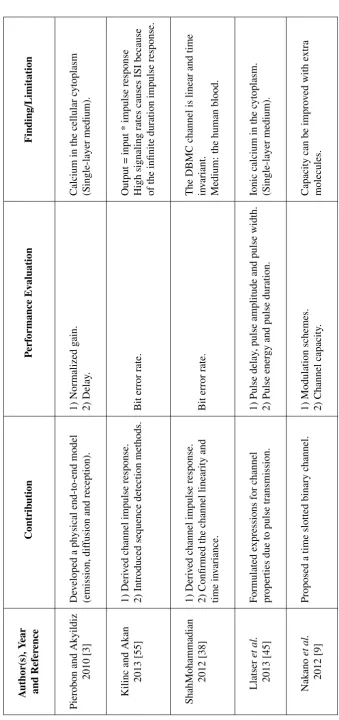
law of diffusion can be found in [3, 9, 38, 45, 55] as summarized in Table 2.2. In [3] a mathematical framework for a physical end-to-end model including transmission, propagation and reception modules, under a continuous diffusion of molecules in a fluidic medium has been introduced. A mathematical framework for each module is derived. In this model, information molecules are modulated by the TN at the differences concentration rate. Then, it propagates by diffusion process to the RN. Finally, the RN detects the modulated molecules in terms of concentration rate and decodes the received signal. However, the performance of the proposed model is investigated in terms of normalized gain and delay only. Therefore, further extension of the work needs to be done to study the end-to-end behavior of diffusion-based molecular communication model in terms of noise, capacity, throughput and modulation schemes.
In [38, 55], the channel impulse response of the DBMC channel is derived by solving the diffusion equation for an impulsive transmission of molecules. The output response can be obtained using the convolution operation of the channel impulse response with the input signal [55]. The results indicated that the propagation of molecules through a DBMC channel is linear and time invariant [38]. Analytical expressions for channel properties such as pulse delay, pulse amplitude, pulse width, pulse energy, and pulse duration of the DBMC model are derived for amplitude and for the energy detection of pulse transmission in [45].
A time-slotted binary channel based on the naive modulation and extended modulation schemes in a one-dimensional environment for capacity analysis is proposed in [9]. The developed model is simple and can be used as the basis for further studies on molecular communication. In extended modulation scheme, the transmitter transmitsN1 molecules at the beginning of each time slot to send a ’1’ or it transmits
N0 molecules to send a ’0’ (N1 is greater thanN0). But in naive modulation scheme,
the transmitter transmits one molecule to send a ’1’ and no molecules to send a ’0’. The receiver receives a ’1’ if one or more molecules arrive in the time slot and it receives a ’0’ if no molecule arrives (for naive modulation scheme) or the number of received molecules is less thanN1(extended modulation scheme). Based on the result reported
communication. The purpose of this work is to characterize intersymbol interference (ISI) in terms of communication range for these to modulation schemes.
From the information theory perspective, channel capacity is the most important performance metrics which quantifies the maximum amounts of information that can be transferred from the TN to the RN for a given number of transmitted molecules. The work in [58,69] studied capacity for both the diffusion channel and the ligand-binding reception. In [58], the capacity expression is developed for continuous transmission of molecules, while in [69] is for the on-off keying and time slot scheme. Moreover, the general mathematical expression of channel capacity which considered the Fick’s diffusion, and the molecular noise can be found in [22]. The capacity is derived for any continuous time signal of molecule transmission as a function of the average thermodynamic power spent by the TN. In addition, Atakan and Akan [70], developed an information theoretical approach for the capacity of the ligand-binding reception. It is found that maximum capacity can be achieved by a proper value of temperature, the number of emitted molecules, the TN-RN distance and duration of molecule emission.
Atakan and Akan [71] derived a deterministic capacity expression for three different molecular channels (point-to-point, broadcast and multiple-access) for a realistic model and investigated the information rate for each channel. The transmitter nanomachine emits the molecules in the medium by a diffusion process. The detection of target molecules is based on the collision of molecules with the surface receptors of receiver nanomachine. Based on numerical analysis results, the researchers concluded that high molecular communication rate could be obtained by increasing the upper bound of the channel input for both point-to-point and broadcast channels. However, in the multiple-access channel, scheduling transmissions or using different molecule, which can be distinguished by the receiver nanomachines, is needed. The researchers concluded that increasing the number of molecules increases the channel capacity.
2.4.2 Multilayer Diffusion
In the human body, diffusion of molecules practically occurs through multiple mediums such as across an alveolar-blood capillary barrier in a respiratory system and across a stomach-blood barrier during the absorption process. Figure 2.4 (a) presents the diffusion of oxygen, O2from the alveolar air to the haemoglobin as well as
carbon dioxide, CO2 from the haemoglobin to the alveolar air across various barriers.
These barriers consist of an alveolar epithelial cell, a capillary endothelial cell, and the intervening interstitial space containing extra-cellular matrix [34]. In the stomach-blood barrier as shown in Figure 2.4 (b), digested particles, nutrients or medicine are diffused from the stomach to blood vessel also across various barriers. An arterial wall, which has different material properties in each layer, is commonly modeled as a multilayer medium [35, 36].
(a)
[image:42.595.238.402.339.667.2](b)
2.5 Context of the Research
Based on the important research work presented in the previous section, although, the DBMC has been the focus of considerable attention, the existing studies are limited to the propagation of molecules in a single channel. In practice, the diffusion process can occur through a multilayer channel, for example, in the respiratory system (across an alveolar-blood capillary barrier) and in the absorption process (over the stomach-blood barrier). Modeling and analysis of molecules propagation over multilayer channel with different medium properties are important to be explored in order to support the future biomedical applications such as regulating the release of drugs over a multilayer barrier in a living tissue, as well as for the BANs and IoBNT applications. To the best of our knowledge, no works have been reported throughout the literature that analytically modeled and evaluated the performance of multilayer DBMC channel. Therefore, this work aims to model the multilayer DBMC channel and to study the channel properties of the multilayer DBMC channel such as channel impulse response, channel time delay, channel attenuation, channel delay spread, and channel capacity. A pulse-based modulation scheme with an amplitude detection scheme proposed in [45] is extended for the propagation of molecules across a multilayer medium. Then, the channel capacity for multilayer DBMC channel is derived based on the work proposed in [22].
2.6 Summary
RESEARCH METHODOLOGY
3.1 Introduction
The previous chapter highlighted the literature on the diffusion-based molecular communication (DBMC) system as a promising approach in realizing a nanoscale communication and networks, particularly, for biomedical and healthcare applications. Moreover, it has been identified that modeling and analysis of multilayer DBMC are very crucial to support the future biomedical applications such as to control and regulate the release of drugs over a multilayer barrier environment in living tissue. In this chapter, the detailed implementation of the research work to mathematical model and analyze the multilayer DBMC channel are outlined. The major contribution of this research work will be on the physical layer issue regarding to a mathematical modeling of mean molecular concentration at the receiver nanomachine (RN) across a multilayer channel and the formulation of the channel properties such as channel impulse response, channel time delay, channel attenuation, channel delay spread, and channel capacity. Therefore, with mathematical modeling and performance analysis of multilayer DBMC channel, it is expected that performance evaluations of the study are able to help engineers in developing or realizing the DBMC system involving a multilayer transmission medium.
1. Akyildiz, I. F., Brunetti, F. and Blaquez, C. Nanonetworks: A New Communication Paradigm. Computer Networks, 2008. 52(12): 2260–2279. 2. Akyildiz, I. F., Jornet, J. M. and Pierobon, M. Propagation Models
for Nanocommunication Networks. Proceedings of the Fourth European
Conference on Antennas and Propagation (EuCAP). April 12-16, 2010.
Barcelona, Spain: IEEE. 2010. 1–5.
3. Pierobon, M. and Akyildiz, I. F. A Physical End-to-End Model for Molecular Communication in Nanonetworks. IEEE Journal on Selected Areas in
Communications, 2010. 28(4): 602–611.
4. Nakano, T., Moore, M. J., Fang, W., Vasilakos, A. V. and Jianwei, S. Molecular Communication and Networking: Opportunities and Challenges.
IEEE Transactions on Nano Bioscience, 2012. 11(2): 135–148.
5. Atakan, B., Akan, O. B. and Balasubramaniam, S. Body Area Nanonetworks with Molecular Communications in Nanomedicine. IEEE Communications
Magazine, 2012. 50(1): 28–34. 0163-6804.
6. Na-Rae, K. and Chan-Byoung, C. Novel Modulation Techniques Using Isomers as Messenger Molecules for Nano Communication Networks via Diffusion. IEEE Journal on Selected Areas in Communications, 2013. 31(12): 847–856.
7. Malak, D. and Akan, O. B. Molecular Communication Nanonetworks Inside Human Body. Nano Communication Networks, 2012. 3(1): 19–35.
8. Nakano, T., Moore, M., Enomoto, A., Suda, T., Koujin, T., Haraguchi, T. and Hiraoka, Y. A Cell-Based Molecular Communication Network. Proceedings of the 1st International Conference on Bio Inspired Models of Network,
Information and Computing Systems (BIONETICS 06). December 11-13,
2006. Cavalese, Italy: ACM. 2006. 1–1.
10. Srinivas, K. V., Eckford, A. W. and Adve, R. Molecular Communication in Fluid Media: The Additive Inverse Gaussian Noise channel. IEEE
Transactions on Information Theory, 2012. 58(7): 4678–4692.
11. Kadloor, S., Adve, R. S. and Eckford, A. W. Molecular Communication using Brownian Motion with Drift. IEEE Transactions on Nano Bioscience, 2012. 11(2): 89–99.
12. Farsad, N., Guo, W. and Eckford, A. W. Tabletop Molecular Communication: Text Messages Through Chemical Signals. Plos One, 2013. 8(12): 1–13. 13. Pierobon, M. and Akyildiz, I. F. Diffusion-Based Noise Analysis for
Molecular Communication in Nanonetworks. IEEE Transactions on Signal
Processing, 2011. 59(6): 2532–2547.
14. Nakano, T., Okaie, Y. and Vasilakos, A. V. Throughput and Efficiency of Molecular Communication between Nanomachines. 2012 IEEE Wireless
Communications and Networking Conference (WCNC). April 1-4, 2012.
Shanghai, China: IEEE. 2012. 704–708.
15. Mahfuz, M. U., Makrakis, D. and Mouftah, H. T. Sampling Based Optimum Signal Detection in Concentration-Encoded Molecular Communication: Receiver Architecture and Performance. 6th International Conference on
Bio-inspired Systems and Signal Processing (BIOSIGNALS-2013). February
11-14, 2013. Barcelona, Spain: INSTICC. 2013. 372–376.
16. Nakano, T. and Jianwei, S. Repeater Design and Modeling for Molecular Communication Networks. 2011 IEEE Conference on Computer
Communications Workshops (INFOCOM WKSHPS). April 10-15, 2011.
Shanghai, China: IEEE. 2011. 501–506.
17. Moore, M. J., Suda, T. and Oiwa, K. Molecular Communication: Modeling Noise Effects on Information Rate. IEEE Transactions on Nano Bioscience, 2009. 8(2): 169–180.
18. Eckford, A. W., Farsad, N., Hiyama, S. and Moritani, Y. Microchannel Molecular Communication with Nanoscale Carriers: Brownian Motion versus Active Transport. 2010 10th IEEE Conference on Nanotechnology
(IEEE-NANO). August 17-20, 2010. Seoul, Korea: IEEE. 2010. 854–858.
19. Guney, A., Atakan, B. and Akan, O. B. Mobile Ad Hoc Nanonetworks with Collision-Based Molecular Communication. IEEE Transactions on Mobile
Computing, 2012. 11(3): 353–366.
935–945.
21. Aijaz, A. and Aghvami, A.-H. Error Performance of Diffusion-Based Molecular Communication Using Pulse-Diffusion-Based Modulation. IEEE
Transactions on NanoBioscience, 2015. 14(1): 146–151.
22. Pierobon, M. and Akyildiz, I. F. Capacity of a Diffusion-Based Molecular Communication System with Channel Memory and Molecular Noise. IEEE
Transactions on Information Theory, 2013. 59(2): 942–954.
23. Chahibi, Y., Pierobon, M., Sang Ok, S. and Akyildiz, I. F. A Molecular Communication System Model for Particulate Drug Delivery Systems. IEEE
Transactions on Biomedical Engineering, 2013. 60(12): 3468–3483.
24. Akyildiz, I. F., Pierobon, M., Balasubramaniam, S. and Koucheryavy, Y. The Internet of Bio-Nano Things. IEEE Communications Magazine, 2015. 53(3): 32–40.
25. Allen, T. M. and Cullis, P. R. Liposomal Drug Delivery Systems: From Concept to Clinical Applications. Advanced Drug Delivery Reviews, 2013. 65(1): 36–48.
26. Chude-Okonkwo, U. A. K., Malekian, R., Mharaj, B. T. and Olisah, C. C. Bio-Inspired Physical Layered Device Architectures for Diffusion-Based Molecular Communication: Design Issues and Suggestions. Proceeding
-2015 IEEE International Conference on Industrial Informatics, INDIN -2015.
Julai 22-24, 2015. Cambridge: IEEE. 2015. 1472–1479.
27. Chude-Okonkwo, U. A. K., Malekian, R. and Maharaj, B. T. S. Molecular Communication Model for Targeted Drug Delivery in Multiple Disease Sites With Diversely Expressed Enzymes. IEEE Transactions on NanoBioscience, 2016. 15(3): 230–245.
28. Zhu, J. and Shi, X. Dendrimer-Based Nanodevices for Targeted Drug Delivery Applications. Journal of Materials Chemistry B, 2013. 1(34): 4199–4211. 29. Kogan, M. J., Olmedo, I., Hosta, L., Guerrero, A. R., Cruz, L. J. and Albericio,
F. Peptides and Metallic Nanoparticles for Biomedical Applications.
Nanomedicine, 2007. 2(3): 287–306.
Multifunctional Polymer-Coated Carbon Nanotubes for Safe Drug Delivery.
Particle & Particle Systems Characterization, 2013. 30(4): 365–373.
32. Pondman, K. M., Bunt, N. D., Maijenburg, A. W., van Wezel, R. J. A., Kishore, U., Abelmann, L., ten Elshof, J. E. and ten Haken, B. Magnetic Drug Delivery with FePd Nanowires. Journal of Magnetism and Magnetic Materials, 2015. 380: 299–306.
33. Madsen, M. H., Krogstrup, P., Johnson, E., Venkatesan, S., Muhlbauer, E., Scheu, C., Sorensen, C. B. and Nygard, J. Experimental Determination of Adatom Diffusion Lengths for Growth of InAs Nanowires. Journal of Crystal Growth, 2013. 364: 16–22.
34. Boron, W. F. and Boulpaep, E. L. Medical Physiology. 2nd ed. Philadelphia, PA: Saunders, Elsevier. 2011.
35. McGinty, S. A Decade of Modelling Drug Release from Arterial Stents.
Mathematical Biosciences, 2014. 257: 80–90.
36. Pontrelli, G. and Monte, F. Mass Diffusion Through Two-Layer Porous Media: An Application to the Drug-eluting Stent. International Journal of Heat and
Mass Transfer, 2007. 50: 3658–3669.
37. Farsad, N., Yilmaz, H. B., Eckford, A., Chae, C.-B. and Guo, W. A Comprehensive Survey of Recent Advancements in Molecular Communication. IEEE Communications Surveys & Tutorials, 2016. PP(99): 1–34.
38. ShahMohammadian, H., Messier, G. G. and Magierowski, S. Optimum Receiver for Molecule Shift Keying Modulation in Diffusion-Based Molecular Communication Channels. Nano Communication Networks, 2012. 3(3): 183– 195.
39. Garralda, N., Llatser, I., Cabellos-Aparicio, A., Alarcon, E. and Pierobon, M. Diffusion-Based Physical Channel Identification in Molecular Nanonetworks.
Nano Communication Networks, 2011. 2(4): 196–204.
40. Llatser, I., Pascual, I., Garralda, N., Cabellos-Aparicio, A., Pierobon, M., Alarcon, E. and Sole-Pareta, J. Exploring the Physical Channel of Diffusion-Based Molecular Communication by Simulation. 2011 IEEE
Global Telecommunications Conference (GLOBECOM). December 5-9, 2011.
Kathmandu: IEEE. 2011. 1–5.
41. Pierobon, M. and Akyildiz, I. F. Noise Analysis in Ligand-Binding Reception for Molecular Communication in Nanonetworks.IEEE Transactions on Signal
42. Monson, R. and Baldocchi, D. Terrestrial Biosphere-Atmosphere Fluxes. New York: Cambridge University Press. 2014.
43. Crank, J. The Mathematic of Diffusion. 2nd ed. Great Britain: Oxford University Press. 1975.
44. Jornet, J. M. and Akyildiz, I. F. Information Capacity of Pulse-Based Wireless Nanosensor Networks. 2011 8th Annual IEEE Communications Society Conference on Sensor, Mesh and Ad Hoc Communications and Networks
(SECON). June 27-30, 2011. Salt Lake City, UT: IEEE. 2011. 80–88.
45. Llatser, I., Cabellos-Aparicio, A., Pierobon, M. and Alarcon, E. Detection Techniques for Diffusion-Based Molecular Communication. IEEE Journal on
Selected Areas in Communications, 2013. 31(12): 726–734.
46. Atakan, B., Galmes, S. and Akan, O. B. Nanoscale Communication with Molecular Arrays in Nanonetworks. IEEE Transactions on Nano Bioscience, 2012. 11(2): 149–160. 1536-1241.
47. Abadal, S. and Akyildiz, I. F. Bio-Inspired Synchronization for Nanocommunication Networks. 2011 IEEE Global Telecommunications
Conference (GLOBECOM 2011). December 5-9, 2011. Houston, TX, USA:
IEEE. 2011. 1–5.
48. Nakano, T., Okaie, Y. and Vasilakos, A. V. Transmission Rate Control for Molecular Communication among Biological Nanomachines. IEEE Journal
on Selected Areas in Communications, 2013. 31(12): 835–846.
49. Jornet, J. M. and Akyildiz, I. F. Graphene-Based Nano-Antennas for Electromagnetic Nanocommunications in the Terahertz Band. Proceedings of
the Fourth European Conference on Antennas and Propagation. April 12-16,
2010. Barcelona, Spain. 2010. 1–5.
50. Jornet, J. M. and Akyildiz, I. F. Channel Modeling and Capacity Analysis for Electromagnetic Wireless Nanonetworks in the Terahertz Band. IEEE
Transactions on Wireless Communications, 2011. 10(10): 3211–3221.
51. Yalgashev, O., Bakhouya, M., Chariete, A., Gaber, J. and Manier, M. Electromagnetic-Based Nanonetworks Communication in SoC Design. 2015 International Conference on High Performance Computing & Simulation
(HPCS). Amsterdam: IEEE. 2015. 364–370.
53. Llatser, I., Kremers, C., Chigrin, D. N., Jornet, J. M., Lemme, M. C., Cabellos-Aparicio, A. and Alarcon, E. Characterization of Graphene-Based Nano-Antennas in the Terahertz Band. 2012 6th European Conference on Antennas
and Propagation (EUCAP). Prague: IEEE. 2012. 194–198.
54. Deng, Y., Noel, A., Elkashlan, M., Nallanathan, A. and Cheung, K. C. Modeling and Simulation of Molecular Communication Systems with a Reversible Adsorption Receiver. IEEE Transactions on Molecular, Biological
and Multi-Scale Communications, 2016. PP(99): 1–16.
55. Kilinc, D. and Akan, O. B. Receiver Design for Molecular Communication.
IEEE Journal on Selected Areas in Communications, 2013. 31(12): 705–714.
56. ShahMohammadian, H. System Design for Nano-Network Communications. Ph.d. thesis. University of Calgary. 2013.
57. Mahfuz, M. U., Makrakis, D. and Mouftah, H. T. A Comprehensive Study of Sampling-Based Optimum Signal Detection in Concentration-Encoded Molecular Communication. IEEE Transactions on Nanobioscience, 2014. 13(3): 208–222.
58. Qiang, L., Kun, Y. and Peng, H. Channel Capacity Analysis for Molecular Communication with Continuous Molecule Emission. 2013 International
Conference on Wireless Communications & Signal Processing (WCSP).
October 24-26, 2013. Hangzhou, China: IEEE. 2013. 1–6.
59. Shojaie, A., Takhtfooladi, M. D. and Safaeinezhad, M. Bio-Inspired Diffusion Based Molecular Communication in Long-Range Nanonetworks.
Proceedings - 12th International Conference on Computational Science and
Its Applications, ICCSA 2012. June 18-21, 2012. Salvador: IEEE. 2012. 63–
66.
60. Kuran, M. S., Yilmaz, H. B., Tugcu, T. and Akyildiz, I. F. Interference Effects on Modulation Techniques in Diffusion Based Nanonetworks. Nano
Communication Networks, 2012. 3(1): 65–73.
61. Kuscu, M. and Akan, O. B. On the Physical Design of Molecular Communication Receiver Based on Nanoscale Biosensors. IEEE Sensors
Journal, 2016. 16(8): 2228–2243.
62. Kilinc, D. and Akan, O. B. An Information Theoretical Analysis of Nanoscale Molecular Gap Junction Communication Channel Between Cardiomyocytes.
IEEE Transactions on Nanotechnology, 2013. 12(2): 129–136.
Sea Conference on Communications and Networking (BlackSeaCom). July 3-5, 2013. Batumi, Georgia: IEEE. 2013. 79–83.
64. Berg, H. C. Random Walks in Biology. Princeton: Princeton University Press. 1993.
65. ShahMohammadian, H., Messier, G. G. and Magierowski, S. Nano-Machine Molecular Communication over a Moving Propagation Medium. Nano
Communication Networks, 2013. 4(3): 142–153.
66. Pica, E. M. and Jantschi, L. Simulation of Diffusion Equation. Acta Technica
Napocensis, series Applied Mathematics and Mecanics, 1999. II(42): 47–54.
67. Dressler, F. and Fischer, S. Connecting In-Body Nano Communication with Body Area Networks: Challenges and Opportunities of the Internet of Nano Things. Nano Communication Networks, 2015. 6(2): 29–38.
68. Mahfuz, M. U., Makrakis, D. and Mouftah, H. T. On the Characterization of Binary Concentration-Encoded Molecular Communication in Nanonetworks.
Nano Communication Networks, 2010. 1(4): 289–300.
69. Qiang, L. and Kun, Y. Channel Capacity Analysis of a Diffusion-Based Molecular Communication System with Ligand Receptors. International
Journal of Communication Systems, 2015. 28(8): 1508–1520.
70. Atakan, B. and Akan, O. B. An Information Theoretical Approach for Molecular Communication. Proceedings of the Bio-Inspired Models of
Network, Information and Computing Systems (BIONETICS 2007). December
10-12, 2007. Budapest: IEEE. 2007. 33–40.
71. Atakan, B. and Akan, O. B. Deterministic Capacity of Information Flow in Molecular Nanonetworks. Nano Communication Networks, 2010. 1(1): 31– 42.
72. NanoNetworking Center in Catalunya. N3Sim: A Simulation Framework for Diffusion-Based Molecular Communication. Retrieved on January 1, 2014, from http://www.n3cat.upc.edu/n3sim.
73. Llatser, I., Demiray, D., Cabellos-Aparicio, A., Altilar, D. T. and Alarcon, E. N3Sim: Simulation Framework for Diffusion-Based Molecular Communication Nanonetworks. Simulation Modelling Practice and Theory, 2014. 42: 210–222.
74. Freitas, J. R. A. Nanomedicine, Volume I: Basic Capabilities. Georgetown, Texas, U.S.A: Landes Biosciences. 1999.
![Figure 2.1: An overview of nanonetworks: (a) nano-electromagnetic communication,and (b) molecular communication [1]](https://thumb-us.123doks.com/thumbv2/123dok_us/8760839.893942/33.595.158.482.73.475/figure-overview-nanonetworks-nano-electromagnetic-communication-molecular-communication.webp)
![Table 2.1: Nano-electromagnetic versus molecular communications [1,48]](https://thumb-us.123doks.com/thumbv2/123dok_us/8760839.893942/34.595.125.512.90.255/table-nano-electromagnetic-versus-molecular-communications.webp)
![Figure 2.2: Molecular communication with (a) active transport, and (b) passivetransport by diffusion [1]](https://thumb-us.123doks.com/thumbv2/123dok_us/8760839.893942/35.595.178.456.266.609/figure-molecular-communication-active-transport-b-passivetransport-diffusion.webp)
![Figure 2.3: Diffusion-based molecular communication (DBMC) system [55]](https://thumb-us.123doks.com/thumbv2/123dok_us/8760839.893942/36.595.134.505.266.499/figure-diffusion-based-molecular-communication-dbmc-system.webp)