2017 2nd International Conference on Computer, Mechatronics and Electronic Engineering (CMEE 2017) ISBN: 978-1-60595-532-2
Physical Worldview as Essential Outcome of Teaching
Students of Engineering
T.N. GNITETSKAYA
Far Eastern Federal University, 8, Suhanova St., Vladivostok, 690090 Russia
Keywords: Physical worldview, Course of physics, Modeling the content, Engineering education, Disciplinary connections.
Abstract. The article discusses the relevance of teaching the concept of physical worldview to engineers by describing the peculiarities of it at the contemporary stage and by showing the need for developing qualitative methods of modelling the content. It is noted that the complicacy of students’ perception of physical fundamental elements of knowledge depends on the entropy of their content; recommendations are suggested.
Introduction
Development of IT and their widespread implementation into all areas of human life has made a major effect on the human mindset thus generating new research areas and, consequently, new areas of engineering knowledge such as Electronic Engineering, Intelligent Mechatronics and Robotics, Industrial Automation and Control System Computer-aided Geometric Design & Simulation and many others. Teaching of these specialties starts with the fundamental course of Physics the role of which can barely be overestimeted in training future engineers. Nowadays, more and more enterprizes beging to rely on science-intensive technologies. High professional skills of engineers ensure the functional security of science-intensive technologies. In his report of the National Commission on Mathematics and Science Teaching for the 21st century, issued on September 27, 2000, John Glenn said, “A professional spreads values related to a specific area; they posses a specific set of skills and knowledge required for efficient carrying out of their specific work” [2].
The level of possible professional risks of engineers is inversely dependent on the level of their professionalism that in its turn is directly dependent on the level of their fundamental training that serves as a basis for optimal decisions in their professional activity. These circumstances prioritize researching the methods of teaching Physics to engineers in order to develop the methods that would ensure a comprehensive worldview and raise the level of fundamental knowledge.
Major trends in developing the methods of teaching Physics are defined, firstly, by the internal logics of the development process of both the physical worldview and the Physics in general. Secondly, the methods of teaching physics are influenced by external circumstances related to the social and government order for trained professionals. Both defining factors have changed dramatically over a relatively short period of time. Changes in worldviews have been triggered by new factors in the neutron and nuclear physics that increased the knowledge of the world structure as well as by the new modern methods of studying physical objects and phenomena.
On the Physical Worldview
The concept of physical worldview evolution is a methodological basis of the Physics courses [2]. The relevance of this concept has increased dramatically due to extended knowledge of nuclear physics and physics of micro- and nanoparticles. According to this concept, discovery of new facts and revealing of new properties or peculiarities of fundamental interactions inevitably influence on the perception of the world referred to as the worldview.
explained all phenomena of natural science. Here, a fundamental science is defined as a science where the main laws and concepts are not derived from a different science but rely on experience. Throughout the history of natural sciences only three disciplines have claimed to obtain the status of a fundamental science – physics, chemistry and biology. Development of physics and emergence of quantum mechanics have substantially challenged the fundamental status of chemistry since the major concepts and laws were explained by physics. It does not mean that chemistry has lost its relevance or independence. It means that physics and hence the physical worldview claim to have a mono-fundamental status.
Nowadays, the physical worldview is going through another stage of its evolution. Changes in worldviews have been triggered by new factors that increase the knowledge of the world structure as well as by the new modern methods of studying physical objects and phenomena. The progress has touched those areas of physics that study physical objects and phenomena based on the methods of spectroscopy, electronic microscopy, scanning probe microscopy, magnetic resonance tomography, x-ray analysis, SQUID magnetometry, diffraction, refractometry, as well as the commonly applied neutron methods that offer a unique possibility for testing modern theories, including The Standard Model of Electroweak Interactions. A new methodological emphasis has emerged in the elementary-particle physics: a neutron has obtained a status of a “main” elementary particle. Up until recently an electron was a methodologically relevant particle.
Since a neutron is involved in all known interactions, studying its electromagnetic properties as well as both weak and strong interactions can increase our understanding of particle structures, their interactions and the secrets of emergence and evolution of the Universe.
Therefore, experiments in studying the fundamental properties of a neutron such as searching for and measuring of the electric dipole moment of a neutron, searching for neutron-antineutron oscillations, revealing the lifespan of a neutron, measuring a gravity mass of a neutron, works in studying the fundamental symmetries in the processes that involve a neutron (from beta-disintegration and neutron optics to nuclear reaction and fission) can be considered of high priority [3] due to their high methodological relevance for the modern physics and physical worldview. The properties of neutrons (electric neutrality, magnetic moment, etc.) make them a unique tool of studying the structure, dynamics and properties of the matter that resulted in their widespread application in different areas of science: physics, chemistry, biology, geophysics, material engineering, medicine and others. Transfer of physical research methods into other areas of science confirms the fundamental nature of generalized knowledge about the world that comprises the modern physical worldview.
Modern physical worldview that complies with new research methods is based on the interdisciplinary knowledge. For example, the ability of neutrons to determine the position of light atoms in the presence of heavy atoms makes them an irreplaceable tool for studying organic (including biological) structures containing hydrogen. Neutron’s sensibility to isotopic composition allows using the isotopic substitution for defining the structure of isolated fragments of macromolecules and aggregates [4]. Modern physical worldview is bound to include hi-technologies (for example, nanotechnologies, atomic and biotechnologies) as well as wireless communication-based technologies of spreading news. Therefore, at the contemporary stage of evolution, the physical worldview changes both its methodological aspect and its structure, which has been discussed in our work before [5].
On Modelling the Methods of Teaching Physics
In present-day conditions, research works in physics teaching methods are moving to a new level of research. It is no longer enough just to develop and suggest a theoretical foundation for teaching methods, even very efficient ones. The methods are now supposed to rely on a theoretical model that defines the conditions of their functioning.
pedagogical objects and processes [for example, 6]. The models that have appeared recently often contain an informational context; the authors of the models reduce the meaning of this context to the definition of information suggested by Shannon. However, except for the definition and hypothetical conclusions, the works lack a model that would rely on the methods of evaluating entropy as a quantitative measure of information, the academic information included. According to the author of the article, it can be caused by insufficient research of the connection phenomenon in the academic process.
Obviously, an academic course teaches an engineer to determine similar features of the objects that are studied or the phenomena that are seen for the first time in their professional activity. Overlapping of the known and unknown objects and defining connections between them result in understanding of both the essence of the unknown object and the principle of its functioning. Relevance of the connection as an element in the model of any pedagogical object and process is defined by the informational nature of teaching and academic content.
Information as an element of teaching is transferred in the process of teaching from the sources to the consumer via a communication channel between them. Therefore, information does not take leading positions in teaching that are more probably taken by the communication channel between the source of academic information and its consumers. According to L.S. Vygotskiy, “neither … hand nor mind are worth a lot alone; perfection can be achieved via instruments and tools” [7]. The example provided by J. Bruner in describing the “Model of the World” would be appropriate here: “«…two senseless words YRULPZOC и VERNALIT are exposed for 500 milliseconds for tachistoscopic recognition; these words have been built according to the Shannon principles as statistically close to the English language of the zero and fourth order respectively. The subject can clearly perceive (with respect to their position in the word) 48% of the letters in the first word and 93% letters of the second one. Both words are equal with respect to the quantity of information rendered by these sequences of letters, i.e. the possibility of correction due to the abundance of the message. Differences in perception can be explained by the fact that the subject knows a stochastic model of the English text structure and “knows” the probable letter sequences. We say that in one case (93% of correctly perceived letters) the perception is more correct than in the other case. It means that the model exposed to the subject reflects the rules of English more adequately; if the stimulus fails to comply with this model, the result of perception will be worse …”. Bruner also mentions that “…correct perception in non-optima conditions is based on the ability of a person to coordinate the incoming stimulus with the corresponding system of coding…”. While analyzing the correspondence of the consciousness coding system to the incoming message, J, Bruner derives the following conclusion: «…perceptive teaching mostly involves… Studying the proper ways of coding the world around us and consequent categorization of the incoming stimuli with the help of coding systems …» [8]. According to Bruner, the ways of coding information are those that consider its objectiveness, connectivity, abundance, etc.
According to the author of the article, categorization of information signals makes it possible for the education system to provide for the required channel of connection for transmitting these signals to students with this channel becoming one of the tools and instruments. Then, the objectiveness implies systematization of information signals by disciplines that is really a target of the education system. Informational abundance as a phenomenon that leads to overloads was first described and studied in the early XX century. For example, it is known that Robert Oppenheimer, a physicist, wrote about a rapid increase of knowledge in the XX century and the complicacy of mastering it. He mentioned the impossibility of reading all works published by other researchers since it was possible to know about them only in face-to-face communication with these researchers. Nowadays, the problem of information abundance has surpassed all expectations. Along with this, the required level of connectivity and the permissible level of abundance of academic information can be defined by evaluating the entropy of academic content.
psychology (B.F. Lomov). They rely on the same choice of the connection type – “… connections that ensure the transfer of substance, energy or information…” [9]; entropy is defined as a measure of information transmitted by the connection. Of course, these theories involve different objects responsible for the connection and information transfer. Information transfer defines the connection and characterizes the nature of the academic process; however, the pedagogical knowledge lacks the attempts of informational modelling of connections and academic processes. The research works headed by V.P. Mizintsev in the second half of the XX century are distinguished by the entropic method of measuring the information that is included into the content of a concept. However, this research failed to include objective connections. In 1998 the author of this article made first steps in this area [10]. Nowadays the pedagogical and psychological knowledge experiences a discussion on the informational concept of academic process; however, the pedagogy lacks any research that would suggest a quantitative evaluation of informational properties of the academic process; in psychology, all research fails to go beyond the conclusion of B.F. Lomov that “nervous system has a calculating mechanism that functions in accordance with statistical regularities; therefore, it would be logical to conclude that the methods of information theory are a proper tool of studying it”. In his works of the 1970s, Lomov discussed the consciousness channel capacity [11].
The author of the article has suggested qualitative models of intra- and interdisciplinary connections than comply with the psychological research mentioned above [12]. In 2010s, a group of American researchers in psychology studied the problem of defining intra- and interdisciplinary connections as a reflection of analytical activity, which a person is either capable or incapable of. They also discussed the possibility of teaching this activity. However, informational content of connections was not included into this research. Russian researchers widely discussed the problem of intra- and interdisciplinary connections in the second half of the XX century, though only at the qualitative level.
Therefore, application of quantitative models of intra- and interdisciplinary connections [13] in modelling of the academic process as a process of information transfer can be useful for addressing the tasks of teaching ideas of the evolving physical worldview to the students of engineering.
Building Fundamental Concepts in the Course of General Physics Based on the Informational Model of Interdisciplinary Connections.
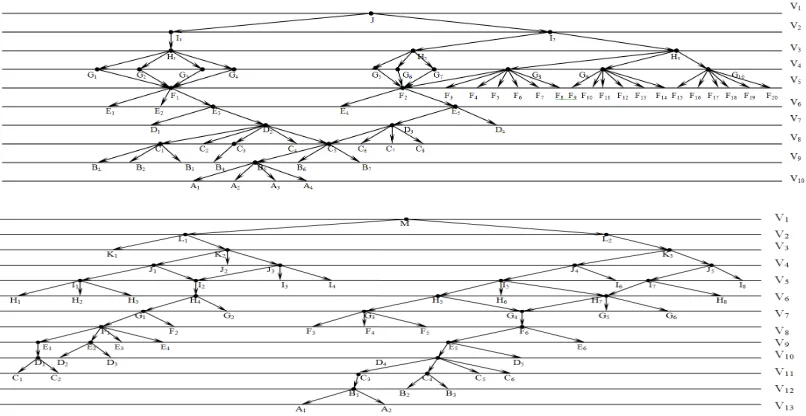
Figure 1. Semantic graphs of the lecture in Particle Dynamics. The first variant is higher, the second – lower.
The picture shows two most different graphs that interpret different variants of rendering the content of the topic. They are both possible from the viewpoint of physics. The difference in structure configuration is visually obvious. The upper graph offers bigger configuration symmetry and interaction; the squared number of its entropy is 0.45 Kbit2. The lower graph consists of two independent hierarchical areas that get connected at the top which contains the concept of particle dynamics that includes the whole information of this graph. Such discrepancy doubles the squared number of entropy and equals to 0.89 Kbit2. If the process of teaching physics fails to trace the sequence of rendering the theme topics based on the minimum entropy of their content, then in the end the mind is supposed to generalize the fundamental elements of knowledge with a complex structure into a single image of worldviews. It is impossible. The world around us is integral; the worldview that describes it is supposed to be integral as well. It is obvious that building a generalized image of network in the worldview is more feasible if it includes less differently ordered elements. With consideration of the relevance of teaching proper ways of coding the world around us elaborated by J. Bruner, it is suggested to analyze the content of Physics course for engineers. The analysis aimed at revealing the content with minimal entropy has to be carried out before compiling the content of any study material on physics – a textbook, a lecture or an experiment.
The author has developed an approach to evaluating the entropy of the Physics course in its graph representation based on the informational models of intra- and interdisciplinary connections.
Reference
[1] John Glenn, “It is not yet too late” http://www.ed.gov/americacounts/glenn/
[2] Yefimenko V.F, Physical worldview and mindset. Vladivostok, FEFU publ., 1997. 230 p.
[3] Neutron studies of the substance structure and fundamental properties of matter. Program of fundamental research of the RAS Department of Physics. Moscow, 2011, p. 8.
[4] Serebrov A.P., Basic Research into Ultra cold Neutrons, Report of Russian Academy of Sciences, 2009, vol. 79. pp. 14-24.
[6] Krayevsky V.V. The content of education - running on the spot // Pedagogy. 2000. № 7. Pp. 3-12.
[7] Vygotskiy L.S. Mind and speech. Moscow, Labyrinth publ., 1999. 352 p.
[8] Bruner J http://www.koob.ru М.: Progress, 1977. - 413 pp.
[9] Encyclopedia in Phylosophy. Moscow, Soviet Encyclopedia publ., 1983. 840 p.
[10] Mizintsev V.P. The problem of an analytical assessment of the quality and effectiveness of the educational process in school: Proc. allowance (special course, part 1). - Kuibyshev: Kuibysh. state. Univ., 1979. - 107 p.
[11] Gnitetskaya T.N. Fundamentals of interdisciplinary connections theory. Physical education in universities. Moscow, vol. 5 No. 2, 1999. pp. 23-39.
[12] Lomov B.F. Man and technology. Essays on engineering psychology.- M.: Izd. Soviet radio. - 464 p.