2017 2nd International Conference on Wireless Communication and Network Engineering (WCNE 2017) ISBN: 978-1-60595-531-5
The Performance Analysis of Phase Offset Estimation in Coherent
FSO System
Hong-wei LI
1,2,3,4, Yong-mei HUANG
1,3,*,
Qiang WANG
1,3and Jia-wei LI
51
Institute of Optics and Electronics Technology of the Chinese Academy of Sciences, Chengdu, China
2
School of Optoelectronic Information, University of Electronic Science and Technology of China, Chengdu,
3
Key Laboratory of Optical Engineering, Chinese Academy of Sciences, Chengdu, China
4
University of Chinese Academy of Sciences, Beijing, China
5
Shanghai Institute of Optics and Fine Mechanics, Chinese Academy of Sciences, Shanghai, China
*Corresponding author
Keywords: FSO, Phase offset estimation, Atmosphere channel, Viterbi-Viterbi algorithm.
Abstract. This paper focus on the phase offset estimation algorithm in FSO system. The Viterbi-Viterbi algorithm is employed. The simulation result in time invariant channel and strong turbulence atmosphere channel is given. The improved method is discussed too.
Introduction
Free space optical (FSO) communication system provides higher transmission speed, higher security, and less power consumption than the microwave communication system [1]. The FSO system can be used in the link between satellite to satellite, satellite to earth, and ground to ground. The atmosphere channel is a main disadvantage to the FSO system, except the satellite to satellite link. The optical signal arriving at the receiver is always weak as a result of the beam propagating and absorbing of the particles in the atmosphere. The signal power fluctuation and wavefront distortion by the atmosphere turbulence is serious to the FSO system. The sensitivity of the coherent detection in the receiver is higher than the directed detection and can be used in the receiver taking advantage of the amplification of the local laser [1,2]. There are two ways of realizing the coherent reception. One is controlling frequency and phase of the local laser precisely to keep synchronization with signal by optical PLL [3]. Another way is utilizing the digital signal processing technology to estimate and compensate the frequency offset and phase offset between the local laser and the signal [4,5].
In this paper, the DSP method is employed to estimate the phase offset between the local laser and the signal.
Model and Phase Offset Estimation Algorithm
(1) The model of the phase offset
The phase offset between the signal and the local laser can be considered as a Winner process, and it can be expressed as
(k 1) ( ) g( )k k
ϕ
ϕ
∆ + = ∆ + (1)
( )k ϕ
2 2
s
f
R
π
σ
= (2)f is the equivalent linewidth of the laser and s
R is the symbol transmission rate.
(2) The phase offset estimation algorithm
In this paper, the Viterbi-Viterbi algorithm [6] is employed. This algorithm can be used in fiber communication system in which the SNR is higher than the FSO system. To overcome the noise, a mean filter is combined with the Viterbi-Viterbi algorithm.
A receiving QPSK symbol is
[ ( ( ) ( )]
0
( )
j nTs n a ns n
e
∆ω + ∆ϕ +n
=
+
(3)ω
∆ and ∆ϕ is the frequency offset and phase offset. a n( ) is the modulated information symbol
phase ( ( ) ,3 ,5 ,7 ) 4 4 4 4
a n ∈π π π π
. n0 is the noise. Focusing on the phase offset estimation, ∆ω and n0
are ignored.(3)is expressed shortly as
[ ( ( ) ( )] ( ) j n a n
s n e ∆ϕ +
= (4) So
{
}
4
( ) exp 4[( ( ) ( )] exp[ 4 ( )]
s n = j ∆ϕ n +a n = j ∆ϕ n (5)
The phase offset can be estimated by
4
1
( ) arg ( ) 4
n s n
ϕ
∆ = (6)
To overcome the noise, a mean filter is employed as
4 1 4
( ) ( )
1
n l
i n m
s n s i
m l +
= −
=
+ +
∑
(7)The average phase offset is
4 1
( ) arg ( ) 4
n s n
ϕ
∆ = (8)
Simulation Experiments
(1) The simulation in time invariant channel
0 1000 2000 3000 4000 5000 t
-0.3 -0.2 -0.1 0 0.1 0.2 0.3
Erro
r
(
ra
d
)
[image:3.612.195.406.78.295.2]The real vale of phase offset The estimation vale of phase offset
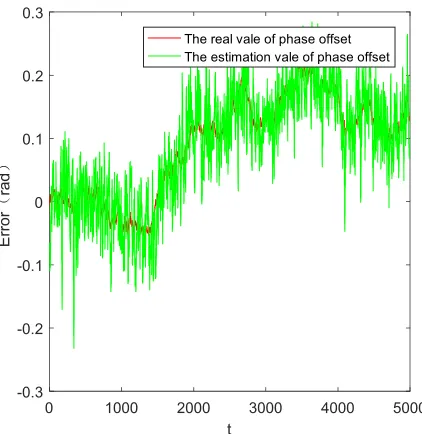
Figure 1. The phase offset tracking curve with 15db SNR in time invariant channel.
In order to evaluate the performance of Viterbi-Viterbi algorithm in time invariant channel with different SNR, the simulation result expressed in Figure 2 is given. If the SNR is more than 8db, the estimation error can get below 0.1 rad. This SNR is easily to reach in fiber communication system.
Figure 2. The phase offset tracking error in time invariant channel with different SNR.
(2) The simulation in strong turbulence atmosphere channel
[image:3.612.186.418.375.556.2]0 1000 2000 3000 4000 5000
t
0 0.5 1 1.5 2 2.5 3
C
h
a
n
n
e
l
g
a
[image:4.612.182.421.80.326.2]in
Figure 3. The channel gain with strong turbulence atmosphere.
The phase offset tracking curve in Figure 4 shows the performance of Viterbi-Viterbi algorithm with strong turbulence and the mean SNR is 35db. The mean SNR is defined as the ratio of the mean signal energy to the noise energy. In engineering, the 35 db SNR is difficult to reach. However, the tracking performance is not better than the performance showed in Figure 1.
-0.8 -0.6 -0.4 -0.2 0 0.2 0.4 0.6 0.8 1 1.2
E
rr
o
r
(
ra
d
)
[image:4.612.162.432.425.699.2]Discussion and Future Work
The mean SNR with strong turbulence is higher than the SNR in time invariant channel, but the phase offset tracking performance is not better. This is caused by the large number of extremely low SNR symbols in atmosphere channel. To solve this problem, two methods can be selected. The one is taking advantage of reliable filtering algorithm such as Kalman filtering method. The other one is employing the diversity receiving method.
References
[1] Khalighi, M. A., & Uysal, M. (2014). Survey on free space optical communication: a communication theory perspective. Communications Surveys & Tutorials IEEE, 16(4), 2231-2258.
[2] Kikuchi, K., & Tsukamoto, S. (2008). Evaluation of sensitivity of the digital coherent receiver. Journal of Lightwave Technology, 26(13), 1817-1822.
[3] Park, H. C., Lu, M., Bloch, E., Reed, T., Griffith, Z., & Johansson, L., et al. (2012). 40gbit/s coherent optical receiver using a costas loop. Optics Express, 20(26), 197-203.
[4] Schaefer, S., Gregory, M., & Rosenkranz, W. (2016). Coherent receiver design based on digital signal processing in optical high-speed intersatellite links with m-phase-shift keying. Optical Engineering, 55(11), 111614.
[5] Kazovsky, L. G., Kalogerakis, G., & Shaw, W. T. (2006). Homodyne phase-shift-keying systems: past challenges and future opportunities. Journal of Lightwave Technology, 24(12), 4876-4884.