2016 Joint International Conference on Artificial Intelligence and Computer Engineering (AICE 2016) and International Conference on Network and Communication Security (NCS 2016)
ISBN: 978-1-60595-362-5
Application of PSO-BP Neural Network Model on Identification
of Human Dynamic Balance
Jin-Zhuang XIAO
1,a,*, Li-Wei JIAO
1,b, Hong-Rui WANG
1,c1College of Electronic and Information Engineering,
Hebei University, Baoding, Hebei, China
arobot@ hbu.edu.cn, b[email protected], chongrui@ hbu.edu.cn
*Corresponding author
Keywords: Dynamic Balance Model, Nonlinear Identification, Random Visual Excitation, Particle Swarm Optimization, Back Propagation.
Abstract. Since the human dynamic balance system is nonlinear, common models can hardly
characterize the adjustment process of human dynamic balance veritably. In this research, the particle swarm optimization (PSO) algorithm and back propagation (BP) neural network algorithm had been introduced to the identification of nonlinear system models for human dynamic balance. Firstly, in order to establish BP neural network based on prediction model about human dynamic balance system, torque and angle of human ankle for 50 healthy college students had been acquisited to act as input and output of nonlinear identification respectively in conditions of suffering random visual excitation; secondly, aiming at improving the convergence performance of conventional BP neural network, this article adopted PSO algorithm to optimize the initial weights and thresholds of BP neural network and then the prediction model based on PSO-BP algorithm had been built; finally, the predictive results before and after optimization had been compared. According to the results of simulation and quantitative comparison, the presented algorithm had accomplished modeling for the adjustment process of human dynamic balance, and it also showed that PSO optimization algorithm not only improved the performance of BP neural network, making it didn’t fall into local minimum easily, but also strengthened the generalization capability and enhanced prediction accuracy, making it more truly and accurately to characterize the adjustment process when human body maintains dynamic balance.
Introduction
The dynamic balance ability of human body is an ability that human body carries out an action actively (walking, running, jumping) or as well as suffers interference stimuli (Impact, stumble, visual stimulation) to recover a stable state [1]. Studies have shown that the human body maintains dynamic balance through the synergy of vision, vestibule, proprioception and central nervous system [2]. Thus it can be corroborated that the adjustment process of human dynamic balance is a complicated nonlinear system, and building a nonlinear model for human dynamic balance plays an extremely important role in promoting further research on the dynamic balance and improving the medical level.
the high degree of human body nonlinearity. Based on this, this study introduces the PSO optimization algorithm and the BP neural network algorithm to the identification of nonlinear system model for human dynamic balance. Compared with the traditional methods, the BP neural network can also establish the complex relationship between the nonlinear mapping of the kinematic data even if we cannot recognize the mathematical equation of the mapping relationship in advance. However, BP neural network is easy to fall into local minimum in the identification process, which leads to the hardly idealprediction accuracy [8-9]. The particle swarm optimization algorithm inspired by the group phenomenon with foraging behavior of birds and first proposed by Kennedy and Eberhart in 1995 generally improved the accuracy of network optimization [10-11].
In this article, firstly, the experiment is designed for acquisiting torques and angles of human ankle in the adjustment process of human body dynamic balance under the excitation of random visual according to the balance mechanism, and the result is extremely easy to fall into the local minimum by adopting BP neural network algorithm; then the particle swarm optimization algorithm is used to optimize the initial weights and thresholds of BP neural network, and identify the nonlinear system for human dynamic balance again. Finally, the prediction results before and after optimizing are analyzed comparatively.
Materials and Methods
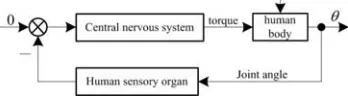
[image:2.612.231.405.461.509.2]Nonlinear system identification is a mathematical model of the nonlinear system which is defined by the relationship between input and output data. Therefore, it is necessary to identify the input and output values in the adjustment process of dynamic balance through the dynamic balance mechanism of human body. As shown in Fig.1, the adjustment process of human dynamic balance possesses the characteristics of closed loop control system. When the body is subjected to external disturbance, the body sways, the joint angle and the center of the human body gravity change; the variation of these information will be perceived by the body corresponding sensory organs (including the vestibular organ, the visual organ, proprioceptive system), and then these feedback information will be transmitted to the central nervous system; the balance state restore under the regulation of the central nervous system with the corresponding joint torque produced in this regulatory process.
Figure 1. Mechanism of dynamic balance of human body.
System Composition
The experiment equipment in this research includes force platform, angle sensor and PC104 industrial grade data acquisition device.
The voltage signal obtained from force platform can be transformed into not only trajectory of the body’ COP (center of pressure) but also torque of human ankle according to the principle of moment conservation to provide data source for nonlinear identification as the modeling input data. In the process of experiment, the weight of the subjects should be limited to the 90% measuring range of the equipment (below 90kg), otherwise it is highly possible to cause this equipment damage, or make the measurement data exist system errors.
The industrial grade integrated controller PC104 with high stability which is fully compatible with the standard PC machine is highly suitable for achieving force signal acquisition in the adjustment process of human body dynamic balanceand real-time storage.
Methods and Data Processing
Experimental Methods. In order to accurately evaluate the body dynamic balance ability and
establish complete dynamic balance model for human body in the process of external excitation, this test applies the human balance test system based on random visual stimulation to measure the torque and angle of human ankle [12]. At the same time, advance preparation in the evaluation process is avoided by adopting the equiprobable random visual excitation. This study invited 50 healthy college students, including 29 men and 21 women. During the experiment, subjects stand on the force platform with both hands down naturally, first of all, adjusting their COP position to the center at the origin, as shown in Fig.2; after that, there will be a random target on the screen, subjects mainly depend on the sway of the body to control human COP effortlessly so that it reaches the random target circle, and then track another target circle after keeping one second. In order to make the subjects freely and lightly control the body’s COP, we can regulate the difficulty coefficient according to the demands of the participants. During the test, the subjects' hands must not be arbitrarily swung and the legs must not be lifted at will. Frequency of the force platform and the tilt sensor used in this experiment are both 20Hz. Modeling data will be acquisited for 6000 groups, namely, the acquisition time is required for 300 seconds.
[image:3.612.217.402.330.440.2]
Figure 2. Interface of random visual stimulation evaluation system.
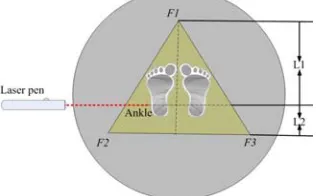
Torque Calculation. The three force sensors signal of force platform is converted into the torque
according to the principle of conservation of torque. As shown in Fig.3, assuming that the three force signal F1, F2, F3 correspond the three sensors S1, S2, S3 respectively, and horizontal distance from the ankle to the sensor S1 is set for L1, to the sensor S2, S3 where is linear horizontal distance set for L2, and T is set as the ankle torque.
Figure 3. Standing position of human body.
[image:3.612.228.386.547.645.2]2 ) 3 2 ( 1
1 L F F L F
T (1)
As shown in formula (1), the ankle torque values in the dynamic balance process for human body are obtained according to the principle of moment conservation.
PSO-BP Neural Network Algorithm
The particle swarm optimization algorithm is inspired by the group phenomenon with foraging behavior of birds. In a search space, there is a population of particles
) , , ,
(X1 X2 Xn
X , where the i-th particle is represented by a D dimensional vector. Position of the i-th particle in D-dimensional space T
iD i i
i x x x
X [ 1, 2,, ] ,then the position of each particle X corresponding fitness value is calculated according to the objective function. Supposing that the speed of the i-th particle T
iD i i
i V V V
V [ 1, 2,, ] , the search for optimal individual extremum T
iD i i
i P P P
P [ 1, 2, ] , and the search for optimal population global extreme Pg [Pg1,Pg2,,PgD]T. In each iteration, the velocity and position of the individual particle are updated by the individual and global extremum[13].The update operations of particles are shown in the follow formulas:
) (
) ( 22 1 1 1 t id t gd t id t id t id t
id V cr P X c r P X
V (2)
1
1
t
id t id t
id X V
X (3)
With the inertia weight; d=1,2,…,D;i=1,2,…,n;t the current number of iterations;
1
c and c2 the non-negative constant acceleration factors. r1, r2 are the random numbers between of [0,1]. To prevent the particles from aimlessly searching, we generally recommend that it is limited to a certain position and speed range of
-Xmax,Xmax
and
-Vmax,Vmax
separately.In this study, the weights and thresholds of BP neural network are optimized by particle swarm optimization. Its optimization process can be seen from figure 7, the specific implementation steps are as follows:
① Initialize the BP neural network structure and particle population. In this paper, the network structure is 2-5-1; the input layer includes two nodes represented by the torque of human ankle of the current and previous moment; the output layer has a node represented by the angle of human ankle corresponding to the torque of the current moment. The parameters are set as follows: the number of particles used in the swarm (25), the learning factors (c11.5,c21.5) uniformly, the inertia weight coefficient (0.8), the evolution time (100), the maximum iteration number (K5000), the target error (0.001) [14].
② Set the fitness function. The network training error is represented as the particle's fitness value which can evaluate the advantage and disadvantage of individual particles and guide the search of the population, the fitness formula is shown as follow:
21 1
N i i i y Y N fitness (4)In the formula (4): Nwith the number of samples; Yiwith the prediction of the first sample output; yiwith the expected output of i-th sample.
③ Assign the current fitness values as the new personal best and keep previous personal best; Assign the personal best of the best particle as the global best.
④ The velocity and position of particles are updated according to the formula (2) and (3).
⑥ The global optimal solutions obtained in the algorithm operation process is corresponding to the weights and thresholds of the BP neural network, bought into the BP neural network for learning and training.
In this paper, the identification data is the 6000 sets of torque and angle values of human ankle acquisited under the random vision excitation. In particular, the 5400 sets of data are used for the network training and the remaining 100 sets of data are used for the network prediction after excluding the initial unsuitable time and final fatigue time.
Results and Discussion
This study applies MATLAB to achieve the design of BP neural network, training and PSO algorithm, and verify the feasibility in nonlinear modeling of human dynamic balance and the progressiveness of particle swarm optimization algorithm by comparing the forecast data with the original data.
Fig.4 presents the curve comparison chart between the forecast output and the expected output for BP neural network, whose horizontal coordinates and longitudinal coordinates respectively represents the number of predictive samples and angle values of human ankle. We can see that the predictive output can approximate the expected output by adopting simple BP neural network modeling from the comparison of the curve chart, but the accuracy of the model is not satisfactory exceedingly and there is still a large deviation for the output value of the model prediction by adjusting the related parameters of BP neural network repeatedly.
From what has been discussed above, this is the non-ideal result that BP neural network is easy to fall into local minimum in the nonlinear identification process. In order to overcome the defects of BP prediction algorithm, such as easy to fall into local minima, sensitivity of the initial weights and thresholds, the prediction model of BP neural network is combined with PSO algorithm.
The comparison curve between forecast output and expected output of the model based on PSO-BP neural network is shown in Fig.5. Compared with the traditional BP neural network, PSO algorithm optimizing BP neural network can more accurately predict the true angle output at the ankle and its predictive result is more highly similar to the expected output than that of applying BP neural network simply.
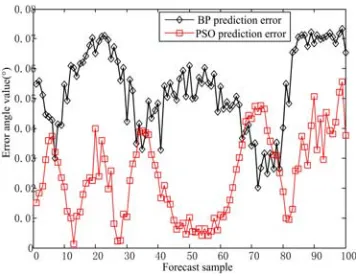
The prediction error curve and the percentage curve of prediction error before and after optimization are shown in Fig.6 and Fig.7 respectively. It can be seen that the prediction accuracy of BP neural network optimized by PSO algorithm is significantly higher than that of the BP neural network without optimization, and the identification accuracy is greatly improved by comparing the prediction error and the percentage error of the two curves.
In order to make a further comparison of the prediction results, the root mean square error is introduced as the basis of the discrimination, namely, the smaller RMS error is, the higher accuracy the model identifies with.
% 100 n
1
1
2
n
i i
i i mse
E E A
E (5)
In the formula(10), Airepresents the i-th predictive output value, Eirepresents the i-th expected output value, n is the total sample number.
Figure 4. Comparison of forecasts with expected values by using BP neural network.
[image:6.612.326.540.66.162.2]Figure 5. Comparison of forecasts with expected values after optimization.
Figure 6. Prediction error curve before and after optimization.
Figure 7.The percentage of prediction error curve before and after optimization.
Table 1. Comparison of prediction error and Percentage of prediction error between BP neural network and PSO optimization.
Prediction error Percentage of prediction error BP neural
network
PSO optimization
BP neural network
PSO optimization
Minimum value 0.0202 0.0014 1.7302 0.1308
Maximum value 0.0734 0.0554 7.6606 5.0097
Average value 0.0531 0.0244 5.1897 2.2471
Relative error of root-mean-square 5.48% 2.81%
Conclusions
The BP neural network model adopted to identify the nonlinear system of human dynamic balance had a comparatively ideal feasibility.
This article adopted the PSO algorithm to improve the ability of global exploration by optimizing with BP neural network weights and threshold as the particles vector. Obviously, it is reasonable and successful to improve the BP neural network algorithm shortcoming which is brought on the basis of the past experience easy to fall into local minimum and overcome the inaccuracies of the model parameters. We concluded that PSO-BP algorithm had a higher predicted accuracy and a better generalization performance through the results of simulation and quantitative comparison between PSO-BP neural network and the traditional BP neural network.
[image:6.612.104.282.207.345.2] [image:6.612.337.518.207.345.2]References
[1] Emery and Carolyn A., Effectiveness of a home-based balance-training program in reducing sports-related injuries among healthy adolescents: a cluster randomized controlled trial, Canadian Medical Association Journal. 172(6): 749-754 (2005).
[2] X.B. Huang, B. Liu and J.W. Sun, Analysis and evaluation of the balance function in patients with type 2 diabetes, Journal of surgery. 1: 27-30 (2016).
[3] J. Lu, D. Zhou and Z.J. Li, Dynamics characteristic analysis of standing human-structure interaction under lateral excitation, Journal of Nanjing Tech University(Natural Science Edition). 37(6): 61-68 (2015).
[4] W. Liu and Benno M. Nigg. A mechanical model to determine the influence of masses and mass distribution on the impact force during running, Journal of Biomechanics. 33: 219-224 (2000). [5] X.D. Zhou, Louis F.D. and Farid A., A dynamic model for simulating a trip and fall during gait, Medical Engineering and Physics. 24: 121–127 (2002).
[6] R.R. Qin, Virtual Simulation of Human Walking Based on Multi-rigid-body Dynamics Model, Research and Exploration in Laboratory. 31(6): 225-228 (2012).
[7] Kimura H. and Y.F. Jiang, A PID model of human balance keeping [J]. IEEE Control Systems Magazine. 26(6): 18-23 (2006).
[8] D. Yi, Ge X.R., An improved PSO 2based ANNwith simulated annealing technique, Neurocomputing. 63(11): 527-533 (2005).
[9] Beccali M., Cellura M. and Lo Brano V., Forecasting daily urban electric load profiles using artificial neural networks, Energy Conversion and Management. 45(18): 2879 -2900 (2004).
[10] Kannana S., Mary S.and Slochanal R., Application of particle swarm optimization technique and its variants to generation expansion planning problem, Electric Power Systems Research. 70(8): 203- 210 (2004).
[11] W.P. Hong and Z. Chen, Efficiency Prediction of Ammonia Flue Gas Desulfurization Based on Adaptive PSO-BP Model, Chinese Journal of Power Engineering. 33(4): 290-295 (2013).
[12] J. ZH. Xiao, SH. K. Sui , H.R. Wang, Research on a Evaluation System of Human Balance Capacity Based on Random Visual Stimulation, Chinese Journal of Biomedical Engineering. 33(4): 498-502 (2014).
[13] Z.Y. Li, J.Y. Wang and CH. Guo, A New Method of BP Network Optimized Based on Particle Swarm Optimization and Simulation Test, 36(11): 2224-2228 (2008).