Positive Psychology
Journal Paper
Developing a Growth Mindset through
Outdoor Personal Development: Can an
intervention underpinned by psychology
increase the impact of an outdoor learning
course for young people?
MSc Applied Positive Psychology
PYM711
Student Number: U1200048
September 2014
Acknowledgements
This project would not have been possible without the involvement of The Outward
Bound Trust (OBT) and the three schools who agreed to participate.
Much appreciation also goes to Tim Lomas from UEL whose support and guidance
Contents
Page Number
Abstract
4
Introduction
and
Literature
Review
6
Methodology
14
Results
19
Discussion and Implications for Practice
23
Limitations
28
Conclusions
29
References
30
Appendices
Appendix A – Journal Rationale and Guidelines42
Appendix B – Student Questionnaire
46
Appendix C – Intervention Outline, Models and Resources
50
Appendix D – Consent Form
57
Appendix E – Debrief Information
60
Abstract
This study considers the impact of using a series of Mindset1 interventions during a
five day Outdoor Personal Development (OPD2) course.
Self efficacy, resilience and Mindset were measured pre-course, post-course and
one month post-course. It was hypothesized that both groups would increase their
self efficacy and resilience, however it was thought that the Mindset (experimental)
group would significantly increase beyond the levels of the control group, who took
part in the standard OPD course. It was also predicted that the Mindset group would
move towards a Growth Mindset, whereas the control group would not show any
change in Mindset.
Hypotheses were tested using a randomized, quasi-experimental method. Separate
mixed Analysis of Variance (ANOVAs) were carried out for each dependent variable,
followed by planned comparisons and post-hoc tests using a Bonferroni correction.
Results showed that both groups increased self efficacy over time, however there
was no further significance for the experimental group. Resilience only increased
significantly in the experimental group while the control made no significant gain, and
students in the experimental group moved significantly towards a Growth Mindset,
while the control group did not.
1 Mindset is a positive psychology theory. It will be given a capital throughout to emphasise that it is the theory which is being referred to rather than a more generalised conception of the term.
2 OPD is used throughout to highlight focus upon outdoor courses which have the explicit aim of providing personal development outcomes. This may also be referred to as outdoor education, outdoor learning or
Mindset theory may provide outdoor practitioners with a model underpinned by
extensive empirical research, which supports understanding of some of the many
processes associated with overcoming challenges to reach achievement in a variety
of contexts. Future directions and implications for practice are discussed.
Keywords: outdoors, personal development, positive psychology, resilience, mindset,
Introduction and Literature Review
Outdoor Personal Development (OPD) courses are beginning to gain a reputation for
developing desirable personality characteristics which are in keeping with the
positive psychology (PP) movement (Sheard & Golby, 2006). However, as yet there
is little evidence to support claims that such programs can have an effect on
psychological constructs (Niall & Dias, 2001 and Sheard & Golby, 2006), and even
less of such research is based on five day residential programmes typically attended
by young people in the UK (Scrutton, 2014).
PP is a branch of psychology which seeks to use psychological theory, research and
interventions to recognize and develop human potential (Seligman & Cziksentmihali,
2000). Recent literature suggests that finding congruent themes from within
psychology and OPD may provide an integrative framework for understanding some
of the processes underlying the success of OPD courses, and may also strengthen
the impact of programmes and research (Mackenzie, Son & Hollenhurst, 2014). It
has also been suggested that the impact of OPD courses may be enhanced if
instructors have an awareness of the factors which contribute to particular areas of
psychological development, and explicitly focus upon these (e.g. Ewert & Yoshino,
2011).
A series of potentially valuable and compatible themes may emerge from Implicit
Self Theories research (now commonly known as Mindset, Dweck, 2000). Mindset
theory is a socio-cognitive model representing the way in which underlying beliefs
regarding the self can transform into powerful motivational processes to construct
Leggett, 1988). The theory explains how different meaning systems, and subsequent
self regulatory processes, are created in achievement situations, depending upon a
person’s beliefs regarding the fixed or malleable nature of intelligence, personality
and character (Burnette, O'Boyle, VanEpps, Pollack, & Finkel, 2012 and Dweck &
Molden, 2005). Such patterns are particularly significant when people are faced with
challenge or failure (Dweck & Sorich, 1999).
Someone who has a Fixed Mindset believes that intelligence, personality and
character are fixed from birth, therefore these are uncontrollable entities which they
can’t change (Dweck & Sorich, 1999). This creates a meaning system focussed on
proving oneself, and the pursuit of tasks which will reaffirm this pre-set ability.
Challenges are viewed as a threat to their abilities, if they cannot meet them, failure
becomes a final measure of aptitude, and application of effort is seen as a measure
of their incapability in that area (Bandura & Dweck, 1985, Elliott & Dweck, 1988,
Stone & Dweck, 1998). Subsequently those with a Fixed Mindset tend to avoid
challenges for fear of revealing weaknesses, give up easily, become distracted and
withdraw effort when things become difficult (Elliott & Dweck, 1988). Early research
describes this as a ‘helpless’ response (Diener & Dweck, 1978 and Dweck &
Repucci, 1973).
Conversely a person with a Growth Mindset believes that intelligence, personality
and character are malleable, therefore open to change and development under
personal volition (Dweck & Leggett, 1988). People with a Growth Mindset seek out
challenges seeing them as opportunities to learn (Elliott & Dweck, 1988). Rather
than viewing effort as a measure of ability, they see it as the switch which can turn
Trzesniewski & Dweck, 2007, Dweck, 1986 and Hong, Chiu, Dweck, Lin &
Wan,1999). This means when things become difficult a person with a Growth
Mindset will tend to adopt new strategies, find solutions, apply more effort and use
self monitoring to overcome the challenge (Diener & Dweck, 1978 and Doron,
Stephan, Boiche & Scanff, 2009). This is also described as a ‘mastery’ response
(Diener & Dweck, 1978) and has been shown to be a key factor in predicting
achievement outcomes (Burnette et al., 2012).
Initial studies were undertaken in laboratories leaving some uncertainty as to
whether or not such significant patterns would play out in real world situations (e.g.
Bandura & Dweck, 1985, Elliott & Dweck, 1988, Erdley, Cain, Loomis, Dumas-Hines
& Dweck, 1997 and Stone & Dweck,1998). However, there have been huge research
efforts in the past 20 years to increase the ecological validity of this theory and
create the existing body of evidence suggesting that Mindsets do matter, they have
huge implications for creating successful outcomes in young peoples’ lives, and
crucially, they can be changed (Dweck, 2008).
A Growth Mindset has been shown to have a favourable influence on grades and
achievement test scores, as well as self-esteem (Aronson, Fried & Good, 2003;
Good, Aronson & Inslicht, 2003; Henderson, 1990 and Robins & Pals, 2002). This
Mindset also predicted an upward trajectory in grades across a junior high transition,
while those in a fixed mindset showed a flat or downward trend in grades (Blackwell,
Trzesniewski & Dweck, 2007).
Although research began with a focus on intelligence, and therefore influences in the
academic domain, it has been shown to be applicable to any areas of the self
performance (Kasimatis, Miller & Marcussen, 1996 and Ommundsen, 2003), social
confidence (Beer, 2002) and effective dieting (Burnette, 2010).
Studies in recent years have shown that interventions targeting beliefs can change
behaviour patterns, which in turn affect achievement outcomes (Dweck, 2008). This
may have crucial implications for people working in personal development contexts.
Early studies considering changing Mindset took students who were at risk of
underperforming due to belonging to a negatively stereotyped group and taught them
a Growth Mindset through discussions with mentors and letter writing. Both showed
a significant increase in their overall performance on standardised tests as well as
increasing their valuing of academics and enjoyment of academic work (Aronson,
Fried & Good, 2002 and Good, Aronson & Inslicht, 2003). The most in-depth recent
study followed students aged eleven and twelve throughout their junior high
transition. They were taught a Growth Mindset over eight weekly sessions during
their first year of high school. Pre-intervention the majority of students showed a
downwards trend in grades at this time, however the programme was shown to
reverse this trend due to its impact on underlying beliefs, which in turn changed
potentially detrimental cognitive and behavioural patterns (Blackwell, Trezniewski &
Dweck, 2007). Students in the intervention group were also three times as likely to
show positive changes in classroom motivation, rated by teachers unaware of the
experiment. Encouragingly these results still held two years later with students who
showed a Growth Mindset significantly outperforming their peers (Blackwell,
Trezniewski & Dweck, 2007).
These interventions yielded surprisingly large changes with modest input, showing
and self regulatory processes (Dweck, 2008). Dweck and Molden (2005: p137)
comment that, ‘Although self theories can be relatively stable over time, they are
knowledge structures, and as such their accessibility can be changed by powerful
situations and interventions.’
OPD and Mindset
This is where OPD returns to the focus. The attitudes and behaviours associated
with the two Mindsets are incited when individuals confront challenging situations
(Dweck & Molden, 2005 and Dweck, 2012). An outdoor course has the potential to
create just the challenging circumstances required to elicit the concert of motivational
and behavioural processes associated with these, as has been shown in a sports
context (Ommundsen, 2003). Miles and Priest (1999: p112) comment that,
(OPD) courses require participants to leave the safety of the home, the daily routine and cope with the unfamiliar, the uncomfortable, the difficult and the adventurous, in search of an opportunity to understand, test and demonstrate their own resources, participants are challenged to learn about themselves and the world and discover endless possibilities for personal growth.
Consequently it is feasible that course members will experience aspects of their
Fixed or Growth Mindset during an OPD course. Facilitators may be able to
intervene in real time situations if they have an understanding of how each Mindset
can play out, as well as teaching and encouraging the Growth Mindset throughout
the course.
One of the most widely investigated areas in the outdoor literature is changes to
defined generally as, ‘the individual's belief about himself or herself, including the
person's attributes and who and what the self is’ (Baumeister, 1999:p21). Research
has shown that the effect of OPD courses on self-concept can be greater than those
typically found in classroom settings (Hattie et al., 1997). However, previous outdoor research has been criticised for describing the outcomes of courses but neglecting to
gain a deeper perspective on the processes by which change occurs in such areas
(Baldwin, Persing & Magnuson, 2004; Ewert & McAvoy, 2000; Henderson, 2004 and
Sibthorp, Paisley & Gookin, 2007) This has been described as the “black box”
(Ewert, 1989). As the two Mindsets can be seen as two fundamentally different ways
of conceptualising the self, this model may advance understanding into changes in
this area. Mindset may offer an insight into how OPD courses significantly impact
self-concept as they encourage individuals to consider their own capacity for
personal growth. By explicitly using this model, which seeks to explain underlying
psychological processes, it is hoped that an increase in impact can be demonstrated,
thereby offering greater understanding into what may occur in the “black box” (Ewert,
1989). Such theoretical integration may allow practitioners to better elucidate and
employ the methodologies which promote positive outcomes for participants
(Mackenzie, Son & Hollenhorst, 2014).
Many of the other adaptive functions of the Growth Mindset have also been shown to
be enhanced by OPD courses including increased capacity to take on challenges
(Cooley, Holland, Cumming, Novakovic, & Burns, 2014 and Hattie et al., 1997) and increased use of mental strategies to overcome difficulties and the perception of the
utility of effort when challenged (Scherl & Smithson, 1986). This adds weight to the
argument that OPD courses may enhance factors associated with the Growth
young people to highlight and reflect on specific areas as recommended by Ewert
and Yoshino, (2011).
Two psychological constructs which are gaining support in the outdoor literature, and
have also been linked to Mindset, are self efficacy and resilience (Dweck, 2008 and
Hans, 2000). Self efficacy refers to a person’s beliefs regarding their ability to create
a positive outcome in a given situation (Bandura, 1977), and has been shown to
increase after an outdoor learning course (Beightol, Jevertson, Carter, Gray, & Gass,
2012; Cason & Gills, 1994; Hayhurst, Hunter, Kafka, & Boyes, 2013; Marsh,
Richards & Barnes, 1997and OBT Social Impact Report, 2014).
Resilience can be defined in a number of ways but fundamentally includes positive
adaptation, balance, competence, determination and acceptance (Wagnild, 2009).
Some studies have shown resilience to increase post outdoor course (Hayhurst et al., 2013; Ewert & Yoshino, 2011; Neill & Dias, 2001 and OBT Social Impact Report, 2014), while others have shown null effects (Ewert & Yoshino, 2008 and Skehill,
2001), or limited effects based on non-parametric tests (Beightol et al., 2013). Much of the published evidence to date is based on studies undertaken with university
students (Ewert & Yoshino, 2011), often with small sample sizes (Sheard & Golby,
2006), or on the three week Australian model of OPD (Neill and Dias, 2001).
Many researchers are highlighting the need for systematic, longitudinal research
which gathers empirical evidence using randomised controls and larger sample
sizes, to support and understand some of the intricacies of program effects in these
areas (Hattie et al., 1997; Gillis, Gass & Russell, 2008; Ewert & Sibthorp, 2009; Neill, 2002 and Sheard & Golby, 2006). It is hoped that this study will contribute to a
effects of five day programmes typically experienced by young people in the UK. As
there is currently no published academic research investigating the impact of
explicitly combining a PP theory within an OPD context, this may offer a valuable
contribution to advancing knowledge into the process of developing positive
psychological qualities in young people through OPD courses.
One unpublished study has considered the combination of a Mindsets intervention
with an OPD course. This study found that the intervention had a significant impact
on young peoples’ Mindset, self efficacy and optimism, although the specifics of the
intervention were unclear (The Centre for Confidence, 2009). The following research
aims to build on this study in a number of ways, including recruiting a higher
numbers of participants, post-course data collection and using similarly trained
instructors.
The above synthesis of research has outlined the potential benefits to be gained
from interweaving an intervention based on Mindset theory within an OPD course.
Therefore it is hypothesised that:
Hypothesis 1 (H1): The OPD course (control group) will increase students self reported levels of self efficacy and resilience, but will not change their Mindset.
Methodology
Design
This research has been granted ethical approval (UEL, 2014). It is undertaken from
a positivistic standpoint in that it uses the scientific method to approximate
understanding of objective reality (Creswell, 2003). The limitations of this are
recognised as there are a number of confounding variables due to it taking place in
an open human environment. Therefore the intention is to identify trends and
estimate the probability of the intervention increasing resilience, self efficacy and Growth Mindset (Muijs, 2004).
The research follows a quasi-experimental design, with students randomly assigned
to the experiment and control groups by the centre administrator. The Mindset
intervention forms the independent variable. Participants completed a pre-test,
post-test and one month post-post-test batch of questionnaires which measure the dependent
variables of self efficacy, resilience and Mindset. This is a commonly used design in
educational research; randomisation ensures that threats to internal validity are
controlled for (Campbell & Stanley, 1963).
It is recognised that the ideal experiment would also have a control group who
experienced no changes during the study period. Unfortunately the school that were
providing this were unable to take part at the last minute due to unforeseen
circumstances. While this was inconvenient, the absence of a pure control group
does not render the study invaluable. There are numerous studies publishing data
using similar scales to show the stability of such constructs over time by the use of
control groups (e.g. Blackwell, Trzesniewski & Dweck, 2007; Neill & Dias, 2001 and
The OPD Course
This research has been carried out within The Outward Bound Trust (OBT), the
leading organization within adventure education around the world since 1941 (Miles
& Priest,1999). They are also one of the biggest providers of personal development
in the UK, working with 24,602 young people in 2013 (Social Impact Report, 2014).
As the entire intervention took place in a residential setting, the participants were
exposed to a comparable social environment, daily routine and activities so any
confounding variables were kept to a minimum (Creswell, 2003). Key variables which
were controlled for to ensure all participants had parity of experience included,
jumping in the lake, a full day linked journey involving rock climbing or gorge walking
and journeying on the lake, a two day mountain expedition with a wild camp (this
was a mountain day for one school), and a variety of activities to promote teamwork
and support in the groups. As the instructors create a programme to fit the needs of
the students in their group, programmes contained some variation. In real world
educational settings it is recognised that it would be a mistake to attempt to hold all
variables constant in situations which are usually interactive, dynamic and relational
(Cohen, Manion & Morrison, 2007).
It is accepted that a significant confounding variable may be that of the instructor
delivering the course (Hattie et al., 1997). All of the instructors have worked at OBT for at least 12 months so had experienced similar training. Their experience in
delivering outdoor learning courses varied from 3 to 10 years. However, these
factors were the same for the instructors working with both the experiment and
control groups. The researcher took on the role of Course Director during each of the
making sure the control groups were not exposed to any explicit learning about
Mindsets. Instructors were also given a written brief of session plans to work from
(Appendix C) and the OBT learning process model was used throughout all of the
courses. This is outlined below (OBT, 2014):
The Intervention
The intervention was designed by the researcher and colleagues, based on explicitly
exploring the areas of responding to challenge, application of effort and overcoming
setbacks, found to be key components of Mindset theory. It consisted of four
integrated sessions which were spread out throughout the week and delivered using
the learning process format above. These can be viewed in Appendix C
A structured approach was taken to ensure a level of continuity for the experimental
groups. While there was a basic written framework for the interventions, and the
F R A M E F R O N T L O A D A C T I V I T Y T R A N S F E R R E V I E W
To unlock the potential of young people through discovery and adventure in the wild
Learning Objectives
same models were used, there will have been some differences in the exact
methods instructors used in their delivery. There was also some adaptation from
instructors in response to their students’ needs and interaction with the intervention.
This would happen in most educational settings with young people so while it may be
seen as a limitation in terms of scientific research it has a logical sense to it in real
world application (Cohen, Manion & Morrison, 2007).
Participants
Three schools from within the UK agreed to take part in the study (n = 196; male =
104, female = 92). Pupils were in years six to nine at school3.
Participants from each school were split equally into the experimental (n = 103) or
control group (n = 93) by the centre administrator, meaning that the students were
blind to the experimental condition they were part of. They were given minimal
information regarding the study, only that the research was looking at changes in
psychological constructs over time. This reduced the subtle effects incurred from the
students knowing the details of the experiment, and allowed the study to be carried
out under natural conditions, without them altering their behaviour or responses
(Cohen, Manion & Morrison, 2007).
Ten students from the control group were eliminated from the analysis due to them
not filling in the correctly coded questionnaires, therefore their responses for each
time point could not be matched.
Data collection
Three psychology scales were filled in at school the week before students attended
the course, on the final day of the course, and one month later back in the school
environment. The General Self Efficacy (GSE) scale measures a sense of personal
competence to deal effectively with a selection of stressful situations (Schwarzer &
Jerusalem, 1995). Numerous studies have established its validity and reliability with
Cronbach’s alphas ranging from 0.76 to 0.9, the majority being in the high 0.8’s
(Schwarzer & Jerusalem, 2014). The Resilience Scale – 14 (RS – 14) was used to
measure resilience as it measures five facets of the construct including
perseverance and self reliance (Wagnild & Young, 1993). It has also previously been
used in outdoor adventure studies (Neill & Dias, 2001 and Skehill, 2001). The shorter
version was selected to suit this younger population, which has alphas ranging from
0.85 – 0.94 across a range of studies (Wagnild, 2009). The Implicit Self Theories
scale was used to measure the participants’ theory of intelligence (Mindset). The
scale measures the degree to which participants hold a Growth or a Fixed Mindset. It
has high internal reliability with Cronbach’s alphas ranging from .94 to .98 (Dweck,
Results
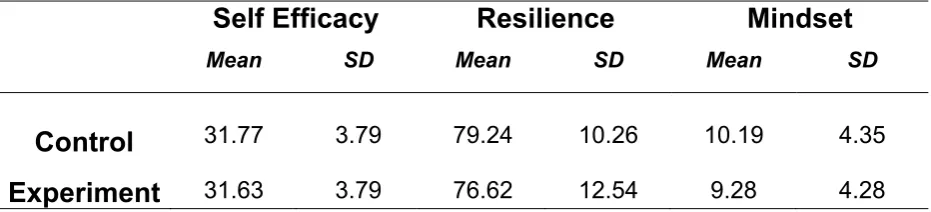
A one-way ANOVA confirmed that Levene’s Test for Equality of Variances had not
been violated and the starting means for all dependent variables were comparable
(see table 1 below). Mauchly’s test was reviewed indicating that the assumption of
sphericity had not been violated for any of the variables. While gender and
participant age may reveal significant results, it is beyond the scope of this paper to
explore them further here so they were not included as variables in any of the
[image:19.595.68.534.374.480.2]following analysis.
Table 1
Mean Scores for Self Efficacy, Resilience and Mindset at Time One
Self Efficacy
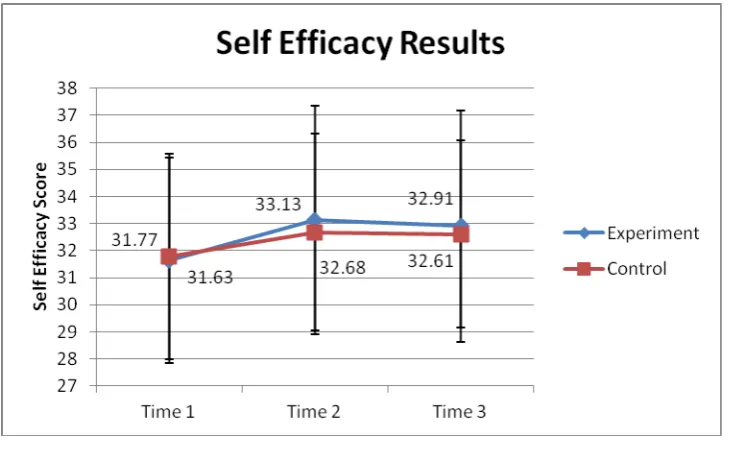
A mixed-factorial ANOVA was conducted with a within-participants factor of time (T1,
T2, T3), a between-participants factor of group (experimental, control), and self
efficacy as the dependent variable. There was a main effect for time, F(2,191) =
10.64, p < 0.001, ƞ2 = 0.10), but no interaction with condition, F(2, 191) = 0.76 , p = 0.467, η2 = 0.008. A medium effect size was found (Cohen, 1988).
Follow up pair-wise comparisons using the Bonferroni correction for time indicated
that changes in T1 – T2 scores reached statistical significance (p < 0.001), as did T1
Self Efficacy
Resilience
Mindset
Mean SD Mean SD Mean SD
Control
31.77 3.79 79.24 10.26 10.19 4.35– T3 (p < 0.001). Changes from T2 – T3 were not significant (p = 0.73). See figure 1
[image:20.595.117.482.188.415.2]below:
Figure 1 – Self Efficacy Results, with Std.Dev bars.
Resilience
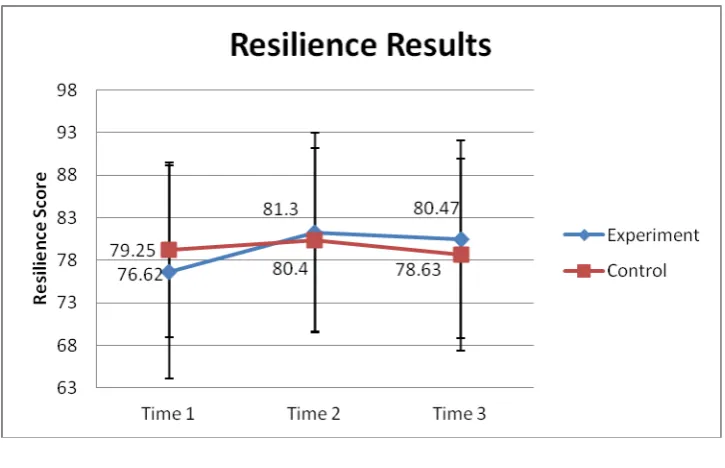
A mixed-factorial ANOVA was conducted with a within-participants factor of time (T1,
T2, T3), a between-participants factor of group (experimental, control), and resilience
as the dependent variable. There was a main effect for time, F(2,191) = 8.67, p <
0.001, η2 = 0.08. There was also an interaction with condition, F(2, 191) = 5.83, p = 0.003 , η2 = 0.058.
A planned comparison highlighted that the main effect for time was only significant
for the experimental group, F(2,101) = 12.73, p < 0.001, η2 = 0.20. There is a significant linear (p<0.001) and quadratic component (p<0.001) to this, showing that
slightly one month post-intervention. A large effect size was found (Cohen, 1988).
The control group did not significantly change their resilience over time, F(2,91) =
1.90, p=0.16, η2 = 0.04.
Post-hoc pair-wise comparisons using a Bonferroni correction for time indicated that
changes in T1 – T2 scores for the experimental group reached statistical significance
(p < 0.001), as did T1 – T3 (p < 0.001). Changes from T2 – T3 were not significant (p
[image:21.595.117.480.332.566.2]= 0.06). See figure 2 below:
Figure 2 – Resilience Results, with Std.Dev bars.
Mindset
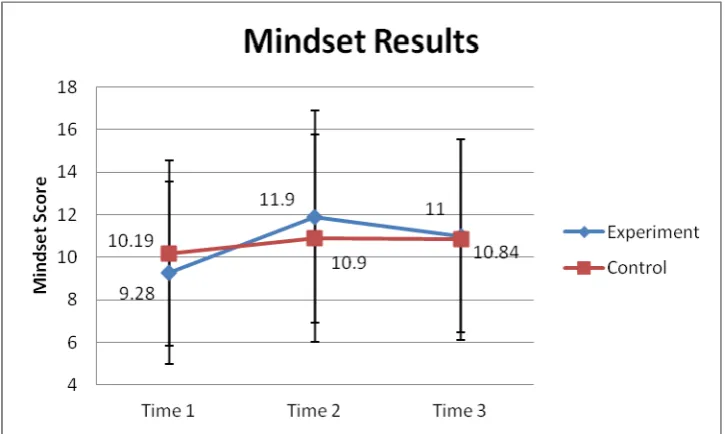
A mixed-factorial ANOVA was conducted with a within-participants factor of time (T1,
T2, T3), a between-participants factor of group (experimental, control), and Mindset
as the dependent variable. There was a main effect for time, F(2,193) = 11.05, p <
A planned comparison highlighted that the main effect for time was only significant
for the experimental group, F(2,101) = 15.46, p < 0.001, η2 = 0.24. A large effect size was shown (Cohen, 1988) There is a significant linear and quadratic component to
this (p<0.001 for both) showing that students in the intervention group made
significant progress towards a Growth Mindset over time, which reduced slightly one
month post intervention. The control group did not significantly change their Mindset
over time, F(2,91) = 0.99, p=0.37, η2 = 0.02.
Post Hoc Tests with a Bonferroni correction showed that changes within the
experimental group were significant at T1 – T2 (p < 0.01) and T1 – T3 (p = 0.01), but
[image:22.595.117.480.402.619.2]non-significant from T2 – T3 (p = 0.09). See figure 3 below:
Discussion and Implications for Practice
For the first time this study provides evidence that combining a Mindset intervention
within an OPD course can increase the impact of the course in terms of resilience
and change in Mindset. This supports growing evidence to suggest that OPD
courses may be enhanced by understanding key psychological theory and may also
offer advances in knowledge into the intricacies of the process by which OPD
courses are able to impact on certain areas of psychological development.
At the beginning of the study it was hypothesised that, the control group would
increase in self efficacy and resilience, but not change Mindset (H1), and that the
experimental group would further increase in self efficacy and resilience, as well as
moving towards a Growth Mindset (H2).
The Mindset results support both H1 and H2. As expected only the group who took
part in the Mindset intervention throughout their outdoor course significantly moved
towards a Growth Mindset. While this study does not delve beyond self report, it is
possible that students who moved towards a Growth Mindset could go on to
experience the many behavioural and motivational benefits found in the Mindset
literature, such as improved motivation to learn, increase in grades and higher self
esteem (Blackwell, Trzesniewski & Dweck, 2007). A longitudinal study including
behavioural, motivational and achievement measures may offer more insight into this
fascinating area.
The resilience results give pause for thought. While resilience showed a significant
increase for those who took part in the Mindset intervention during their OPD course,
supporting H2, but not H1. It is likely that the increase in resilience for the
experimental group is linked to these students’ move towards a Growth Mindset, as
previous research has found strong links between these two areas (Dweck, 2008). If
participants are explicitly encouraged towards the belief that they have personal
control over their development, gain an understanding of the utility of effort when
facing challenges and have built up a bank of transferable strategies to use when
facing setbacks, they are more likely to feel resilient and display resilient behaviours
in future situations. In this respect Mindset may offer outdoor practitioners a well
researched and logical framework to use when processing challenging experiences
with young people, which can contribute to enhancing resilience.
The study may also contribute to understanding resilience development in a number
of ways. Mixed results from previous studies coupled with these results support the
previous suggestion that resilience development may not be as straightforward as
participants just taking part in a series of progressive outdoor challenges (Hayhurst
et al., 2013). Previous outdoor studies discuss Rutter’s (1990) idea of ‘psychological immunisation’, where participants experience manageable doses of adversity and
challenge, in order to practice the skills and behaviours required to successfully
overcome these (Hayhurst et al., 2013 and Neill & Dias, 2001). It has been thought that such experiences can lead to greater resilience in new situations (Rutter, 1987).
The results of this study suggest that this alone may not be the case.
Both groups took part in similarly progressive challenging outdoor experiences, yet
only the group who engaged with structured processing specific to overcoming
challenge with support, application of effort and highlighting transferable strategies
The complexities of impacting on young people’s resilience are beginning to be
considered in more detail in the literature. Hayhurst et al. (2013: p2) comment that, ‘programmes must allow young people to successfully overcome challenges in a
manner which increases self efficacy and confidence in one’s ability to influence their
environment.’ This suggests that structured programming and facilitation is
important. Similarly other researchers have highlighted the need for resilience
enhancing courses to provide experiences of persevering to overcome challenge in a
supportive group, combined with the use of these experiences in discussion and
debriefs (Ewert & Yoshino, 2011). It has also been suggested that increasing
resilience requires development of tools and strategies which participants can use in
a variety of contexts, as well as connecting the adventure experience to appropriate
settings such as school or home (Beightol et al., 2013).
It may be that it was the focussed processing during the interventions in this study
which enabled these young people to increase their resilience (Knapp, 1990).
Changes in thinking may be underpinned by their deeper understanding of the
process by which success had been achieved during their outdoor programme,
coupled with tangible strategies which can be used when facing future challenges or
setbacks (Luckner & Nadler, 1997). This is an area of interest which could be
pursued further with a qualitative follow up study.
It is also possible that the existing resilience studies which have found significant
results have included considerable processing in these areas, while the others have
not. The limited articulation of learning process used during outdoor programmes is
support earlier suggestions that this may be an area worthy of further research
(Cason & Gills, 1994 and Mackenzie, 2000).
While the structured processing appeared to have an impact on changing Mindset
and increasing resilience, it had less of an influence on self efficacy. Although self
efficacy improved slightly more for the experimental group, this was not found to be
statistically significant, supporting H1, but not H2. It could be expected that
participants would develop in this area by engaging with a series of well planned,
facilitated and progressive challenges where they are experiencing mastery. This
finding supports previous studies which suggest that OPD courses improve self
efficacy (Hattie et al., 1997; Sheard & Golby, 2006 and Beightol et al., 2012), and suggests that further specific intervention had little effect on this construct.
It has been shown that using a series of interventions underpinned by the
psychology theory of Mindset can increase the impact of an OPD course in terms of
resilience and Mindset. However, there may be drawbacks to focussing considerable
attention on one area of processing. While the experimental group made significant
gains in resilience and Mindset, they may have missed out in other important areas
which were not measured by this study. It is possible that time spent focussing on
Mindset may have inadvertently directed attention away from other important
outcomes such as teamwork, communication, or learning about the natural
environment. Similarly, as instructors for the control groups were asked to “meet the
outcomes of the course without explicitly using any Mindset theory or models” they
may have spent less time and focus on themes of challenge, effort and setbacks,
significant increase in resilience for this group and also presents a possibility that
they developed further in areas not measured.
The latter has implications for practitioners as it suggests that the areas of focus
chosen by the instructor and how they choose to facilitate these could have a large
impact on the outcomes experienced by young people. In many ways this supports
current practice of developing targeted courses to suit different populations (OBT,
2014). This may be built upon and impact may be increased for a range of clients by
creating structured and focussed interventions underpinned by current psychological
research to complement the many benefits which OPD courses have frequently been
shown to offer. Further research could include another group, as well as a pure
control, who undertake a structured and focussed intervention relating to a different
course outcome. Inclusion of measures of a variety of outcomes would allow any
differences in development to be highlighted, giving further insight into the impact of
intentional focus directed by the instructor through processing.
PP has a growing empirical knowledge base which offers a multitude of opportunities
for outdoor practitioners, both in terms of theory and scientifically validated
interventions. Equally OPD programs use unique environments and methods to
engage young people in their personal growth. A ‘symbiotic integration’ of knowledge
from both fields may facilitate development of a common language between youth
development practitioners in a variety of contexts, ultimately meaning greater impact
Limitations
While this study offers a significant contribution to the outdoor literature, particularly
regarding development of resilience, there are some limitations and suggested
improvements. As previously stated, unfortunately the school that were providing the
control group were unable to participate, meaning there was no comparison for the
effects of time or usual environment on the constructs measured. In future studies
this should be included.
Results were gained using self-report. While this may provide the beginnings of
understanding into a very complex process, self-perception of each construct is
measured, rather than actual behaviour in real situations which may be vastly
different (Baumeister, Vohs & Funder, 2007). Future studies could build on this to
incorporate follow-up measures which aim to consider changes in behaviour, as well
as thinking post-course - similar to Blackwell, Trzesniewski and Dweck, (2007).
It is also possible that certain elements of courses and the intervention, or the mix of
the two had a particular impact. It would be useful to undertake qualitative research
with a sample of the participants to ascertain which experiences were most salient to
them in developing resilience and moving towards a Growth Mindset, and also
whether or not self reported changes have led to any observed behaviour changes in
Conclusions
This preliminary study has investigated whether the inclusion of an intervention
underpinned by psychological theory and research can increase the impact of an
OPD course, in terms of self efficacy, resilience and Mindset. Findings suggest that
interweaving a structured and focussed intervention within an OPD course can have
a significant impact on participants’ Mindset as well as increasing their resilience
levels.
Results also suggest that taking part in an outdoor programme alone is not enough
to increase resilience and change Mindset. Something deeper is required, arguably a
series of progressive challenges undertaken in a supportive environment, combined
with structured facilitation which focuses on the psychology of this area of
development. Mindset may offer one theoretical model based on extensive research
within the psychology field which can provide outdoor practitioners with a framework
to use in supporting young people to develop their understanding of the
psychological processes involved with overcoming challenges and creating
successful outcomes in their lives. This research supports further integration of
psychology theories into OPD practice to enhance understanding and subsequently
increase practitioners’ ability to provide courses which have a lasting impact
References
Aronson, J., Fried, C. B., & Good, C. (2002). Reducing the effects of stereotype
threat on African American college students by shaping theories of
intelligence. Journal of Experimental Social Psychology, 38(2), 113-125.
Baldwin, C., Persing, J., & Magnuson, D. (2004). The role of theory in research and
evaluation about adventure education. Journal of Experiential Education,
26(3), 167-183.
Bandura, A. (1977). Self-efficacy: toward a unifying theory of behavioral change.
Psychological review, 84(2), 191.
Bandura, M., & Dweck, C. S. (1985). The relationship of conceptions of intelligence and achievement goals to achievement-related cognition, affect and behavior. Manuscript submitted for publication
Baumeister, R. F. (Ed.) (1999). The Self in Social Psychology. Philadelphia, PA: Psychology Press (Taylor & Francis).
Baumeister, R. F., Vohs, K. D., & Funder, D. C. (2007). Psychology as the science of
self-reports and finger movements: Whatever happened to actual behavior?.
Perspectives on Psychological Science, 2(4), 396-403.
Beightol, J., Jevertson, J., Carter, S., Gray, S., & Gass, M. (2012). Adventure
education and resilience enhancement. Journal of Experiential Education, 35(2), 307-325.
Blackwell, L. S., Trzesniewski K. H., & Dweck, C. S. (2007). Implicit theories of
intelligence predict achievement across an adolescent transition: A
longitudinal study and an intervention. Child Development, 78(1), 246- 263.
British Psychological Society (2009). Retrieved from:
http://www.bps.org.uk/system/files/documents/code_of_ethics_and_conduct.
Burnette, J. L. (2010). Implicit theories of body weight: Entity beliefs can weigh you
down. Personality and Social Psychology Bulletin, 36, 410– 422. doi:10.1177/0146167209359768
Burnette, J. L., O'Boyle, E. H., VanEpps, E. M., Pollack, J. M., & Finkel, E. J. (2012).
Mind-Sets Matter: A Meta-Analytic Review of Implicit Theories and Self-Regulation.
Psychological Bulletin. Advance online publication. doi: 10.1037/a0029531
Cason D., & Gillis, H. L. (1994). A meta-analysis of outdoor adventure programming
with adolescents. Journalof Experiential Education, 17(1), 40-47.
Cohen, L., Manion, L., & Morrison, K. (2007). Research methods in education (7th edition). London, RoutledgeFalmer.
Cooley, S. J., Holland, M. J., Cumming, J., Novakovic, E. G., & Burns, V. E. (2014).
Introducing the use of a semi-structured video diary room to investigate
students’ learning experiences during an outdoor adventure education
groupwork skills course. Higher Education, 67(1), 105-121.
Creswell, J. W. (2003). Research design: qualitative, quantitative, and mixed method approaches (2nd ed.). Thousand Oaks, Calif.: Sage Publications..
Diener, C. I., & Dweck, C. S. (1978). An analysis of learned helplessness:
Continuous changes in performance, strategy and achievement cognitions
following failure, Journal of Personality and Social Psychology, 36, 451- 462.
Doron, J., Stephan, Y., Boiché, J., & Scanff, C. L. (2009). Coping with examinations:
Exploring relationships between students' coping strategies, implicit theories
of ability, and perceived control. British Journal of Educational Psychology, 79(3), 515-528.
Dweck, C. S. (2000). Self-theories: Their role in motivation personality and development. Francis and Taylor: Hove.
Dweck, 2008. Can personality be changed? The Role of Beliefs in Personality and
Change. Current Directions in Psychological Science, 17, 391-394
Dweck, C. S. (2012). Implicit theories. In P. A. M. Van Lange, A. W. Kruglanski, & E.
T. Higgins (Eds.), Handbook of theories of social psychology (Vol. 2, pp. 43– 61). Thousand Oaks, CA: Sage.
Dweck, C. S., Chiu, C., & Hong, Y. (1995). Implicit theories and their role in
judgments and reactions: A world from two perspectives, Psychological Inquiry, 6(4), 267-285.
Dweck, C. S., & Leggett, E. L. (1988). A social-cognitive approach to motivation and
personality. Psychological Review, 95, 256–273. doi:10.1037/0033-295X.95.2.256
Dweck, C. S., & Molden, D. C. (2005). Self-theories: Their impact on competence
motivation and acquisition. In A. J. Elliot & C. S. Dweck (Eds.), Handbook of competence and motivation (pp. 122–140). New York, NY: Guilford Press.
Dweck, C. S., & Reppucci, N. D. (1973). Learned helplessness and reinforcement
Dweck, C. S., & Sorich, L. A. (1999). Mastery-oriented thinking. In C. R. Snyder
(Ed.), Coping: The psychology of what works (pp. 232–251). New York, NY: Oxford University Press
Elliott, E. S., & Dweck, C. S. (1988). Goals: An approach to motivation and
achievement. Journal of Personality and Social Psychology, 54, 5–12. doi:10.1037/0022-3514.54.1.5
Ewert, A. (1982). Outdoor adventure and self concept: A research analysis. Eugene: University of Oregon, Centre of Leisure Studies.
Ewert, A. (1989). Outdoor adventure pursuits: Foundations, models, and theories. Columbus, OH: Publishing Horizons.
Ewert, A. & McAvoy, L. (2000). The effects of wilderness setting on organized
groups: A state of knowledge paper. In S. F. McCool, D. N. Cole, W. T.
Borrie, & J. O’Loughlin (Eds.), Wilderness as a place for scientific inquiry (USDA Forest Service Proceedings RMRS-P-0-VOL-3, pp. 1–14).
Washington, DC: U.S. Department of Agriculture.
Ewert, A., & Sibthorp, J. (2009). Creating outcomes through experiential education:
Ewert, A., & Yoshino, A. (2008). A preliminary exploration of the influence of
short-term adventure-based expeditions on levels of resilience. Journal of Experiential Education, 30(3), 262–266.
Ewert, A., & Yoshino, A. (2011). The influence of short-term adventure-based
experiences on levels of resilience. Journal of Adventure Education and Outdoor Learning, 11(1), 35-50.
Gillis, H. L., Gass, M. A., & Russell, K. C. (2008). The effectiveness of Project
Adventure’s behavior management programs for male offenders in
residential treatment. Residential Treatment for Children & Youth, 25, 227-247.
Good, C., Aronson, J., & Inzlicht, M. (2003). Improving adolescents‟ standardized
test performance: An intervention to reduce the effects of stereotype threat.
Journal of Applied Developmental Psychology, 24, 645- 662.
Hans, T. A. (2000). A meta-analysis of the effects of adventure programming on
locus of control. Journal of contemporary psychotherapy, 30(1), 33-60.
Hattie, J., Marsh, H. W., Neill, J. T., & Richards, G. E. (1997). Adventure education
and Outward Bound: Out-of-class experiences that make a lasting
Hayhurst, J., Hunter, J. A., Kafka, S., & Boyes, M. (2013). Enhancing resilience in
youth through a 10-day developmental voyage. Journal of Adventure Education & Outdoor Learning, (ahead-of-print), 1-13.
Henderson, V. (1990). Students' explanations for their theories of intelligence,
Unpublished raw data, University of Illinois, Champaign-Urbana. Referenced
in C. S. Dweck, C. Chiu, & Y. Hong, (1995). Implicit theories and their role in
judgments and reactions: A world from two perspectives, Psychological Inquiry, 6(4), 267-285.
Henderson, K. (2004). Got research in experiential education? Theory and evidence.
Journal of Experiential Education, 26(3), 184–189.
Hong, Y. Y., Chiu, C.-Y., Dweck, C. S., Lin, D. M.-S., & Wan, W. (1999). Implicit
theories, attributions, and coping: A meaning system approach. Journal of Personality and Social Psychology, 77, 588-599.
Kasimatis, M., Miller, M., & Marcussen, L. (1996). The effects of implicit theories on
exercise motivation. Journal of Research in Personality, 30, 510–516. doi:10.1006/jrpe.1996.0037
Knapp, C. E. (1990). Processing the adventure experience. In J. Miles & S. Priest
Luckner, J. L., & Nadler, R. S. (1997). Processing the experience: strategies to
enhance and generalize learning (2nd ed.). Dubuque, Iowa: Kendall/Hunt.
Marsh, H. W., Richards, G. E., & Barnes, J. (1986). Multidimensional Self-Concepts
A Long-Term Follow-Up of the Effect of Participation in an Outward Bound
Program. Personality and Social Psychology Bulletin, 12(4), 475-492.
McKenzie, M. D. (2000). How are Adventure Education Program Outcomes
Achieved?: A review of the literature. Australian Journal of Outdoor Education, 5(1), 19-28.
Mackenzie, S. H., Son, J. S., & Hollenhorst, S. (2014). Unifying Psychology and
Experiential Education: Toward an Integrated Understanding of Why It
Works. Journal of Experiential Education, 1053825913518894.
Miles, J. C., & Priest, S. (1999). Adventure programming. State College, Pa.: Venture Pub.
Muijs, D. (2004). Doing qualitative research in education with SPSS. London, Sage.
Neill, J. T., & Dias, K. L. (2001). Adventure education and resilience: The
Neill, J. T. (2002). Meta-analytic research on the outcomes of outdoor education. In
6th Biennial Coalition for Education in the Outdoors Research Symposium, Bradford Woods, IN (pp. 11-13).
Ommundsen, Y. (2003). Implicit theories of ability and self-regulation strategies in
physical education classes. Educational Psychology, 23, 141–157. doi:10.1080/01443410303224
Robins, R. W., & Pals, J. L. (2002). Implicit self-theories in the academic domain:
Implications for goal orientation, attributions, affect, and self-esteem change.
Self and Identity, 1, 313–336. doi:10.1080/ 15298860290106805
Rutter, M. (1987). Psychosocial resilience and protective mechanisms. American Journal of Orthopsychiatry, 57, 316-331.
Rutter, M. (1990). Psychosocial resilience and protective mechanisms. In J. Rolf, A.
S. Masten, D. Cicchetti, K. H. Nvechterlein, & S. Weintraub (Eds.), Risk and
protective factors in the development of psychopathology (pp. 181–214).
Cambridge: Cambridge University Press.
Scrutton, R. A. (2014). Outdoor adventure education for children in Scotland:
quantifying the benefits. Journal of Adventure Education & Outdoor Learning, (ahead-of-print), 1-15.
Seligman, M.E.P & Czikszentmihaly, M (2000). Positive Psychology: An Introduction.
American Psychologist 55 (1): 5–14
Sheard, M., & Golby, J. (2006). The efficacy of an outdoor adventure education
curriculum on selected aspects of positive psychological development.
Journal of Experiential Education, 29(2), 187-209.
Sibthorp, J., Paisley, K., & Gookin, J. (2007). Exploring participant development
through adventure-based programming: A model from the National Outdoor
Leadership School. Leisure Sciences, 29(1), 1-18..
Skehill, C. M. (2001). Resilience, coping with an extended stay outdoor education
program and adolescent mental health (Doctoral dissertation, University of
Canberra).
Social Impact Report (2014). Retrieved from:
http://www.outwardboundtrust.org.uk/social-impact-report-2014.pdf
Stone and Dweck (1998). Theories of intelligence and the meaning of achievement
Schwarzer, R., & Jerusalem, M. (1995). Generalized Self-Efficacy scale. In J.
Weinman, S. Wright, & M. Johnston, Measures in health psychology: A user’s portfolio. Causal and control beliefs (pp. 35-37). Windsor, UK: NFER-NELSON.
Schwarzer & Jerusalem (2014). Retrived from:
http://userpage.fu-berlin.de/health/engscal.htm
The Centre for Confidence and Wellbeing (2009). Report on research conducted by
the Centre on the impact of different types of outdoor education
interventions. Retreived from:
http://www.centreforconfidence.co.uk/information.php?p=cGlkPTE5MQ
The Outward Bound Trust (2014). Retrieved from:
http://www.outwardbound.org.uk/schools-a-colleges/our-instructors.html
University of East London (2014). Retrieved from:
http://www.uel.ac.uk/gradschool/research/
Wagnild, G. M., & Young, H. M. (1993). Development and psychometric evaluation
Wagnild, G (2009). The Resilience Scale Users Guide for the US English version of
the Resilience Scale and the 14 Item Resilience Scale (RS-14). Worden,
Appendix A - Journal Rationale and Submission Guidelines
1) Title of work:
‘Developing a Growth Mindset through Outdoor Personal Development: Can an intervention underpinned by psychology increase the impact of an outdoor learning course for young people?’
2) Title of Journal:
Journal of Adventure Education and Outdoor Learning
3) Editor:
Barbara Humberstone
4) Rationale
a) Aims and scope of chosen journal
I have selected to submit my piece of work to this journal based on the aims and scope, for the following reasons:
I am keen to reach an audience from the outdoor personal development sector.
It is the official journal for the Institute of Outdoor Learning, the main body for outdoor practitioners in the UK.
There is current literature and research within the outdoor field suggesting that outdoor learning may benefit from greater integration with positive psychology.
It provides a central point for publication of works relating to advancing knowledge in disciplines which use the outdoors as a medium for development, as well as recreation. It has wide international readership.
It especially welcomes papers from different theoretical perspectives.
It has clear guidelines and a suitable word limit of 6000 words (not including references).
b) Examples of similar pieces of work:
The journal is published 3 times a year and often includes impact studies, more recently those relating to development of positive psychological constructs, for example:
Neill, J. T., & Dias, K. L. (2001). Adventure education and resilience: The double-edged sword. Journal of Adventure Education and Outdoor Learning, 2(1), 35–42.
Ewert, A., & Yoshino, A. (2011). The influence of short-term adventure-based experiences on levels of resilience. Journal of Adventure Education and Outdoor Learning, 11(1), 35-50. Scrutton, R. A. (2014). Outdoor adventure education for children in Scotland: quantifying the
c) Alternative choice(s):
Journal of Experiential Education
Reasons for not submitting to this journal include:
Less well known in the UK.
A lower word limit of 3000 – 6000 words including references.
Submission to this journal will be considered for future work.
Submission Guidelines for JAEOL
The purpose of this international journal is to promote dialogue, research, thinking, understanding, teaching and practice in the field of adventure education and outdoor learning.
Journal of Adventure Education and Outdoor Learning considers all manuscripts on the strict condition that
the manuscript is your own original work, and does not duplicate any other previously published work, including your own previously published work.
the manuscript is not currently under consideration or peer review or accepted for publication or in press or published elsewhere.
the manuscript contains nothing that is abusive, defamatory, libellous, obscene, fraudulent, or illegal.
Manuscript preparation
1. General guidelines
JAEOL will consider original papers written in English, which have not been published already nor submitted simultaneously in another Journal. The Journal welcomes papers that report on research with a wide international interest.
Any consistent spelling and punctuation styles may be used. Follow the APA manual for punctuation. Please use single quotation marks, except where ‘a quotation is “within” a quotation’. Long quotations of 40 words or more should be indented without quotation marks. Always state authors, date and page number.
A typical manuscript generally ranges from 5000 to 6000 words in length, excluding tables, references, captions, footnotes and endnotes. Manuscripts that greatly
exceed this will be critically reviewed with respect to length. Authors should include a word count with their manuscript.
Manuscripts should be compiled in the following order: title page (including Acknowledgements as well as Funding and grant-awarding bodies); abstract;
keywords; main text; references; appendices (as appropriate); table(s) with caption(s) (on individual pages); figure caption(s) (as a list).
Abstracts of 150 words are required for all manuscripts submitted. Abstracts should also include the title of the article. No references should appear in the abstract.
Search engine optimization (SEO) is a means of making your article more visible to anyone who might be looking for it. Please consult our guidance here .
Section headings should be concise.
All authors of a manuscript should include their full names, affiliations, postal addresses, telephone numbers and email addresses on the cover page of the manuscript. One author should be identified as the corresponding author. Please give the affiliation where the research was conducted. If any of the named co-authors moves affiliation during the peer review process, the new affiliation can be given as a footnote. Please note that no changes to affiliation can be made after the manuscript is accepted. Please note that the email address of the corresponding author will normally be displayed in the article PDF (depending on the journal style) and the online article.
All persons who have a reasonable claim to authorship must be named in the manuscript as authors; the corresponding author must be authorized by all co-authors to act as an agent on their behalf in all matters pertaining to publication of the manuscript, and the order of names should be agreed by all authors.
Please supply a short biographical note for each author.
Please supply all details required by any funding and grant-awarding bodies as an acknowledgement in a separate Funding paragraph as follows:
o For single agency grants: "This work was supported by the [Funding Agency] under Grant [number xxxx]."
o For multiple agency grants: "This work was supported by the [Funding Agency 1] under Grant [number xxxx]; [Funding Agency 2] under Grant [number xxxx]; and [Funding Agency 3] under Grant [number xxxx]."
Authors must also incorporate a Disclosure Statement which will acknowledge any financial interest or benefit they have arising from the direct applications of their research.
For all manuscripts non-discriminatory language is mandatory. Sexist or racist terms must not be used. Ensure that writing does not emphasise bias. Beware of treating groups as oddities, exceptional cases and of stereotyping.
Authors must adhere to SI units . Units are not italicised.
When using a word which is or is asserted to be a proprietary term or trade mark, authors must use the symbol ® or TM.
Authors must not embed equations or image files within their manuscript.
Headings: Where necessary, the structure of the article should be made clear by sub-headings. The author should indicate in the margin against each sub-heading its rank in the structure.
Footnotes to the text should be kept to an absolute minimum. They should be typed on a separate sheet at the end of the article, numbered 1, 2 etc. and the text
reference indicated by the corresponding superscript number.
3. Figures
Please provide the highest quality figure format possible. Please be sure that all imported scanned material is scanned at the appropriate resolution: 1200 dpi for line art, 600 dpi for grayscale and 300 dpi for colour.
Figures must be saved separate to text. Please do not embed figures in the manuscript file.
All figures must be numbered in the order in which they appear in the manuscript (e.g. Figure 1, Figure 2). In multi-part figures, each part should be labelled (e.g. Figure 1(a), Figure 1(b)).
Figure captions must be saved separately, as part of the file containing the complete text of the manuscript, and numbered correspondingly.
The filename for a graphic should be descriptive of the graphic, e.g. Figure1, Figure2a.
Tables: should be numbered with Arabic numerals and should carry a descriptive title. Vertical rules will be removed.
Appendix B - Student Questionnaire
Please
answer
the
following
questions
by
circling
your
response.
There
are
no
right
or
wrong
answers,
just
circle
the
box
which
best
represents
how
you
feel
about
the
statement.
Your
answers
will
be
confidential
and
will
only
be
seen
by
the
researchers.
I can always manage to solve difficult problems if I try hard enough.
1 = Not at all true 2 = Hardly true 3 = Moderately true 4 = Exactly true
If someone opposes me, I can find the means and ways to get what I want.
1 = Not at all true 2 = Hardly true 3 = Moderately true 4 = Exactly true
It is easy for me to stick to my aims and accomplish my goals.
1 = Not at all true 2 = Hardly true 3 = Moderately true 4 = Exactly true
I am confident that I could deal efficiently with unexpected events.
1 = Not at all true 2 = Hardly true 3 = Moderately true 4 = Exactly true
Thanks to my resourcefulness, I know how to handle unforeseen situations.
1 = Not at all true 2 = Hardly true 3 = Moderately true 4 = Exactly true
I can solve most problems if I invest the necessary effort.
1 = Not at all true 2 = Hardly true 3 = Moderately true 4 = Exactly true
I can remain calm when facing difficulties because I can rely on my coping abilities.
1 = Not at all true 2 = Hardly true 3 = Moderately true 4 = Exactly true
When I am confronted with a problem, I can usually find several solutions.
1 = Not at all true 2 = Hardly true 3 = Moderately true 4 = Exactly true
If I am in trouble, I can usually think of a solution.
1 = Not at all true 2 = Hardly true 3 = Moderately true 4 = Exactly true
I can usually handle whatever comes my way.
Please
read
the
following
statements.
Below
each
you
will
find
seven
numbers,
ranging
from
"1"
(Strongly
Disagree)
on
the
left
to
"7"
(Strongly
Agree)
on
the
right.
Circle
the
number
which
best
indicates
your
feelings
about
that
statement.
For
example,
if
you
strongly
disagree
with
a
statement,
circle
"1".
If
you
are
neutral,
circle
"4",
and
if
you
strongly
agree,
circle
"7",
etc.
1 2 3 4 5 6 7
STRONGLY NEUTRAL STRONGLY
DISAGREE AGREE
I usually manage one way or another.
1 2 3 4 5 6 7
I feel proud that I have accomplished things in life.
1 2 3 4 5 6 7
I usually take things in my stride.
1 2 3 4 5 6 7
I am friends with myself.
1 2 3 4 5 6 7
I feel that I can handle many things at a time.
1 2 3 4 5 6 7
I am determined.
1 2 3 4 5 6 7
I can get through difficult times because I’ve experienced difficulty before.
1 2 3 4 5 6 7
I have self-discipline.
1 2 3 4 5 6 7
1 2 3 4 5 6 7
I can usually find something to laugh about.
1 2 3 4 5 6 7
My belief in myself gets me through hard times.
1 2 3 4 5 6 7
In an emergency, I’m someone people can generally rely on.
1 2 3 4 5 6 7
My life has meaning.
1 2 3 4 5 6 7
When I’m in a difficult situation, I can usually find my way out of it.
1 2 3 4 5 6 7
Please
indicate
the
extent
to
which
you
agree
or
disagree
with
the
following
statements
by
circling
your
answer.
1 = Strongly Disagree 2= Disagree 3=Mostly Disagree
4=Mostly Agree 5= Agree 6= Strongly Agree
You have a certain amount of intelligence and you really can’t do much to change it.
1 2 3 4 5 6
Your intelligence is something about you that you can’t change very much.
1 2 3 4 5 6
You can learn new things but you can’t really change your basic intelligence.
1 2 3 4 5 6
changed very much.
1 2 3 4 5 6
Whether a person is responsible and sincere or not is deeply ingrained in their personality. It cannot be changed very much.
1 2 3 4 5 6
There is not much that can be done to change a person’s moral traits (e.g. honesty).
1 2 3 4 5 6
The kind of person someone is, is something very basic about them and it can’t be changed very much.
1 2 3 4 5 6
People can do things differently, but the important parts of who they are can’t really be changed.
1 2 3 4 5 6
Everyone is a certain kind of person and there is not much that can be done to really change that.
1 2 3 4 5 6
Appendix C - Project Outline for Instructors
The project will investigate the impact of using Mindsets Theory within an outdoor learning context. You and two others will be delivering the Mindsets course. Three other group instructors will deliver a standard Adventure and Challenge course, but will not use any mindset theory, i