2020 4th International Conference on Modelling, Simulation and Applied Mathematics (MSAM 2020) ISBN: 978-1-60595-674-9
One Rough Intuitionistic Type-2 FCM Algorithm for Image Segmentation
Zhong-qiang PAN
1, Di LI
2and Xiang-jian CHEN
1,*1
Jiangsu University of Science and Technology, School of Computer Science and Engineering, ZhenJiang, China
2
China Shipbuilding Industry Corporation 723th, China.
*Corresponding author
Keywords: Intuitionistic type-2 fuzzy, Image segmentation, Rough sets, Intuitionistic type-2 fuzzy
c-means clustering.
Abstract. In recent years, the segmentation of images now is confronted with presence of uncertainty and noise. Because the fuzzy clustering algorithm is not very effective in noise processing and the accuracy of image segmentation is not high enough. So one hybrid clustering algorithm combined with intuitionistic fuzzy factor and local spatial information is proposed. Experimental results show that the proposed algorithm is superior to other methods in image segmentation accuracy and improves the robustness of the algorithm. In noise image segmentation, noise interference is better suppressed.
Introduction
Image segmentation[1,2] is based on dividing the image into regions with different features, which have similar features in each region and have differences among regions, and extracting the objects of interest from these regions. More and more applications of image segmentation are needed in real life, such as military operations, security inspection, product inspection and remote sensing information processing. It is conceivable that the image segmentation technology is indispensable to the target extraction and analysis of all kinds of images.
At present, there are many image segmentation algorithms. Common Image segmentation methods include threshold selection based on region characteristics[3], edge detection[4] based on specific theory. The development of image segmentation technology has not yet found a universal segmentation theory. With the development of science and technology in recent years, many researchers combine the special theory with the existing image segmentation technology and propose many new segmentation algorithms. Such as image segmentation technology based on Modulus and clustering, mathematical morphology, artificial neural network, genetic algorithm and wavelet analysis[5]. These new algorithms not only expand the theoretical knowledge of image clustering and segmentation, but also have great significance for the cross study of multiple disciplines.
With the introduction of Zadeh's[6] mould and set theory in 1965, Ruspini first introduced the theory of mould and partition in 1969[7]. This method was later called mould and partition analysis. After decades of research and application, this method has become a hot research topic. However, there is uncertainty in the process of image classification, so unsupervised FCM clustering algorithm is suitable for image segmentation. Ren Mingwu[8] et al used edge pattern histogram to reduce the noise and the threshold effect of Edge on image segmentation. Yu Yong[9] et al used the threshold value of the minimum energy histogram to segment the image. Xue Jinghao[10] and others proposed a Posteriori cross-entropy I value segmentation algorithm based on the difference between the target class and the background class, and estimated the target class and background class of each pixel by using Bayes formula, then the maximum cross-entropy between the posterior probabilities of two regions is calculated. This method combines the advantages of the minimum cross-entropy and the traditional i-value algorithm.
absolute degree of typicality of an element in the cluster. In addition, the possibility membership method is robust because the remote noise point belongs to the low probability cluster, so it will not affect the cluster significantly. In order to implement this approach, a possible c-means clustering algorithm is proposed in [11] and improved in [12]. Although this possibility approach is reasonable, the two algorithms tend to find the same clustering.
The structure of this paper is organized as: Part 2 described the proposed method; Part 3 provides the experimental results; Finally, the conclusion is given in the Part 4.
Rough Intuitionistic Type-2 fuzzy c-means Clustering Algorithm
This section describes the complete algorithm using rough set based on intuitionistic type-2 fuzzy c-means clustering for robust and fast segmentation, which is a bottleneck to restrict the application of magnetic resonance imaging in clinic, and the segmentation of brain MRI now is confronted with presence of uncertainty and noise, many various kinds of algorithms have been proposed to handle this problem. In this paper, a hybrid clustering algorithm combined with a new intuitionistic fuzzy factor and local spatial information is proposed, where randomness is handled by type-2 fuzzy logic, vagueness could be dealt with the rough set, and the intuitionistic fuzzy logic can address the external noises. The proposed algorithm is listed in the following three subsections:
Initialization of Cluster Centroids by IT2F Roughness
The intuitionistic type-2 fuzzy (IT2F) histogram value ofu xI( ij th) is considered as an approximation. If the upper and lower approximation of an imageI m n( , )can be described as Q ki( )andq ki( ), then the IT2F roughness at the kth intensity can be given by:
| ( ) |
( ) 1 , 0 1
| ( ) | i i
i
q k
k k L
Q k
(1)
Where the q ki( )and Q ki( )can be given as following equation:
( ) | ( ) |, 0 1, 0 1 i I ij
q k u x i M j N (2)
( )
1 1
( ) (1 ( , ) ( (2 1) * ( ) )) M N
bit
i I ij
m n
Q k u m n u x k
(3)where 1 ( , ) 2
( , ) exp(1 ( ) ) 2
d m n u m n
means the Gaussian MF used as type-2 fuzzy memberships, so
the total distance of all the pixels can be given as:
2 2 2 ( , ) ( ( , ), ( , )) 1 { (( ( ( , )) ( ( , ))) 2 ( ( ( , )) ( ( , ))) )} ( ( ( , )) ( ( , ))) } r R t T
d m n d I m n I r t
I m n I r t
v I m n v I r t
I m n I r t
(4)The Intuitionistic Fuzzy Factor
The proposed novel IT2FCM algorithm includes one important factor, which is intuitionistic fuzzy factor, this factor is composed of similarity and local spatial information, by using it, wen can balance the images with noises, and this is no parameter need to be tuned, the defination of the local spatial information can be described as:
2
(1 ) ( )
1
j
m m
ik k i ik
ij
k N jk
k j
u x v s
G d
Where uikis the membership degree between the pixels, sikrepresents the similarity between the
pixel and cluster center, x dj, ikrepresent the spatial distant, and which also include the local spatial information.
Experimental Results
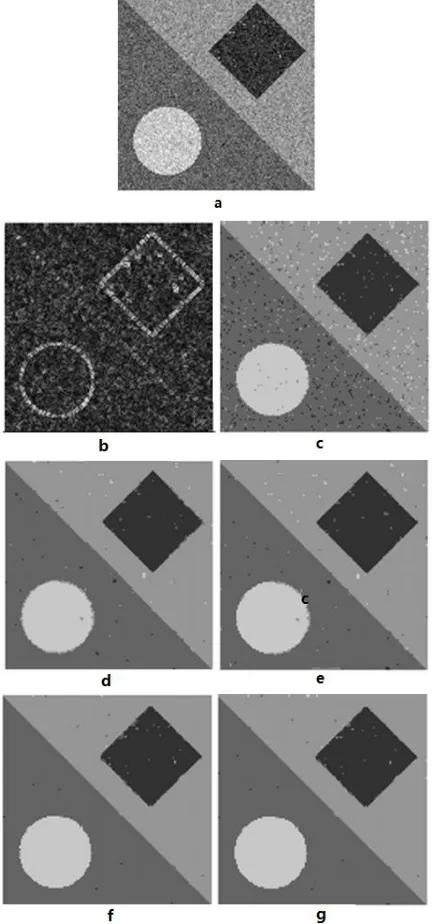
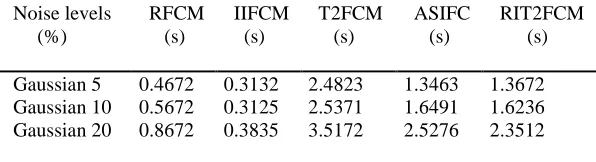
[image:3.595.190.406.289.751.2]In order to compare the rough intuitionistic type 2 fuzzy clustering algorithm with the other methods, one synthetic test image has been given in Fig.1a, which is 128*128 pixels and gray-scale range is 0–255, in order to verify the performance of the proposed algorithm, Gaussian noise with levels of 5, 10, and 20 used in the experiment. Gaussian noise level of 20 has been added in the images, and the comparison results also have been shown in the Fig.1 c-g, also the SA valules listed in the Table.1. From the results, we can see that the proposed method is better than the other four ones. The average execution time is shown in Table.2, from the comparison results, we know that the proposed method provides the slower than the other methods, but which really improve the computational complexity by using the fuzzy clustering framework.
Table 1. SA values of five methods for the synthetic image.
Noise levels RFCM IIFCM T2FCM ASIFC RIT2FCM
(%) (%) (%) (%) (%) (%)
Gaussian 5 0.05 0.03 0.02 0.02 0.02 Gaussian 10 0.31 0.02 0.22 0.22 0.21 Gaussian 20 6.18 0.85 0.73 0.64 0.62
Table 2. Average computational time for five methods.
Noise levels RFCM IIFCM T2FCM ASIFC RIT2FCM (%) (s) (s) (s) (s) (s)
Gaussian 5 0.4672 0.3132 2.4823 1.3463 1.3672 Gaussian 10 0.5672 0.3125 2.5371 1.6491 1.6236 Gaussian 20 0.8672 0.3835 3.5172 2.5276 2.3512
Conclusion
One hybrid cluster algorithm is proposed to handle the uncertaity in image segmentation, which combined the adavantages of rough sets theory, type-2 fuzzy sets theory, and intuitionistic fuzzy sets theory. This mtheod also introduced one intuitionistic fuzzy factor and local spatial information. From the simulation results, we can see that the proposed method could handle the randomness, vagueness, and external noises better than other methods.
References
[1] Wang, L., Shi, F., Gao, et.al. Integration of sparse multi-modality representation and anatomical constraint for isointense infant brain MR image segmentation. NeuroImage, 89, 152-164, 2014. [2] C. Panagiotakis, H. Papadakis, E. Grinias, et.al. Interactive Image Segmentation Based on Synthetic Graph Coordinates, Pattern Recognition, 46 (11), 2940–2952, 2013.
[3] P. Liu, L. D. Wu. Comparison of I value selection methods in image segmentation. Pattern recognition and artificial intelligence, 3:271-277, 1997.
[4] X. L. Zhang. A survey of image edge detection technology. High Energy density physics, 1:37-40, 2007.
[5] K. J. Cheng. Nice ride. Research on Modulus and clustering algorithm based on kernel function. University of Electronic Science and Technology, 2009.
[6] Zadeh L A. Fuzzy sets, information and control. Information Control, 8(3):338-353, 1965. [7] Ruspini E H. A new approach to clustering. Information Control, 15(1):22-32, 1969.
[7] Q. Yan, X. Q. Ye, J. L. Liu, etc. Maximum entropy threshold processing algorithm based on quantized image histogram. Pattern recognition and artificial intelligence, 3:352-358, 1998.
[8] Yu, P. F. Shi, L. C. Zhao. Image segmentation method based on minimum energy. Infrared and laser engineering, 284:21-24, 1999.
[image:4.595.148.446.213.294.2][10] Krishnapuram R, Keller J M. A possibilistic approach to clustering. IEEE Transactions on Fuzzy Systems,1(2):98-110, 1993.