Twenty-First Annual Report of the Data Protection
Commissioner 2009
Presented to each of the Houses of the Oireachtas pursuant to section 14 of the Data Protection Acts 1988 & 2003.
Contents
Part 1 ...4
Foreword ...4
Introduction...6
Customer Service ...7
Governance ...8
Complaints and Investigations...8
Use of Legal Powers ...12
Data Breach Notifications...13
Bord Gáis Éireann...16
Health Service Executive (HSE)...16
Privacy audits...17
Audit Guidance ...18
Revenue Commissioners...18
Organisations audited in 2009: ...19
List of Organisations audited ...20
Motor Tax Circular ...21
Promoting awareness ...22
Age-related Awareness Raising...23
Video Clip Competition...24
Training opportunities...24
Policy issues...25
Direct Marketing Exemption ...25
Codes of Practice ...26
Anti-money laundering ...28
DNA Bill...29
Spent Convictions Bill ...29
NRA/eFlow ...30
Health Information Bill...31
Health Audit Networks ...32
Engagement with Ethics Committees ...33
Communications (Retention of Data) Bill 2009 ...33
ePrivacy Directive...33
Google Street View...34
International Responsibilities...34
Article 29 Working Party...34
International Data Transfers ...35
Towards new Data Protection Standards? ...35
Third Pillar Groups ...36
Administration ...38
Running Costs...38
Part 2 ...39
Case Studies ...39
Part 3 ...71
Guidance ...71
Breach Notification Guidance: ...71
Direct Marketing - A General Guide for Data Controllers:...71
Appendices ...73
Appendix 1 – Presentations and Talks...73
Appendix 2 - REGISTRATIONS 2009 ...75
Appendix 3 - Abstract* of Receipts and Payments in the year ended 31 December 2009...76
List of tables and figures
Table 1 - Enforcement Notices ...13Table 2 - Information Notices...13
Table 3 - Running costs ...38
Figure 1 - Complaints opened, concluded and outstanding...9
Figure 2 - Breakdown of complaints by issue ...11
Figure 3 - Number of complaints received since 2000 ...11
Figure 4 - Organisations reporting breaches by sector ...15
Part 1
Foreword
2009 was a year of change - both actual and promised - in the legal framework governing data protection.
The Lisbon Treaty embedded data protection as a fundamental right of European Union citizens. It provided the basis for an extension of data protection rights into all areas of EU activity. It gave new authority to the European Parliament as co-legislator in this area.
There was increased recognition of the international dimension of data protection. An outline of an international standard on data protection was approved by the International Conference of Data Protection and Privacy Commissioners. There was significant progress in work being done to the same end within the International Standards Organisation and in the APEC (Asia-Pacific) region. Developments within the European Union further facilitated the safe transfer of personal data to other regions of the world. The interest of international business in these developments was demonstrated by their active involvement in an Accountability project facilitated by our Office.
In Ireland, increasing government concern at data breaches led to the establishment of a working group to examine the possible need for legislative change in this area. Such change would reflect the new provisions introduced at EU level in the revised ePrivacy Directive. We have been actively involved in promoting best practice in this
area through our guidance and audit activities.
Data protection principles have stood the test of time. The challenge of giving practical effect to the fundamental right to protection of personal data remains.
During the year, we continued to use the full "tool-kit" provided to us by law to advance the data protection rights of individuals. Most organisations do their best to respect the rights of their customers and clients - recognising that this is also an issue of good customer service. For them, our focus continued to be on advice on how best to meet their obligations. For the minority who are careless about data protection rights, we used the full range of our enforcement powers to bring about change. Targeted use of prosecutions has been particularly effective to stamp out abuses in the area of electronic marketing. Selective use of our audit and investigation powers have also helped to bring about improvements at sectoral level.
An area of some disappointment has been the reluctance of some State bodies to take sufficient account of data protection issues when framing new legislation or applying existing law. In some such cases, I have, reluctantly, felt it necessary to bring concerns directly to the attention of the legislature. In all such cases, I try to fully recognise the difficult balancing act that is often required to take account of issues such as security, fraud and administrative efficiency.
As I come to the end of my 5-year term of office, I wish to pay a warm tribute to the staff of the Office. Despite reduced resources, they have continued to work cheerfully and patiently to make data protection a reality for all who come in contact with us.
Billy Hawkes
Data Protection Commissioner
Portarlington, March 2010
Introduction
The Lisbon Treaty, which entered into force in December 2009, embedded data protection as a Treaty-guaranteed fundamental right in the European Union’s legal order. A framework decision on data protection in EU police and judicial cooperation entered into force in January. A revised e-privacy directive approved in November will strengthen the powers of national data protection authorities to address breaches of privacy in the telecommunications area. In this country, the Minister for Justice, Equality and Law Reform established a Data Protection Review Group to make recommendations on whether Irish data protection legislation needs to be amended to provide for mandatory notification of data security breaches and for the imposition of penalties where necessary. With all these developments, it would be comforting, but misleading, to imagine that our data protection rights are well-entrenched and our privacy is therefore adequately safeguarded.
Despite efforts to raise awareness of data security issues, data security breach reports from both private and public sector organisations increased in 2009. While the performance of some organisations has undoubtedly improved, I remain disappointed with the continuing security problems within particular sectors. It was also disappointing that my Office felt obliged to prosecute several organisations, mostly in relation to unsolicited electronic communications.
proportionate, fair and balanced practices on the part of public and private sector bodies - in everybody’s interests.
Customer Service
As a public office, I consider that customer service is of great importance and we retain a focus on the provision of comprehensive and practical information and advice on data protection to all our customers. Indeed much of the day-to-day work of the Office entails the provision of advice and information in response to enquiries received either in person, by phone, by email or by post. Our website, www.dataprotection.ie, remains our key point of contact with our customers. Content is regularly reviewed to ensure that it is accessible, up-to-date and accurate. As part of this broad effort we are currently developing a new layout to increase the accessibility of this key customer tool. We try to ensure that all the tasks that we undertake - audits, investigations and enforcement - contribute to our broader goal of ensuring that members of the public are aware of and demand their rights and that organisations are aware of their corresponding obligations. During 2009 we continued our practice of involving the entire team in the provision of advice and information directly to our customers so that everyone is in touch with their concerns.
Our interaction with the media continues to be a valuable means of raising awareness of data protection issues. We try to make staff available to respond to queries and requests for interviews to the maximum extent possible, allowing us to communicate best practice in response to emerging data protection issues. Last year my Office dealt with over one hundred queries from the media.
unfortunately resource constraints on the Office necessitate that they cannot all be accepted.
I encourage a ‘train the trainer’ approach through the provision of guidance material and learning aids on my Office's website where it is not possible for my Office to give a presentation.
Our Irish Language Scheme under the Official Languages Act 2003 has been in effect for four years. During that time my Office has made great progress in providing services to customers in both Irish and English and in ensuring that key information is available on our Irish language website, www.cosantasonrai.ie. In the early months of 2010 we developed a new Irish Language Scheme aimed at copper fastening the progress already achieved.
Governance
A Revised Code of Practice for the Governance of State Bodies was issued on 9th June 2009 by the Department of Finance and it was circulated to all Heads of Agencies. It is mandatory for all State bodies.
My Office utilises core systems and services provided by the Department of Justice, Equality & Law Reform - payroll, general payments, HR, and IT (Citrix) - which are subject to that Department's procedures. The Office is also subject to the Department's internal audit system. In so far as matters under its control are concerned, the Office is in full compliance with the requirements of the Code.
Complaints and Investigations
informally where possible or to seek additional information from a complainant to support a complaint. The continued high volume of complaints places a considerable burden on my Office’s Investigation Unit and on the resources of my Office generally.
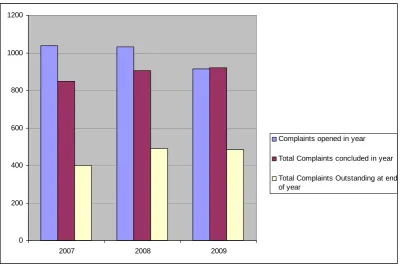
Figure 1 - Complaints opened, concluded and outstanding - illustrates the numbers of complaints opened, concluded and outstanding in 2007, 2008 and 2009.
Figure 1 - Complaints opened, concluded and outstanding
0 200 400 600 800 1000 1200
2007 2008 2009
Complaints opened in year
Total Complaints concluded in year
Total Complaints Outstanding at end of year
requirements governing the use of phone numbers which are entered on the National Directory Database Opt-Out Register. As the number of phone numbers entered on that Register continues to grow, complaints concerning cold calling continue to decrease. Regarding unsolicited marketing text messages, my Office opened 50 fewer complaints in 2009 than in 2008, and almost 250 fewer complaints than in 2007. This decrease can be attributed to the effect on the text marketing sector of prosecution proceedings which I lodged in the District Court towards the end of 2007 against a number of companies operating in the premium rate text messaging sector. Many of those cases were eventually heard by the District Court in 2009. I successfully prosecuted four companies operating in the premium rate text messaging sector in 2009 for offences under S.I. 535 of 2003, namely Opera Telecom (Ireland) Ltd, Zamano Solutions Limited, Mountwilson Ltd and Púca Technologies Ltd (in its capacity as a provider of the SMS technology and network used for the sending of messages by a client). A number of other summonses lodged in the District Court in 2007 have yet to be heard and I expect that these will be successfully concluded later this year.
2009
Access Rights 29%
Electronic Direct Marketing 28% Disclosure 17% Unfair obtaining of data 5%
Failure to secure data 4%
Unfair processing of data 3% Accuracy 2%
Use of CCTV footage 2%
Excessive data requested 2%
Postal Direct Marketing 2%
[image:11.595.192.404.94.264.2]Unfair retention of data 2% Other 4%
[image:11.595.180.416.480.717.2]Figure 2 - Breakdown of complaints by issue
Figure 2 - Breakdown of complaints by issue illustrates the breakdown of complaints by data protection issue. After a big increase in 2008, complaints in relation to breaches of the Data Protection Acts, 1988 & 2003 have decreased slightly from 710 in 2008 (which was 69% of the overall total) to 652 in 2009 (72% of the overall total). Complaints concerning access rights accounted for 29% of complaints overall. A total of 259 such complaints were opened in 2009 compared with 312 complaints about access rights in 2008 and 187 in 2007. This reflects a greater level of public awareness of the right of access to personal data, a key fundamental right enshrined in data protection legislation.
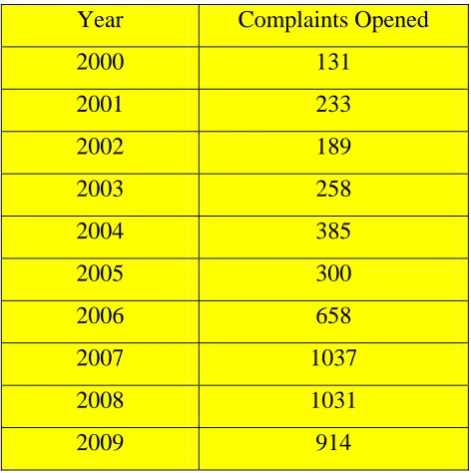
Year Complaints Opened
2000 131
2001 233
2002 189
2003 258
2004 385
2005 300
2006 658
2007 1037
2008 1031
2009 914
When a complaint is opened under the Data Protection Acts, I am required by Section 10 of the Acts to investigate it and to try, in the first instance, to arrange an amicable resolution. I do not open investigations where there is no prima facie basis to form a view that the Data Protection Acts were breached based on the information provided to me. I can also deem that a complaint is ‘frivolous or vexatious’ and therefore no requirement to investigate arises (it is very rare for my Office to have to consider that a complaint falls into that category). As in previous years, the vast majority of complaints concluded in 2009 were resolved amicably without the need for a formal decision under Section 10 of the Acts. In 2009 I made a total of twenty-four formal decisions. Two of these rejected the substance of the data subject’s complaint, two partially upheld the complaint and the remaining twenty fully upheld the complaint. This was a substantial increase on the number of formal decisions I issued in 2007 (ten) and 2008 (seventeen).
As Commissioner, I do not have the power to award compensation. However, if a data controller fails to observe their duty of care in respect of personal data, they are liable to be pursued for damages through the courts (under Section 7 of the Acts). My Office has no function in relation to any such proceedings (which I understand are rarely instigated).
Use of Legal Powers
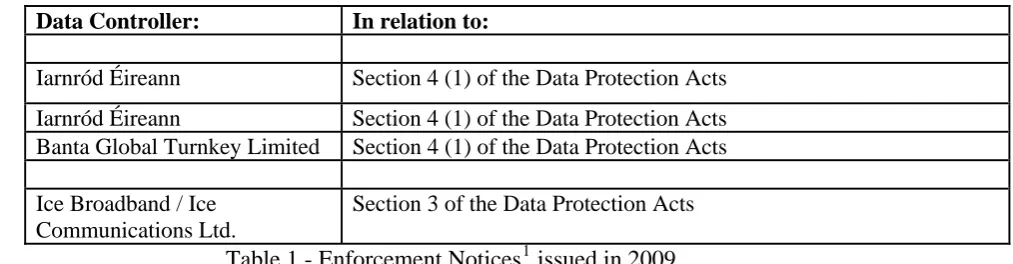
Table 1 - Enforcement Notices
Data Controller: In relation to:
Iarnród Éireann Section 4 (1) of the Data Protection Acts
Iarnród Éireann Section 4 (1) of the Data Protection Acts Banta Global Turnkey Limited Section 4 (1) of the Data Protection Acts
Ice Broadband / Ice Communications Ltd.
Section 3 of the Data Protection Acts
Table 1 - Enforcement Notices1 issued in 2009
Table 2 - Information Notices
Data Controller:
Dunnes Stores Ice Broadband
Table 2 - Selected Information Notices2 issued in 2009
Data Breach Notifications
During 2009, my Office received 119 data security breach notifications. This is a significant increase on the 81 breach notifications received in the preceding 12 months.
Rather than an increase in the absolute number of data security breaches, I attribute this increase to a greater awareness among organisations of their data protection responsibilities. As a matter of good practice when faced with a data security breach, more organisations are contacting my Office for advice on how to deal with the matter. I welcome this development, though obviously I would prefer to see evidence of a reduction in the number of data security breach incidents.
A total of 86 organisations (some organisations reported more than once) notified my Office of data security breaches in 2009. Sixty of these organisations were in the private sector and twenty six organisations were in the public sector. This is an
1
Under section 10 of the Data Protection Acts, 1988 and 2003, the Data Protection Commissioner may require a data controller or data processor to take whatever steps the Commissioner considers appropriate to comply with the terms of the Acts.
2
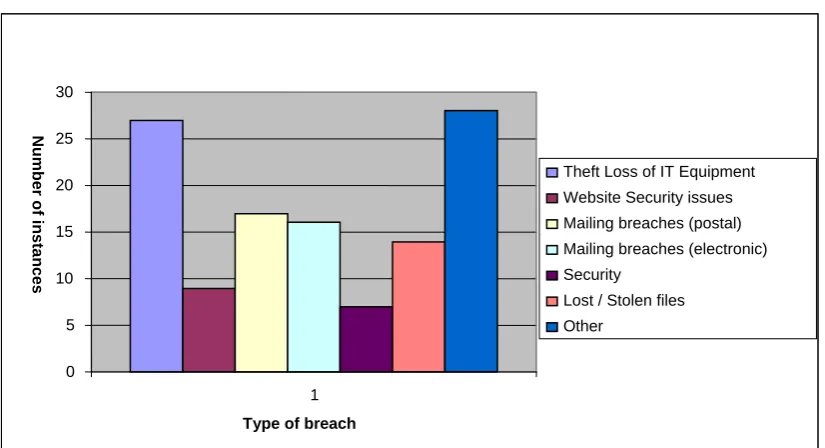
increase of 26 organisations reporting breaches to my Office on last year (see Figure 4 - Organisations reporting breaches by sector). The most common cause of reports to my Office is the theft or loss of IT Equipment. We received 27 reports of such incidents (see Figure 5 - type of data breach). This includes the loss or theft of laptops and mobile storage devices such as USB memory sticks. As the use of such devices is now very common and given their capacity to hold large amounts of data, it is very important that organisations ensure that a valid business need exists for personal data to be held on such devices and that appropriate security is in place on the device. At this point there really is no excuse for any organisation placing personal data on a portable device without securing that device properly.
Figure 4 - Organisations reporting breaches by sector 0 10 20 30 40 50 60 70 2008 2009 Year Num b er o f Or ga nisati ons Private Sector Public Sector 0 5 10 15 20 25 30 1
Type of breach
Num b er o f ins ta n ces
Theft Loss of IT Equipment Website Security issues Mailing breaches (postal) Mailing breaches (electronic) Security
Lost / Stolen files Other
Figure 5 - type of data breach
[image:15.595.93.506.306.530.2]Another security vulnerability that came to our attention during the year was the prescription of readily-known pieces of information - such as date of birth or mother's maiden name - as passwords for access to services. It is essential that organisations, in considering the basis on which they permit access to personal data, ensure that such access is properly safeguarded against abuse by third parties.
Certain security breaches attracted a considerable amount of attention among members of the public concerned at the implications of the cases for their personal privacy.
Bord Gáis Éireann
In June I launched an investigation in relation to a significant loss of personal data arising from the theft of a laptop computer held by Bord Gáis Éireann which had reported the matter to my Office upon becoming aware of the theft. The information included records relating to “Big Switch” customers3, including names, addresses, email addresses and financial data. Throughout the process Bord Gáis Éireann co-operated completely with the conduct of the investigation. The investigation concluded that Bord Gáis Éireann failed to have security measures on the stolen laptop that were appropriate to the harm that could result to individuals from the loss of their personal data. As well as an apology to those affected by this incident, Bord Gáis Éireann's efforts to reach an amicable resolution to the complaints which I received included a substantial donation to the Peter McVerry Trust.
Health Service Executive (HSE)
Also in June I launched an investigation in relation to a report from the HSE that a robbery at the HSE West PCCC4 Offices in Roscommon had resulted in the theft of an unencrypted laptop containing personal data related to clients of the HSE. The HSE cooperated fully with the conduct of the investigation. The investigation concluded that the HSE failed to have security measures on the stolen laptop that were appropriate to the harm that could result to individuals from the loss of the data. I note that the HSE was also mentioned in the context of breach reports in my Annual Report for 2008. Therefore the recommendations of my Office in regard to this incident were extensive and demanding:
3
Customers who had chosen to move electricity supplier from the Electricity Supply Board
4
• The HSE must take organisational responsibility for the encryption of all laptops; it is not sufficient to delegate this responsibility to individual staff members. All HSE areas should make the appropriate arrangements with their laptop suppliers to ensure that laptops are encrypted before they are allocated to staff members. The level of encryption should be regularly reviewed to ensure that it reflects the highest standards currently used in the Irish public service. Steps must be taken to ensure that previously issued laptops are encrypted or to prevent the use of such laptops for any purpose involving personal data.
• The HSE must introduce policies to prevent situations arising in which they do not own or control devices storing HSE patient data.
• The HSE should prioritise the development of secure networks and devices for the transfer of patient data.
• The results of the investigation indicate that the existing controls on patient database development within the HSE are insufficient to prevent the development of ad-hoc databases. HSE staff should be trained to recognise when the creation of a record amounts to a new database and to understand the nature of the controls around such developments.
• The development of appropriate controls governing access to patient databases, including directory services, should be a priority for the HSE. • Staff training should be further improved to ensure that all staff, particularly at
management level, understand the need to report serious data security breaches to the appropriate Consumer Affairs Area Office and, through them, to the ODPC. The HSE should develop a comprehensive breach management policy to cover all forms of data security breach including those involving manual data.
I will be following up progress in this regard.
Privacy audits
Scheduled audits are intended to assist a data controller in ensuring that their data protection systems are effective and comprehensive. These audits are in addition to investigations carried out by my Office in response to specific complaints. My Office also continued with unscheduled inspections under powers conferred under section 24 of the Data Protection Acts in response to specific issues of concern.
An audit should be viewed as an aid to the organisation concerned in ensuring that its data processing operations are conducted in compliance with the provisions of the Act. Upon conclusion of the audit process, a final report is issued to each organisation audited containing a set of findings and recommendations based on my audit team's examination of key systems processing personal data within the organisation.
Priorities and targets for audit are identified taking account of complaints and enquiries to the Office. During 2009 my Office continued to adopt a proactive role in this regard. In the course of the year, over thirty comprehensive audits were carried out.
Audit Guidance
At the beginning of 2009, I published guidance on audits aimed at assisting organisations selected for audit by the Office of the Data Protection Commissioner - http://www.dataprotection.ie/documents/enforcement/AuditResource.pdf. The audit resource also provides organisations holding personal data with a simple and clear basis to conduct a self-assessment of their compliance with their obligations.
Revenue Commissioners
The audit of Revenue focused on ascertaining and verifying the exact legal basis for each data transfer, the means by which such information is disclosed to Revenue and the channels deployed for any outward bound disclosures. I sought evidence and assurance of the safe and secure transmission of all personal data contained in these transfers. Internal Revenue repositories for the storage and retention of large volumes of personal data were examined in detail in order to assess the efficacy of the policies and procedures in place to safeguard the data held by Revenue.
My Inspection Team found a very high organisational awareness of data protection principles in Revenue and the resulting report commended Revenue for this, at the same time outlining a series of recommendations concerning data retention, privacy impact assessments, data transfers, data protection training and laptop security. I will continue to liaise with the Data Protection Unit in Revenue to ensure that these recommendations are acted upon.
I am pleased that Revenue took the decision to publish the audit report in full on its website:
Report of the Data Protection Commissioner on Data Protection in Revenue
(http://www.revenue.ie/en/about/data/data-protection-commissioner-report.pdf)
Organisations audited in 2009:
In the course of 2009, 30 audits were carried out by my Office. This is an increase on the previous year in which 28 audits were completed. I intend, resources permitting, to continue this level of audit frequency in 2010.
to better understand the challenges faced by organisations and to produce more relevant guidance material.
My inspection teams found that there was a reasonably high level of awareness of, and compliance with, data protection principles in the organisations that were inspected. Notwithstanding this, the majority of organisations had areas where immediate remedial action was necessary. I note with satisfaction that the majority of the data controllers audited have demonstrated a willingness to put procedures in place to ensure they are meeting their data protection responsibilities in full. I would like to thank all of the organisations audited and inspected throughout the year for their cooperation.
I encourage organisations to agree to the publication of the audits we carry out, as an aid to good practice at sectoral level. I am happy that a number of the audited organisations agreed to such publication.
List of Organisations audited
Joint National Internet Research (JNIR) Dublin Airport Driving School
Higher Education Authority Eumom
National Roads Authority (Operation of M50 barrier free tolling) Eircom
Irish Rugby Football Union Cedar Clinic
Prescreen.ie
Alzheimer's Society
Central Applications Office (CAO) Tullamore Credit Union
Vodafone
Allied Foods Mazda
All Ireland League Rugby Club Corduff Community CCTV Lidl
Allianz VHI
Dublin Airport Authority St Attracta's School Tubercurry AIB Tullamore
NIB Athlone
Dundrum Credit Union Experian
Boran Plastic Packaging
Motor Tax Circular
In the last quarter of 2008, my Office conducted an audit of Laois Motor Tax Office and an audit of the National Vehicle & Driver's File (NVDF) at the Driver and Vehicle Computer Services Division (DVCSD), Department of Transport, in Shannon Co. Clare. During that same period my Office attended and presented at a national Motor Tax Conference targeted at authorised officers employed in motor tax offices across the country.
A key issue to emerge from my engagement with this sector was the concern expressed by practitioners themselves regarding procedures around the release of the personal data of drivers to third parties. The attention of my Office was directed to an array of both primary legislation and Statutory Instruments (SIs) providing for the release of certain driver and vehicle data to a range of third parties some of whom were specifically listed. Alongside these there also existed another set of SIs featuring provisions whereby unnamed third parties could request basic driver data.
similar services. Such requests typically sought to verify not only an individual’s licence, but also an individual’s licence history, including details of penalty points, disqualifications or convictions. With regard to sensitive data such as penalty points and road offence convictions, the Data Protection Acts were being invoked by way of a type of 'enforced subject access request'; data subjects seeking insurance or renewal of insurance would sign a declaration agreeing to the release of information held on the NVDF to a third party such as an insurance company or an employment screening company. After a review of the sector via the audit findings and direct consultation with both practitioners and policy makers, I reiterated a previously conveyed view of this Office in similar circumstances that a request (signed by the individual and forwarded by a third party) for penalty point data or copies of endorsements on licences held by a Motor Tax Office could not be considered as the ‘free’ or ‘valid’ consent of the data subject as would be required to engage the provisions of Section 8(h) of the Data Protection Acts.
I was pleased therefore to note that in 2009 new guidelines were issued by the Department of Transport to all motor tax offices addressing the disclosure of driver data held on the National Vehicle Drivers File (NVDF). My Office was consulted regarding the content of the guidelines.
The guidelines outline the conditions under which it is possible for a third party to make a legitimate request for basic driver data on behalf of another individual. However, with regard to sensitive data such as penalty points, the guidelines state that detailed data will only be issued through the post to the data subject or provided to his/her legal representative.
Promoting awareness
In 2009, I continued to pursue an awareness campaign targeted at young people and I also extended my targeted activities to include the over 65s. Another awareness-raising initiative, a video clip competition hosted on YouTube entitled 'Private I, Public Eye', was organised by my Office in 2009 in association with Google.
Age-related Awareness Raising
The findings from the 2008 Public Awareness survey5 indicated lower levels of awareness amongst the upper and lower age groups (65+ and 15-24 year olds).
In terms of the 12-18 year old cohort, in 2009 I continued to highlight and promote a data protection resource produced by my Office in 2007 aimed at second level schools - 'Sign Up, Log In, Opt Out: Protecting Your Privacy & Controlling Your Data' (http://www.dataprotection.ie/docs/CSPE_Booklet/862.htm). I was pleased to note the inclusion of a question on the CSPE 2009 Junior Cert Examination concerning CCTV (Closed Circuit Television). I am hopeful that there will be further questions on CSPE examination papers reflecting other topics and issues addressed in the 'Sign Up, Log In, Opt Out' resource. I am also aware of the data protection question which appeared on the Leaving Cert Business Studies Examination Paper (Ordinary Level) in 2008. All of this is indicative of the growing incorporation of privacy-related issues into the Irish educational curriculum.
With regard to the over 65's, I submitted several articles for publication to Ageing Matters - an Age Action Ireland publication. In these articles I highlighted key rights under data protection including access rights, the right to opt-out from marketing and I also drew attention to the need for online security measures. I was pleased to be informed by Age Action that the online security material produced by my Office is being used in free computer classes delivered by Age Action to the over 55s.
5
Survey Key Findings:
http://www.dataprotection.ie/documents/trainingandawarenes/PAS08.pdf
Video Clip Competition
An innovative video clip competition was launched in 2008 by my Office in association with Google. This competition was hosted on my Office's YouTube channel ( www.youtube.ie/dataprotection ). In 2009, I decided to run the competition again, replacing the 2008 theme of ‘Privacy in the 21st Century’ with the theme 'Private I, Public Eye'. The competition had a total prize fund of €10,000 generously provided by Google and attracted a high standard of entries that provided a creative and entertaining look at a range of privacy issues. In an effort to focus on the 18-24 year old age group, I particularly targeted third level colleges where digital media courses were being taught.
The winning clips are available to view at:
First prize www.youtube.com/watch?v=a5V8OCJA6jA Second prize www.youtube.com/watch?v=BiQ_2h-CwPU Third prize www.youtube.com/watch?v=EbHzi8RQD8A
Gallery of entries to the competition http://www.youtube.ie/dataprotection
Training opportunities
In response to a number of high profile data breaches and cases concerning inappropriate employee access to personal data held by a public sector data controller, a special training initiative targeted at the Civil Service was held in Dublin in February 2009 jointly organised with the Centre for Management and Organisation Development (CMOD) in the Department of Finance. As well as presentations by staff members from my Office, I was pleased at the participation of the Department of Social & Family Affairs and CMOD in delivering presentations to the large audience present.
My Office was invited to participate in the Garda College Human Rights Community Fair in April 2009. This event offered the opportunity to promote awareness amongst Garda students of the data protection considerations involved in everyday policing practice.
In the private sector, I gave a significant number of presentations to the insurance sector throughout 2009. I did this in light of the publication by my Office in 2008 of a Code of Practice for the Insurance Sector and the ensuing need to inform and ensure the sector is in a position to comply with all areas of the Code.
The following training aids and guidance material are available free of charge to assist organisations in raising staff awareness of their responsibilities when processing personal information:
( http://www.dataprotection.ie/docs/Publications_and_Forms/960.htm )
1. Booklet - A guide for Data Controllers 2. Booklet - A guide to your Rights
3. Training DVD - 'My Data, Your Business' and Facilitator’s Guide to DVD 4. PowerPoint Presentations
5. Rights & Responsibilities Chart
6. Sign Up, Log In, Opt Out: Protecting Your Privacy & Controlling Your Data 7. Audit Resource (January 2009)
Hardcopies of the booklets, chart, DVD and Facilitator’s Guide can be obtained by contacting my Office.
Policy issues
Direct Marketing Exemption
contacts, even when the complainant had made clear that they did not wish to be contacted. This is because of the definition of direct marketing in the Data Protection Acts:
"'direct marketing' includes direct mailing other than direct mailing carried out in the course of political activities by a political party or its members, or a body established by or under statute or a candidate for election to, or a holder of, elective political office."
The definition excludes any direct marketing carried out for political purposes by political parties or electoral candidates from the scope of the Data Protection Acts. While I have doubts about the consistency of this definition with EU Directives in this area (doubts that I brought to the attention of the Department of Justice, Equality and Law Reform), given the present legislative position I could not investigate these complaints. I would suggest that this is an area that may need to be revisited to ensure that individuals can at least refuse the receipt of such communications going forward if they simply do not wish to receive them.
I also received a number of complaints from individuals who were concerned about the manner in which their details were accessed by the candidates for election to facilitate the contact that was made. Where sufficient evidence was provided I investigated such complaints and, in a number of cases, I found that the contact details of individuals were provided or sourced in contravention of the Data Protection Acts. While the Data Protection Acts provide somewhat generous exemptions to facilitate the conduct of political and electoral activity, I would remind all candidates for election and political parties that it is not appropriate to source the details of individuals from any available source and that doing so may bring them into conflict with the requirements of the Data Protection Acts.
Codes of Practice
2008 (http://www.ict.gov.ie/docs/Data_Protection_Guidelines.pdf). At the same time all Government Departments, Offices and Bodies were encouraged to prepare a Code of Practice for their handling of personal data to be approved by my Office. I welcome this development. As of 1 March 2010 I have received two such draft Codes. While it is likely that some public sector organisations are waiting until I have approved the first Code, I consider this response to be somewhat disappointing. I would encourage public sector organisations to approach my Office with their draft Codes as a means of assisting them in improving their personal data handling practices.
Automatic Number Plate Recognition
As part of our ongoing and very constructive engagements with An Garda Síochána during 2009, we finalised discussions in relation to the rollout by An Garda Síochána of an Automated Number Plate Recognition (ANPR) system. The ANPR system involves an in-car camera that reads the Vehicle Registration Numbers (VRNs) of other vehicles on the road and then checks each VRN against a database of watch lists. If a ‘hit’ is detected then an audible signal is given to the members of An Garda Síochána in the vehicle and a picture of the vehicle, its VRN and other relevant information are displayed on the in-car camera screen allowing the members of An Garda Síochána to take appropriate action, as required. The benefits of the technology in supporting certain functions of An Garda Síochána are clear, however this Office must focus on ensuring that any large-scale recording of personal data is proportionate under the Data Protection Acts and that acceptable safeguards as to the uses and storage of, as well as access to, the information are in place.
Anti-money laundering
In July 2009, the Minister for Justice, Equality and Law Reform published the Criminal Justice (Money Laundering) Bill 2009 which will transpose the third EU Money Laundering Directive into Irish Law. The third EU Money Laundering Directive increases the obligations on credit and financial institutions and on lawyers, accountants, estate agents and others in relation to money laundering and terrorist financing throughout the European Union. It is of particular relevance from a data protection perspective that the Bill confers additional obligations on designated bodies covered by the legislation to perform certain due diligence operations to identify customers.
Prior to the Bill's publication, my Office made submissions in relation to the draft Heads of the Bill. This provided a very welcome opportunity for us to input views into the drafting process to seek an appropriate balance between the sometimes competing requirements of money laundering legislation and data protection legislation. We know that, in the past, a large number of financial institutions have found this to be a difficult balance to strike at a practical level. We see the transposition of this Directive as an important opportunity to further clarify issues for these designated entities. In the past there has been confusion among entities in relation to their Money Laundering obligations. In some cases this resulted in an over-reliance on money laundering obligations in a range of inappropriate circumstances to justify requests for personal data. We have received complaints from members of the public about the collection of excessive amounts of personal data, inappropriately justified as required for anti-money laundering obligations. In other cases, documentation provided legitimately for money laundering compliance purposes is used for further, unacceptable purposes.
DNA Bill
My Office was invited on two occasions during 2009 to provide observations on the development of the provisions of the Criminal Justice (Forensic Evidence and DNA Database System) Bill 2009. The establishment of a DNA Database raises significant issues of data protection as well as broader issues of civil liberties. While I acknowledge the potential of a DNA database to become an effective crime control resource, it is also necessary to take account of the potential human rights impact of the proposed legislation. From a data protection perspective, the provisions in relation to the retention and sharing of DNA information are particularly important. In considering the draft provisions, my Office had regard to the judgement of the European Court of Human Rights (ECHR) in the case of S. and Marper v the United Kingdom on 4 December 2008.
The ECHR found, in this case, that the blanket and indiscriminate retention of fingerprints, cellular samples and DNA profiles of persons suspected but not convicted of offences failed to strike a fair balance between the public interest in the detection of crime and the right to respect for private life. Blanket and indiscriminate retention was found to constitute a disproportionate interference with the applicants’ right to respect for private life and could not be regarded as necessary in a democratic society. The Court concluded unanimously that there had been a violation of Article 8 of the European Convention on Human Rights (right to privacy) in this case.
The Criminal Justice (Forensic Evidence and DNA Database System) Bill 2009 (published early in 2010) had to be reviewed in light of this landmark decision. This Office's submissions focussed on the implications of the Marper Judgement and the need to fully incorporate them into the legislation. The submission focused in particular on the compatibility with the Judgment of the proposed retention of the DNA samples and profiles of persons not found guilty of an offence.
Spent Convictions Bill
and provided further comments for consideration. We welcome being consulted in regard to this important issue from both a data protection and human rights perspective. Ireland is one of a small number of EU Member States without substantive legislation in place providing for the spending of certain convictions after a stated period of time. The lack of legislation in this area has been a specific concern of this Office for a significant period of time given the requirement of the Data Protection Directive to set retention periods for personal data. The lack of set retention periods places persons convicted here, sometimes of minor offences a long time ago, in an unfavourable position in comparison to persons convicted of the same offences in other EU member states.
NRA/eFlow
The operation of the M50 Barrier-Free Tolling Project continued to generate queries to my Office during 2009. I dealt with this matter in last year's Annual Report when I indicated that our engagement with the NRA had not yet been finalised.
The key issue that had remained unresolved was the setting of an appropriate period to retain motorists personal data to allow for the appropriate toll to be paid. This Office was keen to ensure that, in so far as it was possible, the right to anonymous travel across the M50 should be maintained. That said, my Office acknowledged that the NRA faced considerable practical issues in relation to deleting the personal data of motorists at an early date as desired by this Office. This was due to the large number of payment queries that arose in the early stages of the project. Our engagement on outstanding issues intensified in early 2009. It was agreed that we would carry out an audit of BetEire Flow Ltd, which administers the E-Flow scheme on behalf of the National Roads Authority (NRA). The audit gave us the information we needed to more fully assess the data processing needs of this type of operation.
Following the audit and a series of further engagements with the NRA, we agreed the following steps with the NRA:
For those motorists for whom the privacy of their journeys across the M50 is paramount, the NRA agreed to introduce a procedure to allow them to request the deletion of their personal data (in return, the motorist will have to agree to certain conditions, including waiving their right to query transactions). Implementation is expected during 2010. The NRA also indicated a willingness to consider the feasibility of a new form of tag product that would address some of the same concerns.
Retention Periods generally
My Office is working with the NRA/BetEire Flow to amend the unregistered payment process to take certain data protection concerns into account while allowing motorists to access their outstanding balance when paying their toll. Once this is implemented, the NRA intends to reduce the retention period to six months for both unregistered and registered users (with the exception of those who have not paid the relevant toll charges). In line with its obligations under the Data Protection Acts, the NRA has also undertaken to continue to keep the retention period under review.
While the issues outlined above took quite a lengthy period to resolve (given the unique nature of the system) I nonetheless consider that this is a good example of effectively accommodating data protection requirements in a complex system.
Health Information Bill
In my 2008 report I noted a proliferation of uses for the PPSN (Personal Public Service Number) in the health sector which had come to our attention through our engagements with that sector. This position was further supported during 2009 through a number of engagements with different parts of the health system that also indicated that the PPSN was being used as an identifier. My Office once again availed of every opportunity during 2009 to highlight our serious concerns as to the suitability of the PPSN as a national Unique Health Identifier (UHI). I also noted that HIQA's report on the UHI for individuals also reached the conclusion, on a number of grounds, that the PPSN is not fit for purpose as a UHI.6
6
A positive development in relation to the management and use of health information in this country is the intention of the Department of Health and Children to bring forward a comprehensive Health Information Bill which will provide a specific legal basis for intended uses of health information while at the same time safeguarding patient privacy. I very much welcome the intentions of the Department in this area and although the Bill is not yet published, it appears that my Office may be conferred with a number of additional responsibilities upon enactment. We look forward to working further with the Department of Health and Children in relation to these responsibilities. Our continuing approach will be to seek an acceptable balance between the need for health care providers to share personal health information for the care of patients and patients’ right to control the use of their personal information.
Health Audit Networks
My Office received queries from a number of units within different health facilities during 2009 requesting advice in relation to their proposed participation in UK-based health audit networks. This participation involved the transfer of what could be considered as patient identifiable information to a clinical audit database regarding all admissions to a particular unit to allow comparison with UK benchmarks in relation to outcomes, processes and structures to facilitate future planning and research.
Under Section 60 of the UK Health and Social Care Act 2001 approval may be granted in respect of certain projects which process patient identifiable information where patient consent has not been obtained and there is no other reliable basis in law to permit the disclosure and use of identifiable patient information. Currently there is no 'Section 60' equivalent in this jurisdiction, therefore the transfer of patient identifiable information in such circumstances would require the express consent of the patients. We have previously addressed the use of health data for clinical audit purposes in our 2007 Guidance Note on Research in the Health Sector.
the Data Protection Acts. In all cases a successful solution to meet all concerns was identified.
Engagement with Ethics Committees
I appreciated that my Office was approached during the year to participate in the finalisation of a draft Common Application Form for persons or entities applying for ethical approval to Ethics Committees in various hospitals and HSE areas. The process which was convened by Molecular Medicine Ireland was intended to assist in streamlining the process for researchers applying for ethical approval to Research Ethics Committees. It provided a key opportunity for my Office to assist Ethics Committees to highlight to applicants for ethical approval what the key data protection requirements are for any work with personal data for research purposes. A pilot of the new application form will now be put in place across selected hospitals and I look forward to continuing to work on this important initiative.
Communications (Retention of Data) Bill 2009
This Bill, which was going through the Oireachtas at the end of the year, updates the data retention provisions in the Criminal Justice (Terrorist Offences) Act 2005 and aligns Irish law with the requirements of EU Directive 2006/24/EC. It requires telecommunications companies to retain customer call data and to make this available to designated State authorities on request. In our observations on the Bill, we repeated our concerns about the adequacy of the oversight regime, the length of time during which data would be retained and the fact that the right to access data was being granted to the Revenue Commissioners as well as to An Garda Síochána and the Defence Forces.
ePrivacy Directive
has been a breach of security in relation to personal data. The EU Commission has committed to examining the case for an extension of this requirement to other sectors.
Google Street View
In the course of 2009, Google began to film streets in different parts of the country to add street-level imagery to its Google Maps product. This process inevitably involved the capture of images of identifiable individuals and of other forms of personal data. The Office had a number of engagements with Google to confirm that the system would operate in accordance with data protection law. The undertakings given by Google included that advance publicity would be given to the filming and that any reasonable objections to filming would be respected. Google also confirmed that it would adopt its standard practices of blurring faces and vehicle number-plates and of providing a facility whereby any individual could secure the removal of images related to them. Google also indicated that images that were not blurred would not be retained for more than a year after these images went "live".
International Responsibilities
Article 29 Working Party
During the year, the Office maintained its active involvement with the Article 29 Working Party. The Working Party acts as an adviser and advocate when data protection issues arise at European level. It promotes a uniform application of the provisions of the EU Data Protection Directive 95/46/EC throughout the European Economic Area.
All of these documents are available on the Working Party's website (http://ec.europa.eu/justice_home/fsj/privacy/workinggroup/wpdocs/2009_en.htm) .
International Data Transfers
2009 saw further progress in facilitating multinational companies to safely transfer personal data outside of the European Economic Area. By the end of the year, the Article 29 Working Party had recommended to the EU commission that Israel and Uruguay should be added to the list of countries whose systems for the protection of personal data were deemed to be "adequate". The Working Party had also commented favourably on a new, more business-friendly set of standard contractual clauses for the transfer of personal data to processors established in third countries. There was also further progress in the development of the system of "Binding Corporate Rules" (BCRs). BCRs allow the composite legal entities of a corporation (or conglomerate) to jointly sign up to common data processing standards that are compatible with EU data protection law. If they use BCRs, companies do not need individual contracts between EU and non-EU subsidiaries for the transfer of personal data between them. A number of BCRs were approved during the year and further material was published on the Working Party's website, designed to make the system more user-friendly for companies.
Towards new Data Protection Standards?
The 31st International Conference of Data Protection and Privacy Commissioners was hosted this year in Madrid by the Spanish data protection authority. A major achievement of the Conference and of its host was the approval of a "Draft of International Standards on the protection of Privacy with regard to the processing of Personal Data":
https://www.agpd.es/portalweb/canaldocumentacion/conferencias/common/pdfs/31_c
onferencia_internacional/estandares_resolucion_madrid_en.pdf
The Draft drew on existing standards developed by the EU, the Council of Europe, the OECD and APEC (Asia-Pacific countries). It should serve as a template for future work in developing a harmonised international approach to data protection.
Personal Data Accountability
The principle that organisations should be held accountable for the personal data that they gather and process is a key feature of data protection. Such accountability is also expected of organisations when they transfer personal data internationally. Accountability, and how an organisation can apply and demonstrate it in practice, is likely to become even more significant in the future. In the course of the year, my Office facilitated a project led by the US-based Centre for Information Policy Leadership which further explored this theme. The resulting discussion paper7 was the fruit of two meetings held in Dublin involving representatives from industry, data protection authorities, academia and NGOs. A second phase of the project is due to take place in 2010, facilitated by our French data protection colleagues (CNIL).
Third Pillar Groups
Though the entry into force of the Lisbon Treaty abolished the pillar structure of the European Union, the advisory role of the Article 29 Working Party is still focused on economic, social and environmental matters. The Office is also represented at meetings of groups dealing with European cooperation in the fight against crime. These groups include the EUROPOL Joint Supervisory Body (which reviews the activities of EUROPOL to make sure that its use of personal information does not violate individual privacy rights), the Customs Joint Supervisory Authority (which
7
ensures that personal data within the European Customs Information System is processed in a manner that respects individual data protection rights) and the EUROJUST Joint Supervisory Body (which meets in the Hague to ensure that cross-border cooperation between EU judicial and prosecution authorities respects data protection rights).
Over the past year, these and related groups have dealt with issues such as:
• The entry into force of the Lisbon Treaty and of the Framework Decision on Data Protection in EU Police and Judicial Cooperation. The EU's data protection authorities explored the implications of these developments to develop the best strategies for continuing to uphold the data protection rights of people living and working in the European Union.
• European Commission proposals to allow law enforcement authorities access to the EURODAC system (the EURODAC system is intended to allow EU member states to compare fingerprints of asylum seekers and illegal immigrants, so that the EU's immigration and asylum functions can be properly administered). Under conditions set out in the proposals, the personal data in the EURODAC system would be used for the prevention and investigation of terrorist and other serious offences. The EU's data protection authorities drew attention to the need to ensure that such proposals were legitimate given the privacy rights of innocent people.
Administration
Running Costs
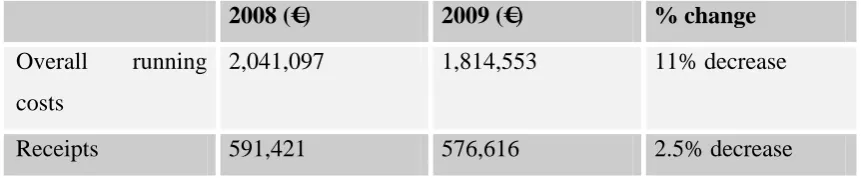
The costs of running the Office in 2009 were as follows:
2008 (€) 2009 (€) % change Overall running
costs
2,041,097 1,814,553 11% decrease
[image:38.595.82.513.159.248.2]Receipts 591,421 576,616 2.5% decrease
Table 3 - Running costs
Part 2
Case Studies
Case study 1: Disclosure of personal data due to inappropriate security measures
In August 2008, I received a complaint regarding the alleged disclosure of personal information by an airline. The complainant to my Office stated that in June 2008, in response to a phone call, the airline disclosed by email a travel itinerary for herself and her husband to her husband's employer and on foot of this disclosure, her husband was dismissed from his employment. The complainant stated that her husband's employer had made a written statement to the effect that the email in question was disclosed by the airline on the provision of a surname only. A copy of this statement was provided to my Office.
In the course of this investigation, the airline informed my Office that security questions were asked prior to the email in question being issued to the third party. It did not dispute that it sent the email. However, as the airline did not record the telephone call requesting the information, nor were its security questions system prompted and logged, it was not able to provide any evidence to prove that the appropriate security questions were asked in this instance. My Office also took into consideration that the booking was made from the complainant's own computer using a personal email address rather than from an email address at her husband's workplace.
On the basis of the information presented, together with the fact that the airline could not provide evidence that its own security measures were in fact used on this occasion, I arrived at the decision, following the investigation of this complaint, that the airline had contravened Section 2(1)(c)(ii) by further processing the complainant's personal data and that of her husband when it disclosed to her husband's employer their travel itinerary in an email. It also contravened Section 2(1)(d) by failing to have in place appropriate security measures to prevent the unauthorised disclosure of her personal information and that of her husband.
Case study 2: Prosecution of Jackie Skelly Fitness for unsolicited marketing text messages
My Office received complaints from two individuals regarding unsolicited marketing text messages which they received in the spring of 2008 from Map Dance Limited, trading as Jackie Skelly Fitness. One complainant was a former customer of Jackie Skelly Fitness and the other was an existing customer. Both complainants informed me that they had not consented to receiving marketing text messages from this company. Furthermore, the marketing text messages did not contain an opt-out facility as required.
As part of my Office’s investigation into the matter, we sought the traffic records from the third party company used to send the messages on behalf of Jackie Skelly Fitness to the complainants' mobile phones. We did this to confirm that the messages were sent by Jackie Skelly Fitness and to establish the content of those messages.
The traffic records which we obtained showed that Jackie Skelly Fitness had sent the marketing text messages in question and that the messages did not contain an opt-out facility as required by the regulations in Statutory Instrument 535 of 2003. Following my Office's investigation, I was satisfied that offences had been committed and I decided to exercise my powers to prosecute Jackie Skelly Fitness in respect of those offences.
Case study 3: Disclosure of personal details by a local authority on its website
I received a complaint from a member of the public towards the end of 2008 regarding the disclosure of personal data submitted as part of an application for planning permission to a local authority.
Background
(i) In the latter part of 2006, my Office entered into discussions with the Department of the Environment, Heritage and Local Government in an effort to establish an appropriate balance between an open and transparent planning system and the rights of individuals to privacy and data protection. Following these discussions, the Minister for Environment, Heritage and Local Government signed the Planning and Development Regulations 2007 (SI 135 of 2007). Amongst other things, these regulations introduced an amended planning application form. The amended form re-arranged the address/contact details section from the front of the form to a detachable page at the rear of the form to ensure that these personal details could be removed prior to the publishing of planning applications on the planning authority's website.
(ii) The Department of the Environment, Heritage and Local Government also issued Development Management Guidelines for planning authorities which, among other things, recommended the use of a Robots Exclusion Protocol (this is a simple protocol that, when placed on a web page, reputable search engines do not then proceed to index the page for inclusion in search results) by all planning authorities in relation to planning application data on their website to protect personal data on those websites from search engine access.
Complaint
In this case, the complainant completed the planning application form and provided the planning authority with his contact details on the detachable part of the form. However, the information supplied in this section was subsequently made available to the public on the local authority's website.
implemented a Robots Exclusion Protocol to prevent personal data appearing on search engines.
In reply, the local authority informed my Office that, on this occasion, its procedures which it had in place to comply with the data protection requirements did not operate and that as the procedures were relatively new, the physical removal of the contact details portion of the planning application form was overlooked. It also indicated that the procedures had since been strengthened to ensure compliance with the data protection requirements. The response also indicated that the local authority had not yet implemented a Robots Exclusion Protocol and that it was currently being considered. At that point, my Office made it clear to the local authority that, given the passage of time since the Department had published its Development Management Guidelines in 2007, we found it unacceptable that a Robots Exclusion Protocol had not yet been put in place. We pointed out that by not having it in place personal information of individuals making planning applications continued to be at risk of being picked up by search engines when the applications were uploaded onto the websites. The local authority was instructed by my Office to put in place a Robots Exclusion Protocol immediately and failing that, I would use whatever legal powers I deemed necessary to protect the personal data of those individuals who submit planning applications to that local authority. My Office subsequently received confirmation from the local authority that a Robots Exclusion Protocol had been put in place.
The complainant in this case requested a formal decision under Section 10 of the Acts. My decision found that the local authority had contravened Section 2(1)(d) of the Data Protection Acts when it published, on its website, the contact details which the planning applicant had submitted on part of the planning application form. It breached this requirement by not having in place appropriate measures to prevent the unauthorised disclosure of the planning applicant's contact details.
Case study 4: Alleged disclosure of credit card details by a booking agent
In January 2009 I received a complaint regarding the alleged disclosure of personal information by an internet booking agent. The complainant informed my Office that, when booking a hotel with the booking agent, he provided his credit card details to pay a deposit. However, after his subsequent stay at the hotel and having paid the bill, he received a phone call from the hotel to inform him that the bill had been undercharged by €200 in error. The complainant alleged that the hotel then contacted the booking agent who in turn provided the hotel with his credit card details and that these details were used by the hotel to debit €200 from his credit card account.
My Office contacted the booking agent in question and asked where on its terms and conditions did it state that an individual's credit card details would be shared with the hotel booked by the customer.
The booking agent, as part of its response, provided my Office with a copy of the full terms and conditions associated with the use of its website. The terms and conditions clearly state that no reservation contract exists between the customer and the booking agent and that the contract is between the customer and the hotel. The booking agent acts as a facilitator for the hotel and all rooms, availability, pricing and descriptions on hotel websites and all websites using the booking agent's technology are under the control of the hotel
In this case, the complainant, when using the booking agent to book the hotel, was actually booking directly with the hotel and not with the agent. Therefore, when he provided the credit card details on-line to pay the deposit for the hotel, the details were provided directly to the hotel and not to the booking agent as he had previously thought. Therefore, no actual disclosure to a third party took place.
Case study 5: Harvesting of mobile numbers from a website for the sending of marketing text messages
In January 2009 an individual complained to me regarding his receipt of an unsolicited marketing text message. The complainant stated that he had placed his number on a website to advertise a property he had available to rent. He subsequently received a text message from an energy efficiency testing company offering its services to him. He was concerned not only about the way his number was obtained and processed by the company, but also by the fact that there was no 'opt out' option included in the message he received which would have allowed him to object to receiving any further communications.
In order to legitimately contact an individual mobile phone subscriber by text message for direct marketing, the sender must have obtained prior consent from the individual. Otherwise the marketer runs the risk of committing a criminal offence under Regulation 13(1)(b) of S.I. 535 of 2003 (as amended), and may be prosecuted. The failure of a sender to include a cost free opt out in a marketing text message is also an offence liable to prosecution.
My Office commenced an investigation into the matters raised by the complainant. We contacted the company to seek an explanation and provided it with a copy of our Guidance Note on the use of electronic mail for direct marketing purposes to assist it in responding on the matter.
As an act of good faith and in an effort to amicably resolve the matter to the satisfaction of the complainant, the company donated a sum of €100 to a charity of the complainant's choice. The complainant was satisfied with this outcome.
Case study 6: Email marketing error causes data protection breach
In September of 2008 four complaints were received by my Office regarding the sending of a marketing email by a company, in which the email addresses were visible to each of the recipients. The complainants also advised that they had not consented to receiving the email in question. It was also brought to my attention that the email did not contain an 'unsubscribe' option which would have enabled the recipients to record their preferences not to receive any further marketing communications. It was also a matter of concern to me that one of the complainants advised me that he had previously contacted the company to request removal of his email address, and despite that, he subsequently received the email which was the subject of the complaints to my Office.
The company notified me, following its own receipt of a complaint, that it had sent a marketing email which contained 1400 email addresses. These addresses were disclosed in the carbon copy field (cc) in error, as opposed to listing the addresses in the blind carbon copy field (bcc), which would have ensured that the personal email addresses of the individual recipients would not have been visible. Once it had realised the error, the company advised me that it recalled all the emails and shut down its server. However, as the complaints to my Office raised a number of other concerns regarding the electronic marketing practices of this company, I decided that an investigation of the matters raised by the complainants was warranted.
recipients without their consent and also without including an unsubscribe option in the email.