60483500
CONTROL DATA
( ^
\ 5 l
X £ J
C O R P O R A T I O N
DMS-170
CYBER DATABASE
CONTROL SYSTEM
VERSION 2
FORTRAN
APPLICATION PROGRAMMING
USER'S GUIDE
CDC® OPERATING SYSTEMS:
NOS 2
REVISION RECORD
Revision A (03/06/81)
B (10/08/82)
Description
Original reLease at PSR Level 528.
Updated to reflect FORTRAN Data Base Facility (FDBF) 1.3, CYBER Database Control System (CDCS) 2.3, and use under NOS 2 (but not NOS 1); released at PSR Level 564. The guide has been retit Led. Major changes include adding documentation of data base transactions, and creating the data base for sample programs with FORTRAN.
^■^^v
REVISION LETTERS I, 0, Q, AND X ARE NOT USED
©COPYRIGHT CONTROL DATA CORPORATION 1981, 1982 AIL Rights Reserved
Printed in the United States of America
Address comments concerning this manual to: CONTROL DATA CORPORATION
Publications and Graphics Division 215 KOFFETT PARK DRIVE
SUNNYVALE, CALIFORNIA 94086
or use Comment Sheet in the back of this manual
( ^
L I S T
O F
E F F E C T I V E
P A G E S
New features, as well as changes, deletions, and additions to information in this manual are indicated by bars in the margins or by a dot near the page number if the entire page is affected. A bar by the page number
indicates pagination rather than content has changed.
Page Revision
Front Cover Inside Front Cover Title Page
i i
i i i / i v
V
vi
v i i
v i i i
ix
1-1 thru 1-3 1-4 thru 1-7 2-1 thru 2-3 2-4 thru 2-6 3-1 thru 3-4 3-5 thru 3-14 3-15 thru 3-19 4-1 thru 4-6
5-1
5-2
5-3
5-4
5-5
5-6
5-7 thru 5-22 5-23 thru 5-28 6-1 thru 6-3 A-1 thru A-4 B-1 thru B-3
C-1
PREFACE
The DMS-170 data management system clearly defines t w o r o l e s : t h e r o l e o f a d a t a a d m i n i s t r a t o r w h o develops, controls, and maintains the physical data base; and the role of an application programmer who accesses and manipulates the data within that data b a s e . A l t h o u g h t h e t w o r o l e s d i f f e r c o n s i d e r a b l y, each role requires a knowledge of the tasks being p e r f o r m e d b y t h e o t h e r. T h e d a t a a d m i n i s t r a t o r, f o r e x a m p l e , c a n n o t d e v e l o p a d a t a b a s e w i t h o u t fi r s t u n d e r s t a n d i n g w h a t t y p e o f a p p l i c a t i o n s w i l l b e r e q u i r e d . T h e a p p l i c a t i o n p r o g r a m m e r, o n t h e other hand, cannot successfully access data without fi r s t u n d e r s t a n d i n g h o w t h e d a t a i s d e s c r i b e d a n d what specific controls have been established.
T h i s g u i d e d e s c r i b e s t h e r o l e o f t h e F O R T R A N 5 application programmer who is accessing data within a D M S - 1 7 0 c o n t r o l l e d d a t a b a s e e n v i r o n m e n t . T h e p r e s e n c e o f a d a t a a d m i n i s t r a t o r i s a s s u m e d , a n d t h e f u n c t i o n s a s s o c i a t e d w i t h t h a t p o s i t i o n a r e d e s c r i b e d a s t h e y d i r e c t l y a f f e c t t h e a p p l i c a t i o n programmer.
Yo u s h o u l d n o t e t h a t a p p e n d i x C , e n t i t l e d T h e S a m p l e A p p l i c a t i o n , i s p a r t i c u l a r l y i m p o r t a n t . T h i s a p p e n d i x s e t s u p a w o r k i n g e n v i r o n m e n t c o m p l e t e w i t h s t o r e d d a t a f o r u s e w i t h s a m p l e p r o g r a m s . T h i s e n v i r o n m e n t c a n b e d u p l i c a t e d t o provide a better understanding of DMS-170 and the t o o l s t h a t a r e u s e d t o c r e a t e a t o t a l d a t a management system.
As described in this publication, DMS-170 operates under control of the following operating systems:
# NOS 1 for the CONTROL DATA CYBER 170 Series; CYBER 70 Models 71, 72, 73, and 74; and 6000 Series Computer Systems.
• NOS/BE 1 for the CDC CYBER 170 Series; CYBER 70 Models 71, 72, 73, and 74; and 6000 Series
Computer Systems.
The NOS Manual Abstracts and the NOS/BE Manual A b s t r a c t s a r e i n s t a n t - s i z e d m a n u a l s c o n t a i n i n g b r i e f d e s c r i p t i o n s o f t h e c o n t e n t s a n d i n t e n d e d audience of all NOS and NOS product set manuals, a n d N O S / B E a n d N O S / B E p r o d u c t s e t m a n u a l s , r e s p e c t i v e l y. T h e a b s t r a c t s m a n u a l s c a n b e u s e f u l i n d e t e r m i n i n g w h i c h m a n u a l s a r e o f g r e a t e s t i n t e r e s t t o y o u . T h e S o f t w a r e P u b l i c a t i o n s R e l e a s e H i s t o r y s e r v e s a s a g u i d e i n d e t e r m i n i n g w h i c h r e v i s i o n l e v e l o f s o f t w a r e d o c u m e n t a t i o n corresponds to the Programming Systems Report (PSR) l e v e l o f i n s t a l l e d s i t e s o f t w a r e .
As a FORTRAN 5 application programmer, you can find a d d i t i o n a l p e r t i n e n t i n f o r m a t i o n i n t h e l i s t e d C o n t r o l D a t a C o r p o r a t i o n p u b l i c a t i o n s . T h e s e p u b l i c a t i o n s a r e l i s t e d a l p h a b e t i c a l l y i n g r o u p i n g s t h a t i n d i c a t e r e l a t i v e i m p o r t a n c e t o y o u a s r e a d e r s o f t h i s g u i d e .
The following manuals are of primary interest:
P u b l i c a t i o n
P u b l i c a t i o n Number
FORTRAN Data Base Facility Version 1 Reference Manual
FORTRAN Version 5 Reference Manual
60482200
60481300
The following manuals are of secondary interest:
P u b l i c a t i o n P u b l i c a t i o nNumber
CYBER Database Control System Version 2 Reference Manual
NOS Version 1 Manual Abstracts
NOS Version 1 Reference Manual, Volume 1 of 2
NOS/BE Version 1 Manual Abstracts
NOS/BE Version 1 Reference Manual
Software Publications Release H i s t o r y
60481800
84000420
60435400 84000470
60493800
C D C m a n u a l s c a n b e o r d e r e d f r o m C o n t r o l D a t a C o r p o r a t i o n , f Literature and Distribution Services, 308 North Dale Street,
St. Paul, Minnesota 55103.
This manual describes a subset of the features and parameters documented in the FORTRAN Data Base Facility Version 1 Reference Manual. Control Data cannot be responsible for the p r o p e r f u n c t i o n i n g o f a n y f e a t u r e s o r parameters not documented in the FORTRAN Data Base Facility Version 1 Reference Manual.
CONTENTS
j f n
N O T A T I O N S i x
1. FORTRAN PROGRAMMING WITHIN DMS-170 1-1
S y s t e m C o m p o n e n t s 1 - 1 D a t a D e s c r i p t i o n L a n g u a g e 1 - 1 T h e S c h e m a 1 - 1 T h e S u b - S c h e m a 1 - 1 F O R T R A N D a t a M a n i p u l a t i o n L a n g u a g e 1 - 2 C Y B E R D a t a b a s e C o n t r o l S y s t e m 1 - 2 M a s t e r D i r e c t o r y 1 - 2 C D C S B a t c h T e s t F a c i l i t y 1 - 2 D a t a B a s e P r o c e d u r e s 1 - 3 C Y B E R R e c o r d M a n a g e r 1 - 3 F i l e O r g a n i z a t i o n 1 - 3 M u l t i p l e - I n d e x P r o c e s s i n g 1 - 3 S p e c i a l F e a t u r e s 1 - 4 C o n c u r r e n c y 1 - 4 F i l e P r i v a c y 1 - 4
R e l a t i o n s 1 - 4
C o n s t r a i n t s 1 - 4
R e c o v e r y 1 - 4
Summary of DMS-170 Components and Features 1-4
2 . A C C E S S I N G T H E D A T A B A S E 2 - 1
I n t e r p r e t i n g t h e F O R T R A N S u b - S c h e m a 2 - 1 F O R T R A N D a t a M a n i p u l a t i o n L a n g u a g e 2 - 1 D M L L a n g u a g e C o m p o n e n t s 2 - 1 S y n t a x R e q u i r e m e n t s 2 - 1 S t a t e m e n t P o s i t i o n i n g 2 - 1
3 . P R O C E S S I N G T H E D A T A 3 - 1
U s i n g D M L t o A c c e s s t h e D a t a B a s e 3 - 1 I d e n t i f y i n g t h e S u b - S c h e m a 3 - 1 E s t a b l i s h i n g t h e I n t e r f a c e W i t h C D C S 3 - 2 S a t i s f y i n g P r i v a c y R e q u i r e m e n t s 3 - 3 O p e n i n g a R e a l m 3 - 3 L o c k i n g / U n l o c k i n g a R e a l m 3 - 3 C l o s i n g a R e a l m 3 - 4 Te r m i n a t i n g t h e I n t e r f a c e W i t h C D C S 3 - 4 U s i n g D M L t o M a n i p u l a t e D a t a 3 - 5 W r i t i n g a R e c o r d 3 - 5 R e a d i n g a R e c o r d 3 - 6 S e q u e n t i a l R e a d 3 - 6 R a n d o m R e a d 3 - 6 P o s i t i o n i n g a R e a l m 3 - 6 R e w r i t i n g a R e c o r d 3 - 7 D e l e t i n g a R e c o r d 3 - 8 U s i n g D M L t o P r o c e s s R e l a t i o n s 3 - 8 S t r u c t u r e o f a R e l a t i o n 3 - 9 U s i n g t h e S u b - S c h e m a 3 - 1 0 O p e n i n g a R e l a t i o n 3 - 1 0 C l o s i n g a R e l a t i o n 3 - 1 0 R e a d i n g a R e l a t i o n 3 - 1 2 S e q u e n t i a l R e l a t i o n R e a d 3 - 1 2 R a n d o m R e l a t i o n R e a d 3 - 1 3 C o n t r o l B r e a k 3 - 1 3 N u l l O c c u r r e n c e 3 - 1 3 P o s i t i o n i n g a R e l a t i o n 3 - 1 4 U p d a t i n g R e a l m s J o i n e d i n a R e l a t i o n 3 - 1 5
4. ERROR PROCESSING AND STATUS HANDLING TECHNIQUES
Using ERR and END Processing Options Establishing a Data Base Status Block
Error Checking Status Checking Defining Recovery Points Av o i d i n g C o n s t r a i n t Vi o l a t i o n s A n t i c i p a t i n g D e a d l o c k S i t u a t i o n s
5. DEVELOPING FORTRAN PROGRAMS
Developing an Application Program
Compiling and Executing the Source Program Sample Programs
6. USING THE CDCS BATCH TEST FACILITY
Requirements Obtaining Load Maps
Executing the CDCS Batch Test Facility
APPENDIXES
A S t a n d a r d C h a r a c t e r S e t s B G l o s s a r y
C T h e S a m p l e A p p l i c a t i o n
INDEX
FIGURES
1-1 Schema and Sub-Schema Generation 1-2 CYBER Record Manager Interface 2-1 A Basic FORTRAN Sub-Schema 2-2 A Relational FORTRAN Sub-Schema 2-3 DML Statement Positioning 3-1 Sub-Schema AVERAGE
3 - 2 I d e n t i f y i n g t h e S u b - S c h e m a
3- 3 Es t abl i s hi ng t he In ter fa c e W i th CDCS 3 - 4 S a t i s f y i n g P r i v a c y R e q u i r e m e n t s 3-5 Opening a Realm
3 - 6 L o c k i n g / U n l o c k i n g a R e a l m 3 - 7 C l o s i n g a R e a l m
3-8 Terminating the Interface With CDCS 3 - 9 W r i t i n g a R e c o r d
3 - 1 0 R e a d i n g S e q u e n t i a l l y 3-11 Reading Randomly 3-12 Positioning a Realm
3-13 Rewriting a Record 3-14 Deleting a Record
3-15 Tree Structure and Ranks of a Three-Realm Relation 3-16 Sub-Schema COMPARE
3-17 Tree Structure of Record Occurrences 3-18 Reading a Relation Sequentially 3-19 Reading a Relation Randomly 3-20 Null Record Occurrence Examples 3 - 2 1 P o s i t i o n i n g a R e l a t i o n
4-1 4-1 4-2 4-2 4-2 4-4 4-4 4-6 5-1 5-1 5-1 5-3 6-1 6-1 6-1 6-1 1-2 1-3 2-2 2-3 2-5 3-2 3-2 3-3 3-3 3-4 3-4 3-5 3-5 3-5 3-6 3-6 3-7 3-8 3 - 9
4-1 Establishing a Data Base Status Block 4-2 Defining Recovery Points
4-3 Single-File Constraint Example 4-4 Two-File Constraint Example 4-5 Deadlock Processing
5-1 FORTRAN DML Preprocessing 5-2 DML Control Statement
5-3 Executing DML and Compiling the Source Program
5-4 Compiling and Executing the Source Program
5-5 Program RATING 5-6 Program INDAVGE 5-7 Program RELATE 5-8 Program CHARGES
4-2 5-9
4-4 6-1
4-5 6-2
4-5 4-7 5-1
5-2 TAI
5-3 1-1
5-3 2-1
5-4 4-1
5-7 4-2
5-11 4-3
5-15 6-1
P r o g r a m A D M I T 5 - 1 8
CDCSBTF Control Statement Format 6-1 Sample FORTRAN Execution of CDCS
B a t c h T e s t F a c i l i t y 6 - 2
Summary of DMS-170 Components and
F e a t u r e s 1 - 5
D M L S t a t e m e n t s 2 - 4
Error and Status Processing Mechanisms 4-1 S t a t u s B l o c k C o n t e n t 4 - 3 L o c k i n g O p e r a t i o n s 4 - 7 L o a d M a p S w i t c h S e t t i n g s 6 - 1
/ ^ | k
yzmg^s.
v i i i
J ^ \
NOTATIONS
The specifications for FORTRAN DML statements and for particular control statements are described in r e f e r e n c e f o r m a t s . T h e n o t a t i o n s u s e d i n t h e reference formats are described as follows:
Z U Brackets enclose optional portions
of a reference format. You can optionally omit or include all of the format within the brackets.
UPPERCASE Uppercase words are reserved words and must appear exactly as shown. You can use reserved words only as specified in the reference formats.
Lowercase Lowercase words are generic terms that represent user-supplied words or symbols.
. . . E l l i p s e s i m m e d i a t e l y f o l l o w a p a i r of brackets to indicate that you can optionally repeat the enclosed material.
FORTRAN PROGRAMMING WITHIN DMS-170
DMS-170 is a Control Data software package for data management. The system was designed on the premise that a data base should be centrally controlled and the data within that data base should be completely independent of application programs. In line with this philosophy, the role of data administrator emerged. This individual was to lead the design, programming, implementation, maintenance, and recovery efforts associated with the DMS-170 data management system.
T h e d a t a a d m i n i s t r a t o r i s r e s p o n s i b l e f o r t h e structural organization and layout of an entire data base. This individual assigns names to and describes the characteristics of all data items within the data base. This total description is called a schema. The schema is generated by the data administrator and stored as a permanent file. As a FORTRAN programmer, you probably would never need or even want to access an entire data base. You would, however, need to access selected portions of a data base organized in a number of ways to meet the requirements of your various application programs. The grouping of data base items into separate data base portions is the r e s p o n s i b i l i t y o f t h e d a t a a d m i n i s t r a t o r. T h e descriptions of these grouped items are called sub-schemas. Sub-schemas are generated by the data a d m i n i s t r a t o r a n d s t o r e d i n a p e r m a n e n t fi l e l i b r a r y.
Internal control is handled by the CYBER Database Control System (CDCS). CDCS interprets aLL data base requests from application programs, ensures the validity of such requests, and passes them along to the input/output processor. The controls exercised by CDCS guarantee that one user cannot alter the contents of the data base and adversely affect another user's program.
The controls designated by the data administrator, incorporated into the schema and sub-schema, and carried out by CDCS relieve application programmers of many tedious tasks such as data description, data conversion, and validity checking.
SYSTEM COMPONENTS
The components of DMS-170 that are discussed in this guide include the Language that describes the data (Data Description Language); the Language that provides data base access to a FORTRAN application program (FORTRAN Data Manipulation Language); the module that controls data base activity (CYBER Database Control System); and the processor that handles all input and output operations (CYBER Record Manager). The components of DMS-170 that are not discussed in this guide include a special, nonprocedural Language (Query Update) that provides data base access to programming and nonprogramming users and the COBOL Language extensions that provide data base access to COBOL application programs.
DATA DESCRIPTION LANGUAGE
The Data Description Language (DDL) is a compiler l a n g u a g e t h a t t h e d a t a a d m i n i s t r a t o r u s e s t o describe data. DDL can generate four types of descriptions: the schema definition that describes an entire data base; the FORTRAN sub-schema definition that describes selected portions of a schema-defined data base for use by a FORTRAN a p p l i c a t i o n p r o g r a m ; t h e C O B O L s u b - s c h e m a definition that describes selected portions of a schema-defined data base for use by a COBOL application program; and the QUERY UPDATE s u b - s c h e m a d e fi n i t i o n t h a t e i t h e r d e s c r i b e s selected portions of a schema-defined data base or describes an independently controlled data base for use by the interactive query software product Query Update. The data descriptions for the schema and each sub-schema are declared in DDL source statements for input to the DDL compiler.
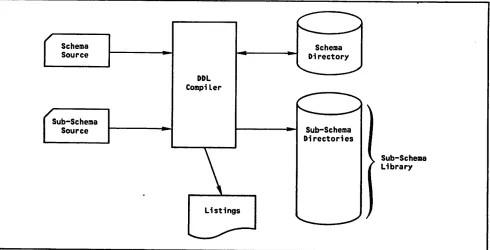
A block diagram illustrating schema/sub-schema generation is shown in figure 1-1.
The Schema
The schema is a detailed description of all the data in a data base. The schema description is generated from DDL statements that name the schema, organize the schema into files (called areas in the schema), describe each record type together with the characteristics of the data in the record, and d e s c r i b e r e l a t i o n s h i p s ( c a l l e d r e l a t i o n s ) a n d dependency conditions (called constraints) among areas. The schema also includes an access control capability that provides privacy at the area level. The data administrator writes the DDL source statements and uses them as input to the DDL compiler for compilation into an object schema or schema directory. After storing the directory as a permanent file, the data administrator provides you with pertinent information so you can tailor your FORTRAN program to meet processing requirements. If, for example, you need to access an area that has been defined as having controlled access in the s c h e m a , i t i s t h e r e s p o n s i b i l i t y o f t h e d a t a administrator to supply you with the appropriate privacy key.
The Sub-Schema
T h e s u b - s c h e m a i s a d e t a i l e d d e s c r i p t i o n o f selected portions of the data in a data base. The FORTRAN sub-schema description is generated from D D L sta t e me n t s th a t i d e n tif y th e s c h e ma a n d sub-schema, specify files (called realms in the sub-schema) and the content and structure of records, indicate changes in data format required by the application program, identify relations to b e u s e d , a n d s p e c i f y r e c o r d q u a l i fi c a t i o n f o r
Schema Source
£
Sub-Schema SourceDDL Compiler
Schema Directory
Listings
Sub-Schema Directories
Sub-Schema Library
Figure 1-1. Schema and Sub-Schema Generation
->>s%
The data administrator writes the DDL source statements and uses them as input to the DDL compiler for compilation into an object sub-schema o r s u b - s c h e m a d i r e c t o r y. A f t e r s t o r i n g t h e directory in the sub-schema Library, the data adninistrator provides you with a Listing of the sub-schema so you can obtain the names and descriptions of the data to be referenced in your FORTRAN program. The data administrator also provides you with the name of the sub-schema library, which you must attach with an operating s y s t e m AT TA C H c o n t r o l s t a t e m e n t f o r D M L preprocessing of the Data Manipulation Language statements in your FORTRAN program just before compilation.
FORTRAN DATA MANIPULATION LANGUAGE
The FORTRAN Data Manipulation Language (DML) is the language that provides a FORTRAN application program with access to the DMS-170 controlled data b a s e . T h e l a n g u a g e c o n s i s t s o f a s e r i e s o f statements that provide for opening and closing of data base files; reading, writing, updating, and deleting records from those files; and relation processing. The DML statements you include in your FORTRAN source program code are translated by the DML preprocessor into statements acceptable to the FORTRAN compiler.
CYBER DATABASE CONTROL SYSTEM
The central controlling component of DMS-170 is CYBER Database Control System (CDCS), which monitors and interprets all data base requests from application programs. CDCS preprocesses each
application program request, performs any necessary data conversion, handles structural differences between the schema and the sub-schema by an operation called mapping, and prepares the request for input/output processing.
Master Directory
T h e m a s t e r d i r e c t o r y i s a fi l e t h a t c o n t a i n s information relating to all data bases, schemas, and sub-schemas known to CDCS. The directory is g e n e r a t e d b y o n e o f t h e d a t a b a s e u t i l i t i e s provided through CDCS. The data administrator creates the master directory and stores it as a permanent file. Your application program cannot reference a sub-schema unless information about that sub-schema exists in the master directory. It is the responsibility of the data administrator to e n s u r e t h e s u b - s c h e m a i s v a l i d . T h e m a s t e r directory file is attached through the job stream of CDCS and is automatically available for your job.
CDCS Batch Test Facility
The CDCS Batch Test Facility is an absolute program that you can use during program development and testing. The facility enables you to run CDCS as a normal batch job, which means you can attach a new version of the master directory file each time you run a job.
The program, which resides on the system library, is called into execution by the CDCSBTF control s t a t e m e n t . W h e n u s i n g t h i s f a c i l i t y, y o u a r e responsible for attaching the master directory file and any necessary Log files each time you run a job.
[image:12.610.53.543.55.305.2]Data Base Procedures
Data base procedures are special-purpose subpro grams that CDCS caLLs when specific situations occur during CDCS processing. The data admin
istrator writes the data base procedures and stores them in a permanent file library. The name of the procedure, the point at which it is to be called, and the conditions governing its execution are specified in the schema definition. Loading of data base procedures is handled automatically for you.
CYBER RECORD MANAGER
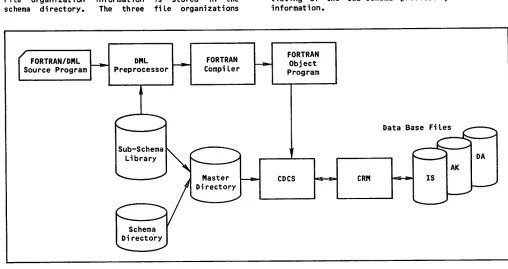
CYBER Record Manager (CRM) is the processor that performs all input/output operations for FORTRAN as well as the other CYBER host Languages operating within DMS-170. The Advanced Access Methods (AAM) file manager handles all operations concerning the physical storage and access of data by application programs. All data base files supported by CDCS are conventional CRM files.
A I L n e c e s s a r y i n f o r m a t i o n r e g a r d i n g t h e characteristics of a data base file is supplied to C R M a t s c h e m a c o m p i l a t i o n t i m e . T h e d a t a administrator specifies appropriate parameters on FILE control statements that are included in the DDL source deck when the schema is created. In DMS-170, all communication with CRM is handled automatically for you.
A block diagram illustrating the CRM interface with CDCS and the data base is shown in figure 1-2.
File Organization
F i l e o r g a n i z a t i o n i n f o r m a t i o n i s s t o r e d i n t h e schema directory. The three file organizations
allowed for data base files that are to be accessed t h r o u g h C D C S a r e : i n d e x e d s e q u e n t i a l , d i r e c t access, and actual key.
Records in indexed sequential files are stored in ascending order by key. An application program can access the records either randomly by key or sequentially.
Records in direct access files are stored randomly in fixed-length blocks. The number of the block to receive a record is determined by a calculation p e r f o r m e d b y t h e s y s t e m o n t h e r e c o r d . A n application program can access the records either randomly by key or sequentially.
R e c o r d s i n a c t u a l k e y fi l e s h a v e k e y v a l u e s assigned by the system. The key value is a number that identifies the block and the position within t h e b L o c k i n w h i c h t h e r e c o r d i s s t o r e d . A n application program can access the records either
randomly by actual key or sequentially.
The primary key is specified in the schema. A Listing of the sub-schema provides you with this information.
Multiple-Index Processing
M u l t i p l e - i n d e x p r o c e s s i n g i s p e r f o r m e d w h e n alternate keys are defined for a fiLe. An index is created for each alternate key in a data file when t h e fi l e i s c r e a t e d . T h e i n d e x e s a r e u p d a t e d automatically whenever the data file is updated. An application program can retrieve the records by the primary key or by an alternate key.
Each alternate key is specified in the schema. A listing of the sub-schema provides you with this information.
FORTRAN/DML
Source Program PreprocessorDML
FORTRAN Compiler
FORTRAN Object Program
CDCS
Data Base Files
CRM
Schema Di rectory
[image:13.610.70.578.418.687.2]SPECIAL FEATURES
Eight special features with which you need to be familiar are: concurrency, immediate return, file privacy, relations, constraints, data base ver sions, recovery, and data base transactions. When these mechanisms are present in the CDCS operating environment, some action on the part of your appli cation program might be required.
CONCURRENCY
The concurrency feature allows two or more applica tion programs to access the same data base file at the same time for retrieval or update purposes. During concurrent update operations, CDCS provides a locking mechanism by which files and records can be locked and unlocked at appropriate times.
CDCS always Locks the current record whenever the file is opened for input/output. Your application program, however, can issue explicit Lock and unlock requests for CDCS to lock the entire file. By issuing a lock request, your program prevents other jobs from updating the file that it is using until it issues an unlock request. The file being locked and unlocked must be a file identified in the sub-schema.
A deadlock situation can occur when a program attempts to access files or records that have been locked by CDCS for other programs. When this situ ation occurs, CDCS arbitrarily releases the locked resources held by one of the contending programs. To ensure proper recovery handling in this type of situation, you should include appropriate code in your FORTRAN program.
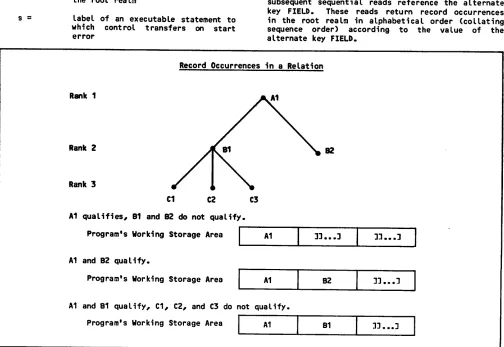
a relation. An application program can access the data from related files with a single read request. Relations are specified in the schema. Any rela tion that is available to an application program is specified in the sub-schema.
Your application program can access a relation by specifying a single read request with the name of the relation that is to be read. CDCS processes the request and returns a record occurrence from each file in the relation to your program's working storage area for the file.
The data administrator can place limitations on relations by including restrictions in the sub schema. Restrictions are in the form of qualifi cation criteria that must be satisfied before a record occurrence is made available to your program. A Listing of the sub-schema provides you with the name of the relation and indicates what specific restrictions apply.
CONSTRAINTS
The constraint feature allows controls to be imposed on update operations involving logically associated fi l e s . C o n s t r a i n t s p r o t e c t t h e i n t e g r i t y o f t h e data base by allowing update operations to be performed only when specific conditions are satis fied. Constraints are specified in the schema and are enforced by CDCS.
The data administrator provides you with information concerning constraints. You can avoid constraint violations by becoming familiar with the rules that apply when modifying files on which constraints have been imposed.
IMMEDIATE RETURN
The immediate return feature of CDCS provides FORTRAN application programs with the ability to receive an immediate response from CDCS when either CDCS cannot get the resources it needs, or a fatal error occurs. When this feature is used, CDCS returns control to the application program.
The immediate return feature cannot be enabled before CDCS is invoked. See the CDCS 2 Application Programming reference manual for more information.
FILE PRIVACY
The file privacy feature provides file access con trol. When file privacy has been specified in the schema, your program must supply privacy keys to gain access to the file.
The data administrator provides you with this information so you can ensure your FORTRAN program meets the privacy requirements when CDCS checks for appropriate privacy keys.
RELATIONS
The relational data base feature allows files to be linked together into a logical relationship called
DATABASE VERSIONS
The data base version feature of CDCS allows an application program to use the same schema and subschema to access more than one group of permanent files corresponding to the areas in the schema; each of these groups is defined as a data base version. Data base versions are defined by the data administrator in the master directory. By specifying use of different versions, an applica tion program can perform operations on different groups of files, each group forming a data base v e r s i o n . F o r d e t a i l e d i n f o r m a t i o n a b o u t t h i s feature, see the CDCS 2 Application Programming reference manual.
RECOVERY
The recovery feature provides for reconstruction of a damaged or inconsistent data base and provides for the removing of updates made with erroneous logic. The data base can be recovered when physi cal storage or system failure occurs and all or part of the data base is lost or otherwise unread able. The data base can be restored to a previous checkpoint or beginning of job when an application program failure or logic error occurs.
i ^ \
Recovery operations are made possible through a Logging facility, which is the recording of user i n t e r a c t i o n s w i t h a d a t a b a s e fi l e . L o g g i n g requirements are defined by the data administrator for a schema and serviced by CDCS. CDCS records the logging information on an independent file that ultimately serves as input for data base recover and restore operations. Log files, if specified, are attached through the job stream of CDCS and are automatically available to record the interactions of your program with the data base.
DATA BASE TRANSACTION
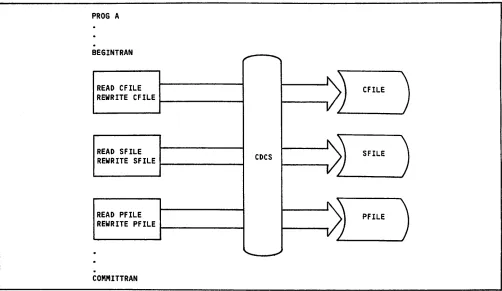
The data base transaction feature of CDCS provides the FORTRAN application program with the ability to group a series of data base updates into a logical unit, called a data base transaction.
The application program specifies the beginning of the transaction, performs the update operations, and specifies the end of the transaction, which can be either a commit or a drop. When the application program specifies a commit operation, all updates made within the transaction become permanent. When the application program specifies a drop operation,
all updates within the transaction are reversed; therefore, the data base remains in the state it was in before the beginning of the transaction.
I f t h e a p p l i c a t i o n p r o g r a m f a i l s t o c o m m i t a transaction because of system or program failure, a u t o m a t i c r e c o v e r y i s p e r f o r m e d ; t h a t i s , t h e transaction is dropped and the data base is re stored to its state before the beginning of the transaction.
Transaction processing also provides an application program with the ability to determine the point at which to restart processing after a system failure. The application program can use this feature to determine the last transaction that was committed before the system failure occurred. The program can then determine the point at which processing should be restarted.
SUMMARY OF DMS-170
COMPONENTS AND FEATURES
A summary of DMS-170 components and features appears in table 1-1. This table provides a quick refer ence for appropriate information.
TABLE 1-1. SUMMARY OF DMS-170 COMPONENTS AND FEATURES
Component/
Feature D e fi n i t i o n
Information
Appears In Programmer Action
Alternate key A key other than the primary key by which a file can be accessed; de fined by the data administrator.
Sub-schema listing On a random read, set the key to a value indicating the desired record occurrence. CDCS Batch Test
F a c i l i t y
A non-concurrent version of CDCS for use during program development.
N/A
Attach the master directorywhen executing the applica tion program.
Concurrency Simultaneous access to the same data by two or more application programs.
N/A
Include appropriate code inthe application program to handle a deadlock situation; deadlock can occur when two programs are contending for access to a locked file or
record. Constraints Controls imposed on records in
associated files or on items in a single file to protect the integ rity of the data base during update operations; defined by the data
administrator.
Schema Obtain information from the
data administrator. Follow the rules for modifying
files on which constraints have been imposed.
CYBER Database Control System (CDCS)
The central controlling module of DMS-170.
N/A
None.CYBER Record Manager (CRM)
The input/output processor for DMS-170 operations.
N/A
None.Data base
procedures Special-purpose routines that perform predefined operations; written by the data administrator.
TABLE 1-1. SUMMARY OF DMS-170 COMPONENTS AND FEATURES (Contd)
Component/
Feature Definition InformationAppears In Programmer Action
Data base transaction
A series of update operations identified by a user-assigned transaction identifier. A trans action is bracketed by a begin transaction operation and either a commit or drop operation.
N/A
Include appropriate code inthe application program to bracket the series of update operations and to assign transaction identifiers. Transaction log files must have been defined by the data administrator in the master directory.
Data base status
block An array defined within an application program to which CDCS returns information concerning the status of operations on data base files and relations.
N/A
Include appropriate code inthe application program.
Data base
version A set of permanent files that isassociated with the areas described by the schema; defined by the data administrator.
Master directory To use a data base version other than MASTER (which is otherwise assumed), specify the version name in the application program. Data
Description Language (DDL)
The language that is used to struc ture a schema and sub-schema; used by the data administrator.
N/A
None.File
organization
The predetermined arrangement of stored data; indexed sequential, direct access, or actual key; defined by the data administrator.
Schema None.
File privacy A situation in which an application program can only gain access to a file by supplying a privacy key; defined by the data administrator.
Schema Obtain information from the
data administrator. Include a PRIVACY.statement in the application program. FORTRAN Data
Manipulation Language (DML)
The language that provides a FORTRAN application program with
access to the DMS-170 controlled data base.
N/A
Include appropriate DMLstatements in the FORTRAN source program code.
Immediate return A feature of CDCS that provides FORTRAN application programs with the ability to receive immediate
response from CDCS when either CDCS cannot get the resources it needs, or a fatal error occurs.
N/A
Include appropriate code inthe application program.
Log files Disk files on which user inter actions with data base files are recorded for recovery purposes.
Master directory None.
F a c i l i t y. Master
directory
A file containing information re lating to all data bases, schemas, and sub-schemas known to CDCS; created by the data administrator.
N/A
Attach the master directoryonly when executing the pro gram through the CDCS Batch Test Facility.
Multiple-index processor
A processor that allows CRM files to be accessed by alternate keys.
N/A
None.TABLE 1-1. SUMMARY OF DMS-170 COMPONENTS AND FEATURES (Contd)
Component/
Feature D e fi n i t i o n InformationAppears In Programmer Action
Primary key A key that must be defined for a file when the file is first
created; defined by the data administrator.
Sub-schema listing On a random read, set the key to a value indicating the desired record occurrence.
Recovery:
Automatic A means by which a data base can
be automatically recovered in case of a system or program failure.
N/A
Data base transactions provide for automatic recovery; use them for sensitive up dates.
Recovery:
Manual A means by which a damaged or
destroyed data base can be re constructed or restored; defined by the data administrator.
N/A
None.Relations Logical structures formed by the
joining of files; permit retrieval of data from more than one file at the same time; defined by the data administrator.
Sub-schema listing To read a relation, specify a single read request with
the name of the relation. During update, follow the rules for updating files joined in a relation. Restrictions Criteria that must be satisfied in
a relation before a record occur rence can be made available to the application program; defined by the data administrator.
Sub-schema listing None.
Schema A detailed description of all the
data in a data base; created by the data administrator through DDL.
Schema listing None.
Sub-schema A detailed description of selected portions of the data in a data base; created by the data adminis trator through DDL.
Sub-schema listing Attach the sub-schema library in which the sub schema resides for DML preprocessing of the
ACCESSING THE DATA BASE
Every DMS-170 data base file that is to be accessed through FORTRAN must be described in a directory called a FORTRAN sub-schema. The data admin istrator, working with application programmers, is responsible for creating the sub-schemas. Every FORTRAN program that accesses a DMS-170 data base file must use the FORTRAN Data Manipulation Language (DML). The application programmer is responsible for coding appropriate DML statements and including them in the FORTRAN source program. This section details the two principal data base access tools: the sub-schema that describes the data, and the language that provides access to that data.
the data base. You must code the DML statements along with FORTRAN statements in the FORTRAN source program. The DML statements identify the sub schema, establish an interface with CDCS, and provide access to realms defined by the sub
schema. DML statements can appear both in the main program and in subprograms.
The DML statements are translated into statements acceptable to the FORTRAN compiler. The DML preprocessor performs the translation and writes the translated statements to a file along with the FORTRAN statements in the source program. This new file is then the input file to the FORTRAN compiler.
/fP^V
INTERPRETING THE FORTRAN
SUB-SCHEMA
The data administrator tailors sub-schemas to meet s p e c i fi c a p p l i c a t i o n s . A s s u m e , f o r e x a m p l e , y o u h a v e a n a p p l i c a t i o n t h a t r e q u i r e s a c c e s s t o o n l y t w o fi e l d s i n a d a t a b a s e fi l e : s t u d e n t I D s a n d t u i t i o n c h a r g e s . T h e d a t a a d m i n i s t r a t o r m i g h t p r o v i d e y o u w i t h a s u b - s c h e m a t h a t r e s e m b l e s sub-schema SAMPLE1 shown in figure 2-1.
With the exception of the sub-schema library name and any required privacy keys, the listing provides y o u w i t h c o m p l e t e i n f o r m a t i o n . T h e h a n d w r i t t e n n o t a t i o n i n t h i s e x a m p l e i n d i c a t e s t h e s u b - s c h e m a l i b r a r y n a m e i s D D L L I B . I f y o u w e r e p l a n n i n g t o c o m p i l e a n a p p l i c a t i o n p r o g r a m u s i n g s u b - s c h e m a SAMPLE1, you would need to attach DDLLIB. Since no p r i v a c y k e y i s r e q u i r e d , t h e s c h e m a o b v i o u s l y
imposes no access control on realm ACCOUNT.
N o t i c e t h e t h r e e a l i a s e s a s s i g n e d . S i n c e s y m b o l i c names in FORTRAN cannot exceed seven characters and c a n n o t i n c l u d e a h y p h e n , t h e d a t a a d m i n i s t r a t o r changes the names for your application.
Assume, for example, you have an application that r e q u i r e s a c c e s s t o t w o d a t a b a s e fi l e s . A s s u m e , also, that you need a relationship between the two fi l e s s o t h a t y o u c a n s e a r c h o n e fi l e a n d r e t r i e v e c o r r e s p o n d i n g r e c o r d s f r o m t h e o t h e r. T h e d a t a a d m i n i s t r a t o r m i g h t p r o v i d e y o u w i t h a s u b - s c h e m a that resembles sub-schema SAMPLE2 in figure 2-2. T h e h a n d w r i t t e n n o t a t i o n i n t h i s e x a m p l e i n d i c a t e s the sub-schema library name is DDLLIB. If you were p l a n n i n g t o c o m p i l e a n a p p l i c a t i o n p r o g r a m u s i n g s u b - s c h e m a S A M P L E 2 , y o u w o u l d n e e d t o a t t a c h D D L L I B . T h e s c h e m a a p p a r e n t l y i m p o s e s a c c e s s control on realm FILE2. The privacy key XX99 must b e i n c l u d e d i n a D M L P R I VA C Y s t a t e m e n t t o g a i n access to that realm.
DML LANGUAGE COMPONENTS
The DML language components include DML statement keywords, recognized symbols and punctuation, and user-supplied names of variables and constants. T h e s e c o m p o n e n t s a r e g r o u p e d t o g e t h e r i n t o statements for input to the DML preprocessor, which translates each statement appropriately into a FORTRAN specification or CALL statement.
The first word of a statement is always a DML keyword that identifies the task to be performed. M o s t k e y w o r d s a r e f o l l o w e d b y u s e r - s u p p l i e d elements and sometimes are followed by additional keywords.
A list of available DML statements is shown in table 2-1 for reference purposes. The statements are listed in alphabetic order by the leading word (keyword), which identifies the purpose of the complete statement. The comments column provides s p e c i fi c r u l e s f o r t h e s t a t e m e n t a n d i n c l u d e s applicable default options.
SYNTAX REQUIREMENTS
The syntax requirements and coding conventions for DML statements are exactly the same as for FORTRAN statements. The following restrictions apply: • A DML statement cannot be the object of a
logical IF.
• A DML statement must not reference f i les that are referenced elsewhere in the program by a conventional FORTRAN input/output statement or by a FORTRAN PROGRAM statement.
Any executable DML statement can have a statement label. The DML preprocessor copies the label into the translated FORTRAN statement.
FORTRAN DATA MANIPULATION
LANGUAGE
The FORTRAN Data Manipulation Language (DML) is the means through which your FORTRAN program accesses
STATEMENT POSITIONING
• >» • S O Q
-BS
• 1 3• o p . - o
«&> S
o t o o s - T 2 o
« 0 £
* « o Z o o
O C D E O Z < o I —
O J 2 J o
■
«-»H «n
^ I
* v, o OJ w» OJ 6
t - S o <o c ♦»
2 c w c o >
$-°> h
j c o r - O
$-o o
« u
feg
■
^
■
o
in "w v t
0 )
S- +J X ( * • ' "
S - J C o o % . O I c u < U H O l t - i - t 0 ) 4-»
O J -C OJ o c
Vt O
o o to
v t
cu C « r
-S
CO o J C o r - « C* ^ c «o C V ) ' i - t o V t
10
g t i a i
Z— ••— »i— u u O M l / l
5 oj cu
I — " O " O
=> o o o
<
to cu 5-« ♦ -cu of t
i « o » CO
CU i n j D C U o c ? • > - ( O ± > 4 J C J * ^ I B
5- CU Q| OJ O)
ui o. <o 3 O e n o o > « J O J C B ^ ' o . O J O J * * '
«=^ ._
a . I
e o°-t i l s
•f- CO <o X U
i - C J +-> JC
to C -U o <u
0 " 0 O O - r - + »
- - V t
^°£
» t
•O <y
<o . " O Vt <]>
- °
2 cc c o • o 3 O CO
e
OJ CO
■M s -i—i «J
3 I U J O r - a O O O U U | -<C <t tO I I I I I I I t » I -Z U 1 -Z
3 oe tu
O r - O O O = ) CJ CJ r-< r-< C O
E 0 6 ^ - J O E < CJ UJ UJ UJ r-K ( E H
< « C <
UJ <c oc UJ
<
r -X ZM U J ae a.o a-u. <
O O O O o o o
i - t n v >
o a. z o o
<
o o o o o o o o o o o o o o o o o o o i - o o o o o o o o o
-/(!3%.
CU
J C
" O • > c o to —*
? u - o c « . O U . J
•O CM «JJ (A uj U-I CO E a i 5 -« ! j U . " o O J h h 5
•-^ £8
• = 0 )
£^2! a.
U I o c " O $-o o
3
H-l o u . 0 )■o I S en t» CA 2 t o c
CO CO t 1
-**- o cu • o.
J-o .
u . t o . u 3
. . I 4 - * xj«-• •"-4)1-1
in _
*-«/) C CO OJ «0 4J
C O J = J Q - O 0 0 1 • c H O
t o - r 4 ^ <j b *
P. oi «n U J - O t O
*~I "°
- j m c o h t n U . i
-T)2 "S - ~ e n
s-rr* en
V-o
t — Q U I s c i - < o Ul CM<C Q U J O C i - » _ J C O
Co ••> V ) E . . o j * > S o - i - + j . O , i
->> cu i— JO
cu cO > O t -O .
o£ ■"'^
CM, tO^ S
" ° c o t n f c - o C O ° cu.~*
m i
o
" O 0 )
+J»
• r - 1 °
01 O J_ U I CO
oc
CM _ l
u.
**
M-■o
$-o 0 )
u o>
OJ to
J -
J-OJ
>
c tO o + J •o UJ« - t . p c c ^ - J nco en
JP^N
OJ r - C U U U I
- . 5
t n J = OJ t- t n _ jjy •— i i - t
■
gu.
t o +>o.
I J l - C t n c
r?
t n OJCME Q . U I J C
3t OJ C A _ I t u - o q j + j 0 " 0 c u OJ 4-> CO •—c J C c J C f - X C + J 3 5 * - J - U - 1— to I- 3: 1 - « T
-e ^ - o
t u i n „ 4-> i- en tn
O J £ £ J = co u u CJ
u i a ec in I I
l t -z -z I- UJ UJ z a a
UJ 3 3 O h l -3 CO V>
t - I I I I co o a
II uj •-< »- ae
*-UJ 1- *-UJ
E K a _ l O E < U U I UJ Ul
I-K K H
hi ae 3 o c 3 i -oe o co 3 I I I I O O O II UJ l-l
cm ae t\j UJ CM UJ
E K n _ l O E < U U 1 UJ Ul h-ae h-ae i-4
CO CO
o o f-l UJ
r - i M w * i n ^ ) N t D O O t - N m - * i n * o r >
O O O O O O O O O r r * t t r « t -O O O O O O O O O O O O O O O « « - » o o o o o o o o g o o o o o o o o o o o o o o o o o o o o o
i o o
O Q
i o o < M I M
T- CM
CM CM
o o
I O I O
8 SS S
t ooe o
I
t
t
t
I
r o m o o o C M » r ^ C M . -O— O Q O O OO O O O O o o o o o
>-U l >-U l >-U l >- xt >• xt xt U l U l Xt UJ Xt UJ UJ
I - I 1 -> - « t -> - < « t O C X 0 £ Z Z <t ae < ae oe E ui E UJ ui
M l M l I -a e j -a e _ j _ j a . < c o . < < t
* * < * m * T - C M C M * * t M C M *
* ? ° S *
* * o o * * * o o *
UJ E _ i o
a.
TABLE 2-1. DML STATEMENTS
Statement Description Comments
ASSIGNID
BEGINTRAN
CLOSE
CLOSE relation
COMMITTRAN
DELETE
DROPTRAN
FINDTRAN
INVOKE
LOCK
NEWVERSION
OPEN
OPEN relation
PRIVACY
Obtains a restart identifier assigned by CDCS.
Begins processing of a data base transaction.
Ends processing of a realm.
Ends processing of the realms joined in a relation.
Completes processing of a data base transaction.
Removes a record from a realm.
Cancels processing of a data base transaction.
Obtains information for a program restart operation after system f a i l u r e .
Establishes the interface between the executing program and CDCS. Establishes an exclusive or protected
lock on realms. Exclusive prohibits read and update operations on the realm. Protected prohibits only update operations (allows read operations).
Changes the data base version being used by an application program.
Initiates processing of a realm.
Initiates processing of the realms joined in a relation.
Establishes the right of a program to access a realm.
The program must execute the ASSIGNID statement before processing data base transactions in order to determine the status of a data base transaction in a restart operation after a system failure occurs. The FINDTRAN statement is used in the restart operation.
Updates are considered temporary until the data base transaction is committed.
Realms can be opened and closed any number of times by a program.
Relations can be opened and closed any number of times by a program.
This statement causes all updates within the data base transaction to be considered permanent. The record being deleted is the record most recently read from the realm. The value of the primary key cannot change after the last read. All realms are restored to the states that existed just before the data base transaction began. The program must have obtained a restart identifier by executing the ASSIGNID statement in order to use the FINDTRAN statement.
The statement must be executed before any other DML statements except SUBSCHEMA.
The realm must be a realm described in the sub schema.
All sub-schema realms must be closed before executing the NEWVERSION statement. See the CDCS 2 Application Programming reference manual
for details.
If the processing mode is not specified, the realm is opened for input/output.
If the processing mode is not specified, the rela tion is opened for input/output. A processing mode of open for output only is not valid.
If the processing mode is not specified, the realm can be accessed for input/output. The mode must be the same as the mode indicated in the OPEN
statement.
j j f f P ^ .
TABLE 2-1. DML STATEMENTS (Contd)
Statement Description Comment s
READ Transfers data from a realm record
to the variables defined in the sub schema record description.
If a key is not specified, the read is sequential. If a key is specified, the value of the referenced key must be set by the program before the read is executed.
READ relation Transfers data from the relation records to the corresponding vari ables defined in the sub-schema record descriptions.
If a key is not specified, the read is sequential. If a key is specified, the key must be in the root realm; the value of the referenced key must be set by the program before the read is executed. REWRITE Replaces the last record read with a
new record, using the current values of the variables defined in the sub schema record description.
The value of the primary key must not have changed since the last read.
START Logically positions a realm for
a subsequent sequential read operation.
The processing mode must be either input or input/output. If a key is specified, it must be a primary or alternate key defined for the realm. If a key is not specified, positioning is by primary key.
START relation Logically positions the root realm (the first realm named in the sub schema) of a relation for a subse quent relation read operation.
The processing mode must be either input or input/output. If a key is specified, it must be a primary or alternate key that is defined in the root realm. If a key is not specified, positioning is by primary key of the root realm. SUBSCHEMA Identifies the sub-schema to be used
by the program.
A FORTRAN program can reference only one sub schema.
TERMINATE Terminates the interface between the
FORTRAN program and CDCS. When a TERMINATE statement is issued, an INVOKEstatement must be executed before any other DML statements are issued.
UNLOCK Releases a lock on a specified realm and releases all record locks.
The realm must be a realm described in the sub schema.
WRITE Writes a record, using the current
values of the variables defined in the sub-schema record description.
Schema record data items that are not defined in the sub-schema are given null values by CDCS.
j Specification statements
_i
SUBSCHEMA M u s t a p p e a r h e r e
j ,
■ DATA or NAMELIST statements i S t a t e m e n t f u n c t i o n d e fi n i t i o n s
■ a i d i e m e r u l u i i k t i u i i u e i i n 11 i o n :
i — — — — — — — — — — ^ — — — i
FORTRAN executable statements
INVOKE* -< Must precede other DML statements (except SUBSCHEMA statement)
ASSIGNID*/FINDTRAN* PRIVACY* ^
open*-<-LOCK* ^_ BEGINTRAN
-*-READ/WRITE/REWRITE/DELETE/START
C0MMITTRAN\ DR0PTRAN f ~* UNLOCK* CLOSET TERMINATE -*
Must precede OPEN statement Must precede LOCK statement
Must precede UNLOCK statement
Begins processing of a data base transaction
Ends processing of a data base transaction
Must be last DML statement . FORTRAN executable statements .
'Cannot appear within a data base transaction.
Figure 2-3. DML Statement Positioning
PROCESSING THE DATA
/0s*.
Processing data base files within the DMS-170 environment involves several steps. These steps are:
1. Obtain a current listing of the sub-schema from the data administrator so you can have the names and descriptions of the data your program will be referencing.
2. Obtain the name of the appropriate sub-schema library from the data administrator. You will need to attach this library for preprocessing your program.
3. Ask the data administrator if any realms in the sub-schema are defined in the schema as having controlled access. When access is controlled, you must know the privacy key.
4. Ask the data administrator if any constraints exist in the schema. When constraints exist, CDCS enforces them by not allowing updates that violate constraints.
5 . C o d e t h e F O R T R A N p r o g r a m a n d i n c l u d e appropriate Data Manipulation Language (DML) statements for opening, closing, and processing sub-schema realms.
6. Preprocess and compile the FORTRAN program. Include, in the job stream before the FTN5 control statement, an ATTACH control statement naming the sub-schema library and a DML control statement to execute the DML preprocessor. 7. When compilation is successful, execute the
FORTRAN program. Include an LDSET control statement to load the DMS-170 library.
DML statements are available to perform a variety of operations on data base items described in a FORTRAN sub-schema. This section describes these statements and presents them in the following sequence:
Data Base Access SUBSCHEMA INVOKE PRIVACY OPEN LOCK/UNLOCK CLOSE TERMINATE
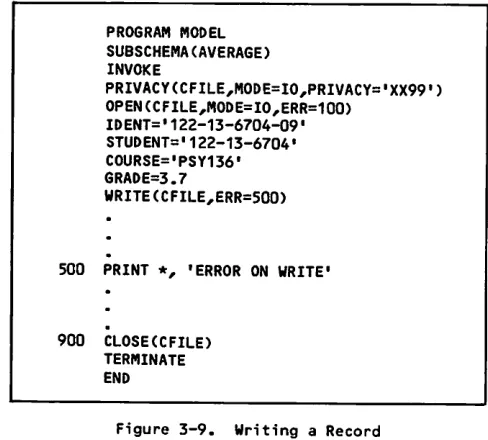
Data Base Manipulation WRITE
READ START REWRITE DELETE Relation Access
6PEN
CLOSE READ START
For purposes of illustration, a new sub-schema named AVERAGE is shown in figure 3-1. This sub-schema is referenced in subsequent examples. The examples show portions of program MODEL which illustrate statements necessary for particular data base operations.
The sub-schema provides the following information: • The realm (file) to be accessed is named CFILE. • The record is named CRECORD.
• A character item named IDENT is the primary key. • A character item named STUDENT is an alternate
key.
• A character item named COURSE is an alternate key.
• A real item named GRADE is an alternate key. The handwritten notation on the listing indicates the sub-schema is stored on a library named SSLIB. The notation also indicates CFILE has controlled access and requires a privacy key of XX99.
USING DML TO ACCESS
THE DATA BASE
To access a data base, a FORTRAN program must identify the sub-schema that the program uses, establish an interface with CDCS, satisfy privacy requirements, and perform the usual functions of opening and closing files. The following para graphs describe these functions and the DML state ments that you include in your program to provide these functions.
IDENTIFYING THE SUB-SCHEMA
To identify the sub-schema, you must include a SUBSCHEMA statement in your program. This must be the first DML statement to appear in your program. The format is:
SUBSCHEMA(sub-schema-name)
The SUBSCHEMA statement is required. You must position the statement in the program as follows: • After the specification statements
• Before the first DATA or NAMELIST statement • Before any statement function
• Before any executable statement
AVERAGE * SOURCE LISTING * (80351) DDLF 1.2+538.
00001 SUBSCHEMA AVERAGE,SCHEMA=UNIVERSITY
00002
00003 ALIAS(REALM) CFILE=CURRICULUM
00004 ALIAS(RECORD) CRECORD=CURR-REC
00005 ALIAS(ITEM) STUDENT=STUDENT-ID.CURR-REC
00006 ALIAS(ITEM) COURSE=COURSE-ID.CURR-REC
00007
00008 REALM CFILE
00009
00010 RECORD CRECORD
00011 ** WITHIN CFILE
00012 CHARACTER*14 IDENT
** ORDINAL
00013 CHARACTERS1 STUDENT
** ORDINAL
00014 CHARACTER*6 COURSE
** ORDINAL
00015 REAL GRADE
** ORDINAL
00016
END
00017
* * * * * END OF SUB-SCHEMA SOURCE INPUT
PRIMARY KEY 00012 IDENT FOR AREA CFILE
ALTERNATE KEY 00013 STUDENT FOR AREA CFILE
ALTERNATE KEY 00014 COURSE FOR AREA CFILE
ALTERNATE KEY 00015 GRADE FOR AREA CFILE
* * * * * RECORD MAPPING IS NEEDED FOR REALM - CFILE
Klbxanu -rtwma,
SSLlo-Figure 3-1. Sub-Schema AVERAGE
c o m p i l a t i o n . I n t h i s w a y , D M L p r o v i d e s y o u r p r o g r a m w i t h t h e a b i l i t y t o r e f e r e n c e a l l r e c o r d s , data items, and relations that are described in the sub-schema.
In a program using the sample sub-schema AVERAGE, the SUBSCHEMA statement appears as shown in figure 3 - 2 .
PROGRAM MODEL
CHARACTER ... DIMENSION ...
SUBSCHEMA(AVERAGE) DATA ...
DO ...
END
Figure 3-2. Identifying the Sub-Schema
ESTABLISHING THE INTERFACE WITH CDCS
To establish the interface with CDCS, you must include an INVOKE statement in your program. This must be the second DML statement to appear in your program. The format is:
INVOKE
The INVOKE statement is required. The statement must appear in the program before any other DML statement except SUBSCHEMA.
When the INVOKE statement is executed, CDCS automatically attaches for use by the program all realms described in the sub-schema identified by the program.
In a program using the sample sub-schema AVERAGE, the INVOKE statement appears as shown in figure 3-3.
SATISFYING PRIVACY REQUIREMENTS
If a realm is defined in the schema as having con trolled access, your program must provide a privacy key to access the realm. To provide the privacy key, you must include the PRIVACY statement in your program. The format is:
PROGRAM MODEL
CHARACTER ... DIMENSION ...
SUBSCHEMA(AVERAGE) DATA ...
DO ...
INVOKE
END
Figure 3-3. Establishing the Interface With CDCS PRIVACY(realm-name, CMODE=mode,D
PRIVACY=privacy key) where
m o d e = I ( a c c e s s a l l o w e d f o r i n p u t ) 10 (access allowed for both input and output, called input/output; default)
0 (access allowed for output) privacy key = character constant, variable
name, unsubscripted array name A privacy key can be from 1 through 30 characters in length. If you use a character constant to specify a privacy key, enclose the character string I in apostrophes. If you use a variable name to specify a privacy key, define the variable as type CHARACTER*30. Ensure that the privacy key is left-justified and blank filled in the field of the variable. If you use an array name to specify the privacy key, define the array as a 3-word array. Ensure that the privacy key is left-justified and blank filled in the field of the array.
The PRIVACY statement is required when access is c o n t r o l l e d . A s e p a r a t e P R I VA C Y s t a t e m e n t i s required for each realm defined with controlled access. The PRIVACY statement must be executed before the statement that opens the realm.
The handwritten notation on the sample sub-schema listing (figure 3-1) indicates access to the realm is controlled and a privacy key called XX99 is required. In a program using the sample sub-schema AVERAGE, the required PRIVACY statement appears as shown in figure 3-4.
OPENING A REALM
Before your program can access any data records in a n e x i s t i n g r e a l m , t h e p r o g r a m m u s t o p e n t h e r e a l m . To o p e n t h e r e a l m , y o u m u s t i n c l u d e t h e OPEN statement in your program. The format is:
OPEN (realm-name CM0DE=mode1 C,ERR=s1)
PROGRAM MODEL
SUBSCHEMA(AVERAGE)
INVOKE
PRIVACY(CFILE,M0DE=I0,PRIVACY=,XX99')
END
Figure 3-4. Satisfying Privacy Requirements where
mode = I (open for input only)
10 (open for both input and output, called input/output; default)
0 (open for output only; valid only for creating a new file)
s = l a b e l o f a n e x e c u t a b l e s t a t e m e n t t o which control transfers on open error For a realm with controlled access, the mode of access indicated in the PRIVACY statement must provide for the access mode indicated in the OPEN statement. For example, if you open a realm for input (M0DE=I) you can specify M0DE=I0 in the PRIVACY statement.
If a separate privacy key is required for input (M0DE=I) and another privacy key is required for output (M0DE=0), two PRIVACY statements are required to open a realm for input/output (M0DE=I0).
In a program using the sample sub-schema AVERAGE (figure 3-1), the OPEN statement appears as shown in figure 3-5. The MODE option is not included, indicating a default to input/output.
PROGRAM MODEL
SUBSCHEMA(AVERAGE)
INVOKE
PRIVACY(CFILE,M0DE=I0,PRIVACY='XX99') 0PEN(CFILE,ERR=100)
100 PRINT *, 'ERROR ON OPEN*