P. Zaphiris et al. (Eds.): TPDL 2012, LNCS 7489, pp. 298–310, 2012. © Springer-Verlag Berlin Heidelberg 2012
Dong Zhou1,2, Séamus Lawless2, and Vincent Wade2
1
School of Computer Science and Engineering, Hunan University of Science and Technology, Taoyuan Road, Xiangtan, Hunan, 411201, China
2
Center for Next Generation Localisation, Knowledge and Date Engineering Group, School of Computer Science and Statistics, Trinity College Dublin, Dublin 2, Ireland
{Seamus.Lawless,Vincent.Wade}@scss.tcd.ie
Abstract. Web search that utilizes social tagging data suffers from an extreme
example of the vocabulary mismatch problem encountered in traditional Infor-mation Retrieval (IR). This is due to the personalized, unrestricted vocabulary that users choose to describe and tag each resource. Previous research has pro-posed the utilization of query expansion to deal with search in this rather com-plicated space. However, non-personalized approaches based on relevance feedback and personalized approaches based on co-occurrence statistics have only demonstrated limited improvements. This paper proposes an Iterative P er-sonalized Query Expansion Algorithm for Web Search (iPAW), which is based on individual user profiles mined from the annotations and resources the user has marked. The method also incorporates a user model constructed from a co-occurrence matrix and from a Tag-Topic model where annotations and web documents are connected in a latent graph. The experimental results suggest that the proposed personalized query expansion method can produce better results than both the classical non-personalized search approach and other per-sonalized query expansion methods. An “adaptivity factor” was further investi-gated to adjust the level of personalization.
Keywords: Personalized Web Search, Query Expansion, Social Data,
Tag-Topic Model, Graph Algorithm.
1
Introduction
Over the past decade, the area of personalized web search has gained much attention in the literature [8, 12]. An important concern in personalized search systems is how to store and represent the gathered usage information. Some systems store this infor-mation in an individualized user model [18], while other systems maintain an aggre-gate view of usage information [1].
Recent years have also witnessed the explosive growth of information on the World Wide Web (WWW). In social tagging systems such as del.icio.us1, users are able to annotate each web resource with any number of free-form tags of their own choice. This type of system provides an ideal test bed for personalized search [17]. A user profile can be easily derived from their feedback, providing a good indication of the user’s interests.
However, the uncontrolled manner of social tagging results in the use of an unre-stricted vocabulary. This makes searching through the collection difficult and general-ly less accurate. In current social media systems, search algorithms also tend to be rather simplistic in nature, relying upon term matching methods, which often fail to deal with the vocabulary mismatch problem and result in poor ranking results.
Query expansion can partially solve the above mentioned problem. A classic tech-nique is Pseudo relevance feedback (PRF) or local analysis [3]. This approach has been previously proven to work well. However, in the context of personalized search, the selected terms may be different from the users’ true interests, so that the retrieved documents may not be relevant to a particular user. There have been few attempts at selecting the appropriate expansion terms from a user profile [4, 5, 6]. Past research appears to favor tag-tag relationships, by selecting the most related tags from a user’s profile to enhance the source query. Given the fact that the tags might not be the pre-cise descriptions of resources, the resulting retrieval performance has been markedly low [4, 5]. Borrowing from the traditional Information Retrieval (IR) field, local anal-ysis and co-occurrence based user profile representation have been adopted to expand the query according to a user’s interaction with the system [6, 8]. However, in this case the selection of expansion terms is solely based on lexical matching between the query and the terms which exist in the user profile. If the terms are not found in the user’s profile, the query cannot be expanded at all.
In this work, an Iterative Personalized Query Expansion Algorithm for Web Search, called iPAW, is presented. This algorithm is based on individual user profiles. In the user profile, terms are modeled according to their relationships, which can be defined by co-occurrence statistics or defined by a tag-topic model, introduced below. Each term in the user profile will have an associated weighting score calculated based on its relationship with other terms in the profile and terms extracted from top-ranked documents. After calculation, the terms with the highest scores will be chosen to ex-pand the original query. The intuition behind the model is the prior assumption of term consistency: the most appropriate expansion terms for a query are likely to have the same weighting scores, be associated with, and influenced by terms extracted
from the documents ranked highly for the initial query. In other words, the selection
of expansion terms for a given query is not solely based on lexical matching, but by iterative context enhancing and weight propagation. In addition, one important “adap-tivity factor” was examined that could affect the expansion process.
1
2
Related Work
Manual query expansion has been studied in early IR systems [11]. This approach demands user intervention and requires the user to be familiar with the search system, which is generally not true for the modern web. For these reasons, the overwhelming majority of search systems in existence today, function via automatic query sion. One common technique employs a machine readable thesaurus to locate expan-sion terms in lists of synonyms [16]. Other approaches extract expanexpan-sion terms from large collections of documents [13]. Local analysis involving relevance feedback is another popular category of approach. Explicit feedback is often difficult to obtain. An alternative method is implicit relevance feedback through pseudo relevance feed-back (PRF) [3]. Web query logs are also used by researchers to bridge the gap be-tween the user-centric query space and author-centric web page space [10]. However, in practice, acquiring web query logs is difficult for most researchers due to the vari-ous concerns of search companies.
Personalized web search has been extensively studied. There are approaches that utilize query log and click-through analysis [12]. There are systems that explore desk-top data and external resources [8]. In personalized social media search, Personaliza-tion usually involves two general approaches. The first approach runs the unmodified original query for all users but re-ranks the returned results based on an individual user profile [7, 17]. Another group of work modifies or augments a user’s original query, or query expansion. Researchers have frequently used co-occurring tags to enhance the source query [4, 5].
3
Personalized Query Expansion
3.1 Problem Definition
In social tagging systems such as del.icio.us, users can label interesting web pages with primarily short and unstructured annotations in natural language called tags. These web pages are denoted as a URL in the del.icio.us website. Textual content is crawled by following a URL that refers to a document or web document. Multimedia content is excluded in this research. In response to a query, an initial set of the most relevant documents is fetched. The top “c” ranked documents are assumed to be rele-vant, and therefore refer to the top-ranked documents. Term refers to a word in the vocabulary, these two terminologies are used interchangeably. Terms extracted from documents are specifically called docTerm, to be distinguished from general “terms” used in user profiles and from tags.
Formally, social tagging data can be represented by a tuple , , , , where , , are finite sets of users, web documents and tags, and
is a ternary relation, whose elements are called tag assignments or annotations. The set of annotations of a user is defined as: , | , , . The tag vocabu-lary of a user, is given as | , . The user’s set of documents is
| where denotes the words in the document corpus. is the full list of tags that the user has used, and is the vocabulary ex-tracted from the documents that the user has tagged. So that terms in a user profile could be chosen from , doc , or doc .
Given a source query , a set of terms/words in the user profile , … , and a set of initial top-ranked documents , … the goal is to return a ranked list of profile terms to be added to the query, regularized by terms extracted from the top-ranked documents.
Previous User Search Behaviour
User Model
Query
Document Corpus
Top-ranked Documents iPAW
Enhanced Query IR component
[image:4.439.130.311.164.310.2]Final Result List
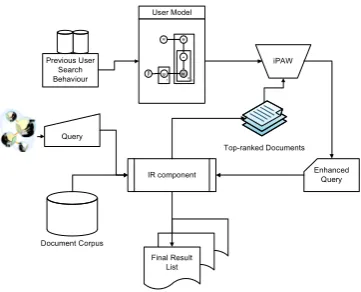
Fig. 1. Solution Architecture
3.2 Solution Overview
Figure 1 shows a sketch of the proposed solution architecture where personalized query expansion consists of two phases: (1) The construction of user models by using a co-occurrence matrix built for all the tags and documents in the training set or a tag-topic model where the tags and web documents are modeled simultaneously. This phase will be detailed in the next section. (2) The expansion of the given query by using the iPAW algorithm where the global term consistency is assumed over the word graph in addition to leveraging the top-ranked documents retrieved by the initial query. This process is described in the next section.
3.3 iPAW Algorithm
Inspired by semi-supervised learning methods [19], here an iterative personalized query expansion algorithm for web search is developed. The algorithm is shown in Figure 2.
The algorithm can be understood intuitively in terms of spreading activation net-works [14]. A pairwise relationship is first defined, which can be viewed as the user model construction, and then it is symmetrically normalized, which is necessary for the convergence of the iteration step 3. During each iteration of step 3, terms in the user model will receive the information (weights) spreading from its neighbors, but also influenced by terms extracted from top-ranked documents (initial information). The parameter specifies the relative amount of the information from its neighbors and its initial weighting information.
Term consistency is assumed in the iteration phase. The first term of the iteration function in step 3 is the global consistency constraint, which means that a good weighting function should not change too much between nearby points. In this paper, nearby points are refined weighting scores with respect to initial relationships be-tween words and context information (top-ranked documents) obtained by the initial query. They are likely to have the same effect over the graph. The second term is the fitting constraint, which means the weighting of words should fit the weighting scores of words extracted from the top-ranked documents retrieved by the given query.
After simplifying, a closed form solution can be derived as (see also [19, 20]):
1
An important feature of such computation is that the weightings calculated here share similarities with the entries obtained in the calculation in Zhou et al’s paper [19], where they try to find the largest entry in order to get the corresponding label, while this approach attempts to find select terms with large added weights. The actual val-ues of weights are not so critical as far as they have discriminative power to separate high potential words from low potential words.
1. Form the affinity matrix , which is defined by co-occurrence statistics or relationships that are calculated by the tag-topic model proposed in the user model construction section.
2. Construct the matrix / /.
3. Iterate 1 1 until convergence, where is the initial weighting matrix obtained by terms extracted from the top-ranked documents (tf-idf weighting used in the current paper (Jones 1988)) and is a parameter in (0,1).
4. Let denote the limit of the sequence . Compute the final weighting scores for each word as ∑ , , from which the top words can be acquired from the final ranked list of profile words to be added to the query.
4
User Model Construction
In order to capture accurate information for the construction of the user model, in this paper the tags and web documents are modeled simultaneously. Initially, a simple user model is defined using a co-occurrence matrix. A new model is then introduced where a latent graph is built among terms.
4.1 Co-occurrence Matrix
Firstly, a co-occurrence matrix was built according to [6, 8]. For all the tags and doc-uments in the training set, important terms (or keywords) with high tf-idf scores (20% was used in the experiment described below) were selected. The cosine similarity between two words and was then calculated using:
, , ·
Where , is the document frequency of word . Note that here tags and doc-Terms are modeled into the matrix together. Graph is built in which the nodes denote the terms and the edges are weighted by their co-occurrence similariy.
4.2 A Tag-Topic Model
In the current paper, an Author-Topic model, introduced by Steyvers et al. [15], was adopted and a Tag-Topic model was proposed in order to learn topic-word and tag-topic distributions from the annotation data in an unsupervised manner. Then a latent graph is built based upon the features derived. This can be achieved through impor-tant docTerms, tags or a mixture of both.
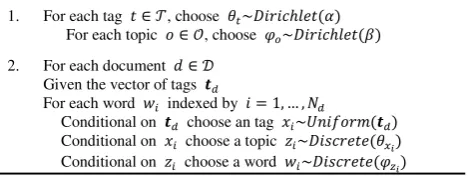
To run the original Author-Topic model on the social tagging data at an individual user level, the tags can be viewed as authors in the new proposed model. When gene-rating a document, a tag is chosen at random for each individual word in the docu-ment. This tag picks a topic from its multinomial distribution over topics, and then samples a word from the multinomial distribution over words associated with that
1. For each tag , choose ~ For each topic , choose ~ 2. For each document
Given the vector of tags
[image:6.439.101.336.155.244.2]For each word indexed by 1, … , Conditional on choose an tag ~ Conditional on choose a topic ~ Conditional on choose a word ~
topic. This process is repeated for all words in the document. This process is summa-rized in Figure 3.
In the figure, and denote topic-word distributions and tag-topic distributions respectively, while and denote Dirichlet priors. From the count matrices ob-tained during the modeling process [15], and can be easily estimated. The algo-rithm assigns words to random topics and tags (from the set of tags annotated to the document), and then repeats the Gibbs sampling process to update topic assignments for several iterations.
After the topic-word distributions and tag-topic distributions have been obtained, the adjacency graph of word associations and tag associations can be constructed. To illustrate how the model could be used in this respect, taking tags as an example, the distance between tags and was defined as the symmetric KL divergence be-tween the topic distributions conditioned on each of the tags:
, log log
Similarly we can compute associations between words.
So a latent graph is defined using the latent feature obtained from the tag-topic model, where the nodes denote the terms and the edges are weighted by . After normalization, matrix can be calculated. This process is executed offline, and then matrix is saved for the query expansion model. Since terms extracted from the documents are not equally important, only the top terms from each topic are re-tained to form the graph. Tags are usually regarded as high quality descriptors of the web pages’ topics and a good indicator of web users’ interests, so they are all retained in the user profile. To compare the use of docTerms extracted from documents and tags assigned to the documents for query expansion, three sets of user profiles have been defined: selected docTerms, tags and a mixture of both.
5
Empirical Evaluation
5.1 Experimental Setup
In order to evaluate the methods on real-world data a crawl was conducted on the popular social tagging site delicious during 2010. A total of 5,943 users, 1,190,936 web pages and 283,339 tags were obtained. The average number of tags per user and pages per user in the corpus are 47.68 and 200.39, respectively. Users with less than 10 personal tags were removed from the sample.
with annotated web pages were used to create the user profile and the other 25% were used as a test collection.
The evaluation method used by previous researchers in personalized social search [7, 17] is employed. The main assumption is as follows: Any documents tagged by with are considered relevant for the personalized query , t ( submits the query ).
[image:8.439.60.379.259.365.2]The following evaluation metrics were chosen to measure the effectiveness of the various approaches: the precision of the top 5 documents (P@5), mean reciprocal rank (MRR), mean average precision (MAP) and the recall of the top 5 documents (R@5). The first three measurements are commonly used to evaluate search algo-rithms while the last one is useful for evaluating query expansion systems as this me-thod has been shown to improve both recall and precision in the past. Statistically-significant differences in performance were determined using a paired t-test at a con-fidence level of 95%.
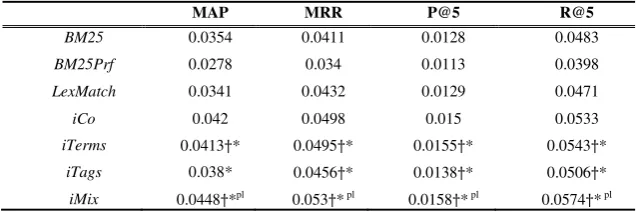
Table 1. Overall Results
MAP MRR P@5 R@5
BM25 0.0354 0.0411 0.0128 0.0483
BM25Prf 0.0278 0.034 0.0113 0.0398
LexMatch 0.0341 0.0432 0.0129 0.0471
iCo 0.042 0.0498 0.015 0.0533
iTerms 0.0413†* 0.0495†* 0.0155†* 0.0543†*
iTags 0.038* 0.0456†* 0.0138†* 0.0506†*
iMix 0.0448†*pl 0.053†*pl 0.0158†*pl 0.0574†* pl
5.2 Experimental Runs and Parameter Tuning
In order to usefully evaluate the performance of the personalized query expansion framework 2 different non-personalized baselines were selected: BM25 – a popular and quite robust probabilistic retrieval method, and BM25Prf – a pseudo-relevance feedback oriented query expansion method based on the Divergence from Random-ness theory [2]. In addition to non-personalized baselines, we also have several perso-nalized baselines. Firstly, a method was adopted which processes the user model using lexical matching between query terms and terms that exist in the user model (constructed by using co-occurrence matrix) [8]. This method is denoted as LexMatch.
For the tag-topic modeling, and were set to 5 and 20 empirically. In the ex-pansion framework, the optimal values were obtained when 0.9 and γ 10 for terms (used in LexMatch as well) and γ 1 for tags. The number of top docu-ments used in the query expansion framework was set to 10. The parameters
for BM25Prf were also set to 10 documents and 10 terms.
5.3 Personalization vs Non-personalization
Firstly, we examine the experimental results that describe the performance of the three personalized query expansion runs (iPAW with the tag-topic model) proposed in this paper together with two non-personalized baselines on the overall test users, which are shown in Table 1. The statistically significant differences are marked as † w.r.t to the BM25 baseline and * w.r.t to the BM25Prf baseline.
As illustrated by the results, the BM25Prf model was the lowest performer for all evaluation metrics. This result is not surprising because the evaluation described in this paper is based upon a personalized-approach rather than the non-personalized evaluation model normally employed in large evaluation campaigns. This further demonstrates that merely borrowing common techniques from traditional IR will not solve the personalized search problem. Pleasingly, the three personalized query ex-pansion-based search models all outperform the simpler text retrieval model with the highest improvement of 28.95% (In terms of the iMix method with the MRR metric when compared to BM25), which is statistically significant. It should be noted that all three personalized query expansion methods provide an average improvement of 40.74% compared to the traditional query expansion method with the highest im-provement at 61.15%.
There were noticeable improvements in retrieval effectiveness when using user profiles that consisted of terms and a mixture of terms and tags in query expansion, but a more modest increase for the user profiles consisting tags alone. This reinforces the earlier finding that using tags alone for expanding queries is not sufficient. Anoth-er exciting obsAnoth-ervation is that in many cases, the pAnoth-ersonalized quAnoth-ery expansion me-thods can outperform the baselines for all the evaluation metrics, with statistically significant improvements in almost entire runs.
5.4 Personalization via Lexical Matching and Co-occurrence statistics
The goal of the second set of experiments was to evaluate the performance of person-alized query expansion using lexical matching and co-occurrence statistics (
Lex-Match), in comparison with the iCo. The statistically significant differences in the
table are marked as l w.r.t to the LexMatch baseline and p w.r.t to the iCo for the iMix
method only.
tagging systems, many tags are freely chosen and different from the terms stored in the user models. This results in a large number of queries being left un-expanded. Furthermore, the expanded terms sometimes show noise, resulting in lower perform-ance than the BM25 baseline.
However, using the same co-occurrence matrix as in LexMatch, the iCo method works much better, with performance just slightly lower than the iMix method. In some metrics it appears to work better than iTerms. This shows the power of using pseudo-relevance feedback documents to enhance the word graphs. Also the effec-tiveness of using the Tag-Topic model is also empirically confirmed (in terms of iMix
which works better than iCo). It should be noted that the improvements achieved are statistically significant.
0.00 .01 .02 .03 .04 .05 .06 .07 P@5
R@5
[image:10.439.145.295.212.328.2]iMix iMixAdapt
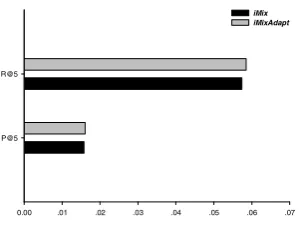
Fig. 4. Adaptivity Factor
5.5 Groups and Recall Results
A comparison of the results was also conducted across all the user groups. It is worth mentioning that there are improvements for users with low levels of activity. This demonstrates that the method is very effective even for users who do not have much available data in online social tagging systems.
In addition to the precision-based measurements, the personalized query expansion methods also showed significant improvements w.r.t the recall-based metric R@5. These improvements are on a similar scale when compared to the non-personalized and various personalized baselines. This reveals the benefits of adopting this method even in situations where recall is important.
6
Adaptivity Factor
could affect the expansion process. Initial experimental results when using the factor, namely query clarity, are also presented.
It has been long known that the success of IR systems clearly varies across differ-ent topics. Therefore, a widely accepted method was adopted, called query clarity [9], to automatically tweak the amount of personalization fed into the algorithm. It meas-ures the divergence between the language model associated with the user query and the language model associated with the collection. A simplified version was em-ployed here [8] and it is defined as:
| · |
where | is the probability of the word within the submitted query, and is the probability of in the entire collection of documents.
In general, when there is no relevance information available for queries, Cronen-Townsend et al. [9] proposed using the scale of possible clarity scores for the collec-tion at hand to heuristically set the clarity score threshold. In this research, the thre-shold is set heuristically to 90%. Simply put, a query is deemed “clear enough” if an estimated 90% or more of all queries would have a lower clarity score. If a query is defined to be clear, it is left unaltered in the retrieval process.
The same experimental setup was used as previously, however, only the iMix me-thod is evaluated (where adaptation meme-thod is denoted as iMixAdapt), with P@5 and R@5. It can be seen from the results (Figure 4), there is more significant improve-ment in terms of recall than precision. In fact, the difference between the two methods in terms of R@5 is statistically significant. The major reason for this difference ap-pears to be the arbitrary selection of queries to be expanded.
7
Conclusion
In this paper an Iterative Personalized Query Expansion Algorithm for Web Search, called iPAW, was described which is based on individual user profiles mined from the annotations and resources the users bookmarked. The intuition behind the model is the prior assumption of term consistency. A tag-topic model for the construction of user models was also introduced which simultaneously integrates the annotations and web documents through a statistical model in a latent space graph. The proposed per-sonalized technique performed well on the social data crawled from the web, deliver-ing statistically significant improvements over non-personalized and personalized representative baseline systems. An adaptivity factor was applied to the proposed algorithm and also demonstrated improvements in a separate set of experiments.
References
1. Agichtein, E., Brill, E., Dumais, S.: Improving web search ranking by incorporating user behavior information. In: Proceedings of the 29th Annual International ACM SIGIR Con-ference on Research and Development in Information Retrieval, pp. 19–26. ACM, Seattle (2006)
2. Amati, G., Rijsbergen, C.J.V.: Probabilistic models of information retrieval based on mea-suring the divergence from randomness. ACM Trans. Inf. Syst. 20(4), 357–389 (2002) 3. Baeza-Yates, R.A., Ribeiro-Neto, B.: Modern Information Retrieval. Addison-Wesley
Longman Publishing Co., Inc. (1999)
4. Bender, M., Crecelius, T., Kacimi, M., Michel, S., Neumann, T., Parreira, J.X., Schenkel, R., Weikum, G.: Exploiting social relations for query expansion and result ranking. In: IEEE 24th International Conference on Data Engineering Workshop, ICDEW 2008, April 7-12, pp. 501–506 (2008)
5. Bertier, M., Guerraoui, R., Leroy, V., Kermarrec, A.-M.: Toward personalized query ex-pansion. In: Proceedings of the Second ACM EuroSys Workshop on Social Network Sys-tems, pp. 7–12. ACM, Nuremberg (2009)
6. Biancalana, C., Micarelli, A.: Social Tagging in Query Expansion: A New Way for Perso-nalized Web Search. In: Proceedings of the 2009 International Conference on Computa-tional Science and Engineering, vol. 04, pp. 1060–1065. IEEE Computer Society (2009) 7. Carmel, D., Zwerdling, N., Guy, I., Ofek-Koifman, S., Har’el, N., Ronen, I., Uziel, E.,
Yo-gev, S., Chernov, S.: Personalized social search based on the user’s social network. In: Proceeding of the 18th ACM Conference on Information and Knowledge Management, pp. 1227–1236. ACM, Hong Kong (2009)
8. Chirita, P.-A., Firan, C.S., Nejdl, W.: Personalized query expansion for the web. In: Pro-ceedings of the 30th Annual International ACM SIGIR Conference on Research and De-velopment in Information Retrieval, pp. 7–14. ACM, Amsterdam (2007)
9. Cronen-Townsend, S., Zhou, Y., Croft, W.B.: Predicting query performance. In: Proceed-ings of the 25th Annual International ACM SIGIR Conference on Research and Develop-ment in Information Retrieval, pp. 299–306. ACM, Tampere (2002)
10. Cui, H., Wen, J.-R., Nie, J.-Y., Ma, W.-Y.: Query Expansion by Mining User Logs. IEEE Trans. on Knowl. and Data Eng. 15(4), 829–839 (2003)
11. Harter, S.P.: Online information retrieval: concepts, principles, and techniques. Academic Press Professional, Inc. (1986)
12. Joachims, T., Granka, L., Pan, B., Hembrooke, H., Gay, G.: Accurately interpreting click-through data as implicit feedback. In: Proceedings of the 28th Annual International ACM SIGIR Conference on Research and Development in Information Retrieval, pp. 154–161. ACM, Salvador (2005)
13. Qiu, Y., Frei, H.-P.: Concept based query expansion. In: Proceedings of the 16th Annual International ACM SIGIR Conference on Research and Development in Information Re-trieval, pp. 160–169. ACM, Pittsburgh (1993)
14. Shrager, J., Hogg, T., Huberman, B.A.: Observation of phase transitions in spreading acti-vation network. Science 236, 1092–1093 (1987)
15. Steyvers, M., Smyth, P., Rosen-Zvi, M., Griffiths, T.: Probabilistic author-topic models for information discovery. In: Proceedings of the Tenth ACM SIGKDD International Confe-rence on Knowledge Discovery and Data Mining, pp. 306–315. ACM, Seattle (2004) 16. Voorhees, E.M.: Query expansion using lexical-semantic relations. In: Proceedings of the
17. Xu, S., Bao, S., Fei, B., Su, Z., Yu, Y.: Exploring folksonomy for personalized search. In: Proceedings of the 31st Annual International ACM SIGIR Conference on Research and Development in Information Retrieval, pp. 155–162. ACM, Singapore (2008)
18. Zhang, Y., Koren, J.: Efficient bayesian hierarchical user modeling for recommendation system. In: Proceedings of the 30th Annual International ACM SIGIR Conference on Re-search and Development in Information Retrieval, pp. 47–54. ACM, Amsterdam (2007) 19. Zhou, D., Bousquet, O., Lal, T.N., Weston, J., Scholkopf, B.: Learning with local and
global consistency. In: Advances in Neural Information Processing Systems, vol. 16, pp. 321–328 (2004)