
The Association between Genetic Variation of Interferon
Gamma +874 T/A and Plasma Interferon Gamma Level
in Pulmonary Tuberculosis
Erwin Arief*, Muh. Nasrum Massi**, Irawaty Djaharuddin*, Budu Mannulusi**, Eliana Muis***, Suwarti
Rantono***
*Department of Pulmonology, Medical Faculty – Hasanuddin University **Biomedic Program, Medical Faculty – Hasanuddin University ***Department of Internal Medicine, Medical Faculty – Hasanuddin University
Makassar
Abstract. These days, Mycobacterium tuberculosis (Mtb) bacil is estimated to have infected one third of the world's population. World Health Organization (WHO) data shows that in 2011 there were 8.7 million case of tuberculosis (TB) or equivalent to 125 cases per 100.000 of the world’s population. Some studies have been done to understand the role of certain genes toward the susceptibility of TB patients, most of those studies focused on genes that are involved in signal pathway of interferon gamma (IFN-γ). Interferon gamma is one of the cytokine that has a role in pathogenesis of pulmonary tuberculosis. Single nucleotide polymorphism of IFN-γ at +874 T/A position in the first intron is reported to have association with pulmonary TB in different population. The aim of this study is to investigate the genetic variation of IFN-γ in +874 T/A and its relation with IFN-γ plasma level in pulmonary tuberculosis patients. The study’s method is cross sectional. Blood sample was taken from the veins of new AFB (Acid-Fast Bacillus) positive tuberculosis patients. Purification examination of Deoxyribonucleic Acid (DNA) and Polymerase Chain Reaction-Restriction Fragment Length Polymorphism (PCR-RFLP) for determining the genotype of IFN-γ genes and the level of IFN-γ is measured using Enzyme Linked Analysis Techniques Immunosorbent Assay (ELISA). The data is presented using tables and pictures. There is a significant association between IFN-γ +874T/A genetic variations with the plasma level of IFN-γ. There is a domination of IFN-γ +874T/A heterozygote genotype found in pulmonary TB population with positive +1of AFB and far advanced lesion on chest x-ray.
Key word: IFN-γ, pulmonary TB, genetic variation
I. INTRODUCTION
Tuberculosis (TB) is an infectious disease that is caused by Mycobacterium tuberculosis (Mtb) bacillus complex, in human, mostly caused by Mtb species. This disease often invades lungs (pulmonary TB), but it also can invade other organs (extrapulmonal TB) (WHO, 2013).
Since a few decades ago, pulmonary TB has gained a lot of attention from medical experts. This is the result of the yearly increase prevalence of the disease. Pulmonary tuberculosis
patients can be cured if handled from the outset and carefully. In 2012, it is estimated that the global incidence of TB was 8.6 million (ratio 122 : 100,000 per year) and mortality 1.3 million. From these numbers, there were 50,000 cases of Multidrug Resistance-Tuberculosis (MDR-TB) and 170,000 mortality rate from MDR-TB. Most of the case of global TB happens in South-East Asia and West Pacific totaling 58%, Africa 27% (ratio 255 : 100.000 per year), India 26%, China 12%, Eastern Mediterranean 8%, Europe 4%, and America 3%. The lowest incidence ratio is mostly found in developed country such as Western Europe, Canada, USA, Japan, Australia, and New Zealand. Whereas in South Africa and Swaziland, incidence ratio of TB is 1000 : 100.000 per year (WHO, 2013). In 2013, TB incidence in Indonesia was 327.094 with 80.99% being new positive AFB pulmonary TB. The biggest proportion of AFB positive pulmonary TB (21.40%) is found in productive adult age group (25-34 years old) (Indonesia Ministry of Health, 2014).
Pulmonary tuberculosis is caused by positive gram bacillus, Mycobacterium tuberculosis. Mtb genome measured 4.4 Mb (mega base) with the most Guanine (G) and Cytosine (C) content. Results from the genes mapping, it is known that there are more than 165 genes and genetic marking that can be divided into 3 groups (PDPI 2011). The main structure of Mtb cell wall is mycolic acid, complex waxes, threhalosedimycolate which is known as cord factor, and mycobacterial sulpholipids that has a role in virulence. Mycobacterium tuberculosis is transmitted by air particles known as droplet nuclei with 1-5 micron in diameter. Transmission occurs if droplets nuclei that contains Mtb is inhaled, later it enter the airway passage and finally end at lung alveoli (CDC, 2013; Soeroto, 2012), where Mtb will be phagocyte by phagocytic immune cell (macrophage and dendrite cells) (Ahmad, 2011; Mortaz, 2012). The inflammation process will activate T helper-1 cell (Th1). One of the cytokine that is produced by Th1 cell is IFN-γ, which has an important role in eliminating Mtbbacillus. Interferon gamma strengthens the phagocyte potential from Mtb-infected macrophage by stimulating the formation of phagolysosom. Interferon gamma also stimulates the formation of free radical to destroy the bacillus Mtb component, DNA and cell wall (Kumar, 2005).
defect in IFN-γ, subunit receptor of IFN-γ, and STAT-1, either genetically or acquired, which in all is component of IFN-γ cytokine path (Ottenhoff, 2002). The result of the study also shows that the genetic variation of IFN-γ genes influence the production of IFN-γ by T-cell cluster differentiated-4+ (CD4+) as well as cluster differentiated-8+ (CD8+). Homozygote T/T, A/A and heterozygote T/A each linked with the production of high, low and moderate IFN-γ (Pravica, 2000; Lopez, 2003).
Disturbance or decrease in the activity of Th1 cell and its cytokine, IFN-γ, has a meaningful role in influencing the mechanism of body defense mechanism against tuberculosis. Therefore, the information about the role of IFN-γ in body defense mechanism against pulmonary tuberculosis is very important.
II. IDENTIFY, RESEARCH AND COLLECT IDEA
METHOD
This study uses draft research cross sectional. Sample used is the plasma of pulmonary tuberculosis patients in Makassar, South Sulawesi, that are measured using purification technique Deoxyribonucleic Acid (DNA) and Polymerase Chain Reaction-Restriction Fragment Length Polymorphism (PCR-RFLP) to determine the genotype gen of IFN-γ and Enzyme Linked Immunosorbent Assay (ELISA) examination to measure the plasma level of IFN-γ. Data is presented in tables and figures.
Sample Selection Method
Selection of the study subject uses accidental sampling method. Accidental sampling is the unplanned method of study subject selection, the patients that come for treatment within certain period and meet certain criteria were asked to be the subject. Period and criteria of this study is new case that has been diagnosed with positive AFB pulmonary tuberculosis who come in during September – December 2014 in Makassar.
Examination Procedure of IFN-γ Level Using ELISA Kit
5 ml of the subject’s venous blood was taken and put inside non-EDTA tube. The tube then centrifuged in 5000 rpm for 30 minutes. The blood that has been centrifuged will separate as erythrocyte, buffy coat layer, and blood plasma. Plasma then separated and stored in microtube. Later it was wrapped using parafilm, where it stored in the refrigerant in -800C until it was used.
Blood plasma and ELISA kit then put in room temperature. Dissolving Lyophilized IFN-γ Standard and Assay Diluent made standard solution. The standard solution later examined using duplo, while the other well filled with the sample that was added with Assay Diluent first. Every well then added with Rabbit anti-Human IFN-γPlyclonal Antibody. The plate then closed with sealer (Acetate Plate Sealer) to prevent evaporation and incubated in room temperature for 3 hours.
After incubation, the sealer was opened and the plate then washed using Wash Buffer. Goat anti-Rabbit Conjugated Alkaline Phosphates then added to each well and resealed, later incubated in room temperature for 45 minutes. Sealer then opened and the fluid discarded, after that the plated washed using Wash Buffer. Coloring reagent then added and incubated in room temperature for 6 minutes, afterwards the stop solution is added. The result was read using ELISA reader so that we could find the IFN-γlevel.
Data Analysis
The gathered data is presented in tables and figureswith description provided.
III. WRITE DOWN YOUR STUDIES AND FINDINGS
RESULT
This study used 62 subjects of new positive AFB pulmonary TB patients who has had their +874 T/A IFN-γ gen genetic variation and IFN-γ plasma levelexamined when the diagnosed was made. From the 62 subjects, the youngest is 17 years old and the oldest is 65 year old, with mean age of 36.5±14.5 years old. Almost 75% of pulmonary TB patients are in <50 years old age group.
[image:2.612.308.581.317.411.2]Most of the pulmonary TB patients in this study come from age group of 16-29 years old. Most of the genetic variation of +874 T/A IFN-γin our pulmonary TB population heterozygote TA (32 subject or 51,6%) and the lowest is wild type homozygote TT (4 subjects or 6,5%). Distribution of subject’s +874 T/A IFN-γ gen genetic variation based on age group is presented in table 1.
Table 1. Distribution of +874 T/A IFN-γ gen genetic variation based on age group
Genetic Variation
Age Group
Total 16-29
n (%)
30-49 n (%)
50-65 n (%) AA
TA TT TA/TT
8 (12,9) 12 (19,4)
1 (1,6) 3 (4,8)
10 (16,1) 10 (16,1) 1 (1,6) 1 (1,6)
3 (4,8) 10 (16,1)
2 (3,2) 1 (1,60
21 (33,9) 32 (51,6) 4 ( 6,5)
5 (8,1) Total 24 (38,7) 22 (35,5) 16 (25,8) 62 (100,0)
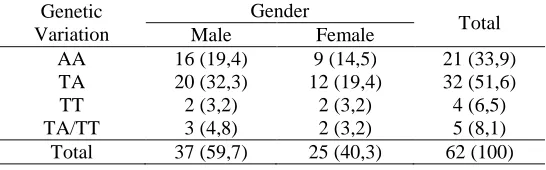
In this study, the most of the male’s genetic variation of +874 T/A IFN-ɣ found is the TA genotype (32.3%) and the least is TT genotype (3.2%), the same result also found in woman where +874 T/A IFN-γ gen genetic variation found the most is TA genotype (19.4%) and the least is TT genotype (3.2%). The distribution of subject’s +874 IFN-γ gen genetic variation based on gender is presented in table 2.
Table 2. Distribution of +874 T/A IFN-γ gen genetic variation based on gender
Genetic Variation
Gender
Total Male Female
AA TA TT TA/TT
16 (19,4) 20 (32,3) 2 (3,2) 3 (4,8)
9 (14,5) 12 (19,4)
2 (3,2) 2 (3,2)
21 (33,9) 32 (51,6) 4 (6,5) 5 (8,1) Total 37 (59,7) 25 (40,3) 62 (100)
Toward all 62 subjects after the diagnosis of pulmonary TB was enforced, the IFN-γlevel examination was executed. Obtained the average of 22,13±22,33pg/mL, with the lowest level in 6.25 pg/mL and the highest 112.97 pg/mL.
[image:2.612.309.582.537.622.2]between +874 T/A IFN-γ gen genetic variation and IFN-γ plasma level with p=0.001 (p<0.01). (figure 1)
Figure 1. IFN-γ plasma level (phase 0) based on +874 T/A IFN-γ gen genetic variation. Red line shows the median of IFN-γlevel in each genotype. Spearman correlation test, p<0.01.
[image:3.612.30.302.450.556.2]The AFB level in sputum test and the lesion area in chest x-ray can determine the severity of pulmonary TB. In this study based on the lesion area, the most common to find is far advanced lesion (48.4%). The most genetic variation of +874 T/A IFN-γ gen found in pulmonary TB patients with broad lesion is TA genotype (29.0%) and the least is TT genotype (0.0%). The distribution of +874 T/A IFN-γ gen genetic variation based on lesion area in chest x-ray is presented in table 3.
Table 3. Distribution of +874 T/A IFN-γ gen genetic variation based on lesion area in chest x-ray
Genetic Variation
Degree of Lesion in Chest X-ray
Total Minimal Moderate Far
advanced AA
TA TT TA/TT
3 (4,8) 5 (8,1) 2 (3,2) 0 (0,0)
8 (12,9) 9 (14,5) 2 (3,2) 3 (4,8)
10 (16,1) 18 (29,0) 0 (0,0) 2 (3,2)
21 (33,9) 32 (51,6) 4 (6,5) 5 (8,1) Total 10 (16,1) 22 (35,5) 30 (48,4) 62
(100,0)
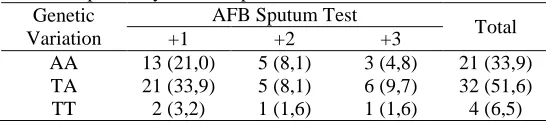
Based on the positivity of AFB sputum test, in this study, the most common to find is AFB positive one (59.7%). Genetic variation of +874 T/A IFN-γ gen found the most in the subject with AFB positive one is TA genotype (33.9%), and the least is TA/TT genotype (1.6%). Distribution of +874 T/A IFN-γ gen genetic variation based on positivity of AFB sputum test is presented in table 4.
Table 4. Distribution of +874 T/A IFN-γ gen genetic variation based on positivity of AFB sputum test
Genetic Variation
AFB Sputum Test
Total
+1 +2 +3
AA TA TT
13 (21,0) 21 (33,9) 2 (3,2)
5 (8,1) 5 (8,1) 1 (1,6)
3 (4,8) 6 (9,7) 1 (1,6)
21 (33,9) 32 (51,6) 4 (6,5)
TA/TT 1 (1,6) 0 (0,0) 4 96,5) 5 (8,1) Total 37 (59,7) 11 (17,1) 14 (22,6) 62 (100,0)
IV. GET PEER REVIEWED
Interaction of human against Mtb infection is determined by environmental factor, the pathogen, and genetic factors, also the interaction between the three. Control over Mtb infection in the body requires the formation of T antigen-specific cells response, Mtb infected macrophage activation, and the formation of granuloma to prevent the spreading of Mtb bacillus. Macrophages that are activated by IFN-γ are very important for immunity against Mtb, thereby the shortcoming of one of the component in IFN-γ signal path will cause susceptibility to TB. This study is focused in IFN-γ, because even though the activation of immune response mediated by IFN-γhas an important role in immunity against intracellular pathogen either on human or animal, its role in tuberculosis in human has not fully understand yet.
The genetic variation in single nucleotide gen that encode the cytokinesvariedly correspond with TB infection location and the degree of severity of this disease in different population as well as in the same study population. Some studies about the correlation between genetic variation of IFN-γ +874 T/A gen and the severity of pulmonary TB has been done by Vallinoto et al (2010), Etokebe et al (2006), Henao et al (2006), Ansari et al (2011).
V. IMPROVEMENT AS PER REVIEWER COMMENTS
This study aims to investigate the role of IFN-γ +874 T/A gen polymorphism andIFN-γ plasma levelwith the severity of pulmonary Tb patients based on the positivity of AFB sputum test and lesion area in chest x-ray.
In this study, the most genetic variation of IFN-γ +874 T/A gen that was found is TA genotypes, namely 51.6% and 32.3%, are male. Etokebe study (2006) also finds that the group with TA genotype is the group with the highest frequency of genetic namely 50.4%, different result found in Vallinoto study (2010) that has AA genotype group namely 56,6%, as well as Hwang (2007) who also found similar major genotype frequency that is AA group namely 82.5%. The relation between the susceptibility of TB and IFN-γ polymorphisms has been observed inside different population. (Lopez, 2003; Etokobe, 2006)
[image:3.612.30.303.680.743.2]profound low IFN-γ plasma level compared to patients with +874 T/A and +874 T/Tgenotype, which can be strong evidence that the polymorphisms decreases the production of IFN-γ and cellular immunity activation that can increase the possibility of infection.
Genetic variation based on lesion area found the most in this study is far advanced lesion with TA genotype as the group with highest genetic frequency namely 29,0%, different result found in a study by Lopez (2003) where the most patients are patients with moderate lesion and AA genotype.
Analysis of genetic variation of IFN-γ +874 T/A towards subjects in this study shows that from the four genotype types, homozygous +874 T/A constituting the most genotype (51.6%). Polymorphisms ofIFN-γ +874 has shown to have meaningful correlation with tuberculosis. Studies by Lopez et al (2003) and Pravica et al (2000) found that frequency of allele A is high in pulmonary TB patients and control with TST (+) and TST (-) compared with miliary tuberculosis patients and pleural TB, whereas allele T that connects with the IFN-γ production that is high in-vitro, increases in patients with miliary and pleural TB. Vallinoto et al (2010) shows that there is a correlation between allele +874 A and active TB, at the same times shows a high frequency of allele +874 T in control group. These results show the protective role of allele +874 T, on the other hand, allele +874 A is the predisposition factor of Mtb infection. The result of these studies strengthen the correlation between genotype +874 AA with the susceptibility towards bacteria, whereas genotype +874 T/T may have connected with the protection against Mtb infection, or even the partial protection if allele T shows in heterozygote.
The expression and production of IFN-γ is regulated genetically, study by Lopez et al (2003) shows that this polymorphisms influence the production of IFN-γ inducted by PPD in TB patients, healthy contact, or normal subject. The lowest production of IFN-γ found in AA genotype both before and after therapy. Production of IFN-γ with genotype AA is twice as low comparedwith the other two genotype (TA and TT) and still low even after 6 month post treatment even compared to control. Settlement of low IFN-γ production by peripheral mononuclear cell more than 6 months show that there is a genetic defect in the production of IFN-γ in the patients with homozygote allele A that become the basis of the increase of reactivation ratio from one latent tuberculosis focus. Statistic analysis also shows that the presence of AA genotype and lymphocyte count is the independent predictor toward the production of IFN-γ.
In our study,the most commonly genetic variation found in patients with AFB sputum test result of positive 3 is genotype TA. This is in accordance with the study of Etokobe et al (2006), in tuberculosis patients with positive AFB sputum test result the most commonly found genotype group is TA, but it is said to not have any influence toward the severity of the disease.
.
After submission IJSRP will send you reviewer comment within 10-15 days of submission and you can send us the updated paper within a week for publishing.
This completes the entire process required for widespread of research work on open front. Generally all International Journals are governed by an Intellectual body and they select the most suitable paper for publishing after a thorough analysis of submitted paper. Selected paper get published (online and printed) in their periodicals and get indexed by number of sources.
VI. CONCLUSION
This study shows that there is an association between genetic variations of IFN-γ +874T/A with the level of plasma IFN-γ. There is a domination of heterozygote +874T/Agenotype found in pulmonary TB patients with AFB sputum test positive one and far advanced lesion onchest x-ray.
REFERENCES
Ahmad, S. 2011. Pathogenesis, immunology, and diagnosis of latent mycobacterium tuberculosis infection.ClinDevImmunol, vol. 2011, 814943. http://www.hindawi.com/journals/jir/2011/814943.pdf. 10 Juli 2014.
Ansari A, Hasan Z, Dawood G, et al.2011. Differential combination of cytokine and interferon-ɤ +874 T/A polymorphisms determines disease severity in pulmonary tuberculosis. Plos One; 6:11
Centers for Disease Control and Prevention. 2013. The core curriculum on tuberculosis: what the clinician should know, (6th ed., p. 19-105). Centers for Disease Control and Prevention
Etokebe, G.E., Bulat-Kardum, L., Johansen, M.S., Knezevic, J., Balen, S., et al. 2006. Interferon-ɣ gene (T874A and G2109A) polymorphisms are associated with microscopy-positive tuberculosis. Scand J Immunol;63 (2), 136–41.
Heinemeyer T, Wingender E, Reuter I, Hermjakob H, Kel AE, Kel OV, Ignatieva EV, Ananko EA, Podkolodnaya OA, Kolpakov FA, et al. 1998. Databases on transcriptional regulation: TRANSFAC, TRRD and COMPEL. Nucleic Acids Res;26:362–367.
Henao, M.I., Montes, C., Paris, S.C., Garcia, L.F. 2006.Cytokine gene polymorphisms in Colombian patients with different clinical presentations of tuberculosis.Tuberculosis (Edinb);86 (1), 11–19. Hwang, J.H., Kim, E.J., Kim, S.Y., Lee, S.H., Suh, G.Y., et al. 2007.
Polymorphisms of interferon-ɣ and interferon- ɣreceptor 1 genes and pulmonary tuberculosis in Koreans.Respirology;12 (6), 906–10. Indonesia Ministry of Health. 2014. Data and Information of Indonesia Health
Profile in 2013, (p. 138-140). Jakarta: Indonesia Ministry of Health Kumar V, Abbas AK, Fausto N. Pathologic Basis of Disease. Philadelphia:
Elsevier Saunders 2005.
Lopez-Maderuelo D, Arnalich F, Serantes R, et al. 2003.Interferon gamma and interleukin-10 gene polymorphisms in pulmonary tuberculosis. Am J RespirCrit Care Med ;167:970–5
Mortaz, E., Varahram, M., Farnia, P., Bahadori, M., Masjedi, M.R. 2012. New aspects in immunopathology of Mycobacterium tuberculosis.ISRN Immunol, vol. 2012, 963879.http://www.hindawi.com/journals/isrn. immunology/2012/963879.pdf. 10 Juli 2014.
Ottenhoff, T.H., Verreck, F.A., Lichtenauer-Kaligis, E.G., Hoeve, M.A., Sanal, O., et al.2002. Genetics, cytokines and human infectious diseases: lessons from weakly pathogenic mycobacteria and salmonellae. Nat Genet, 32 (1), 97-105.
Indonesia Society of Respirology(PDPI). 2011. Tuberculosis: Diagnosis and Treatment Guidelines in Indonesia. Jakarta: Perhimpunan Dokter Paru Indonesia.http://www.klikpdpi.com/konsensus/tb/tb.html. 10 Juli 2014.
Pravica, V., Asderakis, A., Perrey, C., Hajeer, A., Sinnott, P.J., et al. 1999. In vitro production of IFN-gamma correlates with CA repeat polymorphism in the human IFN-gamma gene. Eur J Immunogenet, 26 (1), 1-3. Pravica, V., Perrey, C., Stevens, A., Lee, J.H., Hutchinson, I.V. 2000. A single
Soeroto, A.Y. 2012.Tuberkulosis. In: Dahlan, Z., Amin, Z., Soeroto, A.Y., (Eds.). Kompendiumtatalaksanapenyakitrespirasidankritisparu, (jilid1., p. 129-141). Bandung: PerhimpunanRespirologi Indonesia (PERPARI). Vallinoto ACR, Graca ES, Araujo MS, et al. IFNG-874T/A polimorphism and
cytokine plasma levels are associated with susceptibility to mycobacterium tuberculosis infection and clinical manifestation of tuberculosis, Human Immunology 2010; 71: 692-96
World Health Organization. 2013. The burden of disease caused by TB. In: Global tuberculosis report 2013, (p. 6-27). France: World Health Organization.
Ahmad, S. 2011. Pathogenesis, immunology, and diagnosis of latent mycobacterium tuberculosis infection. Clin Dev Immunol, vol. 2011, 814943. http://www.hindawi.com/journals/jir/2011/814943.pdf. 10 Juli 2014.
Centers for Disease Control and Prevention. 2013. The core curriculum on tuberculosis: what the clinician should know, (6th ed., p. 19-105). Centers for Disease Control and Prevention.
Indonesia Society of Respirology(PDPI). 2011. Tuberculosis: Diagnosis and Treatment Guidelines in Indonesia. Jakarta: Perhimpunan Dokter Paru Indonesia.http://www.klikpdpi.com/konsensus/tb/tb.html. 10 Juli 2014.
Mortaz, E., Varahram, M., Farnia, P., Bahadori, M., Masjedi, M.R. 2012. New aspects in immunopathology of Mycobacterium tuberculosis. ISRN Immunol, vol. 2012, 963879. http://www.hindawi.com/journals/isrn. immunology/2012/963879.pdf. 10 Juli 2014.
Soeroto, A.Y. 2012. Tuberkulosis. In: Dahlan, Z., Amin, Z., Soeroto, A.Y., (Eds.). Kompendium tatalaksana penyakit respirasi dan kritis paru, (jilid
1., p. 129-141). Bandung: Perhimpunan Respirologi Indonesia (PERPARI).
World Health Organization. 2013. The burden of disease caused by TB. In: Global tuberculosis report 2013, (p. 6-27). France: World Health Organization.
AUTHORS
First Author – Erwin Arief, Department of Pulmonology,
Medical Faculty Hasanuddin University, Indonesia,
Second Author – Muh. Nasrum Massi, Biomedic Program,
Medical Faculty Hasanuddin University, Indonesia,
Third Author – Irawaty Djaharuddin, Department of
Pulmonology, Medical Faculty Hasanuddin University, Indonesia, [email protected]
Correspondence Author – Eliana Muis,
![4′ Methyl 3 (4 nitrophenyl) 4 phenyl 4,5,1′,2′,3′,4′ hexahydrospiro[isoxazole 5,2′ naphthalen] 1′ one](data:image/gif;base64,R0lGODlhAQABAIAAAP///wAAACH5BAEAAAAALAAAAAABAAEAAAICRAEAOw==)