APPLICATION OF ONLINE DYNAMIC CASCADED-CONDITIONAL
BASED OPTIMIZATION FOR HANDLING MODEL UNCERTAINTY IN
SEMI BATCH AUTOCATALYTIC ESTERIFICATION PROCESS
F. S. Rohman, S. Abdul Sata and N. Aziz
School of Chemical Engineering, Universiti Sains Malaysia, Engineering Campus, Nibong Tebal, Seberang Perai Selatan, Malaysia E-Mail: [email protected]
ABSTRACT
This work addresses the implementation of an online dynamic cascaded-conditional based optimization for handling model uncertainty occurred in an autocatalytic esterification of Propionic Anhydride with 2-Butanol. The online optimization strategy includes an integration of the dynamic re-optimization mechanism (trigger, i.e. ±5% of conversion and dynamic re-optimizer, i.e. hybrid strategy in maximizing profit), estimator (cubature Kalman Filter) and controller (dual mode-adaptive PID). The optimization and control problems are solved separately in cascaded. The re-optimization mechanism is activated conditionally by using trigger. The simulation results show that the proposed strategy offers a large improvement in semi batch reactor performance if compared to the method which the optimal trajectories set point is pre-determined (offline optimization). Moreover, the online dynamic optimization of temperature and feed flow rate trajectories obtained able to sustain the conversion within acceptable range (on-spec). Meanwhile, the offline optimization failed to handle the effect of parameter model uncertainty thus the end conversion produced is off-spec and can lead to loss in profit.
Keywords: online dynamic optimization, handling uncertainty, batch esterification, optimal control trajectory.
INTRODUCTION
The dynamic optimization is preferable to be implemented to enhance the batch processes performance due to its ability to capture the dynamic behavior of the process and can deal with the ODE/DAE model. Dynamic batch system is very sensitive to uncertainties and disturbances in the process operation. In semi batch esterification process, a parameter model uncertainty such as a mismatch kinetic constant parameters may cause the final product differs from the desired value. This discrepancy may risk the violation of safety constraints, production off-spec products, and more vitally the loss of invaluable profit. Under these circumstances it is desirable to implement online dynamic optimization strategy to desired trajectories to reach the optimal performances (Kadam and Marquadt, 2007). The aim of the online dynamic optimization for semi batch reactor is to generate the optimal trajectories of process variables such as flow rates of feeds and temperature, which are typically re-adjusted to optimize the objective function in the presence of the parameter model uncertainty (Würth et al. 2009).
The cascaded-conditional based optimization is applied in this study because it is found to be an effective technique for updating system with uncertainty. It is solving the optimization and control problem separately by decomposing the overall problem into two levels (Alonso et al. 2013). As the significance uncertainty and disturbance occurred, the re-optimizer will generate a new/modified optimal trajectory in order to ensure optimum performance is obtained. There was one strategy using the conditional based which implemented sensitivity of Lagrange of the objective function as a trigger. However, it is complicated to
calculate the first and the second derivative of the Lagrange function. Furthermore, the components integrated in the cascaded-conditional based optimization that have been reported are (Kadam et al.
2002, Kadam and Marquadt, 2007, Würth et al. 2009, Wolf et al. 2014): (i) trigger used was sensitivities of Lagrangian of objective function; (ii) dynamic optimizer applied was CVP in maximizing profit and yields; (iii) controllers implemented were PI, NMPC, neighboring external controller; (iv) estimators used were EKF and CEKF. Therefore, the development of effective way for online dynamic optimization strategy is a must which can lead to the more efficient optimal solution computation.
In this work, the online dynamic optimization strategy proposed is the integration of: (i) trigger used was a simple objective function as active constraint; (ii) dynamic optimizer applied is hybrid strategy (HS); (iii) controller implemented is an adaptive PID; (iv) estimators used is cubature Kalman filter (CKF). The process considered is Catalyzed Esterification of Propionic Anhydride with 2-Butanol in a semi batch reactor. The optimal feed flow rate and temperature trajectories obtained are based on maximum profit problem.
DESIGN OF ONLINE CASCADED-CONDITIONAL BASED OPTIMIZATION
Würth et al. (2009), and Kadam and Marquadt (2007) as shown in Figure-1.
Figure-1. Schematic diagram of online dynamic optimization; online optimization loop, offline optimization loop, input/ output process.
Process modeling of autocatalytic esterification in semi batch reactor
Esterification of propionic anhydride with 2-butanol produce sec-butyl propionate and propionic acid. The process is homogeneous reaction which moderately exothermic with no danger of decomposition reactions. The reaction rate variable is a function of catalyst (strong acid, such as sulphuric acid); exhibits a second-order kinetics when no strong acid is present and exhibits a kind of autocatalytic behaviour when sulphuric acid is introduced (Zalvidar, et al. 1993).
In the presence of sulfuric acid, Zalvidar, et al.
(1993) found that the reaction rate seems to be proportional to the acid concentration; the reaction rate increases with propionic acid concentration and lead to a kind of autocatalytic behavior. However, after reaching a certain concentration, propionic acid has no longer influenced the reaction rate. Since the various theoretical reaction pathways are complex, a model was developed by assuming the existence of two catalysts (cat1, cat2). Meanwhile, the transformation of the initial catalyst was developed by taking into account the acidity function. The esterification reaction scheme under consideration can be written as (Zalvidar, et al. 1993):
Reaction 1: 2-butanol + propionic anhydride → propionic acid + sec-butyl propionate
Reaction 2: catalyst 1(sulphuric acid) → catalyst 2(mono -butyl sulphuric acid)
The model is developed based on the following assumptions: constant reacting heat capacity, effective
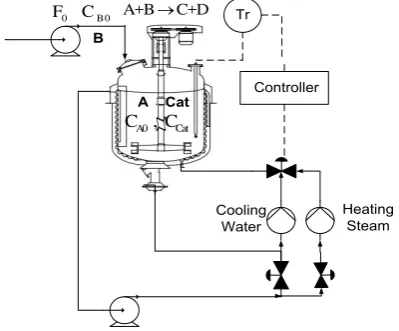
overall heat transfer coefficient, transport properties of reaction mixture and density are exist; the heat losses with the ambient surroundings are negligible; homogeneous mixing and uniform distribution temperature: no heat accumulation in the reactor wall; no secondary heating effects such as power introduced by stirrer; no pressure effect; 2- butanol stated as limiting reactant. The scheme of esterification semi batch reactor is shown in Figure-2.
Tr
Controller
Cooling Water
Heating Steam
A+BC+D
B 0 B 0
F C
A Cat
A0 Cat C , C
Figure 2. Scheme of esterification process a) batch reactor and b) semi batch reactor; A: 2-butanol (limiting reactant),
B: propionic anhydride, Cat: catalyst.
Reaction rate constants follow Arrhenius law.
[image:2.595.319.519.531.696.2]4
1 1 2 3
(
cat c)
p
H
p C
p C
p
T
(1)The concentrations profile in the autocatalytic esterification reaction can be denoted by using the mass balances equations which were involved in the dynamic optimization task. The mass balances for semi batch autocatalytic esterification reactor (Ubrich, 2000) are given by Equations (2-6) as given below:
The dynamic model the heating-cooling jacket was derived from Ubrich (2000) which was useful for design of controller. The energy balances for semi batch reactor which can be represented by the reactor and jacket dynamics are expressed in the Equations (7 and 8). The parameters and their values involved in the energy balances equation are tabulated in Table-2.
The semi batch reactor model which consist of the mass and energy balances are represented by following equations:
(2)
(3)
(4)
(5)
(6)
(7)
(8)
where CA, CB,CC, CCat1, and Ccat2 are the concentration of 2-butanol, propionic anhydride; propionic acid, sulphuric acid and mono-butyl sulphuric acid, respectively. Fo , V are the feed rate and the volume of solution within reactor. Fj is the jacket flow rate, Tj is the jacket temperature; Tjin is the inlet jacket temperature; Tfeed is the feed temperature; A is the heat exchange area; Vj is the volume of jacket; U is the heat exchange coefficient; Cp, Cj is heat capacity of solution in the reactor and the jacket, respectively; H is the acidity function; ∆Hr is the heat of reaction; ρ is density of solution in reactor; ρj is
density of jacket solution. Those pertaining constant value is depicted from Ubrich et al. (1999). The initial value of CA, CB, CC, CD, Ccat1, Ccat2 V, T and Tj is 3.4M, 0M, 0M, 0M, 1.02 x 10⁻²M, 0M, 1L, 303K and 303K, respectively.
The reaction kinetics of this esterification has been investigated and the data of parameters is depicted from Zaldivar et al. (1993) as shown in Table-1
Table-1. Kinetic parameter equations (Zalvidar et al, 1993).
Table-2. Parameters involved with energy balances (Alos,
et al. 1996, Andre, et al. 2002, Ubrich, 2000).
Hybrid strategy of dynamic optimization
The aim of dynamic optimization problem is to determine control profiles that is minimizing or maximizing the given objective function without violating the specified process constraints. With the optimal control policy, the controlled system is driven from the initial state to a final desired state in an optimal way (Peters et al.
hybrid strategy implemented a control vector parameterization as a NLP transformation and hybrid (stochastic-deterministic) as a NLP solver. The detail description and procedure of CVP and hybrid based optimization is explained below. Then, the problem optimization of this case study is also described in the following sub section.
Control vector parameterization
The basis of the CVP method is to parameterize the control trajectories and leave the state trajectories continuous. First, the ODE solver calculates the differential equation. Then, the original problem of dynamic optimization is transformed into the finite dimensional problem (NLP) for execution the static optimizer. Further, a suitable gradient method with a NLP type algorithm is needed. This corresponds to a ‘feasible’ path approach since the differential equations are satisfied at each step of the optimization. A piecewise-constant or piecewise -polynomial approximation of the inputs is often utilized. The basic procedure is as follows: 1) Parameterize the inputs using a finite number of decision variables (typically piecewise polynomials). The vector of decision variables also includes final time; 2) Choose an initial guess for the decision variables; 3) Integrate the system states to the final time and compute the performance index and the constraints; 4) Use an optimization algorithm (such as steepest descent or Quasi-Newton methods to update the values of the decision variables; Repeat Steps 3-4 until the objective function is minimized.
Hybrid based NLP solver
The hybrid optimization applied two phase of NLP solver, i.e stochastic and deterministic based optimization. The stochastic method of NLP problem considered is Differential Evolution (DE) method which uses population based approach for minimizing the performance index (Storn and Price, 1997). Meanwhile, sequential quadratic programming (SQP) was applied in deterministic based which usually requires very good estimates of the gradient of the performance index with respect to the decision variables. The HS method was implemented by using code package using DOTcvp code package created by Hirmajer et al (2010). where the algorithm had been developed by from Banga et al’s
(2005) work.
. The HS method operates in two sequential steps. In the first step, the CVP-stochastic (DE) method is used to locate the vicinity of the global solution with a user-specified initial point and stopping when a convergence criterion (SC1) related to the distance between iterates is satisfied. This information is then used to initialize a CVP-deterministic (SQP) method in the final step,and a refined global or near-global solution, satisfying a convergence criterion (SC2).
The DE’s stop criteria SC1 can be tuned based on empirical results for specific problem classes, the ranges for the stopping criteria: 0.01-0.05. Meanwhile, SQP’s
stop criteria value SC2 can be determined by tolerance of function: 10-6 (Balsa-Canto et al. 2008, Banga et al. 2005, Hirmajer et al. 2010).
Formulation of optimization problem
In this study, volume of solution, the reactant, catalyst and product concentration were considered as states variables. The control variables considered were feed flow rate and temperature reactor. The objective function was to maximize profit. The inequality constraint associated was end concentration of limiting reactant and total volume reactor. The operation profit is derived from the price of the product. The operation profit (RM/min) expression is presented by Equation 9 (Aziz, 2001):
C C D D
A0 A
A B
BF B
V C P
C P
C
C P V P C
C V
P
t
(9)where PA, PB, Pc and PD, are the prices of A, B, C and D, E and F with numerical values [26.75, 34.39, 10.17, 339.1], respectively (Xingtai, 2014, Sigma-Aldrich, 2014). All values are in RM/mol. The dynamic optimization formulations for both problems are shown as:
Problem:
0
,
max
T F
P
Subject to semi batch dynamic model Equation.2-4; Inequality constraints: V≤ 2.2L; Bounds: 0≤ F0≤ 5x 10⁻⁴L s-1 and 303K≤ T ≤ 343K.
Cubature Kalman filter (CKF) of estimator
An estimator can be used for generating data about current state and parameter of the system and unmeasured state and parameter. The information of states and parameter were used to calculate the updated value. The estimator structure builds the mathematical framework for combining sensor signals from the real process (measurement) to calculated data from the model (Tumuluri, 2008).
The estimator problem is concerned with the estimation of the state vector of a dynamic system which is governed by the non-linear stochastic differential equations approximated in discrete time as:
x k = f(x k − 1 , k − 1) + q k – 1
y k = h(x k , k) + r k (10)
where x k∈ R n is the state on the step time k, f is the dynamic model function, qk−1 ∼ N(0, Qk−1) is the
process noise on the step time k−1, Q is process noise covariance. The prior distribution for the state is x0∼ N (m0, P0), where parameters m0 and P0 are initial mean and covariance of the states which are set using the known information from the system under consideration. y k∈ R m
CKF has been used to develop nonlinear state observers for the esterification process.
Cubature Kalman filter (CKF) uses a third-degree cubature approximation to solve the Gaussian integrals (Arasaratnam and Haykin, 2009). Specifically, a third- degree spherical-radial cubature rule provides a set of cubature points scaling linearly with the state-vector dimension. The CKF may therefore provide a systematic solution for high- dimensional nonlinear filtering problems. CKF method was implemented using package code developed by Hartikainen et al (2011).
The states x and measurements y of the autocatalytic esterification semi batch reactor considered were:
1 2
[ A B c D cat cat ];j [ A ]j
x C C C C C C T T y C T T
The initial condition of the state estimation which is the same as the initial model is:
-2
0 [3.4M 0 0 0 1.02x 10 M 1 303 K 303 K]
x
Measurement noise has been considered on concentration of 2-butanol, the reactor and jacket temperatures. State noise was added to the system dynamic equations. The noises involved in the cases was maintained at low level where their values set as process noise covariance (Q matrix) = diag [ 0 2.4 x 10⁻¹⁴ 2.4 x 10 -10
1x 10-12 1 x 10-14 1x 10-14 0 0] and measurement noise covariance (R matrix) = diag [5x 10⁻¹ 5 x 10⁻¹ 5x 10⁻¹] (Ramkhelawan, 2000).
Controller for tracking
The temperature trajectory can be tracked by the dual mode of adaptive PID controller. The dual mode control (DM) strategy which combines the on-off and adaptive PID controller was implemented. The general DM control algorithm adopted from Liptak (1999). The adaptive PID controller implemented digital PID controller algorithm which is suitable for the control of system with time delay since the information of input data generated from estimator was supplied in a discrete time. The details of adaptive PID controller and its tuning can be found in Landau (1990). Meanwhile, the computer code of the adaptive PID controller was developed by Salmah et al. (2001).
Reoptimizer activator (trigger)
A simple trigger was designed as the conditional switch to activate the dynamic re-optimization. The spec of final product (±5% of conversion) constraint was selected as trigger because the trigger of conversion was simple to calculate and directly correlated with the objective function (component of the economic equation). Therefore, the dynamic re-optimizer was activated if the condition of conversion significantly deviates from pre-determined optimal profile of conversion and across the active constraint (±5% of conversion) in the presence of disturbance and uncertainty.
The simulation of cascaded-conditional based optimization was carried out in the SIMULINK® environment. The simulations were conducted by using
IntelR CoreTM i3 CPU 530 with 2.93GHz and 3.17GB of RAM.
In order to evaluate the performance of online optimization strategy, the significance uncertain parameter that can violate the active constraints and generate the off-spec product (< lower constraint) was introduced in the process. The decrement of constant parameter from actual nominal value, - 30% of k01 and +5% of Ea3, were examined as uncertainty. Finally, the results obtained from the online strategy were compared to those obtained from the offline strategy.
RESULTS AND DISCUSSION
Figure-3 shows the conversion profile obtained by the online dynamic optimization in the presence parameter uncertainty, i.e. - 30% of k01 and +5% of Ea3. The optimum profit for this case study resulted in new optimal temperature trajectories as shown in Figure-4. Meanwhile, the new optimal feed flow rate in the presence of parameter uncertainty is shown in Figure-5. The CKF estimation to predict actual parameter k01 and Ea3 in the presence of initial uncertainties is shown in Figures 6a and 6b, respectively. The results of online and offline dynamic optimization including the conversion and profit under uncertainty occurrence are summarized in Table-3
From Figure-3, the conversion obtained from offline optimization decreased significantly since the change of - 30% of k01 and +5% of Ea3 reduced the formation rate of the product. In the online strategy, the CKF applied can acknowledge the impact of parameter uncertainty so that parameter k01 and Ea3 was updated to generate an estimate value close to the actual value as shown in Figure-6. However, there was a mismatch during the first 40 min causing the conversion to exceed the active constraint around 10 min as shown in Figure-3. The trigger activated the dynamic re-optimizer to re-optimize the temperature and feed flow rate trajectories as shown in Figures-4 and 5 respectively. This action kept the conversion within active constraints (acceptable range).
Table-3. Results of optimization of online optimization and offline optimization in the presence of parameter
uncertainty, i. e. - 30% of k01 and +5% of Ea3.
Figure-3. Conversion profile for dynamic optimization study.
Figure-4. Optimal temperature trajectory for dynamic optimization study.
Figure-5. Optimal feed flow rate trajectory for dynamic optimization study.
(a)
(b)
Figure-6. Estimation of a) -30% of k01 b) +5% of Ea3.
CONCLUSIONS
The online dynamic optimization of Catalyzed Esterification of Propionic Anhydride with 2-Butanol in semi batch has been carried out. The cascade optimization strategy was implemented to update the optimal trajectories when a significant parameter model uncertainty occurs in the process. The re-optimized temperature and feed flow rate trajectories drove the conversion within the active constraint which maintains the profit of process. Meanwhile, the offline optimization mode cannot capture the effect disturbance which led to off-spec end product.
ACKNOWLEDGEMENTS
The financial support from Ministry of Science, Technology and Innovation (MOSTI), Malaysia through Science fund grant and Universiti Sains Malaysia through RU grant is greatly acknowledged.
REFERENCES
Batch Thermal Sterilization of Prepackaged Foods, Food Control, pp.392–403
[2] Alos, M.A., Zaldivar, J.M., Strozzi, F, Nomen, R, and Sempere, J. (1996) Application of Parametric Sensitivity to Batch Process Safety: Theoretical and Experimental Studies, Chemical Engineering & Technology, pp.222-232
[3] Andre, R, Bou-Diab, L, Lerena, P, Stoessel, F, Giordano, M and Mathonat, C. (2002) A New Reaction Calorimeter for Screening Purposes during Process Development, Organic Process Research & Development, pp.915-921
[4] Arasaratnam, I. and Haykin, S. (2009) Cubature Kalman filters, IEEE Transactions on Automatic Control, 54(6), pp.1254–1269
[5] Aziz, N (2001) Dynamic Optimization and Control of Batch Reactor, PhD Thesis, University of Bradford
[6] Balsa-Canto, E, Vassiliadis, V.S., and Banga, J.R. (2005) Dynamic optimization of single- and multi-stage systems using a hybrid stochastic-deterministic method, Industrial and Engineering Chemistry Research, 44(5), pp.1514–1523
[7] Banga, J. R, Balsa-Canto, E, Moles, G and Alonso, A.A. (2005) Dynamic optimization of bioprocesses: Efficient and robust numerical strategies, Journal of Biotechnology, pp.407–419
[8] Hartikainen, J, Solin, A, and Särkkä, S (2011) Optimal Filtering with Kalman Filters and Smoothers, Department of Biomedical Engineering and Computational Science, Aalto University School of Science
[9] Hirmajer, T, Balsa-Canto, E, and Banga, J.R. (2010) DOTcvp: Dynamic Optimization Toolbox with Control Vector Parameterization approach for handling continuous and mixed-integer dynamic optimization problems, Technical Report
[10] Kadam, J.V and Marquardt, W (2007) Integration of Economical Optimization and Control for Intentionally Transient Process Operation Lecture Notes in Control and Information Science, pp. 419-434
[11] Kadam, J. V., Schlegel, M., Marquardt, W., Tousain, R. L., Van Hessem, D. H., Van Der Berg, (2002) A two-level strategy of integrated dynamic optimization and control of industrial processes – A case study. In ESCAPE-12. The Netherlands: The Hague, pp.511– 516
[12] Landau, I. D. (1990) System Identification and Control Design, Prentice Hall International
[13] Liptak, B.G (1999) Optimization of Industrial Unit Processes: 2nd edition, CRC Press, Florida
[14] Peters, N, Guay, M, DeHaan, D. (2007) Real-time dynamic optimization of batch systems, Journal of Process Control, pp.261-271
[15] Ramkhelawan, P (2000) Modelling and Estimation of Polycondensation Process, Thesis, University of Toronto
[16] Salmah, Wahyuni, S, Widodo, and Wijayanti, I. E. (2001) Adaptive Predictive Control for Aeroservoelastic System, Technical Report, Universitas Gadjah Mada
[17] Sigma-Aldrich (2014) Chemical Invoice, www.sigma-aldrich.com
[18] Storn, R and Price, K (1997) Differential evolution -a simple and efficient heuristic for global optimization over continuous spaces, Journal of Global Optimization, 11(4), pp.341–359.
[19] Tumuluri, U (2008) Nonlinear State Estimation in Polymer Electrolyte Membrane Fuel Cells, Thesis, Cleveland State University
[20] Ubrich, O, Srinivasan, B, Bonvin, D, Stoessel, F (1999) Optimal Feed Profile for a Second Order Reaction in a Semi-Batch Reactor under Safety Constraints. Experimental Study, Journal of Loss Prevention in the Process Industries, 12 (6), pp.485-493
[21] Ubrich, O, Srinivasan, B, Bonvin, D, Stoessel, F. (1999) Optimal Feed Profile for a Second Order Reaction in a Semi-Batch Reactor under Safety Constraints. Experimental Study, Journal of Loss Prevention in the Process Industries, 12 (6), pp. 485-493
[22] van der Merwe, R. (2004) Sigma-Point Kalman Filters for Probabilistic Inference in Dynamic State-Space Models, PhD Dissertation, OGI School of Science & Engineering at Oregon Health & Science University
[23] Wolf, I.J., Munoza, D, Marquardt, W. (2014) Consistent hierarchical economic NMPC for a class of hybrid systems using neighboring-extremal updates, Journal of Process Control, pp.389–398
optimization, Journal of Process Control, pp.1277– 1288
[25] XingtaiYuetai (2014) Chemical Invoice, www.xt-chem.com