BIROn - Birkbeck Institutional Research Online
Al Alkeem, E. and Kim, S.-K. and Yeun, C.Y. and Zemerly, J. and Poon, K. and
Yoo, Paul (2019) An Enhanced Electrocardiogram biometric authentication
system using machine learning. IEEE Access 7 , pp. 123069-123075. ISSN
2169-3536.
Downloaded from:
Usage Guidelines:
Please refer to usage guidelines at
or alternatively
Received July 29, 2019, accepted August 19, 2019, date of publication August 26, 2019, date of current version September 12, 2019.
Digital Object Identifier 10.1109/ACCESS.2019.2937357
An Enhanced Electrocardiogram Biometric
Authentication System Using Machine Learning
EBRAHIM AL ALKEEM1, SONG-KYOO KIM 2, CHAN YEOB YEUN 1,2,
MOHAMED JAMAL ZEMERLY1, KIN FAI POON3, GABRIELE GIANINI3,4, AND PAUL D. YOO 5,6
1Department of Electrical Engineering and Computer Science, Khalifa University of Science and Technology, Abu Dhabi 127788, UAE 2Center for Cyber-Physical Systems, Khalifa University of Science and Technology, Abu Dhabi 127788, UAE
3Emirates ICT Innovation Centre, Khalifa University of Science and Technology, Abu Dhabi 127788, UAE 4Dipartimento di Informatica Gianni Degli Antoni, Università degli Studi di Milano, 20122 Milano, Italy 5CSIS, Birkbeck College, University of London, London WC1E 7HX, U.K.
6Cranfield School of Defence and Security, Defence Academy of the United Kingdom, Shrivenham SN6 8LA, U.K.
Corresponding author: Chan Yeob Yeun ([email protected])
This work was supported in part by the Center for Cyber-Physical Systems, Khalifa University, under Grant 8474000137-RC1-C2PS-T3, in part by the EU H2020 Research Programme Threat-Arrest under Grant 786890, and in part by the Concordia University under Grant 830927.
ABSTRACT Traditional authentication systems use alphanumeric or graphical passwords, or token-based techniques that require ‘‘something you know and something you have’’. The disadvantages of these systems include the risks of forgetfulness, loss, and theft. To address these shortcomings, biometric authentication is rapidly replacing traditional authentication methods and is becoming a part of everyday life. The electrocardiogram (ECG) is one of the most recent traits considered for biometric purposes. In this work we describe an ECG-based authentication system suitable for security checks and hospital environments. The proposed system will help investigators studying ECG-based biometric authentication techniques to define dataset boundaries and to acquire high-quality training data. We evaluated the performance of the proposed system and found that it could achieve up to the 92% identification accuracy. In addition, by applying the Amang ECG (amgecg) toolbox within MATLAB, we investigated the two parameters that directly affect the accuracy of authentication: the ECG slicing time (sliding window) and the sampling time period, and found their optimal values.
INDEX TERMS Authentication, biomedical signal processing, electrocardiogram signal (ECG), machine learning, multi-variable regression.
I. INTRODUCTION
Biometric authentication is replacing typical identification and access control systems to become a part of everyday life [1], [2]. The electrocardiogram (ECG) is one of the most recent traits to be explored for biometric purposes [3], [4]. ECGs report electrical conduction through the heart and can be used to recognize specific individuals [5]. The utilization of ECGs as a biometric trait was first proposed in a 1977 US military report [6]. Although much progress has been achieved over the last decades, many challenges remain to be overcome [5], including data acquisition, pre-processing for data enhancement, the assignment of authen-tication categories. However, the recent development of deep learning (DL) and other machine learning (ML) classification
The associate editor coordinating the review of this article and approving it for publication was Chi-Yuan Chen.
techniques [7] open new perspectives to this approach to authentication. ML techniques have recently been used to construct a verification model for identification based on live ECG data [8]–[11]. ML is a subfield of Artificial Intel-ligence: ML algorithms build a mathematical model based on training data; typical models are regression (predictions) models and decisions models (e.g. classification and pattern recognition) [12]. The diverse applications of ML include the analysis of videos, images, and sounds [13], as well as ECG data [11], [14], [15].
E. A. Alkeemet al.: Enhanced Electrocardiogram Biometric Authentication System Using Machine Learning
system that are relevant for external users [23]. The three use cases are security checks (SCK), hospitals (HOS) and wearable devices (WD). The analysis of these three use cases helps researchers in the field of biometric authentication to understand the conditions and setup the requirements for each scenario [22]. In this article, we consider the SCK and HOS use cases in more detail. In a typical SCK scenario, biometric authentication based on a simple ECG scan, would take place at a security checkpoint of an entrance to a building and would identify employees and visitors, while excluding unknown persons [22]. In contrast, the HOS use case involves complex medical equipment which collects detailed ECG data during the training and testing phases. This requires a longer sampling time period and multiple leads to attach a person to gather the data [22].
Our proposed authentication system uses multi-variable regression to break down the dataset into smaller subsets, then builds a decision tree (DT) model based on these variables to predict target values [24], [25].
With respect to competing techniques, such as DL tech-niques, we consider the following. The convoluted nature of popular deep-structured machine learning implies lack of transparency and interpretability. The knowledge obtained by more interpretable learners (such as decision trees) is critical in biometric software design. The deep learning methods [26]–[29] could be applied but the DT is more flexible for the input size of the samples and the changes in sampling frequency.
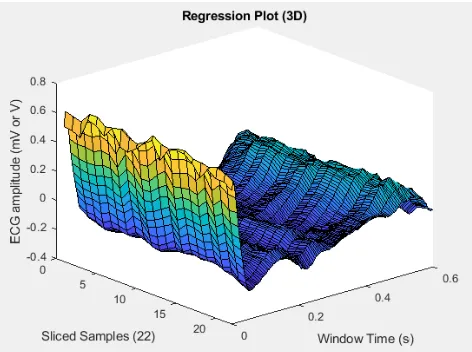
We use the time-sliced ECG method to build the training and testing datasets [22] and also investigate the optimum sliding window size. Time-sliced ECG data provides a suffi-cient number of samples and each sliced dataset can be used as the input for ML training. Although time-sliced ECG data offers sufficient flexibility to mix with other training inputs, we have used this source of data on its own. Previous research showed that the performance of ML is dependent on the ECG slicing time [7]–[10], we have therefore investigated this relationship. The minimum heartbeat interval within a typical heart rate [29] was chosen as the sliding window width. Representative time-sliced ECG data are shown in Fig. 1. We used the Amang ECG (amgecg) toolbox in MATLAB for ECG time slicing and to build the training input for the regression approach [22].
This paper is organized into four sections. Section II describes the new ML-based authentication system and eval-uates its classification performance [32]. Section III considers the two most relevant parameters (slicing time and sampling time period) that directly affect authentication performance: their relationship and impact are evaluated. Finally, the new authentication system and its contributions are summarized in Section IV.
II. ECG-BASED AUTHENTICATION USING ML
This section describes the ECG-based authentication system using regression as a ML technique that particularly comple-ments the security check, or SCK, use case. The sampling
FIGURE 1. ECG time slicing with R-peak anchoring [31].
time period for the testing (validation) phase is relatively short: less than 20s. The system can identify the unknown entity within this short interval [22].
[image:3.576.300.536.65.241.2]A. SECURITY CHECK CASE: EXPERIMENTAL SETUPS Several ML approaches could be used to develop a regression model, however our previous studies showed that the DT method achieves the best performance with time-sliced ECG data [22]. We confirmed this by comparing the performance of the decision tree (a fine tree, with a rich structure, i.e. many nodes) and support vector machine (SVM) methods and the results are shown in Table 1. Based on these results, we selected the DT-based regression method for our authentica-tion system. The performance comparison between DT and SVM have been analyzed by theRegression Leanerfunction in Matlab. The values in Table 1 is automatically generated by the Matlab function during training the dataset.
TABLE 1.Performance comparison between decision trees (dt) and support vector machines (SVM).
We therefore applied this method to the SCK use case based on 90 ECG data samples arbitrary collected in a HOS environment [22]. An ECG-based authentication system can be used to identify employees and exclude unknown persons assuming that employees have registered their identities and the ECG data are stable enough during both the training and testing phases. Out of the 90 samples used to construct the dataset for this experiment, 63 were sourced from the PhysioBank database [31], [33] and 27 from the Diabetes
FIGURE 2. The training process for the SCK use case.
Complications Research Initiative [34]. The data from the PhysioBank [31], [33] have been downloaded and transform-ing into Matlab formats by ustransform-ing the WFDB toolbox [35] and the data from the other source [34] are originally supported as the Matlab format. Ten additional samples (indicated here-after as ‘unknown’) were randomly selected from the dataset using the same sources but in different sampling time periods [31], [33], [34] and added during the testing phase [22]. Pre-processing for the HOS use case is still necessary even when dealing with the SCK scenario because the sources are not originally from the security check.
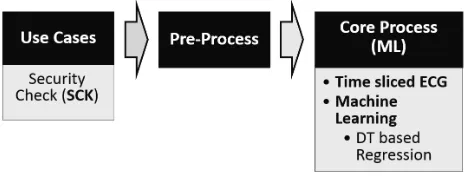
The authentication process began with use-case catego-rization and pre-processing, before training the dataset. All pre-processing steps recommended in our previous study [22] were applied (including baseline drift adjustment, power line interference (PLI) noise adjustment and checking the flipping signal) because the data were sourced from medical equip-ment (HOS use case). Although the pre-process for ECG signals by using various techniques has been widely studied [36]–[39], our system only follows the basic standard meth-ods which have been suggested from the ML framework [22]. The polynomial curve fitting for the baseline drift adjustment and the Fourier Transform for the PLI noise cancellation have been applied in this research [22]. The ECG data were collected at two different times, resulting in two datasets, which were defined as the training and testing sets. The ECG data were trained using the DT regression method (Fig. 2).
Although many different measures and techniques are cited in the biometric literature for feature selection filters, we used mutual information in DT model as a measure to score and rank the features. Mutual information was proposed by Shan-non [40] as part of this information theory, and was based in the concept of entropy, used to quantify the irreducible complexity of random signals (below which no lossless com-pression is possible). The entropyH of a random variablex
with a probability mass functionp(x) is
H(x)= −X
x∈X
p(x)log2p(x) (1)
whereXis a set of all possible outcomes ofx. From the above definition derive the definitions of: (i) conditional entropy,
H(x|y)= −X x∈X
X
y∈Yp(x,y) log2[p(x|y)] (2)
quantifying the entropy of a random variablex conditional upon the knowledge of another random variabley; and (ii) mutual information,
I(x;y)=X x,y
p(x,y)log2 p(x,y)
p(x)p(y)=H(x)−H(x|y) (3)
denoting the amount of information gained aboutyas a result of knowingx. In terms of our mutual information theoretic feature selection filter, the random variablesxandycan be used to represent features and class labels:xcan be used to denote a feature within the dataset, andycan be used to denote a class label. The information theoretic measures help quan-tifying how likely the machine learner is to correctly predict the class label, for any given instance, as a result of learning a given feature. Once mutual information is estimated, one can rank the features based on their capability to predict the target and selected accordingly. We point out that this approach to feature selection inherently relies on the assumption that classifier performance is linked to the amount of mutual information shared between the class label and a feature,i.e.
the greater the number of high-ranking features selected for classifier training, the better the classifiers perform in terms of correctly identifying the class label for any given instance. However, this approach disregards the potential for better subsets to exist, comprising features that are not sequentially ranked in terms of their mutual information values.
Computing the equations from (1) to (3) requires the knowledge of probability measuresp(x),p(y) and p(x,y). Since these quantities are frequently unknowna priori for any given datasets, we invoke a widely-used histogram-based approach [41] to estimate the probability distribution. Gener-allyhistogrammingis known to introduce estimation bias due to sensitivity to bin size.
The sliced ECG time (sliding window) for this experiment is 0.6 s which is equivalent to the interval between heartbeats at a typical rate of 100 beats per minute [30]. However, the slice time can be changed, and may therefore affect the authentication performance, and this relationship is discussed in Section III. The detailed process flow for the training and testing phases is summarized in Fig. 3.
E. A. Alkeemet al.: Enhanced Electrocardiogram Biometric Authentication System Using Machine Learning
[image:5.576.43.271.67.216.2]FIGURE 3. Process flow for ECG-based authentication in the SCK use case.
FIGURE 4. The reference ECG regression functions for the SCK use case.
B. EXPERIMENTAL RESULTS
Authentication performance was evaluated by means of standard metrics [32] such as accuracy and recall a.k.a. sen-sitivity). Given the characteristics of the SCK use case, the authentication process focuses on the detection of unknown entities, thus the recall is defined as the ratio of the detected unknown and the total of unknown entities. We also applied a data quality measure based on the mean square error (MSE) before starting to detect the testing ECG data. The experi-ment was performed 150 times using 100 samples, with a sampling time period of 15s for the authentication testing and the confusion matrix. Notably, 28 out of the 150 ECG datasets (17.61%) were rejected because they did not meet the data quality criteria [22]. The resulting dataset consisted in 122 samples. The confusion matrix resulting from the experiment is shown in Table 2.
The values of the performance metrics are the follow-ing: overall accuracy 90/122 (73.77%); recall (proportion of unknown actually detected) 6/8 (75%).
The acceptance criteria for validation could be strength-ened based on the quality of the training data (according to the upper control limit of the MSE). When these higher data
[image:5.576.298.537.82.134.2]TABLE 2.Authentication confusion matrix for SCK use case I.
[image:5.576.307.523.170.414.2]TABLE 3.Authentication confusion matrix for SCK use case II.
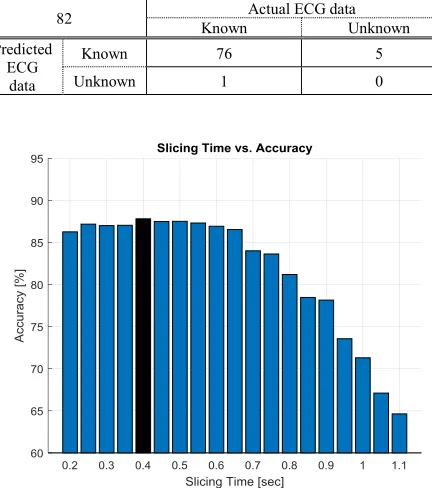
FIGURE 5. Authentication accuracy based on slicing time.
quality criteria were used, the samples were reduced to 82. The corresponding confusion matrix is shown in Table 3.
The accuracy of this biometric authentication system was 76/82 (92.7%). However, the recall was 0. Notably, the values could vary because the ECG testing data were randomly selected for each trial to make the SCK use case more realistic.
III. SLICING AND SAMPLING TIME PERIOD DEPENDENCIES
Some ML performance measures depend on the ECG slic-ing time (slidslic-ing window). We gathered 70 samples from the various sources discussed above [31], [33], [34] and the HOS use case was addressed to find a relationship between the authentication performance and two key parameters: the sliding window size (i.e., ECG slice time) and the ECG data sampling time period. The relationship between the slicing time and authentication accuracy is shown in Fig. 5, revealing that the optimal slicing time is approximately half the average interval between heartbeats (0.4s).
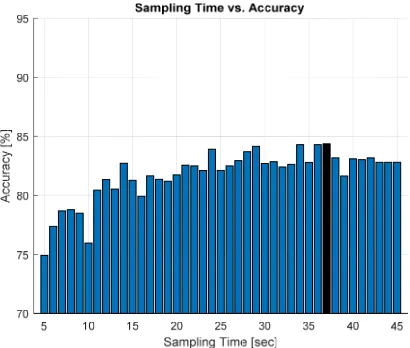
We also investigated the relationship between sampling time period and authentication accuracy (Fig. 6). Although there was no clear relationship between these parameters, the
[image:5.576.46.269.255.423.2]FIGURE 6. Authentication accuracy based on sampling time period.
optimal sliding time was 37 seconds in our experiment. The optimal slicing and sampling time periods may not remain the same if different datasets are used. However, our experiments clearly demonstrated that optimal values for these parameters exist and can be used to improve performance.
IV. CONCLUSION
In this paper, we proposed an enhanced ECG-based biomet-ric authentication system for the SCK use case in which a regression-based interpretable ML approach was used to define the dataset boundaries and to acquire good-quality training data. We trained on a total of 90 ECG data samples to generate the reference function database. The reference func-tion for each ECG data entity (i.e., identificafunc-tion) was then generated using a mutual-information-based DT regression approach. The authentication performance of the proposed system was evaluated not only with a confusion matrix but also by using theamgecgtoolbox in MATLAB to analyze two key parameters: the ECG slicing time (sliding window) and the sampling time period. We found that a sliding window of 0.4s achieved the best performance and that the optimal sampling duration is 37s. In conclusion, using these opti-mized parameters, the proposed authentication system is able to achieve accurate results.
APPENDIX
Theamgecgtoolbox v.0.5 [22] and WFDB toolbox v0.10.0
[35] were used to design our authentication system. The corresponding MATLAB codes are available on GitHub1for users to try the demonstrations.
REFERENCES
[1] F. Agrafioti, J. Gao, D. Hatzinakos, and J. Yang, ‘‘Heart biometrics: Theory, methods and applications,’’ inBiometrics, J. Yang, Ed. Rijeka, Croatia: InTech, 2011, pp. 199–216.
[2] A. K. Jain, A. A. Ross, and K. Nandakumar,Introduction to Biometrics. New York, NY, USA: Springer, 2011.
1https://github.com/amangkim/ECGRegreSec
[3] F. Agrafioti, F. M. Bui, and D. Hatzinakos, ‘‘Secure telemedicine: Bio-metrics for remote and continuous patient verification,’’J. Comput. Netw. Commun., vol. 2012, Oct. 2012, Art. no. 924791.
[4] M. Li and S. Narayanan, ‘‘Robust ECG biometrics by fusing temporal and cepstral information,’’ inProc. 20th Int. Conf. Pattern Recognit. (ICPR), Istanbul, Turkey, Aug. 2010, pp. 1326–1329.
[5] J. R. Pinto and J. S. Cardoso, ‘‘Towards a continuous biometric system based on ECG signals acquired on the steering wheel,’’Sensors, vol. 17 no. 10, p. 2228, 2017.
[6] G. E. Forsen and M. R. Nelson, ‘‘Personal attributes authentication tech-niques,’’ Rome Air Develop. Center, Pattern Anal. Recognit. Corp., Rome, NY, USA, Tech. Rep. RADC-TR-77-333, 1977.
[7] Y. Xin, L. Kong, Z. Liu, Y. Chen, Y. Li, H. Zhu, M. Cao, H. Hou, and C. Wang, ‘‘Machine learning and deep learning methods for cybersecu-rity,’’IEEE Access, vol. 6, pp. 35365–35381, 2018.
[8] Q. Zhang, D. Zhou, and X. Zeng, ‘‘HeartID: A multiresolution convolu-tional neural network for ECG-based biometric human identification in smart health applications,’’IEEE Access, vol. 5, pp. 11805–11816, 2017. [9] J. R. Pinto, J. S. Cardoso, and A. Lourenço, ‘‘Evolution, current
chal-lenges, and future possibilities in ECG biometrics,’’IEEE Access, vol. 6, pp. 34746–34776, 2018.
[10] E. J. da Silva Luz, G. J. P. Moreira, L. S. Oliveira, W. R. Schwartz, and D. Menotti, ‘‘Learning deep off-the-person heart biometrics representa-tions,’’IEEE Trans. Inf. Forensics Security, vol. 13, no. 5, pp. 1258–1270, May 2018.
[11] H. Kim and S. Y. Chun, ‘‘Cancelable ECG biometrics using compres-sive sensing-generalized likelihood ratio test,’’ IEEE Access, vol. 7, pp. 9232–9242, 2019.
[12] J. R. Koza, F. H. Bennett, D. Andre, and M. A. Keane, ‘‘Automated design of both the topology and sizing of analog electrical circuits using genetic programming,’’ inArtificial Intelligence in Design. Dordrecht, The Netherlands: Springer, 1996, pp. 151–170.
[13] F. Camastra and A. Vinciarelli,Machine Learning for Audio, Image and Video Analysis: Theory and Applications, 2nd ed. New York, NY, USA: Springer, 2015.
[14] A. Mincholé and B. Rodriguez, ‘‘Artificial intelligence for the electrocar-diogram,’’Nature Med., vol. 25, no. 1, pp. 22–23, 2019.
[15] E. Tatara and A. Cinar, ‘‘Interpreting ECG data by integrating statistical and artificial intelligence tools,’’IEEE Eng. Med. Biol. Mag., vol. 21, no. 1, pp. 36–41, Jan. 2002.
[16] H. J. Kim and J. S. Lim, ‘‘Study on a biometric authentication model based on ECG using a fuzzy neural network,’’IOP Conf. Ser., Mater. Sci. Eng., vol. 317, no. 1, 2018, Art. no. 012030.
[17] M. Sansone, R. Fusco, A. Pepino, and C. Sansone, ‘‘Electrocardiogram pattern recognition and analysis based on artificial neural networks and support vector machines: A review,’’J. Healthcare Eng., vol. 4, no. 4, pp. 465–504, 2013.
[18] A. E. Saddik, J. S. A. Falconi, and H. A. Osman, ‘‘Electrocardiogram (ECG) biometric authentication,’’ U.S. Patent 9 699 182 B2, Jul. 4, 2017. [19] S. Y. Chun, J.-H. Kang, H. Kim, C. Lee, I. Oakley, and S.-P. Kim,
‘‘ECG based user authentication for wearable devices using short time Fourier transform,’’ inProc. 39th IC-TSP, Vienna, Austria, Jun. 2016, pp. 656–659.
[20] A. F. Hussein, A. K. AlZubaidi, A. Al-Bayaty, and Q. A. Habash, ‘‘An IoT real-time biometric authentication system based on ecg fiducial extracted features using discrete cosine transform,’’ 2017, arXiv:1708.08189. [Online]. Available: https://arxiv.org/abs/1708.08189
[21] B. E. Manjunathswamy, A. M. Abhishek, J. Thriveni, K. R. Venugopal, and L. M. Patnaik, ‘‘Multimodal biometric authentication using ECG and fingerprint,’’Int. J. Comput. Appl., vol. 111, no. 13, pp. 33–39, 2015. [22] S. K. Kim, C. Y. Yeun, E. Damiani, and N. W. Lo, ‘‘A machine learning
framework for biometric authentication using electrocardiogram,’’IEEE Access, vol. 7, pp. 94858–94868, 2019.
[23] Use Cases. Accessed: Feb. 1, 2019. [Online]. Available: https://www.usability.gov/how-to-and-tools/methods/use-cases.html [24] P. Gupta.Decision Trees in Machine Learning. Accessed: Feb. 1, 2019.
[Online]. Available: https://towardsdatascience.com/decision-trees-in-machine-learning-641b9c4e8052
[25] J. R. Quinlan, ‘‘Induction of decision trees,’’Mach. Learn., vol. 1, no. 1, pp. 81–106, 1986.
E. A. Alkeemet al.: Enhanced Electrocardiogram Biometric Authentication System Using Machine Learning
[27] L. Yann.LeNet-5, Convolutional Neural Networks. Accessed: Feb. 1, 2019. [Online]. Available: http://yann.lecun.com/exdb/lenet/
[28] W. Yu, K. Yang, Y. Bai, H. Yao, and Y. Rui, ‘‘Visualizing and comparing convolutional neural networks,’’ Jun. 2019,arXiv:1412.6631. [Online]. Available: https://arxiv.org/abs/1412.6631
[29] R. D. Labati, E. Muñoz, V. Piuri, R. Sassi, and F. Scotti, ‘‘Deep-ECG: Convolutional neural networks for ECG biometric recognition,’’Pattern Recognit. Lett., to be published. doi:10.1016/j.patrec.2018.03.028. [30] American Heart Association.All About Heart Rate (Pulse). Accessed:
Feb. 1, 2019. [Online]. Available: https://www.heart.org/en/health- topics/high-blood-pressure/the-facts-about-high-blood-pressure/all-about-heart-rate-pulse
[31] A. Taddei, G. Distante, M. Emdin, P. Pisani, G. B. Moody, C. Zeelenberg, and C. Marchesi, ‘‘The European ST-T database: Standard for evaluating systems for the analysis of ST-T changes in ambulatory electrocardiogra-phy,’’Eur. Heart J., vol. 13, pp. 1164–1172, Sep. 1992.
[32] T. Fawcett, ‘‘An introduction to ROC analysis,’’Pattern Recognit. Lett., vol. 27, no. 8, pp. 861–874, 2005.
[33] A. L. Goldberger, L. A. N. Amaral, L. Glass, J. M. Hausdorff, P. C. Ivanov, R. G. Mark, J. E. Mietus, G. B. Moody, C.-K. Peng, and H. E. Stanley, ‘‘PhysioBank, PhysioToolkit, and PhysioNet: Components of a new research resource for complex physiologic signals,’’Circulation, vol. 101, no. 23, pp. e215–e220, Jun. 2000. [Online]. Available: http:// circ.ahajournals.org/content/101/23/e215.full
[34] M. H. Imam, C. K. Karmakar, H. F. Jelinek, M. Palaniswami, and A. H. Khandoker, ‘‘Detecting subclinical diabetic cardiac autonomic neuropathy by analyzing ventricular repolarization dynamics,’’ IEEE J. Biomed. Health Inform., vol. 20, no. 1, pp. 64–72, Jan. 2016. [35] I. Silva and G. B. Moody, ‘‘An open-source toolbox for analysing and
processing physionet databases in MATLAB and octave,’’J. Open Res. Softw., vol. 2, no. 1, p. e27, Sep. 2014. doi:10.5334/jors.bi.
[36] Y.-W. Bai, W.-Y. Chu, C.-Y. Chen, Y.-T. Lee, Y.-C. Tsai, and C.-H. Tsai, ‘‘Adjustable 60 Hz noise reduction by a notch filter for ECG signals,’’ inProc. IEEE Instrum. Meas. Technol. Conf., Como, Italy, May 2004, pp. 1706–1711.
[37] A. R. Verma and Y. Singh, ‘‘Adaptive tunable notch filter for ECG signal enhancement,’’Procedia Comput. Sci., vol. 57, pp. 332–337, Jan. 2015. [38] E. Ebrahimzadeh, M. Pooyan, S. Jahani, A. Bijar, and S. K. Setaredan,
‘‘ECG signals noise removal: Selection and optimization of the best adap-tive filtering algorithm based on various algorithms comparison,’’Biomed. Eng., Appl. Basis Commun., vol. 27, no. 4, pp. 1–13, Jul. 2015. [39] P.-Y. Chen, M.-J. Chang, K.-C. Tu, S.-S. Yu, and C.-C. Liu, ‘‘Study of
using Fourier transform to capture the ECG signals between awakeness and dozing,’’ inProc. IS3C, Xian, China, Jul. 2016, pp. 1055–1058. [40] C. E. Shannon, ‘‘A mathematical theory of communication,’’Bell Syst.
Tech. J., vol. 27, no. 3, pp. 379–426, 1948.
[41] G. Egnal, ‘‘Image registration using mutual information,’’ Univ. Pennsyl-vania, Philadelphia, PA, USA, Tech. Rep. MS-CIS-00-05, 1999.
EBRAHIM AL ALKEEM received the bache-lor’s degree in communication engineering and the master’s degree in information security from Khal-ifa University of Science and Technology, where he is currently pursuing the Ph.D. degree. He is a Global Digital Leader specializing in the effects of artificial intelligence and other rapidly developing technologies on the economy, healthcare, and soci-ety, focusing on threats and opportunities created by these new developments. During his 13 years in the cybersecurity industry, he has worked with many technologies in var-ious technical and management positions. He currently manages the ENEC Information Security Department as the acting Chief Information Security Officer. He has presented many international and domestic seminars. He has published many articles in the field of security. In 2015, he has received the Tamayaz Excellence Award in recognition of his work and inventions in the field of information technology and smart services. He is an active member of many of engineering associations across the world.
SONG-KYOO (AMANG) KIMreceived the M.S. degree in computer engineering and the Ph.D. degree in operations research from the Florida Institute of Technology, in 1999 and 2002, respec-tively. He is a Research Scholar with the Khal-ifa University of Science and Technology. He has been an Associate Professor with several UAE universities. Before moving to the Gulf region, he was a core Faculty Member of the Asian Institute of Management, providing courses in technology, innovation, and operations. Before his academic career, he was the Technical Manager of the Mobile Communications Division, Samsung Electronics, for more than ten years and mainly dealt with technology management in the information technology industry. He has been an Invited Speaker with many international conferences concerning technology management and innovation process. He is the author of over 70 research articles. He holds ten patents relating to the mobile technology industries. His current research area include artificial intelligence and ECG-based biometric security. He is also an External Reviewer of the IEEE TRANSACTIONS ONNETWORKSCIENCE ANDENGINEERING.
CHAN YEOB YEUNreceived the M.Sc. degree in information security from Royal Holloway, in 1996, and the Ph.D. degree in information security from the University of London, in 2000. After the Ph.D. degree, he joined Toshiba TRL, Bris-tol, U.K., and later became the Vice President of LG Electronics, Mobile Handset R&D Center, in Seoul, South Korea, in 2005. He was responsi-ble for developing mobile TV technologies and related security. He left LG Electronics, in 2007, and joined KAIST, South Korea, until August 2008, and then the Khalifa University Science and Technology, in September 2008. He is currently a Researcher in cybersecurity including the IoT/USN security, cyber-physical system security, cloud/fog security, and cryptographic techniques. He is also an Associate Professor with the Department of Electrical Engineering and Computer Science Department and an active member of the Center for Cyber-Physical Systems (C2PS). He also enjoys lecturing for the M.Sc. degree students information security and the Ph.D. degree engineering courses with the Khalifa University of Science and Technology. He has published over 100 journal articles and conference articles and seven book chapters. He held ten international patent applications. He also serves on the editorial board of multiple international journals and on the steering committee of international conferences.
MOHAMED JAMAL ZEMERLY received the M.Sc. degree from University College Cardiff, Wales, and the Ph.D. degree from The University of Birmingham, U.K., in 1986 and 1989, respec-tively. Since 1989, he was with various U.K. uni-versities, such as UCL, Warwick, and Westminster, and then moved to Khalifa University of Science and Technology, in 2000, where he is currently an Associate Professor. He was the Research gram Chair (and ex-Computer Engineering Pro-gram Chair) of the Electrical and Computer Science Department for the M.Sc. degree. He has published over 100 journal and conference papers as well as eight book chapters. He is also the Co-Editor-in-Chief of the IJRFIDSC journal of the Infonomics Society. His research interests include ubiquitous computing, augmented reality, image processing and computer vision, context aware mobile systems, and information security. He was the Co-Program Chair of the ICITST Conference Series for the years 2011 and 2012. He was also the Co-Chair of the same conference, from 2014 to 2015.
KIN FAI POON received the bachelor’s degree from the University of Sunderland, in 1995, and the master’s degree in digital systems engineer-ing, and the Ph.D. degree, in 2002. He is cur-rently a Chief Researcher, leading the network optimization theme with Emirates ICT Innovation Centre (EBTIC), Khalifa University of Science and Technology, setting out research and develop-ment directions to downstream research activities to EBTIC partners. He won the IET outstanding Student Prize. He has contributed numerous technical articles and published four book chapters. He has filed five patents. Prior to joining EBTIC, he was a member of the Intelligent Systems Research Centre, working as a Network Optimization Consultant with British Telecom (BT), U.K. He was responsible for the design and implementation of new algorithms to solve telecom network problems. In 2003, he left BT and became the co-founder of evolved networks working as a research and development principle to com-mercialize some of the BT software applications. His main interests include network planning, graph theory, hardware and software development, and optimization techniques, in particular evolutionary algorithms.
GABRIELE GIANINI received the M.Sc. degree in physics, in 1992, and the Ph.D. degree in physics, in 1996. Since 2005, he has been an Assistant Professor with the Department of Com-puter Science, Università degli Studi di Milano, Italy. Since 2017, he has been a Senior Research Fellow of EBTIC/Khalifa University of Science and Technology. He has held visiting positions at a number of international institutions, including INSA de Lyon, France, and the University of Pas-sau, Germany, CERN, Geneva, Switzerland, Fermilab, Chicago, USA, and CBPF, Brazil. From 2005 to 2012, he was an Adjoint Professor with the Free University of Bolzano, Italy. Since 1992, he has coauthored about 200 articles published in internationally refereed journals and conferences. His research interests include statistical and soft computing techniques for machine learning and big data, quantitative modeling of processes, and game theoretic applications to networking and to security.