Budget Formulation and Implementation
in Korea: A Macroeconomic Perspective
He, Dong
International Monetary Fund
March 2003
Online at
https://mpra.ub.uni-muenchen.de/9756/
II. BUDGET FORMULATION AND IMPLEMENTATION I~ KOREA: A MACROECONOMIC PERSPECTIVE 1
A. Introduction
1. Korea has an admirable tradition of fiscal conservatism, with a deep-rooted resistance
to incurring fiscal deficits and public debt. On the eve of the financial crisis that enipted in late 1997, gross public debt was below 10 percent of GDP as a result of near balanced budget outcomes in the preceding decade. The fiscal accounts, however, have not been very
transparent: the budget structure is unnecessarily complicated and fragmented; and
weakesses in budget formulation and implementation make the budget a poor indicator of the overall fiscal stance and reduce its efficiency as a tool of macroeconomic policy.
2. In recent years the government has introduced a medium-term plan for fiscal
consolidation and initiated refonn measures to improve fiscal transparency. A special law on fiscal soundness was submitted to the National Assembly in 2001 that aims to achieve a
balanced budget and ensure prudent debt management. There is a polítical consensus in
Korea on the need to reduce public debt, which, although low by OECD standards, is at historically high levels as a result of the financial crisis in the late 1990s. There are also plans to revise the Budget and Account Law to adopt performance-based budget preparation and implementation and to ensure better provision of information on fiscal operations to the public. These reform measures notwithstanding, more consideration needs to be given to the role of fiscal policy in macroeconomic management. In particular, there is a need to
formulate fiscal policy in a medium-term framework so that the fiscal stance is appropriate to developments in the business cycle.
3. Fiscal policy as a tool of macroeconomic management is hampered by two factors. First, the automatic fiscal stabilizers are relatively weak in Korea. The weakness of the automatic stabilizers reflects the small size of government and the small social welfare system, which means that expenditures are relatively insensitive to fluctuations in economic activity. Second, there is a relatively high degree of uncertainty about fiscal outcomes in Korea, with actual budget outtms often deviating from the budget plans by a large margin. Thus, the impact of fiscal policy in any given year is often different from what was initially intended or considered desirable, with the risk that it becomes destabilzing. In paricular, large systematic expenditure shortfalls and overshooting of revenues tend to make the fiscal stance pro~cyclical during an economic downtu.
4. This chapter describes the main featues of the Korean fiscal system from a
macroeconomic perspective. It discusses why fiscal outtrns tend to differ from the budget and makes suggestions to improve budget formulation and implementation. It also discusses how medium-term fiscal objectives such as maintaining a balanced budget and reducing public debt can be reconciled with the short-term objective of avoiding procyclical fiscal impulses in a downtun.
5. The following section describes the main characteristics ofthe revenue and
expenditure structures and analyzes how such characteristics affect the size of automatic fiscal stabilizers in Korea. Section C describes patterns of deviations of budget outtrns from budget plans and analyzes the causes for such deviations. Section D discusses the impact of the budget on aggregate demand. Section E presents recommendations about the role of a medium-term fiscal framework in strengthening the budget as a tool of macroeconomic management. Section F concludes.
B. Main Features of Government Expenditure and Revenue
6. Since the mid-1980s, the Korean
government implemented conservative fiscal policies that contributed to low gross public debt on the eve of the 1997-98 financial crisis.2 The principle of "expenditue within revenue," which was adopted in the mid-1980s, limited spending commitments to anticipated revenues, even though no formal fiscal rules were imposed by the constitution
or by legislation. The breakout of the financial crisis in late 1997 marked a major shift in the stance of fiscal policy. Instead of balanced budgets during a period of high growth, the government ran large deficits during the crisis, reflecting the shar contraction of tax receipts in the economic downtu as well as discretionary fiscal support to demand. In addition, the governent incurred large contingent liabilties by
guaranteeing bonds issued by the
Deposit Insurance Fund and the Nonperforming Assets Management Fund in the context of financial sector
restrcturing.
Consolidated Central GoveTninent Balance
g,o!
.1.01
-i.o
.Hi
-.j,O
J~I i~n 19'5 L911 tSin J9a1 1')$3 1'65 19&" l~~ i'm l?'~ 19'15 199"1 ¡Wi 101 Sources: Ministr of Finance and Economy; and Fund staff estimates.
Cenlral Government Gross Debt ..
"
GO\'cnc:lit-guMimlctl imël--for financial ~~o. re.~c.twn8
..
"
~ ;u
l ~
..
1,)7J l'i JrlS 1m n"') IlJt l'lu 1m 1~7 1'l"i 1991 1991 l'l:Ç 1"l1 lQ1 2Ml
Sources: Minislry or Finance nnd Economy; and Fund Stff estimates.
2 Korea was one of the few OEeD countres where net public debt was negative; that is, the central government was a net creditor to the other sectors in the economy. There are doubts, however, about the quality of government assets, which are mostly loans to local
7. Another defining characteristic
of Korean fiscal conservatism is the Gereral Governnt Spendin by Economc Category(in pl!reent ofGDP in 2tX.U)
relatively small size of governent. On (ßcome Subsidies Interest Consumption ~etCalital Total a general government basis, total public Transfet'S Paymenls Outlays Ouilays
expenditure in 2000 amounted to Ko'Ca(200) J.6 O.J 0.7 10.1 8.3 23.0
23 percent ofGDP, the lowest except for Australia 8.9 l. 2.0 t8.5 2.2 32.7
Germny 18.9 1.6 3.J t9.0 3.0 45.7
Mexico among OECD coimtries c.eece (200 16.3 0.2 7.1 15.5 4.9 44.0
Japõin 10.0 0.9 J.3 16.7 5.9 36.8
(GECD, forthcoming). While this was Me,;co 00(0) 1.7 0.3 3.6 11. 5.l 21.8
Portugal 12.5 1.4 3.1 20.7 4.4 42.1
partly due to Korea's level of economic Sweden 18.1 1.5 3.4 26.7 2.5 52.2
development, Greece, Portgal, and Unñed StBtes 11.4 flS 3.4 15.1 0.9 31.2
several central European countres with OECDiol.i 12.8 0.9 3.5 17.3 2.8 37.3
comparable or lower income levels have Source: OEC (forthcomig). far higher spending levels.
8. Moreover, the composition of
govemment expenditures by economic classification differs substantially from most OECD countries. Three major factors underlie the comparatively low public spending level in Korea. First, income transfers are limited by the relatively small size of the social safety net. At 3.6 percent ofGDP, such spending is a quarer of the GECD average, although it is higher than in Mexico. Second, government
consumption, at around i 0 percent of
GDP, is well below the OECD average of 17 percent. Third, relatively low public debt translates into modest interest payments as a share of GDP. In contrast, public investment is exceptionally high, with net capital outlays exceeding 8 percent of GDP. The structue of public expenditure classified by fuction also shows large differences with other OECD countries. Publicly provided social protection is significantly lower in Korea. On the other hand, defense spending; at around 3 percent of GDP, is double the OECD average, reflecting continued security concerns in the Korean peninsula.
Prii Govcnirni Spendin by FwitIn
(in pen:t:Tlt urGDP in 20)
Defence General
Public
Services Educalion Health
Social Economi Prtei:üon Affir Public Orer and Safery Korea 199 1998 3.9 3.1
i.
3.2 1.2 1.5 3.4 4.1 1.7 2.4 2.5 3.9 3.8 5.6 Gernimy 1.2 Giece 3.3 Japan 1.0 Porlugal 1.7 Swi:deu 2.2 United Stotes 3.33.9 100 2.9 6.4 10.2 4.2 1.6 i. I.S 2.0 1.3 1.9 4.3 4.2 '.2 6.9 6.9 '.8 6,3 3.9 6.2 6.4 6.3 5.0 21.9 19.6 10,1 B.O 24.5 6.5 4.2 0.2 4.7 5.8 4.0 1.9
Anrage 2,3 5.8 1.6 5.1 S.2 J4,3 3.8 Source: OECO (forthcuming).
more heavily on consumption and property taxes than many other OBCD countres. The 38 percent share of consumption taxes in total revenues is substantially higher than in countres such as Japan and the United States, despite a shar fall in recent years,3 In
addition, taxation of labor (as measured by average effective tax rates) is much lower in Korea than elsewhere in the OECD, while average taxation of consumption and capital appear to be close to the GECD average.
Tax Structure in Selected OI!CD Countries in 2000
I_POIllOll;a Jli(lJ ._~C~~lç lruix ~~~ial Securilyand P::.'rou ClConst111on ISOthe-r I
I)liik: Stcf J~ Gmny ~ Auitiulia Swen acEO
Source: Revenue Statistics. 1965-2001. OECD. 1~'Il'
10. These characteristics of government expenditure and revenue render the automatic
fiscal stabilizers weak in Korea. As indicated by van den Noord (2000), the most important
factor detennining the cyclical sensitivity of the fiscal position is the size of the general government sector: the larger the share of government expenditure in domestic output, the greater is the sensitivity of the fiscal position to fluctuations in economic activity. The
progressivity of taxes, the generosity of unemployment benefits and the cyclical sensitivity of
varous tax bases are also significant factors in determining the cyclical sensitivity of the fiscal position. In future, the automatic stabilizers in Korea may be strengthened as a result of expected changes in the size and structue of governent spending and tax reforms discussed below.
1 1. The size and strcture of
govemment expenditue and revenue in Korea are likely to experience
significant changes over the medium term, Social welfare spending increased as the social safety net was expanded after the 1997-98 financial crisis. Subsequently, the government launched the "productive welfare" system in October 2000 to ensure minimum subsistence standards, which made social benefits under the Basic
Livelihood Protection Program a right
for those who qualify. The newly elected government of President Roh, Moo-hyun may GO""lTnt Spending on th Socia Safety Net
1997 1998 199 20 2001 2002
Total rUl biIion won) (ii pen:~nt orGDP) O/which: 10,14$ 2.2 14.921 ).4 20,52 4.3
17,lO9 22,993 23,980 3A 4.2 4.0 (I percent oftolal)
UnemploYJrnt insurance
Support rornu.imliving coSI
Occupational accident insurnte
National Health Insurance i Nl1'ion:il Pemiiun 2
1.7 9.4 1. 57.3 14.8 8.0 1.6 9.7 461 16.3 8.3 8.7 6.2 38.6 19.0 6.5 13.1 8.3 51.6 9.1 1.5 14,5 7.8 51.6 6$ 8,$ 145 1.9 55.6 9.4 Sourie: OEC(forrbcorrg). 'Paym:nt form:dilal trelin:nl.
1 Pension paym:nl.
3 The share oftaxes on goods and services in total tax revenue was 60 percent in 1985 and
further expand the safety net. Over the longer term, spending pressure are likely to accelerate as a result of population ageing and the consequent demands on social spending, notably on
pensions and health care. In addition, Korea faces the uncertain cost of potential unification
with Nort Korea.
12. The overall tax burden is also likely to rise to finance the higher spending pressures noted above and because tax revenue wil probably grow faster than income, reflecting a progressive income tax system in an environment of fast economic growth. The government has initiated reform measures to address the weaknesses of the tax system, which include generous allowances and loopholes for individuals, large-scale and wide-ranging tax
preferences for enterprises, and an inappropriate taxation of propert (OECD, 2000). The aim
is to create an attactive business environment and improve equity and efficiency by broadening the tax base, lowering tax rates, and making the system more transparent and easier to understand. These reform measures wil likely change the tax mix significantly,
raising the share of direct taes relative to indirect taxes, and the share of individual income taxes relative to corporation taxes.
C. Budget Structure, Formulation, and Implementation
i 3. Even though fiscal discipline has
been maintained at the aggregate level,
fiscal management in Korea suffers from important weakesses. Insuffcient transparency of the budget reflects its highly complicated and fragmented
strcture (Box 11.1). The extensive use
of special accounts and public funds, with eararking of revenue resources,
weakens fiscal planning because the budget authorities have little control over a significant share of public
spending. The fragmented strcture
prevents a holistic view in determining priorities for the use of government
resources, or even risks overlapping expenditures from different accounts or fuds to serve the same policy objective.
Government Spending by Type of Account
(in percent of central government expenditure)
90 90
RO
50 80
70 70
60 . 60
so
4( -General accowit
- - - . $pcc:iill ~counts
.. . .. . Public Funcb 11 "",'- -_ _ __/'....,.. 30
40
30
20 ~--- .... '" 20
10
~--...:.:._...-:.""~... . -...
10
o
1981 1983 1985 1987 1989 1\11 1..3 1995 1997 1999 2001
Source: Ministry of Finimcc and Er:unomy. reproduced from OfiD (furr:oming 11 Ter new finds were added to the cateory of public funds in 200.
14. From a macroeconomic perspective, the fragmented budget strcture makes it
diffcult to form a meaningful view of the budget in economic tenns. The use of a number of different budget concepts risks misunderstanding or confusion about both the policy stance and policy intentions. Given uncertainty about spending out of the public fuds, the total level of expenditue on a consolidated basis is unown when a new budget is prepared and approved by the parliament. Such uncertainty reduces the usefulness of the budget as a tool of macroeconomic policy since the impact of government expenditue on private sector
Box 11.1. The Budget Structure and Budget Concepts
There are four different types of accounts or funds in the Korean budgetary system: one General Account (GA), 22 special
accounts, 47 public funds, and more than ten "other" funds. The GA comprises about half of central governent spending on a
consolidated basis. The proliferation of special accounts and public funds reflects the legacy of the cconomic policies of the i 960s and 1970s when a range of eannarked taxes and so-called quasi-taxes were created to finance public investments and loans to achieve specific policy objectives. While these accounts and funds have separate budgets and are managed independently, there are very complicated financial transfers among thcm, thus reducing transparency and masking accountability.
· The GA includes all transactions not classified by law as being undertaken by special accounts or funds. It is used to carr out the general purposes of governent and its constituent ministries rather than being restricted by taw to a specific
program.
· Special accounts were introduced for certin government activities. These accounts can be divided into four categories: (i) business-like activities such as railway, telecommunications, and grain management, which would typically be
nonfinancial public enterpriscs in other countries; (ii) special funds using earmarked sources of revenue, such as taxes, fees, and charges for particular government activities (e.g., toll roads, energy and resources, rural tax, and agriculture and fisheiies strctural adjustment); (iii) financing funds, such as those for fiscallending and shared taxes to local governments; and (iv) miscellaneous smaller fuds, such as that for prison operations. Special accounts are usually managed by the relevant tine ministry, although responsibility for some special fuds is shared by several ministries.
· Public funds were introduced for major government activities involving the receipt and disbursement of funds. They can be
divided into six categories: (i) the largest are the pension, unemployment, and health insurance funds, which are typically trust funds in many countries; (ii) the public money management fund collects the proceeds from government borrowing and channels it to the GA, the Fiscal Lending Special Account, and othcr public funds; (iii) classic revolving funds such as for the aid budget; (iv) earmarked funds; (v) various industry funds, lending from which is below market rates; and (vi) a large national housing fund that supports low-income households.
· "Other" funds are established under laws pertining to the non-government sector and are not managed by line ministries. However, ministr officials are often appointed as board members, allowing them to exert indirect control. Some "othet' funds have been established to deal with financial sector restructuiing (the Nonperforming Assets Management Fund, and the Deposit Insurance Fund); and there are also some guarantee funds and earmarked funds.
The annual provisions in the budget for the GA and the special accounts need to be approved by the National Assembly (NA). TIie budgets and accounts of public funds are presented to the NA for information, but the decision on the financial balances to be achieved by the funds is determined by the relevant ministries, in consultation with the Ministry of Planning and Budget. However, revisions to the Fund Management Act in December 2001 require that the public funds be subject to parliamentary approval beginning with the 2003 budget. This reform also increased the coverage of public fuds by transfonning a number of "other" funds into public funds, The balances of "othet' funds are not subject to approval by the NA; nor is information on their balances required by the NA.
The authorities use four different budget concepts for the centrl government in budget documents:
· The narrowest budget concept covers only the GA. The detailed information by the functional, economic, and organizational classifications is only provided for this budget concept.
· A second budget concept covers the GA and the Fiscal Lending Special Account, netting out internal transfers. This is the
total amount of "the budget," and it is the rate of increase in this aggregate that is announced by the government in its public
presentation of the budget.
· A third and broader budget concept covers the GA and all 22 special accounts. It is the official budget, as defined in the Budget and Accounts Act, that is proposed by the government and approved by the NA. Detained information on sector amounts and their main programs are published together for this budget concept.
· The broadest budget concept is the consolidated budget, which covers the GA, all22 special accounts, and all public funds. It is compiled and calculated according to the GFS rules (but excluding the "other" funds), specifying the financing and netting out internal transfers. When the authorities refer to the fiscal balance, this is the budget concept used.
The consolidated government budget suffers from weaknesses in its coverage and methodology. First, the GFS accounts do not
include local governents, which hampers budget planning and monitoring at the general government leveL. Second, the
budget is recorded on a cash-basis, which fails to deliver a fair and accurate picture of the impact of government activities on its overall financial position. In addition, fiscal data are typically published in highly aggregated form; and including pnvatization receipts above the line obscures underlying developments. Some ofthese problems are being addressed, The authorities currently plan to include local governments in the consolidated budget starting in 2003 and to move by 2005 at the latest from the present cash-based accounting to accrual accounting standards, a change that is in line with the new GFS
15. Budget formulation also suffers
from incentives that adversely affect the behavior of government officials. Whether for historical or cultual reasons,
"overperformance"-in the sense of conservative revenue estimates and under-spending by ministres resulting in
better-than-expected budget balance
outturns-was encouraged. There appears to be a view among government officials that "the
larger the surplus the better.,,4 This
approach fostered a tradition of deliberately conservative revenue forecasting, leading to a tendency for
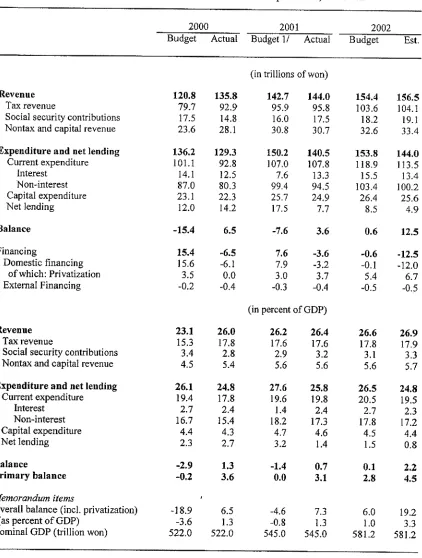
overshooting in revenues; and of implicit encouragement to line ministries to plan for a cushion so that spending did not exceed the budgeted amount, leading to systematic expenditure shortfalls.5 (Table ILl)
Overshooting in Revenue and Expenditure Out-lur Jess budget ag a perctit of budget II
.2
-4
-ó
1991 1992 1993 1994 1995 1996 1997 1998
SoulC: Boiid or Audit and Imp~iori rcpro\Jw from UECD (!òloiJßliTl¡g If D'.ilfrererlu lhej,t:r:d aci:lIunt.
199 2000
16. Weaknesses in budget implementation also contribute to large deviatIons between budget plans and outturns. An'angements for regular in-year monitoring and reporting on expenditue and revenue developments, with an analysis of causes of deviatIons from plans, are not well developed. Monitoring spending from the public funds is the responsibility of the line ministries concerned, rather than the MPB or the MOFE. This mitigates against clear analysis ofthe development of the overall fiscal balance during the year, or of the most economical cash management techniques to balance shortfalls and surpluses in individual accounts. Most fudamentally, there is no provision for a comprehensive mid-year review of the budget, using updated forecasts of the economy and expected fiscal outturns, which would provide a clear basis for decisions about needed fiscal measures such as
supplementary expenditue provisions or other in-year measures, and give a firm framework for the following year's budget proposals.
4 For example, offcials of the Ministr of Finance and Economy have described fiscal performance in 1999-2001 as follows: "Fiscal policy and public debt management have been exemplary, with the fiscal balance showing better results than budgeted figures for three consecutive years."
5 Non-interest expenditure was 1.3 percentage points of GDP lower than budgeted in 2000,
0.9 percentage points lower in 2001, and estimated 0.6 percentage points lower in 2002. The shortfall in 2002 would have been larger were it not for the supplementary budget of
Table II. 1. Consolidated Central Government Operations, 2000-02
2000 2001 2002
Budget Actual Budget 1/ Actual Budget Est.
(in trillons of won)
Revenue 120.8 135.8 142.7 144.0 154.4 156.5
Tax revenue 79.7 92.9 95.9 95.8 103.6 104.1
Social security contributions 17.5 14.8 16.0 17.5 18.2 19.1
Nontax and capital revenue 23.6 28.1 30.8 30.7 32,6 33.4 Expenditure and net lending 136.2 129.3 150.2 140.5 153.8 144.0
Current expenditure 101. 92.8 107.0 107.8 118.9 i 135
Interest 14.1 12.5 7.6 13.3 15.5 13.4
Non-interest 87.0 80.3 99.4 94,5 103.4 100.2
Capital expenditure 23.1 22.3 25.7 24.9 26.4 25.6
Net lending 12.0 14.2 17.5 7.7 8.5 4.9
Balance -15.4 6.5 -7.6 3.6 0.6 12.5
Financing 15.4 ~6.5 7.6 -3.6 -0.6 -12.5
Domestic financing 15.6 -6.1 7.9 -3.2 -0.1 -12.0
of which: Privatization 3.5 0.0 3.0 3.7 5.4 6.7
External Financing -0.2 -0.4 -0.3 -0.4 -0.5 -0.5
(in percent of GDP)
Revenue 23.1 26.0 26.2 26.4 26.6 26.9
Tax revenue 15.3 17.8 17.6 17.6 17.8 17.9
Social security contributions 3.4 2.8 2.9 3.2 3.1 3.3
Nonta and capital revenue 4.5 5.4 5.6 5.6 5.6 5.1
Expenditure and net lending 26.1 24.8 27.6 25.8 26.5 24.8
Current expenditure 19.4 17.8 19.6 19.8 20.5 19.5
Interest 2.7 2.4 1.4 2.4 2.7 2.3
Non-interest 16.7 15,4 18.2 17.3 17.8 17.2
Capital expenditure 4.4 4.3 4.7 4.6 4.5 4,4
Net lending 2.3 2.7 3.2 1.4 1.5 0.8
Balance -2.9 1.3 -1.4 0.7 0.1 2.2
Primary balance -0.2 3.6 0.0 3.1 2.8 4.5
Memorandum items
Overall balance (incL. privatization) -18.9 6.5 -4.6 7.3 6.0 19.2
(as percent of GDP) -3.6
I.
-0.81.
1.0 3.3Nominal GDP (trillion won) 522.0 522.0 545.0 545.0 581.2 581.2
Sources: Ministr of Planning and Budget; and Fund staff estimates.
D. The Budget as a Tool otMacroeconomic Policy
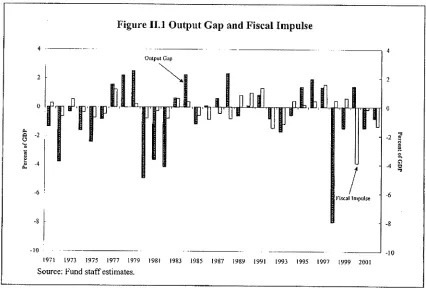
17. The tendency for systematically larger-than-budgeted surpluses (or smaller deficits) implies a systematic contractionary bias in fiscal policy that reduces its effectiveness as a tool of macroeconomic management. This bias is particularly damaging during an economic downtum because it means that fiscal policy tends to be inappropriately pro cyclicaL. As shown in Figure II. 1, since 1971, fiscal policy was contractÎonary in 12 of the 18 years when
the output gap was negative, i.e., when actual output was below potential output.6 In other
words, fiscal policy was supportive of growth only in six out of those I 8 years. Two of the
[image:10.598.87.513.321.610.2]six years of supportive fiscal policies were during the 1997-98 financial crisis. In strong economic upturns, the contractionary bias in fiscal policies may result in a welcome stronger-than-budgeted counter cyclical fiscal stance, as in 2000.
Figure II. Output Gap and Fiscal Impulse
4---Output Gap
~
o 11 1
W U 'f'l
,l.n .
-2 -2
-4 -4
.6 !
I
-6Fiscal 1 mpulse
'I
-8
-10 -10
1971 1973 1975 1977 1979 1981 1983 1985 1987 1989 1991 1993 1995 1997 1999 2001
Source: Fund staff estimates.
6 The fiscal impulse is defined as the change in the cyclically adjusted fiscal balance. A
18. The effectiveness of the budget as a tool of macroeconomic policy is also blunted by the way the macroeconomic effects of fiscal policy are described and presented to the public. The Korean authorities traditionally focus on the contribution of government expenditure to real GDP growth when describing the stance offiscal policy, which, not surrisingly, is almost always "expansionary." This is misleading since it omits the negative impact on aggregate demand from taxes that reduces the disposable income of the private sector. In a world of imperfect competition, the fiscal stimulus to aggregate demand, expressed as a percentage ofGDP, is given by (Chalk, 2002):
6YlYi = ß*6GlYi - J.*LVilY¡
where 6Yt = Y¡ - Yt-1, ß is the expenditure multiplier, and J. is the revenue multiplier. Thus, the stimulus provided by the tiscal position to aggregate demand is given by the change in real expenditure and real tax revenues weighted by their respective multipliers. Accordingly, the positive contribution to GDP of higher real governent expenditue alone is not a proper measure of the demand effect of the govemment budget, since it ignores the negative
contribution to GDP of higher real government revenue.
19. Figure IL2 shows the evolution of the demand impact measure in Korea for both the
budget and the outtrn in 2000-02, as well as the contribution of real govemment
expenditure to GDP, calculated as the change in real governent expenditue from year t-l to year t as a proportion of real GDP in year t. The multipliers for current expenditue, capital expenditure, and revenue, which are derived from simulations using the BOK
macroeconomic model, are 1.5, 1.2, and -0.9, respectively. The multiplier for net lending is assumed to be 0.7, considering that private sector investment is unlikely to change by the same magnitude as the change in government net lending. The contribution of real
government expenditure was always positive and typically overstated the impact of the fiscal position on domestic demand. This was most obvious in 2000, when fiscal policy was significantly contractionary and had a fairly large negative impact on domestic demand.
Figure 11.2. Demand Impact of Fiscal Balance
4 _. 4
Contribution of Go\'emmc:nt Expcndìwre to Growt
3 '
o
..
E3 0
~ I
~ -I_.._-_.._-t. -I
-2 -2
Demond Impact of Fiscal Balance
-3 -3
-4 -4
-5 -5
2000 budget 2000 Actual :WOL budget 2001 Actu 2002 budget 2002 Actual
Source: Fund staf estimates.
E. The Role of a Medium-Term Fiscal Framework
21. A special law on fiscal soundness was submitted to the National Assembly in 2001 that aims to achieve a balanced budget in the medium term and ensure prudent debt management. It would require that a medium-tenn fiscal plan be presented to the National Assembly along with the annual budget bil. Since the consolidated central government balance has been in surplus since 2000, the objective of achieving a balanced budget
presumably means a balanced budget excluding surpluses of the social security fuds (SSF), an objective estimated to have been achieved in 2002.7
7 Yet another interpretation of the balanced budget target is to treat the additional outlays of
absorbing part of the cost of financial sector restructuring as spending. In the four year period of 2003-06, the government plans to convert W 49 trilion of maturing
22. While the introduction of a medium-tern1 goal of a balanced budget may be
appropriate, the connection between the objective and the annual budgeting process is unclear. It is partcularly important to clarify that the medium-term objective implies an arumal balanced budget on a cyclically-adjusted basis, Although the principle of "expenditure within revenue" has the merit of fiscal prudence when applied over the business cycle, it is unnecessarily restrctive as a guide to anual budgets in an advanced economy such as Korea. Most economic policymakers in advanced economies have long accepted the importance of focusing on the underlying structural budget balance rather than the actual
balance, which reflects the stage of the business cycle. In a period of economic downturn, the government should accommodate the higher fiscal deficit and not seek to achieve annual balance budget targets that may risk being pro-cyclicaL. In other words, the objective of maintaining a balanced budget should be achieved over the course of a business cycle rather than in every year irrespective of the cycle. 8
23. Cyclical deviations from the balanced budget norm could come from both the effects
of "letting automatic stabilizers work" and the use of discretionary revenue and expenditure policies. Whle there are important arguments against active use of discretionary fiscal policy, particularly where automatic stabilizers are large, ajudicious use of temporary and fast-acting policy measures to support aggregate demand is appropriate in the face of a significant negative output gap, particularly if the automatic stabilizers are weak, as in Korea.
24. A medium-term fiscal framework can be used to reconcile short-term and longer-term fiscal objectives. Under such a framework, temporary deviations from the balanced budget objective would be allowed so long as the medium-term fiscal path is acceptable. In the meantime, transparency and accountability would ensure that any short-term build up of public debt wil be unwound in the medium term. In this regard, the govemment could usefully prepare and submit to the parliament, together with the budget bil, an annual fiscal strategy statement that sets out the government's medium-term fiscal objectives (for
example, to reduce debt levels to a stated level), and any temporary fiscal policy actions needed to moderate cyclical fluctuations in economic activity, as well as plans for their
reversaL.
25. If and when the automatic fiscal stabilizers are strengthened, a useful approach to the adoption of a medium-term fiscal framework that is consistent with fiscal prudence is to set aggregate expenditure policy according to medium-term targets, while allowing revenues to fluctuate with the level of economic activity. Such an approach would avoid expenditures that are significantly higher in a downturn or substantially lower in a boom, and would also address the concern that higher expenditues may be more difficult to trim once an economy slows (Heller, 2002).
8 Cyclically adjusting the budget balance is not a straightforward exercise since it is an inherently judgmental exercise to estimate the output gap. However, such difficulties do not
F. Concluding Remarks
26. To improve the effectiveness of the budget as a tool ofmacroeconoilic management, the Korean authorities should strengthen their macroeconomic and revenue forecasting capabilities. They should also improve their analysis of the demand impact ofthe budget, pay greater attention to the cyclical effects of the budget, and reduce the uncertainty in budgetary outtS. A more transpaJent and accountable budgetary system wil be essential to the success of such efforts. One of the reform prioiities should be to streamline the budget stnicture by consolidating special accounts and public funds so as to reduce drastically their number as well as their share of expenditure.
27. Budget implementation should be improved by enhancing fiscal monitoring and
reporting. Formal arrangements should be put in place for regular in-year monitoring and reporting on budget implementation centered on a mid-year review. Such a review should enable the authorities to revisit the economic assumptions underlying the budget on the basis of the latest macroeconomic forecasts; to examine the actual course of revenue and
expenditue in relation to budget plans, and examine the reasons for any significant variations; to consider the need for any in-year adjustments and to ensure that such
REFERENCES
Chalk, Nigel A., 2002, "Strctural Balances and All That: Which Indicators to Use in Assessing Fiscal Policy," IMF Working Paper WP/021l01 (Washington, D.C.: International Monetary Fund).
Heller, Peter S., 2002, "Considering the IMF's Perspective on a Sound Fiscal Policy," IMF PoJicy Discussion Paper PDP/02/8 (Washington, D.C.: International Monetary Fund).
International Monetary Fund, 2001, "Republic of Korea-Repoli on Observance of Standards and Codes-Fiscal Transparency Module."
Jun, Joosung, 2002, "Fiscal Policy During and After the Crisis in Korea," processed, Ewha University, Seoul, Korea.
Koh, Young-Sun, 2000, "Budget Strctue, Budget Proc.ess, and Fiscal Consolidation in Korea," Korea Development Institute.
Organization for Economic Cooperation and Development (OECD), forthcoming, OEeD Economic Surveys: Korea.
Organization for Economic Cooperation and Development (OECD), 2000, OEeD Economic Surveys: Korea.