A Study on Attrition among New Entrants in Software
Testing Professionals
M. Kannan
Research Scholar, Department of Computer Science and Applications
SCSVMV University, Enathur, Kanchipuram-631561
K. Vivekanandan
Professor, Department of Computer Science and Engineering
Pondicherry Engineering College, Puducherry - 605 014
ABSTRACT
The Purpose of the Study was to investigate the turnover intentions among new entrants in software testing professionals who are working in software industry which is located in Chennai. The Samples unit [N = 135, Male = 67, Female = 68] was drawn from Software Industry. The Study investigated the Organizational Satisfaction, Job Satisfaction, Interpersonal Relationship with Supervisor’s and Life Satisfaction has significant impact on Turnover Intentions among new entrants. The results were interpreted using SPSS 17.0 and the findings given for the software industry to understand perception of employees towards employers and take necessary steps to reduce the turnover intentions.
Keywords:
Turnover Intentions, Software Industry, Employers1. INTRODUCTION
Software Development Life Cycle is a systems approach to problem solving and is made up of several phases, each comprised of well define input and output milestones. Testing phase has much importance in Software Development Life Cycle due to a major contribution in finding and correcting the errors and it was performed by Software Testers. The field of Information Technology has faced a revolution in past decades and has opened new areas of success and opportunities for entrepreneur globally. But now the software industry is facing a serious problem of high turnover. High turnover will affect the project success. The roles of software testers have significant impact on the project success. The following problems will encounter when software testers left their current job during Testing Phase.
Functional Knowledge on the application. Experience on the application
Experience on the usage of testing tools with respect to specific project Client interactions
Collaboration within the testing team Collaboration within the development
team
Time to build a new member2. LITERATURE REVIEW
Zhigang Wu [1] et al, analyze the impact of employee turnover along controllable variable and Uncontrollable variable. Zhang Guangyu [2] et al, developed a model to understand the talents loss risk using an evaluating indexes system with fuzzy comprehensive evaluation method. Xinhui Jiang [3] et al, while examining to study the turnover intentions with respect to impact and supervisors’ monitoring,
results indicate that former did not reduce turnover intentions, but when the later was high, turnover intentions was high. Dayong Wang [4], conducted a study to determine turnover intentions of new employees based on 6 types of pressure such as pressure from work itself, organizational management pressure, role ambiguity and role conflict pressure, interpersonal relationship and communication pressure, career development pressure and personal qualities pressure. Personal qualities pressure has no impact on turnover intentions. Zhang Jiandong [5], conducted a study in IT industry to determine employee engagement such as work input, organizational identity and work-happiness with respect to gender, age, marital status, education and working time. Qin Zhou [6], suggests that low perceived organization support and low job satisfaction leads to high turnover intentions. Dawn Owens [7] et al, conducted a study and classified into two categories to retain the talented employees such as Non-Monetary (Intrinsic) and Monetary (Extrinsic) characteristics. Jo Ellen Moore [8], results suggests that low affective commitment, high perceived job alternatives, and high psychological futility of voice are the primary determinants of turnover. Oksan Imamoglu [9] et al, determines the attributes for project success or failure. The causes of failure are went over time, went over budget, no organizational benefits and low user satisfaction. The reasons for project success are good project management and leadership, effective planning, executive and sponsor commitment, total organization and project team commitment. Janice M.Bum [10] et al identified five key dimensions for motivating their jobs in computing professionals such as skill variety, task identity, task significance, autonomy and feedback. F. Calisir [11] Y.P.S.Kanwar [13] Sinem Aydogdu [38] et al, determines that organizational commitment and job satisfaction predicts intention to quit the job. Sohrab Ahmad [29] et al, determined organizational commitment has significant impact on turnover intentions of call center personnel in Pakistan. Caramollah Daneshfard [37] et al, identifies that there is a direct relationship between organizational commitment and job satisfaction. Abdul Rahman [16] et al, determines perceived alternative job opportunities had significant impact on turnover intentions among IT professionals in Pakistan. Janice Anna Knights [22] et al, determines Psychological Contract Violation have significant impact on job satisfaction and organizational commitment. Jordan Shropshire[23] et al, identified that Stress, job insecurity and burnout are the major turnover intentions to leave the IT field. Age was not found to be any reasonable relationships.
3. SCOPE OF THE STUDY
safe and happy. In our present research work, we have exclusively taken new entrants in software testing professionals for the study and we have cross compared the various factors for their turnover intentions in Software Industry under present scenario.
In the early work done by researchers, Y.P.S.Kanwar[13] Sinem Aydogdu[38] Caramollah Daneshfard[37] Sohrab Ahmad[29] et al have taken two modules such as module 1[Job satisfaction] and module 2[Organizational commitment] and they have applied correlation and/or regression analysis and obtain crucial results. Qin Zhou[6] Abdul Rahman[16] Jordan Shropshire[23] et al have taken three modules such as [Locus of control, Perceived Organizational support, Job Satisfaction], [Job Satisfaction, Organizational Commitment, Perceived Alternative Job Opportunities] and [Impact of Stress, Job Insecurity, Burnout] by using factor analysis [6], correlation analysis [16] and structural equation model [23] they obtain the results. Qin Zhou [6] Abdul Rahman[16] Jordan Shropshire[23] et al have taken three modules such as [Locus of control, Perceived Organizational support, Job Satisfaction], [Job Satisfaction, Organizational Commitment, Perceived Alternative Job Opportunities] and [Impact of Stress, Job Insecurity, Burnout] by applying factor analysis[6], correlation analysis[16] and structural equation model[23] they obtain the results. Calisir[11] et al have taken five modules such as the[Impact of stressors, Job stress, Organizational commitment, Locus of control and Job satisfaction], by applying multiple regression analysis they obtain the results. Previous research work is pertaining to IT professionals and Non-IT professionals in general and they have thoroughly tabulated the results.
Our research interest has taken from the above lead and we have selected four modules such as module 1[Organization satisfaction], module 2[Job satisfaction], module 3[Interpersonal relationship with supervisor’s] and module 4[Life satisfaction]. We have applied correlation and regression analysis to compare these four modules and obtain the results which is shown in later pages. The unique work we can defend in our work is that the particular four combinations is not been travelled by many researchers and that to among software testing professionals.
4. OBJECTIVES OF THE STUDY
The study has the following objectives
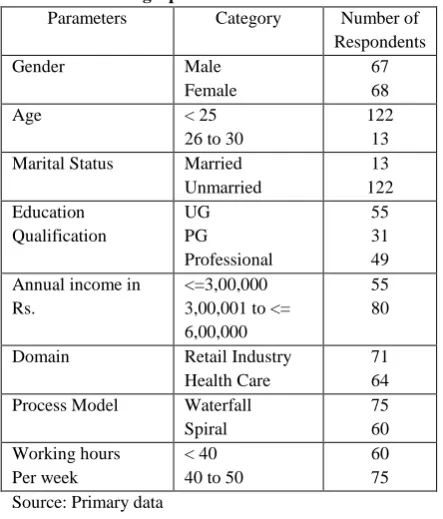
To study the demographic profile of the respondents.
To understand the satisfaction level according to gender about the organization satisfaction, job satisfaction, interpersonal relationship with supervisors and life satisfaction.
To examine the turnover intentions in software testing professionals.
5. HYPOTHESIS OF THE STUDY
H1: There is no significant difference between gender and turnover intentions in software testing professionals at 5 percent level of significance.
H2: There is no significant difference between age and turnover intentions in software testing professionals at 5 percent level of significance.
H3: There is no significant difference between income level and turnover intentions in software testing professionals at 5 percent level of significance.
H4: Male employees will have greater organization satisfaction, job satisfaction, interpersonal relationship with supervisor’s and life satisfaction and lesser turnover intent compared to Female employees.
H5: Organization Satisfaction is negatively correlated with turnover intent.
H6: Job Satisfaction is negatively correlated with turnover intent.
H7: Interpersonal relationship with supervisors is negatively correlated with turnover intent.
H8: Satisfaction in Life is negatively correlated with turnover intent.
6. RESEARCH METHODOLOGY
Type of Research Descriptive cum Exploratory in nature
Nature of data Primary and Secondary data
Data Collection
Questionnaire was prepared and distributed to the respondents; responses were collected through personal interview, E-mails and hosted web site
Area of the study Chennai
Population frame Employees’ from Software Industry
Sampling Unit Employees’ from Software Testing Professionals
Sample size 135
Tools for analysis
Descriptive Statistics :
Frequency, Cross Table, ANOVA, Correlation and Regression
Questionnaire Analysis[Reliability]
Cronbach Alpha:
Organization Satisfaction = 8 items, 0.956 , Job Satisfaction = 13 items, 0.773, Interpersonal relationship with supervisor’s = 9 items, 0.976 , Life Satisfaction = 5 items, 0.663, Turnover Intentions = 2 items, 0.933
Scaling Method
Likert Scale: Strong Agree = 5, Agree = 4, Neutral = 3, Disagree = 2, Strong Disagree = 1
7. RESULTS
profile of the respondents. The section shows the ANOVA results for significant different in hypothesis. The third section describes correlation results and fourth section presents regression analysis.
7.1 Demographic Profile of the Respondents
Table 1: Demographic characteristicsParameters Category Number of
Respondents
Gender Male
Female
67 68
Age < 25
26 to 30
122 13 Marital Status Married
Unmarried 13 122 Education Qualification UG PG Professional 55 31 49 Annual income in
Rs.
<=3,00,000 3,00,001 to <= 6,00,000
55 80
Domain Retail Industry
Health Care
71 64 Process Model Waterfall
Spiral 75 60 Working hours Per week < 40 40 to 50
60 75 Source: Primary data
7.2 ANOVA Results
The Table 2, 3 and 4 shows that there is a significant difference exists among Gender, Education and Income level with respect to turnover intentions. Hence H1, H2 and H3 are rejected. Table 5 shows that comparative study of male employees and female employees on different group variables such as organization satisfaction, job satisfaction, interpersonal relationship with supervisor’s, life satisfaction and turnover intentions. The result reveals that male employees are more satisfied in different group variables and lesser turnover intent. Hence H4 is accepted.
Table 2: ANOVA
Sum of Squares
Df Mean
Square
F Sig.
Between Groups
23.713 1 23.713 12.8
61 .001
Within Groups
245.221 133 1.844
Total 268.933 134
Source: Primary data
Table 3: ANOVA
Sum of Squares
df Mean
Square
F Sig.
Between Groups
13.449 2 6.724 3.47
4 .034
Within Groups
255.485 132 1.935
Total 268.933 134
[image:3.595.309.532.81.165.2]Source: Primary data
Table 4: ANOVA
Sum of Squares
df Mean
Square
F Sig.
Between Groups
13.246 1 13.246 6.89 0
.010
Within Groups
255.688 133 1.922
Total 268.933 134
Source: Primary data
Table 5: Comparison of Male and Female Groups on Different variables [N=135]
Sex
Variables Male ( N = 67) Mean S.D
Female ( N = 68)
Mean S.D Organization
Satisfaction
3.287 0.941 2.572 0.91
Job Satisfaction 3.691 0.482 3.37 0.408 Interpersonal
Relationship with Supervisor’s
3.249 0.983 2.428 0.87
Life Satisfaction 3.397 0.544 3.015 0.616 Turnover
Intentions
3.00 1.348 3.838 1.367
[image:3.595.48.270.148.408.2]Source: Primary data
Table 6: Opinion about Organization Satisfaction
SA A N D SD
I am familiar with
organization's current vision & mission 49 (36.3) 69 (51.1) 12 (8.9) 4 (3.0) 1 (.7 ) The Organization is maintaining consistent policies 32 (23.7) 21 (15.6) 2 (1.5) 23 (17.0) 57 (4 2.2 ) The Organization motivates employees 6 (4.4) 49 (36.3) 7 (5.2) 30 (22.2) 43 (3 1.9 ) The Organization openly discusses job related issues with the employees 6 (4.4) 30 (22.2) 40 (29.6 ) 51 (37.8) 8 (5. 9) The Organization follows standard appraisal procedure 4 (3.0) 54 (40.0) 13 (9.6) 11 (8.1) 53 (3 9.3 ) The Organization
[image:3.595.313.545.388.758.2]Source: Primary data [SA=Strongly Agree, A=Agree, N=Neutral, D=Disagree, SD=Strongly Disagree]
Table 7: Opinion about Job Satisfaction
SA A N D SD
I am fairly paid for the job i perform 55 (40.7) 49 (36.3) 11 (8.1) 13 (9.6) 08 (5.2)
I have sufficient resources to do my job 75 (55.6) 40 (29.6) 11 (8.1) 05 (3.7) 04 (3.0)
I am relatively free to my job
55 (40.7) 62 (45.9) 11 (8.1) 04 (3.0) 03 (2.2) I am having good
relationship with my team members
17 (12.6) 62 (45.9) 14 (10.4) 38 (28.1) 04 (3.0)
I am satisfied with my supervisor(s) role 06 (4.4) 44 (32.6) 33 (24.4) 16 (11.9) 36 (26. 7) Work load is
reasonable 11 (8.1) 110 (81.5) 11 (8.1) 02 (1.5) 01 (.7) My present job
demands frequent extended working hours 10 (7.4) 63 (46.7) 18 (13.3) 20 (14.8) 24 (17. 8)
I feel I have a secured job 73 (54.1) 49 (36.3) 13
(9.6) 0 0
There is a Stress in my job
07 (5.2) 34 (25.2) 13 (9.6) 71 (52.6) 10 (7.4) I am encouraged
to come up with innovative ideas on the job
22 (16.3) 35 (25.9) 58 (43.0) 12 (8.9) 08 (5.9)
There is a recognition in my job 19 (14.1) 44 (32.6) 16 (11.9) 47 (34.8) 09 (6.7)
I am aware of promotional opportunities and also i have a chance of advancement 21 (15.6) 42 (31.1) 57 (42.2) 09 (6.7) 06 (4.4) The way organizational policies are put into practice is good 19 (14.1) 30 (22.2) 48 (35.6) 22 (16.3) 16 (11. 9)
Source: Primary data [SA=Strongly Agree, A=Agree, N=Neutral, D=Disagree, SD=Strongly Disagree]
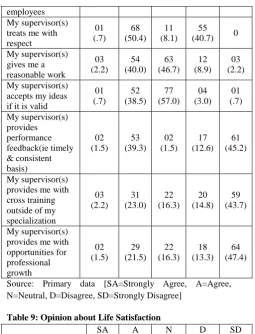
Table 8: Opinion about Interpersonal Relationship with Supervisor’s
SA A N D SD
There is a smooth interpersonal communication 44 (32.6) 26 (19.3) 21 (15.6) 44 (32.6) 0
I get sufficient knowledge from my supervisor(s) 32 (23.0) 24 (17.8) 25 (18.5) 47 (34.8) 08 (5.9) My supervisor(s) is consistent in applying the rules to all the
02 (1.5) 27 (20.0) 26 (19.3) 27 (20.0) 53 (39.3) employees My supervisor(s) treats me with respect 01 (.7) 68 (50.4) 11 (8.1) 55 (40.7) 0
My supervisor(s) gives me a reasonable work 03 (2.2) 54 (40.0) 63 (46.7) 12 (8.9) 03 (2.2) My supervisor(s) accepts my ideas if it is valid
01 (.7) 52 (38.5) 77 (57.0) 04 (3.0) 01 (.7) My supervisor(s) provides performance feedback(ie timely & consistent basis) 02 (1.5) 53 (39.3) 02 (1.5) 17 (12.6) 61 (45.2) My supervisor(s) provides me with cross training outside of my specialization 03 (2.2) 31 (23.0) 22 (16.3) 20 (14.8) 59 (43.7) My supervisor(s) provides me with opportunities for professional growth 02 (1.5) 29 (21.5) 22 (16.3) 18 (13.3) 64 (47.4)
[image:4.595.48.290.111.592.2]Source: Primary data [SA=Strongly Agree, A=Agree, N=Neutral, D=Disagree, SD=Strongly Disagree]
Table 9: Opinion about Life Satisfaction
SA A N D SD
In most ways my life is close to my ambition & wishes
25 (18.5) 65 (48.1) 18 (13.3) 19 (14.1) 08 (5.9)
The conditions of my life are excellent
11 (8.1) 51 (37.8) 43 (31.9) 19 (14.1) 11 (8.1) I am satisfied with
my life 15 (11.1) 30 (22.2) 61 (45.2) 11 (8.1) 18 (13.3) So far i have got the
important things i wanted in life
03 (2.2) 39 (28.9) 69 (51.1) 21 (15.6) 03 (2.2)
I would change almost nothing hereafter in my life
05 (3.7) 10 (7.4) 102 (75.6) 11 (8.1) 07 (5.2)
Source: Primary data [SA=Strongly Agree, A=Agree, N=Neutral, D=Disagree, SD=Strongly Disagree]
7.3 Correlation Results
[image:4.595.48.291.115.591.2]Source: Primary data
7.4 Regression Results
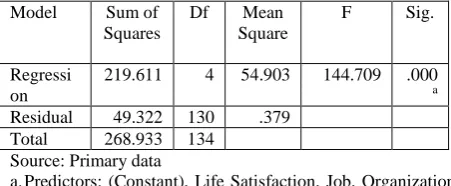
[image:5.595.61.534.87.282.2]Based on the results of the correlation analysis, stepwise regression analysis were carried out to determine true relationship exists between four independent variables such as organization satisfaction, job satisfaction, interpersonal relationship with supervisor’s, life satisfaction and one dependent variable is turnover intentions. The table 12 reveals that it is significant for predicting independent variables and dependent variable. The table 13 reveals that Organization Satisfaction and Interpersonal relationship with supervisors are the strong predictors for turnover intentions among new entrants in software testing professionals.
Table 11: Model Summary
Model R R
Square
Adjusted R Square
Std. Error of the Estimate
1 .904
a
.817 .811
.61596 Source: Primary data
[image:5.595.72.550.88.505.2]a. Predictors: (Constant), Life Satisfaction, Job, Organization, Interpersonal Relationship
Table 12: ANOVA
Model Sum of Squares
Df Mean Square
F Sig.
Regressi on
219.611 4 54.903 144.709 .000 a
Residual 49.322 130 .379 Total 268.933 134
Source: Primary data
a.Predictors: (Constant), Life Satisfaction, Job, Organization, Interpersonal Relationship
[image:5.595.275.547.90.709.2]b.Dependent Variable: Turnover Intentions
Table 13: Coefficients
Model Unstandardize
d Coefficients
Standar dized Coeffic ients
T Sig.
B Std. Error
Beta
(Constant) 7.59 4
.512 14.824 .000
Organization Satisfaction
-.343 .172 -.240 -1.996 .048
Job Satisfaction -.297 .176 -.099 -1.689 .094 Interpersonal
Relationship with Supervisor’s
-.862 .183 -.616 -4.712 .000
Life Satisfaction
.102 .101 .044 1.009 .315
Source: Primary data
a. Dependent Variable: Turnover Intentions
Figure 1
Source: Primary Data
Figure 2 Table 10 : Correlations between Different Variables (N = 135)
Organizatio n Satisfaction
Job Satisfaction
Interpersonal Relationship
with Supervisor’s
Life Satisfaction
Turnover Intentions
Organization Satisfaction
Pearson Correlation 1 .725** .950** .468** -.876**
Sig. (2-tailed) .000 .000 .000 .000
Job Satisfaction Pearson Correlation .725** 1 .766** .436** -.726**
Sig. (2-tailed) .000 .000 .000 .000
Interpersonal Relationship
Pearson Correlation .950** .766** 1 .504** -.898**
Sig. (2-tailed) .000 .000 .000 .000
Life Satisfaction Pearson Correlation .468** .436** .504** 1 -.422**
Sig. (2-tailed) .000 .000 .000 .000
Turnover Intentions
Pearson Correlation -.876** -.726** -.898** -.422** 1
Sig. (2-tailed) .000 .000 .000 .000
[image:5.595.49.274.457.504.2] [image:5.595.49.275.560.653.2]Source: Primary Data
8. CONCLUSION
The study shows Organization Satisfaction and Interpersonal relationship with supervisors are the strong predictors for turnover intentions. Job Satisfaction and Life Satisfaction have no impact on turnover intentions among software testing professionals. Results from the Figure 1 and Figure 2, clearly indicates that maximum impact reason for turnover intentions among software testing professionals are lesser amount of motivation towards employees[11.07%], No standard appraisal procedures for employee career benefits[11.07%] and Supervisor’s doesnot providing opportunities for professional growth[8.48%]. From the table 5, it is understood that male employees are more satisfied when compared to female employees. It is also observed that male = 80.59 % and female = 80.88 % agrees that they are interested in doing testing job. The study can be extended to compare and contrast with a variety of other sectors. The study concludes that employee is the biggest asset for the organization. The organization has to revise the current policies for the new entrants and needs to motivate them. As well as the supervisors has to be more open mind in providing consistent performance feedback and give more opportunity for the new entrants to learn new things in the current technology in order to retain the talented young employees.
9. ACKNOWLEDGEMENT
I sincerely thank Mr.V.Balu, System Administrator, SCSVMV University for his kind co-operation.
10. REFERENCES
[1] Zhigang Wu & Xiangmin Li, “Strategic Analysis of Employee Turnover”, IEEE, 978-1-4244-6581-1, 2011.
[2] Zhang Guangyu, Li Huajun & Zhang Depeng, “Risk Management on Knowledge Employees Turnover in High-tech Firms -Based on Fuzzy Comprehensive Evaluation”, IEEE, 978-0-7695-3435-0/08, pp.399-402.
[3] Xinhui Jiang & Qiang Zhang, “When Will Employees with High Impact Quit? The Interactive Effect of Impact and Supervisor’s Monitoring on Chinese Employees’Turnover Intention”, CROWN, 978-1-4244-6581-1, 2011.
[4] Dayong Wang ,”Research on the Influence of Working Pressure on Turnover Intention of New Employees”, IEEE, 978-1-4244-6581-1, 2011.
[5] Zhang Jiandong, “Employee Engagement Investigation in IT Industry”, IEEE, 978-1-4244-4507-3, 2009.
[6] Qin Zhou, “The Impact of Job Satisfaction Affect on Turnover Intention: An Empirical Study Based on the Circumstances of China", IEEE, 978-0-7695-3936-2, 2009, pp.220-223.
[7] Dawn Owens&Deepak Khazanchi, “Best Practices for Retaining Global IT Talent”, IEEE, 1530-1605,2011, pp.1-12.
[8] Jo Ellen Moore , “Illuminating the Other Road: The Role of Voice in IT Turnover”, IEEE, 1530-1605, 2011.
[9] Oksan Imamoglu & Sitki Gozlu, “The Sources of Success and Failure of Information Technology Projects: Project Managers’ Perspective”, PICMET Proceedings, 27-31 July 2008, Cape Town, South Africa, pp.1430-1435.
[10]Janice M Bum, Dr. D Couger, Louis Ma & Dr. Hiram Tompkins, “Motivating IT Professionals - The Hong Kong Challenge”, IEEE, 0073-11 29,1991, pp.524-529.
[11]F. Calisir, C.A. Gumussoy & I. Iskin, “Factors Affecting Intention to Quit among IT Professionals”, IEEE, 978-1-4244-4870-8, 2009, pp.49-53.
[12]J. Sheard & S. Markham,“Creating an Interest in IT: A Gender Study”, Proceedings of the International Conference on Computers in Education (ICCE’02), 0-7695-1509-6, 2002.
[13]Y.P.S. Kanwar, A.K.Singh & Amitabh Deo Kodwani, “A Study of Job Satisfaction and Organizational Commitment and Turnover Intent among the IT and
ITES Sector Employees”, SAGE,
DOI:10.1177/097226291201600103, 16(1), 2012, pp.27-35.
[14]Steven G. westlund & John C. Hannon, “Retaining talent: Assessing job satisfaction facets most significantly related to software developer turnover intentions”, Journal of Information Technology Management, ISSN: 1042-1319, Volume XIX, Number 4, 2008, pp.1-15.
[15]Prodromos D. Chatzoglou, Eftichia Vraimaki, Eleni Komsiou, Elena Polychrou & Anastastios D. Diamantidis,Factors Affecting Accountants’ Job Satisfaction and Turnover Intentions: A Structural Equation Model, 8th International Conference on Enterprise Systems, Accounting and Logistics (8th ICESAL 2011) 11-12, July 2011, Thassos Island, Greece, pp.130-147.
[16]Abdul Rahman, S. M. M. Raza Naqvi & M. Ismail Ramay,”Measuring Turnover Intention: A Study of IT Professionals in Pakistan”, International Review of Business Research Papers, Vol. 4 No.3, June 2008, pp.45-55.
[18]Ify Diala, “Job Satisfaction Management System Approach on Information Technology Professionals”, World Applied Programming, ISSN: 2222-2510, Vol (1), No (4), October 2011, pp.232-236.
[19]Kalim Ullah Khan, Syed Umar Farooq & Muahmmad Imran Ullah,”The Relationship between Rewards and Employee Motivation in Commercial Banks of Pakistan”, Research Journal of International Studies - Issue 14,May 2010, pp.37-52.
[20]Mark E. McMurtrey, James P. Downey, Steven M. Zeltmann, & William H. Friedman,”Critical Skill Sets of Entry-Level IT Professionals: An Empirical Examination of Perceptions from Field Personnel”, Journal of Information Technology Education Volume 7, 2008, pp.101-120.
[21]Deborah J. Armstrong , Cynthia K. Riemenschneider, Myria W. Allen , Margaret F. Reid, “Advancement, voluntary turnover and women in IT: A cognitive study of work–family conflict”, Information & Management, 44,2007, pp.142–153.
[22]Janice Anna Knights & Barbara Jean Kennedy,”Psychological Contract Violation: Impacts on Job Satisfaction and Organizational Commitment Among Australian Senior Public Servants”, Applied H.R.M. Research, 2005, Volume 10, Number 2, pp.57-72
[23] Jordan Shropshire & Christopher Kadlec, “I’m Leaving
the IT Field: the Impact of Stress, Job Insecurity, and Burnout on IT Professionals”, International Journal of Information and Communication Technology Research, Volume 2 No. 1, January 2012, pp.6-16.
[24]Sarah Beecham, Nathan Baddoo, Tracy Hall, Hugh Robinson & Helen Sharp, “Motivation in Software Engineering: A systematic literature review”, Information and Software Technology 50, 2008, pp.860– 878.
[25]Jamie Cano & Greg Miller, “A Gender Analysis of Job Satisfaction, Job Satisfier Factors, and Job Dissatisfier Factors of Agricultural Education Teachers”, Journal of Agricultural Education, 1992, pp.40-46.
[26]Omesh Chadha, Employee Satisfaction- A Study Of Hcl Limited, International Journal Of Research In Commerce & Management, ISSN 0976-2183, Volume No. 2, Issue No. 9,2011, pp. 131-135.
[27]S.M. Shariq Abbas, “Banking Professionals And Attitudinal Dimension Of Job Satisfaction: A Descriptive Study”, International Journal Of Research In Commerce, IT & Management, ISSN 2231-5756, Volume No.1, Issue No. 6, 2011, pp.119-124.
[28]Syed Akif Hasan & Muhammad Imtiaz Subhani,”Managerial Social Wisdom: A Major Facet for Employee Turnover Intentions, Work Commitments and Manager-Subordinate Relationships, European Journal of Economics, Finance and Administrative Sciences, ISSN 1450-2275, Issue 40,2011, pp.132-137.
[29]Sohrab Ahmad, Khurram Shahzad, Shams-ur-Rehman, Nadeem Ahmed Khan & Ikram Ullah Shad, “Impact of Organizational Commitment and Organizational Citizenship Behavior on Turnover Intentions of Call Center Personnel in Pakistan”, European Journal of Social Sciences – Volume 17, Number 4,2010, pp.585-591.
[30]Hamdia Mudor & Phadett Tooksoon, “Conceptual framework on the relationship between human resource management practices, job satisfaction, and turnover”, Journal of Economics and Behavioral Studies, Vol. 2, No. 2, 2011, pp.41-49.
[31]Iqtidar Ali Shah, Zainab Fakhr, M. Shakil Ahmad & Khalid Zaman, “Measuring Push, Pull and Personal Factors Affecting Turnover Intention: A Case Of University Teachers In Pakistan”, Review of Economic & Business Studies, ISSN-1843-763X, Volume 3, Issue 1, 2010, pp. 167-192.
[32]Priya Chandna & Venkat R. Krishnan, “Organizational
Commitment of Information technology professionals: Role of Transformational leadership and work-related beliefs”, Tecnia Journal of Management Studies, Vol. 4, No. 1, 2009, pp.1-13.
[33]Dr.S.S. Riaz Ahamed,”Studying the feasibility and importance of Software Testing: An Analysis”, International Journal of Engineering Science and Technology, Vol.1(3),2009, pp.119-128
[34]Xihui Zhang, Jasbir Dhaliwal & Mark L. Gillenson,” Organizing Software Testing For Improved Quality and Satisfaction”, Journal of Information Technology Management, ISSN :1042-1319, Volume XXI, Number 4, 2010, pp. 1-12.
[35]Thomas Acton & Willie Golden ,”Training: The Way to Retain Valuable IT Employees?”, Informing Science,2002, pp.1-12
[36]Tariq Mehmood Rana, M. Rashid Salaria, Gobind M. Herani and Mohammad Ahmed Amin, “Identifying Factors Playing Important Role in the Increasing Employee Turnover Rate: A Case of Telecom Industry in Pakistan”, Indus Journal of Management & Social Sciences, 3(2), 2009, pp.80-89.
[37]Caramollah Daneshfard & Kokab Elsadat Ekvaniyan,Organizational Commitment and Job Satisfaction In Islamic Azad University, Interdisciplinary Journal Of Contemporary Research In Business, Vol.3, No.9,2012, pp.168-181.
[38] Sinem Aydogdu & Baris Asikgil, “An Empirical Study
of the Relationship Among Job
Satisfaction,Organizational Commitment and Turnover Intention, International Review of Management and Marketing, ISSN: 2146-4405, Vol. 1, No. 3, 2011, pp.43-53.
[39]Raheleh Emami, Ebrahim Moradi, Durrishah Idrus & Dhaifallah Obaid Almutairi “Investigating the Relationship between Organizational Learning Culture, Job Satisfaction and Turnover Intention in it SMEs”, International Journal of Innovative Ideas, Volume 12(1),2012, pp. 8-23.
[40]M.Kannan & K.Vivekanandan, “The cost and impact of staff attrition”, International Journal of Emerging Technologies and Applications in Engineering Technology and Sciences, ISSN: 0974 -3588, Vol.3, Issue 2, 2010, pp.37-40.