Operations on Intuitionistic Fuzzy Hypergraphs
R.Parvathi
Department of Mathematics Vellalar College for Women Erode, Tamilnadu, India.
S.Thilagavathi
Department of Mathematics Vellalar College for Women Erode, Tamilnadu, India.
M.G.Karunambigai
Department of Mathematics Sri Vasavi College, Erode
Tamilnadu, India.
ABSTRACT
Hypergraph is a graph in which an edge can connect more than two vertices. Hypergraphs can be applied to analyze architecture structures and to represent system partitions. The concept of hypergraphs was extended to fuzzy hypergraph
.
In this paper, we extend the concepts of fuzzy hypergraphs into that of intuitionistic fuzzy hypergraphs. Based on the definition of intuitionistic fuzzy graph, operations like complement, join, union, intersection, ringsum, cartesian product, composition are defined for intuitionistic fuzzy graphs. The authors further proposed to apply these operations in clustering techniques.Keywords
Intuitionistic fuzzy hypergraph (IFHG), Complement, Union, Join, Intersection, Ringsum, Cartesian product, Composition.
1.
INTRODUCTION
Hypergraph theory, originally developed by C.Berge in 1960, is a generalization of graph theory. The concept of hypergraphs can model more general types of relations than binary relations. The notion of hypergraphs has been extended in fuzzy theory and the concept of fuzzy hypergraphs was proposed by Lee-Kwang and S.M.Chen. The concept of an intuitionistic fuzzy graph (IFG) was introduced by Atanassov [1,2,3,4]. The authors have already introduced the concept of intuitionistic fuzzy hypergraph [7]. Operations on IFGs have also been analyzed by the authors [5,6]. Akram [8] applied the concepts in [7] to a real-life problem with a numerical example.
2.
PRELIMINARIES
Definition 2.1
An intuitionistic fuzzy graph (IFG) is of the V, E
G where (i) V v , v , ...,v
1 2 n
such that1 0 1
μ :V , and γ :V1 0 1, denote the degree of membership and non-membership of the element vi V respectively and
0 μ (v ) γ (v ) 1 i 1 i 1 (1)
for every vi V , ( i = 1, 2, …, n ), (ii)E V V where μ :V V2 0 1, and γ :V V2 0 1, are such that
μ (v , v ) μ (v ). μ (v )2 i j 1 i 1 j (2)
γ (v , v ) γ (v ). γ (v )2 i j 1 i 1 j (3)
and 0μ (v , v ) γ (v , v ) 2 i j 2 i j 1 (4)
for every (v , v ) Ei j .
Definition 2.2
An IFHG H is an ordered pair H V, E where (i) V
v1, v2, ...,vn
, a finite set of vertices (ii) E
E1, E2, ...,En
, a family of intuitionistic fuzzysubsets of V. .(iii)Ej
v ,μ v ,γ vi j
i j i
: μ v ,γ vj
i j i 0 and 0j( )vi j( ) 1v i , j = 1, 2 ,…, m (iv) Ejφj = 1,2,…,m (v) Ujsupp
Ej V, j=1, 2 ,…, mHere the edges Ej are IFSs. j( ) andx i j( )xi denote the
degree of membership and non-membership of the vertex vi to edgeE . Thus, the elements of the incidence matrix of IFHG j are of the form a ,μ x ,γ x
ij j
i j i
. The sets V and E are crisp sets.Notations
The triple v , μ , γi 1i 1i denotes the degree of membership and non-membership of the vertexvi. The triple e , μ , γij 2ij 2ij
denotes the degree of membership and non-membership of the edge eij
v ,vi j on V. That is,1i 1 i 1i 1 i and
μ μ (v ), γ γ (v ) μ2ijμ (v ,v ), γ2 i j 2ijγ (v ,v )2 i j
.
Note 2.3
Definition 2.4
An IFHG , G V, E is said to be a semi - μ strong IFHG if μ2ijμ .μ1i 1jfor every i and j.
Definition 2.5
An IFHG , G V, E is said to be a semi - γ strong IFHG if γ2ijγ .γ1i 1j for every i and j.
Definition 2.6
An IFHGG V, E is said to be a strong IFHG if
2ij 1i 1j
μ μ .μ and γ2ijγ .γ1i 1jfor all ( , )v vi j E.
Definition 2.7
An IFHG , G V, E is said to be a complete -μ strong IFHG if μ2ijμ .μ1i 1j and γ2ijγ .γ1i 1j
Definition 2.8
An IFHG , G V, E is said to be a complete -γ strong IFHG if μ2ijμ .μ1i 1j and γ2ijγ .γ1i 1j for all i and j.
Definition 2.9
An IFHG , G V, E is said to be a complete IFHG if
2ij 1i 1j
μ μ .μ and γ2ijγ .γ1i 1j, for every (v ,v ) Vi j .
3.
COMPLEMENT OF AN IFHG
Definition 3.1
The complement of an IFHG G V, E is an IFHG, E
, V
G , where
V V μ μ1i 1i and γ γ1i 1i, for all i = 1, 2, …, n.
μ (μ . μ ) μ2ij 1i 1j 2ijandγ (γ . γ ) γ2ij 1i 1j 2ij for all i, j = 1, 2, …, n.
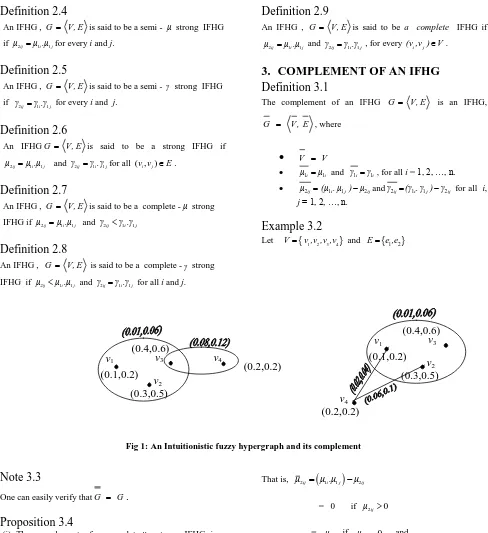
Example 3.2
[image:2.595.54.542.68.601.2]Let V
v ,v ,v ,v1 2 3 4
and E
e ,e1 2
Fig 1: An Intuitionistic fuzzy hypergraph and its complement
Note 3.3
One can easily verify thatG G
.
Proposition 3.4
(i) The complement of a completeμ - strong IFHG is a complete IFHG.
(ii) The complement of a complete γ- strong IFHG is a complete IFHG.
Proof
(i) LetG V, E be a complete μ - strong IFHG. Therefore,
2ij 1i 1j
μ μ .μ and γ2ijγ .γ1i 1j for all i and j.
To prove that either (a) μ2ij0 orγ2ij0, (b) μ2ij0 or
2ij 0
γ .
That is, μ2ij
μ .μ1i 1j
μ2ij= 0 if μ2ij0
= μ1i if μ2ij0 and
1 1
22ij i j ij 0
γ γ .γ γ for every i and j, since G is a complete μ - strong IFHG. (ii) Proof of (ii) is the same as proof of (i).
Definition 3.5
Consider the two IFHGs G1 V , E1 1 andG2 V , E2 2 . An isomorphism between two IFHGs G1andG2 , denoted by G1G2, is a bijective map
1 2
h :V V which satisfies
1 i 1 i ;
μ (v ) μ'(h(v )) γ (v ) γ'(h(v ))1 i 1 i and
v
4v
1v
2v
3(0.1,0.2)
(0.3,0.5)
(0.4,0.6)
(0.2,0.2)
(0.2,0.2)
v
4v
1v
2v
3(0.1,0.2)
2 i j 2 i j ;
μ (v ,v ) μ '(h(v ),h(v )) γ (v ,v ) γ '(h(v ),h(v )2 i j 2 i j for
every( vι,vj)V .
Definition 3.6
An IFHG G is self-complementary if G is isomorphic toG. Symbolically, G1G2.
Theorem 3.7
Let G V, E be a self-complementary IFHG. Then, there exists an isomorphism h:V V such that
1 i 1i
μ (v ) μ ;γ (v ) γ1 i 1i, for every vi V and
2 i j 2i
μ (h(v ),h(v )) μ ; γ (h(v ),h(v )) γ2 i j 2i for every V
) j ,v ι
( v .
Proof
By Definition 3.1, we have
2 i j 1 i 1 j 2ij
μ (h(v ),h(v )) ( μ (h(v )).μ (h(v ))) μ 2 i j 1i 1j 2ij
μ (v ,v ) μ .μ μ
μ2ijμ .μ1i 1jμ2ij
2ij 1i 1j 2ij
μ (μ .μ ) μ
i j i j i j
2 μ2ij (μ .μ )1i 1j
i j i j
2 1 1
1 2
ij i j
μ (μ .μ )
i j i j
. and
2 i j 1 i 1 j 2ij
γ (h(v ),h(v )) ( γ (h(v )).γ (h(v ))) γ 2ij 1i 1j 2ij
γ (γ .γ ) γ
γ2ij (γ .γ )1i 1j γ2ij
i j i j i j
2 1 1
2 γij (γ .γ )i j
i j i j
2 1 1
1 2
ij i j
γ (γ .γ )
i j i j
.
Remark 3.8
The condition in the above theorem is not sufficient.
Theorem 3.9
If G is a strong IFHG, then Gis also strong.
Proof
Let uvE. Then
2 1 1 2
μ (uv) μ (u). μ (v) μ (uv)
=μ (u). μ (v) μ (u). μ (v)1 1 1 1 , since G is strong
= 0 and γ (uv) γ (u).γ (v) γ (uv)2 1 1 2 =γ (u).γ (v) γ (u). γ (v)1 1 1 1 , since G is strong = 0.
Let uvE. Then μ (uv) (μ (u). μ (v)) μ (uv)2 1 1 2 =
1 1
μ (u).μ (v) and γ (uv) γ (u). γ (v) γ (uv)2 1 1 2 = γ (u). γ (v) 1 1 .
4.
OPERATIONS ON INTUITIONISTIC
FUZZY HYPERGRAPHS
Definition 4.1
Let G1 V , E1 1 and G2 V , E2 2 be two IFHGs with
1 2
VIV φ. Then the union of G1andG2 is an IFHG
1 2
G G UG V1UV , E2 1UE2 defined by
1 1 1
1 1
1 2 1
μ (v) if v V V
(μ μ')(v)
μ'(v) if v V V
U
1 1 2
1 1
1 2 1
γ (v) if v V V
(γ γ')(v)
γ'(v) if v V V
U
and 2 2 2 1 2
2 2 1
ij ij i j
ij ij
μ if e E E
(μ μ ')(v v )
μ ' if e E E
U
2 1 2
2 2
2 2 1
ij ij i j
ij ij
γ if e E E
(γ γ ')(v v )
γ ' if e E E
U
where (μ ,γ )1 1 and (μ ',γ ')1 1 refer the vertex membership and non-membership of G1andG2 respectively; (μ ,γ )2 2 and
2 2
(μ ',γ ')refer the edge membership and non-membership of 1and 2
G G respectively.
Definition 4.2
The join of two IFHGs G1andG2is an IFHG GG1G2 =
1 2 1 2
VUV , E UE UE' defined by
1 1 1 1 if 1 2
(μ μ')(v) (μ Uμ')(v) v V UV
1 1 1 1 if 1 2
(γ γ')(v) (γ Uγ')(v) v V UV
2 2 i j 2 2 i j
if
i j 1 2(μ
μ ')(vv ) (μ μ ')(v v ) vv E E
U
U
1 i 1 j
if
i j(μ (v ).μ'(v )
v v E'
and
2 2 2 2 1 2
1 1 if if
i j i j i j
i j i j
(γ γ ')(v v ) (γ γ ')(v v ) v v E E (γ (v ).γ '(v ) v v E'.
U U
Definition 4.3
Let G1 V , E1 1 and G2 V , E2 2 be two IFHGs. Then the intersection of IFHGs G1andG2 denoted by G1I G2is an
IFHG defined by 1 1 1 1 2
1 2 1
if and
if and
(v) v V V
( ')(v)
'(v) v V V
I
1 1 2
1 1
1 2 1
if and
if and
γ (v) v V V (γ γ')(v)
γ'(v) v V V
and
2 1 2
2 2
2 1 2
if and
if and
ij ij i j
ij ij
μ e E E
(μ μ ')(v v )
μ ' e E E
I
2 1 2
2 2
2 1 2
if and
if and
ij ij i j
ij ij
e E E
( ')(v v )
' e E E
I
Definition 4.4
Let G1 V , E1 1 and G2 V , E2 2 be two IFHGs. Then the ringsum of IFHGs G1andG2 is an IFHG defined by
1 2 1 2 1 2
G G GUG GI G .
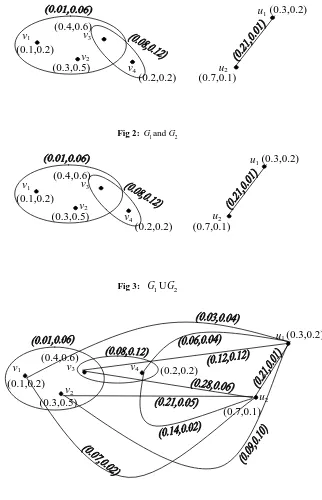
Example 4.5
[image:4.595.149.471.238.738.2]Let V1
v ,v ,v ,v1 2 3 4
and V2
u ,u1 2
such that V1IV2φFig 2: G1andG2
Fig 3:
G
1U
G
2Fig 4:
v
4v
1v
2v
3(0.1,0.2)
(0.3,0.5)
(0.4,0.6)
(0.2,0.2)
(0.7,0.1)
u
2u
1(0.3,0.2)
v
1(0.1,0.2)
v
4v
2v
3(0.3,0.5)
(0.4,0.6)
(0.2,0.2)
(0.7,0.1)
u
2u
1(0.3,0.2)
v
1(0.1,0.2)
v
4v
2v
3(0.3,0.5)
(0.4,0.6)
(0.2,0.2)
(0.7,0.1)
u
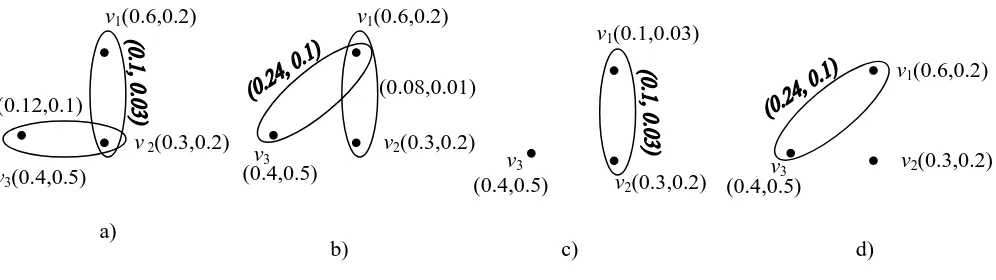
2Example 4.6
For the operation intersection and ringsum we consider
1 1 2 3
V v ,v ,v and V2
v ,v ,v1 2 3
and V1I V2φTheorem 4.7
Let G1 V , E1 1 and G2 V , E2 2 be two IFHGs. Then (i)
1 2 1 2
G G GUG (ii)G1UG2G1G2
Fig 5: a) G1 b) G2 c) G1IG2 d) G1G2
Proof
Consider the identity map I :V1UV2V1UV2.To prove (i), it is enough to prove
a) (i) ( μ1μ' )(v ) ( μ1 i 1Uμ' )(v )1 i
(ii) ( γ1γ' )(v ) ( γ1 i 1Uγ' )(v )1 i
(b) (i) ( μ2μ ' )(v ,v ) ( μ2 i j 2Uμ ' )(v ,v )2 i j
(ii) ( γ2γ ' )(v ,v ) ( γ2 i j 2Uγ ' )(v ,v )2 i j .
(a) (i) ( μ1μ' )(v ) (μ1 i 1μ')(v )1 i , by Definition 4.1
= 1 1
1 2
if if
i i i i
μ (v ) v V μ'(v ) v V
= 1 1
1 2
if if
i i
i i
μ (v ) v V μ'(v ) v V
= ( μ1Uμ' )(v )1 i .
(ii) ( γ1γ' )(v ) (γ1 i 1γ')(v )1 i , by Definition 4.1
= 1 1
1 2
if if
i i i i
γ (v ) v V γ'(v ) v V
= 1 1 1 2 if if i i i i
γ (v ) v V γ'(v ) v V
= ) i )( v ' γ γ
( 1 1 .
(b) (i) 2 2 1 1 1 1
2 2
( )
i j i j
i j
( ' )(v ,v ) ' (v ).( ')(v )
( ')(v ,v )
1 1 1 1 2 2
1 2
1 1 1 1 1 1
if
i j i j
i j
i j i j
(μ μ')(v ).(μ μ')(v ) (μ μ ')(v ,v ) (v ,v ) E E (μ μ')(v ).(μ μ')(v )) μ (v ).μ'(v )
U U U
U
U U
if i j
(v ,v ) E'.
1 1 2 1
1 1 2 2
1 1 1 1
if if
if
i j i j i j i j i j i j i j i j i j
μ (v ).μ (v ) μ (v ,v ) (v ,v ) E μ'(v ).μ'(v )) μ '(v ,v ) (v ,v ) E μ (v ).μ'(v ) μ (v ).μ'(v ) (v ,v ) E'
2 1 2 2 if if 0 if
i j i j
i j i j i j
μ (v ,v ) (v ,v ) E μ '(v ,v ) (v ,v ) E
(v ,v ) E'
= ( μ2Uμ ' )(v ,v )2 i j .
(b) (ii) 2 2 1 1 1 1
2 2
( )
i j i j
i j
( γ γ ' )(v ,v ) γ γ' (v ).(γ γ')(v ) (γ γ ')(v ,v )
1 1 1 1 2 2
1 2
1 1 1 1 1 1
if
i j i j
i j
i j i j
(γ γ')(v ).(γ γ')(v ) (γ γ ')(v ,v )
(v ,v ) E E (γ γ')(v ).(γ γ')(v ) γ (v ).γ'(v )
U U U
U
U U
if i j
(v ,v ) E'.
1 1 2 1
1 1 2 2
1 1 1 1
if if
if i j i j i j i j i j i j i j i j i j
γ (v ).γ (v ) γ (v ,v ) (v ,v ) E γ'(v ).γ'(v ) γ '(v ,v ) (v ,v ) E γ (v ).γ'(v ) γ (v ).γ'(v ) (v ,v ) E'
2 1 2 2 if if 0 if
i j i j
i j i j i j
γ (v ,v ) (v ,v ) E γ '(v ,v ) (v ,v ) E (v ,v ) E'
= ( γ2Uγ ' )(v ,v )2 i j .
v
2(0.3,0.2)v
1(0.6,0.2)a)
d)
v
3b)
v
1(0.6,0.2)(0.12,0.1)
v
2(0.3,0.2)(0.08,0.01)
v
2(0.3,0.2)v
1(0.6,0.2)v
3c)
v
3v
2(0.3,0.2)v
1(0.1,0.03)(0.4,0.5)
(0.4,0.5)
(0.4,0.5)
[image:5.595.67.565.171.311.2]To prove (ii), it is enough to prove that
(a) (i) ( μ1Uμ' )(v ) ( μ1 i 1μ' )(v )1 i
(ii) ( γ1Uγ' )(v ) ( γ1 i 1γ' )(v )1 i
(b) (i) ( μ2Uμ ' )(v ,v ) ( μ2 i j 2μ ' )(v ,v )2 i j
(ii) ( γ2Uγ ' )(v ,v ) ( γ2 i j 2γ ' )(v ,v )2 i j .
Consider the identity map : I :V1UV2V1UV2.
(a) (i) ( μ1Uμ' )(v )1 i = (μ1Uμ')(v )1 i
1 1 1 2 if if i i i i
μ (v ) v V μ'(v ) v V
1 1 1 2 if if i i i i
μ (v ) v V μ'(v ) v V
1 1 i
( μ μ' )(v )
U ( μ1μ' )(v )1 i .
(a)(ii) ( γ1Uγ' )(v )1 i = (γ1Uγ')(v )1 i
1 1 1 2 if if i i i i
γ (v ) v V γ'(v ) v V 1 1 1 2 if if i i i i
γ (v ) v V γ'(v ) v V
1 1 i
( γ γ' )(v )
U ( γ1γ' )(v )1 i .
(b)(i)
2 2 1 1 1 1
2 2
i j i j
i j
( μ μ ' )(v ,v ) (μ μ')(v ).(μ μ')(v ) (μ μ ')(v ,v )
U U U
U
1 1 2 1
1 1 2 2
1 1 1 2
if if 0 if
i j i j i j i j i j i j
i j i j
μ (v ).μ (v ) - μ (v ,v ) (v ,v ) E μ '(v ).μ '(v ) - μ '(v ,v ) (v ,v ) E μ (v ).μ '(v ) - v V , v V
2 1 2 2
1 1 1 2
if if
if
i j i j
i j i j
i j i j
μ (v ,v ) (v ,v ) E μ '(v ,v ) (v ,v ) E
μ (v ).μ'(v ) v V , v V
2 2 1 2
1 1
if or
if
i j i j
i j i j
( μ μ ' )(v ,v ) (v ,v ) E E μ (v ).μ'(v ) (v ,v ) E'
U
2 2 i j
( μ μ ' )(v ,v )
(b)(ii) 2 2 1 1 1 1
2 2
i j i j
i j
( γ γ ' )(v ,v ) (γ γ')(v ).(γ γ')(v ) (γ γ ')(v ,v )
U U U
U
1 1 2 1
1 1 2 2
1 1 1 2
if
if
0
if
i j i j i j
i j i j i j
i j i j
γ (v ).γ (v ) γ (v ,v ) (v ,v ) E
γ'(v ).γ'(v ) γ '(v ,v ) (v ,v ) E
γ (v ).γ'(v )
v V , v
V
2 1 2 21 1 1 2
if
if if i j i j
i j i j i j i j
γ (v ,v ) (v ,v ) E γ '(v ,v ) (v ,v ) E
γ (v ).γ'(v ) v V , v V
2 2 1 2
1 1
if or
if
i j i j i j i j
( γ γ ' )(v ,v ) (v ,v ) E E γ (v ).γ'(v ) (v ,v ) E'
U
2 2 i j
( γ γ ' )(v ,v )
.
Definition 4.8
Let G G 1G V , E'' 2 be the Cartesian product of two graphs G1andG2 where V V1 V2 and
2 2 1 2 2 2
1 1 2 1 1 1
E (u, u )(u, v ) : u V ,u v E
(u , w)(v , w) : w V ,u v E .
U
Then, the Cartesian product of IFHGs G1andG2 is an IFHG defined by G G 1G V , E'' 2 where
(i)
1 1 1 2 1 1 1 2 1 2
(
μ
μ ' u ,u
)(
)
μ u .μ ' u
( )
(
) for every (
u ,u
)
V
and
1 1 1 2 1 1 1 2
for every
1 2(γ
γ ')(u ,u ) γ (u ).γ '(u )
(u ,u ) V
(ii)
2 2 2 2 1 2 2 2
1 2 2 2
2 2 2 2 1 2 2 2
1 2 2 2
for every
and
for every
and
and
(μ
μ ')(u,u )(u,v ) μ (u).μ (u v )
u V ,
u v
E
(γ
γ ')(u,u )(u,v ) γ (u).γ (u v )
u V ,
u v
E
2 2 1 1 1 2 1 1
2 1 1 1
2 2 1 1 1 2 1 1
2 1 1 1
for every
and
for every
and
(μ
μ ')(u ,w)(v ,w) μ (w).μ (u v )
w V ,
u v
E
(γ
γ ')(u ,w)(v ,w) γ (w).γ (u v )
w V ,
u v
E .
Example 4.9
Fig 6:G1G 2
Definition 4.10
Let GG G1o 2=
V1V ,E2
be the composition of twographs G1andG2, where
2 2 1 2 2 2
1 1 2 1 1 1
1 2 1 2 1 1 1 2 2 .
E (u, u )(u, v ) : u V ,u v E (u , w)(v , w) : w V ,u v E (u , u )(v , v ) : u v E ,u v
U U
Then the composition of IFHGs G1andG2, denoted by
1 2
GG Go , is an IFHG defined by
(i)(μ1oμ')(u ,u ) μ (u ).μ'(u1 1 2 1 1 1 2) for every (u ,u ) V V1 2 1 2 and
1 1 1 2 1 1 1 2 for every 1 2 1 2
(γ oγ')(u ,u ) γ (u ).γ'(u ) (u ,u ) V V
(ii) 2 2 2 2 1 2 2 2 1
2 2 2
for every and
(μ μ ')(u,u )(u,v ) μ (u).μ (u v ) u V ,
u v E
o
2 2 2 2 1 2 2 2 1
2 2 2
for every V ,
and
(γ γ ')(u,u )(u,v ) γ (u).γ (u v ) u u v E
o
and
2 2 1 1 1 2 1 1
2 1 1 1
for every
and
(
')(u ,w)(v ,w)
(w).
(u v )
w V ,
u v
E
o
2 2 1 1 1 2 1 1
2 1 1 1
for every
and
(γ
γ ')(u ,w)(v ,w) γ (w).γ (u v )
w V ,
u v
E
o
2 2 1 2 1 2 1 2 1 2 2 1 1 1 2 1 2
for every
and
(μ
μ ')(u ,u )(v ,v ) μ'(u ).μ'(v ).μ (u ,v )
(u ,u )(v ,v )
E
E''
o
2 2 1 2 1 2 1 2 1 2 2 1 1
1 2 1 2
for every
,
(γ
γ ')(u ,u )(v ,v )
γ '(u ).γ '(v ).γ (u ,v )
(u ,u ) (v ,v )
E
E''
o
where
2 2 1 2 2 2
1 1 2 1 1 1
for every
for every
.
E'' (u, u )(u, v ) : u V , u v E (u , w)(v , w) : w V , u v E
U
Theorem 4.9
Let G1 V , E1 1 and G2 V , E2 2 be two strong IFHGs. Then, G1oG2 is a strong IFHG.
Proof
Let G1oG2= G V,E where V V1 V2 and
2 2 1 2 2 2
1 1 2 1 1 1
1 2 1 2 1 1 1 2 2
E (u, u )(u, v ) : u V ,u v E (u , w)(v , w) : w V ,u v E (u , u )(v , v ) : u v E ,u v .
U
U
(i)μ (u,u )(u,v ) μ (u).μ (u v ) 2 2 2 1 2 2 2
1 1 2 1 2
μ (u).(μ'(u ).μ'(v )),
since G2 is strongu
1v
2(0.09,0.01)
u
1v
3(0.12,0.12)
u
1v
4(0.06,0.04)
u
2v
1u
2v
2(0.21,0.05)
u
2v
3(0.28,0.06)
u
2v
4(0.14,0.02)
(0.021,0.002)
(0.063,0.005)
(0.084,0.006)
(0.042,0.002)
(0.03,0.04)
(0.07,0.02)
1 1 2 1 1 2
μ (u).μ'(u ).μ (u).μ'(v )
1 1 2 1 1 2
(μ μ')(u,u ).(μ μ')(u,v )
o o .
2 2 2 1 2 2 2
γ (u,u )(u,v ) γ (u).γ (u v )
1 1 2 1 2
γ (u).(γ'(u ).γ'(v )),
since G2 is strong
1 1 2 1 1 2
γ (u).γ'(u ).γ (u).γ'(v )
1 1 2 1 1 2
(γ γ')(u,u ).(γ γ')(u,v ).
o o
(ii)μ ((u ,w)(v ,w)) μ'(w).μ (u ,v ) 2 1 1 1 2 1 1
1 1 1 1 1
μ'(w).(μ (u ).μ (v )),
since G1 is strong
1 1 1 1 1 1
μ'(w).μ (v ).μ'(w). μ (v )
1 1 1 1 1 1
(μ μ')(u ,w).(μ μ')(v ,w).
o o
1 1 1 1 2 1 1
γ ((u ,w)(v ,w)) γ'(w).γ (u ,v )
1 1 1 1 1
γ'(w).(γ (u ).γ (v )),
since G1 is strong1 1 1 1 1 1
γ'(w). γ (v ).γ'(w). γ (v )
(γ
1o
γ')(u ,w).(γ γ')(v ,w)
1 1 1o
1 1(iii)μ (u ,u )(v ,v ) μ (u ,v ).μ'(u ).μ'(v ) 2 1 2 1 2 2 1 1 1 2 1 2
1 1 1 1 1 2 1 2
(μ (u ).μ (v )).μ'(u ).μ'(v ),
G1 is strong
1 1 1 2 1 1 1 2
μ (u ).μ'(u ).μ (v ).μ'(v )
1 1 1 2 1 1 1 2
(μ μ')(u ,u ).(μ μ')(v ,v ).
o o
2 1 2 1 2 2 1 1 1 2 1 2
γ (u ,u )(v ,v ) γ (u ,v ).γ'(u ).γ'(v )
1 1 1 1 1 2 1 2
(γ (u ).γ (v )).γ'(u ).γ'(v ),
G1 is strong
2 1 1 1 2 1 1
1( u ).γ'( u )).γ ( v ).γ'( v )
(γ
1 1 1 2 1 1 1 2 .
(γ γ')(u ,u ).(γ γ')(v ,v )
o o
From (i), (ii), (iii), G is a strong IFHG.
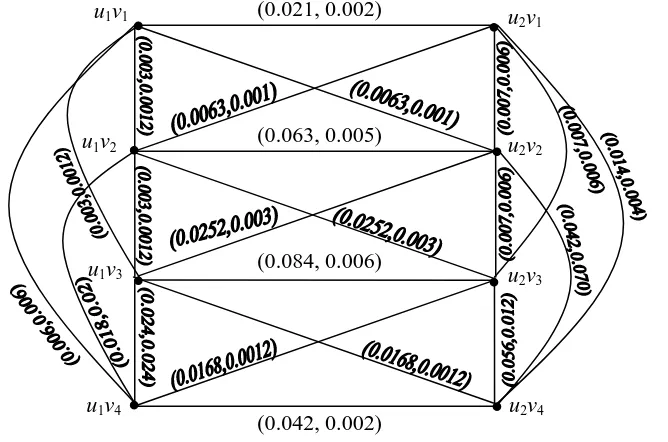
Example 4.11
Let Let V1
v ,v ,v ,v1 2 3 4
and V2
u ,u1 2
such that1 2
VIV φ
[image:8.595.158.492.420.641.2].
Fig 7: G1oG2
5.
CONCLUSION
In this paper, operations like complement, join, union, intersection, ringsum, Cartesian product, composition on IFHGs are defined. Currently, the authors are working on
existing clustering techniques. Further, it is proposed to apply the properties of IFHGs to develop a new clustering algorithm and the same may be checked with a numerical dataset .
u
1v
1u
1v
2u
1v
3u
1v
4u
2v
1u
2v
2u
2v
3u
2v
4(0.021, 0.002)
(0.063, 0.005)
(0.084, 0.006)
6.
REFERENCES
[1] K.T.Atanassov, Intuitionistic fuzzy sets, Fuzzy Sets and Systems 20, (1986), 87-96.
[2] K.T.Atanassov, More on intuitionistic fuzzy sets, Fuzzy Sets and Systems 33, (1989), 37-46.
[3] K.T.Atanassov, New operations defined over the intuitionistic fuzzy sets, Fuzzy Sets and Systems 61, (1994), 137-142.
[4] K.T.Atanassov, Remarks on the intuitionistic fuzzy sets-III, Fuzzy Sets and Systems 75, (1995), 401-402. [5] S.Thilagavathi, R.Parvathi and M.G.Karunambigai,
Operations on Intuitionistic fuzzy graphs II,
Developments in fuzzy sets, intuitionistic fuzzy sets, generalized nets and related topics 1, (2008), 319-331. [6] R.Parvathi, M.G.Karunambigai and K.T.Atanassov
Operations on Intuitionistic fuzzy graphs, Fuzzy Systems, 2009, Fuzz-IEEE 2009. IEEE international conference 1396-1401.
[7] S.Thilagavathi, R.Parvathi and M.G.Karunambigai, Intuitionistic fuzzy hypergraphs, J.Cybernetics and Information Technologies 9(2), (2009), 46-53, Sofia. [8] M.Akram and W.A.Dudek Intuitionistic fuzzy