PC_FFIW – a Robust Image Matching Algorithm
Behloul Ali
Department of Computer Science
University of Hadj Lakhdar - Batna
Batna, ALGERIA
Aksa Abla
Department of Computer Science
University of Hadj Lakhdar - Batna
Batna, ALGERIA
ABSTRACT
Image matching, it's a crucial problem in computer vision and image processing. In order to improve the matching results, a proposed solution consists on employing geometric constraints. In this paper, we propose two effectiveness matching methods, which are called “First Found Is Winner” (FFIW) and “Polarity Coordinates And FFIW” (PC_FFIW). The first one is based on photometric data, while the second one, uses both photometric and geometric data. The proposed methods are based on three-step. Firstly, we detect for each image its corner points. Secondly, descriptors vectors are calculated for each corner points. Thirdly, to match the pair of images and , we apply a matching algorithm optimized to find the best match for each descriptor from the first image with the descriptors of the second image. Experimental results presented to demonstrate that our proposed methods are efficient and give promising results in terms of repeatability and processing time.
General Terms
Image Processing, Image Matching, Pattern Recognition.
Keywords
Image matching; photometric and geometric data; local feature; repeatability.
1.
INTRODUCTION
Images usually contain the same objects but, the task of identifying similar objects within the querying image remains challenging due to view points or lighting changes, deformation and partial occlusions that may exist across different examples [1, 2]. The emphasis of research is then, to find out a matching method with higher robustness for image deformation. In fact, image matching algorithms can be classified into two types: template matching algorithms based on photometric data and matching algorithms based on geometric data. The first alternative is based on grey level. It is widely used in engineering due to the simplicity of the rule and the validity of the operation.
One of the most famous and simplest matching methods based on photometric data is Winner Takes All. However, this approach presents the disadvantage of being non symmetrical, the solution to this problem consists on using a crossed matching, but all the key points don’t find necessary their corresponding key points.
This problem can be solved by employing a crossed matching algorithm but, this solution is not efficient because, all the points don’t find necessary their corresponding points using this algorithm.
Many methods have improved the template matching methods, such as the matching method based on multi-scale wavelet expression [3], the correlation matching algorithm with respect of correlation coefficients [4], the image matching method based on the projection feature [5, 6], and the matching skill based on local projection entropy [7]. These matching methods present better matching results than typical methods, but they present also some shortages such as high calculation cost, the complexity of the algorithm and the strict restriction of the condition in application [8].
Image matching researchers based on geometric data explored also many ways to increase the matching precision, such as the method proposed by Schmid [9], triangles based matching method [10]. Graph matching based algorithms are also the most successful correspondence establishment methods [11, 12, 13, and 14]. Matching methods based on geometric data gives good matching results, but most of them are used only when the camera parameters are known.
In this paper, we present two new matching methods. The first one is based on photometric data, while the second one uses both photometric and geometric data. Our proposed matching methods aim to improve the matching results returned by typical matching methods such as Winner takes All (WTA) and the geometric data based matching method proposed in [9], and also to compare the results obtained with the algorithm Brute force.
2.
TYPICAL MATCHING METHODS
In order to illustrate the matching results returned by our proposed matching methods, we compare these results with those returned by Winner Takes All (WTA) and Threshold Neighbor (TN) matching proposed in [9].In this section, we briefly review the principal of each one of these methods.
Let and be the two images to be matched. In image ,
key points … indexed by and
described by a set of descriptor vectors . In image , m key points … indexed by and described by a set of descriptor vectors
2.1
Winner Takes All (WTA)
The idea of this matching algorithm is simple:To match the pair of images and , we determine point-to-point correspondence.
We select for each descriptor of the image its most similar descriptor from the image based on a particular distance (e.g. Euclidian distance).
The disadvantage of this approach is that many descriptor vectors of might select the same similar descriptor vector . In order to respect, the ones of correspondence’s constraint, the descriptor vector will be affected to the first descriptor vector that was selected. By result, the key point ( ) of the image will match with the key point of the image while ( ) or … or ( ) might be its correct corresponding key point.
2.2
Threshold Neighbor (TN) matching
This method is proposed by Schmid [4]. It exploits geometrical properties presented by the signal in the key point’s Neighborhood. The matching procedure is described below:For each key point ( ) of the image as well as each key point of the image
2. Calculate for each key point detected in the image its corresponding key point from the image using WTA algorithm.
3. If at least neighbor of the key points ( ) detected in the image matches at least neighbors of the key point detected in the image then: the key point ( ) matches the key point .
Obviously, this approach is better than the previous; the using of nearest-neighbor improves the matching. But the limitation of this approach is that it can leave more points without matching.
2.3
Brute-force algorithm
This algorithm is integrated into the Library OpenCV1 (Open Source Computer Vision Library). The matching procedure is described below:
minDist = infinity for each pi in P
for each qj in Q
if dist(pi, qj) < minDist
minDist = dist(pi, qj)
if (pi is masked out in mask)no
match is added for this descriptor
else
closestPair = (pi, qj)
end if end for end for
mask – Mask specifying permissible matches between an input descriptor (pi) and train matrices of descriptors Q. For matching images, we first index the images with the SIFT method [6]. Then, we use the brute force algorithm for matching.
3.
THE PROPOSED METHODS
In this section, we give the main steps of each one of the proposed matching methods.
The first proposed matching method is First Found Is Winner (FFIW) based on photometric data.
3.1
First Found Is Winner (FFIW)
The motivation of this method is to overcome the disadvantage of WTA matching method.
To match the pair of images and . Our proposed algorithm follows these steps;
1. For each key point detected in the image , find its three candidate winners from those detected in the image
The first candidate winner for each key point is calculated as follows;
A. For each key point detected in the image find its most similar key point in the image and save the distance between their descriptor vectors.
B. For the key points ( ) … ( ) of the image which have selected the same corresponding key point from the image , the key point matches the key point of the image , which presents the most similar descriptor to its descriptor , e.g. the
1
http://opencv.willowgarage.com/wiki/
descriptor which presents the smallest distance with .
C. Find for the other key points which selected the affected common winner other winners using the algorithm WTA.
D. The second and the third candidate winner for each key point are calculated using the algorithm WTA.
2. Arrange the three candidate winners using an ascending order based on the descriptor vector’s ranks e.g. if , , are the first, the second and the third candidate winner of the key point ( ); these winners will be ordered as follows: , , and the first candidate winner will become .
3. For each key point of those detected on the image f its first, second or third candidate winner is not matched with another key point of the image ; Match this key point with its available first, second or third winner.
Otherwise
a. Search for its fourth, the fifth and the sixth candidate winner.
b. If the fourth, the fifth or the sixth candidate winner of this key point is not affected, then, match this key point with its available fourth or fifth or sixth candidate winner. c. Eliminate the treated key points of the
image and their corresponding key points of those detected in the image .
4.
Repeat 3.The idea of our second proposed matching method is to make full use of both photometric and geometric data. The matching procedure is realized either by employing geometric properties (generally in cases of scale and rotation), or by exploiting photometric data (generally in cases of illumination changes). The steps of this matching algorithm are described below.
3.2
Polarity Coordinates And FFIW
(PC_FFIW)
First, the matching is realized by a proposed filtrating matching method “Filtered Points Matching” (section 3.2.1). According to the number of correspondences returned by this method, we apply either a proposed geometric data matching algorithm “Polarity Coordinates Matching” (section 3.2.2) or the method “FFIW” based on photometric data (section 3.1). We first, explain the principle of the proposed filtrating matching method.
3.2.1
Filtered Points Matching
1. Consider as a reference point the image centre ( ). For each key point detected in the image as well as the key points detected in the image . 2. Calculate its cosine and sinus using the rules
(1)
(2)
Where
(3)
4. Calculate the median cosine error and median sinus error corresponding to the median of differences between the normalized cosine values (normalized sinus values) of the key points of and those of . 5. So that, a key point matches a key
point the difference between their cosine and their sinus values must be less than the median error (cosine median error, sinus median error).
6. Eliminate the found matched key points from the image and the image .
7. Repeat 5.
Our experiments on 100 images confirm us that, using Filtered Points Matching method under different image transformations, the number of correspondences resulting is more than the third of detected key points in cases of illumination changes and scale. While, in the cases of rotation this number is always below the third of detected key points. We exploit this information in order to come out with a new matching method which makes full use of both geometric and photometric data. In cases of scale and illumination changes, the matching procedure is realized using a proposed geometric data based algorithm. While, in cases of rotation this procedure is realized by employing photometric data. We first, explain the geometric proposed algorithm used in cases of scale and illumination changes.
3.2.2
Polarity Coordinates Matching:
When the number of matched key points returned by the proposed “Filtered Points Matching” is below the third of the number of detected key points, we apply these steps;
1. For each key point detected in the image P, as well as those detected in the image Q; Calculate its cosine and sinus value using the equations (1), (2) and (3). For each key point ( ) from the image , find its most similar key point from the image that presents with its cosine value a difference below 0.01.
2. If no matched point has been found, search for the key points that present a cosine difference below 0.05 with the key point ( ).
3. If no key point has been found, search for the key point that presents the minimum difference in terms of cosine or sinus value with the point ( ). Eliminate the treated key points from those detected in the image and their corresponding key points from those detected in the image .
4. Repeat 2.
If the number of correspondences returned by Filtered Points Matching method is above the third of the number of detected key points, we apply the proposed photometric data based matching method “FFIW” explained in the section (3.1)
4.
EXPERIMENTAL RESULTS
In this section, we compare our methods with classical matching methods WTA and Threshold Neighbor [9], and with the brute force algorithm using SIFT descriptors (BF_SIFT) [6]. Mainly in terms of efficiency of the task of finding correspondence between key points of a pair of images under different deformations such as scale, rotation and illumination changes. The key points are detected by the practical OpenCV’s function “cvGoodFeaturesToTrack”, and described by color histograms.
100 pairs of images from of the standard Columbia Object Image Library (COIL-100)2 image collections were used to
2
http://www1.cs.columbia.edu/CAVE/software/softlib/coil-100.php
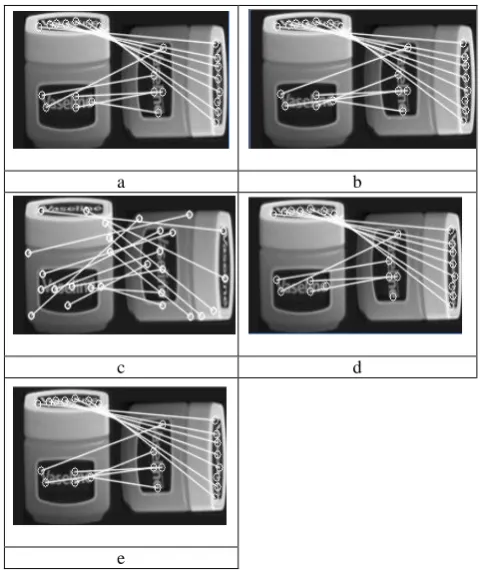
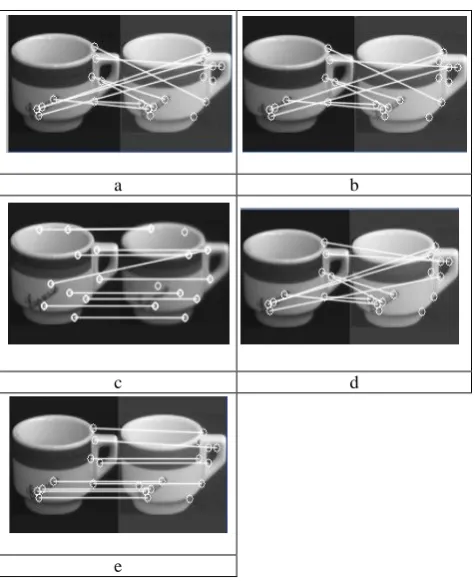
evaluate the proposed methods. Our experimental results show that the proposed methods give much better matching results than the (WTA) and Threshold Neighbor. Examples are shown in Fig. 1, Fig. 2 and Fig. 3.
a b
c d
[image:3.595.309.548.110.368.2]e
Fig. 1. Examples of the matching results of classical methods WTA (a), TN (b), BF_SIFT (c) and the proposed
methods in the FFIW (d), PC_FFIW (e) in cases of zoom in 150%.
a b
c d
[image:3.595.308.549.421.706.2]e
Fig. 2. Examples of the matching results of classical methods WTA (a), TN (b), BF_SIFT (c) and the proposed methods in the FFIW (d), PC_FFIW (e) in case of rotation
a b
c d
[image:4.595.49.287.67.358.2]e
Fig. 3. Examples of the matching results of classical methods WTA (a), TN (b), BF_SIFT (c) and the proposed
[image:4.595.316.545.296.422.2]methods in the FFIW (d), PC_FFIW (e) in case of blur.
Fig.1, Fig. 2 and Fig. 3 illustrate the improvement brought by our proposed matching methods, FFIW (d), PC_FFIW (e) when compared with the results returned by the classical matching methods, WTA (a), TN (b) and BF_SIFT (c) respectively in cases of zoom in (150%), rotation of 90 degrees and blur.
Fig. 4. Comparison of the proposed methods with WTA and TN matching methods in terms of repeatability for
different transformations.
In our experiments, we use repeatability to evaluate the matching quality:
(4)
Where
(5)
(6)
The Fig. 4 allows us to conclude easily that, our proposed matching methods give better matching results than those returned by classical matching methods for the eight transformations, and results close to those obtained for BF_SIFT for the transformations (Rotate 180°).
We conclude also that, the proposed photometric FFIW method gives pleasing results in case of rotation (repeatability = 70%). The results returned by this method in case of scale are also acceptable. But like the classical (WTA and Threshold Neighbor) methods, the proposed FFIW method fails in case of brightness deformations. While, the proposed Polarity Coordinates And FFIW matching method seems to be the best method because it gives pleasing matching results for all the transformations, because in cases of scale and brightness changes, the matching procedure is used by exploiting only geometric constraints and in case of rotation, the matching results returned by this method are the same as those returned by FFIW matching method because in this case the matching procedure is realized using the photometric FFIW method.
Fig. 5. Comparison of the proposed methods with the classical matching methods in terms of processing time
and the repeatability.
From Fig. 5 we can easily conclude that our proposed matching methods give better matching results than those returned by classical matching methods in terms of repeatability and they are not time consuming. In fact, the average matching accuracies are 46.74% and 65.27% and the processing times are 0.0061 and 0.01140385 seconds for the proposed methods FFIW and PC_FFIW, while the average matching accuracies are 36.99 %, 36.2% and 46.48%; and the processing times are 0.0045; 0.058 and 0.0085 seconds for the classical matching methods, WTA, TN and BF_SIFT respectively.
5.
CONCLUSIONS AND FUTURE
WORK
We have presented two new matching methods. The first one is based on photometric data, and aims to overcome the drawback of WTA classical matching method. It was shown how better matching results can be achieved efficiently without time consuming. However, this proposed matching method gives pleasing results in cases of rotation but the matching results returned by these matching methods as well as those returned by the classical matching methods in case of illumination changes are not sufficient. The idea of the second proposed matching method is to make full use of both photometric and geometric data; in case of rotations, the matching procedure is realized by using the proposed photometric data based on matching method. While; only geometric constraints are used in cases of scale and 0
0.2 0.4 0.6 0.8 1
Repeatability PC_FFIW FFIW BF_SIFT TN WTA
0 0.2 0.4 0.6 0.8
0 0.02 0.04 0.06 0.08
R
epe
at
abi
li
ty
r
ac
e
processing time (s)
PC_FFIW
BF_SIFT
FFIW
TN
[image:4.595.54.284.470.613.2]illumination changes, which means the matching procedure is realized without passing by the step of indexation that increases the processing time. Results from experiments on images with different transformations proved the practical applicability and performance of this matching method in terms of repeatability and the processing time for different transformations.
In the future, we are interested on implementing our methods using robust descriptors of key points like SURF descriptors.
6.
REFERENCES
[1] Grauman,K., Darrel, T., “Efficient Image Matching with Distributions of Local Invariant Features”. In proceeding of the IEEE Conference on Computer Vision and Pattern Recognition, 2005.
[2] Zitova, B., Flusser, J. , “Image registration methods: a survey, Image and Vision Computing”, 21(2003), pp.977-1000.
[3] Tingfang, S., Ziwen, F., “Digital Image Processing and Pattern Recognition”, Beijing: Press of Beijing University of Science and engineering, 1998, PP.150-151.
[4] Schmid, C., Mohr, R., “local Gray value Invariants for Image Retrieval”, IEEE PAMI, 19 (1997): PP.530-534.
[5] Harris, C., Stephens, M., “A Combined Corner and Edge Detector”, In Proc. Alvey Vision Conf., Manchester (1988) pp.189-192.
[6] Lowe, D.G., “Distinctive Image Feature from Scale-Invariant Key points”, International Journal of Computer Vision, 60, 2 (2004), PP.91-110.
[7] Tuytelaars, T., Van Gool, L.,” wide Baseline Stereo Matching Based on Local Affinely Invariant Regions”, In: BMVC, (2000), pp.412-425.
[8] Shan, B., Cui, F., “Image Matching Based on Local Invariant Feature and Histogram-Based Similar Distance”. In First International Workshop on Education Technology and Computer Science - Volume 01 (ETCS 2009). Pp 1030-1033.
[9] Schmid, C., “Appariement des images par l’invariant local niveau de gris : Application à l’indexation d’une base d’objets” thèse de doctorat, institut nationale Polytechnique de Grenoble ,1996.
[10] Abbas. A., “Construction d’une mosaïque à partir d’une séquence vidéo”. mémoire présenté Pour l’obtention du grade du maitre en science. Université de Montréal 2002
[11] Caelli, T., Kosinov, S., “An eigenspace projection clustering method for inexact graph matching”. 2004. IEEE Trans. Pattern Anal Machine Intell.26 (4), pp.515-519;
[12] Leordanu, M., Hebert, M., “A spectral technique for correspondences problems using pairwise Constraint”. In: Proc. IEEE.ICCV 2005.
[13] Kim, G., Faloutsos, C., and Hebert, M., “Unsupervised modeling of object categories using link analysis Techniques”. In: Proc, IEEE CVPR 2008.