http://dx.doi.org/10.4236/wet.2015.62003
Throughput Estimation with Noise
Uncertainty for Cyclostationary Feature
Detector in Cognitive Radio Network
Mohsen M. Tantawy
National Telecommunication Institute, Cairo, Egypt Email: [email protected]
Received 11 May 2015; accepted 2 June 2015; published 5 June 2015
Copyright © 2015 by author and Scientific Research Publishing Inc.
This work is licensed under the Creative Commons Attribution International License (CC BY). http://creativecommons.org/licenses/by/4.0/
Abstract
Cognitive Radio Networks (CRNs) are recognized as the enabling technology for improving the fu-ture bandwidth utilization. In CRNs secondary users are allowed to utilize the frequency bands of primary users when these bands are not currently being used. The secondary users are required to sense the radio frequency environment. The lower the probability of false alarm, the more chances the channel can be reused and the higher the achievable throughput for the secondary network. The main contribution of this paper is to formulate the sensing-throughput-noise uncer-tainty tradeoff for cyclostationary feature detection. Computer simulations have shown that for a 1 MHz channel, when the sensing duration is 2% of total time, the spectrum will get 99% probabil-ity of detection regardless of 50% noise uncertainty.
Keywords
Cognitive Radio Network, Cyclostationary Feature Detector, Throughput, Noise Uncertainty
1. Introduction
Spectrum sensing can be divided into two main categories cooperative detection technique and noncoopera-tive. In the cooperative detection secondary users collect the information regarding channel occupancy and transmit this information into spectrum map that updated periodically. In non-cooperative detection, individual radios act locally and autonomously to carry out their own spectrum occupancy measurements and analysis. It can be divided into two classes blind sensing which does not need any information about the primary user signal such as energy detector, and signal specific sensing which need information about the primary user signal such as matched filter and feature detector [3].
According to IEEE 802.22 wireless regional area networks (WRAN), each medium access control (MAC) frame consists of one sensing slot and one data transmission slot, and thus periodic spectrum sensing should be carried out such that the cognitive radio users can decide whether the next frame can continue to transmit on the spectrum band [5] [6]. Associated with spectrum sensing are two parameters: probability of detection and prob-ability of false alarm. The higher the detection probprob-ability, the better the primary users can be protected. How-ever, from the secondary users’ perspective, the lower the false alarm probability, the more chances the channel can be reused when it is available, thus the higher the achievable throughput for the secondary users. Thus there could exist a fundamental tradeoff between sensing capability and achievable throughput for CR different de-tectors [7].
This paper is organized as follows: Section 2 investigates the related work in throughput in cyclostationary feature detectors in CRN; Section 3 discusses the system model and its assumptions; Section 4 presents the nu-merical results; and Section 5 gives the conclusion and the future work.
2. Related Work
CRN has to enforce quiet periods to effectively sense the spectrum availability to protect the PUs. Spectrum sensing and sensing time length can vary depending on the algorithm according to [8]. In cooperative sensing, the length of sensing time at individual SUs is proportional to the sensing accuracy increasing sensing time de-creases the transmission time. The trade-off is called the sensing efficiency problem and is discussed in [9] and
[10]. In [11] the CRN system throughput is maximized by cooperative sensing. Optimal spectrum sensing time considering spectrum handoff due to false alarm discussed in [12]. As in [13], sensing decision problem for maximizing the system throughput is discussed. Also in [13] a suggested algorithm to maximizing the through-put by cooperative sensing is suggested. In [14], maximizing secondary network throughput while keeping under control the average interference is formulated. Authors in [15] study the effect of noise uncertainty on choosing the minimum number of samples in energy and matched filter detectors. The authors in [16] propose a fast spec-trum detecting algorithm based on cyclic autocorrelation of communication signals and select the users with good detection performance to cooperative sense to improve sensing sensitivity without considering noise un-certainty. In [17] a comparison of sensing algorithms which revealed wide variability in their computational complexity for the targeted detection performance without considering network throughput is presented. Authors in [18] propose novel spectrum sensing algorithm, and examines the sensing throughput tradeoff for energy de-tector in CRN under noise variance uncertainty.
3. System Model
The problem of signal detection in additive Gaussian noise can be formulated as a binary hypothesis testing problem with the following hypotheses:
( )
( )
( )
( )
( )
0
1
: , 1, 2, , ;
: , 1, 2, ,
H X n V n n N
H X n S n V n n N
= =
= + =
(1)
where X(n), S(n) and V(n) are the received signals at CR nodes, transmitted signals at primary nodes and white noise samples, respectively; H1 and H0 stand for the decision that the licensed user is present or not, respectively. Noise samples V(n) are from additive white Gaussian noise process with power spectral density σ2 [19].
The feature detector correlates received signal X(n) with frequency shifted version of itself resulting in spec-tral correlation function (SCF) [19].
( )
* 1 1 , , 2 2 N X K K nS f X n f X n f
NK
α α α
=
= + −
∑
(2)Here XK(n, f) is the K point FFT around sample n and α is the amount of frequency shift. The decision statistic is modeled in this SCF and it is compared against given threshold γ.
( )
1( )
N X
n
T X =
∑
=Sα f >γ (3)The probability of false alarm and the probability of detection can be given as [19]
2 4 2 e N f P γ σ −
= (4)
,
d m
T T
P Q
ψ γ
σ σ
=
(5)
where,
2
S KP
ψ = ,
2 4 S T KP N N σ σ
σ = + , FT points [19]. And Qm(.) is the first order Marcum Q functionac- cording to [20] and given in Equation (6).
( )
, exp 2 2 0( )
d , 0, 02
m b
x a
Q a b = ∞x − + I ax x a≥ b≥
∫
(6)where I0(.) is the zeroth-order modified Bessel function given in Equation (7)
( )
(
)
0 0
1
exp cos d . π
I y =
∫
∞ yθ θ
(7)Solving for γ to get detection probability
2 ln , . 1 2 1 f d m P SNR K N
P Q SNR K SNR K − = + + (8)
Denote C0 as the throughput of the secondary network in the absence of PU, C1 is the throughput in the pres-ence of PU, so the throughput C of the secondary network according to [21] will given by
(
)
0 2
1 2 2
0 Log 1
Log 1 Log 1 .
1 S
s s
p p
C SNR
C P SNR
C
P N SNR
= + = = + = + + + (9)
The normalized rate for unit bandwidth for the secondary network with sensing slot time τ and a frame dura-tion time T under hypothesis H0 and H1 are given by
( )
(
)
( )
( )
(
)
( )
0 0 0
1 1 1
1 ,
1 , .
f
d T
R C P p H
T R
T
R C P p H
T
τ γ τ
τ γ τ
− = − = − = − (10)
And the average throughput for the secondary network will given by
( )
0( )
, 1( )
,R τ =R γ τ +R γ τ
( )
0(
1 f( )
,)
( )
0 1(
1 d( )
,)
( )
1 .T T
R C P p H C P p H
T T
τ τ
For cyclostationary feature detector Pf and Pd are given from Equations (4) and (5) then the average through-put for the secondary network will be
( )
(
)
(
)
( )
( )
2 0 2
1
Log 1 1 Log 1
1 2 ln 1 , 1 2 1 S S f P f P m P p SNR T T
R SNR P p H
T T SNR
P SNR K N
Q p H
SNR K SNR K
τ τ
τ = − + − + − +
+ − × − + + (12)
Due to noise uncertainty, the estimated noise power may be different from the actual noise power. Let the es-timated noise power changed in the interval 2 2 , 2
v
σ ∈ σ β βσ where β > 1 is the noise uncertainty factor. For feature detector and in a noise variation environment, minimizing the Marcum Q function in Pd and maximizing
Pf, with threshold γ, hence
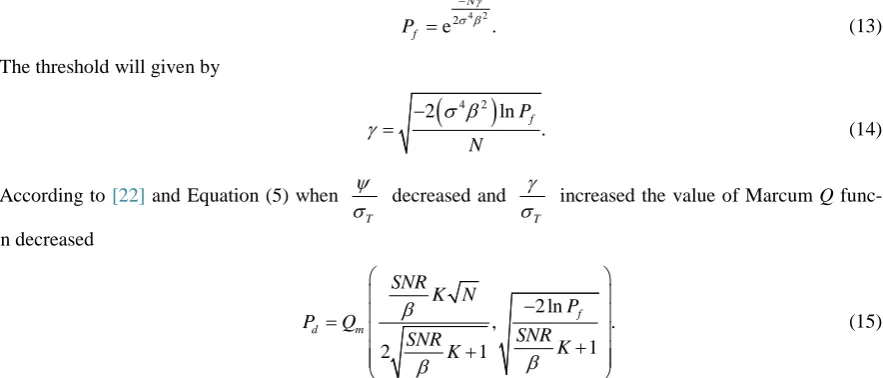
4 2 2 . e N f P γ σ β −
= (13)
The threshold will given by
(
4 2)
2 ln . f P N σ β
γ = − (14)
According to [22] and Equation (5) when T ψ
σ decreased and T γ
σ increased the value of Marcum Q func-tion decreased 2 ln , . 1 2 1 f d m SNR K N P P Q SNR SNR K K β β β − = + + (15)
Modifying (12) to show the effect of noise variation on throughput in cyclostationary feature detector will give
( )
(
)
(
)
( )
( )
2 0 2
1
Log 1 1 Log 1
1 2 ln 1 , 1 2 1 S S f P p f m p p SNR T T
R SNR P p H
T T SNR
SNR K N
P
Q p H
SNR SNR K K τ τ τ β β β − − = + − + + + − × − + + (16)
where N= fsτ and Pf is given by Equation (13).
4. Numerical Results
In this section, numerical results are presented to evaluate the sensing-throughput trade-off with noise uncer-tainty for feature detector scheme. Table 1 summarizes the numerical values used in the paper according to [7]
and [8].
[image:4.595.97.539.249.438.2]Probability of detection versus probability of false alarm with SNR variation for feature detector is shown in
Figure 1. As it could expected, the performance of feature detector decreases with SNR. The receiver operating
Table 1.System parameters.
System parameters Value
P(H0) 0.8
P(H1) 0.2
Sampling frequency fs 106 Hz
K is the number of FFT points 8
Frame duration (T) 100 ms
Sensing duration 1 ms: 25 ms
SNR [0, −30] dB
Probability of false alarm (Pf) [0, 0.5]
Noise uncertainty factor (β) Up to 1.5
Figure 1. Effect of SNR on the feature detector receiver operating
characteris-tics.
Figure 2. Receiver operating characteristics of feature detector with noise
uncertainty.
0 0.1
0.2 0.3
0.4 0.5
-30 -20 -10 0 0.2 0.4 0.6 0.8 1
pd
pf SNR
0 0.05 0.1 0.15 0.2 0.25 0.3 0.35 0.4 0.45 0.5 0
0.1 0.2 0.3 0.4 0.5 0.6 0.7 0.8
Probability of false alarm (Pf)
P
robabi
lit
y
of
det
ec
ti
on (
P
d)
[image:5.595.187.444.491.691.2]The effect of different noise uncertainty factor values on probability of detection with variable SNR values with 0.01 false alarm probability is shown in Figure 3. The figure shows that SNR value between −18 to −20 dB has dramatically effect on detection probability.
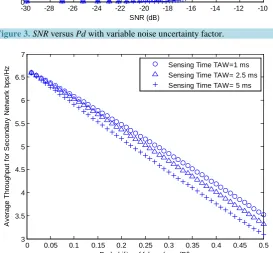
Figure 4 shows the effect of sensing time on normalized secondary network throughput with −20 dB SNR
[image:6.595.177.450.248.477.2]value, and 1.5 noise uncertainty factor. Figure 5 shows that 20 ms sensing time or spending 2% of total time to sense the spectrum will get 99% probability of detection regardless of 50% noise uncertainty change.
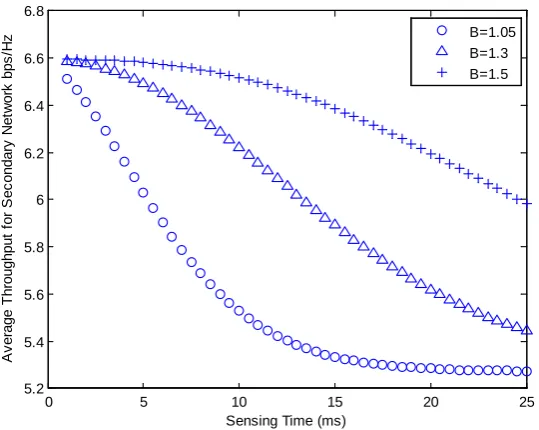
Figure 6shows the effect of noise uncertainty on the secondary network throughput with −20 dB SNR, and
0.01 probability of false alarm. The figure shows that increasing the uncertainty factor from 1.05 to 1.5 leads to changing the overall throughput by 8%.
5. Conclusion and Future Work
[image:6.595.177.451.436.689.2]The effect of noise uncertainty on the secondary network throughput with low SNR values is analyzed. Moreover,
Figure 3. SNR versus Pd with variable noise uncertainty factor.
Figure 4. Effect of sensing time on normalized secondary network through-
put.
-30 -28 -26 -24 -22 -20 -18 -16 -14 -12 -10
0 0.1 0.2 0.3 0.4 0.5 0.6 0.7 0.8 0.9 1
SNR (dB)
P
robabi
lit
y
of
det
ec
ti
on (
P
d)
B=1.05 B=1.3 B=1.5
0 0.05 0.1 0.15 0.2 0.25 0.3 0.35 0.4 0.45 0.5
3 3.5 4 4.5 5 5.5 6 6.5 7
Probability of false alarm (Pf)
A
v
er
age T
hr
oughput
f
or
S
ec
ondar
y
N
et
w
or
k
bps
/H
z Sensing Time TAW=1 ms
Figure 5. Probability of detection (Pd) versus sensing time for with noise uncertainty.
Figure 6. Normalized secondary network throughput versus sensing time
with noise uncertainty.
selecting the sensing time with the proper value of SNR leads to better overall normalized throughput. The con-tribution of this paper is that increasing the noise uncertainty by 50% decreases throughput by 8%. On the other hand, noise uncertainty of 50% can be overcome if the sensing time reaches 2% of the total time. This work can be extended to include eigenvalue based detector.
References
[1] Akyildiz, I.F., Lee, W.-Y., Vuran, M.C. and Mohanty, S. (2006) Next Generation/Dynamic Spectrum Access/Cogni- tive Radio Wireless Networks: A Survey. Computer Network, 50, 2127-2159.
http://dx.doi.org/10.1016/j.comnet.2006.05.001
[2] Zhang, Y., Zheng, J. and Chen, H.-H. (2010) Cognitive Radio Networks Architectures, Protocols, and Standards. http://dx.doi.org/10.1201/EBK1420077759
0 5 10 15 20 25
0 0.1 0.2 0.3 0.4 0.5 0.6 0.7 0.8 0.9 1
Sensing Time (ms)
P
robabi
lit
y
of
det
ec
ti
on (
P
d)
B=1.05 B=1.3 B=1.5
0 5 10 15 20 25
5.2 5.4 5.6 5.8 6 6.2 6.4 6.6 6.8
Sensing Time (ms)
A
v
er
age T
hr
oughput
f
or
S
ec
ondar
y
N
et
w
or
k
bps
/H
z B=1.05
[image:7.595.179.449.335.550.2][3] Imam, M.S., Ingle, S. and Ara, S. (2013) A Review Paper Based on Spectrum Sensing Techniques in Cognitive Radio Networks. IISTE, 3.
[4] Thakre, S. and Dixit, S. (2014) Security Threats and Detection Technique in Cognitive Radio Network with Sensing Strategies. IJRET, 3.
[5] (2005) IEEE 802.22 Wireless RAN, Functional Requirements for the 802.22 WRAN Standards, IEEE802.22-05/ 0007r46.
[6] Pei, E., Li, J.B. and Cheng, F. (2013) Sensing-Throughput Tradeoff for Cognitive Radio Networks with Additional Primary Transmission Protection. Journal of Computational Information Systems, 9, 3767-3773.
[7] Liang, Y.-C., Zeng, Y.H., Peh, E.C.Y. and Hoang, A.T. (2008) Sensing-Throughput Tradeoff for Cognitive Radio Networks. IEEE Transactions on Wireless Communications, 7, 1326-1337.
http://dx.doi.org/10.1109/TWC.2008.060869
[8] Yucek, T. and Arslan, H. (2009) A Survey of Spectrum Sensing Algorithms for Cognitive Radio Applications. IEEE Communications Surveys & Tutorials, 11, 116-130. http://dx.doi.org/10.1109/SURV.2009.090109
[9] Lee, W. (2008) Optimal Spectrum Sensing Framework for Cognitive Radionetworks. IEEE Transactions on Wireless Communications, 7, 3845-3857. http://dx.doi.org/10.1109/T-WC.2008.070391
[10] Min, A. and Shin, K. (2009) An Optimal Sensing Framework Based on Spatialrss-Profile in Cognitive Radio Networks.
Proceedings of SECON, Piscataway, 207-215.
[11] Faisal Amjad, M., Aslam, B. and Zou, C.C. (2012) Transparent Cross-Layer Solutions for Throughput Boost in Cogni-tive Radio Networks. Consumer Communications and Networking Conference, Las Vegas, 14-17 January 2012. [12] Lee, D.-J. and Jang, M.-S. (2009) Optimal Spectrum Sensing Time Considering Spectrum Handoff Due to False Alarm
in Cognitive Radio Networks. IEEE Communications Letters, 13, 899-901. http://dx.doi.org/10.1109/LCOMM.2009.12.091448
[13] Li, S., Zheng, Z.Z., Ekici, E. and Shroff, N. (2014) Maximizing System Throughput by Cooperative Sensing in Cogni-tive Radio Networks. IEEE/ACM Transactions on Networking, 22, 1245-1256.
http://dx.doi.org/10.1109/TNET.2013.2272722
[14] Shokri-Ghadikolaei, H., Forough, Y. and Carlo, F. (2014) Analysis and Optimization of Centralized Sequential Chan-nel Sensing in Cognitive Radio Networks. 20th European Wireless Conference, Barcelona, 14-16 May 2014, 1-6. [15] Tantawy, M. (2014) Responsive Communication Jamming Detector with Noise Power Fluctuation Using Cognitive
Radio. International Journal of Innovation Research in Computer and Communication Engineering, 2, 5967-5973. [16] Ou, Y. and Wang, Y.-M. (2012) Performance of Spectrum Sensing and Optimization Based on User Selection in
Cog-nitive Radio. International Journal of Communications, 6.
[17] Umar, R. and Shekha, A.U.H. (2012) A Comparative Study of Spectrum Awareness Techniques for Cognitiveradio Oriented Wireless Networks. Elsevier Physical Communication Journal, 1-23.
[18] Bogale, T.E., Vandendorpe, L. and Le, L.B. (2014) Sensing Throughput Tradeoff for Cognitive Radio Networks with Noise Variance Uncertainty. CROWNCOM 2014—9th International Conference on Cognitive Radio Oriented Wireless Networks, Oulu, 2-4 June 2014.
[19] Cabric, D., Tkachenko, A. and Brodersen, R.W. (2006) Experimental Study of Spectrum Sensing Based on Energy Detection and Netwotk Cooperation. International Workshop on Technology and Policy for Accessing Spectrum, Bos-ton. http://dx.doi.org/10.1145/1234388.1234400
[20] Corazza, G. and Ferrari, G. (2002) New Bounds for the Marcum Q-Function. IEEE Transactions on Information Theo
-ry, 48, 3003-3008.http://dx.doi.org/10.1109/TIT.2002.804113
[21] Cognitive Radio Networks (CRNs). University of Waterloo, Department of Electrical and Computer Engineering, Wa-terloo.
[22] Bocus, M.Z., Dettmann, C.P. and Coon, J.P. (2013) An Approximation of the First Order Marcum Q-Function with Application to Network Connectivity Analysis. IEEE Communication Letters, 17, 499-502.
http://dx.doi.org/10.1109/LCOMM.2013.011513.122462
[23] Zeng, Y.H. and Liang, Y.C. (2009) Eigenvalue Based Spectrum Sensing Algorithms for Cognitive Radio. IEEE Tran-