Munich Personal RePEc Archive
Dollar Shortages and Crises
Rajan, Raghuram G. and Tokatlidis, Ioannis
14 March 2005
Online at
https://mpra.ub.uni-muenchen.de/832/
Raghuram G. Rajan and Ioannis Tokatlidis
International Monetary Fund
Emerging markets do not handle adverse shocks well. In this paper, we lay out an argument about why emerging markets are so fragile, and why they may adopt contractual mechanisms—such as a dollarized banking system—that in-crease their fragility. We draw on this analysis to explain why dollarized economies may be prone to dollar shortages and twin crises. The model of crises described here differs in some im-portant aspects from what are now termed the first-, second-, and third-generation models of crises. We then examine how domestic policies, especially monetary policy, can mitigate the adverse effects of these crises. Finally, we consider the role, po-tentially constructive, that international financial institutions may undertake both in helping to prevent the crises and in helping to resolve them.
JEL Codes: E5, F3, G2.
There is a strong correlation between the stoppages of capital flows to a country, the extent of dollarization of the country’s bank-ing system, and the prevalence of bankbank-ing crises. Between 1974 and 2003, 56 percent of all episodes where capital flows underwent a “sudden stop” ended in a banking crisis; the same proportion rises to 75 percent in those episodes where the country also had a high level of dollarization, and to 100 percent if, in addition to a high level of dollarization, the country had in place a fixed exchange rate (see Inter-American Development Bank 2005). What accounts for these correlations? Are there domestic policies that can mitigate such risks? How can international financial institutions (IFIs) help
∗This paper reflects our opinions and is not meant to represent the views of
the International Monetary Fund or its member countries. We thank Douglas Diamond, Olivier Jeanne, Se-Jik Kim, and Ashok Mody for helpful comments. The paper is based on talks Rajan gave at the Central Bank of Argentina and the Central Bank of Chile.
178 International Journal of Central Banking September 2005
their member countries avoid or diminish the consequences of such a predicament? We address these questions in this paper.
We review, first, why emerging markets may adopt contractual mechanisms—such as a dollarized banking system—that accentuate rather than lessen their vulnerabilities. We argue that weak institu-tions in emerging markets tend to make it harder for the emerging markets to cope properly with economic adversity. The burden of downturns, instead of being shared in predictable ways, is spread in a haphazard manner through, for example, selective defaults and high inflation. In such an environment, and with limited contract enforcement, the best protection for investors against risks may well be a domestic deposit denominated in foreign currency (following the convention in this literature, we will call the foreign currency “dollars”).
Then, we explore various possible policy interventions to mitigate the effects of dollar shortages, including whether the multilateral fi-nancial institutions have a role to play. If dollarization arises primar-ily from institutional infirmities rather than a distorted incentive to take on risk, it may be costly to legislate it away. Countries may have to learn to live with dollarization for awhile. At the same time, if poor institutions rather than poor incentives are to blame, inter-ventions to mitigate the effects of dollarization need not exacerbate typical sources of moral hazard.
In the rest of the paper, we lay out first the basic argument and provide evidence for some of its assumptions. We then examine vari-ous interventions domestic authorities could undertake, and end with a discussion of possible interventions by the multilateral institutions.
1. A Framework
1.1 Why Are Emerging Markets Different?
A growing number of economists identify the quality of institutions as producing important differences between emerging markets and developed economies. Broadly speaking, economic institutions may be basic or narrow. By basic, we mean fundamental institutions, such as those that ensure the security of property, including through the prevention of arbitrary taxation, or those that help enforce con-tracts. Basic institutions create the broad enabling environment for transactions between private agents and the state, and between pri-vate agents themselves. By narrow, we mean more detailed features of the institutional environment, such as whether the central bank is de-facto independent or whether there is a functioning bankruptcy code. Although not without exceptions, a country with weak basic institutions also finds it difficult to build effective narrow institu-tions.
One important role played by basic institutions is to mediate the process and outcome of social conflicts, particularly in times of adversity. Typically, in a growing economy, differences between social actors may be papered over. A downturn, though, usually brings out or sharpens latent social tensions.
180 International Journal of Central Banking September 2005
is much harder to swallow, while satisfaction from additional gains is less important to fight for. Individual aversion to losses in wealth is well documented in behavioral science. On the other hand, con-flict may dissipate growth opportunities more easily than it may worsen an already stagnant situation. For example, squabbling be-tween workers and management may drive investors away, chasing away the chance to start new projects; however, if there are no new investment opportunities on the horizon, squabbling is less costly, as the existing plant and machinery is already a sunk investment.
Regardless of why conflicts are greater in times of economic ad-versity, how a society deals with such conflicts depends on the kind of conflict management institutions it has. In a comprehensive study of failed states, Collier et al. (2003) find that years of poor economic growth precede civil war. Even after concluding a peace, the proba-bility of these states lapsing back into war is high. Not surprisingly, these states typically have weak conflict management institutions, such as patchy law enforcement, limited adherence to democratic principles, and few meaningful checks and balances on the govern-ment. Similarly, Rodrik (1999) finds that the countries that expe-rienced the sharpest drops in growth after 1975 were those with divided societies and weak conflict management institutions (as prox-ied for by indicators of the quality of government institutions, rule of law, democratic rights, and social safety nets).
Acemoglu et al. (2003) find that countries with poor institu-tions have the highest volatility of growth and higher levels of in-flation than countries with well-functioning institutions. Satyanath and Subramanian (2004) show that over and above the effect of poli-cies, the quality of political institutions affects the extent of nominal macroeconomic instability in a country.
By contrast, when institutions are too weak to offer predictable and acceptable settlements, or protect existing shares, everyone has an incentive to jockey for a greater share of the pie. Outcomes will be mediated more by the relative bargaining power of actors than by preexisting implicit or explicit contracts.
Often, bargaining will break down. Then, a government without the institutional capacity to allocate the burdens of adversity among its citizenry fairly will be tempted to spread it through the easi-est means available—inflation. Nominal instability will accompany real instability in countries with weak institutions, lending support to the view that while the proximate cause for inflation may be monetary expansion, inflation is always and everywhere a political phenomenon!
1.2 Evidence for the Link Between Inflation and Poor Growth
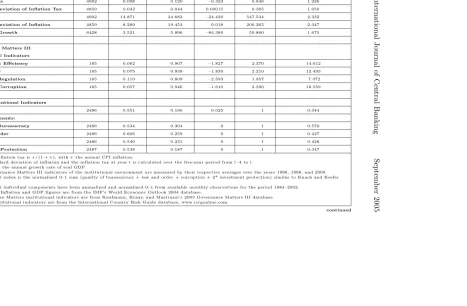
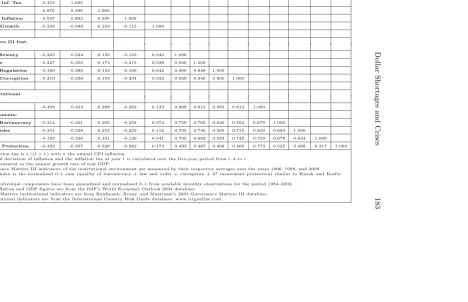
We want to establish two facts here, which are a little different from the work cited so far. First, we want to test whether the inflation “tax” is higher in downturns, and second, whether this phenomenon is particularly acute for countries with poor institutions. To check this, we have data on the value of the inflation tax, which is meas-ured as ∆CPI /(1 + ∆CPI), where ∆CPI is the change in the con-sumer price index in the country over the year. This is computed every year from 1965 through 2002 for 165 countries. In table 1, we present summary statistics and cross-correlations for the inflation tax, the standard deviation of the inflation tax computed over the preceding five years, the growth rate in GDP, and the quality of insti-tutions measured by four different indices: government efficiency, rule of law, quality of regulation, and control of corruption. These indices are from the Governance Matters III database (see Kaufman, Kraay, and Mastruzzi 2004). We also report an index of institutional qual-ity constructed using the International Country Risk Guide (ICRG) indicators; this second institutional index approximates the one used by Knack and Keefer (1995).
182 In te rn at ion al J ou rn al of C en tr al B an k in g S ep te m b er 2005
Table 1. Institutions, Growth, and Inflation in a Panel of 165 Countries, 1965–2002
A. Summary Statistics
Variable Obs. Mean Std. Dev. Min. Max. CV
Inflation Tax 4902 0.098 0.120 –0.323 0.846 1.226
Standard Deviation of Inflation Tax 4859 0.042 0.044 0.00015 0.365 1.050
Inflation 4902 14.871 34.683 –24.430 547.534 2.332
Standard Deviation of Inflation 4859 8.289 19.453 0.018 206.265 2.347
Real GDP Growth 6428 3.521 5.896 –84.380 59.860 1.675
Governance Matters III Institutional Indicators
Government Efficiency 165 0.062 0.907 –1.827 2.370 14.612
Rule of Law 165 0.075 0.939 –1.830 2.210 12.493
Quality of Regulation 165 0.110 0.809 –2.593 1.957 7.372
Control of Corruption 165 0.057 0.946 –1.610 2.390 16.559
ICRG Institutional Indicators
Index 2486 0.551 0.190 0.025 1 0.344
with components:
Quality of Bureaucracy 2486 0.534 0.304 0 1 0.570
Law and Order 2486 0.606 0.259 0 1 0.427
Corruption 2486 0.540 0.231 0 1 0.428
Investment Protection 2487 0.538 0.187 0 1 0.347
Notes: Inflation tax isπ /(1 +π), withπthe annual CPI inflation.
The standard deviation of inflation and the inflation tax at yeartis calculated over the five-year period fromt–4 tot. Growth is the annual growth rate of real GDP.
The Governance Matters III indicators of the institutional environment are measured by their respective averages over the years 1996, 1998, and 2000. The ICRG index is the normalized 0–1 sum (quality of bureaucracy + law and order + corruption + 2* investment protection) similar to Knack and Keefer (1995).
The ICRG individual components have been annualized and normalized 0–1 from available monthly observations for the period 1984–2002.
Sources: Inflation and GDP figures are from the IMF’s World Economic Outlook 2004 database.
Governance Matters institutional indicators are from Kaufmann, Kraay, and Mastruzzi’s 2003 Governance Matters III database. ICRG institutional indicators are from the International Country Risk Guide database, www.icrgonline.com.
1
No.
2
D
ol
lar
S
h
or
tage
s
an
d
C
ris
es
183
Std. Dev. Std. Dev. Gov. Rule Qlt. Ctrl. Qu. Law/ Inv. Inf.Tax (I. Tax) Inflat. (Infl.) Growth Eff. Law Reg. Corr. Index Bur. Order Corr. Prot. Inflation Tax 1.000
St. Dev. of Inf. Tax 0.453 1.000
Inflation 0.876 0.386 1.000
St. Dev. of Inflation 0.547 0.802 0.595 1.000
Real GDP Growth –0.236 –0.088 –0.233 –0.115 1.000
Gov. Matters III Inst. Indicators
Govern. Efficiency –0.205 –0.324 –0.156 –0.193 0.049 1.000
Rule of Law –0.227 –0.350 –0.173 –0.215 0.038 0.940 1.000
Quality of Regulation –0.160 –0.286 –0.133 –0.169 0.042 0.866 0.848 1.000
Control of Corruption –0.210 –0.338 –0.159 –0.204 0.032 0.949 0.946 0.800 1.000
ICRG Institutional Indicators
Index –0.409 –0.423 –0.288 –0.292 0.133 0.808 0.815 0.685 0.813 1.000
with components:
Quality of Bureaucracy –0.314 –0.401 –0.205 –0.258 0.074 0.759 0.766 0.620 0.764 0.879 1.000
Law and Order –0.351 –0.338 –0.255 –0.239 0.112 0.705 0.740 0.569 0.715 0.839 0.684 1.000
Corruption –0.165 –0.236 –0.101 –0.126 0.041 0.705 0.692 0.583 0.745 0.759 0.678 0.634 1.000
Investment Protection –0.429 –0.357 –0.320 –0.282 0.173 0.493 0.487 0.466 0.468 0.773 0.525 0.489 0.317 1.000
Notes: Inflation tax isπ /(1 +π) withπthe annual CPI inflation.
The standard deviation of inflation and the inflation tax at yeartis calculated over the five-year period fromt–4 tot. Growth is measured as the annual growth rate of real GDP.
The Governance Matters III indicators of the institutional environment are measured by their respective averages over the years 1996, 1998, and 2000. The ICRG index is the normalized 0–1 sum (quality of bureaucracy + law and order + corruption + 2* investment protection) similar to Knack and Keefer (1995).
The ICRG individual components have been annualized and normalized 0–1 from available monthly observations for the period 1984–2002.
Sources: Inflation and GDP figures are from the IMF’s World Economic Outlook 2004 database.
[image:8.612.144.662.138.440.2]184
In
te
rn
at
ion
al
J
ou
rn
al
of
C
en
tr
al
B
an
k
in
g
S
ep
te
m
b
er
[image:9.612.206.566.155.372.2]2005
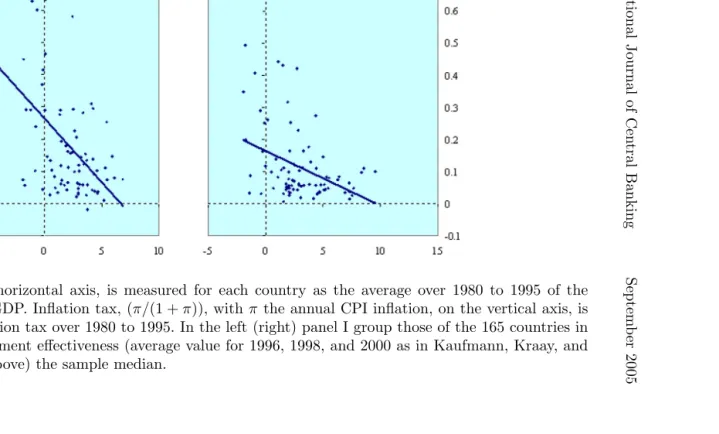
Figure 1. Real Growth and Inflation Tax When Institutional Quality Is Below and Above Its Median
suggesting that slower growth is correlated with more inflation in countries with weak institutions.
Rather than average correlations, we are interested in the time-series patterns across countries. In table 2 we use a panel of yearly observations from 1965 through 2002 where the dependent variable is the inflation tax in a year in a country. In column 1, we estimate a random effects GLS (generalized least squares) model where the explanatory variables are a constant and the growth rate in GDP. The coefficient of the GDP growth rate is negative and highly sig-nificant, suggesting that the inflation tax is highest in periods of low GDP growth. A standard deviation increase in the growth rate is associated with a reduction in the inflation tax by .0241, which is 20 percent of its sample standard deviation. In column 2, we in-clude the index of government efficiency (the results with the other “Governance Matters” institutional variables are qualitatively simi-lar) and the interaction of GDP growth with the index. As the prior literature has found, countries with a better institutional environ-ment tend to experience lower inflation tax. Particularly interesting is that the positive significant coefficient of the interaction term sug-gests, as predicted, that the inflation tax in countries with better institutions is less sensitive to growth. In column 3, we estimate the model including country fixed effects, and find no qualitative change in the coefficients of interest.1
One problem with the estimated model is that we cannot tell the direction of causality. High inflation may, in fact, cause low growth, though why this should be more pronounced in countries with poor institutions is harder to say. Nevertheless, it is important to examine the effect of the exogenous component of growth on the inflation tax. Typically, a country will be affected by similar exogenous shocks as its neighbors—if not directly, then via trade. So one plausible instrument for a countryi’s growth is EXTGROWTH, which is the weighted average growth of all other countriesj, with each country
j’s growth weighted by that country’s log GDP and divided by the square of the distance betweeniandj. In column 4, we reestimate the fixed-effects model, using EXTGROWTH to instrument for growth.
1We also cluster by country and include year indicators with no qualitative
186 In te rn at ion al J ou rn al of C en tr al B an k in g S ep te m b er 2005
Table 2. Determinants of Inflation Tax in a Panel of 165 Countries, 1965–2002
Dependent Variable: Inflation Tax
RE/GLS RE/GLS FE FE/IV FE/IV FE/IV FE/IV2 FE/IV Instrument
Instrument Small Interaction of for Gov. Alternative Fixed for Country Initial GDP Eff. and Institutional Effects Growth Effects and Growth Growth Indicator
1 2 3 4 5 6 7 8
Explanatory Variables:
Constant 0.1191 *** 0.1209 *** 0.1114 *** 0.1388 *** 0.1399 *** 0.1362 *** 0.1351 *** 0.2876 *** (0.0064) (0.0062) (0.0015) (0.0048) (0.0049) (0.0054) (0.0072) (0.0177)
Real GDP Growth Rate –0.0041 *** –0.0048 *** –0.0047 *** –0.0224 *** –0.0233 *** –0.0079 –0.0185 *** –0.0264 *** (0.00025) (0.00035) (0.00035) (0.0020) (0.0021) (0.0068) (0.0055) (0.0070)
Government Efficiency –0.0323 *** (0.0067)
Growth*Institutions 0.0015 *** 0.0014 *** 0.019 *** 0.0216 *** 0.0246 *** 0.0232 **
(Gov. Eff.) (0.0005) (0.0005) (0.0031) (0.0046) (0.0031) (0.0104)
Small*Growth*Institutions –0.0016
(0.0043)
Initial GDP*Growth –.0019 ***
(0.0007)
Institutions = ICRG Index –0.2864 ***
(0.0397)
Growth*ICRG Index 0.0345 ***
(0.0116)
Number of Observations 4895 4895 4895 4753 4388 4387 2916 2178
Notes:Standard deviations are in parentheses below the estimated coefficients. *** indicates significance at 1 percent or less, ** at 5 percent or less. Columns 1 and 2 report the estimates of random effects GLS regressions; columns 3–8 report the estimates of fixed effects.
In columns 4–8 we instrument the growth rate and the interaction of growth with institutions, by the “external” growth rate and its interaction with institutions. For every countryiand every year, the “external” growth rate is calculated as the average of every other country’sj=igrowth rate weighted by the ratio of log GDP to the square of the distance between countryjand countryi .
In column 5, we interact (Growth*Institutions) with the dummy Small, which equals 1, if the country’s GDP in that year is below the ninetieth percentile of the sample in that year.
In column 6, we interact Growth with the log of the initial level of real GDP. For most countries the initial level is that of 1965; when this is not available, as in the transition economies, for example, we take the first year for which we have an observation for real GDP.
In column 7, we instrument the growth rate, institutions, and the interaction of growth and institutions, by the “external” growth rate, the log of population density in 1500 (see Acemoglu, Johnson, and Robinson 2002), and the interaction of “external” growth with the log of population density, respectively.
In column 8, institutions are proxied by the normalized 0–1 ICRG index = quality of bureaucracy + rule of law + corruption + 2* investment protection.
Investment protection includes expropriation, contract repudiation, and repatriation of profits. It is weighted by 2, so that the index can approximate the one used in Knack and Keefer (1995).
Sources:Inflation tax and GDP growth series based on annual CPI and real GDP series from IMF’s World Economic Outlook 2004 database.
Government efficiency indicator: Kaufmann, Kraay, and Mastruzzi (2003) Governance Indicators database. Log of Population Density in 1500: Acemoglu, Johnson, and Robinson (2002).
The coefficient of the interaction is now larger in magnitude and stronger in significance.
Large countries may affect the growth of their neighbors, so there is a case for arguing the instrument is purer for small countries. One should ask if the coefficient estimate for the interaction differs for small countries. In column 5, we reestimate the fixed-effect instru-mented regression with an additional term, the interaction multiplied by an indicator for countries whose GDP is below the ninetieth per-centile GDP. The coefficient estimate for the indicator is statistically insignificant and small, suggesting that small countries do not have a different estimated interaction coefficient than large countries. This lends confidence to the instrument for growth.
There could, however, be some concern about our measure for institutional quality. It may be that the proxy for institutions is simply a proxy for per capita GDP. In column 6, we also include the interaction between initial GDP for the country (in 1965 or the first year for which we have GDP) and the country’s growth rate. The coefficient of the interaction between institutions and growth is now slightly higher in magnitude, and still strongly significant.
We have assumed that institutions are slow moving, and have thus taken the index of government efficiency from Kaufman, Kraay, and Mastruzzi (2004)—averaged over the years 1996, 1998, and 2000—as the measure of institutional quality in a country for the period 1965–2002. One concern is that this measure is not predeter-mined and exogenous. There is some controversy about what instru-ments are appropriate for institutions. Following Acemoglu, Johnson, and Robinson (2002), we use the log of a country’s population density in 1500 (countries that had less of a native population were less likely to have an exploitative colonial structure imposed on them and have better institutions today) as an instrument for institutional quality in column 7. While we lose a number of countries, the coefficient of the interaction is still positive, large, and statistically significant.2
The opposite concern would be that the measure of institutional quality is too static, that it does not reflect changes that take place in a country over time. The problem is that detailed measures of
2Of course, while the instrument for institutional quality is exogenous and
188 International Journal of Central Banking September 2005
institutional quality going back to 1965 are simply not available. However, the index we have constructed from ICRG data is one measure of institutional quality that does go back to 1985.3
In col-umn 8, we use the data from 1985, with the time-varying index as our measure of institutional quality, and find that the interaction variable is positive and significant as predicted.
The bottom line is that the inflation tax is higher when countries experience poor growth (as also in Kaminsky, Reinhart, and Vegh 2005), and it is particularly high when those countries have poor institutions. Poor societies with weak institutions do not share the burden of distress well.4
1.3 Contractual Adaptation
If the country’s underlying basic and narrow institutions do not per-mit a contingent, speedy, and predictable sharing of adverse eco-nomic circumstances, and the tendency of the government is to spread the burden along the path of least resistance, economic agents will take steps to protect themselves. But without a reliable and ef-fective legal system, what can they do? Clearly, the answer is to use instruments that depend in a very limited way on the legal system for enforcement.
One approach is to use inflexible, noncontingent contracts, whose violation is easily detected. For example, labor contracts in many developing countries effectively do not permit employees to be fired. This is seen as inefficient because it does not allow firms to react quickly to business conditions. Often, these prohibitions are ascribed to overly strong unions that hold the economy to ransom. But if courts are slow and corrupt, so that a worker who is wrongfully fired has no redress, perhaps the prohibition of firing—because vio-lations are so easily and publicly observable and can be responded to through mass protests—is the only way to protect workers from
3We try to approximate the index created by Knack and Keefer (1995). The
ICRG measures for quality of bureaucracy, rule of law, corruption, and invest-ment protection (including risk of expropriation, contract repudiation, and repa-triation of profits) are all normalized to be between zero and one. The index is the weighted sum of these four measures, with the first three having a weight of 0.2, and the last having a weight of 0.4.
4This contrasts with the view in Lane and Tornell (1998) where developing
arbitrary decisions by employers (also see Glaeser and Shleifer 2001). Job tenure may also act as a form of social security because the gov-ernment does a miserable job providing a safety net, and private insurance markets do not exist. Thus an inflexible contract can pro-tect workers when the preponderance of bargaining power is with firms.
This is not to argue that such contractual arrangements should never be reformed—they may outlive their initial usefulness if the legal system improves, but may continue to be supported by vested interests. The arguments we have made may be trotted out as a defense long after they are valid.
1.3.1 Demandable Debt
Another form of a rigid contract, but one with special features, is a bank demand deposit. Essentially, a demand deposit has two fea-tures that make it virtually self-enforcing. First, the bank is required to honor the claim when it is presented at the teller window. If it is slow in doing so, or attempts in any way to renege, the news spreads quickly since the refusal to honor a demand deposit is such a clear and incontrovertible event. Second, the bank honors withdrawals in the order they are presented until no more depositors want to with-draw or the bank fails. “Sequential service” implies that when de-positors sense even the slightest hint of potential distress, they have a strong incentive to withdraw their money—if they do, at worst they have the trouble of redepositing if the bank later turns out to be safe; if they don’t, they may end up penniless as the bank fails.
The two features ensure that the ordinary depositor has a fairly secure claim, supported by other depositors. The threat of a bank run plays the same role as the threat of a labor strike—if bank man-agement reneges on the commitment to repay the deposit contract, it will face a depositor run, which will close it down. So except in the case where it absolutely cannot pay, bank management will honor deposit contracts (see Calomiris and Kahn [1991] and Diamond and Rajan [2001]). This may be one reason why banks are such an im-portant component of the financial sector in emerging markets.
190 International Journal of Central Banking September 2005
a job; for depositors, it is the option to get their money. For the economy as a whole, however, the exercise of these options adds to the difficulty of adjustment in downturns, exacerbating the problems created by institutional weakness.
In the rest of the paper, we will examine these problems further, specifically focusing on how demandable debt raises the risks of fi-nancing industry in emerging markets. But before we explore that, let us add two more ingredients.
1.3.2 Domestic Liability Dollarization
Inflation is a greater systematic risk, in the financial sense, in emerg-ing markets. When it is likely to explode in downturns there, depos-itors will demand an extraordinarily high risk premium for holding inflation risk. Issuers who want to minimize expected debt service— perhaps because of short horizons, or because they are liquidity constrained—will opt to issue real instruments (see Caballero and Krishnamurthy [2003] for a related explanation, and Ize and Levy-Yeyati [2003] and Jeanne [2005] for other theories of why inflation risk could lead to dollarization).
If there is high volatility in inflation (which usually accompanies a high inflation rate) in addition to weak institutions, inflation-indexed instruments may not be attractive to the public. Uncertainty about the measurement of inflation, delays in producing an accurate esti-mate, and fears that the measurement will be manipulated can in-crease their risks. The natural alternative to issuing inflation-indexed bonds is to denominate them in a foreign currency. This way, suspi-cion about the official actions in a downturn may lead quite naturally to domestic liability dollarization.
1.3.3 Evidence on Liability Dollarization
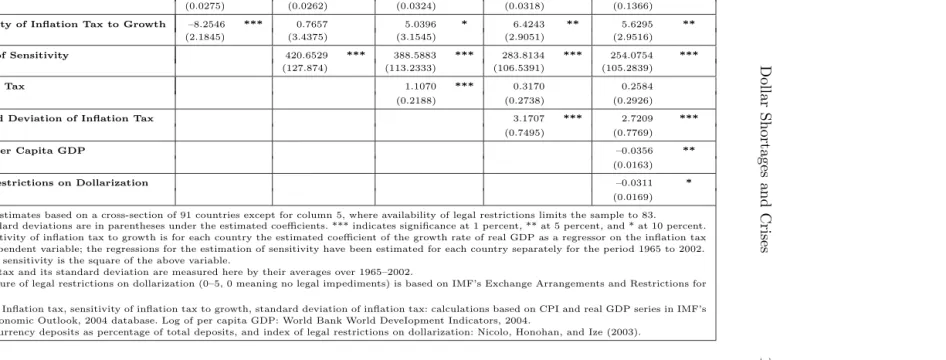
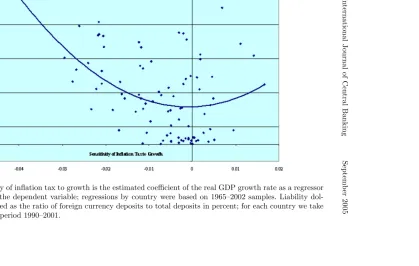
Again, however, we want to test a more nuanced version. We also want to see if there is a relationship between the sensitivity of inflation tax to growth (which, we have seen, appears to reflect the ability of a country to allocate the costs of economic adversity) and the level of dollarization. We also want to see if the extent of dollarization is related to the volatility of inflation, over and above its correlation with the level of inflation. In table 3, we present summary statistics and cross-correlations. The extent of liability dollarization is measured by the ratio of foreign currency deposits to total deposits (FCDTD) in a country’s banking system averaged over the 1990s, using the Nicolo, Honohan, and Ize (2003) data. The sensitivity of inflation tax to growth for a country (henceforth “sensitivity”) is the coefficient estimate on GDP growth in a regression of the inflation tax on GDP growth for that country for the period 1965–2002. The standard deviation of inflation tax is measured for every periodtby its standard deviation during the five years from t−4 to t; then for
the cross-section, we take the average of standard deviation over the period 1965–2002.
In table 4, the dependent variable is liability dollarization in a country in the 1990s. In column 1 we include the sensitivity of in-flation tax to GDP growth and a constant as explanatory variables. The coefficient estimate for the sensitivity is negative and signifi-cant. Since the sensitivity is typically negative (lower growth, more inflation tax), countries with a higher magnitude of the sensitivity have greater deposit dollarization, as expected. In figure 2 (shown on page 194), we plot the extent of dollarization against sensitivity. As the graph suggests, the relationship is likely to be nonlinear. So in column 2, we allow for a nonlinear specification of sensitivity by in-cluding the square of sensitivity. The coefficient of the squared term is positive and strongly significant. Greater sensitivity again is cor-related with greater dollarization. If sensitivity changes from 0 to its lower 1 percentile threshold (–0.029), dollarization increases by 33 percent, which is 140 percent of its standard deviation.
192
In
te
rn
at
ion
al
J
ou
rn
al
of
C
en
tr
al
B
an
k
in
g
S
ep
te
m
b
er
[image:17.612.141.648.137.372.2]2005
Table 3. Growth, Inflation, and Dollarization
A. Summary Statistics Obs. Mean Std.Dev. Min. Max. CV
Foreign Currency Deposits as
Percentage of Total Deposits 91 0.2801 0.2352 0.0014 0.9156 0.840
Sensitivity of Inflation Tax on Growth 91 –0.0070 0.0106 –0.0453 0.0167 –1.524
Inflation Tax 91 0.1350 0.1008 0.0263 0.5666 0.746
Standard Deviation of Inflation Tax 91 0.0574 0.0409 0.0106 0.1706 0.712
Log of Per Capita GDP 91 7.2451 1.2306 4.2402 9.6286 0.170
Legal Restrictions on Dollarization 83 0.5542 1.1609 0 5 2.095
B. Pairwise Correlations
(* indicates significance at 5% or less)
FCD/TD Sensitivity Inf. Tax SD(Inf.Tax) LnPcapGDP Leg.Rest.
Foreign Currency Deposits as
Percentage of Total Deposits 1
Sensitivity of Inflation Tax on Growth 0.3718* 1
Inflation Tax 0.5581* –0.4713* 1
Standard Deviation of Inflation Tax 0.6807* –0.5859* 0.7604* 1
Log of Per Capita GDP –0.3011* 0.0649 –0.2345* –0.2784* 1
Legal Restrictions on Dollarization –0.2097 0.2172* –0.2493* –0.1658 –0.2274* 1
Notes:Foreign currency deposits to total deposits (0–1) for each country is the average of available observations over 1990–2001. Inflation tax and its standard deviation for each country is the average for the period 1965–2002.
The sensitivity of inflation tax on growth is the estimated coefficient of growth as a regressor on inflation tax as the dependent variable. The regressions were estimated by country for the period 1965–2002.
The measure of legal restrictions on dollarization (0–5, meaning no legal impediments) is based on IMF’s Exchange Arrangements and Restrictions for 2001.
Sources:Foreign currency deposits/total deposits and legal restrictions on dollarization: Nicolo, Honohan, and Ize (2003).
1
No.
2
D
ol
lar
S
h
or
tage
s
an
d
C
ris
es
[image:18.612.139.645.157.337.2]193
Table 4. Determinants of Liability Dollarization
Dependent Variable: 1990–2001 Average of Foreign Currency Deposits to Total Deposits, (0–1)
1 2 3 4 5
Explanatory Variables:
Constant 0.2227 *** 0.2184 *** 0.1038 *** 0.0546 * 0.3652 ***
(0.0275) (0.0262) (0.0324) (0.0318) (0.1366)
Sensitivity of Inflation Tax to Growth –8.2546 *** 0.7657 5.0396 * 6.4243 ** 5.6295 **
(2.1845) (3.4375) (3.1545) (2.9051) (2.9516)
Square of Sensitivity 420.6529 *** 388.5883 *** 283.8134 *** 254.0754 ***
(127.874) (113.2333) (106.5391) (105.2839)
Inflation Tax 1.1070 *** 0.3170 0.2584
(0.2188) (0.2738) (0.2926)
Standard Deviation of Inflation Tax 3.1707 *** 2.7209 ***
(0.7495) (0.7769)
Log of Per Capita GDP –0.0356 **
(0.0163)
Legal Restrictions on Dollarization –0.0311 *
(0.0169)
Notes:Estimates based on a cross-section of 91 countries except for column 5, where availability of legal restrictions limits the sample to 83. The standard deviations are in parentheses under the estimated coefficients. *** indicates significance at 1 percent, ** at 5 percent, and * at 10 percent. The sensitivity of inflation tax to growth is for each country the estimated coefficient of the growth rate of real GDP as a regressor on the inflation tax as the dependent variable; the regressions for the estimation of sensitivity have been estimated for each country separately for the period 1965 to 2002. Square of sensitivity is the square of the above variable.
Inflation tax and its standard deviation are measured here by their averages over 1965–2002.
The measure of legal restrictions on dollarization (0–5, 0 meaning no legal impediments) is based on IMF’s Exchange Arrangements and Restrictions for 2001.
Sources:Inflation tax, sensitivity of inflation tax to growth, standard deviation of inflation tax: calculations based on CPI and real GDP series in IMF’s World Economic Outlook, 2004 database. Log of per capita GDP: World Bank World DeveIopment Indicators, 2004.
194
In
te
rn
at
ion
al
J
ou
rn
al
of
C
en
tr
al
B
an
k
in
g
S
ep
te
m
b
er
[image:19.612.176.596.133.399.2]2005
Figure 2. Dollarization as a Function of the Sensitivity of Inflation Tax to Real Growth
included alone, but becomes insignificant when the standard devi-ation of infldevi-ation tax is included. The estimates for sensitivity are qualitatively similar if we include squared terms for inflation tax and the standard deviation of inflation tax (estimates not reported). Fi-nally, in column 5, we include both the log of per capita GDP and the index of legal restrictions on dollarization compiled by Nicolo, Honohan, and Ize (2003), which is available for only eighty-three of the countries, and find qualitatively similar results.
One should not read too much into these last few “kitchen sink” regressions since sensitivity, inflation tax, and the standard deviation of the inflation tax measure various aspects of the same thing. All we want to show the reader is that both sensitivity and the standard deviation of inflation tax seem to be correlated with the extent of dollarization as predicted by the earlier discussion, and seem to cap-ture something more than just the level of the inflation tax, which the prior literature has identified.
The evidence thus far is consistent with the following conclusions: countries with weak institutions have greater sensitivity of inflation to growth. In countries with higher sensitivity, investors have a higher demand for real deposits. Because inflation is also very volatile, they may prefer deposits denominated in foreign exchange rather than deposits that are indexed.5
1.4 Aggregate Dollar Constraints/Sudden Stops
Let us now add the final ingredient to the model. Since emerging markets with the weakest institutions for conflict management (and the most divided societies) have the hardest time spreading the bur-dens of distress, they are also likely to have the most difficulty rais-ing resources to continue to service external debt. The tendency of some countries to default repeatedly (Reinhart, Rogoff, and Savas-tano 2003) may reflect the weakness of their capacity to manage
5There is a sense in which this argument runs counter to the “Original Sin”
196 International Journal of Central Banking September 2005
economic adversity rather than any inherent lack of honesty on the part of their governments. But this means that these countries are likely to face aggregate constraints on external borrowing sooner than other countries. Since in periods of adversity creditors will re-duce their expectations of what the country will be able to repay, they will also reduce what they are willing to lend. Such a “verti-cal” constraint on dollars the country can borrow (as in Caballero and Krishnamurthy [2000, 2004], or as a sudden stop in Calvo and Reinhart [2002]), will interact with liability dollarization to produce unfortunate consequences, which we now document.
2. Consequences: Overshooting, Liquidation, and Contagion
Now that we have the ingredients, dollarized bank deposits and the possibility of aggregate constraints on borrowing, let us sketch the consequences.
2.1 The Sources of Dollar Shortage
In the normal course, dollar depositors will want to withdraw some of their deposits. The reasons for this can range from normal liquidity needs (such as importing foreign goods) to good dollar investment opportunities outside the country. Clearly, if their bank has fewer dollar reserves than the amount of withdrawals, it will buy dollars on the market. Summing across banks, there will be an aggregate demand for dollars, which will have to be met out of the country’s reserves, dollar repatriation by exporters, and, if necessary, addi-tional external borrowing. It does not really matter which domestic entity (government or banks) does the external borrowing since the aggregate available pool of dollar resources will determine whether the aggregate domestic demand can be satisfied.
huge demand for dollars because foreign goods appear cheap. When added to the normal liquidity needs of depositors, the demand may be so high that it even exceeds the willingness of foreign investors to lend the shortfall. Another situation arises when the excess demand is relatively small but the economy is in a bad way, or the govern-ment has overborrowed, so foreign investors are unwilling even to lend meager amounts of extra dollars needed. In fact, the govern-ment can contribute to the private sector dollar shortage by adding its own external financing needs.
Regardless of how the dollar shortage emerges (and we will shortly see some examples), the dollarized banking system can exac-erbate it (see Diamond and Rajan [2005] for a detailed model). Since the banks have issued a nonrenegotiable promise to pay dollars, they either have to convince their own depositors not to withdraw, by hik-ing the interest rates paid on dollar deposits, or they have to attract dollars away from other banks in the spot market. Higher rates may quell some depositor demand, but a core liquidity demand that can-not be deterred with higher rates will remain. If this still exceeds the available dollars, the banks will compete with each other for scarce dollars. Given that a bank fails if it does not come up with the needed dollars, it will be willing to pay what it must for additional dollars. With an overall shortage in place, however, banks can competitively drive each other into failure.
Short banks will sell nondollar spot assets and long-term assets for dollars. Thus the exchange rate (dollars per domestic currency) will tend to fall and interest rates (both for long-term dollar assets and for long-term domestic currency assets) will rise. In principle, because the quantity of dollar demand and supply cannot adjust readily, these prices can move very far from any notion of funda-mental value. Both the exchange rate and the interest rate can over-shoot during the scramble for dollar liquidity. Real decisions will be affected during this scramble, with lasting consequences. Let us go systematically through them.
2.2 Real Consequences
198 International Journal of Central Banking September 2005
receipts and hasten repayment of dollar borrowings to banks (on average, across emerging markets, approximately 30 percent of do-mestic loans made by banks are denominated in foreign currency). To raise these amounts quickly, exporters will sell finished goods inven-tories at steep discounts and reduce near-term sales prices. They will shelve exports that are highly import intensive and abandon long-term projects, especially those that require capital goods imports.
Clearly, all these actions will impair the economy’s medium-run ability to export and thus its ability to generate dollars in the future. The weaker a country’s institutions, the greater will be the discount banks place on a future dollar generated by an exporter relative to a current dollar (foreign investors will be willing to lend less against the future), and the greater the long-run destructive consequences of a scramble for dollars.
We will see these effects not only in the tradable sector, but also in the nontradable sector. As domestic interest rates rise (because long-run domestic assets are being sold for dollars), more and more domestic projects will be shelved as they have to meet an impossible hurdle rate.
As bank assets fall in value, some banks—typically the ones with the greatest asset liability currency mismatch (though see later)— will become insolvent. This will trigger a generalized run on the banks’ assets, causing even those who had no desire to withdraw to add to dollar demand.6
The horizon of failing banks will be even shorter, causing them to be even more indiscriminate in the squeeze they put on borrowers. Even projects that could produce substantial dollar revenues in the near term may be sacrificed for the immediate need—for example, banks may stop offering working capital loans and export credit even if these are essential for the exporter to gen-erate revenues. As a result, the aggregate pool of dollars available over the near term could fall as banks fail, and the aggregate excess demand for dollars could increase, putting pressure on other banks.7
This form of contagion could imperil the entire banking system.
6Note that if the exchange rate is fixed but there are no capital controls,
domestic currency depositors have an even greater incentive to withdraw (and convert) than dollar depositors because they will fear a devaluation.
7Clearly, a bank that fails will refuse to honor some of its dollar depositors. The
To summarize, when bank depositors demand repayment in dol-lars but the economy cannot generate enough doldol-lars to satisfy them, the consequences can be very serious. Domestic dollar interest rates will rise to draw in dollars and choke off depositor demands. If, how-ever, there is a core group of depositors who absolutely want to withdraw dollars, and a limit to which outsiders are willing to lend to the country, the country’s banking system can face an excess de-mand for dollars that it cannot meet. If so, other asset prices will fall precipitously as banks scramble to capture enough dollars from the common pool to save themselves. Domestic currency interest rates will spike up, while the exchange rate will plummet. Banks will squeeze borrowers, and aggregate activity will fall. Some banks may become insolvent and such failures could be contagious.
Of course, in any such model, we could get multiple equilibria, where outside lenders impose a sudden stop, which leads to the dol-lar shortage, which leads to bank actions that reduce future doldol-lar receipts, which justify the stop. We do not need, however, to appeal to multiple equilibria to explain the crisis—a spike upward in dol-lar demand or downward in doldol-lar supply, coupled with a “normal” demand for liquidity, is sufficient to produce the effects.
2.3 Related Literature
Consider now how this model differs from earlier work. In a com-prehensive survey, Frankel and Wei (2004) attempt to distinguish between the three “generations” of crisis models on the basis on their explanation of why the crisis occurs:
“Whose fault is the crisis? Generation I says domestic macroeconomic policy, Generation II says volatile finan-cial markets, and Generation III says finanfinan-cial structure. In neutral language, the explanations are, respectively, excessive macroeconomic expansion, ‘multiple equilibria,’ and moral hazard. In finger-pointing language, the respective culprits are undisciplined domestic policy-makers, crazy international investors, and crony capitalists.”
200 International Journal of Central Banking September 2005
to emerging-market countries. However, in our paper, crises are not necessarily caused by willful misbehavior. Instead, they stem from adverse liquidity shocks that jolt a system that is necessarily rigid, given the institutional inadequacies of the economy. Put another way, better regulation and supervision may not necessarily eliminate the possibility of a crisis. What is really needed is deep-rooted institu-tional reform: susceptibility to crises in our framework ultimately rests not in an incentive problem but a collective action problem.
A closely related paper is that of Calvo, Izquierdo, and Mejia (2004), who also focus on a link between sudden stops, dollar-ization, and banking crises. In their paper, sudden stops lead to a devaluation—in order to maintain external balance—which then causes problems in the dollarized banking system through liability mismatches. In other words, macrocauses have micro-consequences. In our model, the channel is not the need to maintain external balance but, rather, bank liquidity. The sud-den stop creates a dollar shortage, which leads banks to dump assets, causing the exchange rate (and interest rates) to over-shoot fundamentals, which then create balance sheet problems for the banking system. Microcauses aggregate up to have macro-consequences.
While we think both explanations have merit, there are differ-ences. For instance, to the extent that a devaluation gives exporters the ability to earn more (expansionary devaluation), there is no rea-son for it to hurt the solvency of a dollarized banking system—since banks typically make dollar loans to the exporters (see Nicola, Hono-han, and Ize 2003). But to the extent that the capacity to earn future dollars does not translate into current dollars, a liquidity mismatch could persist, and banks could still go under in our framework.
2.4 Some Examples
Consider some examples.
2.4.1 Argentina (2001)
were government securities, issued by a government that was increasingly strapped for financing. Another $41 billion were foreign-currency-denominated loans and securities issued by Argen-tinean corporations, which clearly did not have the ability to repay quickly, as exports amounted to only $31 billion. Of the liabilities, $48.5 billion were foreign currency deposits.
In this fragile situation, depositor runs could start for two related reasons. First, if the government could not draw in more external resources to meet its own external debt service needs, or its new borrowing requirements, the anticipated available dollar pool would be severely constrained. The banking system’s liquidity needs would compete with the government’s needs, pushing up interest rates and leading, perhaps, to a devaluation.8
Second, given the extensive bank holdings of government assets, a government default could render banks insolvent (though see below).
Depositor runs started in 2001. Bank liabilities fell by $24 bil-lion (approximately 9 percent of GDP). In fact, Argentina lost more as a result of the bank run than as a result of the inability of the government to access external markets to meet financing needs. In-terestingly, the fall in domestic-currency-denominated deposits was far greater than the fall in foreign currency deposits, suggesting that depositors feared a devaluation, perhaps from the liquidity shortage, more than a bank default. Since bank holdings of government debt could not be reduced—in fact, they increased—the run was financed by curtailing private lending ($12 billion), running down bank liquid assets ($5 billion), and borrowing from the central bank ($9 billion). Ultimately, the entire banking system was affected, deposits were frozen, then loans and deposits were “pesified” at different rates. The consequences are still being dealt with. The point to take away is that a government may affect the dollarized domestic banking system simply by crowding out access to dollars.
8This would not necessarily lead to a default by dollar borrowers. For
202 International Journal of Central Banking September 2005
2.4.2 Uruguay (2002)
Uruguay experienced an almost reverse sequence of events: liquidity problems in the banking sector triggered a crisis, a devaluation, and problems for the government, which then had to restructure debt. Let us examine how this happened.
Uruguay also had a highly dollarized banking system. Bank de-posits were about 90 percent of GDP by the end of 2001; 90 percent of these deposits were denominated in U.S. dollars. About half these deposits were held by nonresidents, mostly Argentineans.
As the Argentineans saw their deposits in Argentina frozen, they started withdrawing from Uruguayan banks. Their liquidity need could have been met by Uruguay’s domestic holdings of liquid for-eign currency assets. However, anticipating a shortage, Uruguayan residents also began withdrawing deposits. With over 45 percent of the foreign currency deposits withdrawn, the currency depreciated precipitously, prompting further concerns about bank solvency. The government declared a bank holiday to stop the run; eventually, it successfully reopened the banking system with the help of a standby arrangement from the International Monetary Fund (IMF) and a rescheduling of deposits.
As a result of the depreciation, public debt, which was largely denominated in foreign currency, ballooned from about 45 percent of GDP by the end of 2001, to 100 percent of GDP by the end of 2002. Eventually, it had to be restructured. In this case, liquidity problems in the banking sector created problems for the government in servicing its public debt.
2.4.3 South Korea (1997–98)
liquidity shock. Contrast this with the liquidity shock that resulted from the government’s losing access to external borrowing, in the case of Argentina, or the liquidity shock set in motion by Argen-tineans withdrawing their deposits abroad, in the case of Uruguay.
We will not describe the details of the crisis, which resembled in many ways what we have described above (see Ghosh et al. [2002, 210] and Lindgren et al. [1999, 188] for details). Korean banks ini-tially started facing difficulties in mid-1997. The government an-nounced a guarantee of foreign borrowings by Korean banks, and the central bank attempted to help foreign branches and subsidiaries of Korean banks roll over their foreign currency borrowings. But this depleted reserves, leaving the central bank with little to fight do-mestic bank runs. The government simply did not have the neces-sary dollars to back the guarantee it had announced. The won fell sharply.
In early December, the IMF announced a standby arrangement with Korea equivalent to $21 billion, with additional financing from others of $37 billion. Yet this massive package was insufficient, and the won continued falling. It was only when foreign private banks agreed to maintain their exposure to Korean banks by exchanging their interbank loans for short-term government-guaranteed bonds, and when the IMF accelerated disbursement of the loan, that pres-sure on the won abated. In terms of our framework, the shortage was eliminated by reducing dollar demand and increasing dollar supply and thus alleviating pressure on both the exchange rate and the in-terest rate.
Interestingly, in the case of Korea, a liquidity crisis was averted because the government had spare borrowing capacity and could draw in dollars (with some help from the IFIs and developed coun-try governments), which it then lent out to the banks. With a few examples behind us, we can now discuss policy interventions in gen-eral terms.
3. Interventions
204 International Journal of Central Banking September 2005
interest rates (for the same reason, perhaps, that higher interest rates do not draw fresh foreign investors in), then banks will start com-peting for scarce dollars. Since a bank has to satisfy every one of its withdrawing dollar depositors in order to stay in business, it will be willing to pay any feasible price for dollars if it is falling short. This is why prices of nondollar assets can deviate so far from fundamentals— the bank essentially faces a classic short squeeze where it has to de-liver a specific asset in short supply, so it is willing to sell all other assets, almost regardless of price.
The dollar shortage is a form of liquidity shortage for the bank-ing system. However, it can affect the solvency of firms, banks, and even the government, so it is extremely difficult to tell it apart from a solvency problem. There are many ways solvency and liquidity can interact. Consider two. First, the dollar shortage may stem from an insolvent government not being able to roll over dollar liabilities (a sudden stop). Too few dollars relative to demand can cause banks to dump domestic assets, pushing up interest rates and depressing the exchange rate, thus rendering firms with dollar liabilities insolvent. Second, some banks may be insolvent because of bad loans. A run on them may cause a squeeze on credit to exporters, a shortage of dol-lars, and contagion in the banking system, rendering the government insolvent through its contingent liabilities to the banking system.
Put another way, the practical challenge in the midst of a crisis is to make a judgment call on whether the crisis is one of illiquidity. If the judgment is in the affirmative, the proper intervention is to lend freely to the healthiest banks the commodity that is in short supply, in this case dollars (or alternatively, convince dollar demand-ers to hold off pressing their claims). For, if the crisis is truly one of illiquidity, prevailing market rates will fall, and weaker institutions will regain market access rapidly. If the crisis is one of insolvency, market rates will stay high, and the banking system will continue to be fragile. Thus, except when failures are isolated or when as-set values collapse for other reasons than high interest rates or low exchange rates, it is typically only after intervening in a crisis and seeing the consequences that one can tell whether the crisis was one of illiquidity or insolvency.
from international financial institutions, it would sell dollars into the banking system hoping to alleviate pressure. However, we have defined a dollar shortage as one where the government itself has too few resources to contribute. So let us turn to other interventions.
3.1 Ex-post Intervention by Country Authorities
3.1.1 Recapitalization
The authorities can recapitalize specific banks by offering them ad-ditional domestic assets or guarantees (backed by domestic assets). Often, what is termed “liquidity support” are simply loans by the central bank to distressed banks without adequate collateral backing the loans—in short, they are partial recapitalizations.
While targeted recapitalizations can prevent specific banks from failing, they leave, on the aggregate, a dollar gap that has to be closed somehow. Unless other banks are allowed to fail, the aggre-gate dollar demand cannot be satisfied. This implies that a bank recapitalization without any attempt to bridge the dollar gap only forces other, potentially healthier, banks to fail. A blanket recapital-ization or guarantee of all banks simply allows all banks to bid more for dollars (that is, it increases the interest or exchange overshoot-ing) without reducing the eventual extent of bank failures. This is why it is best to close down some banks and thus resolve the dollar shortage before offering indiscriminate guarantees.
3.1.2 Monetary Policy
The monetary authorities could be accommodative and buy long-term domestic assets in exchange for domestic reserves (or do the opposite). Monetary accommodation will reduce the extent to which the burden of adjustment falls on the interest rate, and increase the downward pressure on the exchange rate. If not reversed later, it will increase inflationary pressures.
206 International Journal of Central Banking September 2005
newly failing banks subtract more dollar liquidity in failing than the banks that would fail absent the intervention.
An exchange rate defense (keeping the exchange rate high by tightening monetary policy) and an interest rate defense (keeping the interest rate low by being accommodative) are different in this simple framework only in that they select different sets of banks for failure. The choice between them rests on which one allows the banking system to come through the dollar shortage creating the minimum long-term damage to the real economy—through the damage the failing banks and their clients sustain. We are, of course, abstracting from any issues of credibility here, though it would be hard to unam-biguously relate monetary authority credibility gains to a particular form of defense.
Caballero and Krishnamurthy (2004) also examine monetary pol-icy in a situation of a dollar shortage. However, while our focus is on the effects of monetary policy on the extent of failure and economic damage (an ex-post analysis), their focus is on the ex-ante effects on the incentive to hold dollars. An accommodative monetary policy is unambiguously preferred in their analysis because it increases agent incentives to hold dollars before the crisis. Since the main friction in their model is that the price of dollars is too low ex-post (agents who need them do not have the collateral to buy them), any policy that enhances the price of dollars during the crisis enhances ex-ante incentives.
If, however, such a policy did considerable damage to the banking system (because, for example, moderately illiquid banks had many dollar liabilities), an effect they abstract from, our analysis suggests the policy would be dominated. In fact, such a preannounced policy might have limited credibility ex-ante and thus limited incentive ef-fects. On the other hand, unlike their paper, we assume no frictions in trading dollars ex-post, so we abstract from the effects they focus on. The two papers should therefore be seen as complementary.
overall cost of bank failures. Thus it is similar in consequence to the interventions just discussed.
3.1.3 Forced Conversion/Suspension of Convertibility/Capital Controls
Finally, consider even stronger interventions that violate the rights of the depositors. These include forced conversion into domestic cur-rency at a predetermined (typically below market) rate, the freezing of foreign currency deposits, and the imposition of capital controls. Clearly, such interventions can be implemented only by the country authorities and not by the banks alone.
While these interventions do solve, to differing extents, the prob-lem of dollar shortage, they do so at the expense of a substantial loss in future credibility. Moreover, it is not clear that they can be implemented effectively and for the long term. For instance, capital controls tend to leak, and the longer they are in place, the more they leak. Therefore, the authorities had better be confident that the liquidity shortage is temporary, or else the breathing space these measures give them will be insufficient to rectify the problem; the problem will return with a vengeance with the added difficulty that the authorities then have no credibility.
3.2 Ex-ante Intervention by Country Authorities
Thus far we have discussed measures that could be taken in the midst of a crisis. Consider now measures that could be taken up front by the economy.
3.2.1 Reserves
208 International Journal of Central Banking September 2005
effects of building a hoard large enough to buffer against most crises are ambiguous.
A second question that arises with reserves is whether the coun-try should use them to prepay debt. In other words, is spare debt capacity not the same as holding reserves, and less costly to boot? For the riskiest countries, though, prepaying debt may be dominated by holding reserves: spare debt capacity is less fungible than reserves, and may also disappear in a crisis. Also, by prepaying debt, the coun-try loses the option to force a restructuring, which may be valuable in times of stress.
3.2.2 De-dollarization and Shifting Dollarization
Given the risks associated with dollar shortages, some countries, in-cluding Mexico and Bolivia in 1982 and Peru in 1985, have opted to ban dollarization. But if the proximate cause, monetary instability, is not eliminated, investors will demand significantly higher interest rates to hold domestic currency deposits, and some may simply take the money out of the country. Consistent with this, countries that today have significant restrictions on dollarization—such as Brazil, Colombia, and Venezuela—have particularly high loan spreads (see Inter-American Development Bank 2005).
Also, domestic currency depositors are not passive. With less-than-effective monetary authorities, banks could be subject to stress even if they only issue domestic deposits. For instance, suppose the authorities maintain an overvalued but fixed exchange rate. Fear-ing an eventual return to equilibrium, depositors have an incentive to withdraw and convert into foreign currency. This puts enormous stress on the banking system, forcing it to pay high interest rates to keep depositors in, with the level of interest rates being determined by the degree of overvaluation rather than more typical determinants like the return on investment and expected inflation. As described earlier, domestic currency depositors were prominent in the Argen-tinean bank runs in 2001.
of intermediation that was reversed in Bolivia and Peru only when dollar deposits were allowed again. Similarly, Nicolo, Honohan, and Ize (2003) show that economies with high inflation tend to have more monetary depth with dollarization than without.
Rather than banning liability dollarization altogether, authorities may want to focus on removing the distortions that lead it to its excessive practice, such as the dollar-liability issuers not internalizing all the risks. More useful, of course, is to focus on changing the underlying conditions that lead to dollarization in the first place, a point we will touch on shortly.
Before concluding this section, note two points. First, the tran-sition from an economy with liability dollarization to one where dol-larization is banned implies either violating existing dollar contracts and prohibiting new ones, or shifting dollar liabilities to another domestic entity. The Brazilian government essentially took the lat-ter route by taking on the dollar liabilities of its banking system— through the issuance of dollar-denominated bonds to banks in 1998. As a result, even though the Brazilian real depreciated substantially in 1998–99, the banks were relatively immunized. Of course, govern-ment debt ballooned as a result.
From a theoretical perspective, the government could improve welfare by taking on the dollar liabilities of the banking sector. When individual banks fail during a dollar shortage, we have seen that they can worsen the aggregate shortage. When the government takes over the liabilities of the banking sector, these individual failures are eliminated, so the dollar shortage need not be as severe. Against this, one should weigh the increased moral hazard if the government is expected to step in every time banks anticipate trouble.
210 International Journal of Central Banking September 2005
more useful to focus on changing the underlying institutions rather than on choosing a specific regime.
3.2.3 Institutional Reform
The root cause of deposit dollarization, we have argued, is weak ba-sic institutions for conflict management. The more proximate causes are inadequate fiscal and monetary institutions. Of course, it is easier—though not easy—to reform the narrow institutions rather than the basic ones. But without reforming the deeper basic insti-tutions, which typically requires deep-rooted political change, how successful can reform of narrow institutions be? We do not know much about the process of institutional reform; countries like Chile, Mexico, and South Korea that have improved their basic institu-tions over a relatively short time, aided by good policies and rapid economic growth, offer only a few successful examples. Understand-ing what Understand-ingredients in this mix are essential, and what simply are coincidental, is a topic of ongoing research on which, hopefully, re-searchers will have more to say in the near future. For now, let us turn to the role the international financial institutions can play.
3.3 What Can IFIs Do?
Clearly, the international financial institutions (IFIs) can provide the technical support that will help countries adopt good policies and improve their narrow institutions (such as their fiscal frame-work or their inflation-targeting frameframe-work). They can also provide the bilateral and multilateral economic surveillance that can alert countries to possible sources of shocks. The International Monetary Fund does all this. The million-dollar question, of course, is whether IFIs should lend in such situations.
3.3.1 “Liquidity” Loans
A dollar shortage seems precisely the kind of temporary need that certain IFIs like the International Monetary Fund were set up to meet. By creating a common reserve pool of dollars, the IFIs can substitute for costly reserve hoarding by countries.
tides the country over its temporary exchange shortage, preventing more destructive domestic sector real adjustment, and gets repaid once the reasons for the temporary need vanish (e.g., exports re-cover).
The difficulty, of course, even with this simple scenario, is that the ultimate cause for a dollar shortage has to be that the country loses access to international markets. Thus the IFI has to make the judg-ment call of whether the loss of access is due to irrational/rational uncoordinated behavior by market participants, or whether it stems from genuine fears. If the former is the case, most would agree that the IFI should act as a lender of last resort. The only remaining concern would be whether this role creates bad incentives for market participants, for the government, and for banks—the issue of moral hazard, to which we will come in a moment.
If, however, the adverse shock precipitating the dollar shortage reflects a genuine institutional infirmity in the country—for instance, that the government has no fiscal discipline, it has reached borrowing limits, and thus it is shut off from international capital markets— matters become more difficult. It may well be that the country could undertake reforms that would help it regain access. In this case, the country is illiquid but solvent contingent on undertaking reforms. Solvency, however, will not be restored until the markets gain confi-dence that the reforms are irreversible. This implies that the lending may well not be temporary.
If the alternative is a banking system crisis coupled with a burden to restructure public debt, both of which will set back the country’s economy considerably, it may well make sense to lend even when reforms are highly probable but not fully assured. The IFI bears some risk here that it will not be repaid, but it does so in the larger interest of the member country facing distress (and it should impose conditionality as well as charge an adequate premium for the risk).
212 International Journal of Central Banking September 2005
success (or put its money at stake) before the market is persuaded. The IFI may also be able to put in place incentives for the country to reform. We find the second argument more persuasive, but one should not rule out the possibility that the IFI has an incentive to find a role for itself where none exists (see below).
A final situation where IFI lending may be warranted is when the country’s public debt is too high given its underlying fundamentals, so it cannot borrow, but, as a result, it also faces an immediate dollar shortage that threatens its banking system. Rather than stand back and watch the banking system implode, the IFI may want to offer a bridge loan targeted at the banking system, to be repaid when the country regains market access after restructuring its external public debt. Again, this is a form of liquidity lending but one compounded by the problem that the excessive public debt will prolong the even-tual resolution.
All this, however, raises two questions. First, does IFI interven-tion distort incentives among participants? Second, are there better ways to provide assurance of liquidity support to member countries?
3.3.2 Incentive Distortion and Tough Love
At least three types of incentive distortions are possible: (1) an un-willingness on the part of countries to take adequate precautions or to avoid excessively risky situations, (2) an unwillingness on the part of investors to take all risks into account, knowing they will be “bailed out,” and (3) an unwillingness on the part of domestic corporations and banks to insure themselves adequately.
The question is, how much? Unfortunately, the empirical evi-dence does not offer a reasonable assessment of magnitudes (see Jeanne and Zettelmeyer [2004] for an excellent exposition of the issues). Our reading of the current consensus is that country and investor moral hazard is small in most situations; in a few cases, though, it could be really big. We need more research identifying the circumstances where moral hazard is really a problem.
What seems clearer is that domestic corporations and banks may have too little incentive to prepare themselves for possible shocks, knowing that there are ways they can force the system to share that risk with them. This, however, is a case for better domestic regulation and supervision rather than limiting IFI intervention.
In sum, then, the moral hazard rationale against IFI intervention may well exist in some cases, but we need to be able to identify those cases better. If these cases are indeed few in number, as a reasonable judgment would suggest, then it may well make sense to accept the risks of inducing moral hazard through intervention while trying harder to identify when it is a mistake.
If, however, the reasons for dollarization lie primarily in poor in-stitutions rather than in gaming—a collective action problem rather than an incentive problem—the greater concern should not be about distorting individual incentives but about altering collective actions. Sometimes external discipline forces a country to reform in ways, and at a speed, that the domestic constellation of political forces will simply not allow, if left to its own devices. Put another way, bailouts may help governments shift the burden of a crisis off the shoulders of the domestic business elite and onto domestic taxpayers (see Jeanne and Zettelmeyer 2004). To the extent that the latter do not have an adequate voice, they bear the brunt of excessive inter-vention, and everyone else who has a voice is willing to go along. The knowledge that bailouts may be hard to come by—a policy of “tough love”—could pressure domestic forces to compromise and ef-fect much-needed reform.