http://dx.doi.org/10.4236/jss.2014.28001
How to cite this paper: Voiskounsky, A. and Wang, S.L. (2014) Flow Experience While Computer Gaming: Empirical Study.
Open Journal of Social Sciences, 2, 1-6. http://dx.doi.org/10.4236/jss.2014.28001
Flow Experience While Computer Gaming:
Empirical Study
Alexander Voiskounsky
1, Shilu Wang
2*1Psychology Department, Moscow Lomonosov State University, Moscow, Russia 2Guangdong University of Education, Guangzhou, China
Email: *[email protected]
Received May 2014
Abstract
Video/computer/online gaming acquired great popularity. A series of studies show that gaming is accompanied by flow experience (the term coined M. Csikszentmihalyi), which is associated with intrinsic motivation, creativity and life happiness. The study was held with Chinese adolescent and adult gamers (N = 1574). A 24-item questionnaire (available in English, Russian and French) was adapted to be used within a Chinese population. The results show that Chinese gamers experience low level of Flow during gameplay sessions; males experience flow more frequently compared to females; adolescents experience flow more often than adults. Chinese gamers seldom express facts of immersion during play sessions. In sum, Chinese players seldom regard playing video/compu- ter/online games a reasonable way to attain intrinsic motivation and flow. This result is discussed and supposedly rooted in the social ideals of collectivism in Chinese culture, according to which individuality is not encouraged.
Keywords
Positive Psychology, Cyberpsychology, Optimal Experience, Flow Experience, Intrinsic Motivation, Video/Computer/Online Game, Collectivism, Individualism, Immersion, Culture
1. Introduction
Positive psychology is rapidly developing, parallel to humanistic and existential psychology. Stepping aside from human pathology, weaknesses or damages, positive psychology forwards towards health and happiness [1]. Among major conceptions developed within the field of positive psychology, theory of self-determination [2] and theory of optimal experience, or flow [3] should be mentioned.
While both theories are being fruitfully applied in such areas as human-computer interaction and cyberpsy-chology, the flow (also named autotelic) experience has got more applications [4] [5]. Due to this reason the current paper is devoted to the applications of flow experience such as video, stand-alone computer related, and online gaming.
To be short with the description of flow experience, we need to mention that M. Csikszentmihalyi and his colleagues who observed a range of widespread activities in various kinds of culture, social status, gender, age,
etc., in which consciousness of individuals was controlled to ensure optimum focus upon the defined goals. M. Csikszentmihalyi calls this state of experience “Flow”, because most people use this term when they feel them-selves constantly flowing from one scene to another, being fully integrated into the environment between stimuli and responses, between past, present and future [3].
2. Flow and Gameplay Activity on the Internet
Gameplay occupies a special place in human civilization: almost every human activity can be interpreted as a play (just enough to mention cultural, philosophical and psychological theories of J. Huizinga, L. Wittgenstein, E. Berne or L. Vygotsky). Playing activity is a traditional area of research in psychology and adjacent sciences. Based on the theory of flow, M. Csikszentmihalyi also developed a theory of playing activity: any play is a per-fect example of human’s aspiration for flow. Indeed, gaming motivation is not dependent on the result to acquire, but by the process of playing, i.e. meet the conditions for flow experience [3].
Video/computer/online games got unprecedented popularity within several decades. Information and comput-er technologies, connections to the Intcomput-ernet create a new and unique environment to reach flow expcomput-erience being obsessed with almost every kind of activity, from online marketing to hacking, including of course gameplay ac-tivity [4] [5]. In fact, technological revolution provides a sort of immersion experience into virtual reality of gaming. Not surprisingly, well-controlled video/computer/online gaming is a popular practice for studying phe-nomena of flow.
This is true worldwide, especially for Mainland China. First, Chinese networkers prefer computer games to all the other entertainments on the Internet. As long way back as 2009, 62.8% of Internet users in China reported (see: CNNIC) playing computer games as one of the main purposes for the use of Internet. Second, the devel-opment of the Internet and video/computer/online games made a very deep impact on Chinese society and tradi-tional lifestyles, resulting in a generation gap. There are ambivalent attitudes in China towards the Internet. On the one hand, development of the Internet is encouraged in China for accessing to global economy. On the other hand, conservative people in China do not approve the Internet, which is a promoter of individuality characteris-tic for the Western culture and possibly threatening traditional values of China which emphasize an interdepen-dent self rather than an indepeninterdepen-dent self [6]. Therefore, the Internet users in China, including gamers, are strictly controlled by governmental or educational agencies. While flow experience is widely associated with gameplay activity [4] [5], psychologists in China pay rather little attention to this aspect of the Internet-mediated activity.
The current study is a part of a cross-cultural study of flow experience in the cyberspace, namely vid-eo/computer/online gaming: the previous work was carried out within Russian, American and French popula-tions of online gamers [7]; Russian players [8] [9]. The recent work was carried out using the same survey me-thodology—as a part of the cross-cultural research project, this time held within the population of Chinese ga-mers.
3. Research Hypotheses, Methodology and Participants
3.1. Research Hypotheses
The main hypotheses of the present study are as follows:
1) Chinese players of video/computer/online games show low level of flow experiences. 2) In China, compared to adults, adolescent gamers show higher levels of flow experience. 3) Chinese male gamers, compared to females, demonstrate higher level of flow.
4) In China, during gameplay report feeling pleasure more often than feeling enjoyment.
3.2. Methodology
with the original Russian version of the questionnaire, and the Chinese version was revised again. After this, another two Chinese who know Russian quite well were found to retranslate the revised items into Russian, and the consistency with the original Russian version was checked again. Lastly, the final version of the Chinese questionnaire measuring flow experience while video/computer/online gaming was created.
3.3. Participants
Two methods have been used to distribute the questionnaire in primary or middle schools: first, online adminis-tering, and second, traditional—sheets of paper with printed questions. Participation was voluntary. Totally, 1704 replies were received. After filtration 1574 were left, among which 64.7% (1019) of the respondents were males and 35.3% (555)—females. Their age was mostly between 17 and 25 years old. About 60% respondents reported they played video/computer/online games for more than 3 years. As many as 25.2% respondents re-ported to play over 10 hours per week.
4. Data Analysis and Results
Data processing was conducted with SPSS 18.0.
4.1. The Overall Flow Measure
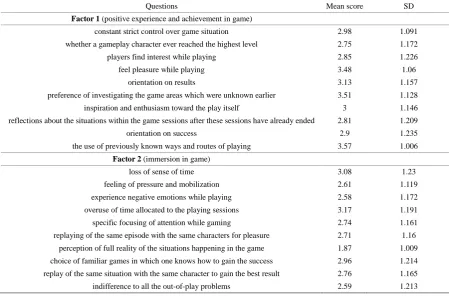
Initially, α Cronbach of 24 items in the flow scale was less than 0.8. After the removal of four minimally relia-ble items it reached 0.836. Table 1 shows the mean scores of each of 20 items. Among these 20 items, there are only 7 points with mean scores higher than the expected mean value 3.0. Average score of all 20 items is 2.90 ± 0.03—also below 3.0. Thus, we can say that the Chinese gamers experience little flow. In addition, basing on the semantic meaning of the items it can be stated that the Chinese gamers are prone to experience stress in the game, and they seldom openly express their interest in gaming. Thus, the first hypothesis is justified.
4.2. Measures of Flow by Different Age Groups of Gamers
The result of one-way ANOVA tells us that players younger 17 experience flow more strongly than others (α < 0.000, see Table 2).
Further two-way analysis of variance shows significant effect of the interaction between age and game expe-rience on the level of flow expeexpe-rience (α < 0.048). For the players who played longer than 1 year, the ones older than 17 report they experience much less flow than the ones younger than 17. But for the players who play less than 1 year, such a difference between age groups was not found (see Table 3). Thus, the second hypothesis has been justified.
4.3. Gender Differences of Gamers’ Flow Experience
The results of one–way ANOVA indicate that male players experience flow during the gaming process stronger than females (α < 0.000, see Table 4). But men play much more than women: is it correct to state that the gend-er polarity occurs only because men play more than women? Furthgend-er comparison was done to find out whethgend-er there is gender difference in experiencing flow, taken that the gamers play equally long (or short) time. The re-sults show that among gamers who play less than 3 hours and more than 10 hours, men still experience signifi-cantly higher level of flow than women (α < 0.01, see Table 4). Therefore, when time spent gaming is the same, males experience flow stronger than females, and the third hypothesis has been justified.
It was found that there is significant difference between male and female gamers who are younger than 16 (see Table 5, α < 0.000). Moreover, as it is shown in the Table 5, according to the results of two–way analysis of variance of the impact of interaction between gender and age on the flow level, for female players there are no significant differences of Flow scores between different age groups.
4.4. The Structure of the Flow Experience among Chinese Players
Table 1. Mean scores of all items of the flow scale and the factor distribution.
Questions Mean score SD
Factor 1 (positive experience and achievement in game)
constant strict control over game situation 2.98 1.091
whether a gameplay character ever reached the highest level 2.75 1.172
players find interest while playing 2.85 1.226
feel pleasure while playing 3.48 1.06
orientation on results 3.13 1.157
preference of investigating the game areas which were unknown earlier 3.51 1.128
inspiration and enthusiasm toward the play itself 3 1.146
reflections about the situations within the game sessions after these sessions have already ended 2.81 1.209
orientation on success 2.9 1.235
the use of previously known ways and routes of playing 3.57 1.006
Factor 2 (immersion in game)
loss of sense of time 3.08 1.23
feeling of pressure and mobilization 2.61 1.119
experience negative emotions while playing 2.58 1.172
overuse of time allocated to the playing sessions 3.17 1.191
specific focusing of attention while gaming 2.74 1.161
replaying of the same episode with the same characters for pleasure 2.71 1.16
perception of full reality of the situations happening in the game 1.87 1.009
choice of familiar games in which one knows how to gain the success 2.96 1.214
replay of the same situation with the same character to gain the best result 2.76 1.165
indifference to all the out-of-play problems 2.59 1.213
Table 2. Comparison of flow levels of players belonging to different age groups.
Age (years) ≤16 17 - 20 21 - 25 ≥26
Number of players 418 440 436 280
[image:4.595.90.539.423.462.2]Mean score of flow 3.0385 2.7966 2.8819 2.8929
Table 3. Relation between flow, age and game experience.
Age (years) ≤16 17 - 20 21 - 25 ≥26
Flow Game experience < 1 year 2.7147 2.6869 2.6439 2.7176
Game experience > 1 year 3.1430 2.8406 2.9370 2.9195
Table 4. Relationship between flow experience, gender and time given to gaming per a week.
time given to gaming per a week (hours) <3 3 - 10 >10
Flow score M. 2.7985 3.0429 3.0794
F. 2.6554 2.8530 2.9642
the game, while the second factor can be called “preoccupation or immersion”. Table 6 shows that the average score of the first factor is 3.0971, it is significantly higher than the average score of the second factor (α < 0.000). So we can draw a conclusion that Chinese players treat computer games as a way of entertainment rather than an activity which they are engaged in, and the fourth hypothesis had been justified.
[image:4.595.89.544.557.597.2]Table 5. Relationship between flow, gender and age.
Age (years) ≤16 17 - 20 21 - 25 ≥26
Flow score M. 3.2186 2.8336 2.9076 2.9579
F. 2.7624 2.7236 2.8275 2.7794
Table 6. Comparison of the levels of the two factors of flow experience.
Mean score SD
Positive experience and achievement in computer game 3.0971 0.65638
Immersion in computer game 2.706 0.62067
Table 7. Comparison of the levels of the two flow factors within different age groups.
Age (years) ≤16 17 - 20 21 - 25 ≥26
Positive experience and achievement in computer game 3.3074 3.0030 3.0300 3.0357
Immersion in computer game 2.7696 2.5902 2.7337 2.7500
(all α < 0.01). Thus, the players who are younger 17 experience a higher level of both factors 1 and 2 of Flow, but in the 17 - 20 age group the level of both factors 1 and 2 of Flow has significantly dropped. After that the level of factor 1 of flow keeps on staying on a low level, but the level of factor 2 of flow return back to the level as high as that of the players who are younger than 17.
5. Discussion and Conclusion
The major hypothesis of the current study is that Chinese gamers experience low level of flow. Justification of this hypothesis needs further comparative research to be done in various cultural backgrounds both inside and outside China, since flow is a widespread experience mediated by the Internet. The results show that the mean score of flow in Chinese gamers is below the mean value (3.0)—it indicates that Chinese players hardly expe-rience as much flow as gamers with background in many other cultures. Furthermore, there is strong coherence between this conclusion and the traditional Chinese culture of collectivism that does not respect individuality, while individuality is essential for flow experience.
Results show there are gender differences in the flow level; reasonable interpretation is that females in China are more subservient than males, so girls are more expected to behave according to the imposed school or family requirements. Males in China are often educated enough to be more independent than females and are more likely to have autotelic experiences. Due to this reason, male players more often experience flow in video/ computer/online gaming compared to females.
It is a Csikszentmihalyi’s idea that flow experience cannot be understood independently of social environment. Despite this idea, many current researchers pay attention to the universal aspects of flow experience. By contrast, in our study an attempt was made to expose the specific culture influence on flow. We think this kind of culture related investigation of flow is essential for both the development of optimal experience theory and understand-ing particular cultures.
References
[1] Seligman, M.E.P. and Csikszentmihalyi, M. (2000) Positive Psychology: An Introduction. American Psychologist, 55, 5-14. http://dx.doi.org/10.1037/0003-066X.55.1.5
[2] Deci, E. and Ryan, R. (1985) Intrinsic Motivation and Self-Determination in Human Behavior. Plenum Press, New York. http://dx.doi.org/10.1007/978-1-4899-2271-7
[3] Csikszentmihalyi, M. (1990). Flow: The Psychology of Optimal Experience. Harper and Row, New York.
[4] Voiskounsky, A.E. (2008) Flow Experience in Cyberspace: Current Studies and Perspectives. In: Barak, A., Ed. Psy-chological Aspects of Cyberspace: Theory, Research, Applications, Cambridge University Press, New York, 70-101.
http://dx.doi.org/10.1017/CBO9780511813740.005
[5] Voiskounsky, A.E. (2012) Flow Experience in Internet-Mediated Environments. In: Leontiev, D., Ed., Motivation,
[image:5.595.90.541.235.274.2][6] Marcus, H.R. and Kitayama, S. (1991) Culture and the Self: Implications for Cognition, Emotion, and Motivation.
Psychological Review, 98, 224-253. http://dx.doi.org/10.1037/0033-295X.98.2.224
[7] Faiola, A. and Voiskounsky, A.E. (2007) Flow Experience of MUD Players: Investigating Multi-User. Dimension Gamers from the USA. Lecture Notes in Computer Science, 4564, 324-333.
http://dx.doi.org/10.1007/978-3-540-73257-0_36
[8] Voiskounsky, A.E., Mitina, O.V. and Avetisova, A.A. (2005) Communicative Patterns and Flow Experience of MUD Players. International Journal of Advanced Media and Communication, 1, 5-25.