R E S E A R C H
Open Access
A new localization set for generalized
eigenvalues
Jing Gao
1and Chaoqian Li
2**Correspondence:
2School of Mathematics and
Statistics, Yunnan University, Kunming, Yunnan 650091, China Full list of author information is available at the end of the article
Abstract
A new localization set for generalized eigenvalues is obtained. It is shown that the new set is tighter than that in (Numer. Linear Algebra Appl. 16:883-898, 2009). Numerical examples are given to verify the corresponding results.
MSC: 15A45; 15A48
Keywords: generalized eigenvalue; inclusion set; matrix pencil
1 Introduction
LetCn×ndenote the set of all complex matrices of ordern. For the matricesA,B∈Cn×n, we call the family of matricesA–zBa matrix pencil, which is parameterized by the complex numberz. Next, we regard a matrix pencilA–zBas a matrix pair (A,B) []. A matrix pair (A,B) is called regular ifdet(A–zB)= , and otherwise singular. A complex numberλis called a generalized eigenvalue of (A,B), if
det(A–λB) = .
Furthermore, we call a nonzero vectorx∈Cna generalized eigenvector of (A,B) associated
withλif
Ax=λBx.
Letσ(A,B) ={λ∈C:det(A–λB) = }denote the generalized spectrum of (A,B). Clearly, ifBis an identity matrix, thenσ(A,B) reduces to the spectrum ofA,i.e.σ(A,B) =σ(A). WhenBis nonsingular,σ(A,B) is equivalent to the spectrum ofB–A, that is,
σ(A,B) =σB–A.
So, in this case, (A,B) hasngeneralized eigenvalues. Moreover, ifBis singular, then the degree of the characteristic polynomialdet(A–λB) isd<n, so the number of general-ized eigenvalues of the matrix pair (A,B) is d, and, by convention, the remainingn–d eigenvalues are∞[, ].
We now list some notation which will be used in the following. LetN ={, , . . . ,n}. Given two matricesA= (aij),B= (bij)∈Cn×n, we denote
ri(A) =
k∈N, k=i
|aik|, rji(A) = k∈N, k=i,j
|aik|,
Ri(A,B,z) =
k∈N, k=i
|aik–zbik|, Rji(A,B,z) =
k∈N, k=i,j
|aik–zbik|,
i(A,B) =
z∈C:|aii–zbii| ≤Ri(A,B,z)
,
and
ij(A,B) =
z∈C:(aii–zbii)(ajj–zbjj) – (aij–zbij)(aji–zbji) ≤ |ajj–zbjj|Rji(A,B,z) +|aij–zbij|Rij(A,B,z)
.
The generalized eigenvalue problem arises in many scientific applications; see [–]. Many researchers are interested in the localization of all generalized eigenvalues of a ma-trix pair; see [, , , ]. In [], Kostićet al.provided the following Geršgorin-type theorem of the generalized eigenvalue problem.
Theorem ([], Theorem ) Let A,B∈Cn×n,n≥and(A,B)be a regular matrix pair. Then
σ(A,B)⊆(A,B) =
i∈N
i(A,B).
Here,(A,B) is called the generalized Geršgorin set of a matrix pair (A,B) andi(A,B)
theith generalized Geršgorin set. As showed in [],(A,B) is a compact set in the complex plane if and only ifBis strictly diagonally dominant (SDD) []. WhenBis notSDD,(A,B) may be an unbounded set or the entire complex plane (see Theorem ).
Theorem ([], Theorem ) Let A= (aij),B= (bij)∈Cn×n,n≥.Then the following
state-ments hold:
(i) Leti∈Nbe such that,for at least onej∈N,bij= .Theni(A,B)is an unbounded set in the complex plane if and only if|bii| ≤ri(B).
(ii) (A,B)is a compact set in the complex plane if and only ifBis SDD,that is,
|bii|>ri(B).
(iii) If there is an indexi∈Nsuch that bothbii= and
|aii| ≤ k∈β(i), k=i
|aik|,
whereβ(i) ={j∈N:bij= },theni(A,B),and consequently(A,B),is the entire complex plane.
A(orB) isSDDfor anyi∈N. Although the set obtained by Nakatsukasa is simpler to compute than that in Theorem , the set is not tighter than that in Theorem in general.
In this paper, we research the generalized eigenvalue localization for a regular matrix pair (A,B) without the restrictive assumption that theith row of eitherA(orB) isSDD for anyi∈N. By consideringAx=λBxand using the triangle inequality, we give a new inclusion set for generalized eigenvalues, and then prove that this set is tighter than that in Theorem (Theorem of []). Numerical examples are given to verify the corresponding results.
2 Main results
In this section, a set is provided to locate all the generalized eigenvalue of a matrix pair. Next we compare the set obtained with the generalized Geršgorin set in Theorem .
2.1 A new generalized eigenvalue localization set
Theorem Let A= (aij),B= (bij)∈Cn×n,with n≥and(A,B)be a regular matrix pair.
Then
σ(A,B)⊆(A,B) =
n
i,j=, i=j
ij(A,B)∩ji(A,B)
.
Proof For anyλ∈σ(A,B), let =x= (x,x, . . . ,xn)T∈Cn be an associated generalized
eigenvector,i.e.,
Ax=λBx. ()
Without loss of generality, let
|xp| ≥ |xq| ≥max|xi|:i∈N,i=p,q.
Thenxp= .
(i) Ifxq= , then from Equality (), we have
appxp+apqxq+
k∈N, k=p,q
apkxk=λbppxp+λbpqxq+λ
k∈N, k=p,q
bpkxk
and
aqqxq+aqpxp+
k∈N, k=q,p
aqkxk=λbqqxq+λbqpxp+λ
k∈N, k=q,p
bqkxk,
equivalently,
(app–λbpp)xp+ (apq–λbpq)xq= –
k∈N, k=p,q
and
(aqq–λbqq)xq+ (aqp–λbqp)xp= –
k∈N, k=q,p
(aqk–λbqk)xk. ()
Solving forxpandxqin () and (), we obtain
(app–λbpp)(aqq–λbqq) – (apq–λbpq)(aqp–λbqp)
xp
= –(aqq–λbqq)
k∈N, k=p,q
(apk–λbpk)xk+ (apq–λbpq)
k∈N, k=q,p
(aqk–λbqk)xk ()
and
(app–λbpp)(aqq–λbqq) – (apq–λbpq)(aqp–λbqp)
xq
= –(app–λbpp)
k∈N, k=q,p
(aqk–λbqk)xk+ (aqp–λbqp)
k∈N, k=p,q
(apk–λbpk)xk. ()
Taking absolute values of () and () and using the triangle inequality yield
(app–λbpp)(aqq–λbqq) – (apq–λbpq)(aqp–λbqp)|xp| ≤ |aqq–λbqq|
k∈N, k=p,q
|apk–λbpk||xk|+|apq–λbpq|
k∈N, k=q,p
|aqk–λbqk||xk|
and
(app–λbpp)(aqq–λbqq) – (apq–λbpq)(aqp–λbqp)|xq| ≤ |app–λbpp|
k∈N, k=q,p
|aqk–λbqk||xk|+|aqp–λbqp|
k∈N, k=p,q
|apk–λbpk||xk|.
Sincexp= andxq= are, in absolute value, the largest and second largest components
ofx, respectively, we divide through by their absolute values to obtain
(app–λbpp)(aqq–λbqq) – (apq–λbpq)(aqp–λbqp) ≤ |aqq–λbqq|Rqp(A,B,λ) +|apq–λbpq|Rqp(A,B,λ)
and
(app–λbpp)(aqq–λbqq) – (apq–λbpq)(aqp–λbqp) ≤ |app–λbpp|Rpq(A,B,λ) +|aqp–λbqp|Rqp(A,B,λ).
Hence,
λ∈
pq(A,B)∩qp(A,B)
(ii) Ifxq= , thenxpis the only nonzero entry ofx. From equality (), we have A ⎛ ⎜ ⎜ ⎜ ⎜ ⎜ ⎜ ⎜ ⎜ ⎜ ⎜ ⎜ ⎜ ⎝ .. . xp .. . ⎞ ⎟ ⎟ ⎟ ⎟ ⎟ ⎟ ⎟ ⎟ ⎟ ⎟ ⎟ ⎟ ⎠ = ⎛ ⎜ ⎜ ⎜ ⎜ ⎜ ⎜ ⎜ ⎜ ⎜ ⎜ ⎜ ⎜ ⎝
apxp
.. . ap–,pxp
appxp
ap+,pxp
.. . anpxp
⎞ ⎟ ⎟ ⎟ ⎟ ⎟ ⎟ ⎟ ⎟ ⎟ ⎟ ⎟ ⎟ ⎠ =λ ⎛ ⎜ ⎜ ⎜ ⎜ ⎜ ⎜ ⎜ ⎜ ⎜ ⎜ ⎜ ⎜ ⎝
bpxp
.. . bp–,pxp
bppxp
bp+,pxp
.. . bnpxp
⎞ ⎟ ⎟ ⎟ ⎟ ⎟ ⎟ ⎟ ⎟ ⎟ ⎟ ⎟ ⎟ ⎠ ,
which implies that, for anyi∈N,aip=λbip,i.e.,aip–λbip= . Hence for anyi∈N,i=p,
λ∈
pi(A,B)∩ip(A,B)
⊆(A,B).
From (i) and (ii),σ(A,B)⊆(A,B). The proof is completed.
Since the matrix pairs (A,B) and (AT,BT) have the same generalized eigenvalues, we can
obtain a theorem by applying Theorem to (AT,BT).
Theorem Let A= (aij)∈Cn×n,B= (bij)∈Cn×n,with n≥,and(AT,BT)be a regular
matrix pair.Then
σ(A,B)⊆AT,BT.
Remark IfBis an identity matrix, then Theorems and reduce to the corresponding results of [].
Remark When all entries of theith andjth rows of the matrixBare zero, then
ij(A,B) =
z∈C:|aiiajj–aijaji| ≤ |ajj|rij(A) +|aij|r i j(A)
and
ji(A,B) =
z∈C:|aiiajj–aijaji| ≤ |aii|rij(A) +|aji|r j i(A)
.
Hence, if
|aiiajj–aijaji| ≤ |ajj|rji(A) +|aij|rij(A) ()
and
|aiiajj–aijaji| ≤ |aii|rji(A) +|aji|r j
i(A), ()
then
otherwise,
ij(A,B)∩ji(A,B) =∅.
Moreover, when inequalities () and () hold, the matrixBis singular, anddet(A–zB) has degree less thann. As we are considering regular matrix pairs, the degree of the polynomial det(A–zB) has to be at least one; thus, at least one of the setsij(A,B)∩ji(A,B) has to
be nonempty, implying that the set(A,B) of a regular matrix pair is always nonempty.
We now establish the following properties of the set(A,B).
Theorem Let A= (aij),B= (bij)∈Cn×n,with n≥and(A,B)be a regular matrix pair.
Then the setij(A,B)∩ji(A,B)contains zero if and only if inequalities()and()hold.
Proof The conclusion follows directly from puttingz= in the inequalities ofij(A,B)
andji(A,B).
Theorem Let A= (aij),B= (bij)∈Cn×n,with n≥and(A,B)be a regular matrix pair.
If there exist i,j∈N,i=j,such that
bii=bjj=bij=bji= ,
|aiiajj–aijaji| ≤ |ajj|
k∈β(i), k=i,j
|aik|+|aij|
k∈β(j), k=j,i
|ajk|,
and
|aiiajj–aijaji| ≤ |aii|
k∈β(j), k=j,i
|ajk|+|aji|
k∈β(i), k=i,j
|aik|,
whereβ(i) ={k∈N:bik= },thenij(A,B)∩ji(A,B),and consequently(A,B)is the
entire complex plane.
Proof The conclusion follows directly from the definitions ofij(A,B) andji(A,B).
2.2 Comparison with the generalized Geršgorin set
We now compare the set in Theorem with the generalized Geršgorin set in Theorem . First, we observe two examples in which the generalized Geršgorin set is an unbounded set or the entire complex plane.
Example Let
A= (aij) =
⎛ ⎜ ⎜ ⎜ ⎝
– . . i . –i
⎞ ⎟ ⎟ ⎟
⎠, B= (bij) =
⎛ ⎜ ⎜ ⎜ ⎝
. . . . – . . i . . –.i
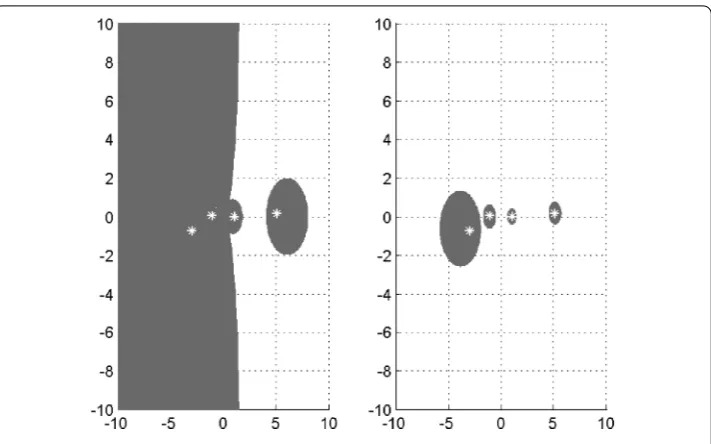
Figure 1 (A,B) of Example 1 on the left, and(A,B) on the right.
It is easy to see thatb= . > and
|b|=
k=,,
|bk|= ..
Hence, from the part (i) of Theorem , we see that(A,B) is unbounded. However, the set(A,B) in Theorem is compact. These sets are given by Figure , where the actual generalized eigenvalues are plotted with asterisks. Clearly,(A,B)⊂(A,B).
Example Let
A= (aij) =
⎛ ⎜ ⎜ ⎜ ⎝
– . . i . –i
⎞ ⎟ ⎟ ⎟
⎠, B= (bij) =
⎛ ⎜ ⎜ ⎜ ⎝
. . – . . i . . –.i
⎞ ⎟ ⎟ ⎟ ⎠.
It is easy to see thatb= ,β() ={}and
|a|=
k∈β(), k=
|ak|=|a|= .
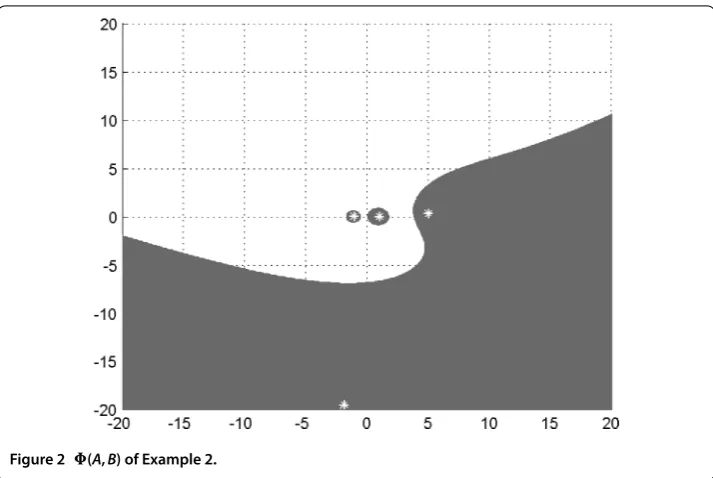
Hence, from the part (iii) of Theorem , we see that(A,B) is the entire complex plane, but the set(A,B) in Theorem is not.(A,B) is given by Figure , where the actual generalized eigenvalues are plotted with asterisks.
Figure 2 (A,B) of Example 2.
Theorem Let A= (aij)∈Cn×n,B= (bij)∈Cn×n,with n≥and(A,B)be a regular matrix
pair.Then
(A,B)⊆(A,B).
Proof Letz∈(A,B). Then there arei,j∈N,i=jsuch that
z∈
ij(A,B)∩ji(A,B)
.
Next, we prove that
ij(A,B)⊆
i(A,B)∪j(A,B)
()
and
ji(A,B)⊆
i(A,B)∪j(A,B)
. ()
(i) Forz∈ij(A,B), thenz∈i(A,B) orz∈/ i(A,B). Ifz∈i(A,B), then () holds. If
z∈/i(A,B), that is,
|aii–zbii|>Ri(A,B,z), ()
then
|ajj–zbjj|Rji(A,B,z) +|aij–zbij|Rji(A,B,z) ≥(aii–zbii)(ajj–zbjj) – (aij–zbij)(aji–zbji)
Note thatRji(A,B,z) =Ri(A,B,z) –|aij–zbij|andRij(A,B,z) =Rj(A,B,z) –|aji–zbji|. Then
from inequalities () and (), we have
|ajj–zbjj|
Ri(A,B,z) –|aij–zbij|
+|aij–zbij|
Rj(A,B,z) –|aji–zbji|
≥ |ajj–zbjj|Ri(A,B,z) –|aij–zbij||aji–zbji|,
which implies that
|aij–zbij|Rj(A,B,z)≥ |aij–zbij||ajj–zbjj|. ()
Ifaij=zbij, then fromz∈ij(A,B), we have
|aii–zbii||ajj–zbjj| ≤ |ajj–zbjj|Rji(A,B,z)≤ |ajj–zbjj|Ri(A,B,z).
Moreover, from inequality (), we obtain|ajj–zbjj|= . It is obvious that
z∈j(A,B)⊆
i(A,B)∪j(A,B)
.
Ifaij=zbij, then from inequality (), we have
|ajj–zbjj| ≤Rj(A,B,z),
that is,
z∈j(A,B)⊆
i(A,B)∪j(A,B)
.
Hence, () holds.
(ii) Similar to the proof of (i), we also see that, forz∈ji(A,B), () holds.
The conclusion follows from (i) and (ii).
Since the matrix pairs (A,B) and (AT,BT) have the same generalized eigenvalues, we can
obtain a theorem by applying Theorem to (AT,BT).
Theorem Let A= (aij)∈Cn×n,B= (bij)∈Cn×n,with n≥and(AT,BT)be a regular
matrix pair.Then
AT,BT⊆AT,BT.
Example ([], Example ) Let
A= (aij) =
⎛ ⎜ ⎜ ⎜ ⎝
. – . i . –i
⎞ ⎟ ⎟ ⎟
⎠, B= (bij) =
⎛ ⎜ ⎜ ⎜ ⎝
. . . . – . . i . . –.i
⎞ ⎟ ⎟ ⎟ ⎠.
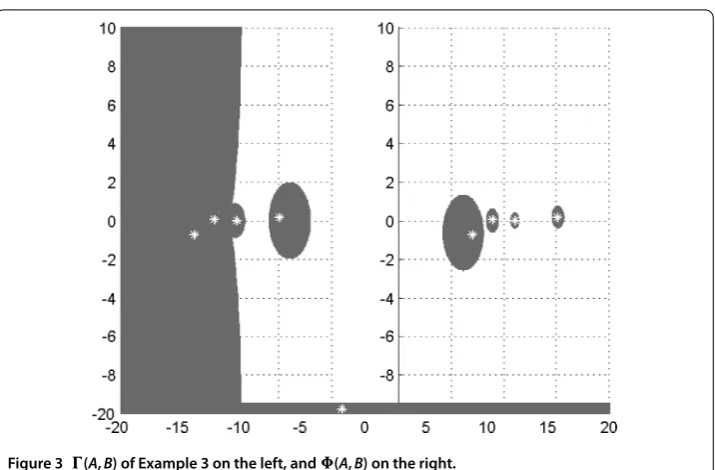
Figure 3 (A,B) of Example 3 on the left, and(A,B) on the right.
Remark From Examples , and , we see that the set in Theorem is tighter than that in Theorem (Theorem of []). In addition, note thatAandBin Example satisfy
|a|= <
k=,,
|ak|= .
and
|b|=
k=,,
|bk|= .,
respectively. Hence, we cannot use the method in [] to estimate the generalized eigen-values of the matrix pair (A,B). However, the set we obtain is very compact.
3 Conclusions
In this paper, we present a new generalized eigenvalue localization set(A,B), and we establish the comparison of the sets(A,B) and(A,B) in Theorem of [], that is,(A,B) captures all generalized eigenvalues more precisely than(A,B), which is shown by three numerical examples.
Competing interests
The authors declare that they have no competing interests.
Authors’ contributions
All authors contributed equally to this work. All authors read and approved the final manuscript.
Author details
1Department of Mathematics, Guangzhou Vocational College of Technology & Business, Guangzhou, Guangdong
510000, China.2School of Mathematics and Statistics, Yunnan University, Kunming, Yunnan 650091, China. Acknowledgements
Publisher’s Note
Springer Nature remains neutral with regard to jurisdictional claims in published maps and institutional affiliations. Received: 13 March 2017 Accepted: 1 May 2017
References
1. Kosti´c, V, Cvetkovi´c, LJ, Varga, RS: Geršgorin-type localizations of generalized eigenvalues. Numer. Linear Algebra Appl. 16, 883-898 (2009)
2. Nakatsukasa, Y: Gerschgorin’s theorem for generalized eigenvalue problem in the Euclidean metric. Math. Comput. 80(276), 2127-2142 (2011)
3. Hua, Y, Sarkar, TK: On SVD for estimating generalized eigenvalues of singular matrix pencil in noise. IEEE Trans. Signal Process.39(4), 892-900 (1991)
4. Mangasarian, OL, Wild, EW: Multisurface proximal support vector machine classification via generalized eigenvalues. IEEE Trans. Pattern Anal. Mach. Intell.28(1), 69-74 (2006)
5. Qiu, L, Davison, EJ: The stability robustness of generalized eigenvalues. IEEE Trans. Autom. Control37(6), 886-891 (1992)
6. Hochstenbach, ME: Fields of values and inclusion region for matrix pencils. Electron. Trans. Numer. Anal.38, 98-112 (2011)
7. Gershgorin, SGW: Theory for the generalized eigenvalue problemAx=λBx. Math. Comput.29(130), 600-606 (1975) 8. Varga, RS: Geršgorin and His Circles. Springer, Berlin (2004)