S T U D Y P R O T O C O L
Open Access
A comparative effectiveness trial of postoperative
management for lumbar spine surgery: changing
behavior through physical therapy (CBPT) study
protocol
Kristin R Archer
1,6*, Rogelio A Coronado
1, Christine M Haug
1, Susan W Vanston
1, Clinton J Devin
1,
Christopher J Fonnesbeck
2, Oran S Aaronson
3, Joseph S Cheng
3, Richard L Skolasky
4, Lee H Riley III
4and Stephen T Wegener
5Abstract
Background:The United States has the highest rate of lumbar spine surgery in the world, with rates increasing over 200% since 1990. Medicare spends over $1 billion annually on lumbar spine surgery. Despite surgical advances, up to 40% of patients report chronic pain and disability following surgery. Our work has demonstrated that fear of movement is a risk factor for increased pain and disability and decreased physical function in patients following lumbar spine surgery for degenerative conditions. Cognitive-behavioral therapy and self-management treatments have the potential to address psychosocial risk factors and improve outcomes after spine surgery, but are unavailable or insufficiently adapted for postoperative care. Our research team developed a cognitive-behavioral based
self-management approach to postoperative rehabilitation (Changing Behavior through Physical Therapy (CBPT)). Pilot testing of the CBPT program demonstrated greater improvement in pain, disability, physical and mental health, and physical performance compared to education. The current study compares which of two treatments provided by telephone–a CBPT Program or an Education Program about postoperative recovery - are more effective for improving patient-centered outcomes in adults following lumbar spine surgery for degenerative conditions.
Methods/design:A multi-center, comparative effectiveness trial will be conducted. Two hundred and sixty patients undergoing lumbar spine surgery for degenerative conditions will be recruited from two medical centers and community surgical practices. Participants will be randomly assigned to CBPT or Education at 6 weeks following surgery. Treatments consist of six weekly telephone sessions with a trained physical therapist. The primary outcome will be disability and secondary outcomes include pain, general health, and physical activity. Outcomes will be assessed preoperatively and at 6 weeks, 6 months and 12 months after surgery by an assessor masked to group allocation.
Discussion:Effective rehabilitation treatments that can guide clinicians in their recommendations, and patients in their actions will have the potential to effect change in current clinical practice.
Trial registration:NCT02184143.
Keywords:Comparative effectiveness research, Cognitive-behavioral therapy, Self-management, Rehabilitation, Postoperative pain, Spine surgery
* Correspondence:[email protected]
1Department of Orthopaedic Surgery and Rehabilitation, Vanderbilt
University Medical Center, Nashville, TN, USA
6Department of Orthopaedic Surgery and Rehabilitation, Vanderbilt
University, School of Medicine, Medical Center East–South Tower, Suite 4200, Nashville, TN 37232, USA
Full list of author information is available at the end of the article
Background
The United States (U.S.) has the highest rate of lumbar spine surgery in the world, with rates increasing over 200% since 1990 among adults over age 60 years with degenerative spinal disease [1-3]. Medicare spends over $1 billion annually on lumbar spine surgery and fusion procedures account for almost half [4]. Despite surgical advances, adults undergoing lumbar spine surgery have poorer physical and mental health outcomes compared to the general population [5,6]. More specifically, up to 40% report persistent pain, functional disability and poor quality of life and 20% to 24% undergo a reopera-tion [7-10].
Providers routinely offer physical therapy after spine surgery, without high-quality evidence that this postopera-tive approach improves outcomes [11]. Several random-ized trials have found no significant difference between standard physical rehabilitation and either no treatment or an educational booklet [12-14]. These trial results may be due to the inability of physical therapy to address the psychosocial factors often associated with poor surgical spine outcomes. Our work and that of others has demon-strated that fear of movement is a risk factor for increased pain and disability and decreased physical function in pa-tients following lumbar spine surgery for degenerative conditions [15-18]. Fear of movement refers to an exces-sive fear of physical activity resulting from a dysfunctional belief that movement will cause harm or reinjury [19].
Cognitive-behavioral therapy interventions have strong empirical support, with positive influence on fear of move-ment, as well as pain catastrophizing and self-efficacy in chronic pain populations [20,21]. Studies have demon-strated that brief and telephone-administered cognitive-behavioral programs are effective for reducing pain and improving function in patients with chronic and surgical pain [22-26]. Cognitive-behavioral based self-management programs have also demonstrated improvement in patient outcomes and the adoption of a physically active lifestyle, as well as improvement in fear-avoidance beliefs and self-efficacy in various populations with chronic condi-tions [27,28].
To date, cognitive-behavioral and self-management treatments have not been tested in a surgical spine population. Two studies have investigated alternative approaches to traditional physical therapy in patients following surgery for lumbar degenerative conditions. Christensen et al. [29] studied a “Café Group” interven-tion (i.e., peer support) and found significantly lower leg pain but not back pain at 2-year follow-up compared to a video group and 8 weeks of exercise training. Abbott et al. [30] found decreased disability with a 3-session psychomotor therapy program (i.e., motor relearning) compared to a home program at 2 years. However, the psychomotor program did not demonstrate a significant
effect on pain and health-related quality of life outcomes [30]. Both studies suggest that intensive and supervised exercise programs are not needed to improve outcomes after spine surgery. Furthermore, the North American Spine Society (NASS) suggests that there is insufficient evidence to support the use of active physical therapy or exercise as a stand-alone treatment strategy [18].
Preliminary work from our lab indicates the potential for a sizeable benefit of a cognitive-behavioral based self-management approach to postoperative rehabilita-tion relative to current practice in patients following lumbar spine surgery for degenerative conditions [31]. Our program – Changing Behavior through Physical Therapy (CBPT) - is designed to engage patients in their own care, improve shared postoperative decision-making, and maximize gains in outcomes that are relevant and meaningful to patients. Pilot testing of our CBPT Program demonstrated greater improvement in pain, disability, physical and mental health, and physical performance compared to education.
The purpose of this study is to compare which of two treatments provided by telephone – CBPT Program focusing on self-management or an Education Program about postoperative recovery - are more effective for im-proving patient-centered outcomes in adults following lumbar spine surgery for degenerative conditions. The primary aims of this study are to: 1) compare the effect-iveness of a CBPT Program and an Education Program for improving pain, disability, general health, and physical activity, 2) determine how the CBPT Program improves outcomes and 3) determine which subgroups of patients are most likely to benefit from the CBPT Program.
Methods/design Funding
This study has received funding from the Patient-Centered Outcomes Research Institute (PCORI) (CER-1306-01970).
Study design
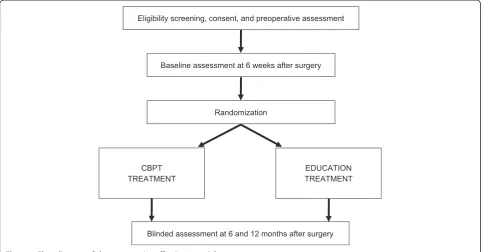
This multi-center, prospective randomized controlled trial has primary recruitment sites in Nashville, TN and Baltimore, MD. Figure 1 illustrates the overall study de-sign with assessments preoperatively and at 6 weeks (baseline), 6 months and 12 months after lumbar spine surgery (see ClinicalTrials.gov and NCT02184143 for more information).
Ethical principles
Study population
Two hundred and sixty English-speaking adults who are having surgical treatment of a lumbar degenerative con-dition (spinal stenosis, spondylosis with or without myelopathy, and degenerative spondylolisthesis) using laminectomy with or without arthrodesis (i.e., fusion) procedures will be recruited for this study. Participants will be recruited from clinical sites at two academic medical centers (Vanderbilt University Medical Center and Johns Hopkins Medicine). Additional recruitment will occur from community orthopaedic surgery prac-tices located in Tennessee and Kentucky.
Exclusion criteria
Patients will be excluded from the study if they meet any of the following criteria:
A microsurgical technique as the primary procedure, such as an isolated laminotomy or microdiscectomy.
Spinal deformity as the primary indication for surgery. Spine surgery secondary to pseudarthrosis, trauma,
infection, or tumor.
Back and/or lower extremity pain < 3 months indicating no history of sub-acute or chronic pain. History of neurological disorder or disease, resulting
in moderate to severe movement dysfunction. Presence of schizophrenia or other psychotic disorder. Surgery under a workman’s compensation claim. Not able to return to clinic for standard follow-up
visits with surgeon.
Unable to provide a stable address and access to a telephone.
Randomization
A computer-generated scheme will randomize patients in a 1:1 ratio in blocks of assignments frequency matched on age and type of surgery (i.e., fusion or no fusion), result-ing in 4 strata: (1) Age 21-59 and fusion; (2) Age 60-90 and fusion; (3) Age 21-59 and no fusion; (4) Age 60-90 and no fusion. Block size will be determined randomly with the patient as the unit of randomization. Randomization will be administered centrally by Vanderbilt through the Re-search Electronic Data Capture (REDCap) system [32]. Randomization will occur immediately following the base-line assessment at 6 weeks after surgery. Participants along with the research coordinators, surgeons, and other re-search personnel responsible for data collection will be un-aware of randomization assignment.
Comparators CBPT treatment
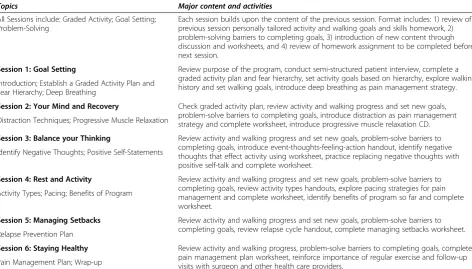
The CBPT Program focuses on a patient-oriented self-management approach to reduce pain and disability and improve physical activity, through reductions in fear of movement and increases in self-efficacy (Table 1). Brief cognitive-behavioral programs for pain developed by Woods and Asmundson [33], Williams and McCracken [34], and Turner et al. [35] and a self-management ap-proach developed for older adults by Lorig [36,37] pro-vide the basis for the CBPT treatment. Sessions cover an introduction and rationale for treatment, deep breathing Eligibility screening, consent, and preoperative assessment
Baseline assessment at 6 weeks after surgery
Blinded assessment at 6 and 12 months after surgery Randomization
CBPT TREATMENT
[image:3.595.57.543.90.342.2]EDUCATION TREATMENT
[38], progressive muscle relaxation [39], graded activity plan, goal-setting [40], distraction techniques [34], auto-matic thoughts [41], coping self-statements [41], pacing techniques [42], and relapse prevention and symptom management plans [43]. Each session builds upon the content of the previous session and weekly action plans are personally tailored based on patient goals. The CBPT Program consists of six weekly telephone sessions with a trained physical therapist. The first session is 60 minutes and the remaining 5 sessions are 30 minutes. Each pa-tient randomized to the CBPT Program will receive a binder to follow along with the study therapist (see www.spine-surgery-recovery.com for more information).
Education treatment
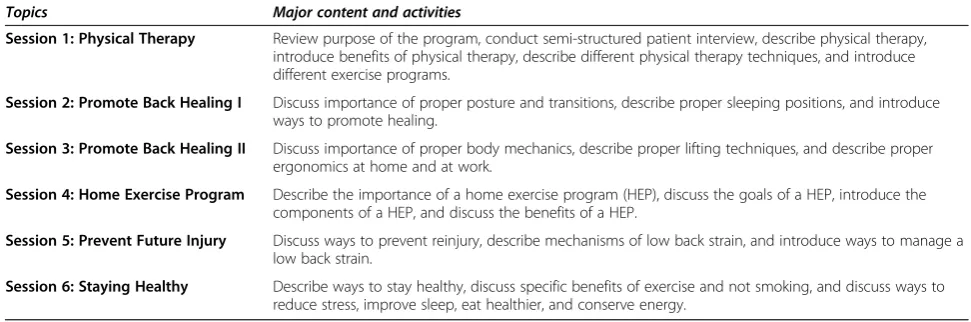
The Education Program focuses on postoperative recovery and consists of modules that were developed and tested in a National Institutes of Health (NIH) funded trial for pa-tients with musculoskeletal injury (R01AR054009). Educa-tional modules were adapted in collaboration with adults who completed preliminary testing of the CBPT treatment [31]. Sessions address benefits of physical therapy, proper biomechanics after surgery, importance of daily exercise, and ways to promote healing. Education on stress reduc-tion, sleep hygiene, energy management, communication with health providers, and preventing future injury are also provided (Table 2). The education treatment is matched to the CBPT treatment in terms of session frequency, length and contact with the study physical therapist. Each patient
randomized to the Education Program will receive a binder to follow along with the study therapist (see www.spine-surgery-recovery.com for more information).
Quality assurance
One study physical therapist (SWV) at Vanderbilt will complete a formal training course in both the CBPT and educational treatments. Formal training will occur during one 2-day session with the PI of the study (KRA) and a clinical psychologist (STW) specializing in cognitive-behavioral and self-management techniques. A written competency for both treatments and a skills test for the CBPT Program will be completed at the end of training. Both treatments will be implemented with study staff and progress will be discussed during weekly research meet-ings. A formal pre-test of the CBPT Program and Educa-tion Program will then occur with 2 patients. All sessions during the pre-test will be audiotaped and reviewed by the PI (KRA) and a clinical psychologist (STW) to evaluate adherence to the treatment protocol and specific CBT competencies [44].
[image:4.595.60.533.101.370.2]Our treatment integrity protocol includes: 1) therapist training and competence in delivering the treatments and in the importance of fidelity; 2) use of detailed treat-ment manuals; and 3) ongoing supervision to ensure ac-curate and consistent treatment delivery (provided via weekly clinical team meetings). The study physical thera-pist’s adherence to procedures will be assessed by audio-recording all sessions and randomly selecting sessions
Table 1 Summary of the CBPT treatment by session
Topics Major content and activities
All Sessions include: Graded Activity; Goal Setting; Problem-Solving
Each session builds upon the content of the previous session. Format includes: 1) review of previous session personally tailored activity and walking goals and skills homework, 2) problem-solving barriers to completing goals, 3) introduction of new content through discussion and worksheets, and 4) review of homework assignment to be completed before next session.
Session 1: Goal Setting Review purpose of the program, conduct semi-structured patient interview, complete a graded activity plan and fear hierarchy, set activity goals based on hierarchy, explore walking history and set walking goals, introduce deep breathing as pain management strategy. Introduction; Establish a Graded Activity Plan and
Fear Hierarchy; Deep Breathing
Session 2: Your Mind and Recovery Check graded activity plan, review activity and walking progress and set new goals, problem-solve barriers to completing goals, introduce distraction as pain management strategy and complete worksheet, introduce progressive muscle relaxation CD. Distraction Techniques; Progressive Muscle Relaxation
Session 3: Balance your Thinking Review activity and walking progress and set new goals, problem-solve barriers to completing goals, introduce event-thoughts-feeling-action handout, identify negative thoughts that effect activity using worksheet, practice replacing negative thoughts with positive self-talk and complete worksheet.
Identify Negative Thoughts; Positive Self-Statements
Session 4: Rest and Activity Review activity and walking progress and set new goals, problem-solve barriers to completing goals, review activity types handouts, explore pacing strategies for pain management and complete worksheet, identify benefits of program so far and complete worksheet.
Activity Types; Pacing; Benefits of Program
Session 5: Managing Setbacks Review activity and walking progress and set new goals, problem-solve barriers to completing goals, review relapse cycle handout, complete managing setbacks worksheet. Relapse Prevention Plan
Session 6: Staying Healthy Review activity and walking progress, problem-solve barriers to completing goals, complete pain management plan worksheet, reinforce importance of regular exercise and follow-up visits with surgeon and other health care providers.
(balanced evenly across the sessions) for the investiga-tors to review and rate treatment integrity using a stan-dardized fidelity checklist. The PI (KRA) and a clinical psychologist (STW) will oversee the ratings and checklist to provide corrective feedback to the study therapist as needed in real time. The study therapist (SWV) will also complete a checklist of all the components delivered during each session and make note of any protocol devi-ations. If the integrity of the treatments is compromised, the study therapist will be re-trained and 100% of audio-tapes will be reviewed until problems are addressed.
Data collection
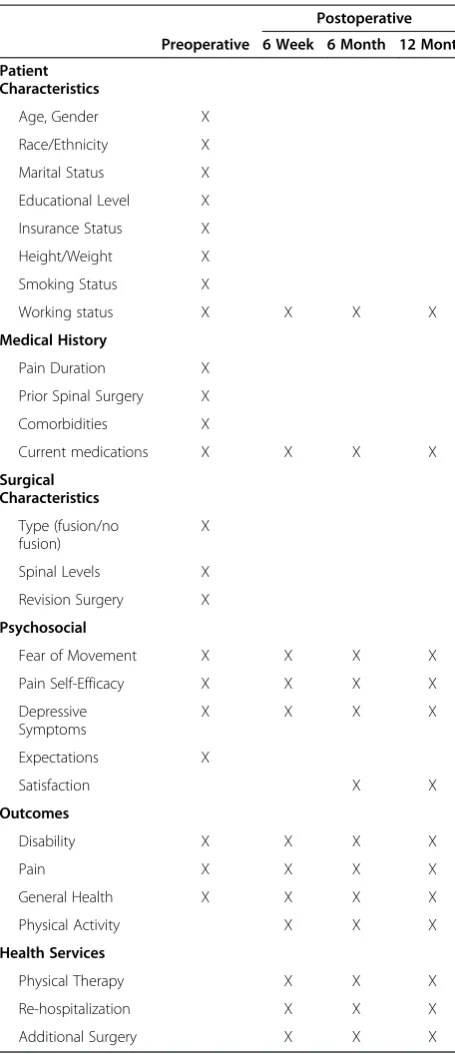
Table 3 summarizes key data collection across time points. Self-report assessments will be conducted before surgery and at 6 weeks, 6 months, and 12 months after surgery. Questionnaires will be completed in clinic or remotely using a REDCap survey. Movement accelerometers will be used to measure physical activity at the 6 week, 6 month, and 12 month time-points. Accelerometers will be pro-vided to patients in clinic at 6 weeks after surgery and through the mail at 6 and 12-month follow-up.
Primary outcome measure Disability
The 10-item Oswestry Disability Index (ODI) is a stand-ard measure of condition-specific disability that assesses the impact of lumbar spinal disorders on various aspects of daily life [45]. Ratings for each item are from 0 (high functioning) to 5 (low functioning). Total scores are di-vided by the total possible score and multiplied by 100 to create a percentage of disability. The ODI has demon-strated strong test-retest reliability and validity, and good internal consistency in both surgical spine patients and patients with chronic low back pain [46,47]. The mini-mum clinically important difference (MCID) has been found to range from 11 to 12.8 points in patients follow-ing lumbar spine surgery [48,49].
Secondary outcomes measures Pain intensity and interference
The Brief Pain Inventory (BPI) will assess pain intensity and pain interference with activity [50]. The 4-item pain intensity subscale assesses current, worst, least, and aver-age pain. For this trial, only the averaver-age pain item will be used to assess pain intensity. A single-item rating of aver-age pain has been found to be as valid for detecting treat-ment effects as a variety of composite scores (i.e., current, worst, least and average), especially for large trials that in-volve group comparisons [51,52]. The 7-item pain interfer-ence subscale assesses general activity, mood, walking ability, normal work, relations with other people, sleep, and enjoyment of life. Both subscales use a numerical rating scale with 0 representing ‘no pain or does not interfere’ and 10 representing ‘pain as bad as you can imagine or completely interferes’. Scores greater than or equal to 5 in-dicate moderate to severe pain intensity and interference. The BPI has proven both reliable and valid in both surgical patients and patients with chronic low back pain [53-55]. The MCID for pain has been found to range from 1.2 to 2.1 points in patients following lumbar spine surgery [48].
General health
[image:5.595.54.540.101.262.2]General physical and mental health will be measured with the physical and mental composite scales of the SF-12 [56]. The physical component scale (PCS) assesses the four subdomains of physical functioning, role-physical, bodily pain, and general health and the mental component scale (MCS) assesses the 4 subdomains of vitality, social functioning, role-emotional, and mental health. Total sub-scale scores range from 0 to 100, with 100 indicating the highest level of health. The PCS and MCS of the SF-12 have demonstrated responsiveness, good test–retest reli-ability, good internal consistency, and validity in general-ized and various patient populations [56-58]. The minimal clinically significant change for the PCS and MCS has been estimated at 10% [58].
Table 2 Summary of the education treatment by session
Topics Major content and activities
Session 1: Physical Therapy Review purpose of the program, conduct semi-structured patient interview, describe physical therapy, introduce benefits of physical therapy, describe different physical therapy techniques, and introduce different exercise programs.
Session 2: Promote Back Healing I Discuss importance of proper posture and transitions, describe proper sleeping positions, and introduce ways to promote healing.
Session 3: Promote Back Healing II Discuss importance of proper body mechanics, describe proper lifting techniques, and describe proper ergonomics at home and at work.
Session 4: Home Exercise Program Describe the importance of a home exercise program (HEP), discuss the goals of a HEP, introduce the components of a HEP, and discuss the benefits of a HEP.
Session 5: Prevent Future Injury Discuss ways to prevent reinjury, describe mechanisms of low back strain, and introduce ways to manage a low back strain.
Physical activity
Physical activity will be measured objectively using a commercially available movement accelerometer (Acti-Graph GT3X-BT) [59]. Accelerometers are used in phys-ical activity monitoring because of their small size, low cost, convenience, the ability to record data for several days [60], and ability to assess multiple dimensions of
physical activity [61,62]. Accelerometers have proven valid with moderate correlations with the criterion method of doubly labeled water for total and active energy expend-iture in young and older adults [63,64]. Physical activity will be assessed using total volume of physical activity, expressed as the mean counts per minute over the dur-ation of accelerometer monitoring. In addition, percentage of time spent in commonly used domains of physical ac-tivity intensity (sedentary, light, moderate, and vigorous) will be considered.
Additional measures Fear of movement
A shortened version of the Tampa Scale for Kinesiopho-bia (TSK) will be used to measure fear of movement [65]. For this trial, the 4 reversed scored items (4, 8,12, 16) were omitted. Psychometric research supports the re-moval of these items to improve internal consistency, fac-tor structure, and goodness of fit of the TSK [66]. A total score can range from 13 to 52. Participants are asked to rate each item on a 4-point Likert scale with scoring alter-natives ranging from‘strongly disagree’to‘strongly agree’. The MCID for the TSK has been reported to be 4 points in patients with back pain [67]. The TSK has been found to have good internal consistency and test-retest reliability in surgical patients and patients with various musculoskel-etal conditions [68,69].
Pain self-efficacy
The Pain Self-Efficacy Questionnaire (PSEQ) will meas-ure the strength and generality of a person’s belief in his/her ability to accomplish a range of activities despite pain [70]. Participants rate how confident they are on a 7-point scale from ‘not at all confident’ to ‘completely confident’. Scores range from 0 to 60, with a score greater than 40 indicating high pain self-efficacy [71]. The PSEQ has been found to have excellent internal consistency, good test-retest reliability, and construct validity through correlations with depression, anxiety, coping strategies, pain ratings, and work-related tasks in patients with chronic pain [70].
Depressive symptoms
[image:6.595.57.285.98.626.2]The 9-item Patient Health Questionnaire-9 (PHQ-9) will be used to assess signs and symptoms that are character-istic of major depression [72]. The total score can range from 0 to 27 with higher numbers indicating higher depres-sive symptoms. Participants rate each item on a 4-point Likert scale with scoring alternative ranging from‘not at all’ to ‘nearly every day’. The PHQ-9 has excellent reliability and is a sensitive and specific measure of major depression in primary care [72,73].
Table 3 Data collection schedule
Postoperative
Preoperative 6 Week 6 Month 12 Month
Patient Characteristics
Age, Gender X
Race/Ethnicity X
Marital Status X
Educational Level X
Insurance Status X
Height/Weight X
Smoking Status X
Working status X X X X
Medical History
Pain Duration X
Prior Spinal Surgery X
Comorbidities X
Current medications X X X X
Surgical Characteristics
Type (fusion/no fusion)
X
Spinal Levels X
Revision Surgery X
Psychosocial
Fear of Movement X X X X
Pain Self-Efficacy X X X X
Depressive Symptoms
X X X X
Expectations X
Satisfaction X X
Outcomes
Disability X X X X
Pain X X X X
General Health X X X X
Physical Activity X X X
Health Services
Physical Therapy X X X
Re-hospitalization X X X
Data analysis
Comparative effectiveness of treatments
Data will be explored statistically and graphically. Group means and corresponding confidence intervals will be calculated for baseline variables, to confirm balance be-tween groups. The characteristics of the patients who are lost to follow-up will be compared to those who complete the follow-up assessments. For each outcome variable, we will fit a longitudinal mixed-effects model, with a random intercept for patient to account for the correlation among observations from the same patient and a group random effect to account for variation among centers. We will explore possible non-linear (i.e., quad-ratic, cubic) effects of the treatment over time. A random slope over time may be included to allow a separate slope to be estimated for each patient. We will fit the model with an independent conditional covariance structure and an autoregressive structure and choose the best data-supported model based on the deviance information cri-teria or a related criterion. The primary analysis will be intent-to-treat; missing observations due to dropout and other reasons not related to the treatments will be han-dled with multiple imputation methodology.
Potential mediators
Separate longitudinal mixed-effects models will be used to explore associations between changes in fear of move-ment and pain self-efficacy from baseline to 6 months and changes in outcomes from baseline to 12 months after surgery for the entire sample. We will construct mediation models that estimate the effect of the mediation by changes in fear of movement and in pain self-efficacy on outcomes as the result of surgery. This comprises 3 sub-models that relate (1) the treatment to health outcomes directly, (2) the treatment to fear of movement and pain self-efficacy and (3) both the treatment and fear of move-ment and pain self-efficacy to health outcomes simultan-eously. This will demonstrate any mediation effect, if present, by seeing how the relationship between treatment and outcomes change when the potential mediators are added or removed.
Subgroup effects
Longitudinal mixed-effects models will be used to ex-plore the interaction between patient characteristics and treatment for each outcome in the entire sample. Import-ant subgroups will be identified based on the strength of association between the response to treatment (change in outcomes) and each covariate included in the model (i.e., patient age, type of surgery, depressive symptoms).
Sample size
We estimated power for all aims of the study, based on a target of 110 patients per arm with complete follow-up
data at 12 months. Power was estimated by generating simulated data, then using the simulated data to try to estimate the original model parameters. We generated 200 simulated datasets by resampling available pilot data from a NIH funded project (R21AR062880). Control subjects were resampled from control individuals in the pilot data, and treatment subjects were also resampled from control individuals, but with the target effect size added to the sampled values. Power was estimated by fit-ting Bayesian models to each of the simulated datasets for each response variable and recording the proportion of calculated 95% credible intervals for effect sizes that excluded zero. There will be sufficient power to detect the following effect sizes: 7.0 points on the 0-100 ODI, 1.5 points on the 0-10 BPI, 30% for the accelerometer, 4.0 points on the 13-52 TSK, 6.0 points on the 0-60 PSEQ, and 10% main effect for subgroup covariates. To account for a 15% patient drop out rate, a total of 260 subjects will be enrolled into the study.
Discussion
Adults undergoing lumbar spine surgery for degenera-tive conditions continue to have poor outcomes follow-ing surgery, with up to 40% reportfollow-ing residual chronic pain and disability. Psychosocial factors, in particular fear of movement, have been found to be significant risk fac-tors for poor long-term outcomes. Cognitive-behavioral and self-management treatments show promise in redu-cing psychosocial risk factors, but are unavailable or insuf-ficiently adapted for postoperative care. Currently, there are no evidence-based programs that clinicians can rec-ommend and patients can do after spine surgery to im-prove outcomes. There is an urgent need for accessible treatments that empower patients to take an active role in their care and reduce psychosocial risk factors in order to prevent long-term disability and chronicity after spine sur-gery. Effective rehabilitation treatments that can guide cli-nicians in their recommendations, and patients in their actions, will have the potential to effect change in current clinical practice.
This study will be the first to investigate a cognitive-behavioral based self-management approach to postopera-tive spine rehabilitation. Our proposed study is timely, be-cause the physical therapy treatment paradigm is shifting away from pain relief to pain management through “ psy-chologically informed”rehabilitation and compelling data are needed to support this expanded scope of practice [74,75]. Our interventional approach seeks to redefine the transdisciplinary model of health care and broaden the availability of effective pain management and behav-ior change strategies by expanding the implementation from traditional providers (i.e., psychologists) to phys-ical therapists. The long-term goal is to increase access to evidence-based, patient-centered treatments that maximize outcomes in the postoperative setting.
Abbreviations
U.S.:United States; NASS: North American Spine Society; CBPT: Changing Behavior through Physical Therapy; PCORI: Patient-Centered Outcomes Institute; REDCap: Research Electronic Data Capture; NIH: National Institutes of Health; ODI: Oswestry Disability Index; BPI: Brief Pain Inventory; PCS: Physical Component Scale; MCS: Mental Component Scale; TSK: Tampa Scale for Kinesiophobia; PSEQ: Pain Self-Efficacy Scale; PHQ-9: 9-item Patient Health Questionnaire.
Competing interests
The authors declare that they have no competing interests.
Authors’contributions
KRA, CJF, CJD, LHR, and STW were responsible for the design of the study. KRA is the principal investigator of the study. KRA and STW procured funding. KRA, SWV, and STW developed the treatment and training manuals. KRA, RAC, CMH, CJD, and STW developed the protocol and manual of operating procedures. KRA and RAC were responsible for registering the trial on CinicalTrials.gov. KRA and CJF were responsible for the randomization scheme and data analysis plan. CMH and RAC are responsible for patient recruitment and procedural reliability in collaboration with CJD, OSA, JSS, RLS, and LHR. KRA, RAC, SWV, and STW are responsible for integrity of the study treatments. RAC drafted the manuscript and KRA critically revised this manuscript for important intellectual content. All authors have read and approved the final manuscript.
Authors’information
KRA, PhD, DPT is Assistant Professor of Orthopaedic Surgery and Physical Medicine and Rehabilitation and Director of Orthopaedic Research at Vanderbilt University Medical Center.
RAC, PT, PhD is a Research Fellow in the Department of Orthopaedic Surgery at Vanderbilt University Medical Center.
CMH is a Clinical/Translational Research Coordinator in the Department of Orthopaedic Surgery at Vanderbilt University Medical Center.
SWV, PT, MS is a Research Physical Therapist in the Department of Orthopaedic Surgery at Vanderbilt University Medical Center. CJF, PhD is Assistant Professor of Biostatistics at Vanderbilt University Medical Center.
CJD, MD is Assistant Professor of Orthopaedic Surgery and Director of the Spinal Column Surgical Quality and Outcomes Research Laboratory at Vanderbilt University Medical Center.
OSA, MD, MMHC is Associate Professor and Residency Program Director of Neurological Surgery and Medical Director of the Vanderbilt Spine Center at Vanderbilt University Medical Center.
JSC, MD, MS is Associate Professor of Neurological Surgery and Director of Neurosurgery Spine Program at Vanderbilt University Medical Center. RLS, ScD is Associate Professor of Orthopaedic Surgery and Director of Spine Outcomes Center at Johns Hopkins Medicine.
LHR, MD is Professor of Orthopaedic Surgery, Chief of Orthopaedic Spine Division and Vice-Director for Clinical Orthopaedic Surgery Operations at Johns Hopkins Medicine.
STW, PhD is Associate Professor of Physical Medicine and Rehabilitation and Director of Division of Psychology and Neuropsychology at Johns Hopkins Department of Physical Medicine and Rehabilitation.
Acknowledgements
This study is being funded by PCORI (CER-1306-01970). The authors would like to acknowledge the study’s Advisory Board for their contribution across the 5 phases of this comparative effectiveness study, including agenda setting, design, implementation, dissemination, and sustainability. The Advisory Board, consisting of patient and clinician stakeholders, will provide ongoing assistance to ensure that outcomes, treatment components, and interpretation of results are relevant and meaningful to patients and dissemination materials are accessible for patients to utilize. Members of our Advisory Board include Suzanne Bell, Lance Hale, Hugh Scarbrough, Caryn Shapiro, Vivian Temple, Dawn Ehde, PhD, Janna Friedly, MD, Nicole Motzny, PT, DPT, Daniel Sciubba, MD, and Timothy Witham, MD.
Author details
1Department of Orthopaedic Surgery and Rehabilitation, Vanderbilt
University Medical Center, Nashville, TN, USA.2Department of Biostatistics, Vanderbilt University Medical Center, Nashville, TN, USA.3Department of Neurological Surgery, Vanderbilt University Medical Center, Nashville, TN, USA.4Department of Orthopaedic Surgery, Johns Hopkins Medicine, Baltimore, MD, USA.5Department of Physical Medicine and Rehabilitation, Johns Hopkins Medicine, Baltimore, MD, USA.6Department of Orthopaedic Surgery and Rehabilitation, Vanderbilt University, School of Medicine, Medical Center East–South Tower, Suite 4200, Nashville, TN 37232, USA.
Received: 9 September 2014 Accepted: 25 September 2014 Published: 1 October 2014
References
1. Cherkin DC, Deyo RA, Loeser JD, Bush T, Waddell G:An international comparison of back surgery rates.Spine1994,19:1201–1206. 2. Deyo RA, Gray DT, Kreuter W, Mirza S, Martin BI:United States trends in
lumbar fusion surgery for degenerative conditions.Spine2005, 30:1441–1445. discussion 1446-1447.
3. Deyo RA, Mirza SK:Trends and variations in the use of spine surgery. Clin Orthop Relat Res2006,443:139–146.
4. Weinstein JN, Lurie JD, Olson PR, Bronner KK, Fisher ES:United States' trends and regional variations in lumbar spine surgery: 1992-2003. Spine2006,31:2707–2714.
5. Martin BI, Deyo RA, Mirza SK, Turner JA, Comstock BA, Hollingworth W, Sullivan SD:Expenditures and health status among adults with back and neck problems.JAMA2008,299:656–664.
6. Weinstein JN, Tosteson TD, Lurie JD, Tosteson AN, Blood E, Hanscom B, Herkowitz H, Cammisa F, Albert T, Boden SD, Hilibrand A, Goldberg H, Berven S, An H:Surgical versus nonsurgical therapy for lumbar spinal stenosis.N Engl J Med2008,358:794–810.
7. Jansson KA, Nemeth G, Granath F, Jonsson B, Blomqvist P:Health-related quality of life (EQ-5D) before and one year after surgery for lumbar spinal stenosis.J Bone Joint Surg (Br)2009,91:210–216.
8. Mannion AF, Denzler R, Dvorak J, Grob D:Five-year outcome of surgical decompression of the lumbar spine without fusion.Eur Spine J2010, 19:1883–1891.
9. Martin BI, Mirza SK, Comstock BA, Gray DT, Kreuter W, Deyo RA: Reoperation rates following lumbar spine surgery and the influence of spinal fusion procedures.Spine2007,32:382–387.
10. Malmivaara A, Slatis P, Heliovaara M, Sainio P, Kinnunen H, Kankare J, Dalin-Hirvonen N, Seitsalo S, Herno A, Kortekangas P, Niinimäki T, Rönty H, Tallroth K, Turunen V, Knekt P, Härkänen T, Hurri H:Surgical or
nonoperative treatment for lumbar spinal stenosis? A randomized controlled trial.Spine2007,32:1–8.
11. Kreiner DS, Shaffer WO, Baisden JL, Gilbert TJ, Summers JT, Toton JF, Hwang SW, Mendel RC, Reitman CA, North American Spine S:An evidence-based clinical guideline for the diagnosis and treatment of degenerative lumbar spinal stenosis (update).Spine J2013,13:734–743.
13. McGregor AH, Dore CJ, Morris TP, Morris S, Jamrozik K:ISSLS prize winner: Function After Spinal Treatment, Exercise, and Rehabilitation (FASTER): a factorial randomized trial to determine whether the functional outcome of spinal surgery can be improved.Spine2011,36:1711–1720.
14. Aalto TJ, Leinonen V, Herno A, Alen M, Kroger H, Turunen V, Savolainen S, Saari T, Airaksinen O:Postoperative rehabilitation does not improve functional outcome in lumbar spinal stenosis: a prospective study with 2-year postoperative follow-up.Eur Spine J2011,20:1331–1340. 15. Mannion AF, Elfering A, Staerkle R, Junge A, Grob D, Dvorak J, Jacobshagen N,
Semmer NK, Boos N:Predictors of multidimensional outcome after spinal surgery.Eur Spine J2007,16:777–786.
16. den Boer JJ, Oostendorp RA, Beems T, Munneke M, Oerlemans M, Evers AW: A systematic review of bio-psychosocial risk factors for an unfavourable outcome after lumbar disc surgery.Eur Spine J2006,15:527–536. 17. Archer KR, Wegener ST, Seebach C, Song Y, Skolasky RS, Thornton C,
Khanna AJ, Riley LH:The effect of fear of movement beliefs on pain and disability after surgery for lumbar and cervical degenerative conditions. Spine2011,36:1554–1562.
18. Archer KR, Seebach CL, Mathis S, Riley LH, Wegener ST:Early postoperative fear of movement predicts pain, disability, and physical health 6 months after spinal surgery for degenerative conditions.Spine J2013,14:759–767. 19. Vlaeyen JW, Kole-Snijders AM, Boeren RG, van Eek H:Fear of movement/
(re)injury in chronic low back pain and its relation to behavioral performance.Pain1995,62:363–372.
20. Butler AC, Chapman JE, Forman EM, Beck AT:The empirical status of cognitive-behavioral therapy: a review of meta-analyses.Clin Psychol Rev
2006,26:17–31.
21. Morley S, Eccleston C, Williams A:Systematic review and meta-analysis of randomized controlled trials of cognitive behaviour therapy and behaviour therapy for chronic pain in adults, excluding headache.Pain1999,80:1–13. 22. Bombardier CH, Cunniffe M, Wadhwani R, Gibbons LE, Blake KD, Kraft GH:
The efficacy of telephone counseling for health promotion in people with multiple sclerosis: a randomized controlled trial.Arch Phys Med Rehabil2008,89:1849–1856.
23. Linton SJ, Andersson T:Can chronic disability be prevented? A randomized trial of a cognitive-behavior intervention and two forms of information for patients with spinal pain.Spine2000,25:2825–2831. discussion 2824.
24. Litt MD, Shafer DM, Kreutzer DL:Brief cognitive-behavioral treatment for TMD pain: long-term outcomes and moderators of treatment.Pain2010, 151:110–116.
25. Riddle DL, Keefe FJ, Nay WT, McKee D, Attarian DE, Jensen MP:Pain coping skills training for patients with elevated pain catastrophizing who are scheduled for knee arthroplasty: a quasi-experimental study.Arch Phys Med Rehabil2011,92:859–865.
26. Von Korff M, Balderson BH, Saunders K, Miglioretti DL, Lin EH, Berry S, Moore JE, Turner JA:A trial of an activating intervention for chronic back pain in primary care and physical therapy settings.Pain2005,113:323–330. 27. Bodenheimer T, Lorig K, Holman H, Grumbach K:Patient self-management
of chronic disease in primary care.JAMA2002,288:2469–2475.
28. Nicholas MK, Asghari A, Corbett M, Smeets RJ, Wood BM, Overton S, Perry C, Tonkin LE, Beeston L:Is adherence to pain self-management strategies associated with improved pain, depression and disability in those with disabling chronic pain?Eur J Pain2012,16:93–104.
29. Christensen FB, Laurberg I, Bunger CE:Importance of the back-cafe concept to rehabilitation after lumbar spinal fusion: a randomized clinical study with a 2-year follow-up.Spine2003,28:2561–2569. 30. Abbott AD, Tyni-Lenne R, Hedlund R:Early rehabilitation targeting
cognition, behavior, and motor function after lumbar fusion: a randomized controlled trial.Spine2010,35:848–857.
31. Archer KR, Motzny N, Abraham CM, Yaffe D, Seebach CL, Devin CJ, Spengler DM, McGirt MJ, Aaronson OS, Cheng JS, Wegener ST:Cognitive-behavioral-based physical therapy to improve surgical spine outcomes: a case series.Phys Ther
2013,93:1130–1139.
32. Harris PA, Taylor R, Thielke R, Payne J, Gonzalez N, Conde JG:Research electronic data capture (REDCap) - A metadata-driven methodology and workflow process for providing translational research informatics support.J Biomed Inform2009,42:377–381.
33. Woods MP, Asmundson GJ:Evaluating the efficacy of graded in vivo exposure for the treatment of fear in patients with chronic back pain: a randomized controlled clinical trial.Pain2008,136:271–280.
34. Williams AC, McCracken LM:Cognitive-behavioral therapy for chronic pain: an overview with specific references to fear and avoidance.In
Understanding and Treating Fear of Pain.Edited by Asmundson GG, Vlaeyen JW, Crombez G. London: Oxford University Press; 2004:293–312. 35. Turner JA, Mancl L, Aaron LA:Brief cognitive-behavioral therapy for
temporomandibular disorder pain: effects on daily electronic outcome and process measures.Pain2005,117:377–387.
36. Lorig K, Holman H:Arthritis self-management studies: a twelve-year review.Health Educ Q1993,20:17–28.
37. Lorig KR, Ritter P, Stewart AL, Sobel DS, Brown BW Jr, Bandura A, Gonzalez VM, Laurent DD, Holman HR:Chronic disease self-management program: 2-year health status and health care utilization outcomes. Med Care2001,39:1217–1223.
38. Syrjala KL:Relaxation and imagery techniques.InBonica's Management of Pain.Edited by Loeser JD. Philadelphia: Lippincott Williams & Wlikins; 2001:1255–1266.
39. Bernstein DA, Borkovex TD, Hazlett-Stevens H:New Directions in Progressive Relaxation Training.Westport: Praeger; 2000.
40. Scobbie L, Wyke S, Dixon D:Identifying and applying psychological theory to setting and achieving rehabilitation goals.Clin Rehabil2009, 23:321–333.
41. Beck AT, Rush AJ, Shaw BF, Emery G:Cognitive Therapy and Depression.New York, NY: Guilford press; 1979.
42. D'Zurilla TJ, Goldfried MR:Problem solving and behavior modification. J Abnorm Psychol1971,78:107–126.
43. Turk DC, Okifuki AD:A cognitive-behavioral approach to pain management.InTextbook of Pain.Edited by Wall PD, Melzack R. London: Churchill Livingstone; 1999:1431–1444.
44. van der Windt D, Hay E, Jellema P, Main C:Psychosocial interventions for low back pain in primary care. Lessons learned from recent trials.Spine
2008,33:81–89.
45. Fairbank JC, Pynsent PB:The oswestry disability index.Spine2000, 25:2940–2952. discussion 2952.
46. Davidson M, Keating JL:A comparison of five low back disability questionnaires: reliability and responsiveness.Phys Ther2002,82:8–24. 47. Pratt RK, Fairbank JC, Virr A:The reliability of the Shuttle Walking Test, the
Swiss Spinal Stenosis Questionnaire, the Oxford Spinal Stenosis Score, and the Oswestry Disability Index in the assessment of patients with lumbar spinal stenosis.Spine2002,27:84–91.
48. Copay AG, Glassman SD, Subach BR, Berven S, Schuler TC, Carreon LY: Minimum clinically important difference in lumbar spine surgery patients: a choice of methods using the Oswestry Disability Index, Medical Outcomes Study questionnaire Short Form 36, and pain scales. Spine J2008,8:968–974.
49. Parker SL, Adogwa O, Paul AR, Anderson WN, Aaronson O, Cheng JS, McGirt MJ: Utility of minimum clinically important difference in assessing pain, disability, and health state after transforaminal lumbar interbody fusion for degenerative lumbar spondylolisthesis.J Neurosurg Spine2011,14:598–604. 50. Cleeland CS, Ryan KM:Pain assessment: global use of the brief pain
inventory.Ann Acad Med Singapore1994,23:129–138.
51. Jensen MP, Hu X, Potts SL, Gould EM:Measuring outcomes in pain clinical trials: the importance of empirical support for measure selection.Clin J Pain2014,30:744–780.
52. Jensen MP, Hu X, Potts SL, Gould EM:Single vs. composite measures of pain intensity: relative sensitivity for detecting treatment effects.Pain
2013,154:534–538.
53. Keller S, Bann CM, Dodd SL, Schein J, Mendoza TR, Cleeland CS:Validity of the brief pain inventory for use in documenting the outcomes of patients with noncancer pain.Clin J Pain2004,20:309–318. 54. Mendoza TR, Chen C, Brugger A, Hubbard R, Snabes M, Palmer SN,
Zhang Q, Cleeland CS:The utility and validity of the modified brief pain inventory in a multiple-dose postoperative analgesic trial.Clin J Pain
2004,20:357–362.
55. Zalon ML:Comparison of pain measures in surgical patients.J Nurs Meas
1999,7:135–152.
56. Ware J Jr, Kosinski M, Keller SD:A 12-Item Short-Form Health Survey: construction of scales and preliminary tests of reliability and validity. Med Care1996,34:220–233.
58. Luo X, George ML, Kakouras I, Edwards CL, Pietrobon R, Richardson W, Hey L:Reliability, validity, and responsiveness of the short form 12-item survey (SF-12) in patients with back pain.Spine2003,28:1739–1745. 59. Chen KY, Bassett DR Jr:The technology of accelerometry-based activity
monitors: current and future.Med Sci Sports Exerc2005,37:S490–S500. 60. Choi L, Ward SC, Schnelle JF, Buchowski MS:Assessment of wear/nonwear
time classification algorithms for triaxial accelerometer.Med Sci Sports Exerc2012,44:2009–2016.
61. Plasqui G, Joosen AM, Kester AD, Goris AH, Westerterp KR:Measuring free-living energy expenditure and physical activity with triaxial accelerometry.Obes Res2005,13:1363–1369.
62. Rothney MP, Brychta RJ, Meade NN, Chen KY, Buchowski MS:Validation of the ActiGraph two-regression model for predicting energy expenditure. Med Sci Sports Exerc2010,42:1785–1792.
63. Strath SJ, Pfeiffer KA, Whitt-Glover MC:Accelerometer use with children, older adults, and adults with functional limitations.Med Sci Sports Exerc
2012,44:S77–S85.
64. Van Remoortel H, Giavedoni S, Raste Y, Burtin C, Louvaris Z, Gimeno-Santos E, Langer D, Glendenning A, Hopkinson NS, Vogiatzis I, Peterson BT, Wilson F, Mann B, Rabinovich R, Puhan MA, Troosters T:Validity of activity monitors in health and chronic disease: a systematic review.Int J Behav Nutr Phys Act
2012,9:84.
65. Goubert L, Crombez G, Van Damme S, Vlaeyen JW, Bijttebier P, Roelofs J: Confirmatory factor analysis of the Tampa Scale for Kinesiophobia: invariant two-factor model across low back pain patients and fibromyalgia patients.Clin J Pain2004,20:103–110.
66. Archer KR, Phelps KD, Seebach CL, Song Y, Riley LH, Wegener ST: Comparative study of short forms for the Tampa Scale for Kinesiophobia: fear of movement in a surgical spine population. Arch Phys Med Rehabil2012,93:1460–1462.
67. Woby SR, Roach NK, Urmston M, Watson PJ:Psychometric properties of the TSK-11: a shortened version of the Tampa Scale for Kinesiophobia. Pain2005,117:137–144.
68. French DJ, France CR, Vigneau F, French JA, Evans RT:Fear of movement/ (re)injury in chronic pain: a psychometric assessment of the original English version of the Tampa scale for kinesiophobia (TSK).Pain2007, 127:42–51.
69. Roelofs J, Goubert L, Peters ML, Vlaeyen JW, Crombez G:The Tampa Scale for Kinesiophobia: further examination of psychometric properties in patients with chronic low back pain and fibromyalgia.Eur J Pain2004, 8:495–502.
70. Nicholas MK:The pain self-efficacy questionnaire: taking pain into account.Eur J Pain2007,11:153–163.
71. Miles CL, Pincus T, Carnes D, Taylor SJ, Underwood M:Measuring pain self-efficacy.Clin J Pain2011,27:461–470.
72. Kroenke K, Spitzer RL, Williams JB:The PHQ-9: validity of a brief depression severity measure.J Gen Intern Med2001,16:606–613.
73. Kroenke K, Spitzer RL, Williams JB, Lowe B:The patient health questionnaire somatic, anxiety, and depressive symptom scales: a systematic review.Gen Hosp Psychiatry2010,32:345–359.
74. Main CJ, George SZ:Psychologically informed practice for management of low back pain: future directions in practice and research.Phys Ther
2011,91:820–824.
75. Nicholas MK, George SZ:Psychologically informed interventions for low back pain: an update for physical therapists.Phys Ther2011,91:765–776.
doi:10.1186/1471-2474-15-325
Cite this article as:Archeret al.:A comparative effectiveness trial of postoperative management for lumbar spine surgery: changing behavior through physical therapy (CBPT) study protocol.BMC Musculoskeletal Disorders201415:325.
Submit your next manuscript to BioMed Central and take full advantage of:
• Convenient online submission • Thorough peer review
• No space constraints or color figure charges • Immediate publication on acceptance
• Inclusion in PubMed, CAS, Scopus and Google Scholar
• Research which is freely available for redistribution