Risk Analysis, Vol. 20, No. 1, 2000
87 0272-4332/00/0200-0087$16.00/1 © 2000 Society for Risk Analysis
Risk Estimation and Value-of-Information Analysis
for Three Proposed Genetic Screening Programs
for Chronic Beryllium Disease Prevention
Scott M. Bartell,
1,2Rafael A. Ponce,
1,2Timothy K. Takaro,
2,3Richard O. Zerbe,
4Gilbert S. Omenn,
5and Elaine M. Faustman
1,2,6Genetic differences (polymorphisms) among members of a population are thought to influence susceptibility to various environmental exposures. In practice, however, this information is rarely incorporated into quantitative risk assessment and risk management. We describe an an-alytic framework for predicting the risk reduction and value-of-information (VOI) resulting from specific risk management applications of genetic biomarkers, and we apply the frame-work to the example of occupational chronic beryllium disease (CBD), an immune-mediated pulmonary granulomatous disease. One described Human Leukocyte Antigen gene variant, HLA-DPb1*0201, contains a substitution of glutamate for lysine at position 69 that appears to have high sensitivity (z94%) but low specificity (z70%) with respect to CBD among indi-viduals occupationally exposed to respirable beryllium. The expected postintervention CBD prevalence rates for using the genetic variant (1) as a required job placement screen, (2) as a medical screen for semiannual in place of annual lymphocyte proliferation testing, or (3) as a voluntary job placement screen are 0.08%, 0.8%, and 0.6%, respectively, in a hypothetical co-hort with 1% baseline CBD prevalence. VOI analysis is used to examine the reduction in total social cost, calculated as the net value of disease reduction and financial expenditures, expected for proposed CBD intervention programs based on the genetic susceptibility test. For the ex-ample cohort, the expected net VOI per beryllium worker for genetically based testing and in-tervention is $13,000, $1,800, and $5,100, respectively, based on a health valuation of $1.45 mil-lion per CBD case avoided. VOI results for alternative CBD valuations are also presented. Despite large parameter uncertainty, probabilistic analysis predicts generally positive utility for each of the three evaluated programs when avoidance of a CBD case is valued at $1 million or higher. Although the utility of a proposed risk management program may be evaluated solely in terms of risk reduction and financial costs, decisions about genetic testing and program im-plementation must also consider serious social, legal, and ethical factors.
KEY WORDS: Value-of-information, beryllium, polymorphism, occupational health, epidemiology
1Department of Environmental Health and Institute for Risk
Analysis and Risk Communication, University of Washington, 4225 Roosevelt Way NE #100, Seattle, WA 98105-6099.
2Consortium for Risk Evaluation with Stakeholder Participation,
University of Washington, Seattle, WA.
3Department of Medicine, University of Washington, Seattle, WA.
4Graduate School of Public Affairs, University of Washington,
Seattle, WA.
5School of Medicine and School of Public Health, University of
Michigan, Ann Arbor, MI.
6Center for Ecogenetics and Environmental Health, University of
Washington, Seattle, WA; corresponding author.
1. INTRODUCTION
88 Bartell et al.
with the practical application of biomarkers of
sus-ceptibility or preclinical effect.(1) Genetic biomarkers
are particularly underused in legitimate disease pre-vention, partly because of the controversial nature of their use and partly because of complexities in judg-ing their practical utility.
In this article, we use risk assessment techniques to estimate the potential disease reduction among be-ryllium workers from the proposed use of relevant genetic information. In particular, we estimate the impact of proposed screening programs and height-ened medical surveillance based on screening beryl-lium workers for a genetic polymorphism at position 69 (Glu-69) of a Human Leukocyte Antigen allele,
HLA-DPb1, which is involved in antigen
recogni-tion.(2) We further apply basic benefit-cost analysis(3–5)
and value-of-information methods(4,5) to assess the
net social benefits derived from using individual ge-netic information to identify and protect susceptible individuals. Clearly the usefulness of genetic infor-mation depends on a number of legal, ethical, and social factors. We briefly address the implications of these factors, as well as the costs and occupational health implications of genetic screening using the Glu-69 test. Model calculations are conducted by using probability distributions to represent uncertainty.
2. BACKGROUND
Beryllium is a rare metal primarily used in the ceramics, aircraft, and nuclear industries during the last half-century, though recent reports indicate new ap-plications in consumer products such as golf clubs
and mountain bicycles.(6) Respirable beryllium
parti-cles are toxic to humans; they cause pneumonitis (acute beryllium disease) at high exposures and chronic beryllium disease (CBD) at lower exposures. CBD is generally characterized by diffuse interstitial infiltra-tion, alveolitis, and fibrosis and often involves devel-opment of granulomas. Beryllium-induced granulo-mas are histologically indistinguishable from those found in sarcoidosis, tuberculosis, and Crohn’s
dis-ease,(7) or from granulomas caused by aluminum and
titanium.(8) Though beryllium diseases including
can-cer and acute beryllium disease are generally associ-ated with pulmonary dysfunction, other organs, in-cluding the lymphatic system, heart, skin, liver, and
spleen, may be affected.(7,9)
After 1949, when an exposure standard of 2 mg/
m3 in air was implemented by the U.S. Atomic Energy
Commission, acute beryllium disease was essentially
eliminated in the U.S. but the incidence of CBD con-tinued unabated. The Occupational Safety and Health Administration (OSHA) later adopted and currently
enforces the 2 mg/m3 standard. CBD, however, is still
prevalent among workers exposed to beryllium dusts,
even at exposures generally below 2 mg/m3.(10)
The overall prevalence rate of CBD among indi-viduals known to have worked in
beryllium-contami-nated areas ranges from about 1% to 5%.(11) Among
beryllium workers routinely engaged in certain work tasks, such as machining and ceramics dry pressing,
CBD prevalence is as high as 10% to 20%,(10,12)
though associated median daily weighted average be-ryllium air concentrations were below the OSHA standard. Though the “beryllium worker” character-ization varies from study to study, most studies now include administrators, engineers, janitors, and other nonmachinists if they are known to have regularly been present in buildings with ongoing or previous beryllium use or potential exposure. Cases of CBD
have been identified among these individuals(10,12) as
well as among workers’ spouses presumably exposed
through contaminated clothing,(13) despite their lack
of direct involvement in high-risk activities.
A beryllium worker health surveillance program was instituted at the beginning of the decade at the U.S. Department of Energy (DOE) Oak Ridge Y-12 Plant and the Rocky Flats Environmental Technol-ogy Site. The program now includes dozens of other DOE sites where beryllium was used and has identi-fied approximately 9,000 workers with potential
pre-vious occupational beryllium exposure.(14) Despite
ex-posure reductions to levels generally at or below the OSHA standard, roughly 1% of beryllium-exposed
DOE workers have developed CBD.(14)
The similar pathogenesis of CBD to other pul-monary granulomatous diseases, including sarcoido-sis, and available animal-based experimental data suggest that susceptibility to CBD involves a genetic component. Although a number of genetic polymor-phisms have been investigated to identify potential associations with CBD, the presence of a glutamate
for lysine substitution at position 69 of HLA-DPb1
(Glu-691) has been found to have the highest
correla-tion with CBD,(2) and has been suggested as a
poten-tial screening tool for occupational CBD risk
man-agement.(15) Human Leukocyte Antigen (HLA) genes
are a group of genes similar to Major Histocompat-ability Complex genes found in other species. Certain HLA genes located in the D-region on the short arm
of chromosome 6 (DPa1, DPa2, DPb1, and DPb2)
rec-Beryllium Disease and Genetic Screening 89
ognition that bind to endocytosed fragments such as beryllium. Polymorphisms in the beta chains are frequent and are suspect contributors to
immune-mediated metal responses.(2)
Another screening biomarker is the beryllium lymphocyte proliferation test (LPT), for which a pos-itive result indicates immunologic sensitization to be-ryllium and heightened susceptibility to CBD. This in vitro assay consists of an evaluation of the prolifera-tive response of isolated lymphoctyes to the presence of beryllium. A positive LPT result is considered a sign of immunologic sensitization to beryllium and is
usually followed by CBD.(16) At DOE sites, beryllium
workers are currently tested with the LPT every 1 to 3 years. Sensitized workers (as indicated by a con-firmed positive LPT) are reassigned to jobs without beryllium exposure and followed up with additional
medical monitoring for CBD.(14)
3. METHODS
In the present analysis we use risk assessment techniques to assess the impact of using the Glu-69 test as a placement or medical screen for occupa-tional beryllium exposure. One proposed interven-tion is the removal of genetically susceptible (i.e.,
Glu-691) workers from beryllium-contaminated
areas, which might require job reassignment. This in-tervention could be required or strictly voluntary. Another option is more aggressive medical monitor-ing for genetically susceptible individuals. This might consist of more frequent LPT, physical examinations, X-rays, or other clinical screens. Heightened medical
surveillance of Glu-691 individuals might be a
rea-sonable intervention strategy for CBD because indi-viduals in the early stages of disease would be identi-fied more quickly, thereby allowing rapid removal from further exposure to beryllium and earlier treat-ment where warranted.
We evaluate three specific examples of Glu-69-based risk management options: (1) required screening of workers for job placement in beryl-lium-contaminated areas, (2) increased frequency of
LPT monitoring for Glu-691 beryllium-exposed
workers from annual to semiannual testing, and (3) voluntary genetic testing and informed decison making by workers with potential beryllium expo-sure. The expected reduction in CBD risk and the implementation cost per person are estimated for each of these three genetic interventions by using distributional analysis. We generated 20,000 simple
random samples for each variable during Monte Carlo simulation.
3.1. CBD Risk Model
For risk management using binary susceptibil-ity biomarkers such as Glu-69, the expected
post-intervention disease risk (rp) is the
population-weighted average of the CBD risk among those
workers testing negative for the biomarker (Glu-692)
and the post-intervention CBD risk among workers testing positive for the biomarker:
rp5 Pr[Glu-692] Pr[CBD1|Glu-692, no intervention]
1 Pr[Glu-691] Pr[CBD1|Glu-691, intervention]
(1)
Conditional disease probabilities are often written as sensitivity, specificity, or predictive value (see
Appen-dix A). We substitute positive predictive value (PV1),
negative predictive value (PV2), and intervention
ef-ficacy (e) into Eq. 1 to yield the following:
rp5 Pr[Glu-692] (1 2PV2)
1 Pr[Glu-691] (1 2e) PV1 (2)
Preplacement occupational screening is one ge-netically based risk management option. This type of risk management program relies on changing the proportion of workers with genetic susceptibility,
rather than reducing the risks to existing workers. If f
is the prevalence of Glu-691 among job applicants
and w represents the likelihood of a Glu-691 applicant
being removed through screening, the post-screening
fraction of workers with the Glu-691 substitution is
expected to be f(1 2w) 1f(1 2w)fw 1 f(1 2w)(fw)21
f(1 2w)(fw)31 . . . 5f(1 2w)/(1 2fw). The
remain-ing fraction, (1 2 f)/(1 2 fw), indicates the
post-screening proportion of Glu-692 workers. Eq. 2 can
therefore be rewritten as:
(3)
We use Eq. 3 to predict the risk reduction at-tained through various genetically based risk
man-agement programs. Because PV1 and PV2 are
depen-dent on the baseline prevalence of disease, they can be directly observed only in cohort studies. However, if the baseline prevalence is known or assumed, the sensitivity and specificity from case-control studies may be used to estimate predictive values as
de-scribed by Hennekens and Buring.(17) We assume that
reported Glu-69 sensitivity and specificity rates for
rp 12f
12fw
CBD are constant with respect to baseline
preva-lence and use the three parameters to estimate PV1
and PV2 as described in the Appendix.
3.2. Glu-69 VOI Model
Analysis of the expected costs and benefits associ-ated with a risk management option provides informa-tion that is useful for rainforma-tional decison making. Value-of-information (VOI) analysis is used to estimate the impact of new data on the net social costs or
opportu-nity loss associated with a decision.(5,18,19) We have
cho-sen to evaluate VOI for each Glu-69-based risk man-agement program in the context of its predicted effect on expected total social cost (TSC). The TSC expresses the net value of the health impacts and financial costs associated with a health risk management alternative:
TSC 5 FC 1 rpBd (4)
where FC is the per capita financial cost of program implementation, including administrative costs, bio-marker sampling and laboratory analysis costs, and any other expenses, and Bd is the health cost associ-ated with each case of CBD. Broader social or legal costs associated with each genetic intervention are not included in our evaluation of TSC but could be
added to Eq. 4 if desired.(5) The cost per beryllium
worker of voluntary screening is related to the cost of genetic testing for each job applicant (Cgenotype) and the
cost of genetic counseling for each Glu-691 job
appli-cant (Ccounsel) by the following equation:
(5)
We set Ccounsel to 0 for required preplacement screen-ing because we assume that genetic counselscreen-ing would not be necessary in this case. Eq. 5 assumes that all job applicants will undergo genetic testing but only
Glu-691 individuals will require counseling. If all
Glu-692 and Glu-691 individuals are to be counseled,
f is removed from the numerator of Eq. 5. In the base-line case, where no susceptibility biomarker informa-tion is collected and no control strategy is
imple-mented, FC 5 0 and rp 5 p.
The cost per beryllium worker of a genetically tar-geted LPT frequency increase is the sum of the cost of genetic testing for each worker (Cgenotype) and the cost of
additional LPTs for each Glu-691 worker (CLPT):
FC 5 Cgenotype 1 fCLPT (6)
No adjustments are made for costs associated with
FC Cgenotype1fCcounsel
12fw
---5
slightly more frequent hiring associated with the LPT based genetic intervention, though this is an expected result of earlier detection and removal of sensitized workers. The effect on costs is assumed to be negligi-ble for the case presented here.
VOI expresses the predicted degree to which a Glu-69-based CBD intervention program mitigates total social impacts:
VOI 5 TSCbaseline 2 TSCoption (7)
where TSCoption is the total social cost for the specified
risk management option and TSCbaseline is the total so-cial cost for the baseline option (i.e., no testing for Glu-69). The most cost-effective risk management option is that which maximizes VOI.
3.3. Characterization of Input Variables
Because many of the parameters used to calcu-late VOI are uncertain, we apply probabilistic uncer-tainty analysis using Monte Carlo simulation
tech-niques.(20) In earlier work, we assigned point estimates
and plausible bounds for each parameter and used them to calculate a best estimate and plausible range of VOI for the Glu-69 test in each risk management
program.(21) Here we estimate the likelihood of all
possible values for most model parameters by using subjective probability distributions (Table I) in com-bination with fixed prevalence rates and fixed CBD avoidance values. The basis for each of these esti-mates is described in the following section.
Variables treated as uncertain in this analysis in-clude the sensitivity and specificity of the Glu-69 test, the cost per LPT and cost per Glu-69 test, the impact of early LPT detection of sensitization on CBD pro-gression, and the proportion of workers in the volun-tary screening program who decide to remove them-selves from exposure if test results indicate genetic
susceptibility (i.e., Glu-691).
3.3.1. CBD Prevalence; Sensitivity and Specificity to Glu-69
The value of Glu-69 testing, or any other type of genetic testing, depends on the prevalence of disease in the target population. The prevalence of CBD among beryllium workers is reported to be about 1%
to 16% depending upon specific job task,(16) and 1% to
5% averaged among all beryllium workers.(22) We
Beryllium Disease and Genetic Screening 91
of potential baseline prevalence rates. Thus, for any specific beryllium-exposed worker cohort, the pre-dicted risk reduction and VOI can be determined by using the baseline CBD prevalence.
The first study to correlate HLA polymorphisms with CBD status found that 97% of CBD-positive
be-ryllium workers had Glu-691 (n 5 33) but that only
70% of CBD negative beryllium workers were
Glu-692 (n 5 44).(2) A more recent cohort study by the
same principal investigator found Glu-69 sensitivity and specificity rates of 83% and 70%, respectively,
among 6 CBD cases and 121 controls.(23) Because the
cohort study had very few cases of disease, the lower estimated sensitivity rate derived from that study has a very wide confidence interval and is statisti-cally indistinguishable from the estimates derived from the original study. We chose to use the case-control study as a basis for selecting the sensitivity and specificity rates for our model. On the basis of the conditional likelihood of the sensitivity and specificity rates given the observed binomial varia-tion, we represent the uncertainty in those rates with beta distributions (Table I).
3.3.2. Value of CBD Avoidance; Cost of Glu-69 Screening and LPT Testing
Bd indicates the economic preference for
avoid-ing a savoid-ingle case of CBD and is typically determined by using “cost of illness” (COI) approaches,
“willing-ness to pay” (WTP) measures, or other methods.(24)
COI estimates are obtained by disaggregation of
di-rect and indidi-rect costs (e.g., health care costs and lost wages). COI estimates underestimate the societal value of disease avoidance because they place no value on lost time other than for wage losses. Though they also fail to value pain and suffering associated with dis-ease, COI techniques are useful for initially estimating the value of disease avoidance. WTP approaches im-plicitly include pain and suffering as well as the COI. In practice, health valuation estimates vary considerably according to the methods and assump-tions chosen. The choice of valuation method and discount rate strongly influence the final valuation. We select a variety of estimates based on different approaches and repeat the risk and VOI calculations for each estimate.
We obtain a low estimate of the COI for CBD based on the medical cost savings per CBD case
avoided according to a DOE economic analysis.(25)
The mean valuation for the four potential treatment scenarios in that analysis is $12,200. This valuation uses a discount rate of 7% and assumes that workers are diagnosed with CBD at age 40 and live to age 70.
A second COI estimate(21) is based on reported
[image:5.594.55.537.95.242.2]treat-ment costs and lost wages for general respiratory dis-eases. For this estimate we assumed 45 years would be spent with reduced activity and extended the daily respiratory disease costs throughout that entire pe-riod without discounting to obtain an expected value of $1,450,000 per case of CBD avoided. With a 5-year latency and a 7% discount rate, this value is reduced to approximately $290,000 per CBD case. We evalu-ate the results by using both the discounted and non-discounted values (Table I).
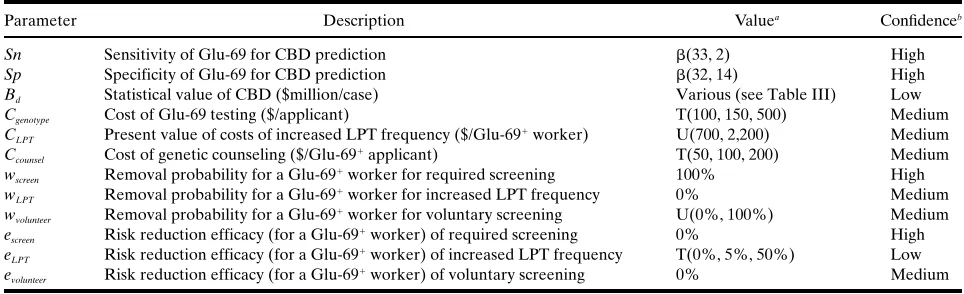
Table I. Input Parameters for Glu-69 Value-of-Information Model
Parameter Description Valuea Confidenceb
Sn Sensitivity of Glu-69 for CBD prediction b(33, 2) High
Sp Specificity of Glu-69 for CBD prediction b(32, 14) High
Bd Statistical value of CBD ($million/case) Various (see Table III) Low
Cgenotype Cost of Glu-69 testing ($/applicant) T(100, 150, 500) Medium
CLPT Present value of costs of increased LPT frequency ($/Glu-691 worker) U(700, 2,200) Medium
Ccounsel Cost of genetic counseling ($/Glu-691 applicant) T(50, 100, 200) Medium
wscreen Removal probability for a Glu-691 worker for required screening 100% High
wLPT Removal probability for a Glu-691 worker for increased LPT frequency 0% Medium
wvolunteer Removal probability for a Glu-691 worker for voluntary screening U(0%, 100%) Medium escreen Risk reduction efficacy (for a Glu-691 worker) of required screening 0% High
eLPT Risk reduction efficacy (for a Glu-691 worker) of increased LPT frequency T(0%, 5%, 50%) Low
evolunteer Risk reduction efficacy (for a Glu-691 worker) of voluntary screening 0% Medium
ab(v,w) indicates a beta distribution, U(l,u) indicates a uniform distribution, and T(l,m,u) indicates a triangular distribution. Values are
as-signed on the basis of empirical evidence, theoretical models, and judgment.
bConfidence indicates the assessors’ level of comfort that the distribution shape and parameters assigned to the given parameter are
No WTP estimates are currently available for CBD. However, most individuals diagnosed with
CBD will die from beryllium-related disease.(25)
Be-cause of a combination of high mortality and long-term morbidity, applying life valuations to CBD may be appropriate. Estimates for the statistical value of
life run as high as $16,300,000.(26) We include that
fig-ure as the highest value in our analysis, without dis-counting for latency.
We estimate that laboratory analysis for Glu-69
will cost $100 per sample.(21) Allowing an extra $50
per sample for sample collection and shipment, we estimate a total cost for Glu-69 testing of $150/sample and assign bounds of $100 and $500 to allow for a large degree of error. This parameter (Cgenotype) is rep-resented by using a triangular distribution (Table I).
Voluntary preplacement screening would
re-quire some counseling for applicants testing Glu-691.
We suggest at least an hour’s worth of counseling for each individual along with the production of written materials for the applicant to take home. Our best
es-timate of this cost is $100 per Glu-691 applicant. We
assign a triangular distribution allowing possible values in the range of half to double the primary esti-mate (Table I).
The present value of the costs from 50 years of additional LPTs in one individual (one extra test per year over a lifetime) is estimated to be $2,200 per
Glu-691 individual using a 7% discount rate and $231
per LPT.(25) If a Glu-691 individual develops a positive
LPT during the fifth year of exposure and is
immedi-ately replaced by a Glu-692 individual, the
dis-counted cost of additional LPTs is about $700. The true value is likely to lie somewhere between these two estimates, so we represent CLPT by using a uni-form distribution (Table I).
3.3.3. Predicted Risk Reduction Efficacy and Preplacement Removal Probability
The efficacy of the proposed risk management programs reflects how well they target and change the behavior, exposure, or medical treatment of
Glu-691 individuals. In a required screening
pro-gram, essentially 100% of Glu-691 beryllium work
applicants would be replaced by Glu-692
individu-als. With voluntary screening participation might be somewhat lower, depending on the proportion of workers consenting to a susceptibility test and de-ciding to remove themselves from exposure when test results are positive. Because participation in the
voluntary screening program is highly uncertain, we assign a uniform distribution allowing for anywhere between 0% and 100% removal likelihood for
Glu-691 applicants.
Medical or industrial hygiene intervention could reduce disease rates through a different use of ge-netic information. Rather than screening out geneti-cally susceptible applicants before they are exposed to beryllium, this type of intervention seeks to reduce the disease risk or severity through targeted exposure mitigation or heightened medical monitoring. We as-sume that increasing LPT frequency would reduce CBD risk by removing workers from beryllium expo-sure earlier in the process of disease development. No known evidence supports or contradicts the as-sumed benefits of early detection of beryllium sensi-tization, but it is reasonable based on other immune-mediated disease models to assume that CBD risk increases with exposure duration. Assuming a uniform likelihood of CBD development in the time interval between LPTs, increasing the LPT frequency from once a year to twice a year would reduce the average beryllium exposure duration by 3 months for sensi-tized individuals. What effect if any this would have on disease progression is unclear, but some evidence indicates that CBD risk increases with exposure
du-ration.(27) Hypothesizing that the prevalence of
dis-ease might be linearly related to exposure duration
for Glu-691 individuals, detection and removal from
exposure 3 months early in a cohort with a 5-year la-tency would reduce CBD prevalence by 5% among individuals in that cohort assuming they are replaced by workers who do not become sensitized. Alterna-tively, the prevalence of disease could be propor-tional to the postsensitization exposure duration, in which case early detection would decrease the CBD prevalence by 50%. Clearly a number of other models could be formed, including the possibility that early detection does not impact the likelihood of CBD de-velopment. We assign a triangular distribution to this parameter, with bounds of 0% and 50% and a mode of 5% (Table I).
4. RESULTS
Beryllium Disease and Genetic Screening 93
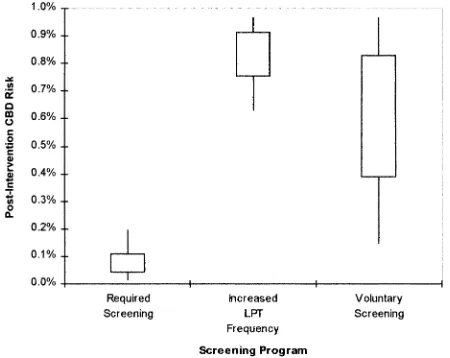
CBD risks at any baseline prevalence rate by rescal-ing the y-axis from 0 to p. In a cohort with 1% base-line CBD prevalence, the expected postintervention prevalence rate for using the Glu-69 test as a required job placement screen is 0.08%. A voluntary screening program in the same cohort would be expected to re-duce CBD prevalence to 0.6%, but this value is highly sensitive to the participation rate. Use of the genetic
variant as a medical screen for semiannual in place of annual lymphocyte proliferation testing yields a 0.8% mean predicted postintervention prevalence for the example cohort. The 90% simulation inter-vals, defined by the 5th and 95th percentiles of Monte Carlo simulation output, are (0.02%, 0.2%) for required screening, (0.6%, 1%) for increased LPT frequency, and (0.2%, 1%) for voluntary screening. These predicted postintervention risks and the other analytical results depend heavily on the parameter estimates in Table I and the underly-ing model assumptions.
Net expected VOI per beryllium worker is esti-mated across a range of baseline prevalence values and CBD avoidance valuations (Table III). For most current occupational prevalence rates and health val-uations exceeding $1.45 million, the mean predicted VOI exceeds zero, indicating an expected net social gain for using the susceptibility biomarker in any of the three proposed strategies. For example, at 10% baseline CBD prevalence and $1.45 million per case of CBD, the expected net per capita VOI for Glu-69 in required or voluntary screening increases to $130,000 or $51,000, respectively. However, at low baseline CBD prevalence rates and low health
valua-tions, the expected VOI for the three Glu-691 based
programs is negative, which indicates that the pro-gram costs are expected to outweigh the benefits of CBD reduction.
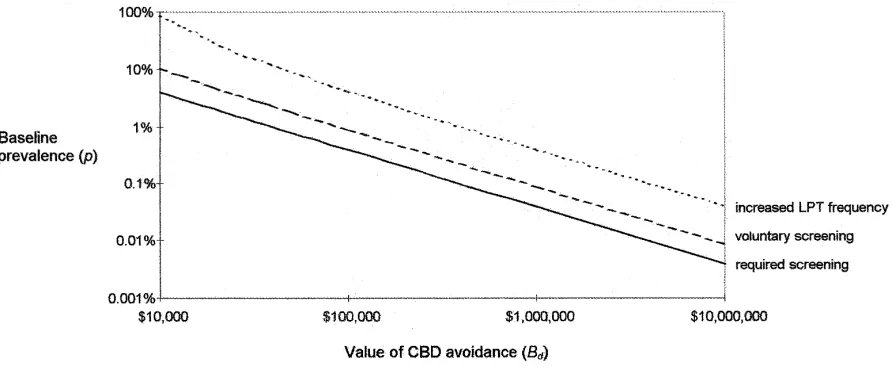
The baseline CBD prevalence and CBD valua-tion for which the expected VOI is zero, or “cut-points,” are shown as lines in Figure 2. Each Glu-69-based risk management program is expected to be cost effective only when the baseline prevalence and selected health valuation produce a point to the right of the respective cutpoint line. These graphs could be expanded by adding VOI endpoints other than zero or displaying cutpoints based on simulation bounds (e.g., 5th and 95th percentiles) to indicate the effects of uncertainty.
[image:7.594.56.286.104.268.2]Sensitivity analysis was conducted for the three risk management programs at 1% baseline preva-lence and $1.45 million per CBD case avoided. Note that p and Bd have the strongest influence by far on the model results and the sensitivity analysis indi-cates the relative importance of the remaining vari-ables. Contribution to variance estimates based on Spearman’s rank correlation indicate that for re-quired screening about 94% of the VOI simulation variance is associated with the sensitivity rate of CBD to Glu-69 (Sn); the specificity rate (Sp) and Glu-69 fi-nancial cost (Cgenotype) each contribute about 3% of the Table II. Predicted Postintervention CBD Risk by Baseline
Prevalence and Intervention Type
Baseline
prevalence Intervention type
Postintervention CBD risk
0.1% Required screen 0.008% (0.001%, 0.020%)a
0.1% Increased LPT
frequency 0.08% (0.06%, 0.10%)
0.1% Voluntary screen 0.06% (0.02%, 0.10%)
1% Required screen 0.08% (0.02%, 0.20%)
1% Increased LPT
frequency 0.8% (0.6%, 1.0%)
1% Voluntary screen 0.6% (0.2%, 1.0%)
10% Required screen 0.9% (0.2%, 2.1%)
10% Increased LPT
frequency 8.3% (6.3%, 9.7%)
10% Voluntary screen 6.5% (1.6%, 9.7%)
a First value indicates expected value of CBD risk; range in
paren-theses indicates 90% simulation interval as defined by the 5th and 95th percentiles of Monte Carlo simulation results. These values depend on hypothetical models and subjective parameter estimates shown in Table I.
[image:7.594.59.284.467.646.2]variance. For voluntary screening 98% of the VOI simulation variance is attributable to uncertainty re-garding the removal rate for voluntary screening (wvolunteer). For increased LPT frequency in Glu-691 workers, 98% of the variance in simulated VOI is associated with the risk-reduction efficacy of
in-creased LPT frequency (eLPT), and 1% of the
vari-ance is associated with the cost of additional LPT
testing (CLPT). Other variables contribute
mini-mally (,1%) to the total uncertainty regarding
VOI for any of these three programs.
5. DISCUSSION
Our analysis indicates that the expected health benefits of a Glu-69-based required screening pro-gram for machinists at typical baseline prevalence levels far outweigh the expected financial costs for most health valuations. If an a priori judgment is made that the qualitative social and ethical risks of required screening are too burdensome or if required
genetic screening is determined to be illegal,(28) other
[image:8.594.57.539.96.238.2]Glu-69-based risk management programs may be Table III. Predicted Glu-69 Value-of-Information by Baseline Prevalence, Intervention Type, and Value of CBD Avoidance
Baseline preva-lence
Intervention type
Value of CBD avoidance
$12,200 $240,000 $1,450,000 $16,300,000
0.1% Required screen 2$350 (2610, 2180)a 2$140 (2400, 40) $970 (680, 1,200) $15,000 (13,000, 16,000)
0.1% Increased LPT frq. 2$690 (21,000, 2410) 2$650 (2990, 2370) 2$440 (2840, 240) $2,100 (2180, 5,400)
0.1% Voluntary screen 2$330 (2560, 2180) 2$250 (2450, 270) $210 (2280, 870) $5,700 (220, 14,000)
1% Required screen 2$250 (2510, 280) $1,800 (1,500, 2,100) $13,000 (11,000, 14,000) $150,000 (130,000, 160,000)
1% Increased LPT frq. 2$680 (21,000, 2400) 2$290 (2790, 270) $1,800 (2230, 4,700) $28,000 (4,800, 61,000)
1% Voluntary screen 2$290 (2500, 2150) $560 (2220, 1,700) $5,100 (120, 12,000) $60,000 (4,900, 140,000)
10% Required screen $710 (410, 950) $21,000 (19,000, 23,000) $130,000 (110,000, 140,000) $1,500,000 (1,300,000, 1,600,000)
10% Increased LPT frq. 2$570 (2980, 2180) $3,300 (10, 8,100) $24,000 (4,100, 52,000) $280,000 (54,000, 610,000)
10% Voluntary screen $70 (2320, 630) $8,000 (360, 20,000) $51,000 (3,800, 120,000) $570,000 (49,000, 1,400,000)
a First value indicates expected value in dollars per beryllium worker; range in parentheses indicates 90% simulation interval as defined by
the 5th and 95th percentiles of Monte Carlo simulation results. These values depend on hypothetical models and subjective parameter es-timates shown in Table I.
Fig. 2. Values of p and Bd that produce an expected VOI of $0 for each GLU-69-based intervention. Each line shows the cutpoints for a single intervention type based on possible combinations of the two key parameters, holding all other parameters at their expected values.
Regions above each cutpoint line indicate combinations of p and Bd expected to result in a positive VOI for that particular GLU-69-based
[image:8.594.75.521.463.647.2]Beryllium Disease and Genetic Screening 95
more appropriate. Voluntary placement, for example, may be as nearly effective as required screening in re-ducing disease. The major risk associated with this
ap-proach is the possibility that few Glu-691 workers will
decide to get tested or to avoid placement in beryllium-exposed job tasks. However, even if every worker de-cides to get tested for susceptibility but nobody with
Glu-691 decides to act on the results, the financial
costs are minimal (z$290/worker). Furthermore,
even if only one of every hundred Glu-691 applicants
decides to remove themselves from exposure, the ex-pected value of the health benefits will still exceed the program costs at health valuations greater than $500,000 per CBD case.
Indirect benefits of biomarker development and use exist but have not been evaluated in this model. The identification of the polymorphism and develop-ment of the Glu-69 test, for example, may ultimately allow understanding of the mechanisms underlying CBD and thus lead perhaps to better prevention or
treatment options.(20) Medical surveillance programs
designed around the susceptibility biomarker might similarly lead to new insights regarding CBD etiol-ogy. Although it may not be appropriate to include these impacts in deciding whether or not to broadly implement a risk management program based on ge-netic susceptibility, they are important considerations when targeting biomarker research.
5.1. Other Risk Management Options
Not all risk management options have been eval-uated here, nor have combinations of the three op-tions. Process changes, personal protective equipment, and limitations on exposure duration are common methods used in industrial hygiene practice to reduce
exposure.(29) Indeed, DOE has recently introduced
substantial exposure reduction activities as part of a suite of hazard mitigation and communication activi-ties intended to reduce CBD incidence among its
workers.(30) Because the dose–response relationship is
unclear, whether exposure reductions beyond the current standard will lead to substantially reduced CBD incidence is uncertain. Although it is prudent to assume that further reductions in exposure concen-tration are likely to reduce disease incidence, for be-ryllium there is little direct evidence to support or contradict this assumption.
Quantitative dose–response models for beryllium-induced CBD are currently unavailable. Such a model could easily be incorporated into this analysis
and would provide a means of estimating the risk re-duction and VOI for beryllium exposure controls. Here we chose not to consider the effectiveness of ex-posure reductions but rather to limit our analysis to the utility of the Glu-69 test at specific baseline CBD prevalence levels. If a Glu-69 genetic screening ap-proach is combined with exposure reductions to all workers, the value of the genetic information de-pends on the baseline prevalence following the expo-sure reduction. For example, current CBD preva-lence among beryllium machinists has been reported
as approximately 10% for one cohort.(23) If additional
exposure controls in these machinists were expected to lead to a 90% reduction in risk, the new baseline prevalence in this cohort would be 1%, and the ex-pected VOI for the voluntary Glu-69 program would decrease from $8,000 to $560 per beryllium machinist based on $240,000 per CBD case avoided (Table III).
Other programs might be considered in addition to those heightened medical monitoring options eval-uated here. For example, the interval between succes-sive LPTs might be changed to other values, and when warranted, other clinical tests could be used to ascertain disease status before the appearance of frank CBD. Although the possibility has not been quantitatively evaluated here, any application of Glu-69 genetic screening might indirectly induce some
Glu-691 beryllium workers to reduce their own
beryl-lium exposures, thereby indirectly increasing the util-ity of the program. However, the disease reduction benefits of early detection of sensitization or disease are unlikely to be greater than the benefits of re-quired or voluntary preplacement screening, and the financial costs of heightened medical monitoring are relatively high. Nonetheless, heightened medical
monitoring targeted to Glu-691 workers may be
su-perior to not using Glu-69-based genetic testing at current occupational CBD prevalence rates. In addi-tion, heightened medical monitoring may be the only genetically based intervention available to former beryllium workers.
polymor-phism is causally implicated in disease onset and progression.
Richeldi et al.(2) investigated multiple
polymor-phisms in the HLA-DPB1 gene after a screening study demonstrated no strong associations with poly-morphisms in the HLA-DR and -DQ genes. They re-port that an aspartic acid–glutamic acid substitution for alanine-alanine at position 55–56 showed signifi-cant association with disease (79% sensitivity and 59% specificity). Because individual data were not provided in the publication, however, whether indi-viduals with both polymorphisms exhibited greater disease prevalence was unclear. A concomitant anal-ysis of genetic linkage between Glu-69 and polymor-phic sites within HLA-DRB4 and TNFB
demon-strated no association with CBD.(2)
In a study of genetic polymorphisms associated
with beryllium hypersensitivity, Stubbs et al.(31)
exam-ined HLA-DRB1, -DRB3, -DRB4, -DRB5, and -DPB1. They observed a significant association between be-ryllium sensitization and the HLA-DPB1 Glu-69 polymorphism, supporting the observations of
Rich-eldi et al.(2) In addition, they observed that five
spe-cific polymorphisms in HLA-DRB1 were associated with susceptibility to beryllium sensitization and that four others within the same gene were associated with protection. Polymorphisms associated with re-duced prevalence of sensitization were also observed within HLA-DRB3 and -DRB5. Whether these poly-morphisms are associated with development of CBD has not been reported, and genetic linkage between HLA-DP genes and other MHC class II genes is
low.(32) Finally, unpublished analyses by Saltini et al.
reportedly demonstrate a significant association
be-tween CBD and polymorphisms in TNF-a; however,
the association is reportedly weaker than that
ob-served with Glu-69,(8) and no information is currently
available regarding disease prevalence among indi-viduals with both polymorphisms.
5.2. Social Implications and Ethics of Genetic Screening
If a decisionmaker decides that the social and ethical risks of required Glu-69 screening should be quantified and weighed against the financial and health risks, Eq. 1 can be expanded to include all of those risks. Because of the difficulty in assigning value to social risks, we have chosen to treat them qualitatively instead of quantitatively in this analysis. For this reason we have also calculated VOI
sepa-rately for each risk management option, rather than taking the more typical approach of optimizing
be-fore the VOI calculation.(33) We feel that our approach
may be more informative to decisionmakers, particu-larly when they might wish to select a “suboptimal” risk management option based on factors external to the quantitative analysis.
Many authors have pointed out the social and
ethical hazards of occupational genetic screening.(34)
These hazards include potential loss of employment, benefits, employability, insurability, and privacy for individuals who are genetically susceptible but may not develop disease after beryllium exposure. Be-cause of the potential for these negative impacts, and
because the majority of beryllium-exposed Glu-691
individuals will not develop CBD, some beryllium re-searchers have recommended that Glu-69 not be
used for employment screening.(23) We do not intend
to belittle these concerns, but when the health risks are substantial the ethical hazards of failing to act are also worthy of consideration. This ethical hazard is heightened in this case by the uncertainty regarding the dose–response relationship for CBD, the absence of a complete cure, and the complications often en-countered when using long-term immunosuppressive therapy as is frequently required for CBD. Although
the current 2 mg/m3 standard is clearly not protective
of all workers, further beryllium exposure reduc-tions are not guaranteed to substantially reduce CBD incidence because of the exquisite susceptibil-ity of some individuals. Hence, other options must be considered for use in conjunction with improved exposure controls.
The social risks of taking action on the basis of genetic test results can be mitigated to some extent. For example, DOE has directed that its workers test-ing positive for sensitization to beryllium be removed from job tasks with known beryllium exposure but re-tain full employment and benefits for some time after
diagnosis.(30) A similar rule could be applied to
cur-rent workers testing positive for genetic susceptibility to beryllium, though this would increase the costs of the screening program and thereby reduce the ex-pected VOI. In addition, federal legislation disallow-ing the use of genetic susceptibility tests by insurance companies and preventing inappropriate use of
ge-netic screening by employers has been proposed.(35,36)
inde-Beryllium Disease and Genetic Screening 97
pendent laboratory to conduct confidential genetic testing and provide confidential counseling to current and prospective beryllium workers. This approach would encourage individuals to get tested by protect-ing their privacy but would increase screenprotect-ing costs for employers. Revised estimates of the VOI for ex-panded programs such as these could be obtained by using our model equations.
The success of any voluntary screening program depends on trust. Participation rates can increase over time as a program becomes established and gains credibility. One study reported that over 99.9% of Maryland parents consented to newborn phe-nylketonuria screening for medical intervention after
the state repealed a required screening law.(37)
Any-thing close to this degree of participation could only be achieved in the occupational setting by carefully addressing the privacy and job security concerns of those tested and through well-conceived risk commu-nication. Although previous surveys found many people reluctant to share genetic information with
employers,(38) it is reasonable to believe that some
be-ryllium workers would give informed consent to sus-ceptibility testing and remove themselves from beryl-lium work on the basis of the results. Given the health risks, we believe that beryllium workers should at least be provided with information about the poten-tial uses of the test.
5.3. Data Needs and Suggestions for Future Research
The health valuation for CBD is clearly the most important aspect of this model in terms of impact on the predicted VOI. Readers are likely to have quite different opinions on the most appropriate value of Bd, and for policy makers to select an appropriate value may be difficult. Although some of these dis-crepancies could be resolved by COI and WTP studies conducted specifically for CBD, further research is unlikely to resolve basic differences of opinion.
Of the other variables in the model, several stand out as crucial areas for additional research. The voluntary participation rate is unknown as we are un-aware of such a genetically based occupational screening model in current use. Even were data avail-able for another genetic screen, how applicavail-able these data would be to the particular case of Glu-69 and CBD is questionable. The specific contextual factors are likely to strongly influence the participation rate for such a program; thus a small-scale pilot study to
preliminarily estimate the parameter would be re-quired. We suggest that Glu-69 may be appropriate for such a pilot study, on the basis of the VOI analysis conducted here.
The medical value of higher LPT frequency is also open to question and is represented by a wide range of possibilities in the present model. A detailed quantitative model of beryllium sensitization and CBD progression is needed for this and other aspects of our model, but existing models are mostly qualita-tive and still open to debate. Future work should in-clude the development and testing of more detailed disease models for CBD, particularly those that take both genetic status and beryllium exposure charac-teristics into account. For example, we have hypothe-sized that the sensitivity and specificity rates are inde-pendent of baseline CBD prevalence by using a relatively simple model for the interaction of genetics and environment in producing CBD. More cohort study data would allow for the exploration of this model and alternative hypotheses.
6. CONCLUSIONS
The Glu-69 genetic biomarker, when used as a required or voluntary screen for occupational place-ment in beryllium-contaminated areas, is expected to be cost-effective in mitigating CBD in typical cohorts when CBD valuation is above $100,000 per case. At lower valuations and lower baseline disease preva-lence rates, cost-effectiveness decreases. However, genetic screening has significant ethical and legal im-plications that may prevent implementation. Volun-tary screening may be nearly as cost effective as re-quired screening and is more likely to be accepted by stakeholders, but predicting the participation rate is difficult. Increasing the frequency of the LPT from
once a year to twice a year for Glu-691 individuals
may also decrease disease prevalence at a reasonable cost but is predicted to be less effective than either of the screening programs.
protec-tion as voluntary genetic testing conducted by an out-side party.
Many more biomarkers are available today than are actually used in clinical, occupational, or environ-mental risk management. Highly sensitive and spe-cific biomarkers are clearly valid for practice, but less obvious biomarkers may also offer significant oppor-tunities for disease reduction. Tools such as decision analysis and VOI analysis can assist in discriminating between good and poor biomarker opportunities by providing information about the predicted costs and benefits of using biomarkers in specific applications.
ACKNOWLEDGMENTS
This manuscript is based on work originally pre-sented at the 1998 American Nuclear Society Topical Meeting on Risk-Based Performance Assessment
and Decision Making.(21) Research funding was
pro-vided by the Consortium for Risk Evaluation with Stakeholder Participation (CRESP) by Department of Energy Cooperative Agreement #DE-FCO1-95EW55084. This support does not constitute en-dorsement of the views expressed herein.
APPENDIX: ESTIMATION OF POSITIVE AND NEGATIVE PREDICTIVE VALUES FROM SENSITIVITY AND SPECIFICITY RATES
The relationship between screening biomarkers and disease can be reported in many different ways. Ep-idemiologists often use positive and negative predictive
values (PV1 and PV2) as one set of measures indicating
the efficacy of binary screening tests for predicting bi-nary disease states. Predictive values can be directly ob-tained only from cohort studies. Predictive values are simply conditional probabilities (Pr) of the test re-sults accurately reflecting the eventual disease state:
PV15 Pr[D1|T1] (8)
PV25 Pr[D2|T2] (9)
where D1 is diseased and D2 is disease-free, and T1 is
a positive screening result and T2 is a negative
screen-ing result. Sensitivity (Sn) and specificity (Sp) are dif-ferent measures of screening efficacy and can be mea-sured in both case-control and cohort studies. Sn and
Sp are the reverse conditional probabilities of PV1
and PV2:
Sn 5 Pr[T1|D1] (10)
Sp 5 Pr[T2|D2] (11)
The proportion of the population screening positive
(f) is estimated(39) from Sn, Sp, and the baseline
dis-ease risk (p) using Bayes’ Rule:
f 5 Pr[T1]
5 Pr[T1, D1] 1 Pr[T1, D2]
5 Pr[T1|D1]Pr[D1] 1 Pr[T1|D2] Pr[D2]
5 Sn p 1 (12 Sp) (12 p). (12)
PV2 and PV1 are then estimated from Sn, Sp, f, and p
in a similar manner:
PV15 Pr[D1|T1]
5 Pr[D1, T1] / Pr[T1]
5 Pr[T1|D1] Pr[D1]/Pr[T1]
5 Sn p/f (13)
PV25 Pr[D2|T2]
5 Pr[D2, T2] / Pr[T2]
5 Pr[T2|D2] Pr[D2] / Pr[T2]
5 Sp (1 2 p) / (1 2 f). (14)
REFERENCES
1. A. P. Decaprio, “Biomarkers: Coming Of Age for
Environ-mental Health and Risk Assessment,” Environmental Science
& Technology31(7), 1837–1848 (1997).
2. L. Richeldi, R. Sorrentino, and C. Saltini, “HLA-DPB1
Glutamate 69: A Genetic Marker Of Beryllium Disease,”
Sci-ence262(5131), 242–244 (1993).
3. R. O. Zerbe, Jr. and D. D. Dively, Benefit-Cost Analysis: In
Theory And Practice (HarperCollins College Publishers, New York, 1994).
4. E. Stokey and R. Zeckhauser, A Primer for Policy Analysis
(W.W. Norton, New York, 1978).
5. R. T. Clemen, Making Hard Decisions: An Introduction to
Decision Analysis, 2nd ed. (Duxbury Press, Belmont, Califor-nia, 1996).
6. T. K. Takaro, “Beryllium Biomarkers of Exposure, Susceptibil-ity, and Effect,” presented at the American Conference on Oc-cupational Health, Boston, 1998.
7. World Health Organization, Environmental Health Criteria
106: Beryllium (World Health Organization, Geneva, Switzer-land, 1990).
8. C. Saltini, M. Amicosante, A. Fanchi, G. Lombardi, and L. Richeldi, “Immunogenetic Basis of Environmental Lung
Dis-ease: Lessons from the Berylliosis Model,” European
Respira-tory Journal12, 1463–1475 (1998).
9. D. G. Freiman and H. L. Hardy, “Beryllium Disease: The Rela-tion of Pulmonary Pathology to Clinical Course and Prognosis Based on a Study of 130 Cases from the U.S. Beryllium Case
Registry,” Human Pathology1(1), 25–44 (1970).
10. K. Kreiss, M. M. Mroz, L. S. Newman, J. Martyny, and B. Zhen, “Machining Risk of Beryllium Disease and Sensitization with
Median Exposures Below 2 mg/m3,” American Journal of
In-dustrial Medicine30(1), 16–25 (1996).
11. K. K. Kreiss, “Beryllium,” in L. Rosenstock and M. R. Cullen
(eds.), Textbook of Clinical Occupational and Environmental
Beryllium Disease and Genetic Screening 99
12. K. Kreiss, M. M. Mroz, B. Zhen, J. W. Martyny, and L. S. New-man, “Epidemiology of Beryllium Sensitization and Disease in
Nuclear Workers,” American Review of Respiratory Disease
148(4 Pt 1), 985–991 (1993).
13. M. Eisenbud, “The Standard for Control of Chronic Beryllium
Disease,” Applied Occupational and Environmental Hygiene
13(1), 25–31 (1998).
14. U.S. Department of Energy, “Chronic Beryllium Disease Pre-vention Program: Notice of Proposed Rulemaking and Public
Hearings,” Federal Register63(232), 66,940–66,975 (1998).
15. L. S. Newman, “To Be21 or Not To Be21: Immunogenetics and
Occupational Exposure,” Science262(8 October), 197–8 (1993).
16. L. S. Newman, J. Lloyd, and E. Daniloff, “The Natural History of
Beryllium Sensitization and Chronic Beryllium Disease,”
Envi-ronmental Health Perspectives104(Suppl. 5), 937–943 (1996).
17. C. H. Hennekens and J. E. Buring, Epidemiology in Medicine
(Little, Brown and Company, Boston, 1987).
18. A. M. Finkel and J. S. Evans, “Evaluating the Benefits of Un-certainty Reduction in Environmental Health Risk
Manage-ment,” Journal of the Air Pollution Control Association37,
1164–1171 (1987).
19. K. M. Thompson and J. S. Evans, “The Value of Improved Na-tional Exposure Information for Perchloroethylene (Perc): A
Case Study for Dry Cleaners,” Risk Analysis17(2), 253–271
(1997).
20. M. G. Morgan and M. Henrion, Uncertainty: a Guide to
Deal-ing with Uncertainty in Risk and Policy Analysis (Cambridge University Press, Cambridge, Massachusetts, 1990).
21. S. M. Bartell, R. A. Ponce, T. K. Takaro, G. S. Omenn, R. O. Zerbe, and E. M. Faustman, “Value-of-Information Analyses for Biomarkers: Susceptibility to Chronic Beryllium Disease at
US DOE Sites,” pp. 205–213 in Proceedings of the Topical
Meeting on Risk-Based Performance Assessment and Decision Making, Richland/Pasco, Washington, April 5–8, 1998 (Amer-ican Nuclear Society, La Grange Park, Illinois, 1998). 22. K. Kreiss, F. Miller, L. S. Newman, Amaize- E. A. Ojo, M. D.
Rossman, and C. Saltini, “Chronic Beryllium Disease—From the Workplace to Cellular Immunology, Molecular
Immunoge-netics, And Back,” Clinical Immunology and
Immunopathol-ogy71(2), 123–129 (1994).
23. L. Richeldi, K. Kreiss, M. M. Mroz, B. Zhen, P. Tartoni, and C. Saltini, “Interaction of Genetic and Exposure Factors in the
Prevalence of Berylliosis,” American Journal of Industrial
Medicine32(4), 337–340 (1997).
24. G. Tolley, D. Kenkel, and R. Fabian, Valuing Health for Policy:
An Economic Approach (The University of Chicago Press, Chicago, 1994).
25. U.S. Department of Energy, Proposed Chronic Beryllium Dis-ease Prevention Program Rule: Economic Analysis, (Office of Environment, Safety, and Health, Germantown, Maryland, 1998).
26. U.S. Environmental Protection Agency, Guidelines for Prepar-ing Economic Analysis: Review Draft, (U.S. EPA, 1999). 27. K. Kreiss, S. Wasserman, M. M. Mroz, and L. S. Newman,
“Beryllium Disease Screening in the Ceramics Industry. Blood Lymphocyte Test Performance and Exposure-Disease
Relations,” Journal of Occupational Medicine35(3), 267–274
(1993).
28. Norman-Bloodsaw v. Lawrence Berkeley Laboratory, Febru-ary 3, 1998 (9th Cir. Report No. WL 39209, 1998).
29. N. A. Ashford, D. B. Hattis, C. J. Spadafor, and C. C. Caldart, Monitoring the Worker for Exposure and Disease (The Johns Hopkins University Press, Baltimore, Maryland, 1990). 30. U.S. Department of Energy, Guidance for Interim Chronic
Be-ryllium Disease Prevention Program (Office of Environment, Safety, and Health Report No. Department of Energy Guid-ance 440.1-7, 1997).
31. J. Stubbs, E. Argyris, C. W. Lee, D. Monos, and M. D. Rossman,
“Genetic Markers in Beryllium Disease,” Chest109(3), 45S
(1996).
32. J. M. Baisch and J. D. Capra, “Linkage Disequilibrium within
the HLA Complex Does Not Extend to HLA-DP,”
Scandina-vian Journal of Immunology37, 499–503 (1993).
33. J. W. Pratt, H. Raiffa, and R. Schlaifer, Statistical Decision
The-ory (The MIT Press, Cambridge, Massachusetts, 1996).
34. N. A. Holtzman, “Medical and Ethical Issues in Genetic
screening—An Academic View,” Environmental Health
Per-spectives104(Suppl 5), 987–990 (1996).
35. E. Marshall, “Clinton Backs Broad Genetic Safeguards,”
Sci-ence277(5324), 308 (1997).
36. A. A. Love, Vice President Proposes Ban of Genetic
Discrim-ination in the Workplace, AP Wire, January 21, 1998
(Associ-ated Press, 1998).
37. N. A. Holtzman, “Editorial: Genetic Screening and Public
Health,” American Journal of Public Health87(8), 1275–1276
(1997).
38. U.S. Department of Labor, Genetic Information and the Workplace, January 20, 1998 (U.S. Department of Labor, De-partment of Health and Human Services, Equal Employment Opportunity Commission, and Department of Justice, 1998).
39. L. D. Fisher and G. Van Belle, Biostatistics: A Methodology for