2019 International Conference on Artificial Intelligence, Control and Automation Engineering (AICAE 2019) ISBN: 978-1-60595-643-5
Research on Spacecraft Collaborative Design Technology
Based on Digital Mock-Up
Fa JING
*, Hao JIANG and Jiang-yong WANG
Institute of Telecommunication Satellite, China Academy of Space Technology, Beijing 100094, China
*Correspond author
Keywords: Digital mock-up, MBD, Collaborative design, Design-manufacturing integration, Digital assembly.
Abstract. In view of the problem that the information transmission of spacecraft development
depends on unstructured information such as documents and drawings, the information of design, manufacturing and assembly are relatively isolated and it is difficult to carry out collaborative design between subsystems, based on MBD technology, A digital mock-up Support collaborative design of spacecraft typical subsystems is established in this paper, and the Electrical diagram and mechanical layout Co-Design, design-manufacturing integration and digital assembly based on digital mock-up are realized, which improves the efficiency and quality of spacecraft development.
Introduction
In recent years, the United States has put forward "re-industrialization" and Germany has put forward "industrial 4.0" strategy. It is hoped that with the help of information technology development, the manufacturing industry will regain its advantages. The world's Aerospace powers have invested a lot of manpower, material and financial resources in digital technology, and have adopted a large number of CAD/CAE/CAM integrated technology for product development. It greatly
shortens the development cycle and reduces the development cost[1]. The informatization ability has
become an important manifestation of the core competitiveness of enterprises[2].
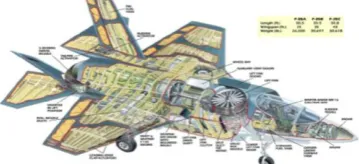
Lockheed Martin has put forward the development model of "digitalization from design to flight ", which uses pre-assembly, production process simulation, virtual test and virtual flight environment, as well as application of intelligent equipment. It reduces the design time of JSF fighter by 35%, the tooling by 90%, the number of parts by 50%, the manufacturing cycle by 67%, and the manufacturing
[image:1.595.209.389.565.647.2]cost by 50%[3].
Figure 1. JSF digital mock-up.
The international competition environment is becoming increasingly fierce, and spacecraft development is also facing the urgent situation that the development tasks are greatly increased and the development cycle is greatly shortened.
At present, Information transmission of traditional development mode still depends on unstructured forms such as documents and drawings. There are some obvious deficiency of this method in several aspects, such as the design period, the version control and reusability of data, traceability of design and so on. The information gap between system and subsystems, design, manufacturing and assembly has become a key problem restricting the improvement of spacecraft
development[4].
Based on the model-based definition technology, a digital mock-up support the collaborative
Design of spacecraft typical subsystems is established in this paper, and the
“information-electrical-mechanical” collaborative design, design-manufacturing integration and digital assembly based on MBD are realized.
Construction of Spacecraft Digital Mock-up
A digital mock-up of the spacecraft is the assembling of MBD model of all structural components, system equipment and accessories. Using MBD model as a single data source, building a digital mock-up of spacecraft products to meet the needs of multi-subsystem collaboration based on the same design basis is very important to the development of collaborative design.
MBD technology is a method to fully express product definition information with integrated three-dimensional entity model. This technology defines three-dimensional design information, three-dimensional manufacturing information and product management information together into
three-dimensional digital model of product[5]. In order to meet the requirements of spacecraft design,
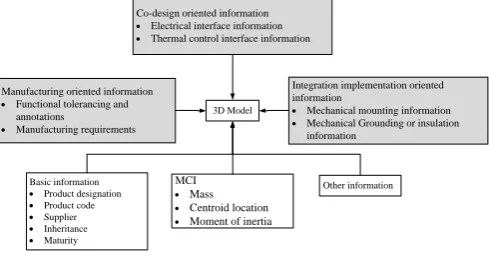
manufacture, assembly integration and collaborative design of different subsystems, MBD structure based on spacecraft integration design and Co-design was established, manufacturing oriented information such as Functional tolerancing and annotations, Manufacturing requirements, Integration implementation oriented information such as Mechanical mounting, Grounding or insulation information, Co-design oriented information such as thermal control interface and electrical interface are embedded in 3D models, just as Fig 2 shows.
3D Model Manufacturing oriented information
· Functional tolerancing and annotations
· Manufacturing requirements
Integration implementation oriented information
· Mechanical mounting information · Mechanical Grounding or insulation
information
Basic information · Product designation · Product code · Supplier · Inheritance · Maturity
MCI · Mass · Centroid location · Moment of inertia
Other information Co-design oriented information
[image:2.595.176.421.461.590.2]· Electrical interface information · Thermal control interface information
Figure 2. MBD Structure based on spacecraft integration design.
Figure 3. A typical MBD model structure built by METRICS.
“Information-Electric-Mechanical” Electrical Diagram and Mechanical Layout Co-Design
Collaborative Design is an important design method of system engineering. To achieve a design goal, each member of a team undertakes a part of the whole project, they should cooperate and work together to meet the requirements of the design goal. Based on the digital mock-up, the collaborative design of information design, electrical design and mechanical design is realized, which breaks through the technical difficulties of the collaborative work of electrical diagram design and mechanical layout design. Through the pre-matched data interface, the design results in the relevant sub-system design environment are automatically acquired online as the design parameters of the sub-system itself, and the online design iteration is carried out to realize the concurrent design, which breaks the information island of the sub-system design based on document design and optimizes the design results.
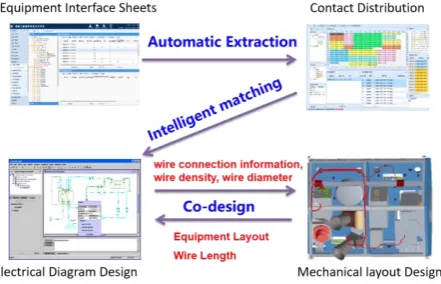
As shown in Fig 4,The equipment connector Contacts attributes are automatically extracted from the equipment interface sheets into the information design system, and the corresponding relationship
between device Contacts is automatically distributed[6], and On-line output to the electrical design
software; The electrical design software draws the electrical diagram automatically according to the Contacts distribution information and the equipment layout and position of the mechanical design software, On-line output the wire connection information, wire density, wire diameter and other information to the mechanical design software, Mechanical design software automatically parses the information and link the diagram to the 3D model to guide the cable to complete the automatic layout. The cable shape and weight are simulated under the mechanical design software. After completion, the information of wire length is transmitted back to the electrical design software, and the signal voltage drop analysis are carried out based on it in the electrical design software. Compared with traditional serial design, the efficiency of collaborative design is improved by more than 50%.
Figure 4. Lectrical diagram and mechanical layout Co-Design.
Design-manufacturing Integration
[image:3.595.182.403.548.690.2]manufacturing. Several typical applications are as follows:①Using MBD model, combined with advanced manufacturing methods such as 3D printing, the processing efficiency of typical structural
parts is increased more than three times, and the production efficiency is greatly improved;②By
extracting the installation information in the product MBD model, the automatic processing of
structural plate holes is realized, and the production preparation time is reduced by 30%;③The MBD
model of spacecraft pipeline is constructed, and the NC bending manufacturing of pipeline is realized in an all-round way. The manufacturing cycle of pipeline is shortened by 40%.
[image:4.595.100.495.181.318.2]
a) 3D Printing Structures b) structural plate c) pipeline
Figure 5. Typical applications of Design-manufacturing integration.
Digital Assembly
In spacecraft development, assembly occupies 30% to 50% of the total working hours, and each
procedure is directly related to the success or failure of the product[7].
According to the requirement of assembly process design, digital assembly requires digital mock-up and EBOM as input, BOM is widely used in manufacturing system to express product structure and related information. It is an important document for design and assembly. It is the key data for data sharing and information integration.
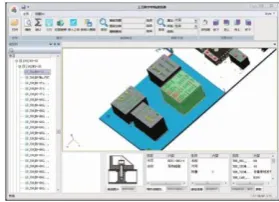
EBOM is constructed by extracting product structure, and attributes of spacecraft digital mock-up. METRICS_AIT software has been developed to extract assembly information from digital mock-up quickly, realize automatic processing and statistics of model information, form EBOM and transfer it to assembly process digitally, As shown in Fig.6.
In the early stage of design, assembly technicians carry out pre-assembly technological inspection based on digital mock-up. After the inspection, designers quickly output digital mock-up and EBOM. Based on this, assembly process mock-up is established to realize digital assembly, As shown in Fig.7.
Therefore, the upstream and downstream work of spacecraft product design, assembly process planning, on-site assembly operation and inspection information recording can be carried out based on digital mock-up and EBOM. The assembly efficiency of the spacecraft is increased by 30%.
[image:4.595.364.504.626.727.2] [image:4.595.91.249.642.723.2]
Conclusion
This paper Research on collaborative design technology based on digital mock-up to realize Electrical diagram and mechanical layout co-design, Design-manufacturing integration and digital assembly. The application shows that this method can achieve the goal of improving the efficiency and shortening the development period of spacecraft .The method and working modes proposed in this paper can be extended to various spacecraft research and development.
References
[1] Deng Yunfei, Zhang Tao, Zhang Xiaofan, et al. Current Status and Prospects of spacecraft MBD Design[J]. Aerospace China, 2017 (3):24-27.
[2] Liu Rui, Duan Guijiang. Development and Application of MBD in Aeronautical Manufacturing[J], Aeronautical Manufacturing Technology, 2016 (5):93-109.
[3] Ning Zhenbo, Zhang Xiaomei. Development and Prospect of Advanced Aircraft Design Technology[J], Aeronautical Manufacturing Technology, 2016 (5):24-28.
[4] He Dehua, Xia Pe ngfei, Cai Yaning. An Exploration of Applications of MBD in Development of Spacecraft[J], Spacecraft Engineering, 2015 24(1):126-132.
[5] Yu Yong, Tao Jian, Fan Yuqing. Summarization of Large Commercial Jet Digital Design and
Manufacturing Technology Application[J]. Aeronautical Manufacturing Technology,
2009(11):56-60
[6] Cheng Yan, Li Diqing, Wang Zhifu, et al. Research on the Concept of Collaborative Design Platform for Spacecraft TT&C Information Flow Based on Web[J], Journal of Telemetry, Tracking and Command, 2017 38(3):7-12.