2016 International Conference on Manufacturing Science and Information Engineering (ICMSIE 2016) ISBN: 978-1-60595-325-0
Research on the Mechanism of Net-based
Collaborative Product Design
QINHUA GUO and SHUGUANG SHAO
ABSTRACT
Manufacture products collaborative design is an advanced design pattern based on sharing distributive design resource. Meanwhile, it adopts modern theory to design products. It also means a process of completing design tasks to a complex mechanical products design task by multi-subject groups cooperatively and collaboratively by means of sharing design resource remotely under the environment of distributed network. This thesis researches on the mechanism of net-based collaborative product design. 1
INTRODUCTION
With the further development of economic globalization process, as one of pillar industries in the national economy, the machine-building industry will face even more fierce market competition. The core of competition among machine-building industries lies on their design ability for mechanical products. Presently, China has been a major country but not a strong power among global manufacturing. The main reason is that most products in China are lack of innovative design ability, short of own intellectual property rights as well as with a low market competition. Hence, it is one of the most pressing tasks to build a net-based collaborative design pattern fitting for the requirement of users and markets, which is also a key for manufacture industry to gain market and have the initiative of competition. The mechanism of net-based collaborative product design has been one of the core problems to be studied.
1
Qiuhua Guo, School of Architecture, Tianjin University, Weijin Road 92, Nankai Distinct, TianJin 300072,China.
CONCEPTUAL MODEL
After years of development and application of product collaborative design theory and technology, many research results have been achieved. But so far, there is not an accurate definition of the connotation of this design model can be fully described.
Concept Model
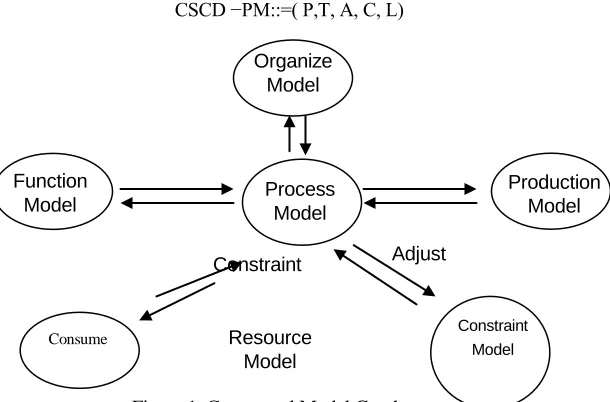
The concept model of product collaborative design is the abstraction and generalization of product collaborative design process. It describes the relationship between design objects, design activities and design environment in the process of collaborative design. The components of product collaborative design concept model relate to the organization management, function management, product data management, process management, resource management and constraint management of collaborative design. The concept model of product collaborative design depicts the concept connotation of different sides of product collaborative design (Figure 1). The concept model of collaborative design can be described as:
CSCD-CM::=(Mfunction, Morganize, Mproduction, Mprocess, Mresource, Mconstraint)
Hierarchical Model
For complex mechanical product collaborative design, it can be described as a four dimensional design activity state space: the dimension of hierarchy, the object dimension, the periodic dimension and the dimension constraint. The hierarchical model of mechanical product collaborative design based on active state space can be described as:
CSCD-AS(4)::=Alayer xAobjectsx Alifecycle xArestriction
Process Model
CSCD −PM::=( P,T, A, C, L)
[image:3.612.162.467.98.299.2]Resource Model
Figure 1. Conceptual Model Graph.
FEATURES ANALYSIS
A Process Of Design Group Collaboration And Management
Collaborative design is made with different domain knowledge of design expert group, based on common design goals, the respective domain knowledge and experience rules, in a distributed and heterogeneous network environment, mutual cooperation together to complete the task of designing a product. The two or more than two main design in the design activity, is a based on information and knowledge integration innovation activities and need to solve the design of the main roles, permissions and knowledge integration and sharing problems, have group sex. Collaborative design must provide the function of group collaboration management.
A Process Of Design Process Management And Control
In the collaborative design process, each stage of the design is in the distributed heterogeneous network environment of a dynamic problem solving and decision making process, because the design is a basis for designers have the knowledge and experience of innovation process, the design results may not guarantee a successful may need multiple dynamic repeated execution and skip execution and transfer its location only dependent at the time dynamic task execution status Information.
A Process of Design Resource Optimization And Configuration
The essence of collaborative design is to solve the problem of a design problem in the environment of the group staff without space and time constraints. Each of
Consume Constraint
Model
Constraint Organize
Model
Function Model
Production Model Process
Model
them has a variety of complex dependencies between the tasks, the design results of each sub-task and decision-making on other sub tasks have an impact, while the other tasks are dependent on the design results and decisions. The collaborative design is the key feature of the collaborative design. Here the synergy is mainly reflected in: the coordinated use of resources, the effective sharing of information, the design process of conflict resolution and collaborative awareness among designers, etc.
A Process of Sharing And Integration Of Design Environment
Due to the multi-agent collaborative design and collaborative design task of decomposable execution characteristics, considering the aging control problem for a class of the whole life cycle of a product, collaborative design is often a plurality of stages of parallel task execution process. Through effective control mechanism to complete each stage of the design tasks, to achieve the purpose of shortening the design cycle.
CHARACTERISTICS
Group Collaboration
Collaborative design group collaboration is mainly manifested in the design activities of the multi subjectivity. Collaborative designers who work at each independent time and space, having a domain knowledge, experience and problem solving ability of group experts and designers together under the support of computer network complete the design of a product. So it has the characteristics of group work and group collaboration.
Dynamic Distribution
Collaborative design process must be implemented to describe the product information model and the consistency control, must carry on the design task decomposition, distribution and scheduling, must be formal modeling and control, solve the conflict problems in the design process the design process. The dynamic of design process is not deterministic problems, the design of task timing problems, resource optimal allocation problem, the model of performance evaluation and analysis of the problem must be controlled and managed.
Shared Synergy
collaborative design stage and level, so in accordance with the planning and design tasks, collaborative design need to provide the different phases and different levels of task scheduling and resource allocation of limited, to maximize meet the requirement of product design. Resource information model and control model are used to optimize and schedule the design resources. Information model, which is based on attribute information, state information, fault tolerance information, capacity information and constraint information, is managed by the control model to realize the different state transitions and transfer events.
Concurrency Control
Collaborative design is a kind of modern advanced design mode, which is supported by the computer in a cross time and space environment. So for the existing product design environment and CAX tools to provide integrated technology, and solve the design environment of network communication collaboration. The process of communication includes the transformation, monitoring and knowledge processing mechanism of different knowledge understanding and expression.
CONCLUSION
Collaborative design is a modern product design mode which can realize the sharing of design resources in the distributed network environment. It is based on the information needs of the whole life cycle of the design object, through a certain information exchange, knowledge sharing and mutual cooperation mechanism, the process of cooperation to complete the design objectives. It takes the collaborative problem in product design process as the research object, emphasizes the design resources optimization allocation and sharing, and the collaborative work of human and human computer interaction in the design process. Based on product collaborative design environment, product information sharing and exchange, design is discussed and the design result of check and modify to improve design efficiency and shorten the design cycle and enhance the competitiveness of their products. Networked mechanical product collaborative design will be an important technology in the development of new products in the future.
REFERENCES
1. Frits P. Tolman. 1999. ”Product modeling standards for the building and construction industry”. Past, Present and Future. Automation in Construction, 8(3):227-235.
2. Guo Yinzhang, Zeng Jianchao. 2011. ‘Dynamic performance analysis for collaborative design model of machinery products based on invariant analysis”. Advanced Materials Research Journal, 211-212:340-346.
4. Li Y, Tan C H, Teo H H. 2012 “Leadership characteristics and developers motivation in open source software development,” J. Information and Management, 49(5):257-267.