2018 2nd International Conference on Modeling, Simulation and Optimization Technologies and Applications (MSOTA 2018) ISBN: 978-1-60595-594-0
Mine Wireless Sensor Network Platform Planning
Shao-juan LI
*, Jing-nan MA, Jia LI, Ying-juan ZHAO and Yuan YAO
Department of Basic Sciences, Air Force Engineering University, Xi’an Shaanxi, China
*Corresponding author
Keywords: Mine, Wireless sensor network, Sensor network node, Sensor deployment.
Abstract. Because of the special environment under the mine, the interference to the normal
operation of the wireless sensor network is inevitable. Therefore, some means must be adopted to reduce or avoid the influence of these factors. This paper starts with the analysis of the factors affecting wireless transmission under the mine, summarizes the matters that should be paid attention to in the node deployment of the sensor network, and gives the deployment scheme of sensor network in mined-out area of coal mine.
Various Factors Affecting Wireless Transmission under the Mine
The environment of underground mine is much more complicated and much harsher than the ground environment. The roadway is narrow; the ground is rough and rough, surrounded by coal and charcoal, as well as brackets, dampers, rails, power lines and so on. In such a complex and limited space, the propagation of radio waves is very different from the free space. Therefore, the factors affecting the communication frequency of underground geology and production environment should be fully considered. Referring to Sun Jiping's relevant information on the characteristics of underground wireless communication [1], it is concluded that the main factors affecting the quality of underground sensor network communication are as follows:
The Relationship between Attenuation and Curvature
The attenuation increases with the increase of the curvature of the roadway, such as 900MHz. For the same roadway with the same wall and cross-section size, the transmission distance can reach 600m when it is straight; when the roadway is bent at 90 degrees, the transmission distance is only 300m. For example, when the frequency is 415MHz, the linear transmission distance can reach 380m, and when the corner is encountered, it can only reach 127m. It can be seen that the transmission distance of the corner must be less than the linear transmission distance.
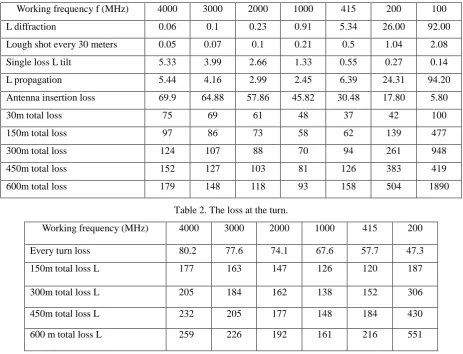
For straight and unobstructed roadways, Table 1 shows the loss of part of the frequency in the straight roadway. It can be seen that the higher the visible frequency, the smaller the transmission attenuation, but when the frequency increases, the turning ability of the radio wave becomes worse, at the corner,the loss is increased and the transmission distance is reduced. Table 2 shows the loss of a part of the frequency at a bend. It is not difficult to see that the corner loss gradually increases as the frequency increases.
Relationship between Attenuation and Roughness and Slope
Table 1. Frequency loss in straight roadway.
Working frequency f (MHz) 4000 3000 2000 1000 415 200 100
L diffraction 0.06 0.1 0.23 0.91 5.34 26.00 92.00
Lough shot every 30 meters 0.05 0.07 0.1 0.21 0.5 1.04 2.08
Single loss L tilt 5.33 3.99 2.66 1.33 0.55 0.27 0.14
L propagation 5.44 4.16 2.99 2.45 6.39 24.31 94.20
Antenna insertion loss 69.9 64.88 57.86 45.82 30.48 17.80 5.80
30m total loss 75 69 61 48 37 42 100
150m total loss 97 86 73 58 62 139 477
300m total loss 124 107 88 70 94 261 948
450m total loss 152 127 103 81 126 383 419
[image:2.595.66.530.86.440.2]600m total loss 179 148 118 93 158 504 1890
Table 2. The loss at the turn.
Working frequency (MHz) 4000 3000 2000 1000 415 200
Every turn loss 80.2 77.6 74.1 67.6 57.7 47.3
150m total loss L 177 163 147 126 120 187
300m total loss L 205 184 162 138 152 306
450m total loss L 232 205 177 148 184 430
600 m total loss L 259 226 192 161 216 551
The Influence of Underground Equipment on Wireless Transmission
In order to ensure the flow of air volume and air flow according to the design route, ventilation facilities such as wind walls[2], wind bridges, dampers, wind windows, etc. need to be installed in the roadway[3]. The wind wall, also known as closed wall, is a facility used to block the wind flow, such as closed abandoned roadways, mined-out area, fire areas and other areas or a certain section of the roadway set up in the roadway without traffic and pedestrians. According to the service life, different wind walls can be divided into two types: permanent wind wall and temporary wind wall. Permanent wind walls are built of brick, stone or cement and other non combustible materials, the thickness is not less than 0.45~1m. Temporary wind walls are made of wooden columns, wooden boards and old wind pipes. Therefore, the temporary wind wall has less impact on wireless transmission, while the permanent wind wall has greater impact on wireless transmission, and the loss increases with the increase of frequency.
The influence of wind bridges on wireless transmission. In the cross roadway of the inlet and return airways, in order to avoid the short circuit of the wind flow and separate the incoming air flow from the return air flow, it is necessary to provide a wind bridge in the cross roadway of the intake air passage and the return air passage. According to the structure of the wind bridge, it can be divided into a bypass type wind bridge, a concrete type wind bridge and an iron tube type wind bridge. The bypass type wind bridge is to develop a ventilation roadway in coal and rock around the intersection of intake and return air roadways.
tube and damper. There should be more than two dampers on each side. The diameter of the air tube is not less than 0.8~1m. The iron tube type wind bridge passes through the original roadway, so the iron tube type wind bridge has great influence on wireless transmission.
The influence of windshields on wireless transmission, to adjust the amount of airflow, a window is usually opened on the damper to adjust the airflow through the windshield by adjusting the ventilation area of the window (such as blinds). The influence of the windshield on wireless transmission is dependent on the material used to make the windshield.
The Influence of Conductor on Wireless Transmission
Because of the guiding effect of the longitudinal conductor, the attenuation of mine wireless transmission will be reduced, and the better the insulation performance of longitudinal conductors and pipes, the smaller the transmission attenuation in the center of the roadway. In the intermediate frequency and low frequency bands, the longitudinal waveguide has a large wave guiding effect, and the medium frequency band transmission distance can reach 2500 m. As the frequency increases, the role of the longitudinal conductor becomes smaller and smaller. In the UHF and above frequency bands, the role of the longitudinal conductor is negligible.
The Relationship between Attenuation and Roadway Section
The wireless transmission of the mine is affected by the ratio of the equivalent radius of the roadway section (the equivalent circular radius of the cross-sectional area) to the wavelength, the larger the ratio, the smaller the transmission attenuation. The larger the roadway section, the smaller the attenuation of wireless transmission. For example, the transmission distance of 400 MHz and 1W radio stations in the semi-circular roadway with bottom width of 2.5m and top height of 1.8 to 1.9m is 150 m, the 470MHz and 1W station transmits in a nearly circular roadway with a bottom width of 7.8m and a top height of 7.7m, the distance is 1500m. And there is a cutoff frequency for the wireless transmission of the roadway: the larger the section of the roadway, the higher the cutoff frequency of the wireless transmission. When the wireless transmission frequency is lower than the cutoff frequency, the transmission attenuation will increase rapidly. The influence of the section of the roadway on the wireless transmission is related to the wavelength. When the difference between equivalent radius of roadway section and wavelength is not more than 10 times (greater or less), the section size of the roadway has the greatest influence on the wireless transmission. When the equivalent radius of the roadway section is far greater or far less than wavelength, the tunnel cross section has less impact on wireless transmission. Because the section of the roadway generally varies between several square meters and several tens of square meters, the tunnel section has less influence on the wireless transmission of the low frequency and below frequency, the very high frequency and the ultra high frequency, and has a greater influence on the wireless transmission of the middle frequency band.
Sensor Network Planning
The following points should be noted in the nodes deployment of sensor networks:
1).We should try to avoid turning between sensor nodes in direct communication. If it is unavoidable, we should shorten the distance between them or deploy redundant nodes to make up for it. Because the mining face is moving forward, it is better to move the sensor nodes at regular intervals. This can also save costs without deploying more nodes.
2).Because the sensor network works in the 2.4 GHz band, the slope of the tunnel attenuates the channel severely[4]. When the slope of the tunnel is large, the spacing between nodes is shortened as far as possible.
3).The conductor has less influence on this frequency band.
underground, the influence of sensor nodes must be taken into account and a certain amount of allowance should be left.
5).Some underground equipment has great influence on the wireless channel, so the sensors should avoid such equipments as permanent wind wall and barrel wind bridge.
In view of the actual situation of the underground mine, the above requirements for the deployment of equipment, it should be noted that these requirements are only a proposal, the specific situation should be considered for the actual mine conditions, and there is a certain margin to prevent some emergencies.
Sensor Deployment Plan for Coal Mine Mined-out Area
At the time of design, the system requires the collection of various sensing data of the mined-out area, but with the advance of the mining face, the mined-out area will collapse, the cable cannot detect various sensing data inside the mined-out area. In order to solve this problem, wireless sensor technology is used to realize data transmission, but the network topology scheme adapted to the system should be determined first.
The ZigBee network can be organized into star network, tree network, or mesh network according to the needs of the application[5]. In the star structure, all devices communicate with the central device PAN network coordinator. In such networks, the network coordinator usually uses a continuous power system to supply power, while the other equipment uses the battery power. The star network is suitable for small-scale indoor applications such as home automation, personal computer peripherals, and personal health care.
A tree network can be understood as a hierarchical, administrative network. The main feature is that the functions of each node are relatively clear, which is conducive to the rational use of resources, and is very suitable for networks with little change in topology.
Unlike a star network, peer-to-peer networks can communicate directly with each other as long as they are within each other's wireless range. A peer-to-peer network also requires a network coordinator, which is responsible for managing link state information and authenticating device identity. Peer-to-peer network mode can support self-organizing networks to allow data to be transmitted over the network through multi-hop routing. The self-organization problem is solved by the network layer. The peer-to-peer network can construct a more complex network structure, which is suitable for wide range of equipment applications.
Because for the sensor data of the mined-out area, the system does not need a wide range of deploying sensor nodes, it is not necessary using the scattering network which is a peer-to-peer network. After all, the network scale is not large, it is not suitable for the peer-to-peer network. For star networks, there is a problem of distance, because the data is sent to the substation and then wired transmission through the substation. The distance from the mined-out area to the substation depends on the specific situation, but due to the poor transmission conditions under the mine, it is still difficult to construct the system through the star network topology. Considering various factors, we choose tree network to construct the mined-out area sensor network, we can place ZigBee sensor nodes in the mined-out area (for example, by drilling holes in mined-out area), through the network relay, we can transfer sensor data to the substation, and then from substation to ground monitoring station, or in some emergency situations, some equipment is directly controlled by the substation.
The above mentioned plan still has some problems in practical applications, such as transmission distance and reliability. Transmission distance can be extended by increasing node power, but this will definitely shorten the service life of battery-powered nodes, and due to the inherent defects of wireless transmission, when the transmission channel is blocked by obstacles, the connection between the nodes may be cut off. The problem of reliability is not only related to hardware but also to software. With the development of ZigBee technology, these problems will be solved over time.
Conclusion
the communication frequency as the center of discussion, the paper makes a rough quantification of the influence of various factors under the mine on the penetration ability of wireless transmission, the turning ability, especially the transmission distance. Based on the estimation, and based on the theoretical basis, the sensor deployment plan of the mine mined-out area is proposed.
References
[1] Sun Jiping, Characteristics of Mine Wireless Transmission, Coal Mine Design.4 (1999).
[2] Feng Wu, Jian-ping Peng, Bing-wei Wang, Current status of mine shaft environmental monitoring and its developing trend, GOLD. 39(2018)76-80.
[3] Zheng Li, Shu-guang Miao, Application of WSN in Mine Laneway Monitoring System Based on ZigBee, Instrument Technique and Sensor. 8(2010)57-59.
[4] Yi-yan Kong, Design of coal mine safety monitoring system based on wireless sensing network, Coal Technology. 32(2013)106-108.