© 2016, IRJET ISO 9001:2008 Certified Journal Page 301
Eco-Smart-Multi-utility Automated Teller Machine
Ritika De
1, Tanumoy Das
21
Student, Department of Electronics and Communication Engineering, Siliguri Institute of technology (MAKAUT),
West Bengal, India
2
Student, Department of Electronics and Communication Engineering, Siliguri Institute of technology
(MAKAUT), West Bengal, India
---***---Abstract-
an ATM (Automated Teller Machine) is a self-service technology in financial self-service delivery usually adopted by financial institutions like banks to reach their customers outside the banking hall. An ESM (Eco-Smart-Multi-utility) ATM is an intelligent system having both backward and forward compatibility which will guarantee a better usability experience for a consumer as well as state. There are three major parts of this project eco-friendliness, intelligence and multi-utility .This ATM is an Eco-friendly system as it runs consuming minimum energy. It has a lower installation and running cost, is energy efficient and space conserving since it is compact. This ATM has some smart advance features that deploy an easier communication between rural areas and banks, has an in-built security and surveillance system which implements the in-built security system and lock down in case of theft attempts. This is an multi-utility system including many functions which are not directly related to management of one’s own bank account such as paying routine bills, fees and taxes, Purchasing train tickets and Adding prepaid cell phone credits. Additionally in rural areas ATM would work as a farming assistance providing information regarding crop rates, public awareness related to farming in regional language.Moreover can be implemented as job alert system in panchayat levels and public grievance system “man ki bat” connecting my govt.portal.Key Words: Multi-utility, Smart ATM, Eco-Friendly, Public grievance system, Farming Assistance.
1. INTRODUCTION
An ATM is a most widely used self-service technology. Almost every one of us visits ATM regularly.
As per the study[1] conducted in 2014 by the World Bank there are 18.7 ATMs per 100,000 person in India which is a tremendous amount keeping in mind the huge population of India. From the above piece of information we may conclude that installation of each of these ATM can be high priced affair. Again an ATM as they are called “cash on go” machines runs day in and day out consuming a hefty of energy, precisely 5.2kWh per day on an average. A conventional ATM requires air-conditioning (temperature below 40C) to run properly making it very cost ineffective.
In additional to these issues, the growing number of ATMs in rural and semi-rural areas are a concern as said above the
conventional ATM requires a myriad of power .The Rural and semi-rural areas are impacted by lack of power, So running an ATM is an enormous challenge .So to solve above mentioned problems we have come up with this concept of ours that is ESM ATMs.Our project is divided in two modules urban module and Rural module. Both have some features different from the other according to the requirements, concentrating on different issues of cities and villages.
1.1
Background Study
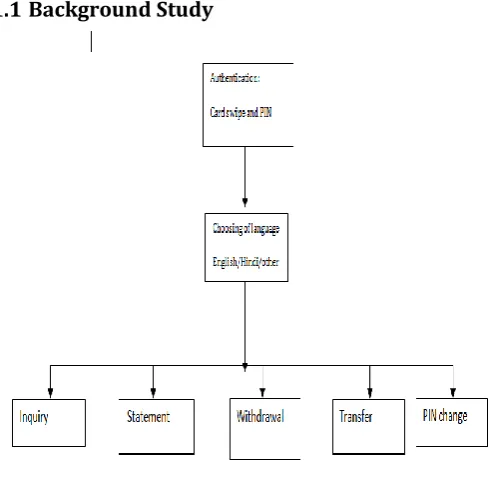
[image:1.595.313.558.337.579.2]Presently known ATMs are basically data terminal equipment with 2 input (card reader and keypad) and 4 output (display, cash dispenser, printer and speaker) devices. ATM is connected to a Host processor which works as DCE (data circuit terminating equipment).The ATM is connected to Host processor that support either leased line or dial up machine . Host processor is a gateway through which an ATM network is available to card holder. When a person carrying an ATM card wants to do an transaction, he or she swipes the ATM card ,the card reader captures the account information regarding the cardholder’s account .The account holder now input his/her PIN using keypad. The ATM forwards this information in encrypted format to the host processor, which routes the transaction request to the
© 2016, IRJET ISO 9001:2008 Certified Journal Page 302 cardholder's bank. If the cardholder is requesting cash, the
host processor causes electronic funds transfer to take place from the customer's bank account to the host processor's account. Once the funds are transferred to the host processor's bank account, the processor sends an approval code to the ATM authorizing the machine to dispense the cash. The processor then ACHs (Automated Clearing House - a bank terminology means that a person or business is authorizing another person or business to draft on an account) the cardholder's funds into the merchant's bank account, usually the next bank business day. In this way, the merchant is reimbursed for all funds dispensed by the ATM. Study in detail in [2].
2.
TECHNICAL STUDIES
2.1. Hardware Specifications:
Touch screen enabled tablet running on Windows (7/8.1)operating system having Octacore or Quad core
processor with sufficient processing speed(1.8GHz-2.5GHz),RAM (2GB or more) and 10” touch screen. The tablet should have Mini USB port to connect to a USB Hub. We are using tablet which removes the constraints of using separate CPU, Display, Touch adapter, modem, and camera.
Four port USB Hub to connect to Card reader, Thermal printer, Cash dispenser machine, Metallic numerical keypad, security surveillance cameras and sensors. More ports required if options are to be increased.
Card reader (Magnetic) to enable user authentication. The magnetic stripe at the back of ATM’s card contains the account information of the card holder and the card reader captures this information and sends to Host processor. Although the PIN (personal identification number) is not specified in the magnetic stripe. Metallic Numerical Keypad with Enter and Cancel
buttons for user inputs. The PIN is encrypted (hidden in code) in a database. The financial institute requires a PIN for verification. Federal law requires that the PIN block be sent to the host processor in encrypted form.
Thermal mini printer for printout of
records/transaction data. The bill count done by electronic eye and all the information pertaining to a particular transaction is maintained in a journal. Cash Dispensing machine (2/3 Cassette type in which
each cassette corresponds to a certain denomination of currency).Cash dispenser has an electric eye that counts every bill coming out of ATM as well as detect if any notes have tear or so. Ideal choice would be Fujitsu F53 media dispenser.
More features:
a) Fingerprint reader. b) Audio in-out port.
Suitable hard casing with aesthetics to secure the entire system.
INTERNET broadband connection minimizing the use of VSAT or other expensive data transmission equipments. DC Power backup.
Security system hardware requirement: UL 291 level 1 safe.
a) Arduino UNO R3: An Open source electronics prototyping platform as well as a microcontroller. It is based on AT mega 328P. By the means of sensors we can sense the environment using arduino UNO R3 and can make changes in surroundings using sensors, actuators and motors.
b) Shock sensor: we will be using KY 002 vibration switch module.SW-18015P.It senses any kind of change in pressure, shake very precisely. [3]
c) D6T series mems thermal sensor: High precision area temperature detection, detecting human intrusion if very close to vault /safe. Detection of stationary human also possible.[4] d) Servo Motor: It is an actuator unlike dc motor it does not move continuously but at a certain angle. It works on servo mechanism.[5] e) GSM module: SIM 900a for sending texts.
2.2. Software Specifications:
As the operating system is Windows – we have a wide range of front end and back end to choose from. The ideal choice may be WAMP (Windows, Apache, and MySQL PHP) implementation with MD5 security encryption of data transmitted/received.
© 2016, IRJET ISO 9001:2008 Certified Journal Page 303
3.
CONSTRUCTION
We already mentioned the project is divided in two modules, one for urban areas and other for rural and suburbs. Figure 2 shows the construction of the ESM ATMs. Urban and rural modules have same hardware construction with a few differences, the ESM ATMs in rural areas will consist solar panels to remove the constraints of running ATMs during frequent black outs in rural areas
The ESM ATM software is installed on the touch screen enabled tablet .Magnetic stripe reader will capture the card information. Input functions (Entering PIN, selection of choice etc.) can be done using both metallic keypad as well as the touch enabled screen. After a transaction the cash dispenser dispense the cash and thermal print the receipt. All the components are connected with each other using USB hub .The tablet is connected to dc power supply which is charged from power grid or solar panels accordingly. The whole system uses a minimum power consumption of 1.5 kWh per day which is in compare to present day ATM is much lower. The system doesn’t require air –conditioning hence reducing more power consumption. The system will use internet broadband connection (instead of VSAT) of sufficient uplink and downlink speed.
Multi- utility: Since we have put a great deal of importance in multi-utility of the ATMs the front end is designed to integrate services other than related to transactions.
a) Multi lingual Farming assistance (in rural modules): To help farmers with the information regarding farming in local languages. It will include the publishing information regarding the rate of crops .Type of crops suitable for the climates etc. also
including an online shopping portal for buying farming accessories and seeds.
b) Promotional features (in both rural and urban modules): Advertisements on idle time.
c) Public grievance system (in both rural and
Urban modules)
d) Job alert System.(in both rural and urban modules)
e) News portal (in both modules): For better connectivity. Stock exchange related updates(in urban module)
3.1. Security system
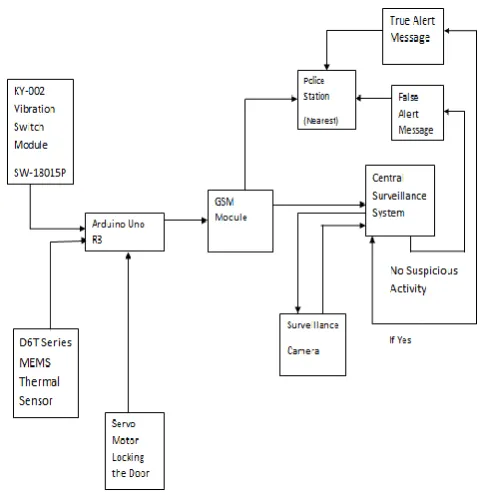
[image:3.595.31.292.111.285.2]ATM burglary attempts are very common nowadays. So security of the cash is one of the concerns. The ESM ATMs consist a UL 291 standard safe having security system based on arduino Uno R3.Two kind of sensors are used that is KY-002 vibration sensor SW18015P (shock sensor)and D6T series mems thermal sensor . The unauthentic intrusion near the safe is detected and a high voltage is sent to arduino by sensor which in turn will activate the GSM module SIM900A and the servo motor. the servo motor will lock the
[image:3.595.310.550.338.586.2]© 2016, IRJET ISO 9001:2008 Certified Journal Page 304 door of the ESM ATM booth to remove the chances of escape
[image:4.595.28.580.55.754.2]of the intruder and The GSM module will send an alert text to the central surveillance system as well as nearest police station which in turn check the cameras for suspicious activity, if found the central surveillance system will send an true alert to police and if not it will send a false alert to police. Figure 3 shows he block diagram of security system.
Table 1: Truth table representation of working of security system
KY-002 vibration sensor
D6T serial mems thermal sensor
GSM module
Servo motor
0 0 0 0
0 1 1 1
1 0 1 1
1 1 1 1
[image:4.595.320.585.67.501.2]3.2. Flow chart representation
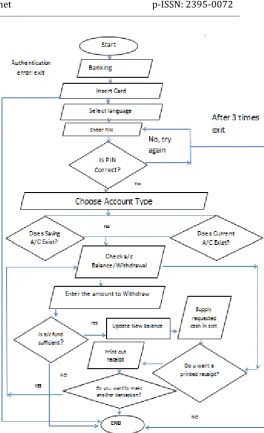
Figure 5: Flowchart of front end design (Banking)
© 2016, IRJET ISO 9001:2008 Certified Journal Page 305
4. ADAVANTAGES AND FUTURE SCOPE
4.1Advantages
Low installation cost and space conserving.
Low power consumption (1.5kWh per day) hence a big approach towards energy saving.No need of air conditioning.
Better connectivity for rural people and with farming assistance at their hand in their own language farmers will be more aware and less clueless about the current rates of crop.
Better connectivity for urban people also as they can easily enter an ESM ATM booth and connect to the world without hassle of getting an internet connection or going to cyber café.
A good security system with gsm based theft alert.4.2 Future scope
Biometric authentication making transaction more secure.
Wi-Fi enabled ATMs be the hub for Wi-Fi zones.
GSM module is replaced by ESP8266 module for vice calling in case of unauthentic intrusion.
Vaults with a technology such that if external intrusion takes place a non-toxic gas will be released which will render the unauthentic intruder unconscious.
Adding more portals for better communication.
Adding features like cash acceptor, cheque, Depositing, coin vending machine and passbook printing.5. CONCLUSIONS
From the above project we can understand that the
deployment of ATMs at both rural and urban regions of
India can be highly cost –effective and
eco-friendly.Moreover Multi-utility of ATMs will remove
many constraints of “digital India “concept. With these
ATMs every individual would be better connected to
world.
6. REFERENCES
[1] http://data.worldbank.org/indicator/FB.ATM.TOTL.P5
[2]
https://www.quora.com/How-do-ATM-machines-work-internally.
[3]
http://www.icstation.com/vibration-switch-module-18015p-vibration-sensor-arduino-p-2762.html
[4]
http://www.mouser.in/new/omronelectronics/omron-d6t/
[5] “DESIGN AND IMPLEMENTATION OF ATM EEMULATOR” 1C.H. UgwuishiwuDepartment of Computer Science, University of NigeriaNsukka, Nigeria [email protected], 080309980782M.E. EzemaDepartment of Computer Science University of
Nigeria Nsukka, Nigeria
[email protected],070379514723N.G. UgwuegbuDepartment of Computer SciencUniversity of Nigeria,Nsukka, [email protected], 08035660292African Journal of Computing & ICT © 2013 Afr J Comp & ICT – All Rights Reserved - ISSN 2006-1781 www.ajocict.net