© 2016, IRJET ISO 9001:2008 Certified Journal Page 1708
Achieving Optimal Throughput in Network Coding by using Routing Flow
--- Abstract -Network layer is responsible for carrying the packet from source all the way to destination. It is responsible for host to host delivery. There are multiple routes are available from source to destination and one of them is chosen. The network layer is responsible decides the root to be taken. This is called as routing. But some issues occur Maximized delay, less throughput, energy utilization .Network Coding is technique of transmission, mixing, remixing of messages arriving at nodes inside the network such that the transmitted messages can be unmixed at their final destinations which maximize the throughput but delay will get increase if each node will act as network coding node. To improve the throughput by minimizing the network coding nodes is the goal of paper. Centrality of node is calculated based on the degree and weight of node to achieve the throughput
TERMS---Network coding Node, Centrality, Degree, Weight, ThroughPut
1. INTRODUCTION
The max-flow min-cut theorem implementation is very tedious in the multicast communication scenario under the routing in the existing applications. It needs more iteration to search the appropriate path to reach at destination. It increases delay and decrease the throughput. Network coding provided the Random Linear Network coding (RLNC) which is coding over routing for multicasting from several sources over a network in [2]. RNC has two attractive features: First, it can be constructed distributively, thereby facilitating application of network coding in large scale networks it achieves max-flow capacity with a probability that rapidly approaches 1 as the size of the associated finite field increases. Random property of RLNC makes it possible robust, distributed transmission of
coded packets without communication with neighbors and higher decoding success probability.Network coding means that bits in information flows do not have to be delivered as commodities; they can be mixed however we wish, as long as the receiving hosts have received sufficient “evidence” or “clues” to reconstruct the original packets from the sending host. Not only network coding is remarkable in improvement of throughput performance, but also according to network coding has other advantages such as minimizing energy, consumption, minimizing delay through reduction of transmission number. To reduce the network coding nodes, we are going to choose the central node on the basis of centrality. which is explained in the section 3.1
2 LITERATURE REVEIW
2.1 .1 RELATED WORK
Ahlswede et al. [1] showed that with network coding, as symbol size approaches infinity, a source can multicast information at a rate approaching the smallest minimum cut between the source and any receiver. Li et al. showed that linear coding with finite symbol size is sufficient for multicast. Koetter and Médard presented an algebraic framework for network coding that extended previous results to arbitrary networks and robust networking, and proved the achievability with time-invariant solutions of the min-cut max-flow bound for networks with delay and cycles. Concurrent independent work by Sanders et al.
and Jaggi et al. considered single-source multicast on acyclic delay-free graphs, showing a similar bound on field size by different means, and giving centralized deterministic and randomized polynomial-time algorithms for finding network coding solutions over a sub graph consisting of flow solutions to each receiver.
1
Amruta Deshpande, 1
ME Computer Networks, Savitribai Phule Pune University, Nutan Maharashtra Institute of
Engineering and Technology College Pune, Maharashtra, 411033, India
2
Ashwini Jadhav
ME Computer Networks, Savitribai Phule Pune University, Nutan Maharashtra Institute of Engineering
and Technology College Pune, Maharashtra, 411033, India
© 2016, IRJET ISO 9001:2008 Certified Journal Page 1709
i)Network Information Flow(2000): The Max- flow Min-cut Theorem for network information flow
ii) On Randomized Network Coding(2003): presented bounds for the success probability of distributed randomized net-work coding for multi-source multicast in netnet-works.
iii) A Random Linear Network Coding Approach to Multicast(2006): Presented a distributed random linear network coding approach which asymptotically achieves capacity, as given by the max- flow min-cut bound of, in multisource multicast.
iv)
Overlay Protection Against Link Failures Using Network Coding: Introduced a resource efficient, and a fast method for providing protection for a group of connections such that a second copy of each data unit transmitted on the working circuits can be recovered without the detection of the failure, or rerouting data.2.1.2 Traditional and Network Coding approach
Network coding is much easier to deploy than multicast techniques, for a similar throughput when the number of trees to manage is large, and for a much better throughput when the number of tree is small. Of course, there are also many other interesting features offered by network coding (dynamicity, robustness, ...) which have been already largely promoted in the literature.
Multicast:
By Multicast, we mean here that several multicast trees can be set up between one source and all of its terminal, and the traffic is split appropriately among the chosen trees to reach the best possible throughput. The optimal throughput in G1 is 8/3=2:666, using 5 trees. The original data are hence sliced
[image:2.612.206.422.371.523.2]
Figure 1: Multicast Routing [4]
Network Coding:
© 2016, IRJET ISO 9001:2008 Certified Journal Page 1710
Figure 2: Multicast Routing by Network Coding Approach[4]
2.1.4 Types of nodes are defined as follows.
Definition 1: One node is called coding node if it satisfies:
1) The node has two incoming edge in the combination max flow; 2) The node has at least one outgoing edge belonging to overlap edge. Definition 2: The overlap edge is the edge used in two or more max-flows.
Definition 3: One node u is called a multicast node if the sum of incoming flow is less than the sum of outgoing flow. Definition 4: One node is called a forward node if the sum of incoming flow is equal to the sum of outgoing flow. In this paper coding nodes are used for the transmission of packets so the goal is to minimize the
2.2.1 Linear Network Coding and Random Network Coding
Random Linear Network Coding is a variant of Network Coding. Random Linear Network Coding works well over Wireless Networks to improve performance of multimedia transmission. In RLNC, the node combines number of packets (each Packet of length L exactly) it has received or created into one or several outgoing packets of L exactly, that’s why it is called Linear. It is called Random because nodes draw coefficients (these coefficients are sent to the destination in the packet header) at random from a finite field to form[3]. Random Linear combinations. In RLNC, outgoing packets are linear combinations of the original packets, where addition and multiplication are performed over the field F2s.An encoded packet carries information about several original packets .
2.3Node Selection Algorithm
The problem of the optimal selection of the NC nodes is known to be an NP-hard problem. We focus here on a greedy approach that searches at each step the optimal placement for a Novel network coding node, assuming that all other NC nodes are known
The algorithm used for selecting K network coding nodes by using Centrality illustrated in Proposed Work
3 Central Node Selection Algorithm
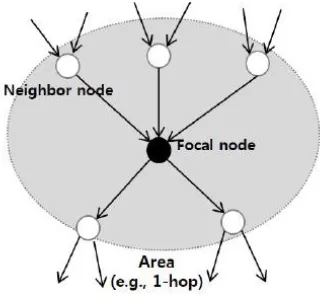
© 2016, IRJET ISO 9001:2008 Certified Journal Page 1711 In network, there are concentrated nodes which are more connected and communicated with its neighbors than other nodes. These nodes have more incoming traffic and opportunity to transmit traffic into network. It means if these nodes turn into Network Coding node, it can more generate innovative packets and transmit packets to receivers with improving the network throughput. A centrality is a tendency to be these concentrated nodes. To estimate the centrality of network node, we define a node traffic flow and sum of bandwidth link. The node degree represents the number of flow which is traffic connection passing through the node from source to receiver(s). And the sum of link bandwidth connected to the other node is represented by strength and traffic flow is represented by degree.
Figure 3 A simple Example
As shown in Figure 5, there is a focal node which can be any node in the network. In the area, the focal node is connected to its neighbor nodes within the same hop distance.
Degree of focal node i(din(i)) is given by:
N N
din(i)=∑ xji dout(j)=∑ Xji j=1 j=1
where i,j ε {1, 2, … , N} is the number of network nodes, i is the focal node and j represents neighbor nodes in the network. If there is traffic connection between node j and i node , Xij is 1 or not 0. When node i sends messages to
node j, din(i) is the input degree of the node i. Otherwise node i sends messages to node j , dout(j) is the output degree of the
node i.
3.1The Centrality Node Selection Algorithm
Input: din, dout, Sin,Sout,Wij,Wji
Ouput:Centrality of the node which is the network Coding node Step1: Initialize the Number of Network Coding Node=1
Step2: for i=1; Traverse all network coding nodes to compute the centrality of node i C(i).by using equations 1 to 5. Step3: for j=1; Traverse all neighbor nodes to compute the centrality of node j i.e. C (j) which are neighbor nodes of i Step 4: Send Centrality of j i.e. C(j) to node i;
© 2016, IRJET ISO 9001:2008 Certified Journal Page 1712 Step 6: Select network Coding node which has maximum of centrality i.e. C(i).
Step 7: If network Coding node is not node i then
Step 8: Send message to Network Coding node notification to node j Step 9: Else Turn node i to network coding node.
Step 10: end if Step 11: end for.
Node failure case handled in two ways
1) If the node gets fail then at the same time shortest path should be chosen by using AODV protocol. AODV Protocol reduces stale routes.It does not need to maintain routes
2) Energy get utilized if node has load more then load balancing algorithm should apply on it
Sin(i)= ∑N Wji,Sout(j)=∑NWji ……….Equation(2)
j=1 j=1
where i is the focal node, j represents neighbor nodes in the network. If there is traffic connection between node i and node j, Wij is the value of link bandwidth between node i and node j or not 0. Thus, Sin(i) is a sum of input strength of the node i and j.
Sout(j) is a sum of output strength of the node i. Based on node degree and strength, we compute input centrality and output
centrality. Input centrality and
output centrality of node Cin and Cout is given by:
Cin=din(i)×(Sin(i)/Din(i))=din(i)1-α×Sin(i)α..Equation(3)
Cout=dout(i) ×(Sout(i)/Dout(i))= dout(i)1-α×Sout(i)α ...………..Equation(4)
where α is a positive weighted parameter that can control
between node degree and strength. If this parameter is between 0 and 0.5, then a degree of node is powerful value, whereas if it is between 0.5 and 1, a strength is powerful value
.
In this paper, we set this value to 0.5 arbitrarily. Finally, centrality of node is given by:
C(i)=C
out(i)×(C
in(i)/C
out(i))
β= C
out(i)
1-β×C
in(i)
βwhere β is a positive weighted parameter to control
between packet transmission rate and packet innovativeness.
© 2016, IRJET ISO 9001:2008 Certified Journal Page 1713
4. Implementation of Centrality based Network coding Node Selection
Step1: the first step is to define the no of nodes. i have initialized as 7 No. of nodes in which
1 node is Focal node which is central node via traffic will move.
Central Node is in blue color and rest of nodes are in Red color
Central Node will perform the network coding operations
Step 2:
© 2016, IRJET ISO 9001:2008 Certified Journal Page 1714
Step 3:
It will start to check the shortest path in network and now AODV protocol will apply with the network coding operation on central node
By this architecture we will get following results
5. Result and Experiments
© 2016, IRJET ISO 9001:2008 Certified Journal Page 1715
Observations made by the graph are throughput obtained by proposed technique is optimal as compared to AODV protocol
Delay Graph:
In the following graph Comparative analysis shown in the figure. Delay obtained by CNCNS and AODV protocol which are in Red and Green colors respectively.
Observations made by the graph are delay obtained by proposed technique is minimum as compared to AODV protocol because to balance the node technique is used.
PDR Graph
In the following graph Comparative analysis shown in the figure. Packet Delivery Ratio obtained by CNCNS and AODV protocol which are in Red and Green colors respectively.
© 2016, IRJET ISO 9001:2008 Certified Journal Page 1716
Jitter Graph
In the following graph Comparative analysis shown in the figure. Jitter obtained by CNCNS and AODV protocol which are in Red and Green colors respectively.
Observations made by the graph are of Jitter obtained by proposed technique is constant and stable as compared to AODV protocol
5. CONCLUSION
Centrality Based Node selection mechanism is used to minimize the coding nodes to achieve throughput. While improving throughput energy utilization is more. It minimizes the delay because network coding node tries to minimized so less time will required to reach at destination
.
References
[1] R. Ahlswede, N. Cai, S.-Y. R. Li, and R. W. Yeung, “Network information flow,” IEEE Trans. Inf. Theory, vol. 46, no. 4, pp. 1204– 1216, Jul. 2000.
[2] T. Ho, M. Medard, J. Shi, M. Effros, and D. R. Karger, “On randomized network coding,” in Proc. 41st Allerton Annual Conf. Communication, Control, and Computing, Monticello, IL, Oct. 2003. [3] T. Ho, M. Medard, R. Koetter, D. R. Karger, M. Effros, S. Jun, and B.Leong, “A random linear network coding approach to multicast,” IEEETrans. Inf. Theory, vol. 52, no. 10, pp. 4413–4430, Oct. 2006. [4] P. A. Chou, Y. Wu, and K. Jain, “Practical network coding,” in Proc. 41st Allerton Conf. Communication, Control, and Computing, Monticello,IL, Oct. 2003.
[5] P. A. Chou and Y. Wu, "Network Coding for the Internet and Wireless Networks," Signal Processing Magazine, IEEE , vol.24, no.5, pp.77,85,
© 2016, IRJET ISO 9001:2008 Certified Journal Page 1717 Protection Against Link Failures Using Network Coding," Networking,
IEEE/ACM Transactions on , vol.19, no.4, pp.1071,1084, Aug. 2011 [7] N. Cleju, N. Thomos, and P. Frossard, “Network coding node placement for delay minimization in streaming overlays,” in Proc. Int. Conf.Communications (ICC’10), Cape Town, South Africa, May 2010. [8] M. Langberg, A. Sprintson, and J. Bruck, "The encoding complexity of network coding," Information Theory, 2005. ISIT 2005. Proceedings. International Symposium on , vol., no., pp.1987,1991, 4-9 Sept. 2005 [9] J. Thibault and M. Hajiaghayi, “Minimizing network coding nodes for multicast”, IEEE Trans. Inf. Theory, vol, no, pp, 2009
[10] M. Kim, M. Medard, V. Aggarwal, U.-M. O'Reilly, W. Kim, C.W. Ahn
and M. Effros, "Evolutionary Approaches To Minimizing Network Coding Resources," INFOCOM 2007. 26th IEEE International Conference on Computer Communications. IEEE , vol., no.,
pp.1991,1999, 6-12 May 2007
11] Tae-hwa Kim*,Hyungwoo Choi,Hong-Shik Park,“Centrality-Based Network Coding Node Selection Mechanism for Improving Network Throughput,ISBN-978-89-968650-3-2,Feb 2014
Ms. Amruta Vasantrao Deshpande
completed B.E. Computer Engineering from Pune University, India in 2010 and currently pursuing M.E. Computer Networks from Savitribai Phule Pune University. I am currently working at T.J.MoRE College at Pune, India. I am conducting research in the field of wireless communication and networks, which mainly involves network coding.
Prof. Ashvini Jadhav completed M.E. Computer Networks from Pune University, India in 2013.
![Figure 1: Multicast Routing [4]](https://thumb-us.123doks.com/thumbv2/123dok_us/8189801.813005/2.612.206.422.371.523/figure-multicast-routing.webp)
![Figure 2: Multicast Routing by Network Coding Approach[4]](https://thumb-us.123doks.com/thumbv2/123dok_us/8189801.813005/3.612.201.416.122.270/figure-multicast-routing-network-coding-approach.webp)