© 2016, IRJET | Impact Factor value: 4.45 | ISO 9001:2008 Certified Journal | Page 2874
EFFECT OF CURING COMPOUNDS ON STRENGTH AND DURABILITY OF
CONCRETE MIXES
Shabarish Patil1, Rajat Vaidya2, Vineethraj Math3
Department of Civil Engineering
KLE Institute of Technology, Hubballi, Karnataka, India
Email- [email protected] 1, [email protected]2, [email protected]3
---***---Abstract- An attempt has been made on the study of
effect of using curing compounds on strength and durability of concrete mixes. Mix proportions were arrived for M20, M30, conventional M40 and M40-Self Compacting Concrete. The cube strengths are tested on 7 and 28 days as a strength parameter and the cylinders are tested for durability aspect by Rapid Chloride Penetration Test (RCPT). Concrete specimens are subjected to curing conditions such as wet curing for 28 days, application of curing compound and application of curing compound after two days of wet curing. The curing compounds used in the study were wax based compounds.
Keywords – Curing compounds, self compacting concrete, rapid chloride penetration test, and wax based compounds.
1. Introduction
Proper curing is particularly important for producing high-quality concrete because of the large surface-area-to-volume ratio, like concrete pavements, canal linings etc,. Proper curing measures are necessary to maintain satisfactory moisture and temperature conditions, both of which promote cement hydration and concrete microstructure development. Curing measures influence not only concrete strength development but also concrete durability. A variety of curing methods and materials are available like water spray, wet burlap, plastic sheets, insulating blankets, and liquid membrane-forming compounds. Among these curing methods, burlap or insulating blankets are considered ideal for retaining heat and moisture, but their application is labour intensive and time consuming. Liquid membrane-forming curing compounds could provide similar insulation and
may be more economical, easier to apply, and maintenance-free. [1].
Curing compound is a liquid that can be applied as a coating to the surface of newly placed concrete to retard the loss of water and, in the case of pigmented compounds, to reflect heat, providing an opportunity for the concrete to develop its properties in a favourable temperature and moisture environment. Control of heat and moisture loss by application of a curing compound, especially in hot and cold weather conditions, has aided contractors in enhancing concrete quality, permitting early completion of project. Concrete practice has indicated that the performance of a curing compound is closely related to the characteristics of the curing materials, application methods like single-or double-layer spray, and application time. However, limited research has been conducted to investigate the effectiveness of different curing compounds and their application technologies. Currently, there is no appropriate testing method available to evaluate the effectiveness of curing, especially in the field. ASTM C156, “Test method for water retention by concrete curing materials,” is often used for estimating water retention ability of curing compounds.
© 2016, IRJET | Impact Factor value: 4.45 | ISO 9001:2008 Certified Journal | Page 2875
curing compounds only (R2) and wet curing for first two days and then applying curing compounds (R3). Two Wax based curing compounds named CC-1 and CC-2, from different manufacturers are selected for the study. And the double layer application of curing compound at right angles with hand sprayers was employed throughout the study. The 7 and 28 day compressive strength tests and Rapid Chloride Penetration Test at 28 days were performed to evaluate the curing effectiveness of curing compounds. Some of the results of this research are presented in the following sections.
2. Research Significance
Importance of concrete as a major construction material can be easily figured by the very fact that concrete is the mostly used material by human kind next only to water. Curing of concrete is one important phase in a quality concrete construction, which is generally catered for using ‘wet curing’ methods which require large amounts of water. Curing period is important for concrete, on which it attains its most of the strength. Normally all structures made of concrete are cured for a period of 28 days by the application of water.
At present, meeting the requirements of drinking water is a global issue. Amidst of this situation, construction industry is growing rapidly and so also the demand for large quantities of water for curing the concrete components. The scarcity of water good for construction purposes is forcing the construction industry to switch over to alternative curing methods which do not use water for curing.
Self Curing of the Concrete is the only solution for these problems. Looking at the demand for large infrastructure projects including in all the metropolitan cities, and also the construction of highways and airfields in the remote places getting assured supply of water for curing purpose is not practically possible. There is a need for a systematic study on the curing
compounds and their effects on strength and/ durability of concrete mixes performance in long term. Hence there are technological innovations connected with development of curing compounds, however before large scale use of such components can be accepted in the construction industry.
3. Experimental Programme
The experimental programme consisted of casting and testing of the concrete specimens cured by different curing conditions like R1, R2 and R3 by the application of CC-1 and CC-2. The grades of concrete mixes used are M20, M30, normal M40 and Self Compacting Concrete-M40.
The materials consist of 43 grade ordinary Portland cement confirming to IS: 8112-1989, river sand of specific gravity 2.6 and fineness modulus 2.17 confirming to zone III of IS: 383: 1970 and locally available crushed granite stone chips (20mm down) of specific gravity 2.7 and fineness modulus of 6.65. The flyash used is the Class ‘C’ with lower calcium content.
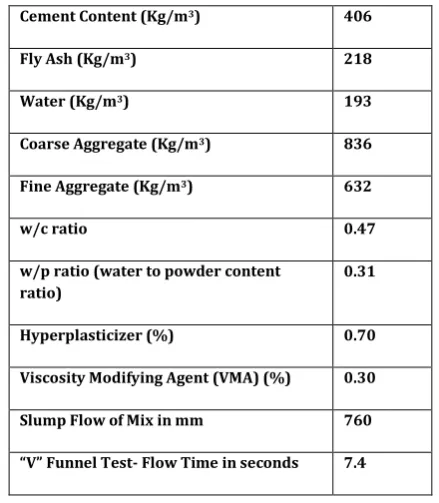
[image:2.595.295.566.576.788.2]Table 1 gives the mix proportion details of different concrete mixes used, which were obtained by the many trial mixes. Table 2 gives the mix proportions and properties of the SCC-M40 which is used in the further study.
Table 1: Details of Mix Designs for various mixes
Ingredients
Nominal Concrete Mixes
M40 M30 M20
Cement ( kg/m3) 420 400 350
Fine Aggregate
(kg/m3) 695 692 620
Coarse aggregate
(kg/m3) 1100 1100 1220
w/c ratio 0.39 0.44 0.48
Superplastizer, % 1.50 1.20 ---
Slump (mm) 60 90
© 2016, IRJET | Impact Factor value: 4.45 | ISO 9001:2008 Certified Journal | Page 2876
Table 2: Mix Details for Self Compacting Concrete of M40 Grade Concrete
Cement Content (Kg/m3) 406
Fly Ash (Kg/m3) 218
Water (Kg/m3) 193
Coarse Aggregate (Kg/m3) 836
Fine Aggregate (Kg/m3) 632
w/c ratio 0.47
w/p ratio (water to powder content ratio)
0.31
Hyperplasticizer (%) 0.70
Viscosity Modifying Agent (VMA) (%) 0.30
Slump Flow of Mix in mm 760
“V” Funnel Test- Flow Time in seconds 7.4
Specimen Curing:
The three types of curing conditions considered herein are R1, R2 and R3. Curing of concrete specimens is carried out in two stages. They are
a) Initial Curing- application of curing compounds on the fresh concrete after the disappearance of water shine (bleed water) on the surface of fresh concrete. (under R2 and R3- for top faces of cubes) b) Final Curing- It was done after final setting of concrete. Final curing measures are water curing for 28 days (R1) after concrete specimens are demoulded. Application of curing compound on the hardened concrete surface (under R2- for left 5 faces in initial curing after demoulding, and R3- for left five faces of cubes, after wet curing it for 2 days).
[image:3.595.51.271.153.405.2]The tests performed and the type and size of test specimens used for the whole study are listed in Table 3.
Table 3: Types of Tests and Properties Studied
Sl. NO .
Types of Tests
Properties
Studied Specimen Size
1
Concrete Strength Properties
Compressiv e Strength at 7 and 28 days
Cubes
150mmX150mmX150m m
2
Durability Characteristic s
Chloride Ion Penetration (RCPT) at 28 days
Cylinders
100mm Ф X 50mm thick
The 7 and 28 day compressive strength on cubes is used as strength aspect and the Rapid Chloride Penetration Test results conducted according to ASTM C 1202–97[2] is used for the durability
aspect. The RCPT method covers the
[image:3.595.302.565.511.644.2]determination of the electrical conductance of concrete to provide rapid indication of its resistance to the penetration of chloride ions. Table 4 shows the chloride ion penetrability range to classify the mixes.
Table 4 : Chloride Ion Penetrability Based on Charge Passed- ASTM C 1202 Recommendations
Charge Passed(Coulombs) Chloride Ion Penetrability
>4,000 High
2,000-4,000 Moderate
1,000-2,000 Low
100-1,000 Very Low
<100 Negligible
4. Results and discussions
4.1 Study on the strength parameters of
concrete mixes
© 2016, IRJET | Impact Factor value: 4.45 | ISO 9001:2008 Certified Journal | Page 2877
curing conditions R1, R2 and R3 and the use of curing compounds CC-1 and CC-2 .
And from the results of all the three sets for the three mixes, M40, M30 and M20 it can be concluded that by the application of curing compound, the concrete strengths are comparable to strengths obtained by water curing. When R 2 and R3 are compared, R 3 results in better strength gain of concrete mixes. In the curing condition of R 2, the CC-2 gives better strength than that of CC-1 for all the three normal concrete mixes. When the performance of the two curing compounds are compared under curing condition of R3, CC-2 gives better strength than CC-1 for all the three normal concrete mixes.
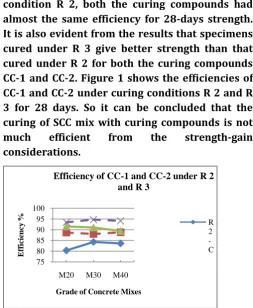
For both the curing compounds CC-1 and CC-2 the curing condition R 3 is better than R 2 for all the three normal concrete mixes. There was much difference in the efficiency of CC-1 between the curing conditions R 2 and R 3 for M20 concrete, in which R 3 giving higher value. For the curing period of 28 days, CC-2 gives the highest efficiency of 95% under curing condition R 3.
Table 5: Relative Strength Performances of M40 Concrete Mixes comparison with curing conditions with different curing compounds
Curing Condition
7 days Compressive Strength (MPa)
7 days Efficiency η (%)
28 days Compressive Strength (MPa)
28 days Efficiency η (%)
R 1 49.0 -- 57.0 --
R 2
CC-1 40.3 82.3 47.6 83.6
CC-2 41.3 84.3 51.0 89.4
R 3
CC-1 45.3 92.5 50.6 88.8
46.6 95.2 53.6 94.1
Table 6: Relative Strength Performances of M30 Concrete Mixes comparison with curing conditions with different curing compounds
Curing Condition
7 days Compressive Strength (MPa)
7 days Efficiency η (%)
28 days Compressive Strength (MPa)
28 days Efficiency η (%)
R 1 31.3 -- 44.6 --
R2
CC-1 26.6 85.1 37.6 84.3
CC-2 28.0 89.3 39.3 88.0
R 3
CC-1 28.6 91.5 40.6 91.0
30.6 97.2 42.3 94.7
Table 7: Relative Strength Performances of M20 Concrete Mixes comparison with curing conditions with different curing compounds
Curing Condition
7 days Compressive Strength (MPa)
7 days Efficiency η (%)
28 days Compressive Strength (MPa)
28 days Efficiency η (%)
R 1 25.6 -- 35.6 --
R 2
CC-1 20.0 77.9 28.6 80.3
CC-2 23.0 89.5 31.6 88.7
R 3
CC-1 22.3 86.9 32.6 91.5
24.3 94.7 33.3 93.4
© 2016, IRJET | Impact Factor value: 4.45 | ISO 9001:2008 Certified Journal | Page 2878
[image:5.595.33.287.102.411.2]condition R 2, both the curing compounds had almost the same efficiency for 28-days strength. It is also evident from the results that specimens cured under R 3 give better strength than that cured under R 2 for both the curing compounds CC-1 and CC-2. Figure 1 shows the efficiencies of CC-1 and CC-2 under curing conditions R 2 and R 3 for 28 days. So it can be concluded that the curing of SCC mix with curing compounds is not much efficient from the strength-gain considerations.
Figure 1. Efficiency of CC-1 and CC-2 under curing conditions R2 and R3 for different mixes at 28 days
4.2 Study on Durability of Concrete Mixes
Here the Rapid Chloride Penetration Test (RCPT) is used to understand the durability aspect of concrete mixes cured using different curing compounds at 28- days of age. The results from the experiments are shown in Table 8.
It is found from the results that, there is wide variation in the chloride ion penetrations (coulombs). For specimens under different curing conditions with both the curing compounds, the normal M40 concrete mix have only under moderate range (2000 to 4000) of penetrability. The M30 mix cured under all different curing conditions, cured by both curing compounds CC-1 and CC-2 have higher penetrabilities. For the M20 grade concrete, the chloride ion penetration in coulombs are much greater than 4000, and hence application of both curing compounds in different curing conditions
[image:5.595.303.566.172.349.2]does not reduce permeability and all the curing conditions fall under high penetrability range.
Table.8: Chloride Ion Penetration for different Concrete Mixes
Chloride ion penetration in coulombs
Curing Conditions
M20 M30 M40 SCC-M40
R 1 -- 6345 4567 2709 1267
R 2
CC-1 7251 5624 3752 2293
CC-2 7354 5427 3562 2154
R 3
CC-1 7133 5310 3478 2063
CC-2 6972 5122 3385 2021
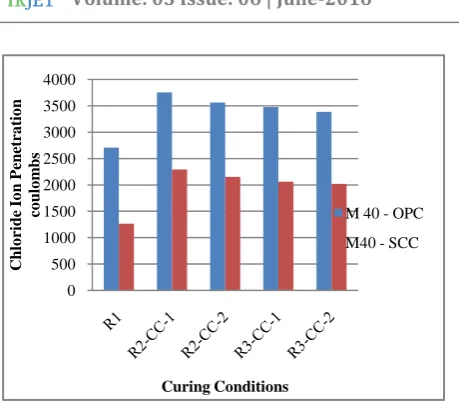
It is observed that curing of concrete done by water curing is more durable as it is shown higher resistance to chloride ion penetration and it has enhanced properties. And as the compressive strength of concrete mix increases, the RCPT value becomes less showing that higher strength concrete mix is less susceptible for chloride penetration.
From the results of RCPT of SCC-M40, it is noted that, SCC mix is more resistant to chloride ion penetration than that of M40 normal concrete mix. The chloride ion penetration in SCC mix is almost 50% of the normal M40 mix. This can be attributed due to the very dense microstructure with much improved pore-structure of concrete mix. The Self Compacting Concrete contains almost 40% of Fly ash as a mineral admixture. Figure 2 shows the comparison between chloride ion penetration results of normal mix and the SCC mix, both of M40 grade when cured under different curing conditions and cured by CC-1 and CC-2.
75 80 85 90 95 100
M20 M30 M40
E
ff
ic
ie
n
cy
%
Grade of Concrete Mixes
Efficiency of CC-1 and CC-2 under R 2 and R 3
© 2016, IRJET | Impact Factor value: 4.45 | ISO 9001:2008 Certified Journal | Page 2879
Figure 2. Chloride Ion Penetration of Normal and SCC concrete mixes
5. CONCLUSION
1. Irrespective of curing compounds employed and methodology of their application used, the water ponding method gives the higher strength and lower permeability than with curing compounds. i.e. efficiency of curing compounds as compared with wet curing is less than 100% both for strength and durability.
2. The performances of both the curing compounds are almost same. However the curing compound CC-2 performed better than CC-1 under both the curing conditions. i.e. applying the curing compounds immediately after demoulding vis-a-vis after two days of water curing. This is true for all the three normal concrete mixes- i.e. M20, M30 and M40.
3. Both the curing compounds proved less efficient for the Self Compacting Concrete mix, even lesser than for normal concrete mixes, no matter what the application method adopted was. This is found true from both strength and durability points of view.
4. As the compressive strength of mix increases the penetrability for chloride ions decreases. 5. The Chloride ion penetrability is almost 50%
less for SCC-M40 mix, compared to normal M40 mix, no matter what the curing condition may be.
REFERENCE
[1] Cable, J. K., Wang, K., and Ge, Z. (2006). “Evaluation of pavement curing effectiveness and curing effects on concrete properties.” Journal of
Materials in Civil Engineering,ASCE, Vol. 18, No. 3,
pp. 377-389.
[2] Electrical indication of concrete’s ability to resist
chloride ion penetration,C 1202-97, Annual book of
American Society for Testing and Materials, ASTM Standards, Vol. 04. pp 1910-1915. C 1202-97. [3] ACI 308R-01, (2001), “Guide to Curing Concrete.”
Detroit., American Concrete Institute. 0
500 1000 1500 2000 2500 3000 3500 4000
C
h
lo
ri
d
e
Io
n
Pe
n
et
ra
ti
o
n
co
u
lo
m
b
s
Curing Conditions
M 40 - OPC