Original Article
Association of GCKR rs780094 polymorphism with
circulating lipid levels in type 2 diabetes and
hyperuricemia in Uygur Chinese
Li Wang
1*, Qi Ma
1*, Hua Yao
1, Li-Juan He
2, Bin-Bin Fang
3, Wen Cai
4, Bei Zhang
5, Zhi-Qiang Wang
2, Yin-Xia
Su
6, Guo-Li Du
7, Shu-Xia Wang
6, Zhao-Xia Zhang
8, Qin-Qin Hou
3, Ren Cai
3, Fang-Ping He
91Key Laboratory of Xinjiang Metabolic Disease, 3Clinical Medical Research Institute, Departments of 6Cadre
Healthcare, 7Endocrinology, 8Laboratory Medicine, 9Liver Disease, The First Affiliated Hospital of Xinjiang Medical
University, Urumqi, Xinjiang, China; 2Occupational and Environmental Health, 4Department of Nursing, 5College of
Fundamental, Xinjiang Medical University, Xinjiang, China. *Equal contributors.
Received August 6, 2018; Accepted August 29, 2018; Epub September 1, 2018; Published September 15, 2018
Abstract: To investigate the relationship between a GCKR rs780094 polymorphism and lipid profiles in the Xinjiang
Uygur population in China. 980 type 2 diabetes mellitus (T2DM) patients, 1017 hyperuricemia (HUA) and 1185 healthy controls were included in this study. After genotyping of rs780094 by Sequenom Mass ARRAY system, chi-square test and logistic regression analysis were used for association analysis as well as a genotype-phenotype
analysis. We found that the serum concentration of TC (P<0.001) was significantly higher and HDL-C (P<0.001) was lower in T2DM than in control participants. Subjects with HUA had a significantly higher TG (P=0.003) and
lower HDL-C (P<0.001) than control participants. Additionally, under the recessive model, rs780094 was shown to
be associated with the risk of HUA (P=0.015, OR=1.311), particularly in males (P=0.047, OR=1.330). Subsequent
interaction analysis between rs780094 and lipid parameters showed that the TG level was positively correlated
with HUA in the rs780094- AA+AG carriers (P=0.005). The TC concentrations showed to be associated with T2DM
in the rs780094- AA+AG carriers (P<0.001). The association between lipid parameters and gender showed that
significantly higher TG levels (P<0.001) and lower HDL-C levels (P<0.001) were observed in female HUA. Higher LDL-C levels were found in male HUA (P=0.015). Moreover, statistically higher TC levels and lower HDL-C levels were found both in male and female T2DM cases (TC: male: P<0.001, female: P=0.014. HDL-C: male: P<0.001, female:
P<0.001.).To conclude, our results demonstrated that different genotypes of rs780094 had different effects on
blood lipids in HUA and T2DM patients in a Uygur population. Gender was also one of the factors influencing blood
lipid levels.
Keywords: GCKR, type 2 diabetes, hyperuricemia, dyslipidemias
Introduction
Exome-wide association study of plasma lipids
in Diabetes mellitus (DM) and hyperuricemia
(HUA) are both metabolic syndromes
character-ized by insulin resistance, dyslipidemia,
hyper-glycemia, hypertension and abdominal obesity
[1]. The prevalence of DM and HUA are
increas-ing rapidly in developincreas-ing countries due to
eco-nomic development, lifestyle changes, and an
increasingly aging population. These diseases
also contribute to a considerably increased
all-cause mortality, cardiovascular risk, and
ath-erosclerotic burden. They not only have a
were associated with the development of
ath-erosclerosis and cardiovascular disease [6, 7].
In order to investigate metabolic risk factors
such as dyslipidemia, it is of particular interest
to cluster genetic loci that have been linked to
metabolic traits.
Glucokinase (GCK), expressed in the liver and
in pancreatic beta cells, encodes the key
enzyme for the first rate-limiting step of glycoly
-sis, regulating glucose balance and
glucose-stimulated insulin secretion [8]. GCK activity is
controlled by the glucokinase regulatory
pro-tein (GCRP), which binds to GCK. Its inhibitory
effect is enhanced by fructose 6-phosphate
and antagonized by fructose 1-phosphate. The
glucokinase regulator gene (
GCKR
) encodes
GKRP. The most commonly reported SNP in
GCKR
, rs780094, has been shown by GWAS
studies to be associated with insulin levels[9],
fasting glucose [9, 10], triglycerides (TG) [11],
uric acid [12] and susceptibility to type 2 DM
(T2DM) [13-15] and HUA [16]. In the European
population associations between rs780094
A-allele and either lower fasting blood glucose
(FPG) levels, less insulin resistance, higher
fasting serum TG levels or a lower risk of T2DM
have been confirmed [9, 17]. A meta-analysis
proved that rs780094 had an association with
the opposite effects on fasting TG levels and
FPG by analyzing Caucasians, African Ame-
ricans, Hispanics, Asian Indians, Chinese and
Malays and with a decreased risk of T2DM in
European populations [18]. In a Japanese stu-
dy, a significant association of the A allele of
GCKR
rs780094 with increased fasting TG
lev-els, decreased FPG and a reduced risk of T2DM
were reported [13]. A significant association of
rs780094 with uric acid and triglycerides
con-centrations was confirmed in a European [19]
and Han Chinese male [20] study. It is of
inter-est to study metabolic risk factors in
popula-tions with high prevalence of T2DM and me-
tabolic syndrome. However, the association
between rs780094 and lipid traits remained
unclear among individuals with T2DM or HUA.
[image:2.612.92.523.84.209.2]The Uygur population, accounting for 46% of
the population of the Xinjiang Uygur Autonomous
Table 1.
Characteristics of study participants
Characteristics Control (1185) T2DM (980) HUA (1017) P P (C/T2DM) P (C/HUA) P (T2DM/HUA)
Age (years) 47.08±11.65 51.16±9.70 46.83±12.15 <0.001* <0.001* 0.942 <0.001*
Males/females 764/421 614/366 628/389 0.400 - -
-BMI (kg/m2) 27.23±2.65 27.59±3.67 27.68±4.85 0.005* 0.030* 0.027* 0.961
FBG (mmol/L) 4.93±0.54 9.52±3.26 4.98±0.67 <0.001* <0.001* 0.142 <0.001*
UA (mmol/L) 281.76±68.82 271.17±70.19 473.34±93.28 <0.001* 0.001* <0.001* <0.001*
TG (mmol/L) 2.32±2.00 2.42±1.98 2.58±1.66 0.004* 0.588 0.003* 0.149
TC (mmol/L) 4.22±1.70 4.65±1.53 4.26±1.64 <0.001* <0.001* 0.916 <0.001*
HDL-C (mmol/L) 1.23±0.31 0.97±0.31 1.00±0.34 <0.001* <0.001* <0.001* 0.348
LDL-C (mmol/L) 2.78±0.61 2.85±0.82 2.84±0.60 0.022* 0.055 0.070 0.949
Continuous variable are expressed as mean ± standard deviation. The P-value of continuous variables was calculated by one-way ANOVA among
three groups. The P-value of the two-two comparisons was calculated by a post-hoc multiple comparisons test. *P<0.05.
Table 2.
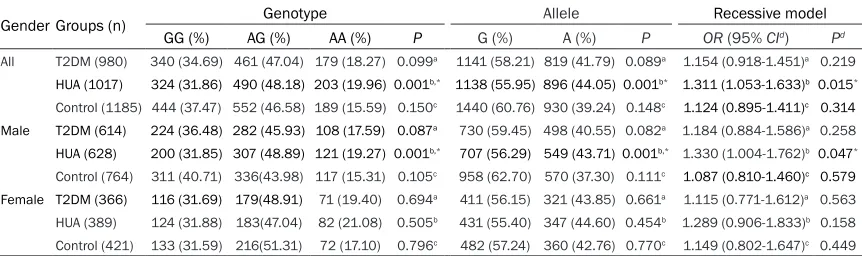
Genotype and allele distributions of rs780094 among the study participants
Gender Groups (n) Genotype Allele Recessive model
GG (%) AG (%) AA (%) P G (%) A (%) P OR (95% CId) Pd
All T2DM (980) 340 (34.69) 461 (47.04) 179 (18.27) 0.099a 1141 (58.21) 819 (41.79) 0.089a 1.154 (0.918-1.451)a 0.219
HUA (1017) 324 (31.86) 490 (48.18) 203 (19.96) 0.001b,* 1138 (55.95) 896 (44.05) 0.001b* 1.311 (1.053-1.633)b 0.015*
Control (1185) 444 (37.47) 552 (46.58) 189 (15.59) 0.150c 1440 (60.76) 930 (39.24) 0.148c 1.124 (0.895-1.411)c 0.314
Male T2DM (614) 224 (36.48) 282 (45.93) 108 (17.59) 0.087a 730 (59.45) 498 (40.55) 0.082a 1.184 (0.884-1.586)a 0.258
HUA (628) 200 (31.85) 307 (48.89) 121 (19.27) 0.001b,* 707 (56.29) 549 (43.71) 0.001b,* 1.330 (1.004-1.762)b 0.047*
Control (764) 311 (40.71) 336(43.98) 117 (15.31) 0.105c 958 (62.70) 570 (37.30) 0.111c 1.087 (0.810-1.460)c 0.579
Female T2DM (366) 116 (31.69) 179(48.91) 71 (19.40) 0.694a 411 (56.15) 321 (43.85) 0.661a 1.115 (0.771-1.612)a 0.563
HUA (389) 124 (31.88) 183(47.04) 82 (21.08) 0.505b 431 (55.40) 347 (44.60) 0.454b 1.289 (0.906-1.833)b 0.158
Control (421) 133 (31.59) 216(51.31) 72 (17.10) 0.796c 482 (57.24) 360 (42.76) 0.770c 1.149 (0.802-1.647)c 0.449 OR, odds ratio; 95% CI, 95% confidence interval. The frequency of genotypes and alleles are presented as a percentage. The distributions of genotypes are all within HWE. The P value of categorical variable was calculated by the chi-square test. The P value of the association of rs780094 was calculated by the logistic regression analysis.
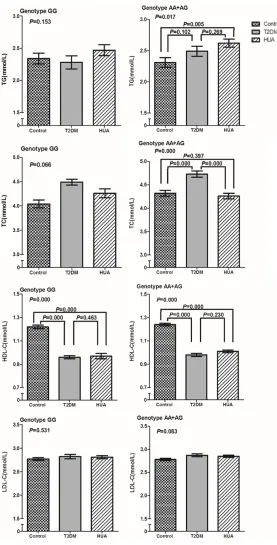
[image:2.612.91.522.264.392.2]Figure 1. The comparison of lipid parameters among participants with dif-ferent genotypes of rs780094. P values were adjusted by age, sex and BMI.
Region of China, originates from a two-way ad-
mixture between Caucasians (42.6%) and Asi-
ans (57.4%) [21]. Because migration is rare, the
Uyghur are an ideal population in which to
dis-cover genetic factors for multifactorial
diseas-es such as T2DM and HUA. This study was
con-ducted to investigate the
association between the
GC-
KR
polymorphism rs780094
with lipid profile in T2DM
cases, HUA cases and healthy
controls from the Uygur region
of China.
Materials and methods
Study subjects
All 3182 subjects, aged 18-76
years old, were recruited for
this study from the Xinjiang
Uygur Autonomous Region of
China. Among them, 980
sub-jects were diagnosed with
T2DM without HUA and 1017
subjects were diagnosed with
HUA without T2DM at the First
Affiliated Hospital of Xinjiang
Medical University between
January 2012 and December
2013. T2DM was defined
us-ing the American Diabetes
Association 2009 criteria [22]
(fasting plasma glucose ≥ 7.0
mmol/L (≥ 126 mg/dL)) or as
self-reported current diabetes
treatments via a survey. HUA
was defined as serum uric
acid (SUA) ≥ 416 mmol/L (7
mg/dl, males) or SUA ≥ 357
mmol/L (6 mg/dl, females),
which are widely accepted di-
agnostic criteria
[23].
The 1185 healthy controls
were randomly selected from
participants in a health exa-
mination by the First
Affiliat-ed Hospital of Xinjiang MAffiliat-edi-
cal University. Control
partici-pants had no personal or fa-
milial history of T2DM, HUA or
any other serious illness. Par-
ticipants with known systemic
diseases, including DM,
hyper-tension, cardiovascular disea-
se, renal or liver disease, gastrointestinal
dis-ease, pulmonary disease or cancer were ex-
cluded.
col-lect
demographic characteristics (age, gender,
etc.). Body weight and height were measured
with subjects wearing light indoor clothing and
[image:4.612.92.374.69.643.2]GCCCGGCCTCAACAAATGTAT. The SNP passed
quality control criteria with a genotyping call
rates > 90%.
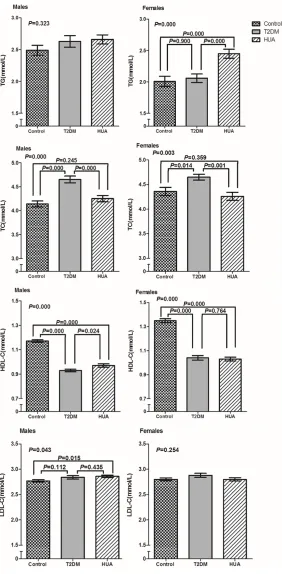
Figure 2. The comparison of lipid parameters among participants according to gender. P values were adjusted by age and BMI.
barefoot. Body mass index
was calculated as the
sub-ject’s weight (kg) divided by
the square of the subject’s
height (m
2). Waist
circumfer-ence was measured midway
between the lower rib and iliac
crest. For clinical chemistry
assays, serum was separated
from peripheral venous blood
samples obtained from each
participant after a 12-hour
fast and stored at -70°C.
Blood was drawn from the
antecubital vein of the arm.
The blood samples were
drawn for biochemical
mea-surements including FBG, UA,
total cholesterol (TC), TG, hi-
gh-density lipoprotein
choles-terol (HDL-C) and low-density
lipoprotein cholesterol (LDL-C)
in accordance with the
proce-dures recommended by the
Clinical Laboratory Depart-
ment of the First Affiliated
Hospital of Xinjiang Medical
University. This study was
approved by the Ethics Com-
mittee of the First Affiliated
Hospital of Xinjiang Medical
University.
Single-nucleotide
polymor-phism genotyping
Statistical analyses
In this study, statistical analyses were
per-formed with the Statistical Package for Social
Sciences version 16.0 (SPSS Inc., Chicago, IL,
USA). Continuous variables are expressed as
mean ± standard deviation and were analyzed
by one-way ANOVA. The chi-square test was
used in the comparison of the rate of genotype
and allele distributions among the study
partici-pants. For all cases and controls, the
Hardy-Weinberg equilibrium (HWE) of the genotype
distribution was tested using the homogeneity
χ
2test. Logistic regression analysis was carried
out to study the effect of the odds ratio (OR)
and 95% confidence intervals (95% CIs).
P-
values of <0.05 were considered statistically
significant.
Results
Characteristics of the study population
Table 1
shows the baseline characteristics of
the T2DM, HUA and control subjects in the
Uygur population. There were differences in the
serum concentration of TG (
P=
0.004), TC
(
P
<0.001), HDL-C (
P
<0.001) and LDL-C (
P=
0.022) among the T2DM, HUA and control
groups. Subjects with T2DM had a significantly
higher TC (
P
<0.001) and lower HDL-C (
P
<
0.001) than control participants. Subjects with
HUA had a significantly higher TG (
P=
0.003)
and lower HDL-C (
P
<0.001) than control
partici-pants. The serum concentration of TC in T2DM
patients was higher (
P
<0.001) compared with
HUA patients.
Distribution of rs780094 among HUA, T2DM
patients and controls
Table 2
shows the distribution of genotypes
and alleles of GCKR rs780094. This SNP
con-formed to HWE in all groups (data not shown).
The frequencies of the GG, AG and AA
geno-types were 37.47%, 46.58% and 15.59%
respectively, among the controls. Meanwhile,
they were 34.69%, 47.04% and 18.27%
respec-tively, in the T2DM group, and 31.86%, 48.18%
and 19.96 % respectively, in the HUA group.
The distribution of rs780094 genotypes and
alleles showed a statistical difference only
between the HUA patients and control
partici-pants (
P=
0.001 and
P=
0.001 respectively). A
further analysis by gender were observed a
sig-nificant difference between patients with HUA
and control participants (
P=
0.001 and
P=
0.001
respectively) in male genotypes and alleles
only.
After adjusting for sex and age, rs780094 was
found to be associated with HUA under a re-
cessive model (
P=
0.015, OR=1.311, 95% CI=
1.053-1.633). Additionally, significant differ
-ence was found in male groups under the
recessive model (
P=
0.047, OR=1.330, 95%
CI=1.004-1.762) between HUA group and
controls.
Figure 1
shows a comparison of the lipid pa-
rameters among participants with different
rs780094 genotypes. The level of TG was
asso-ciated with the risk of HUA in genotype AA+AG
(
P=
0.005) compared to the control group. The
TC concentrations showed statistical
differenc-es with genotype AA+AG between T2DM casdifferenc-es
(
P
<0.001) and the control group, and between
HUA cases (
P=
0.000) and T2DM cases. The
level of HDL-C showed statistical associations
between T2DM and the control group with
gen-otype GG (
P
<0.001) and AA+AG (
P
<0.001).
Additionally, the significant differences were
also found between HUA and the control group
with genotype GG (
P
<0.001) and AA+AG (
P
<
0.001).
Association of lipid parameters with HUA and
T2DM in different gender groups
Figure 2
shows the association of lipid
param-eters with metabolic syndromes in different
gender groups. The TG levels in HUA cases
were significantly higher than controls (
P
<
0.001) and T2DM cases (
P
<0.001) in the fe-
male group. Moreover, the TC levels in T2DM
cases were statistically higher than controls
(
P
<0.001) and HUA cases (
P
<0.001) in males.
A higher level of TC was also found in femal-
es with T2DM cases compared to controls
(
P=
0.014) and HUA cases (
P=
0.001). How-
ever, the level of HDL-C was lower in HUA
(
P
<0.001,
P
<0.001) and T2DM cases (
P
<
0.001,
P
<0.001) compared to controls in both
males and females. Additionally, the LDL-C
lev-els was higher in HUA cases (
P=
0.015)
com-pared to controls in males.
Discussion
factors for various tumors [24] and vascular
dis-eases [25]. In addition it is well established that
T2DM and HUA are more likely to be
dyslipid-emia than the general population. The
coexis-tence of lipid abnormalities and T2DM or HUA
can farther increase the risk of cardiovascular
disease. Dyslipidemia in patients with T2DM
were characterized as high TG, low LDL-C [26],
TC as well as HDL-C concentration [27]. A recent
study revealed that TG was the best lipid index
related to HUA [28]. However there are conflict
-ing data about the role of s-ingle lipid species in
HUA. The relationship between lipids and T2DM
or HUA varied in different populations. In this
study, we observed that the concentrations of
TC were significantly associated with T2DM.
Following TC, the lower HDL-C levels were
asso-ciated with T2DM. Additionally, HUA patients
were characterized as higher serum
concentra-tions of TG and lower HDL-C in our study.
The
GCKR
rs780094 has been shown to be
associated with several circulating lipid
concen-trations in various diseases among different
ethnic populations. The association between
the A allele of rs780094 and higher levels of TG
were reported in Europeans [17], Han Chinese
populations [29], the Japanese population [13]
and the Sri Lankan population [30]. Hadarits
et
al
[31] stratified metabolic syndrome patients
into four quartile groups according to the
avail-able TG values. They found that the frequency
of the homozygote minor allele (AA) of rs780094
was higher in q4 (q4 represented TG > 2.83
mmol/L), but allele frequencies showed no
fur-ther significant differences in different groups.
Additionally, the minor A-allele of rs780094
was shown to be associated with an increased
level of TG, a minor elevation of total fasting
serum TC, World Health Organization-defined
dyslipidemia and a modestly decreased risk of
T2DM in Danes [9]. Mohas
et al
[11] also found
that the minor allele (A) of rs780094 was
asso-ciated with elevated serum TG levels in Hun-
garian subjects with T2DM and metabolic
syn-drome. Hishida
et al
[32] showed that
haplo-types containing the G allele of rs780094 were
significantly associated with a reduced risk of
dyslipidemia (TG ≥ 150 mg/dL and/or HDL-C
<40 mg/dL) with an OR of 0.88 (95%
CI=0.81-0.95) in the Japan Multi-Institutional Coll-
aborative Cohort Study, but TG and HDL-C
lev-els were not significantly associated with
rs-780094. Lee
et al
[33] showed that major allele
(AA) carriers of rs780094 had significantly
higher TC and TG levels in Korean adults and
higher TC and LDL-C levels in Korean children
after adjustment for age, sex, and body mass
index. Qi,
et al
[29] showed that the
rs780094-A allele was highly associated with higher levels
of TC and increased risk of dyslipidemia under
either an additive or dominant model in Han
Chinese individuals. These studies
demon-strate that both the frequency and function of
this SNP differs among different populations.
Our results suggested that the recessive
mo-del of rs780094 polymorphism appeared to
show an increased risk of HUA in Uygur male
population. Additionally, HUA patients with rs-
780094-AA+AG were associated with higher
concentrations of the TG levels. And T2DM
patients with rs780094-AA+AG were
associat-ed with higher concentrations of the TC levels.
Our results showed that
GCKR
not only affects
blood glucose and uric acid levels, but is also
associated with lipid levels. To the best of our
knowledge, this is the first study aiming to
investigate the association between rs780094
and lipid profile among T2DM cases, HUA cases
and healthy controls in the Uygur population of
China.
The importance of sexual dimorphisms
includ-ing both sexes in clinical trials and basic
research has been emphasized recently. Un-
derstanding how and why metabolic processes
differ by sex will enable clinicians to target and
individualized therapies based on gender. In
addition to sex hormone, the particular genetic
variants in metabolism-related genes also have
an effect on sex-specific metabolism [34]. A
previous study has found that men have signifi
-cantly higher TG, LDL-C, and lower HDL-C
com-pared to women in Beijing, China [35]. Another
study has found that males have lower levels of
TC, LDL-C, and HDL-C than females in
Ethiopian-American adults [36]. In this study, we observed
that TG levels were significantly higher in HUA
females cases, LDL-C levels was higher in HUA
male cases. However, TC levels were signifi
-cantly higher in T2DM cases both in males and
females. HDL-C levels were lower in HUA and
T2DM cases both in males and females.
envi-ronmental confounders and increases the
abil-ity to discover genetic effects. Secondly, the
sample size was relatively small and might not
be sufficient to discover an association for a
variant with only moderate or minor effects on
lipid concentrations. Thirdly, we only assessed
one SNP for its relationship with T2DM and
HUA. Other genetic polymorphisms in
GCKR
might play an important role. Therefore, further
studies utilizing a larger sample size with other
common and rare alleles are required.
In conclusion, this case-control study shows
that rs780094 displays an association with
HUA risk in Uygur Chinese males. The genotype
of rs780094-AA+AG showed significant interac
-tion with the concentra-tions of TG levels in HUA
patients. The TC levels were higher for the
rs780094-AA+AG genotypes than for carriers
of the GG genotypes in T2DM patients. It
showed that the TG and LDL-C levels were
affected by HUA in Uygur population.
Acknowledgements
This work was supported by the grants from
the Natural Science Foundation of Xinjiang
(2016D01C335). Authors thank all the
partici-pants for their contribution in this study. They
are grateful to Dr. Renyong Lin, at State Key
Laboratory Incubation Base of Xinjiang Major
Diseases Research, for his support on this
study.
Disclosure of conflict of interest
None.
Address correspondence to: Dr. Hua Yao, Key Laboratory of Xinjiang Metabolic Disease, Clinical
Medical Research Institute, The First Affiliated
Hospital of Xinjiang Medical University, 137 Liyu Mountain Road, Urumqi, Xinjiang, China. Tel: (+86) 13999180161; E-mail: [email protected]
References
[1] Song R, Peng W, Zhang Y, Lv F, Wu HK, Guo J, Cao Y, Pi Y, Zhang X, Jin L, Zhang M, Jiang P, Liu F, Meng S, Zhang X, Jiang P, Cao CM and Xiao RP. Central role of E3 ubiquitin ligase MG53 in insulin resistance and metabolic disorders. Nature 2013; 494: 375-379.
[2] Sladek R, Rocheleau G, Rung J, Dina C, Shen L,
Serre D, Boutin P, Vincent D, Belisle A, Hadjadj
S, Balkau B, Heude B, Charpentier G, Hudson
TJ, Montpetit A, Pshezhetsky AV, Prentki M,
Posner BI, Balding DJ, Meyre D, Polychronakos C and Froguel P. A genome-wide association
study identifies novel risk loci for type 2 diabe -tes. Nature 2007; 445: 881-885.
[3] Kottgen A, Albrecht E, Teumer A, Vitart V, Krum -siek J, Hundertmark C, Pistis G, Ruggiero D,
O’Seaghdha CM, Haller T, Yang Q, Tanaka T, Johnson AD, Kutalik Z, Smith AV, Shi J,
Struchalin M, Middelberg RP, Brown MJ, Gaffo AL, Pirastu N, Li G, Hayward C, Zemunik T, Huff-man J, Yengo L, Zhao JH, Demirkan A, Feitosa MF, Liu X, Malerba G, Lopez LM, van der Harst P, Li X, Kleber ME, Hicks AA, Nolte IM, Johans-son A, Murgia F, Wild SH, Bakker SJ, Peden JF,
Dehghan A, Steri M, Tenesa A, Lagou V, Salo P,
Mangino M, Rose LM, Lehtimaki T, Woodward
OM, Okada Y, Tin A, Muller C, Oldmeadow C,
Putku M, Czamara D, Kraft P, Frogheri L, Thun GA, Grotevendt A, Gislason GK, Harris TB, Launer LJ, McArdle P, Shuldiner AR, Boerwin-kle E, Coresh J, Schmidt H, Schallert M, Martin NG, Montgomery GW, Kubo M, Nakamura Y, Tanaka T, Munroe PB, Samani NJ, Jacobs DR, Jr., Liu K, D’Adamo P, Ulivi S, Rotter JI, Psaty
BM, Vollenweider P, Waeber G, Campbell S, Devuyst O, Navarro P, Kolcic I, Hastie N, Balkau
B, Froguel P, Esko T, Salumets A, Khaw KT, Lan-genberg C, Wareham NJ, Isaacs A, Kraja A,
Zhang Q, Wild PS, Scott RJ, Holliday EG, Org E, Viigimaa M, Bandinelli S, Metter JE, Lupo A,
Trabetti E, Sorice R, Doring A, Lattka E, Strauch K, Theis F, Waldenberger M, Wichmann HE, Davies G, Gow AJ, Bruinenberg M, LifeLines Cohort S, Stolk RP, Kooner JS, Zhang W,
Win-kelmann BR, Boehm BO, Lucae S, Penninx BW,
Smit JH, Curhan G, Mudgal P, Plenge RM, Por-tas L, Persico I, Kirin M, Wilson JF, Mateo Leach
I, van Gilst WH, Goel A, Ongen H, Hofman A,
Rivadeneira F, Uitterlinden AG, Imboden M, von Eckardstein A, Cucca F, Nagaraja R, Piras MG, Nauck M, Schurmann C, Budde K, Ernst F, Farrington SM, Theodoratou E, Prokopenko I,
Stumvoll M, Jula A, Perola M, Salomaa V, Shin
SY, Spector TD, Sala C, Ridker PM, Kahonen M,
Viikari J, Hengstenberg C, Nelson CP, Consor -tium CA, tium D, tium I, Consor-tium M, Meschia JF, Nalls MA, Sharma P, Sin-gleton AB, Kamatani N, Zeller T, Burnier M, Attia J, Laan M, Klopp N, Hillege HL, Kloiber S, Choi H, Pirastu M, Tore S, Probst-Hensch NM,
Volzke H, Gudnason V, Parsa A, Schmidt R, Whitfield JB, Fornage M, Gasparini P, Siscovick DS, Polasek O, Campbell H, Rudan I,
Schipf S, Dunlop MG, Tonjes A, Ripatti S, Soranzo N, Toniolo D, Chasman DI, Raitakari
O, Kao WH, Ciullo M, Fox CS, Caulfield M, Bo -chud M and Gieger C. Genome-wide associa-tion analyses identify 18 new loci associated with serum urate concentrations. Nat Genet 2013; 45: 145-154.
[4] Sandhu MS, Waterworth DM, Debenham SL, Wheeler E, Papadakis K, Zhao JH, Song K, Yuan X, Johnson T, Ashford S, Inouye M, Luben R, Sims M, Hadley D, McArdle W, Barter P, Ke-saniemi YA, Mahley RW, McPherson R, Grundy SM, Wellcome Trust Case Control C, Bingham SA, Khaw KT, Loos RJ, Waeber G, Barroso I,
Strachan DP, Deloukas P, Vollenweider P, Wareham NJ and Mooser V. LDL-cholesterol
concentrations: a genome-wide association study. Lancet 2008; 371: 483-491.
[5] Liu DJ, Peloso GM, Yu H4, Butterworth AS, Wang X, Mahajan A, Saleheen D, Emdin C, Alam D, Alves AC, Amouyel P, Di Angelantonio E, Arveiler D, Assimes TL, Auer PL, Baber U, Ballantyne CM, Bang LE, Benn M, Bis JC, Boehnke M, Boerwinkle E, Bork-Jensen J, Bot-tinger EP, Brandslund I, Brown M, Busonero F,
Caulfield MJ, Chambers JC, Chasman DI, Chen
YE, Chen YI, Chowdhury R, Christensen C, Chu AY, Connell JM, Cucca F, Cupples LA, Damrauer SM, Davies G, Deary IJ, Dedoussis G, Denny JC, Dominiczak A, Dubé MP, Ebeling T, Eiriks-dottir G, Esko T, Farmaki AE, Feitosa MF, Fer-rario M, Ferrieres J, Ford I, Fornage M, Franks PW, Frayling TM, Frikke-Schmidt R, Fritsche LG,
Frossard P, Fuster V, Ganesh SK, Gao W, Gar
-cia ME, Gieger C, Giulianini F, Goodarzi MO,
Grallert H, Grarup N, Groop L, Grove ML,
Gud-nason V, Hansen T, Harris TB, Hayward C, Hirschhorn JN, Holmen OL, Huffman J, Huo Y,
Hveem K, Jabeen S, Jackson AU, Jakobsdottir J, Jarvelin MR, Jensen GB, Jørgensen ME, Jukema JW, Justesen JM, Kamstrup PR,
Kanoni S, Karpe F, Kee F, Khera AV, Klarin D,
Koistinen HA, Kooner JS, Kooperberg C, Kuu-lasmaa K, Kuusisto J, Laakso M, Lakka T, Lan-genberg C, Langsted A, Launer LJ, Lauritzen T, Liewald DCM, Lin LA, Linneberg A, Loos RJF, Lu Y, Lu X, Mägi R, Malarstig A, Manichaikul A, Manning AK, Mäntyselkä P, Marouli E, Masca
NGD, Maschio A, Meigs JB, Melander O,
Metspalu A, Morris AP, Morrison AC, Mulas A, Müller-Nurasyid M, Munroe PB, Neville MJ,
Nielsen JB, Nielsen SF, Nordestgaard BG, Or
-dovas JM, Mehran R, O’Donnell CJ, Orho-Me -lander M, Molony CM, Muntendam P, Padma-nabhan S, Palmer CNA, Pasko D, Patel AP,
Pedersen O, Perola M, Peters A, Pisinger C, Pistis G, Polasek O, Poulter N, Psaty BM, Rader
DJ, Rasheed A, Rauramaa R, Reilly DF, Reiner AP, Renström F, Rich SS, Ridker PM, Rioux JD,
Robertson NR, Roden DM, Rotter JI, Rudan I,
Salomaa V, Samani NJ, Sanna S, Sattar N,
Schmidt EM, Scott RA, Sever P, Sevilla RS, Shaffer CM, Sim X, Sivapalaratnam S, Small
KS, Smith AV, Smith BH, Somayajula S, South -am L, Spector TD, Speliotes EK, Starr JM, Stir-rups KE, Stitziel N, Strauch K, Stringham HM, Surendran P, Tada H, Tall AR, Tang H, Tardif JC, Taylor KD, Trompet S, Tsao PS, Tuomilehto J,
Tybjaerg-Hansen A, van Zuydam NR, Varbo A, Varga TV, Virtamo J, Waldenberger M, Wang N,
Wareham NJ, Warren HR, Weeke PE, Wein-stock J, Wessel J, Wilson JG, Wilson PWF, Xu M, Yaghootkar H, Young R, Zeggini E, Zhang H, Zheng NS, Zhang W, Zhang Y, Zhou W, Zhou Y, Zoledziewska M; Charge Diabetes Working
Group; EPIC-InterAct Consortium; EPIC-CVD Consortium; GOLD Consortium; VA Million Vet -eran Program, Howson JMM, Danesh J, McCar-thy MI, Cowan CA, Abecasis G, Deloukas P, Mu-sunuru K, Willer CJ, Kathiresan S. Exome- wide association study of plasma lipids in > 300,000 individuals. Nature Genetics 2017; 49: 1758-1766.
[6] Nieves DJ, Cnop M, Retzlaff B, Walden CE, Brunzell JD, Knopp RH and Kahn SE. The
ath-erogenic lipoprotein profile associated with
obesity and insulin resistance is largely attrib-utable to intra-abdominal fat. Diabetes 2003; 52: 172-179.
[7] Ellman N, Keswell D, Collins M, Tootla M and Goedecke JH. Ethnic differences in the associ-ation between lipid metabolism genes and lip-id levels in black and white south african wom-en. Atherosclerosis 2015; 240: 311-317. [8] de la Iglesia N, Mukhtar M, Seoane J,
Guin-ovart JJ and Agius L. The role of the regulatory protein of glucokinase in the glucose sensory mechanism of the hepatocyte. J Biol Chem 2000; 275: 10597-10603.
[9] Sparso T, Andersen G, Nielsen T, Burgdorf KS, Gjesing AP, Nielsen AL, Albrechtsen A, Ras-mussen SS, Jorgensen T, Borch-Johnsen K, Sandbaek A, Lauritzen T, Madsbad S, Hansen
T and Pedersen O. The GCKR rs780094 poly -morphism is associated with elevated fasting serum triacylglycerol, reduced fasting and
OGTT-related insulinaemia, and reduced risk
of type 2 diabetes. Diabetologia 2008; 51: 70-75.
[10] Dupuis J, Langenberg C, Prokopenko I, Saxena R, Soranzo N, Jackson AU, Wheeler E, Glazer NL, Bouatia-Naji N, Gloyn AL, Lindgren CM, Magi R, Morris AP, Randall J, Johnson T, Elliott
P, Rybin D, Thorleifsson G, Steinthorsdottir V,
Henneman P, Grallert H, Dehghan A, Hottenga JJ, Franklin CS, Navarro P, Song K, Goel A, Per-ry JR, Egan JM, Lajunen T, Grarup N, Sparso T,
Kanoni S, Shrader P, Cavalcanti-Proenca C, Ku-mari M, Qi L, Timpson NJ, Gieger C, Zabena C,
Rocheleau G, Ingelsson E, An P, O’Connell J,
Luan J, Elliott A, McCarroll SA, Payne F, Rocca-secca RM, Pattou F, Sethupathy P, Ardlie K, Ariyurek Y, Balkau B, Barter P, Beilby JP, Ben-Shlomo Y, Benediktsson R, Bennett AJ, Berg-mann S, Bochud M, Boerwinkle E, Bonnefond A, Bonnycastle LL, Borch-Johnsen K, Bottcher Y, Brunner E, Bumpstead SJ, Charpentier G, Chen YD, Chines P, Clarke R, Coin LJ, Cooper MN, Cornelis M, Crawford G, Crisponi L, Day IN, de Geus EJ, Delplanque J, Dina C, Erdos MR, Fedson AC, Fischer-Rosinsky A, Forouhi NG, Fox CS, Frants R, Franzosi MG, Galan P,
Goodarzi MO, Graessler J, Groves CJ, Grundy S,
Gwilliam R, Gyllensten U, Hadjadj S, Hallmans G, Hammond N, Han X, Hartikainen AL, Has-sanali N, Hayward C, Heath SC, Hercberg S, Herder C, Hicks AA, Hillman DR, Hingorani AD, Hofman A, Hui J, Hung J, Isomaa B, Johnson PR, Jorgensen T, Jula A, Kaakinen M, Kaprio J, Kesaniemi YA, Kivimaki M, Knight B, Koskinen
S, Kovacs P, Kyvik KO, Lathrop GM, Lawlor DA, Le Bacquer O, Lecoeur C, Li Y, Lyssenko V,
Mahley R, Mangino M, Manning AK, Martinez-Larrad MT, McAteer JB, McCulloch LJ, McPher-son R, Meisinger C, Melzer D, Meyre D, Mitch-ell BD, Morken MA, Mukherjee S, Naitza S,
Narisu N, Neville MJ, Oostra BA, Orru M, Pakyz
R, Palmer CN, Paolisso G, Pattaro C, Pearson D, Peden JF, Pedersen NL, Perola M, Pfeiffer
AF, Pichler I, Polasek O, Posthuma D, Potter SC,
Pouta A, Province MA, Psaty BM, Rathmann W, Rayner NW, Rice K, Ripatti S, Rivadeneira F,
Roden M, Rolandsson O, Sandbaek A, Sandhu
M, Sanna S, Sayer AA, Scheet P, Scott LJ, Seed-orf U, Sharp SJ, Shields B, Sigurethsson G, Sij-brands EJ, Silveira A, Simpson L, Singleton A, Smith NL, Sovio U, Swift A, Syddall H, Syvanen AC, Tanaka T, Thorand B, Tichet J, Tonjes A, Tuomi T, Uitterlinden AG, van Dijk KW, van
Hoek M, Varma D, Visvikis-Siest S, Vitart V, Vo -gelzangs N, Waeber G, Wagner PJ, Walley A, Walters GB, Ward KL, Watkins H, Weedon MN, Wild SH, Willemsen G, Witteman JC, Yarnell JW, Zeggini E, Zelenika D, Zethelius B, Zhai G, Zhao JH, Zillikens MC, Consortium D, Consor-tium G, Global BC, Borecki IB, Loos RJ, Mene-ton P, Magnusson PK, Nathan DM, Williams
GH, Hattersley AT, Silander K, Salomaa V,
Smith GD, Bornstein SR, Schwarz P, Spranger J, Karpe F, Shuldiner AR, Cooper C, Dedoussis
GV, Serrano-Rios M, Morris AD, Lind L, Palmer
LJ, Hu FB, Franks PW, Ebrahim S, Marmot M, Kao WH, Pankow JS, Sampson MJ, Kuusisto J,
Laakso M, Hansen T, Pedersen O, Pramstaller
PP, Wichmann HE, Illig T, Rudan I, Wright AF, Stumvoll M, Campbell H, Wilson JF, Anders
Hamsten on behalf of Procardis C, investiga-tors M, Bergman RN, Buchanan TA, Collins FS,
Mohlke KL, Tuomilehto J, Valle TT, Altshuler D,
Rotter JI, Siscovick DS, Penninx BW, Boomsma DI, Deloukas P, Spector TD, Frayling TM, Fer-rucci L, Kong A, Thorsteinsdottir U, Stefansson K, van Duijn CM, Aulchenko YS, Cao A, Scuteri A, Schlessinger D, Uda M, Ruokonen A,
Jarve-lin MR, Waterworth DM, Vollenweider P, Pel
-tonen L, Mooser V, Abecasis GR, Wareham NJ,
Sladek R, Froguel P, Watanabe RM, Meigs JB, Groop L, Boehnke M, McCarthy MI, Florez JC and Barroso I. New genetic loci implicated in fasting glucose homeostasis and their impact on type 2 diabetes risk. Nat Genet 2010; 42: 105-116.
[11] Mohas M, Kisfali P, Jaromi L, Maasz A, Feher E,
Csongei V, Polgar N, Safrany E, Cseh J, Sumegi
K, Hetyesy K, Wittmann I and Melegh B. GCKR gene functional variants in type 2 diabetes and metabolic syndrome: do the rare variants as-sociate with increased carotid intima-media thickness? Cardiovasc Diabetol 2010; 9: 79. [12] Gunnarsdottir KA, Jensen MB, Zahrieh D,
Gel-ber RD, Knoop A, Bonetti M, Mouridsen H and Ejlertsen B. CEF is superior to CMF for tumours
with TOP2A aberrations: a subpopulation treat -ment effect pattern plot (STEPP) analysis on danish breast cancer cooperative group study 89D. Breast Cancer Res Treat 2010; 123: 163-169.
[13] Onuma H, Tabara Y, Kawamoto R, Shimizu I, Kawamura R, Takata Y, Nishida W, Ohashi J, Miki T, Kohara K, Makino H and Osawa H. The
GCKR rs780094 polymorphism is associated with susceptibility of type 2 diabetes, reduced fasting plasma glucose levels, increased
tri-glycerides levels and lower HOMA-IR in Japa -nese population. J Hum Genet 2010; 55: 600-604.
[14] Ma Q, Wang L, Yao H, Zhu J, Wang S, Zhang X, Wang T, Ma Y, Su Y, Wang Z, Ding L. Association of GCKR gene polymorphisms and type 2 dia-betes among ethnic Uygurs. Chin J Med Genet 2016; 33: 532-536.
[15] Zhou W LY, Zhang L, Shi Y, Wang C, Zhang D, Liu X, Mao Z, Li L. Gene-gene interactions lead to higher risk for development of type 2 diabe-tes in a Chinese Han population: a prospective nested case-control study. Lipids Health Dis 2018; 17: 179.
[16] Wang Li MQ, Su YY, Wang ZQ, Mai LMGL, Fang BB, Hou QQ, Yao H. Association of GCKR gene rs780094 polymorphism with hyperuricemia in Uygur in Xinjiang. Chin J Endocrinol Metab 2016; 32: 281-285.
Sax-ena R, Voight BF, Lyssenko V, Burtt NP, de Bak -ker PI, Chen H, Roix JJ, Kathiresan S, Hirschhorn JN, Daly MJ, Hughes TE, Groop L, Altshuler D, Almgren P, Florez JC, Meyer J, Ard-lie K, Bengtsson Boström K, Isomaa B, Lettre
G, Lindblad U, Lyon HN, Melander O, Newton-Cheh C, Nilsson P, Orho-Melander M, Råstam
L, Speliotes EK, Taskinen MR, Tuomi T, Guiduc-ci C, Berglund A, Carlson J, Gianniny L, Hackett R, Hall L, Holmkvist J, Laurila E, Sjögren M, Sterner M, Surti A, Svensson M, Svensson M, Tewhey R, Blumenstiel B, Parkin M, Defelice M, Barry R, Brodeur W, Camarata J, Chia N, Fava M, Gibbons J, Handsaker B, Healy C, Nguyen K, Gates C, Sougnez C, Gage D, Nizzari M, Gabriel SB, Chirn GW, Ma Q, Parikh H, Rich-ardson D, Ricke D, Purcell S. Genome-wide
as-sociation analysis identifies loci for type 2 dia -betes and triglyceride levels. Science 2007; 316: 1331-1336.
[18] Vaxillaire M, Cavalcanti-Proenca C, Dechaume
A, Tichet J, Marre M, Balkau B, Froguel P; Group DS. The common P446L polymorphism in GCKR inversely modulates fasting glucose and triglyceride levels and reduces type 2 dia-betes risk in the DESIR prospective general French population. Diabetes 2008; 57: 2253-2257.
[19] Phipps-Green AJ, Merriman ME, Topless R, Al-taf S, Montgomery GW, Franklin C, Jones GT, van Rij AM, White D, Stamp LK, Dalbeth N and
Merriman TR. Twenty-eight loci that influence
serum urate levels: analysis of association with gout. Ann Rheum Dis 2016; 75: 124-30. [20] Zhou ZW, Cui LL, Han L, Wang C, Song ZJ, Shen
JW, Li ZQ, Chen JH, Wen ZJ, Wang XM, Shi YY and Li CG. Polymorphisms in GCKR, SLC17A1 and SLC22A12 were associated with pheno-type gout in Han Chinese males: a case-con-trol study. BMC Med Genet 2015; 16: 66. [21] Xu S, Huang W, Qian J and Jin L. Analysis of
genomic admixture in Uyghur and its implica-tion in mapping strategy. Am J Hum Genet 2008; 82: 883-894.
[22] American Diabetes A. Diagnosis and classifica -tion of diabetes mellitus. Diabetes Care 2010; 33 Suppl 1: S62-69.
[23] Rakieh C and Conaghan PG. Diagnosis and treatment of gout in primary care. Practitioner 2011; 255: 17-20, 12-13.
[24] Garg D, Sunil MK, Singh PP, Singla N, Rani SR
and Kaur B. Serum lipid profile in oral precan -cer and can-cer: a diagnostic or prognostic
marker? J Int Oral Health 2014; 6: 33-39.
[25] Finkelstein J, Heemels MT, Shadan S and Weiss U. Lipids in health and disease. Nature 2014; 510: 47.
[26] Crandall JP MK, Rajpathak SN, Goldberg RB, Watson K, Foo S, Ratner R, Barrett-Connor E,
Temprosa M. Statin use and risk of developing diabetes: results from the diabetes prevention
program. BMJ Open Diabetes Res Care 2017
5: e000438.
[27] Chehade JM, Gladysz M and Mooradian AD. Dyslipidemia in type 2 diabetes: prevalence, pathophysiology, and management. Drugs 2013; 73: 327-339.
[28] Xu J PH, Ma Q, Zhou X, Xu W, Huang L, Hu J, Zhang Y. Associations of non-high density lipo-protein cholesterol and traditional blood lipid
profiles with hyperuricemia among
middle-aged and elderly Chinese people: a communi-ty-based cross-sectional study. Lipids Health Dis 2014; 23: 117.
[29] Qi Q, Wu Y, Li H, Loos RJ, Hu FB, Sun L, Lu L, Pan A, Liu C, Wu H, Chen L, Yu Z and Lin X. As-sociation of GCKR rs780094, alone or in com-bination with GCK rs1799884, with type 2 dia-betes and related traits in a Han Chinese population. Diabetologia 2009; 52: 834-843. [30] Takeuchi F, Katsuya T, Chakrewarthy S,
Yama-moto K, Fujioka A, Serizawa M, Fujisawa T,
Na-kashima E, Ohnaka K, Ikegami H, Sugiyama T,
Nabika T, Kasturiratne A, Yamaguchi S, Kono
S, Takayanagi R, Yamori Y, Kobayashi S, Ogi -hara T, de Silva A, Wickremasinghe R and Kato N. Common variants at the GCK, GCKR, G6PC2-ABCB11 and MTNR1B loci are associ-ated with fasting glucose in two Asian popula-tions. Diabetologia 2010; 53: 299-308. [31] Hadarits F, Kisfali P, Mohas M, Maasz A, Duga
B, Janicsek I, Wittmann I and Melegh B.
Com-mon functional variants of APOA5 and GCKR
accumulate gradually in association with tri-glyceride increase in metabolic syndrome pa-tients. Mol Biol Rep 2012; 39: 1949-1955. [32] Hishida A, Morita E, Naito M, Okada R, Wakai
K, Matsuo K, Nakamura K, Takashima N,
Su-zuki S, Takezaki T, Mikami H, Ohnaka K, Wata -nabe Y, Uemura H, Kubo M, Tanaka H and Hamajima N. Associations of apolipoprotein
A5 (APOA5), glucokinase (GCK) and glucoki -nase regulatory protein (GCKR) polymorphisms and lifestyle factors with the risk of dyslipid-emia and dysglycdyslipid-emia in Japanese - a cross-sectional data from the J-MICC study. Endocr J 2012; 59: 589-599.
[33] Lee HJ, Jang HB, Kim HJ, Ahn Y, Hong KW, Cho SB, Kang JH and Park SI. The dietary monoun-saturated to monoun-saturated fatty acid ratio modu-lates the genetic effects of GCKR on serum lipid levels in children. Clin Chim Acta 2015; 450: 155-161.
of sexual dimorphisms in metabolic and ge-netic biomarkers. PLoS Gege-netics 2011; 7: e1002215.
[35] Wang Y, Si SY, Liu JL, Wang ZY, Jia HY, Feng K, Sun LL and Song SJ. The associations of
se-rum lipids with vitamin D status. PLoS One
2016; 11: e0165157.