Abstract— Sustainable and renewable energy systems are an effective solution to depletion of fossil energy resources and prevent serious environmental problems resulted from energy production. Government of Turkey is aware of current global warming issue and puts emphasize on growing renewable energy utilization rate in meeting energy demand of the country. In this study, we aimed to find out the best performing energy alternative and thus to guide decision makers on energy investments. Therefore we evaluated four sustainable and renewable energy power plant types, which are solar, wind hydraulic and landfilled gas (LFG). For the evaluation of the alternatives, there are many factors to consider and multicriteria decision making (MCDM) methods are an appropriate approach for this issue. In this regard, we determined 22 evaluation criteria in technical, economical and environmental aspect and applied VIKOR technic among the MCDM methods. In order to cope with vagueness and uncertainty in this evaluation process, we integrated VIKOR method with fuzzy approach. Finally according to the results obtained, LFG is best performing sustainable energy resource followed by solar, wind and hydraulic.
Index Terms— fuzzy VIKOR, energy power plants, MCDM, sustainable and renewable energy
I. INTRODUCTION
HE current energy use and dependence of human beings are increasing inevitably. The majority of energy need (81%) is met from fossil resources all over the world [1]. This high-level consumption rate has caused a rapid reduction of reserves and has been creating serious environmental problems. Fossil fuel use is a primary source of CO2 emissions and only coal-fired plants, which are 40%
of world energy production, are responsible more than 70% of total energy sector emissions [2]. Additionally, fossil fuel reduction causes energy shortage in the next decades and therefore in both energy supply and environmental pollution side, unconscious consumption of fossil fuels should be lowered to an acceptable level. Consequently, in 1997 Kyoto Protocol has emerged as a concrete step for taking precaution and mainly the protocol necessitates reduction of harmful emissions to 1990 levels. If we continue to emit greenhouse gas (GHG) emissions at the same level, most
Manuscript received December 8, 2016. This work was supported by the T.R. Galatasaray University Scientific Research Funds.
Z. K. Turgut is with the Industrial Engineering Department, Galatasaray University, Beşiktaş, İstanbul 34000 TR, (corresponding author to provide phone: 05349661426 e-mail: [email protected]).
A. Cagri Tolga is with the Department of Industrial Engineering as Associate Professor, Galatasaray University, Ortakoy, Besiktas, 34349,
Istanbul, Turkey. (phone: +90-212-2274480-683; e-mail:
[email protected], see http://cv.gsu.edu.tr/en/CV/cagri-tolga ).
probably the global warming temperature threshold which is a limit temperature resulted in dangerous climate change will be exceeded in the next decades [3]. Under these circumstances, an urgent 50-70% emission reduction policy should be applied to stabilize global CO2 concentrations at
the 1990 level by 2100 [4]. In order to draw attention of the world to this issue one more time, Paris Agreement has been declared in 2015. It is a long-term action plan to avoid climate change impacts and keep the warming temperature below the critique level of 2°C.
These scenarios show that if we don’t take due precautions, we will be faced with serious dangers resulted from global warming in a short span of time. In relation to that, authorities have been seeking for a solution to overcome these problems. As a result of this, an orientation has been occurred towards renewable energy resources since it is one solution to both supplying energy need and reducing carbon emissions. Therefore, it becomes a trend followed by governments, companies, and researchers to utilize clean energy sources against increasing in energy demand and environmental problems.
Turkey is one of the signatory countries of Kyoto Protocol and its contribution to global warming in the last 150 years is at a rate of 0.04%. While greenhouse gas emission of Turkey was 187 million ton in 1990, it reached a level of 370 million ton in 2009 [5]. Doubling GHG emissions in 20 years stems from growing industrialization activities of Turkey in recent decades. Progress in the industry has led to increase in energy requirement of Turkey. As energy need of Turkey grows, it is still a foreign dependent country in terms of supplying energy requirement and only 28,5% of energy supply is from domestic production [6]. However it has rich renewable energy (RE) potentials and there are policies encouraging investors, companies, and universities to use RE systems for energy supply. 26.4% of Turkey's electricity generation is from RE resources and the biggest contributor with 24.5% is hydroelectric power plants [7]. Our country aims to obtain 30% of energy production from RE sources by 2023 [8]. These are our main motivations to choose and study on the sustainable energy systems.
When we analyze sustainable and renewable energy operation systems, we should consider many factors in technical, economical, environmental and social perspective. Therefore applying MultiCriteria Decision Making (MCDM) methods is an appropriate approach for this matter. By MCDM methods we are able to solve decision-making problems that may contain conflicting criteria within itself and MCDM techniques increase the quality of decisions.
Sustainable and Renewable Energy Power
Plants Evaluation by Fuzzy VIKOR Technique
Zeynep Kezban Turgut, and Abdullah Ça
ğ
rı Tolga
We determined to apply VIKOR technique among the plenty of MCDM methods because it has additional benefits, which enable maximum group utility of the majority with minimum individual regret of the opponent [9]. Many researchers apply MCDM method by combining its techniques to reach better results. VIKOR studies follow this pattern and besides single applications of VIKOR, there are sheer number of studies combined with different approaches and technics. The most preferred combination with VIKOR is fuzzy approach [10] [11]. It is developed by Lotfi Zadeh in 1965 to cope with vagueness and uncertainty of the problems [12]. When we analyze the energy power plants, we face fuzziness in data and it becomes difficult to define exact values. For example annual electricity production of solar, wind and hydropower heavily depend on seasonal conditions. By fuzzy set theory, we are able to define an accurate interval rather than assigning an exact value. Therefore we integrated fuzzy approach into VIKOR and it will improve the quality of results in our study.
II. LITERATURE REVIEW
Since the global warming and its inevitable impacts on all living creatures become a current issue of the world, there has been an increase in energy studies. The literature is very rich in clean energy studies with MCDM methods. Sustainable energy includes renewable energy sources, thereby the studies center on selecting best renewable energy alternatives/technologies offered by authorities.
There are several common criteria that are widely used in MCDM related to energy studies. These are energy and exergy efficiency; investment, operations and maintenance cost; CO2, NOX emissions, and land use; public opinion and
employment in technical, economical, environmental and social categories respectively [13]. Determination of the criteria heavily depend on the nature of the study for instance, it can vary from country to country or relates whether the study is performed from government side or private sector.
If we analyze the RE energy studies over the past two decades, in 1997 Mirasgedis and Diakoulaki performed a cost analysis of electricity production systems including RE sources [14]. They used MCDM method for identifying their environmental impacts. Iniyan and Sumathy (1998) presented a study to find an optimal RE model reducing cost-efficiency ratio and they also presented best utilization fields of RE sources [15]. Beccali et al. prepared an action plan to spread RE technologies and used ELECTRE method to find the best technology in 2003 [16]. Afgan and Carvalho made an assessment study to specify RE power plant evaluation criteria in sustainability frame. They created sustainability index of the alternatives in their study in 2001 [17].
Kaya and Kahraman applied AHP and VIKOR techniques to obtain the best renewable energy for Istanbul and the plant side of the best option under fuzzy environment. They used AHP method to reach criteria weights and utilized VIKOR for the remaining part. As a result, they found out wind energy and Çatalca district in terms of the best renewable energy type and its place [13]. Same topic with different technics and criteria was investigated to reach best energy policy and technology. In this regard, İ.Kaya and
Kahraman preferred fuzzy AHP technic [18]; Kahraman and Kaya applied modified fuzzy TOPSIS [19].
Zerpa and Yusta applied integrated AHP-VIKOR method in their. In order to be more realistic, they asked for four groups of expert's opinion in different sectors such as academia, private companies and determined the criteria weights. Finally, hybrid renewable technology systems were found as the best solution for their problem [20].
Şengül et al. analyzed RE resources in Turkey frame with fuzzy TOPSIS and applied Shannon's entropy methodology to find criteria weighted values. According to their criteria, the best option was hydropower for Turkey [21].
Tasri and Susilawati conducted a study for Indonesia and aimed to find the best RE alternative in terms of generating electricity. They evaluated RE resources with fuzzy AHP technic and found that hydropower is the most appropriate alternative for Indonesia [1]. Streimikiene et al. had same research with different techniques MULTIMOORA and TOPSIS to find best sustainable electricity generation technologies. The authors suggest water and solar thermal resources in this regard [22].
Zhang et al. emphasized the conflicting criteria when an RE alternatives are evaluated and state that traditional MCDM methods are inadequate to overcome this matter. They proposed an improved model that is integrated with Choquet Integral and fuzzy approach [23].
Almost every country goes through choosing an appropriate electricity production system. For example, San Cristobal worked on renewable energy project alternatives provided by Spanish Government within its energy policy. He performed VIKOR method and utilized AHP method for weighting process [24]. A similar study was done for Malaysia with different technic. In order to cope with uncertainty, the researchers applied intuitionistic fuzzy analytic hierarchy process (IF-AHP). It is a different scale to convert linguistic variable to numbers and obtained from initial AHP scale [25]. Turskis et al. carry out a study for Lithonia to choose best electricity production system. They applied AHP methodology and obtained biomass energy as the best option. Also, a sensitivity analysis was done with ARAS but the result stayed the same [26].
III. FUZZY SET THEORY
The theory was proposed to overcome ambiguity, uncertainty, and vagueness of the problems. Zadeh has specified a fuzzy set such that it is a class of objects with a continuum of grades of membership and this set allows its members to have different grade of membership from 0 to 1 [12]. In other words, an element either belongs or does not belong to a set in classical sets, which compatible with binary logic 0 or 1. Whereas in fuzzy sets, an element can partially belong to that set.
numbers defined such as triangular, bell shaped, trapezoidal and we have preferred triangular fuzzy numbers (TFN) to implement in this study. TFN has more accuracy in results and provides the ease of computation [29]. TFN is defined as follows [30]:
Let x,l,m,u∈! and µA!(x) is a membership function of x in A!. A triangular fuzzy number A!=
( )
l,m,u is defined such that:µA!(x)=
0, x≤l,
(x−l)/(m−l), l<x≤m,
(u−x)/(u−m), m<x≤u, 0, x>u.
⎧
⎨ ⎪ ⎪
⎩ ⎪ ⎪
(1)
where l is the lower bound, u is the upper bound and m is the most probable value of A!. Fig. 1 illustrates the membership function of TFNs.
TFN has mathematical operations and some of them, which we applied in this study, are defined as follows [31]:
1 !
A ⊕A!2=
(
l1+l2,m1+m2,u1+u2)
(2) 1!
AΘA!2=
(
l1−u2,m1−m2,u1−l1)
(3) 1!
A ⊗A!2=
(
l1×l2,m1×m2,u1×u2)
for positive A!1 (4)k⊗A!=
(
k×l,k×m,k×u)
for nonnegative k (5) !A/k=
(
l/k,m/k,u/k)
for positive k (6)TABLEI
TFN values for the determination of the criteria weight
Linguistic Variables Corresponding TFNs
Very Low (0.0, 0.1, 0.2)
Low (0.1, 0.2, 0.3)
Medium Low (0.2, 0.35, 0.5)
Medium (0.4, 0.5, 0.6)
Medium High (0.5, 0.65, 0.8)
High (0.7, 0.8, 0.9)
Very High (0.8, 0.9, 1.0)
TABLE II
TFN values for the performance evaluation
Linguistic Variables Corresponding TFNs
Very Poor (0, 1, 2)
Poor (1, 2, 3)
Medium Poor (2, 3.5, 5)
Fair (4, 5, 6)
Medium Good (5, 6.5, 8)
Good (7, 8, 9)
Very Good (8, 9, 10)
Fig. 1. Membership Function of a TFN
IV. THE FUZZY VIKOR METHOD
VIKOR method was developed by Opricovic in 1990 for multicriteria optimization of complex systems. The method provides a compromise ranking list as a solution. The compromise ranking is obtained by measuring the distance of alternatives to the ideal. If there are conflicting criteria in the problem, VIKOR methodology still ranks the alternatives because it is a solution oriented technic.
In a similar manner, the fuzzy VIKOR method has been developed to reach a compromise solution in an MCDM problem under fuzzy environment. For a fuzzy multicriteria problem, there are J alternatives j=1,2,…J and n criteria i=1,2…n. Ajindicates the jth alternative. f!ij is a triangular fuzzy number for performance rating of jth alternative by ith criterion such that f!ij=
(
lij,mij,uij)
. Ibdenotes criteria representing benefit and Icdenotes cost. Opricovic defines steps of fuzzy VIKOR method as follows [31]:Step1: Determination of fuzzy best f!i∗= l i
*,m
i
*u
i
*
(
)
and fuzzy worst !fi"= li
",m
i
"u
i
"
(
)
values for each criterion!
fi∗=
j
MAXf!ij, f!i "=
j
MINf!ij for i∈I
b; (7)
!
fi∗=
j
MINf!ij, f!i "=
j
MAXf!ij for i∈I
c; (8) Step2: Computation of normalized fuzzy difference d!ij
!
dij= i
∗
!
f Θf!ij
( )
/( )
ui∗−li" for i∈Ib; (9)!
dij= f!ijΘ i
∗ ! f
( )
/( )
ui"−l∗i for i∈Ic; (10) Step3: Computation of S!j= jl
S , j m
S , j
u
S
(
)
and R!j= j lR, j
m
R , j
u R
(
)
. !Sjrefers to the distance of alternative j from the best value and R!j is the distance from the worst value.
!
Sj=
(
w!i⊗d!ij)
i=1
n
∑ (11) R!j=MAX
i w!i⊗
! dij
(
)
(12) Step4: Computation of the values Q!j= jl
Q ,Qmj,Quj
(
)
by!
Qj=v
(
S!jΘS!∗)
/(
S"u−S*l)
⊕( )
1−v R! jΘR!∗
(
)
/(
R"u−R∗l)
(13)where S*=MIN
j S!j, S
!u=MAX
j Sj
u, R!∗=MIN
j R!j,
R!u=MAX j Rj
rand while v is weight to represent the maximum group utility, (1-v) indicates weight of the individual regret. v value can be estimated by v=(n+1)/2n or could be 0.5 to compromise both side.
Step5: Defuzzification of S!j, R!jand Q!jby the relation Crisp(F!)=(2m+l+u)/4. The equation is used to calculate crisp score of a fuzzy number.
Step6: Ranking the alternatives by crisp score of S, R and Q in ascending order.
Step7: Reaching the compromise solution
The alternative having the smallest Q value indicates the best option among the alternatives if the following condition 1 and 2 are satisfied.
Q A
( )
(2) −Q A( )
(1) ≥DQ (14) where A(1)andA(2)are first and second best alternative respectively in the Q ranking list. The threshold value is DQ=1/(J-1)
C2.Acceptable stability in decision-making
The best alternative A(1)must also be the best ranked by S
or/and R. If one of the conditions is not satisfied, then a set of compromise solutions is proposed as the following: -If only the second condition is not satisfied, A(1)and
A(2)or, -If the first condition is not satisfied, A(1),
A(2),… A(J) can be a compromise solution. A(J)is determined by
Q A
( )
(J) −Q A( )
(1) <DQ for maximum J.V. AN APPLICATION:EVALUATION OF SUSTAINABLE AND
RENEWABLE ENERGY POWER PLANTS
There has been a development in renewable energy investments in Turkey and Turkish government supports the investments by providing purchase guarantee for electricity production. We aim to find out the best performing sustainable and renewable energy alternative and by means of this to lead the energy investors. We conducted this study based on four most common sustainable and renewable energy power plant types in Turkey, which are solar energy (SE), wind energy (WE), hydraulic energy (HE) and specifically land filled gas energy (LFG-E) consisting of solid waste under the category of biomass.
A. Determination of evaluation criteria
One of the most important aspects of the MCDM problems is to determine evaluation criteria properly. In this study, firstly we utilized the literature to choose energy evaluation criteria afterwards revised with the decision makers. As the most frequently adopted criteria in the energy evaluation studies are used, there are some different criteria special to our study such as government support rate and cost increasing rate due to expertise of the decision makers. We determined the criteria list that needs to be considered to evaluate sustainable energy power plants. The criteria analyzing in technical aspect are; C1: technical
efficiency, C2: technical risk, C3: maturity, C4: net annually
electricity production, C5: plant construction time, C6: land
use, C7: per unit installed power, C8: plant lifetime and C9:
reserve potential. In economical aspect of the criteria are; C10: annual income, C11: investment cost, C12: total
operating cost, C13: payback period, C14: government
support rate, C15: maintenance and repair cost increasing
rate and C16: employment. In environmental aspect of the
criteria are; C17: lifecycle GHG emissions, C18: GHG
emissions avoided, C19: impact on the ecosystem, C20: social
acceptability, C21: noise and C22: visual impact.
[image:4.595.305.560.70.303.2]To estimate importance weight, the decision makers provided us ratings of all the criteria individually by referring Table I. We synthesized different opinions of decision makers on one criterion by averaging corresponding TFN values given by the decision makers. Consequently, fuzzy weights of the criteria are shown in Table III. The last column of Table III states the order of importance of each evaluation criterion.
TABLE III
Fuzzy importance weights of the criteria
Criteria Fuzzy importance weight Crisp Score
C1 (0.775, 0.875, 0.975) 0.875 [1]
C2 (0.7, 0.813, 0.925) 0.813 [6]
C3 (0.725, 0.825, 0.925) 0.825 [5]
C4 (0.7, 0.8, 0.9) 0.8 [7]
C5 (0.175, 0.313, 0.45) 0.313 [15]
C6 (0.433, 0.55, 0.667) 0.55 [12]
C7 (0.433, 0.55, 0.667) 0.55 [12]
C8 (0.6, 0.713, 0.825) 0.713 [10]
C9 (0.733, 0.833, 0.933) 0.833 [4]
C10 (0.7, 0.8, 0.9) 0.8 [7]
C11 (0.725, 0.838, 0.95) 0.838 [3]
C12 (0.725, 0.825, 0.925) 0.825 [5]
C13 (0.675, 0.788, 0.9) 0.788 [8]
C14 (0.75, 0.85, 0.95) 0.85 [2]
C15 (0.675, 0.788, 0.9) 0.788 [8]
C16 (0.275, 0.388, 0.5) 0.389 [14]
C17 (0.675, 0.788, 0.9) 0.788 [8]
C18 (0.75, 0.85, 0.95) 0.85 [2]
C19 (0.75, 0.85, 0.95) 0.85 [2]
C20 (0.65, 0.75, 0.85) 0.75 [9]
C21 (0.5, 0.613, 0.725) 0.613 [11]
C22 (0.375, 0.488, 0.6) 0.488 [13]
Note: [.] denotes the ranking order.
B. Creating of performance matrix
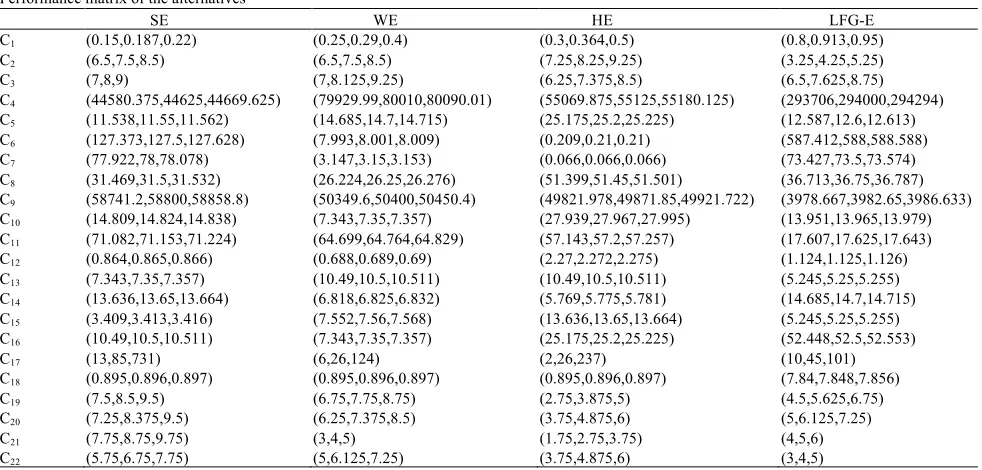
We have 5 qualitative criteria such as visual impact, maturity and 17 quantitative criteria such as construction time, payback period. For the qualitative criteria, the decision makers rated the alternatives by referring Table II. We estimated the performance rating of the alternatives by averaging corresponding TFN values given by the decision makers. For the quantitative criteria, we have given numeric data for each alternative. Table IV shows the fuzzy performance ratings of the alternatives [7], [32]-[36].
C. Calculation of normalized fuzzy difference
After we obtained the performance matrix, (7) and (8) were used to specify fuzzy best and worst values. In the following step (9) and (10) were applied to calculate the normalized fuzzy difference. The results are in Table V.
D. Calculation of S!j, R!jand Q!jvalues !
Sjand R!jvalues computed were using (11) and (12) with the data listed in table IV. For Q!jvalue, (13) was used and v value was estimated as 0,52 utilizing the formula in step 4. All the results of the computations are placed in Table VI.
E. Defuzzification and ranking the alternatives
TABLE IV
Performance matrix of the alternatives
SE WE HE LFG-E
C1 (0.15,0.187,0.22) (0.25,0.29,0.4) (0.3,0.364,0.5) (0.8,0.913,0.95)
C2 (6.5,7.5,8.5) (6.5,7.5,8.5) (7.25,8.25,9.25) (3.25,4.25,5.25)
C3 (7,8,9) (7,8.125,9.25) (6.25,7.375,8.5) (6.5,7.625,8.75)
C4 (44580.375,44625,44669.625) (79929.99,80010,80090.01) (55069.875,55125,55180.125) (293706,294000,294294)
C5 (11.538,11.55,11.562) (14.685,14.7,14.715) (25.175,25.2,25.225) (12.587,12.6,12.613)
C6 (127.373,127.5,127.628) (7.993,8.001,8.009) (0.209,0.21,0.21) (587.412,588,588.588)
C7 (77.922,78,78.078) (3.147,3.15,3.153) (0.066,0.066,0.066) (73.427,73.5,73.574)
C8 (31.469,31.5,31.532) (26.224,26.25,26.276) (51.399,51.45,51.501) (36.713,36.75,36.787)
C9 (58741.2,58800,58858.8) (50349.6,50400,50450.4) (49821.978,49871.85,49921.722) (3978.667,3982.65,3986.633)
C10 (14.809,14.824,14.838) (7.343,7.35,7.357) (27.939,27.967,27.995) (13.951,13.965,13.979)
C11 (71.082,71.153,71.224) (64.699,64.764,64.829) (57.143,57.2,57.257) (17.607,17.625,17.643)
C12 (0.864,0.865,0.866) (0.688,0.689,0.69) (2.27,2.272,2.275) (1.124,1.125,1.126)
C13 (7.343,7.35,7.357) (10.49,10.5,10.511) (10.49,10.5,10.511) (5.245,5.25,5.255)
C14 (13.636,13.65,13.664) (6.818,6.825,6.832) (5.769,5.775,5.781) (14.685,14.7,14.715)
C15 (3.409,3.413,3.416) (7.552,7.56,7.568) (13.636,13.65,13.664) (5.245,5.25,5.255)
C16 (10.49,10.5,10.511) (7.343,7.35,7.357) (25.175,25.2,25.225) (52.448,52.5,52.553)
C17 (13,85,731) (6,26,124) (2,26,237) (10,45,101)
C18 (0.895,0.896,0.897) (0.895,0.896,0.897) (0.895,0.896,0.897) (7.84,7.848,7.856)
C19 (7.5,8.5,9.5) (6.75,7.75,8.75) (2.75,3.875,5) (4.5,5.625,6.75)
C20 (7.25,8.375,9.5) (6.25,7.375,8.5) (3.75,4.875,6) (5,6.125,7.25)
C21 (7.75,8.75,9.75) (3,4,5) (1.75,2.75,3.75) (4,5,6)
C22 (5.75,6.75,7.75) (5,6.125,7.25) (3.75,4.875,6) (3,4,5)
TABLE V
Normalized fuzzy difference values of alternatives
Criteria SE WE HE LFG-E
C1 (0.725, 0.908, 1) (0.5, 0.779, 0.875) (0.375, 0.687, 0.813) (-0.188, 0, 0.188)
C2 (-0.208, 0.125, 0.458) (-0.208, 0.125, 0.458) (-0.333, 0, 0.333) (0.333, 0.667, 1)
C3 (-0.667, 0.042, 0.75) (-0.75, 0, 0.75) (-0.5, 0.25, 1) (-0.583, 0.167, 0.917)
C4 (0.997, 0.999, 1) (0.855, 0.857, 0.858) (0.955, 0.957, 0.958) (-0.002, 0, 0.002)
C5 (-0.002, 0, 0.002) (0.228, 0.23, 0.232) (0.995, 0.997, 1) (0.075, 0.077, 0.078)
C6 (0.781, 0.783, 0.784) (0.985, 0.986, 0.987) (0.998, 0.999, 1) (-0.002, 0, 0.002)
C7 (-0.002, 0, 0.002) (0.958, 0.959, 0.961) (0.998, 0.999, 1) (0.056, 0.058, 0.06)
C8 (0.786, 0.789, 0.793) (0.994, 0.997, 1) (-0.004, 0, 0.004) (0.578, 0.582, 0.585)
C9 (-0.002, 0, 0.002) (0.151, 0.153, 0.155) (0.161, 0.163, 0.165) (0.998, 0.999, 1)
C10 (0.634, 0.636, 0.638) (0.997, 0.998, 1) (-0.003, 0, 0.003) (0.676, 0.678, 0.68)
C11 (0.997, 0.998, 1) (0.878, 0.879, 0.881) (0.737, 0.738, 0.74) (-0.001, 0, 0.001)
C12 (0.11, 0.111, 0.112) (-0.001, 0, 0.001) (0.996, 0.998, 1) (0.274, 0.275, 0.276)
C13 (0.396, 0.399, 0.401) (0.994, 0.997, 1) (0.994, 0.997, 1) (-0.002, 0, 0.002)
C14 (0.114, 0.117, 0.121) (0.878, 0.88, 0.883) (0.995, 0.998, 1) (-0.003, 0, 0.003)
C15 (-0.001, 0, 0.001) (0.403, 0.404, 0.406) (0.997, 0.998, 1) (0.178, 0.179, 0.18)
C16 (0.928, 0.929, 0.93) (0.997, 0.999, 1) (0.602, 0.604, 0.606) (-0.002, 0, 0.002)
C17 (-0.153, 0.081, 1) (-0.163, 0, 0.163) (-0.168, 0, 0.319) (-0.157, 0.026, 0.131)
C18 (0.997, 0.999, 1) (0.997, 0.999, 1) (0.997, 0.999, 1) (-0.002, 0, 0.002)
C19 (-0.296, 0, 0.296) (-0.185, 0.111, 0.407) (0.37, 0.685, 1) (0.111, 0.426, 0.741)
C20 (-0.391, 0, 0.391) (-0.217, 0.174, 0.565) (0.217, 0.609, 1) (0, 0.391, 0.783)
C21 (-0.25, 0, 0.25) (0.344, 0.594, 0.844) (0.5, 0.75, 1) (0.219, 0.469, 0.719)
[image:5.595.45.291.684.761.2]C22 (-0.421, 0, 0.421) (-0.316, 0.132, 0.579) (-0.053, 0.395, 0.842) (0.158, 0.579, 1)
TABLE VI
Fuzzy S, R and Q values of the alternatives
Sj Rj Qj
SE (3.178, 5.846, 9.641) (0.748, 0.849, 0.975) (-0.534, 0.106, 0.822) WE (5.507, 8.724, 12.38) (0.748, 0.849, 0.95) (-0.434, 0.266, 0.89) HE (6.312, 9.754, 13.778) (0.748, 0.849, 0.95) (-0.399, 0.275, 0.951) LFGE (1.71, 4.137, 7.096) (0.732, 0.832, 0.933) (-0.63, 0, 0.63)
TABLE VII
Q, S and R ranking list of alternatives
Crisp Scores Ranking
Alternatives Q S R Q S R
SE 0,125 6,127 0,855 2 2 3
WE 0,247 8,834 0,849 3 3 2
HE 0,275 9,899 0,849 4 4 2
LFG-E 0 4,27 0,832 1 1 1
VI. CONCLUSION
Sustainable and renewable energy alternatives have been evaluated by integrated VIKOR method with the fuzzy
Waste creates both economical and environmental problems in the cities and LFG power plants are a smart and efficient way of eliminating and utilizing of waste while producing energy. Municipalities need a comprehensive waste management policy to use LFG opportunity and so to create a sustainable environment in the cities. LFG power plants are followed by solar, wind and hydraulic alternatives.
In this study, first three most important criteria are technical efficiency, impact on ecosystem, GHG emissions avoided and government support rate. As a consequence technical, economical and environmental aspects of renewable energies are almost equally important and cannot be thought separately. Analyzing a power plant considering
only one or two aspects may mislead decision makers and the results may not be reliable. We conducted this study regarding all the important criteria within technical, economical and environmental scope. This makes our results more quality and improves the reliability.
For the further studies, a research can be conducted locally in a specific region to find out best performing alternatives regarding that area to increase utilization of renewable energy. Also, different multicriteria techniques can be integrated to the solution process if the decision makers increase in numbers. Or different sophisticated economic applications like real options can be applied in lieu of net present value.
REFERENCES
[1] A. Tasri and A. Susilawati, “Selection among renewable energy alternatives based on a fuzzy analytic hierarchy process in Indonesia,” Sustainable Energy Technologies and Assessments, vol.7, pp. 34-44, Sep. 2014
[2] V. Foster and D. Bedrosyan (2014, May). Understanding CO2 emissions from the global energy sector. Live wire knowledge note
series. Vol.1, Available:
http://documents.worldbank.org/curated/en/873091468155720710/Un derstanding-CO2-emissions-from-the-global-energy-sector
[3] J. A. Lowe, C. Huntingford, S. C. B. Raper, C. D. Jones, S. K. Liddicot and L. K Gohar, “How difficult is it to recover from dangerous levels of global warming?” IOPScience Environmental Research Letters, vol. 4, pp. 1-9, Mar 2009
[4] European Environment Agency. “Environment in the European Union at the turn of the century: Summary,” pp. 1-43, 1999
[5] L. Yıldırım, G. Ata, O. Taşkın, T. Lale, (2014, Oct), Sera Gazı Salınımları ve Türkiye’ de Yapılan Çalışmalar. Su Dünyası, Vol. 135 Available: http://www2.dsi.gov.tr/sudunyasi/135/index.html [6] O. Türkyılmaz, “Ocak 2015 İtibarıyla Türkiye’ nin Enerji Görünümü
Raporu,” TMMOB, vol. 200, pp. 1-20, Feb 2015
[7] B. Atılgan and A. Azapagic, “Life cycle environmental impacts of electricity from fossil fuels in Turkey,” Journal of cleaner Production, vol. 106, pp. 555-564, Nov. 2015
[8] EUAS, “ Annual Report 2010”, Ankara FutureCamp, 2011, vol.3. [9] S. Opricovic and G. H. Tzeng, “Compromise solution by MCDM
methods: A comparative analysis of VIKOR and TOPSIS,” European Journal of Operational Research, vol. 156, no. 2, pp. 445-455, Jul. 2004
[10] M. Yazdani and F. Graeml, “VIKOR and its applications: A state of the art survey,” International Journal of Strategic Decision Sciences, pp. 56-83, Jun 2014
[11] A. Mardani, E. K. Zavadskas, K. Govindan, A. A. Senin, A. Jusoh, “A.VIKOR technique: A systematic review of the state of the art literature on methodologies and applications,” Sustainability, Jan 2016
[12] L. A. Zadeh, “Fuzzy Sets,” Information and Control, vol. 8, pp. 338-353, 1965
[13] T. Kaya, and C. Kahraman, “Multicriteria renewable energy planning using an integrated fuzzy VIKOR & AHP methodology: The case of Istanbul,” Energy, vol. 35, no. 6, pp. 2517-2517, Jun 2010
[14] S. Mirasgedis and D. Diakoulaki, “Multicriteria analysis vs. externalities assessment for the comparative evaluation of electricity generation systems,” European Journal of Operational Research, vol. 102, no. 2, pp. 364-379, Oct. 1997
[15] S. Iniyan and K. Sumathy, “An optimal renewable energy model for various end-uses,” Energy, vol. 25, pp. 563-575, Jul 1998
[16] M. Beccali, M. Cellura, M. Mistretta, “Decision-making in energy planning. Application of the Electre method at regional level for the diffusion of renewable energy technology,” Renewable energy, vol. 28, no. 13, pp. 2063-2087, Oct. 2003
[17] N. Afgan and M. Carvalho, “Multi-criteria assessment of new and renewable energy power plants,” Energy, vol. 27, pp. 739-755, Feb 2001
[18] İ. Kaya and C. Kahraman, “A fuzzy multicriteria methodology for selection among energy alternatives. Expert Systems with Applications,” Expert Systems with Applications, vol. 37, no. 9, pp. 6270-6281, Sep 2010
[19] T. Kaya and C. Kahraman, “Multicriteria decision making in energy planning using a modified fuzzy TOPSIS methodology,” Expert Systems with Applications, vol. 38, no. 6, pp. 6577-6585, Jun 2011 [20] J. C. R. Zerpa and J. M. Yusta, “Application of multicriteria decision
methods for electric supply planning in rural and remote areas,” Renewable and Sustainable Energy Reviews, vol. 52, pp. 557-571, Aug 2015
[21] Ü. Şengül, M. Eren, S.E. Shiraz, V. Gezder, A.B. Şengül, “Fuzzy TOPSIS method for ranking renewable energy supply systems in Turkey,” Renewable Energy, vol. 75, pp. 617-625, Mar 2015 [22] D. Streimikiene, T. Balezentis, I. Krisciukaitiene, A. Balezentis,
“Prioritizing sustainable electricity production technologies: MCDM approach,” Renewable and Sustainable Energy Reviews, vol. 16, no. 5, pp. 3302- 3311, Jun. 2012
[23] L. Zhang, P. Zhou, S. Newton, J. Fang, D. Zhou, L.P. Zhang, “Evaluating clean energy alternatives for Jiangsu, China: An improved multi-criteria decision making method,” Energy, vol. 90, pp. 953-964, Oct. 2015
[24] J. R. San Cristobal, “Multicriteria decision making in the selection of a renewable energy project in Spain: The Vikor Method,” Renewable Energy, vol. 36, no. 2, pp. 498-502, Feb. 2011
[25] L. Abdullah and L. Najib, “Sustainable energy planning decision using the intuitionistic fuzzy analytic hierarchy process: choosing energy technology in Malaysia,” International Journal of Sustainable Energy, vol. 35, no. 4, pp. 360-377, Apr. 2014
[26] D. Streimikiene, J. Sliogeriene, J. Turskis, “Multi-criteria analysis of electricity generation technologies in Lithuania,” Renewable Energy, vol. 85, pp. 148-156, Jan. 2016
[27] L. A. Zade, “The concept f a linguistic variable and its application to approximate reasoning-I,” Information Sciences, vol.8, pp. 199-249, 1975
[28] T. H. Chang, “Fuzzy VIKOR method: A case study of the hospital service evaluation in Taiwan,” Information Sciences, vol. 271, pp. 196-212, Jul. 2014
[29] K. Tsai and F. Chou, “Developing a fuzzy multiattribute matching and negotiation mechanism for sealed –bid online reverse auctions,” Journal of Theoretical and Applied Electronic Commerce Research, vol. 6, no. 3, pp. 85-96, Dec. 2011
[30] S. J. Chen, C. L. Hwang, F. P. Hwang, Fuzzy Multiple Attribute Decision Making Methods and Applications, Berlin: Springer-Verlag, 1992, pp. 88-89
[31] S. Opricovic, “Fuzzy VIKOR with an application to water resources planning,” Expert System with Applications, vol. 38, no. 10, pp. 12983-12990, Sep. 2011
[32] Rüzgar Enerjisi Çalışmaları, Yenilenebilir Enerji Genel Müdürlüğü,
Available:
http://www.eie.gov.tr/eie-web/turkce/YEK/ruzgar/ruzgar_en_hak.html
[33] V. Rajaram, F.Z. Siddiqui, M. E. Khan. (2012, Jan). From Landfill Gas to Energy Technologies and Challenges. Available:
https://books.google.com.tr/books?id=finMBQAAQBAJ&printsec=fr ontcover&hl=tr#v=onepage&q&f=false
[34] M. Yılmaz, “Türkiye’ nin enerji potansiyeli ve yenilenebilir enerji kaynaklarının elektrik enerjisi üretimi açısından önemi,” Ankara Üniversitesi Çevrebilimleri Dergisi, vol. 4, no. 2, pp. 33-54, 2012 [35] E. Uluatam, “Yenilenebilir Enerji Teşvikleri,” Ekonomik Forum, pp.
34-41, Oct. 2010