Acquisition of
m
-Sequences Using Recursive Soft Sequential Estimation
Lie-Liang Yang and Lajos Hanzo
Dept. of ECS, University of Southampton, SO17 1BJ, UK. Tel: +44-23-8059 3125, Fax: +44-23-8059 4508 Email: lly,[email protected]; http://www-mobile.ecs.soton.ac.uk
Abstract— A novel sequential estimation method is proposed for the initial synchronization of pseudonoise (PN) signals derived fromm-sequences. This sequential estimation method is designed based on the principle of iterative soft-in-soft-out (SISO) decod-ing, and hence we refer to it as the Recursive Soft Sequential Esti-mation (RSSE) acquisition scheme. The RSSE acquisition scheme exhibits a complexity similar to that of a conventionalm-sequence generator, which increases only linearly with the number of stages in them-sequence generator. Furthermore, our simulation results show that the acquisition time of the proposed RSSE acquisition scheme is also linearly dependent on the number of stages in the
m-sequence generator. Hence, the employment of the proposed RSSE acquisition scheme is beneficial for employment in the ac-quisition of longm-sequences.
I. INTRODUCTION
The sequential estimation acquisition arrangement proposed by Ward [1] constitutes one of the simplest acquisition schemes. The principle of the sequential estimation acquisition scheme is as follows. The acquisition of anm-sequence of length(2S−1) is deemed successful, provided thatSconsecutive chips are cor-rectly received by the acquisition device and are loaded into the localm-sequence generator, where successive shifts of the chips in the generator will generate chips that exactly match the forthcoming received chips of the transmittedm-sequence. However, in the presence of noise, one or more of theS con-secutive received chips might be in error, potentially resulting in loading erroneous values into them-sequence generator. In this case a new set ofSchips can be processed similarly.
Hence, in sequential estimation [1] the most critical require-ment for attaining the successful acquisition of PN sequences is thatSconsecutive chips of the received noise-contaminated PN sequence have to be correctly estimated. It has been shown that techniques such as majority logic decoding [2] and recursive sequential estimation [3] can be employed for improving the acquisition performance of sequential estimation assisted ac-quisition schemes. However, all existing sequential estimation based acquisition schemes operate on the basis of hard-decision chips.
In this contribution, we invoke the iterative SISO decoding principle originally developed for turbo channel decoding [4], [5] for improving the reliabilities associated with deciding upon the S consecutive chips loaded into the m-sequence genera-tor. Upon exploiting the inherent properties ofm-sequences, a RSSE acquisition scheme is proposed, which estimates S
This work has been funded in the framework of the IST project IST-2001-34091 SCOUT, which is partly funded by the European Union. The authors would like to acknowledge the contributions of their colleagues.
consecutive chips using a recursive SISO decoder. An impor-tant feature of the proposed RSSE acquisition scheme is that it exploits the real-time knowledge of the reliabilities associ-ated with theS consecutive chips. This real-time knowledge of the chip-reliabilities increases the probability of successful acquisition of anm-sequence of length(2S−1), onceS con-secutive chips have been loaded into the localm-sequence gen-erator. The proposed RSSE acquisition scheme has an algo-rithmic complexity similar to that of anm-sequence generator. Our simulation results will show that the acquisition time of the RSSE acquisition scheme is a linear function of the number of stages in them-sequence generator. Therefore, the proposed RSSE acquisition scheme constitutes a promising technique, especially for the acquisition of longm-sequences.
II. PRINCIPLE OFSEQUENTIALESTIMATIONACQUISITION
The well-established maximum-length sequences, which are also known asm-sequences are generated using feedback shift registers of the form shown in Fig.1. In Fig.1 D represents a unity time-delay operation, while each of the coefficients,
g1, g2, . . . , gS, represents the presence of a connection if it is a
1 or the absence of a connection if it is a 0. Let the output binary sequence be. . . , c−2, c−1, c0, c1, c2, . . ., whereci∈ {+1,−1}. Furthermore, we assume that in Fig.1 the coefficients are given
bygs1 =gs2 = . . . =gsl = . . . =gsM=S = 1, wheresiis
an integer in the range[1, S], while the remaining coefficients are 0. The above configuration corresponds to the generator polynomial of
g(D) = 1 +Ds1+Ds2+. . .+Dsl+. . .+DsM=S, (1)
where g(D)must be a primitive polynomial [6], i.e., a poly-nomial that cannot be factorized, in order to generate anm -sequence. Based on the above assumptions, it can be shown that the output symbols of Fig.1 obey the recursive equation expressed as
ci = ci−s1ci−s2· · ·ci−sl· · ·ci−(sM=S)
=
M
m=1
ci−smfori=. . . ,−1,0,1, . . . , (2)
whererepresents the product of the coefficients.
D D D D D
g1 g2 g3 gS−1 gS
[image:2.612.64.290.67.141.2]C(D)
Fig. 1. Maximal-length sequence (m-sequences) generator that outputs binary sequences.
generator at the receiver for generating the forthcoming chips, provided that the receiver has the knowledge of the chip val-uesci−1, ci−2, · · ·, ci−S before the transmitter generates the ith chip ci, on condition that the receiver uses the same m -sequence generator as the transmitter. Consequently, the cor-responding replicas of the ith as well as the following chips, namely chipci, ci+1, . . ., can be obtained at the receiver, which exactly match the chips received as a result of the transmitted m-sequence. Hence, the de-spreading of the spread transmitted signal can be successfully carried out by correlating it with the m-sequence replica generated at the receiver.
III. RECURSIVESOFTSEQUENTIALESTIMATION
ACQUISITION
D D D D D
D D D D D
g1
g1 g2
g2 g3
g3
gS
gS gS−1
gS−1 Received code
and noise
× Low-pass
filter
Tracking loop
Soft Channel information
Loading
command command
Soft-IN
Soft-OUT
SISO decoder
Extrinsic information
Reloading
≷0 ≷0 ≷0 ≷0 ≷0
±1
±1 ±1 ±1 ±1
Soft-chip-register
m-sequence generator
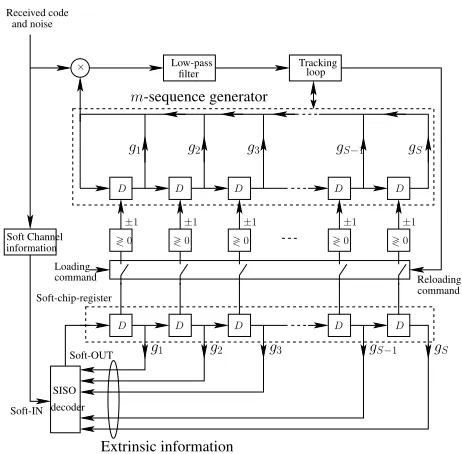
Fig. 2. Schematic diagram of the proposed soft recursive sequential estimator.
A. Description of the RSSE
The schematic diagram of the proposed RSSE acquisition scheme is shown in Fig.2, which includes four fundamen-tal building blocks, namely anm-sequence generator, a soft-chip-register, a SISO decoder and a code phase tracking loop. The soft-chip-register has the sameSnumber of delayunits
-which we refer to as soft-chip-delay-units (SCDUs) - as them -sequence generator. The SCDUs store the instantaneous log-likelihood ratio (LLR) values ofSconsecutive chips. With the aid of theseSnumber of LLR values,Snumber of consecutive chips can be determined, which are loaded into the correspond-ing delay-units of them-sequence generator of Fig.2. The SISO decoder estimates the corresponding LLR soft output after re-ceiving a soft channel output sample associated with a given chip of them-sequence. In addition to the so-called intrinsic information of this chip, which was received from the channel, we also exploit the so-calleda-priori(extrinsic) information re-lated to the chip considered, which is provided by the previous decoded LLR values stored in the SCDUs of Fig.2. The soft output of the SISO decoder is then shifted to the left-most posi-tion of the SCDUs in the soft-chip-register, while the soft value in the right-most SCDUs is shifted out and discarded. Note that both them-sequence generator and the soft-chip-register use the same feedback branches. However, in them-sequence generator the feedback elements are duo-binary values and the product of these feedback elements is used for generating a bi-nary feedback quantity. By contrast, the feedback elements pro-vided from the soft-chip-register to the SISO decoder consist of the LLR values and the specific operations must be employed in the soft-value domain in order to provide extrinsic information for the SISO decoding.
B. RSSE Acquisition Algorithm
LetZi=αici+nirepresent the received channel output cor-responding to chipci, wherei=. . . ,−1,0,1, . . .. When com-municating over a fading channel,αidenotes the fading ampli-tude, whereas for an Additive White Gaussian Noise (AWGN) channel we setαi = 1. Furthermore,ni denotes the AWGN having zero mean and a normalized variance ofN0/2Ec, where
N0 represents the single-sided power spectral density of the AWGN,Ecrepresents the transmitted chip-energy andEc/N0
represents the signal-to-noise ratio (SNR) per chip. As shown in Fig.2, the SISO decoder requires both soft channel output information and extrinsic information provided by the previ-ous estimates of the SISO decoder, in order to compute the soft output for updating the contents of the soft-chip-register. The soft input information related to chipci and entered into the SISO decoder is the LLR ofciconditioned on the channel
out-putZi, i= 0,1,2, . . ., which is given by [5][Eq.(15)]
L(ci|Zi) =Lc·Zi+L(ci), i= 0,1,2, . . . , (3)
whereLc = 4αi·Ec/N0,αi denotes the fading amplitude as-sociated with the transmission of chipciover a fading channel, while we haveαi = 1for an AWGN channel. Explicitly,Lcis referred to as the reliability value of the channel. In Equation (3)L(ci)is the LLR of a random variableci, which is defined as [5]
L(ci) = log
P(ci= +1)
P(ci=−1)
, i= 0,1,2, . . . , (4)
[image:2.612.61.292.370.597.2]As in Section II we assume that in Fig.2 the generator coeffi-cients are given bygs1=gs2 =. . .=gsl=. . .=gsM=S = 1, while the other coefficients are 0, i.e., that the m-sequence generator obeys a recursive equation described by (2). Conse-quently, the previous soft outputs of the SISO decoder of Fig.2 obtained at the time-indices of(i−s1),(i−s2), . . . ,(i−(sM = S))are fed back to the SISO decoder, in order to provide ex-trinsic information for enhancing the correct decoding proba-bility of chipci. Let the previousSnumber of soft outputs of the SISO decoder beL(yi−1), L(yi−2), . . . , L(yi−S). Accord-ing to (2) the extrinsic information used for enhancAccord-ing the cor-rect decoding probability ofcican be approximately expressed as [5][Eq.(12)]
Le(ci)≈
M
m=1
sign(L(yi−sm))
×min|L(yi−s1)|,|L(yi−s2)|, . . . ,|L(yi−(sM=S))|,
i= 0,1,2, . . . , (5)
where we assumed that we haveLe(c−∞) =. . .=Le(c−2) =
Le(c−1) = 0.
Finally, with the aid of the channel output informationLc · Zi +L(ci)of (3) and the extrinsic informationLe(ci)of (5), the soft output of the SISO decoder associated with chipcican be expressed as
L(yi) =L(ci|Zi) +Le(ci)
=Lc·Zi+L(ci) + M
m=1
sign(L(yi−sm)
·min|L(yi−s1)|,|L(yi−s2)|, . . . ,|L(yi−(sM=S))|,
i= 0,1,2, . . . , (6)
where, again, we assumed that we have Le(c−∞) = . . . =
Le(c−2) =Le(c−1) = 0. Note that (6) represents a recursive
equation that can be used for estimating theSnumber of con-secutive chips required by the receiver’sm-sequence generator for producing the fullm-sequence. Provided that the channel’s output SNR per chip value of Ec/N0is sufficiently high, the LLR values of theS consecutive chips will increase upon in-creasing the depth of this recursion. In other words, the relia-bilities associated with theSconsecutive chips increase, while the erroneous loading probability of the generator - which is defined as the probability of the event that them-sequence gen-erator is loaded with one or more erroneous chips - decreases upon increasing the number of recursions or iterations. There-fore, the acquisition device is capable of observing the reliabil-ities of theS consecutive chips through observing the ampli-tudes of the LLR values stored in the SCDUs. If the ampliampli-tudes of the LLR values in the SCDUs become sufficiently high af-ter a number of update operations using (6) and they result in a sufficiently low erroneous loading probability, then, as shown in Fig.2, a ‘loading command’ can be activated for loading the corresponding hard-decision based binary +1 or -1 chip values into the delay-units of them-sequence generator according to the polarity of the corresponding LLR values stored in the SC-DUs.
SISO decoding
Conventional hard-decision
0 20 40 60 80 100
Normalized number of chips received, L/S
0 10 20 30 40 50
Decision
reliability
of
a
chip
S=13,Ec/N0=-1dB
[image:3.612.332.529.81.237.2]S=5,Ec/N0=-4dB
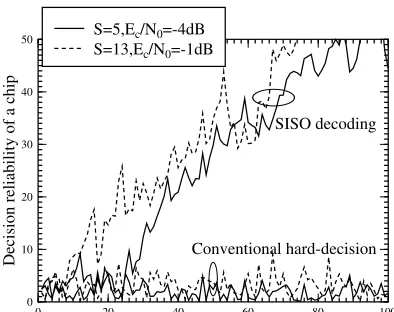
Fig. 3. Decision reliability versus the normalized number of received chips invoked in the recursive SISO decoding, when communicating over an AWGN channel and using an SNR per chip value ofEc/N0 =−4dB forS= 5and
Ec/N0=−1dB forS= 13.
Note furthermore that since the acquisition device is capable of observing the reliabilities of the most recentSconsecutive chips through observing the amplitudes of the corresponding soft outputs stored in the soft-chip-register of Fig.2, the acquisi-tion scheme has the ability to confidently decide, when it should activate the ‘loading command’ for loading the initial chips into them-sequence generator. When the erroneous loading prob-ability is deemed sufficiently low, for example in the region of
10−4, the PN sequence can be acquired with a high
probabil-ity after the first loading of the initial chips. Therefore, the total acquisition time of the RSSE acquisition scheme can be approx-imated by the time duration required by the RSSE for carrying out the recursive SISO decoding, in order to reach a sufficiently low erroneous loading probability.
IV. PERFORMANCE OFTHERSSE SCHEME
In this section we provide a range of simulation results in the context of the proposed RSSE acquisition scheme. Note that the curves were drawn either versus the SNR per chip, namelyEc/N0 or versus the normalized number of chips re-ceived, which also represents the normalized number of chips that the SISO decoder processed. The normalized number of chipsL/S was defined as the total number of received chips, L, divided by the number of generator stages,S, of the corre-spondingm-sequence generator.
S=13, N=8191
L=1S
2S
5S
10S
20S 40S
-6 -4 -2 0 2 4 6 8 10
SNR per chip, Ec/N0(dB)
10-4 2 5 10-3 2 5 10-2 2 5 10-1 2 5 100
Erroneous
loading
probability
,
Pe
[image:4.612.329.535.89.249.2]g(D)=1+D+D3+D4+D13
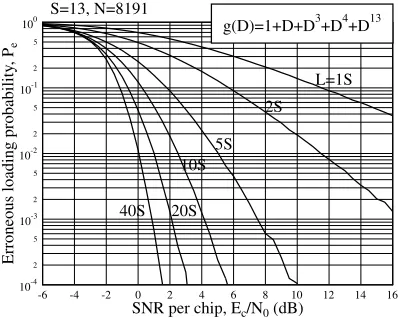
Fig. 4. Erroneous loading probability,Pe, versus the SNR/chip,Ec/N0, performance for various numbers of chips invoked into the proposed recursive SISO decoder, when transmitting them-sequence generated using the generator polynomial ofg(D) = 1 +D+D3+D4+D13over AWGN channels.
[image:4.612.67.267.90.248.2]context of each chip received. By contrast, for conventional hard-decision the decision reliability associated with the deci-sion concerning the polarity of a specific chip was defined as the absolute value of the channel output corresponding to that chip. From the simulation results of Fig.3 we observe that for the conventional hard-decision based scheme the decision reliabil-ity associated with a chip is mainly distributed within the range spanning from 0 to 10 and does not increase as more chips re-ceived, since the polarity of each chip is decided separately. By contrast, for the proposed RSSE acquisition scheme the correct decision reliability increases, when receiving more chips from the channel. Furthermore, we observe that the average correct decision reliability increases nearly linearly upon increasing the normalized number of chips received. This is because the pro-posed recursive SISO decoder is capable of efficiently exploit-ing thea-prioriinformation provided by the previous chips re-ceived. Therefore, according to Fig.3 we expect that the RSSE acquisition scheme will outperform the conventional sequen-tial estimation acquisition scheme [1] without exploiting the a-prioriinformation provided by the previous chips.
Fig.4 shows the acquisition performance of anm-sequence having a period ofN = 8191chips, which was generated by a thirteen-stage (S = 13) generator using the generator polyno-mial ofg(D) = 1 +D+D3+D4+D13. As shown in Fig.4, the m-sequence can be reliably acquired at an SNR per chip value ofEc/N0 =−0.5dB by invoking aboutL= 40×S =
40×13 = 520chips into the recursive SISO decoder. By contrast, without using anya-prioriinformation, i.e., when us-ing the conventional sequential estimation acquisition scheme of [1], the PN code acquisition scheme has to operate at the SNR per chip value of Ec/N0 = 9.5dB, in order to achieve
the erroneous loading probability of 10−4. Hence, the SNR per chip gain owing to using the proposed RSSE acquisition scheme instead of using the conventional sequential estimation acquisition scheme at the erroneous loading probability of10−4
S=5, N=31
L=1S 2S 5S 10S 20S 40S
-10 -8 -6 -4 -2 0 2 4 6 8 10
SNR per chip, Ec/N0(dB)
10-4 2 5 10-3 2 5 10-2 2 5 10-1 2 5 100
Erroneous
loading
probability
,
Pe
[image:4.612.331.530.344.503.2]g(D)=1+D+D2+D4+D5 g(D)=1+D2+D5
Fig. 5. Comparison of erroneous loading probabilities for them-sequences having the same length ofN= 31, but generated by the generating functions ofg(D) = 1 +D2+D5andg(D) = 1 +D+D2+D4+D5, respectively, when communicating over AWGN channels.
S=13, N=8191
L=1S
2S
5S 10S
20S 40S
-6 -4 -2 0 2 4 6 8 10 12 14 16
SNR per chip, Ec/N0(dB) 10-4
2 5 10-3 2 5 10-2 2 5 10-1 2 5 100
Erroneous
loading
probability
,
Pe
g(D)=1+D+D3+D4+D13
Fig. 6. Erroneous loading probability,Pe, versus the SNR/chip,Ec/N0, performance for various numbers of chips invoked into the proposed recursive SISO decoder, when transmitting them-sequence generated using the generator polynomial ofg(D) = 1+D+D3+D4+D13over Rayleigh fading channels.
is about 10dB, whenL= 520chips are loaded into the recur-sive SISO decoder.
re-sults of Fig.5, it can be observed that given a fixed number of chips invoked during the recursive SISO decoding process, the generator using the polynomial ofg(D) = 1+D2+D5 outper-forms that usingg(D) = 1 +D+D2+D4+D5. The reason for these results is that in the context of the generator using the polynomial ofg(D) = 1+D2+D5, the extrinsic information is based on only two feedback branches. By contrast, in the con-text of the generator usingg(D) = 1 +D+D2+D4+D5, the extrinsic information is based on four feedback branches. How-ever, according to (5) the extrinsic information is determined by the minimum of the LLR values of all the feedback branches. Hence, the generator using a low number of feedback branches has a higher probability of providing high-valued, i.e. reliable extrinsic information to the SISO decoder than that using a high number of feedback branches. Nevertheless, the results of Fig.5 show that regardless of which generator polynomial is used, the proposed RSSE acquisition scheme has a significantly lower erroneous loading probability than the conventional sequential estimation acquisition scheme, provided that a sufficiently high number of received chips are invoked in the recursive SISO de-coding process.
In Fig.6 we investigated the acquisition performance of the RSSE acquisition scheme for transmission over Rayleigh fad-ing channels. Specifically, in Fig.6 them-sequence was gener-ated by a thirteen-stagem-sequence generator using the gener-ator polynomial ofg(D) = 1 +D+D3+D4+D13. From the results of Fig.6, we observe that at a given SNR per chip value ofEc/N0, similarly to the results of Fig.4, the erroneous
loading probability decreases, when increasing the number of received chips invoked into the recursive SISO decoder. Fur-thermore, by comparing the results of Fig.6 to those of Fig.4, which were valid when communicating over AWGN channels, it can be shown that for a given number of received chips in-voked into the recursive SISO decoder, the achievable SNR gain is significantly higher in the context of Rayleigh fading chan-nels than that over AWGN chanchan-nels, when using the proposed RSSE acquisition scheme instead of the conventional sequential estimation acquisition scheme. However, for a given number of received chips used by the recursive SISO decoder and for a given SNR per chip value, the acquisition scheme communicat-ing over AWGN channels achieves a lower erroneous loadcommunicat-ing probability than that encountered, when communicating over Rayleigh fading channels.
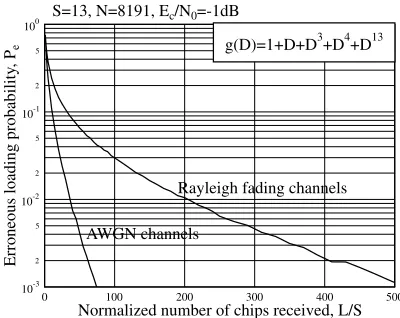
Finally, in Fig.7 we show the erroneous loading probability performance versus the normalized number of received chips used by the recursive SISO decoder for an m-sequence gen-erated by anS = 13-stagem-sequence generator, which has a period of 8191 chips. The results were generated for trans-missions over both AWGN and Rayleigh fading channels at the SNR per chip value of Ec/N0 = −1dB. According to
the results of Fig.7 it can be shown that for AWGN channels the RSSE acquisition scheme is capable of achieving an er-roneous loading probability of 10−3 after receiving approxi-mately 80×13 = 1040 chips. By contrast, when commu-nicating over Rayleigh fading channels, the RSSE acquisition scheme is capable of achieving the erroneous loading probabil-ity of 10−3 after receiving approximately 500×13 = 6500 chips. These results imply that with the aid of the proposed
S=13, N=8191, Ec/N0=-1dB
Rayleigh fading channels
AWGN channels
0 100 200 300 400 500
Normalized number of chips received, L/S
10-3 2 5 10-2 2 5 10-1 2 5 100
Erroneous
loading
probability
,
Pe g(D)=1+D+D
3
[image:5.612.330.530.91.250.2]+D4+D13
Fig. 7. Erroneous loading probability,Pe versus the normalized number of received chips invoked into the proposed recursive SISO decoder for an
m-sequence having a period of 8191, when communicating over AWGN or Rayleigh fading channels and using an SNR per chip value ofEc/N0=−1dB forS= 13.
recursive SISO decoder the required target performance can be achieved, regardless of the specific communication environ-ment encountered, when invoking the required number of chips into the SISO decoder.
V. CONCLUSIONS
In summary, in this contribution we have proposed a recur-sive soft sequential estimation (RSSE) acquisition scheme us-ing the principles of iterative SISO decodus-ing. The acquisition performance of the RSSE acquisition scheme has been investi-gated. It has been shown that the RSSE acquisition scheme has both an implementational complexity and an initial synchro-nization time, which are linearly dependent on the number of stages in the m-sequence generator. In terms of these char-acteristics, the RSSE acquisition scheme outperforms both the family of conventional serial search based acquisition schemes and the class of conventional parallel search aided acquisi-tion schemes. These convenacquisi-tional schemes either result in a high mean-acquisition time or impose a high implementational complexity, that are exponentially dependent on the number of stages in them-sequence generator.
REFERENCES
[1] R. B. Ward, “Acquisition of pseudonoise signals by sequential estimation,”
IEEE Trans. on Commun. Tech., vol. 13, pp. 475–483, Dec. 1965. [2] C. C. Kilgus, “Pseudonoise code acquisition using majority logic
decod-ing,”IEEE Trans. on Commun., vol. 21, pp. 772–774, June 1973. [3] R. B. Ward and K. Yiu, “Acquisition of pseudonoise signals by
recursion-aided sequential estimation,”IEEE Trans. on Commun., vol. 25, pp. 784– 794, Aug. 1977.
[4] C. Berrou, A. Glavieux, and P. Thitimajshima, “Near Shannon limit error-correcting coding and decoding: Turbo-codes,” inIEEE Int. Conf. Comm. ICC’93, pp. 1064–1071, May 1993.
[5] J. Hagenauer, E. Offer, and L. Papke, “Iterative decoding of binary block and convolutional codes,” IEEE Trans. on Information Theory, vol. 42, pp. 429–445, March 1996.