Button Segmentation from an Elevator Inside
Door Image
Yu-Ching Hsu and Yung-Sheng Chen
∗Abstract—Computer vision on the segmentation of buttons from an elevator inside door (EID) image is studied. Due to the reflection phenomenon and the similar color between buttons and the door panel con-sisting of the buttons in the EID image, it is not easy to deal with the button segmentation. To overcome this problem, based on the edge information of the EID image a kernel function called projection-and-checking (PAC) is presented in this paper for the but-ton segmentation, which will be valuable for the robot vision application. Our experiments confirm the fea-sibility of the proposed approach.
Keywords: computer vision, edge information, elevator inside door (EID), image segmentation, projection and checking (PAC)
1
Introduction
Computer vision plays an important role for a robotic system, in particular considering the interaction between a robot and the environment [1]. Except for the study on the interaction between robot and real world, it is also very interesting for exploring that between robot and dig-ital world, such as the CUBot developed by Chen and Lin [2]. The CUBot possesses the abilities of perceiving the information on the computer screen [3] and manipulat-ing the compute mouse to operate the computer like a human being. The CUBot is very suitable for investigat-ing the eye-hand coordination mechanism. In addition, the recognition of keyboard was also studied for its fur-ther integration into the CUBot in the near future [4]. Along such a research direction, another interesting topic on the button recognition of the elevator door control is opened here and presented in this paper. Due to the prompt progress of robot technology, the various robots are coming into our daily life. Consider a scenario that a mobile robot wants to get an elevator as we usually do in our daily life, one of most important key functions is that the buttons of elevator should be perceived by the robot vision. The elevator inside door (EID) image containing buttons is therefore studied. Segmentation of buttons from the EID image is a necessary preprocessing for a human-like robot to operate the elevator and thus
∗Y.-C. Hsu and Y.-S. Chen are with the Department of Electrical Engineering, Yuan Ze University, Taoyuan, Taiwan, ROC. (phone: 886-3-4638800; fax: 886-3-4639355; e-mail: [email protected]; [email protected]).
is the goal of this paper to propose an automatic method for dealing with this topic.
[image:1.595.308.526.280.389.2](a) (b) (c)
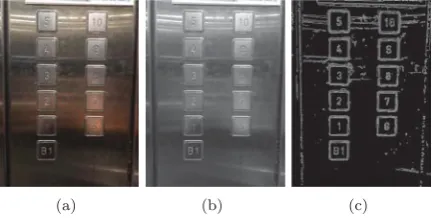
Figure 1: Elevator inside door (EID) image with (a) orig-inal (color), (b) gray, and (c) edge domain.
Given an EID-image as shown in Figure 1(a), some prop-erties can be observed as follows. The color of the door panel and that of buttons are very similar and not easily distinguished. In addition, there is a serious reflection over the EID-image. Therefore, the traditional method, e.g., SIFT [5], will not be helpful for such a situation of unobvious features. Note here that the SIFT technology has been successfully applied for the keyboard recognition [4], where the keyboard image possesses obvious features on each key. Except for the SIFT consideration, it is also possible that by means of a thinning method [6] to extract the stroke information of characters inside button and then recognize the button. However, before performing such a scheme a good thresholding preprocessing should be available but it is not easy due to the mentioned issues of reflection phenomenon and similar color. Fortunately, the edge information appearing in the EID image provide us a cue for designing a feasible approach of locating the buttons, which will be presented in this paper.
2
Proposed Method
As mentioned previously, there exist the inevitable prob-lems of reflection phenomenon and similar color in the EID image. By observing the original (color) EID im-age given in Figure 1(a), the reflection phenomenon is very serious and the metal color makes the button and its symbol difficultly differentiated. Fortunately, the edge information on the EID image provides us a cue for de-signing our approach. Therefore, before presenting our approach the original EID image is first converted into a gray-scale one as shown in Figure 1(b) and then further using the Canny edge detection method [7] to extract the wanted edge information as shown in Figure 1(c), which is called E-image latter for the sake of presenting our method.
Let e(x, y) be a bi-level pixel belonging to the E-image with the size ofW×H pixels,xandybe the coordinate along the horizontal and vertical direction, respectively. The origin (0,0) is located at the left-top corner of the E-image. We then have
e(x, y) =
1, edge pixel (called 1-pixel), 0, otherwise (called 0-pixel). (1)
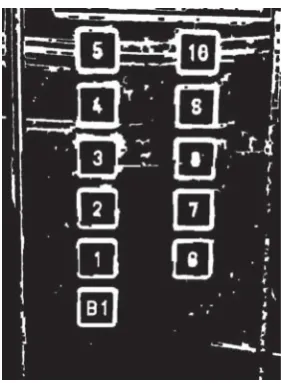
Refer to the image shown in Figure 1(c), even some un-wanted edge information appear in the E-image, the ap-pearance of edge information for each button region can be used for the button segmentation. The more the col-lected edge information, the higher the possibility of be-ing a button region. In order to reduce the noisy pixels in the edge image and make the appearance information more enough, a morphological operation of three times erosions and dilations with 3×3 structure element is ap-plied for the E-image. Along the current illustration, the obtained morphology result is named as M-image as shown in Figure 2, in which the pixel is denoted by
m(x, y). The adopted idea of developing our approach is to project the accumulation of 1-pixel in the M-image onto horizontal and vertical axis iteratively followed with some checking process to identify a useful range (Rx = [x1: x2], orRy= [y1: y2]), which can be used to form a region-of-interest (ROI) image cropped from the M-image and denoted asROI(Rx, Ry) =ROI([x1: x2],[y1: y2]). For example, in this way, the original M-image can be represented as ROI([0 : W−1],[0 : H−1]). Thus the kernel function in this study is named as projection-and-checking (PAC for short) and may be formulated as fol-lows.
PAC: projection-and-checking
Inputan ROI-image.
Output some useful ranges.
1. Given an image withROI([x1: x2],[y1: y2]). 2. Perform projection process:
Figure 2: M-image obtained by performing the mor-phological operations onto the E-image as given in Fig-ure 1(c).
(a) If vertical projection along x-axis (Px) is con-sidered, we have the projection arrayPx(i), i=
x1, . . . , x2.
(b) If horizontal projection along y-axis (Py) is con-sidered, we have the projection arrayPy(i), i=
y1, . . . , y2.
3. Perform checking process:
(a) If checking process (Cx) is performed on the
Px, we obtain Nx wanted ranges, Rx(i), i = 1, . . . , Nx.
(b) If checking process (Cy) is performed on the
Py, we obtain Ny wanted ranges, Ry(i), i = 1, . . . , Ny.
ThePAC function can be further denoted asP ACx (in-cluding Px and Cx) and P ACy (including Py and Cy) depending on the process performed along x-axis or y-axis, respectively.
2.1 Segmentation of button columns
[image:2.595.345.486.102.294.2](a) (b) (c)
Figure 3: Projection results of performingPx for the M-image given in Figure 2: (a) original, (b) thresholded, and (c) filtered result.
namely, thresholding, median filtering, and range detec-tion.
Thresholding: Let ¯px andpminbe respectively the mean and the non-zero minimum of thePx(i), i= 0, . . . , W−1. The thresholding process is designated as
Px(i) =
0, ifPx(i)<(¯px+pmin)/2,
Px(i), otherwise. (2)
Median filtering: After performing this thresholding scheme onto the plot in Figure 3(a), we can obtain some separated ranges but some unwanted “noise” information still included as the plot shown in Figure 3(b). Therefore a median filtering is further applied onto it and a more clear plot can be obtained as shown in Figure 3(c), which is suitable for the range detection.
Range detection and button column segmentation: By ob-serving the plot in Figure 3(c), we can find some, sayNx, ranges with “black” zones, where their widths are de-noted asWx(i), i= 1, . . . , Nx. Let ¯wxbe the mean of the
Wx(i), i= 1, . . . , Nx. That range having its width greater than ¯wx/2 will be remained and used to locate the corre-sponding button column; otherwise are removed. In the current illustration, two wanted range Rx(1) andRx(2) are found as depicted in Figure 4(a), where the num-berNx is reduced to 2. Based on these two ranges, the two button columns can be cropped from the M-image as shown in Figure 4(b) and 4(c), respectively.
2.2 Segmentation of buttons
After locating the button columns, we can obtain the corresponding ROI-image, say ROIBC1 and ROIBC2 for the current illustration as shown in Figure 4(b) and 4(c). It can be found that all buttons are confined in these ROIs. Therefore, the same procedure described in Sec-tion 2.1 can be applied onto these ROIs one by one for locating the wanted buttons. The projection direction is changed from vertical into horizontal one. That is, the
P ACy including Py and Cy functions will be performed
(a) (b) (c)
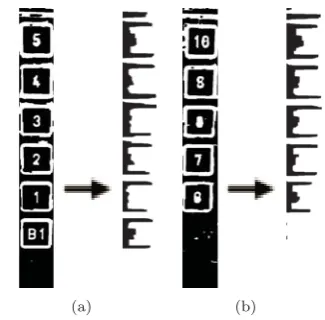
Figure 4: (a) Two detected ranges. (b) and (c) show the cropped button columns (ROIBC1 andROIBC2 ) from the M-image.
(a) (b)
Figure 5: Projection results of performingPyfor the (a)
ROI1
BCand (b)ROIBC2 .
on theROIBCi ,∀i. By performing the P ACy, the corre-sponding projection plots can be obtained as depicted in Figure 5. ForROIBC1 , we obtainNy1= 6 wanted ranges, i.e., R1y(j), j = 1, . . . , Ny1. ForROIBC2 , we have Ny2 = 5 wanted ranges, i.e., R2y(j), j = 1, . . . , Ny2. Thus all the buttons,ROIBk, k= 1, . . . ,Nxi=1Nyi, can be generally lo-cated with the following loops.
Locating all buttons
k= 1
Fori= 1toNx
Forj= 1toNyi
OutputROIBk(Rx(i), Riy(j))
k+ +
End For
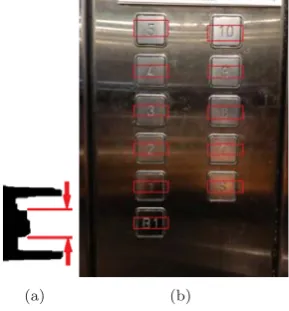
[image:3.595.55.276.101.223.2] [image:3.595.332.495.318.478.2]Because the character on the button will be finally used for robot vision, its region is further extracted in this study. By observing the projection array for an ROIBk, for examplek= 1, the character range in vertical direc-tion can be easily confined with a further checking for the “red markers” shown in Figure 6(a). Such a checking process (calledy-Updating 1) is described as follows.
y-Updating 1
1. Given theROIBk with the rangeRx= [x1: x2] and
Ry= [y1: y2]
2. Find the top valley Py(ytop) and the bottom valley
Py(ybottom)
3. By scanningyfromytoptoybottom, if the casePy(y− 1) < Py(y) AND|Py(y−1)−Py(y)| > TH is first met, then updatey1=y and stop scanning. 4. By scanningyfromybottomtoytop, if the casePy(y−
1) > Py(y) AND|Py(y−1)−Py(y)| > TH is first met, then updatey2=y−1 and stop scanning.
In this study, the TH = 2 is selected for experiments. After performing the y-Updating 1 for all (ROIB)s, all the wanted buttons can be roughly located as shown in Figure 6(b), here the original EID-image is used for reference.
(a) (b)
Figure 6: (a) R1y(1) of ROIB1 modified with a further checking process. (b) All the wanted buttons are roughly located.
2.3 Refining process
By observing the results given in Figure 6(b), it seems that the range of each ROIB should be further re-fined in order to locate the wanted characters more close. With the similar way of y-Updating 1presented privously, theP ACxwithx-Updating andP ACy with
y-Updating 2are further applied sequently for refining
Rxand Ryof eachROIB. The former is used to remove the highlighted side projections (which are formed by the vertical projections of button’s frame), whereas the latter
[image:4.595.345.484.211.399.2]is used to ignore the null side projections (note here that the horizontal projections of button’s frame have been ignored in the process of y-Updating 1). The final re-sults of locating the characters inside buttons are shown in Figure 7, which demonstrates the feasibility of the pro-posed method. As a result, based on the processing steps presented before our approach can be summarized as the flowchart given in Figure 8.
[image:4.595.92.237.432.588.2]Figure 7: Results of locating the characters inside but-tons.
Figure 8: Flowchart of the proposed method.
3
Result and Conclusion
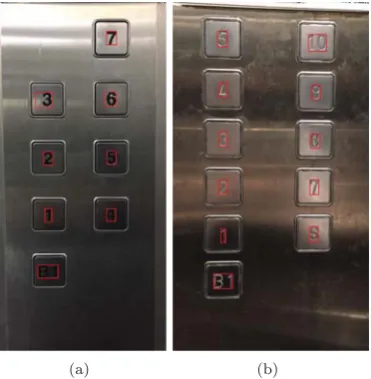
[image:4.595.308.521.449.534.2]can take the elevator from one floor to the other for good service in the near future.
[image:5.595.73.259.138.328.2](a) (b)
Figure 9: Other two results of locating the characters inside buttons.
References
[1] S. Chen, Y. Li, and N. Kwok, “Active vision in robotic systems: A survey of recent developments,”
International Journal of Robotics Research, vol. 30, no. 11, pp. 1343-1377, 2011.
[2] Y.-S. Chen and K.-L. Lin, “CUBot: Computer vi-sion on the eye-hand coordination with a computer-using robot and its implementation,” International Journal of Pattern Recognition and Artificial Intel-ligence, vol. 32, no. 4, 1855005 (25 pages), 2018.
[3] Y.-S. Chen and K.-L. Lin, “Screen image segmenta-tion and correcsegmenta-tion for a computer display,” Interna-tional Journal of Pattern Recognition and Artificial Intelligence, vol. 28, no. 4, 1454002 (21 pages), 2014.
[4] M.-T. Chao and Y.-S. Chen, “Keyboard recogni-tion from scale-invariant feature transform,” IEEE International Conference on Consumer Electronics-Taiwan (ICCE-TW), Taipei, Taiwan, pp. 207-208, 2017.
[5] D. G. Lowe, “Object recognition from local scale-invariant features,” IEEE International Conference on Computer vision, vol. 2, pp. 1150-1157, 1999.
[6] Y.-S. Chen and M.-T. Chao, “Pattern recon-structability in fully parallel thinning,” Journal of Imaging, vol. 3, no. 3, 29 (23 pages), 2017.