doi:10.4236/am.2011.23035 Published Online March 2011 (http://www.scirp.org/journal/am)
Three New Hybrid Conjugate Gradient Methods
for Optimization*
Anwa Zhou, Zhibin Zhu, Hao Fan, Qian Qing
School of Mathematics and Computational Science, Guilin University of Electronic Technology, Guilin, China
E-mail: zhouanwa@126.com
Received November 10, 2010; revised January 9, 2011; accepted January 14, 2011
Abstract
In this paper, three new hybrid nonlinear conjugate gradient methods are presented, which produce sufficient descent search direction at every iteration. This property is independent of any line search or the convexity of the objective function used. Under suitable conditions, we prove that the proposed methods converge glo-bally for general nonconvex functions. The numerical results show that all these three new hybrid methods are efficient for the given test problems.
Keywords: Conjugate Gradient Method, Descent Direction, Global Convergence
1. Introduction
In this paper, we consider the unconstrained optimization problem:
minf x ,xRn (1.1) where f R: n R is continuously differentiable and the gradient of f at x is denoted by g x
.Due to its simplicity and its very low memory re-quirement, the conjugate gradient (CG) method plays a very important role for solving (1.1). Especially, when the scale is large, the CG method is very efficient. Let
0
n
x R be the initial guess of the solution of problem (1.1). A nonlinear conjugate gradient method is usually designed by the iterative form
1 , 0,1, ,
k k k k
x x d k (1.2) wherexkis the current iterate point, k 0 is a
step-length which is determined by some line search, and dk
is the search direction defined by
1
, if 0,
, if 0,
k k
k k k
g k
d
g d k
(1.3)
where gk denotesg x
k , and k is a scalar. Thereare some well-known formulas for k, which are given
as follows:
2 2 1
,
k FR k
k g g
[1];
2
1 1
,
k CD
k T
k k
g
d g
[2];
2
1 1
,
k DY
k T
k k
g
d y
[3];
1 1 1
,
T
HS k k
k T
k k
g y
d y
[4];
1 2 1
,
T
PRP k k
k
k g y
g
[5,6];
1 1 1
,
T
LS k k
k T
k k
g y
d g
[7];
where yk1gkgk1 and stands for the
Eucli-dean norm of vectors.
Although the methods above are equivalent [8,9] when
f is a strictly convex quadratic function and k is
calculated by the exact line search, their behaviors for general objective functions may be far different. Gener-ally, in the convergence analysis of conjugate gradient methods, one hopes the inexact line search such as the Wolfe conditions, the strong Wolfe conditions or the strong *Wolfe conditions,which are showed respectively as follows:
1) The Wolfe line search is to find k such that
, ,
T
k k k k k k k
T T
k k k k k k
f x d f x g d
d g x d d g
(1.4)
with0 1, 2
and 1.
2) The strong Wolfe line search is to findksuch that
, ,
T
k k k k k k k
T T
k k k k k k
f x d f x g d
d g x d d g
(1.5)
with 0 1, 2
and 1.
3) The strong *Wolfe line search is to find k such
that
, 0,
T
k k k k k k k
T T
k k k k k k
f x d f x g d
d g d g x d
(1.6)
with0 1, 2
and 1.
For general functions, Zoutendjk [10] and Al-Baali [11] had proved the global convergence of the FR me-thod with different line searches. And Powell [12] gave a counter example which showed that there exist noncon-vex functions such that the PRP method may cycle and does not approach any stationary point even with exact line search.Although one would be satisfied with its global convergence, the FR method performs much worse than the PRP (HS, LS) method in real computa-tions. In other words, in practical computation, the PRP method, the HS method, and the LS method are generally believed to be the most efficient conjugate gradient me-thods since these meme-thods essentially perform a restart if a bad direction occurs. A similar case happens to the DY method and the CD method. That is to say the conver-gences of the CD , DY and FR methods are established [1-3], however their numerical results are not so well. Resently, some good results on the nonlinear conjugate gradient method are given. Combining the good numeri-cal performance of the PRP and HS methods and the nice global convergence properties of the FR and DY thods, recently, [13] and [14] proposed some hybrid me-thods which we call the H1 method and the H2 method, respectively, that is,
1
max 0, min , ,
H PRP FR
k k k
(1.7)
2
max 0, min , .
H HS DY
k k k
(1.8)
Gilbert and Nocedal [15] extended H1 to the case that
max FR, min PRP, FR .
k k k k
Numerical performances show that the H1 and the H2 methods are better than the PRP method [13,14,16].
As we all know, the FR , DY and CD methods are descent methods, but their descent properties depend on the line search such as the strong Wolfe line search (1.5). Similar to the descent three terms PRP method in [17], Zhang et al. [18,19] proposed a modified FR method which we call the MFR method, that is,
1 1
1 1 1
1 2
:
1 .
T
FR k k
k k k k T k
k k
T
FR k k FR
k k k k
k g d
MFR d g d g
d g
g d
g d
g
(1.9)
And [18] also gave an equivalent form to the MFR method. Similarly, Zhang [19] also proposed a modified DY method called the MDY method, that is,
DY 1
1
1 1 DY 1 DY
1 2
DY :
1
T k k
k k k k T k
k k
T k k
k k k k
k g d
M d g d g
d g
g d
g d
g
(1.10)
It is easy to see that the MFR and MDY methods have an important property that the search directions satisfy
2
,
T
k k k
g d g which depends neither on the line search used nor on the convexity of the objective function; moreover these two methods reduce to the FR method and the DY method respectively with exact line search.
[18] has explored the convergence and efficiency of the MFR method for nonconvex functions with the Wolfe line search or Armijo line search. Based on the idea of the H1 and the H2 methods, recently, Zhang- Zhou [20] replaced kFR in (1.9) and
DY
k
in (1.10) with H1
k
in (1.7) and H2
k
in (1.8), respectively, and proposed two new hybrid PRP–FR and HS–DY methods called the NH1 method and the NH2 method, respec-tively, that is,
H1 1 H1 1 2
N 1: 1
T k k
k k k k k
k g d
H d g d
g
(1.11)
H2 1 H2 1 2
N 2 : 1
T k k
k k k k k
k g d
H d g d
g
(1.12) Obviously, these two new hybrid methods still satisfy
T 2,
k k k
g d g (1.13) which shows that they are descent and independent of any line search used. [20] proved the global convergence of these two methods and also showed their efficiency in real computations.
hy-brid conjugate gradient(CG) methods which we call the H3 method, the MCD method and the NH3 method, re-spectively, that is
3
3 : H max 0, min LS, CD
k k k
H (1.14)
1 1
1 1 1
1 2
:
1
T
CD k k
k k k k T k
k k
T
CD k k CD
k k k k
k g d
MCD d g d g
d g
g d
g d
g
(1.15)
H3 1 H3 1 2
N 3 : 1
T k k
k k k k k
k g d
H d g d
g
(1.16)
From these three methods above, it is not difficult to see that the MCD and the NH3 methods also sat- isfy g dTk k gk 2, which shows that they are suffi-cient descent methods. In the next section, the new algo-rithms are given. The global convergence of the pro-posed methods are proved in Section 3. We give the nu-merical experiments in Section 4, and in Section 5, the conclusion is presented.
2. Algorithm
2.1. Algorithm 1 (The H3 Algorithm)
Step 0: Choose an initial point 0 ,
n
x R 01,
1
0 ,
2
and 1. Set d0 g k0, : 0.
Step 1: If gk ,then stop; Otherwise go to the next step.
Step 2: Compute step size k by strong *Wolfe line
search rule (1.6).
Step 3: Let xk1xkkdk.If gk1 , then stop. Step 4: Calculate the search direction
3
1 1 1 .
H
k k k k
d g d
Step 5: Set k: k 1,and go to Step 2.
2.2. Algorithm 2 (The MCD (Or the NH3) Algorithm)
Step 0: Choose an initial point 0 ,
n
x R 01, 1
0 ,
2
and 1. Set d0 g k0, : 0.
Step 1: If gk ,then stop; otherwise go to the next step.
Step 2: Compute step size k by Wolfe line search
rule (1.4).
Step 3: Let xk1xkkdk. If gk1 ,, then stop. Step 4: Calculate the search direction dk1 by (1.15)
(or (1.16)).
Step 5: Set k: k 1, and go to Step 2.
3. The Global Convergence
Assumption A
1) The level set
0
n
x R f x f x
is bounded,
where 0 ,
n
x R is a given point.
2) In an open convex set N that contains , f is continuously differentiable and its gradientgis Lipschitz continuous, namely, there exists a constant L0 such that
g x
g y L xy ,x y, N. (3.1) Since
f x
k
is decreasing, it is clear that these-quence
xk generated by Algorithm 1 and Algorithm 2 iscontained in . In addition, we can get from Assump-tion A that there exists a constant B and 10,such that
1, , .
x B g x x (3.2) In the latter part of the paper, we always suppose that the conditions in Assumption A hold. Then there is an useful lemma, which was originally given in [10,21].
Lemma 3.1 Let
xk be generated by (1.2) anddkis adescent direction. If k is determined by the Wolfe line
search (1.4), then we have
22 0
.
T k k
k k
g d
d
(3.3)From Lemma 3.1 and (1.13) that for the MCD and NH3 methods with the Wolfe line search,we can easily obtain the following condition
4 2 0
.
k
k k
g d
(3.4)We now establish the global convergence theorem for Algorithm 1 and Algorithm 2 .
3.1. The Global Convergence of the H3 Method
For simlpicity, here, we list the Theorem 2.3 in [14] as the following Lemma 3.2 without proof.
Lemma 3.2 Suppose that x0is an initial point,
Con-sider the method (1.2) and (1.3), where k is computed
by the Wolfe line search(1.4), andkis such that
,1 ,
k
r c where , 1 0. 1
k
k DY
k
r c
0, 0.
T k k
g d k
Further, the method converges in the sense that lim inf k 0.
k g
From the Lemma 3.2 above, similar to Corollary 2.4 in [14], we give the global convergence of the H3 me-thod(Algorithm 1).
Theorem 3.3 Suppose that
x
0is an initial point, Con-sider the Algorithm1, then we have eithergk 0for some k0, or lim inf k 0.k g
Proof From the second inequality of (1.6) and the de- finitions of kH3,kCDandkDY,it follows that
3
0kH kCD kDY. Therefore the statement follows lemma 3.2. 3.2. The Global Convergence of the MCD
Method
Now, we establish the global convergence theorem for the MCD method.
Theorem 3.4 Let
xk be generated by the MCDme-thod (Algorithm 2, wheredk satisfies (1.15)), then we
have
lim inf k 0.
k g (3.5)
Proof Suppose by contradiction that the desired clusion is not true, that is to say, there exists a con-stant 0such that
, 0.
k
g k (3.6)
Set 1
2
1 ,
T
CD k k
k k
k
g d h
g
and then we have
2 2
1 .
CD T
k g dk k h gk k gk
From (1.15) and (1.13), it follows that
2 2
1
2 2 2 2
1 1
2 2 2 2 2 2
1 1
2 2 2 2 2
1
2
2
2
CD
k k k k k
CD CD T
k k k k k k k k
CD T
k k k k k k k k k k
CD
k k k k k k
d d h g
d h d g h g
d h h g g d g h g
d h g h g
2 2 2 21 2
CD T
k dk h d gk k k hk gk
(3.7) Dividing both sides of (3.7) by
g dkT k
2, we get, from(1.13) and the definition ofkCD, that
2 2
4 2
k k
T
k k k
d d
g g d
2 2 2
2 1
2 2
2 2 2 2
1 2
2 2 2
1 2
1 2
4 2 1
2 2
1
4 2 2
1 2 1
4 2 1
2 2 0
2
2
( )
1
2 1 1
1 1
1
1 .
k k k
CD k
k T
T T
k k
k k k k
k k k k k
T
T T
k k
k k k k k
k
k k
k k
k k
k k k
k
k k
k
i i
d h h g
g d
g d g d
g d h h g
g d
g g d g d
d
h h
g g
h d
g g g
d
g g
k g
The last inequality implies
4 2 2
0 0
1 ,
k
k k
k g
k d
which contradicts (3.4). The proof is then completed. 3.3. The Global Convergence of the NH3
Method
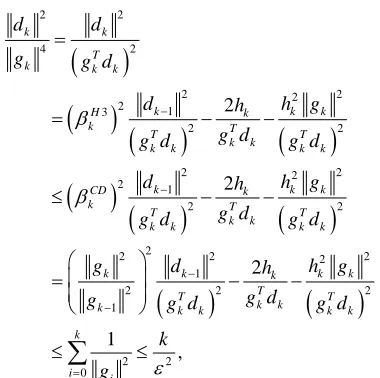
The same as the Theorem 3.4, we can establish the fol-lowing global convergence theorem for the NH3 method. Theorem 3.5 Let
xk be generated by the NH3me-thod (Algorithm 2, where dk satisfies (1.16) ), then we
have
lim inf k 0.
x g (3.8)
Proof Suppose by contradiction that the desired clusion is false, that is to say, there exists a con-stant 0such that
gk , k 0. (3.9) Similar to (3.7), we get from (1.16) that
22 3 2 2 2
1 2 ,
H T
k k k k k k k k
d d h d g h g (3.10)
where
3 1 2
1 .
T
H k k
k k
k g d h
g
Notice that
H3 CD , 0.
k k k
(3.11)
Dividing both sides of (3.10) by
g dTk k
2, we get,from (3.11), (1.13) and the definition of H3,
k
2 2
4 2
k k
T
k k k
d d
g g d
2 2 2
2 1 3
2 2
2 2 2
2 1
2 2
2
2 2 2 2
1
2 2 2
1
2 2 0
2
2
2
1 ,
k k k
H k
k T
T T
k k
k k k k
k k k
CD k
k T
T T
k k
k k k k
k k k k k
T
T T
k k
k k k k k
k
i i
d h h g
g d
g d g d
d h h g
g d
g d g d
g d h h g
g d
g g d g d
k g
which contradicts (3.4). This finishes the proof.
4. Numerical Experiments
In this section, we carry out some numerical experiments. These three algorithms have been tested on some prob-lems from [22]. The results are summarized in the fol-lowing three tables: Table 1-3. For each test problem, No. is the number of the test problem in [22], x0 is the
initial point, xk the final point, k the number of times
of iteration for each problem.
These three tables show the performance of these three methods relative to the iterations, It is easily to see that, for each algorithm, are all very efficient, especially for the problems such as s201, s207, s240, s311. The results for each problem are accurate, and with less number of times of iteration.
5. Conclusions
[image:5.595.66.256.77.266.2]We have proposed three new hybrid conjugate gradient (CG) methods, that are, the H3 method, the MCD me-
Table 1. The detail information of numerical experiments for H3 algorithm.
.
No x0 xk gk k
S201 (8,9) (5.0000000,
6.0000000) 7.08791050e-007 25
S205 (1,1) (2.9999973,
0.4999993) 8.17619783e-007 188
S207 (–1.2,1) (0.9999993,
0.9999983) 7.08905387e-007 61
S240 (100,–1, 2.5)
(1.3367494e-007, –1.3367494e-009, 3.3418736e-009)
8.81057842e-007 29
S311 (1, 1) (2.9999999,
2.0000000) 3.63497147e-007 20
S314 (2,2) (1.8064954,
1.3839575) 9.83714228e-007 339
Table 2. The detail information of numerical experiments for MCD algorithm.
.
No x0 xk gk k
S201 (8,9) (5.0000001,5.9999999) 9.53649845e-007 34
S205 (1,1) (2.9999968,0.4999992) 9.97179740e-007 253
S207 (–1.2,1) (0.9999992,0.9999979) 8.41893782e-007 151
S240 (100,–1,2.5)
(–9.909208e-008, 3.1120991e-008, 2.660865e-008)
8.37563602e-007 41
S311 (1,1) (2.9999999,2.0000000) 7.05200476e-007 24
[image:5.595.308.539.102.227.2]S314 (2,2) (1.8064954,1.3839575) 9.94928488e-007 130
Table 3. The detail information of numerical experiments for NH3 algorithm.
.
No x0 xk gk k
S201 (8, 9) (5.0000001,5.9999999) 9.53649845e-007 34
S205 (1,1) (2.9999972,0.4999993) 9.89188900e-007 418
S207 (–1.2,1) (0.9999990,0.99999751) 9.59168006e-007 168
S240 (100,–1,2.5)
(-9.9092086e-008, 3.1120991e-008, 2.6608656e-008)
8.37563602e-007 41
S311 (1,1) (2.9999999,2.0000000) 5.87169265e-007 25
S314 (2,2) (1.8064954,1.3839575) 9.82136064e-007 339
thod and the NH3 method, where the last two methods produce sufficient descent search direction at every itera-tion. This property depends neither on the line search used nor on the convexity of the objective function. Un-der suitable conditions, we proposed the global conver-gence of these three new methods even for nonconvex minimization. And numerical experiments in section 4 showed that the new three algorithms are all efficient for the given test problems.
6. References
[1] R. Fletcher and C. Reeves, “Function Minimization by Conjugate Gradients,” The Computer Journal, Vol. 7, No. 2, 1964, pp. 149-154. doi:10.1093/comjnl/7.2.149 [2] R. Fletcher, “Practical Methods of Optimization,
Un-constrained Optimization,” Wiley, New York, 1987. [3] Y. H. Dai and Y. Yuan, “A Nonlinear Conjugate
Gra-dient Method with a Strong Global Convergence Prop-erty,” SIAM Journal on Optimization, Vol. 10, No. 1, 1999, pp. 177-182. doi:10.1137/S1052623497318992 [4] M. R. Hestenes and E. L. Stiefel, “Methods of
Conju-gate Gradients for Solving Linear Systems,” Journal of Research of the National Bureau of Standards, Vol. 49, No. 6, 1952, pp. 409-432.
[image:5.595.309.540.262.384.2]No. 1, 1969, pp. 35-43.
[6] B. T. Polyak, “The Conjugate Gradient Method in Ex-treme Problems,” USSR Computational Mathematics and Mathematical Physics, Vol. 9, No. 4, 1969, pp. 94-112. doi:10.1016/0041-5553(69)90035-4
[7] Y. L. Liu and C. S. Storey, “Efficient Generalized Con-jugate Gradient Algorithms, Part 1: Theory,” Journal of Optimization Theory and Applications, Vol. 69, No. 1, 1991, pp. 129-137. doi:10.1007/BF00940464
[8] Y. Yuan and W. Sun, “Theory and Methods of Optimi-zation,” Science Press of China, Beijing, 1999.
[9] Y. H. Dai and Y. Yuan, “Nonlinear Conjugate Gradient Methods,” Shanghai Scientific and Technical Publishers, Shanghai, 1998.
[10] G. Zoutendijk, “Nonlinear Programming, Computation-al Methods,” In: J. Abadie Ed., Integer and Nonlinear Programming, North-Holland, Amsterdam, 1970, pp. 37-86.
[11] M. Al-Baali, “Descent Property and Global Conver-gence of the Fletcher–Reeves Method with Inexact Line Search,” IMA Journal of Numerical Analysis, Vol. 5, No. 1, 1985, pp.121-124. doi:10.1093/imanum/5.1.121 [12] M. J. D. Powell, “Nonconvex Minimization
Calcula-tions and the Conjugate Gradient Method,” Lecture Notes in Mathematics, Vol. 1066, No. 122, 1984, pp. 121-141.
[13] D. Touati-Ahmed and C. Storey, “Efficient Hybrid Conjugate Gradient Techniques,” Journal of Optimiza-tion Theory and ApplicaOptimiza-tions, Vol. 64, No. 2, 1990, pp. 379–397. doi:10.1007/BF00939455
[14] Y. H. Dai and Y. Yuan, “An Efficient Hybrid Conjugate Gradient Method for Unconstrained Optimization,”
Annals of Operations Research, Vol. 103,No. 1-4, 2001,
pp. 33-47. doi:10.1023/A:1012930416777
[15] J. C. Gilbert and J. Nocedal, “Global Convergence Properties of Conjugate Gradient Methods for Optimi-zation,” SIAM Journal Optimization, Vol. 2, No. 1, 1992, pp. 21-42. doi:10.1137/0802003
[16] W. W. Hager and H. Zhang, “A New Conjugate Gra-dient Method with Guaranteed Descent and an Efficient Line Search,” SIAM Journal Optimization, Vol. 16, No. 1, 2005, pp. 170-192. doi:10.1137/030601880
[17] L. Zhang, W. J. Zhou and D. H. Li, “A Descent Mod-ified Polak-Ribière-Polyak Conjugate Gradient Method and Its Global Convergence,” IMA Journal of Numeri-cal Analysis, Vol. 26, No. 4, 2006, pp. 629-640. doi:10.1093/imanum/drl016
[18] L. Zhang, W. J. Zhou and D. H. Li, “Global Conver-gence of a Modified Fletcher-Reeves Conjugate Method with Armijo-Type Line Search,” Numerische Mathema-tik, Vol. 104, No. 4, 2006, pp. 561-572.
doi:10.1007/s00211-006-0028-z
[19] L. Zhang, “Nonlinear Conjugate Gradient Methods for Optimization Problems,” Ph.D. Thesis, Hunan Univer-sity, 2006.
[20] L. Zhang and W. J. Zhou, “Two Descent Hybrid Con-jugate Gradient Methods for Optimization,” Journal of Computational and Applied Mathematics, Vol. 216, No. 1,2008, pp. 251-264. doi:10.1016/j.cam.2007.04.028 [21] P. Wolfe, “Convergence Conditions for Ascent
Me-thods,” SIAM Review, Vol. 11, No. 2, 1969, pp. 226-235. doi:10.1137/1011036