Automatic Term Recognition based on the Statistical Differences of
Relative Frequencies in Different Corpora
Junko Kubo, Keita Tsuji, Shigeo Sugimoto
Graduate School of Library, Information and Media Studies, University of Tsukuba 1-2, Kasuga, Tsukuba, Ibaraki, 305-8550, Japan
E-mail: [email protected], [email protected], [email protected]
Abstract
In this paper, we propose a method for automatic term recognition (ATR) which uses the statistical differences of relative frequencies of terms in target domain corpus and elsewhere. Generally, the target terms appear more frequently in target domain corpus than in other domain corpora. Utilizing such characteristics will lead to the improvement of extraction performance. Most of the ATR methods proposed so far only use the target domain corpus and do not take such characteristics into account. For the extraction experiment, we used the abstracts of a women's studies journal as a target domain corpus and those of academic journals of 39 domains as other domain corpora. The women's studies terms which were used for extraction evaluation were manually identified terms in the abstracts. The extraction performance was analyzed and we found that our method outperformed earlier methods. The previous methods were based on C-value, FLR and methods which were also used with other domain corpora.
1.
Introduction
Automatic Term Recognition (ATR) is useful for updating terminology, dictionaries and various information retrieval. While many methods have been proposed in the past, most of them utilize only the target domain corpus (i.e., the corpus which contains the target terms). The features of the terms are: “(a) they appear frequently in documents of a target field, (b) they are not common words in the target fields and (c) they appear less frequently in the corpora of other fields” (Uchimoto et al., 2000). Based on this idea, we propose an ATR method which utilizes the statistical difference of relative frequencies of the academic terms in the target corpus and in other domain corpora. We compared our ATR results with others and showed our ATR measure outperformed the others.
The idea of using target domain corpus and other domain corpora for ATR is not new (Drouin, 2003; Harter, 1975; Nagao et al., 1976; Anselmo et al., 2001; Uchimoto et al., 2000). The differences between the preceding methods and ours are: (1) the measures proposed in some of the preceding studies are purely heuristic and do not have a statistical basis. Our method uses “the difference between two proportions” in the statistics which follows the normal distribution. In that sense, the statistical meaning of the value of our measure that represents the termhood is easy to understand, (2) we use academic texts not the general texts (e.g., newspapers) as other domain corpora. Some earlier methods used newspaper texts as other domain corpora. In that case, words that frequently appear in the academic texts but are not domain specific terms (e.g., “research” and “evaluation”) are likely to be extracted. Our method does not have such drawbacks, (3) we compared our ATR measures which use target domain corpus and other domain corpora with the existin g
measures which use only the target domain corpus. By comparing ATR measures, we showed our ATR measure outperformed the existing measures.
2.
Data
Below, we explain the corpus and the target terms used for our experiment.
2.1 Corpus
We used the following two corpora, i.e., target domain corpus from which we extract terms and other domain corpora from which we obtain words which are not the terms used in the target domain:
(1) Target corpus: We used the abstract texts of the Women’s Studies International Forum1
as the target domain corpus (henceforth “WSIF corpus”). The reason we chose women’s studies as the target domain is that the first author is familiar with it and can identify the target terms (the terms which should be extracted) for the corpus. The number of abstracts was 1,212. They were published between 1982 and 2007. The number of tokens was approximately 180,000.
(2) Other corpora: We used the abstracts of the 39 journals2 (e.g. “Applied Economics”, “International Journal of Public Administration”, “Urban Studies”, etc. For details, see the Appendix A) for the other domain corpora (henceforth “OTHER corpora”). They were published between 1981 and 2007. We randomly extracted 1,212 abstracts from each journal and used them
1
http://www.sciencedirect.com/science/journal/02775395 2
We can see from the example that the FLR of the term “feminist” is higher than “feminist theory”. Therefore, it seems that “feminist” has a higher probability of being a women’s studies term.
4.
Results and Discussions
We calculated the precision and recall of extracting terms based on the four ATR measures and MDPα.
The precision is defined as (the number of extracted terms which were listed in target terms)/(the number of extracted words). The recall is defined as (the number of extracted terms which were listed in target terms)/(the number of terms which were listed in target terms and existed in the corpus).
4.1 MDP and other existing ATR measures
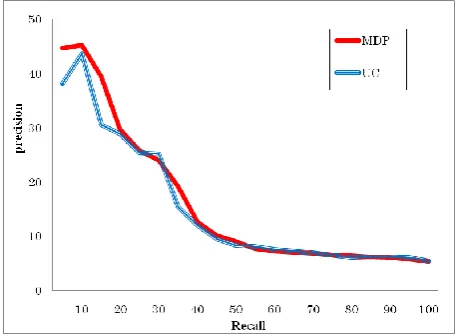
The precision and recall of extracting terms based on the three ATR measures (MDP, C-value and FLR) are shown in Figure 1. In Figure 1, we compare the existing measures which use only the target domain corpus with MDP which uses not only the target domain corpus but also the other domain corpora. In Figure 2, the precision and recall of extracting terms are based on the two ATR measures (MDP and UC) which use both the target domain corpus and the other domain corpora.
Figure 1: Precision and Recall for MDP, C-value and FLR
Figure 2: Precision and Recall for MDP and UC
Figure 1 shows that the precision of extraction based on MDP is much higher than that based on C-value and FLR. As we previously mentioned, MDP uses other domain corpora while C-value and FLR use target corpus only. From this result, we can say that using other domain corpora is effective for ATR. Figure 2 shows that the precision of extraction based on MDP is higher than that based on UC especially at the low recall. From these results, we showed MDP outperformed the earlier three measures.
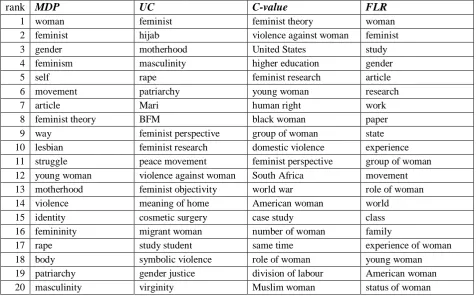
Now, let us look at extraction errors. Table 2 (in Appendix B) shows the top twenty candidate terms extracted based on the MDP, UC, C-value and FLR. Two types of errors were observed in the terms which were extracted based on MDP and other measures. The first type of error is the wrongly extracted words which are common in the academic field but are not the domain specific terms. This type of error was frequently observed among the words which were extracted based on C-value (“case study”, etc) and FLR (“paper”, etc). On the other hand, these kinds of errors were rare among the words which were extracted based on MDP and UC. The reason is that MDP and UC assign high scores only to candidate terms which rarely occur in the OTHER corpora.
The second type of error is wrongly extracted common words such as “work” by C-value and “self” by MDP. The main reason is that MDP focuses only on the difference of frequencies in the target corpus and in other domain corpora and it does not take into consideration how often the words occur in the OTHER corpora, i.e., MDP does not consider the words frequency in the OTHER corpora. Based on this idea, we propose another measure, MDPα
which will be described in the next section.
4.2 MDPα
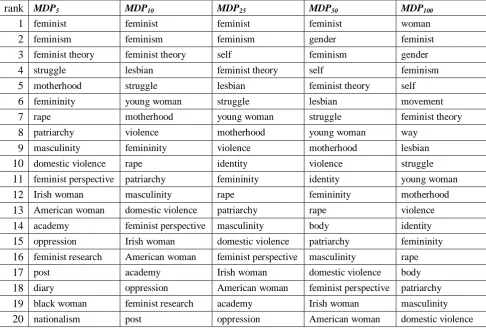
We calculated the precision and recall of extracting terms based on the MDPα. The results are shown in Figure 3.
Figure 3 shows that the precision of extraction based on MDP5 is the highest especially at the low recall. Table 1
shows the top 10 candidate terms extracted based on the MDP and MDP5. Table 3(in Appendix B) shows the top
twenty candidate terms extracted based on the MDPα
We can see in Table 1 that MDP5 failed to extract the core
terms in the women's studies such as “woman” and “gender”, while MDP could do that. However, note that we do not have to extract these core terms when terminological dictionaries for that domain already exist and these core terms are included in them. Therefore, we should choose between MDP and MDP5 depending on the
Figure 3: Precision and Recall for MDPα
rank MDP MDP5
1 woman feminist
2 feminist feminism
3 gender feminist theory
4 feminism struggle
5 self motherhood
6 movement femininity
7 article rape
8 feminist theory patriarchy
9 way masculinity
10 lesbian domestic violence Table1: Top ten candidate terms extracted based on the
MDP and MDP5
5.
Conclusion
In this paper, we showed that our ATR measure which uses MDP or MDP5 outperformed the traditional
measures based on UC, C-value and FLR. Unlike C-value and FLR, MDP (or MDP5) needs other domain corpora in
addition to the target domain corpus. The cost of obtaining such corpora is the drawback of MDP. However, the academic texts are now prevailing and it is getting easier to obtain corpora of various domains. We think that this problem is now being ameliorated.
Further work is needed to clarify the amount of the target corpus and the other domain corpora that is sufficient for extracting terms.
References
Anselmo, P., Felisa, V. and Julio, G. (2001). Corpus-based Terminology Extraction Applied to Information Access, In Proceedings of the Corpus Linguistics 2001, Lancaster, pp.458--465.
Drouin, P. (2003). Term Extraction using Non-technical Corpora as a Point of Leverage. Terminology, 9(1), pp.99--115.
Frantzi, K., Ananiadou, S. and Mima H. (2000). Automatic Recognition of Multi-word Terms: the C-value/NC-value Method, International Journal on Digital Libraries, 3(2), pp.115--130.
Harter, S. P. (1975). A Probabilistic Approach to Automatic Keyword Indexing – Part I. On the Distribution of Specialty Words in a Technical Literature, Journal of the American Society for Information Science, 26(4), pp.197--206.
Harter, S. P. (1975). A Probabilistic Approach to Automatic Keyword Indexing – Part II. An Algorithm for Probabilistic Indexing, Journal of the American Society for Information Science, 26(5), pp.280--289. Nagao, M., Mizutani, M. and Ikeda, H. (1976). An
Automatic Method of the Extraction of Important Words from Japanese Scientific Documents, Journal of Information Processing Society of Japan, 17(2), pp.110--117.
Nakagawa, H., Mori, T. and Yumoto, H. (2003). Term Extraction Based on Occurrence and Concatenation Frequency. Journal of Natural Language Processing, 10(1), pp.27--45.
Appendix A
The list of journals used as “OTHER corpora” is shown below.
Aerosol Science and Technology
Applied Economics
Australian Journal of Earth Sciences
Avian Pathology
British Poultry Science
Clinical Toxicology
Current Eye Research
Early Child Development and Care
Educational Gerontology
Electric Power Components and Systems
Energy Sources, Part A: Recovery, Utilization, and Environmental Effects
Ergonomics
Ferroelectrics
International Journal of Computer Mathematics
International Journal of Control
International Journal of Electronics
International Journal of Mathematical Education in Science and Technology
International Journal of Neuroscience
International Journal of Polymeric Materials
Appendix B
International Journal of Public Administration
International Journal of Radiation Biology
International Journal of Remote Sensing
Journal of Applied Statistics
Journal of Clinical and Experimental Neuropsychology
Journal of Macromolecular Science, Part A
Journal of Modern Optics
Journal of Natural History
Journal of Statistical Computation and Simulation
Medical Mycology
Medical Teacher
Molecular Physics
Pathology
Petroleum Science and Technology
Phase Transitions
Radiation Effects and Defects in Solids
Systems Biology in Reproductive Medicine
The Journal of Adhesion
Urban Studies
Xenobiotica
rank MDP UC C-value FLR
1 woman feminist feminist theory woman
2 feminist hijab violence against woman feminist
3 gender motherhood United States study
4 feminism masculinity higher education gender
5 self rape feminist research article
6 movement patriarchy young woman research
7 article Mari human right work
8 feminist theory BFM black woman paper
9 way feminist perspective group of woman state
10 lesbian feminist research domestic violence experience 11 struggle peace movement feminist perspective group of woman 12 young woman violence against woman South Africa movement 13 motherhood feminist objectivity world war role of woman
14 violence meaning of home American woman world
15 identity cosmetic surgery case study class
16 femininity migrant woman number of woman family
17 rape study student same time experience of woman
18 body symbolic violence role of woman young woman
19 patriarchy gender justice division of labour American woman
20 masculinity virginity Muslim woman status of woman
rank MDP5 MDP10 MDP25 MDP50 MDP100
1 feminist feminist feminist feminist woman
2 feminism feminism feminism gender feminist
3 feminist theory feminist theory self feminism gender
4 struggle lesbian feminist theory self feminism
5 motherhood struggle lesbian feminist theory self
6 femininity young woman struggle lesbian movement
7 rape motherhood young woman struggle feminist theory
8 patriarchy violence motherhood young woman way
9 masculinity femininity violence motherhood lesbian
10 domestic violence rape identity violence struggle
11 feminist perspective patriarchy femininity identity young woman
12 Irish woman masculinity rape femininity motherhood
13 American woman domestic violence patriarchy rape violence
14 academy feminist perspective masculinity body identity
15 oppression Irish woman domestic violence patriarchy femininity
16 feminist research American woman feminist perspective masculinity rape
17 post academy Irish woman domestic violence body
18 diary oppression American woman feminist perspective patriarchy
19 black woman feminist research academy Irish woman masculinity
20 nationalism post oppression American woman domestic violence