ISSN Online: 2165-9389 ISSN Print: 2165-9370
DOI: 10.4236/ojmp.2019.84006 Sep. 3, 2019 57 Open Journal of Medical Psychology
Correlates and Predictors of Psychological
Morbidity in HIV-Infected Persons: A Cross
Sectional Study
O. H. Ezeh
1, C. C. Ezeh
21Department of Community Medicine, ABU, Zaria, Nigeria 2College of Agriculture, ABU, Zaria, Nigeria
Abstract
Introduction: HIV-infection is associated with many factors including: physi-cal, social, cultural and psychosocial factors. Physiological changes associated with HIV infection may generate psychological morbidity. However, specific psychosocial factors contributing to psychological morbidity remain unclear. Identifying factors contributing to psychological morbidity may help in pre-vention and planning interpre-vention. Aims/Objectives: 1) To identify signifi-cant predictors of psychological morbidity from specific dysfunctional coping traits/dimensions among HIV-infected persons; 2) To assess/determine the association between predictor variables (specific coping dysfunctional traits) and psychological morbidity; 3) To identify other correlates of psychological morbidity; 4) To make recommendations on how to reduce levels of dysfunc-tional coping and psychological morbidity. Methods: This cross-secdysfunc-tional descriptive study was conducted to examine data collected from 110 partici-pants, HIV patients receiving HAART services from Ahmadu Bello Universi-ty Teaching Hospital (ABUTH), Zaria, Kaduna State, Nigeria. Results: Re-sults indicate that HIV-patients with high levels of psychological morbidity were more likely to use dysfunctional coping more frequently. Therefore, greater psychological distress and symptoms reporting may be associated with dysfunctional coping. Conclusion/Recommendation: The study recommends that specific dysfunctional coping dimensions should also be targeted in in-terventions designed to reduce psychological morbidity in HIV patients.
Keywords
Psychological Morbidity, Predictors, Correlates, Coping Dysfunction
How to cite this paper: Ezeh, O.H. and Ezeh, C.C. (2019) Correlates and Predictors of Psychological Morbidity in HIV-Infected Persons: A Cross Sectional Study. Open Journal of Medical Psychology, 8, 57-65. https://doi.org/10.4236/ojmp.2019.84006
Received: July 22, 2019 Accepted: August 31, 2019 Published: September 3, 2019
Copyright © 2019 by author(s) and Scientific Research Publishing Inc. This work is licensed under the Creative Commons Attribution International License (CC BY 4.0).
DOI: 10.4236/ojmp.2019.84006 58 Open Journal of Medical Psychology
1. Introduction
Globally, HIV continues to be a major public health problem. In 2017 NACA (National Agency for the Control of AIDS) [1], reported that Nigeria had the second largest HIV epidemic in the world with 2.8 percent HIV prevalence among adults. However, UNAIDS and NACA [2] estimate that there are 1.9 mil-lion people living with HIV in Nigeria. Viral suppression is a very important outcome of HIV treatment because when persons living with HIV are virally suppressed they remain healthy and transmission of the virus is prevented [1]. Psychosocial factors may play significant roles in the progression of HIV-infec- tion. Psychological morbidity and dysfunctional coping are parts of psychosocial influences relating to disease progression. According to NAIIS (National HIV/ AIDS Indicator and Impact Survey) [3], the viral suppression at the national level among people living with HIV aged 15 - 49 years stands at 42.3 percent (45.3 percent among women and 34.5 percent among men). The findings of NAIIS also indicate that a total of 11.3 million adults were counseled and tested for HIV in 2016.
DOI: 10.4236/ojmp.2019.84006 59 Open Journal of Medical Psychology successfully cope with a stressful situation may require the individual’s ability to do something practical about it. Effective and adequate coping with HIV-infec- tion would ultimately improve the survivors’ quality of life.
Increasingly, research [4] supports psychological morbidity as a risk factor for both physical and psychological health problems, few if any study has been able to identify it’s correlates and predictors, in order to plan adequate and effective intervention, treatment and prevention in chronically-ill patients.
The study identified correlates and predictors of psychological morbidity from four specific dysfunctional coping traits/dimensions, in order to inform targeted psychological screening and intervention protocols for HIV-infected persons.
2. Research Questions
1) Could dysfunctional coping be one of the risk factors associated with psy-chological morbidity?
2) What percentage of psychological morbidity is attributable to specific dys-functional coping traits/dimensions?
3) What are the key contributions of specific dysfunctional coping traits to psychological morbidity?
4) How does dysfunctional coping contribute to psychological morbidity? The study was aimed to examine these questions in HIV patients receiving HAART services in a hospital out-patient clinic. HIV patients may be at risk for increased psychological distress because of the bodily and psychological changes that may be generated by the HIV-infection.
3. Objectives
1) To examine predictors of psychological morbidity among HIV-infected persons
2) To determine association between specific dysfunctional coping traits and psychological morbidity.
3) To examine/assess the relative contributions of specific dysfunctional cop-ing dimensions/traits to psychological morbidity.
Examining correlates and predictors of psychological morbidity in a popula-tion of HIV-infected persons would assist in planning appropriate intervenpopula-tions that may decrease psychological distress, promote psychological health, slow down HIV progression and increase productivity.
4. Methods
dysfunc-DOI: 10.4236/ojmp.2019.84006 60 Open Journal of Medical Psychology tional coping items. Dysfunctional coping was defined as scoring above the mean score in the subscales. The same applied to GHQ scores.
Participants were 110 patients, 35 males (31.82 percent); 75 females (68.18 percent), mean age 39.79, SD 11.61, who were receiving HAART (highly active anti-retroviral) services at Ahmadu Bello University Teaching Hospital (ABUTH), Zaria, Nigeria selected through half-hazard/convenience sampling technique. On-ly subjects who were available and who were willing to participate activeOn-ly in the study were selected. A total of 128 sets of questionnaires were distributed and 110 were completely returned giving 85.9 percent response rates. Participants were given information on the survey and their consent to participate in the study was obtained. Ethical clearance was also obtained from ethical committee of the hospital. The subjects were asked to indicate what they usually do when they experience a stressful event, on a 4-point scale ranging from “I don’t do this at all” to “I do this a lot”. The results were calculated as the sum of responses on a particular sub-scale. The results obtained on subscales of dysfunctional coping were taken into account separately and in combination of the 4 dysfunctional subscales (integrated dysfunctional coping) used in this study for data analyses. The 4 subscales include:
1) Denial (DN)
Avoidance of the problem, refusal to believe that there is problem. Activities that aid denial include, drinking, sleeping, isolation etc
2) Behavioral Disengagement (BD)
This involves giving up the attempt to deal with a situation. 3) Substance Use (SU)
This means frequent use of alcohol or other substances to cope with stress. 4) Self-Blame (SB)
Internalizing the problem and blaming oneself, beyond just taking responsi-bility for one’s actions, which may lead to low self-esteem, or even depression etc.
5. Results
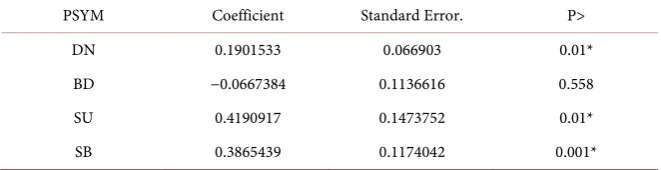
DOI: 10.4236/ojmp.2019.84006 61 Open Journal of Medical Psychology Substance use (SU), and Self-blame (SB). Following the correlational analyses, regression analyses were also carried out to examine specific dysfunctional coping traits as predictors of psychological morbidity. The four specific traits were regressed against psychological morbidity (PSYM) in HIV-infected per-sons.
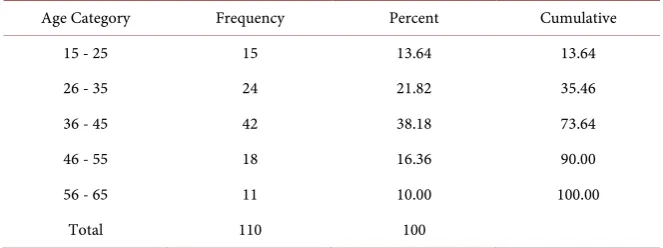
Table 1 indicates that the majority of the patients were within the demo-graphic group of 36 - 45 years, (38.18 percent).
Table 2 indicates that majority of the patients were within the HIV-infection duration of 2 -4 years (38; 34.55 percent) and 5 - 10 years (38; 34.55 percent).
Table 3 indicates differing means for DN (5.75), BD (3.25) SU (2.54) SB (3.62) and TOT (15.16).
Data (Table 4) suggest that prevalence rates of dysfunctional coping dimen-sions (DN, 61.8 percent; BD, 41.8 percent; SU, 21.8 percent; SB, 55.5 percent), and that of Integrated/whole dysfunctional coping (TOT), 44.5 percent were generally high.
Table 5 indicates that psychological morbidity was positively related to sub-stance use coping (SU, P < 0.03) and self-blame coping (SB, P < 0.01), and nega-tively related to behavioral disengagement coping (BD, P < 0.38), although this did not reach significant level. No significant correlation with Denial (DN, P 0.22).
[image:5.595.208.540.455.579.2]Table 6 indicates that frequent use of self-blame (SB) was associated with the largest burden of psychological morbidity (P > 0.001), followed by Denial (DN, P > 0.01), and substance use (SU, P > 0.01).
Table 1. Distribution of respondents by age.
Age Category Frequency Percent Cumulative
15 - 25 15 13.64 13.64
26 - 35 24 21.82 35.46
36 - 45 42 38.18 73.64
46 - 55 18 16.36 90.00
56 - 65 11 10.00 100.00
Total 110 100
[image:5.595.209.540.624.711.2]Field Survey; Ezeh, 2018.
Table 2. Distribution of Respondents by Duration of HIV-infection (Survivability).
Duration Frequency Percent Cumulative
<1 year 11 10.00 10.00
2 - 4 years 38 34.55 44.55
5 - 10 years 38 34.55 79.10
>10 years 23 20.91 100
DOI: 10.4236/ojmp.2019.84006 62 Open Journal of Medical Psychology Table 3. Summarizing dimensions of dysfunctional coping and their composite (total)/ integrated dysfunctional coping.
Variable Obs. Mean Std. Deviation Min. Max.
DN 110 5.75 1.89 2 8
BD 110 3.3 1.52 2 8
SU 110 2.5 1.16 1 8
SB 110 3.63 1.51 2 8
TOTAL (Integrated
dysfunctional coping) 110 15.16 3.03 8 23
[image:6.595.209.541.272.389.2]Field Survey; Ezeh, 2018.
Table 4. Differing prevalent rates of dimensions of dysfunctional coping and the inte- grated whole (Tot.) dysfunctional coping.
Variable Male Female Prevalence Rates Percent N = 110
DN 20 48 68 61.8 percent
BD 14 31 46 41.8 percent
SU 13 11 24 21.8 percent
SB 18 43 61 55.5 percent
Integrated/TOT
Dysfunctional Coping 17 32 49 44.5 percent
Field Survey; Ezeh, 2018.
Table 5. Correlations of PSYM with DN, BD, SU, and SB.
Variables Correlations Significance Values
DN 0.1201 0.22
BD −0.0855 0.38
SU 0.2067 0.03*
SB 0.2515 0.01*
Field Survey; Ezeh, 2018.
Table 6. Regress PSYM against DN, BD, SU, and SB.
PSYM Coefficient Standard Error. P>
DN 0.1901533 0.066903 0.01*
BD −0.0667384 0.1136616 0.558
SU 0.4190917 0.1473752 0.01*
SB 0.3865439 0.1174042 0.001*
R2 = 0.7650. Field Survey; Ezeh, 2018.
[image:6.595.211.540.432.517.2] [image:6.595.209.540.564.649.2]DOI: 10.4236/ojmp.2019.84006 63 Open Journal of Medical Psychology The results also revealed that, the use of some specific traits of dysfunctional coping (SU, P > 0.01; SB P > 0.001) predicted psychological morbidity, in HIV-infected persons. In other words total/combined/integrated coping dys-function predicted psychological morbidity. Regression analyses indicate that with the /exception of BD, all the dysfunctional coping dimensions predicted psychological morbidity, although Self-blame emerged as the strongest predictor of psychological morbidity, among the specific dysfunctional coping dimen-sions. Self-blame is therefore the strongest clinical risk factor for psychological morbidity in this study.
6. Discussion
The findings revealed that more than 49 (44.5 percent) HIV-patients were dys-functional in their coping with HIV-associated stresses. The overall prevalence rates of coping dysfunction and psychological morbidity among the patients were 44.5 percent and 61 percent respectively.
Psychological morbidity and dysfunctional coping are part of psychosocial in-fluences relating to disease progression [9]. When psychological problem or dif-ficulty is present, it interferes with effective and adequate disease management. Specific dysfunctional coping traits/dimensions contributing to psychological morbidity were identified by the study. Interventions to address dysfunctional coping in HIV-infected persons would also improve psychological morbidity and psychological functioning. Effective and adequate social support and func-tional coping may dissipate feelings of distress.
The study suggests that dysfunctional coping was associated with high levels of psychological morbidity, and also predicted it (psychological morbidity). This finding is line with other study that had shown that HIV-infected individuals with high levels of perceived stress typically had poorer stress management skills and less appropriate coping mechanism [4] [10].
Several implications can be derived from the findings of this study;
Many HIV-infected persons experience severe psychological difficulties that may require intervention. This means there is need for routine psychological screening at outpatient contacts. Untreated psychological conditions may esca-late and result to job and other issues.
Yet these factors may be modifiable by psychological interventions, for exam-ple social support can mitigate psychological distress since chronically ill pa-tients with greater social support show better psychological adjustment [11].
Dysfunctional coping was found to be a risk factor for psychological morbidi-ty therefore, functional, effective and adequate coping would constitute protec-tive factors. This finding is line with other study that reports poor stress man-agement skills in HIV-infected persons [12].
DOI: 10.4236/ojmp.2019.84006 64 Open Journal of Medical Psychology services or total lack of support services. All these may constitute risk factors for dysfunctional coping and psychological morbidity.
Functional coping may provide health protective factor. Other factors that may be protective against development of dysfunctional coping and psychologi-cal morbidity include; personality factors, resilience, adequate utilization of so-cial support services and other health-protective behaviors, etc.
Dysfunctional coping contributes to decline in psychological health and qual-ity of health. Coping dysfunction may constitute secondary stress to those who use them frequently.
7. Conclusion
The study has been able to demonstrate that specific dysfunctional coping di-mensions significantly contributed to psychological morbidity. Psychological impact of dysfunctional coping increased the risk of psychological morbidity. Therefore reducing levels of dysfunctional coping would also reduce psycholog-ical morbidity. Interventions to address psychologpsycholog-ical morbidity should also target dysfunctional coping in order to improve psychological functioning and overall quality of life in HIV-infected persons.
Recommendation
The results of the tests may help determine the best coping skills intervention for HIV-patients coping by means of frequent use of dysfunctional coping strate-gies. Clinical interventions can be developed to enhance coping skills, and im-prove survival rates of persons living with HIV-infection. The findings provide new information on the role of psychosocial issues in the spread and treatment of HIV. Screening tools and counseling interventions to reduce and prevent the risks of psychological health problems should be employed.
Effective and adequate screening and treatment of dysfunctional coping and psychological morbidity in HIV-infected persons, insight-oriented counseling, motivational interviewing, and other supportive services to address these psy-chological issues were strongly recommended.
Conflicts of Interest
The authors declare no conflicts of interest regarding the publication of this pa-per.
References
[1] NACA (2017) National Strategic Framework on HIV and AIDS: 2017-2021. [2] UNAIDS and NACA (2019) UNAIDS Report. HIV/AIDS in Nigeria.
http://pushingforthelastmile.com
[3] NAIIS (2018) National HIV/AIDS Indicator and Impact Survey. http://www.internationalhealthpolicies.org
DOI: 10.4236/ojmp.2019.84006 65 Open Journal of Medical Psychology https://doi.org/10.4236/ojmp.2017.64018
[5] Ezeh, O.H. (2019) Diagnosing Dysfunctional Coping in HIV-Infected Persons. Open Journal of Medical Psychology, 8, 36-43. https://www.scirp.org
[6] Dalmida, S.G., McCoy, K., Koenig, H.G., Miller, A., Holstad, M.M. and Thomas, T.L. (2018) Correlates and Predictors of Medication Adherence in Out-Patients Living with HIV/AIDS. Journal of HIV/AIDS and Social Services, 17, 402-420. https://www.tandfonline.com
https://doi.org/10.1080/15381501.2018.1502709
[7] Goldberg, D. (1992) The General Health Questionnaire (GHQ-12). NFER-Nelson, Windsor.
[8] Carver, C.S. (1997) You Want to Measure Coping Protocol Too Long: Consider the Brief Cope. International Journal of Behavioral Medicine, 4, 92-100.
https://doi.org/10.1207/s15327558ijbm0401_6
[9] Balbin, E.G. (2000) Stress and Coping: The Psychoneuroimmunology of HIV/AIDS. Best Practice Research: Clinical Endocrinology and Metabolism, 13, 615-633. https://doi.org/10.1053/beem.1999.0047
[10] O’Cleirigh, C. and Safren, S. (2007) Breaking the Mold or Business as Usual? Meet-ing the Challenges of HIV Prevention in People with Serious Mental Illness and Substance Use Disorders. Clinical Psychology, Science and Practice, 14, 34-38. https://doi.org/10.1111/j.1468-2850.2007.00060.x
[11] Aneshensel, C.S. and Stone, J.D. (1982) Stress and Depression: A Test of Buffering Model of Social Support. Archive of General Psychiatry, 39, 1392-1396.
https://doi.org/10.1001/archpsyc.1982.04290120028005