Dealing with Difficult Days: Functional Coping Dynamics in Self-Harm Ideation and Enactment
Emma Nielsen, BSc1,*, Kapil Sayal, MRCPsych, PhD2 and Ellen Townsend, PhD1
1
School of Psychology, University of Nottingham, Nottingham, UK. 2
Division of Psychiatry and Applied Psychology, School of Medicine, University of Nottingham, Nottingham, UK.
*Corresponding author:
E-mail: [email protected] (EN) Telephone: ++ 44 115 846 7305 Fax: ++ 44 115 951 5324
Dealing with Difficult Days: Functional Coping Dynamics in Self-Harm Ideation and Enactment
There is a convergence of robust research evidence indicating that self-harm, self-poisoning or self-injury regardless of suicidal intent (National Institute for Clinical Excellence, 2011), functions primarily as a means of altering or ameliorating emotional experiences - typically intense aversive states of mind. That is to say, self-harm provides people with a way to escape from distress, at least in the short term (see, Chapman et al., 2006). While research indicates that engaging in self-harm offers people a means of coping (Evans et al., 2005; Warm et al., 2003), there remains a question as to why people engage in this particular behaviour in response to a given situation (Suyemoto, 1998).
While the current study assesses self-harm regardless of suicidal intent (or lack
thereof) research considering non-suicidal self-injury (NSSI), suicide attempts and self-harm
behaviours has been included in the introduction, given that that everyone engaging in
self-harmful behaviours lies on a continuum of suicidal intent (Kapur et al., 2013; Orlando et al.,
2015).
A large proportion of the extant literature primarily addresses distal risk factors for harm and/or suicide. Consequently, relatively little is understood about the whys of self-harm (Townsend, 2014), or indeed the whens. Many studies have relied on the use of long-term retrospective measures that aggregate experiences, whether in the assessment of self-harm, e.g., “Please estimate the number of times in your life you have intentionally (i.e., on
purpose) performed each type of non-suicidal self-harm…” (Klonsky and Glenn, 2009; Klonsky and Olino, 2008), “Have you ever battered or hit yourself?’’, ‘‘Have you ever cut yourself?’’ (Glazebrook et al., 2015; Hawton et al., 2002) or the assessment of coping, e.g., “…indicate what you generally do and feel, when you experience stressful events…” (Carver
appropriately, it is of paramount importance to unpack the more proximal factors surrounding self-harm thoughts and behaviours.
The extant literature suggests that the nature of the stressor itself may be associated with responding. For example, interpersonal stressors (e.g., disputes with family, conflicts within friendships, fall outs with girlfriend/ boyfriend) are consistently reported by those presenting to A&E following self-harm(Townsend et al., 2015) and are independent predictors of suicide attempts in young adults (Johnson et al., 2002). While such research evidence elucidates characteristics of a life stressor that may be associated with self-harm, little is known about the significance of coping characteristics. Despite a notable shift in conceptualisation of psychopathology to focus on behavioural functionality (Armey et al., 2011) and an increased understanding that purpose and meaning are paramount in
understanding the complex and dynamic nature of self-harm (Shaw, 2006), functional coping dynamics are an, as yet, under-researched area.
Elucidating the functional coping dynamics underpinning self-harm thoughts and behaviours – that is to say, what purpose a person believes their coping behaviours and cognitions will serve, their self-defined coping goals – may be an important next step in understanding the whens of self-harm. Developing a clearer understanding of the functions that self-harm experiences serve, in response to a given stressor, has important clinical implications; while the nature of the stressor can not be altered, coping responses are inherently dynamic (Ferguson and Cox, 1997). Functional coping dynamics therefore represent potentially modifiable targets for intervention. Indeed, developing alternative coping strategies is evidenced as key theme in ‘naturalistic’ cessation of self-harm
processes underpinning self-harm thoughts and behaviours (or lack there of) may be an
important step in understanding how to best facilitate alternative coping and support change. Self-Harm Ideation Versus Self-Harm Enactment
Despite key theoretical advances (e.g., Interpersonal-Psychological Theory of suicidal Behaviour: Joiner, 2005; The Integrated Motivational-Volitional Model of suicidal
behaviour: O’Connor, 2011) our ability to predict, explain, prevent and differentiate between self-harm thoughts and behaviour is arguably unsatisfactory at present (Klonsky and May, 2014; Stack, 2014). Many people have feelings or experiences (e.g., thoughts, urges, mental imagery) that relate to self-harming. For some, these experiences may occur before, or around, an episode of self-harm. Others have feelings or experiences that relate to self-harm without engaging in self-harm behaviours - they may ‘just’ think about self-harming. This may be because of effortful resistance or other factors (e.g., the intensity or duration of experiences) (Klonsky & Glenn, 2008; Nock, Prinstein, & Sterba, 2009).
Understanding the transitions between ideation (thoughts) and enactment (behaviours) has been identified as a key hurdle in suicide prevention efforts and a priority research area (Klonsky and May, 2014). Within this, it is paramount to appreciate that transitions are a dynamic process. Those who have harmed may not always continue to do so; self-harming may discontinue across time, or individuals may have periods free from self-harming/ thoughts of harming (Brown et al., 2007; Wadman et al., 2016). Therefore, transitions do not necessarily follow a uni-directional progression from ideation to enactment.
For a more comprehensive understanding of the processes underlying self-harm and suicide, research must address not only ideation to enactment but also behaviour change (e.g., pauses in behaviour engagement). Typically, research into ideation and enactment has
management of self-harm (Lynch and Cozza, 2009; Nixon and Heath, 2009), so it is
important to have targeted research to understand ideation in those with a history of self-harm as well as those who have only ever thought of harming. That is to say, in those who have a history of self-harm, what predicts self-harm experience (ideation, enactment, or lack thereof) in response to a given stressor.
Functional Coping Dynamics and Change in Self-Harm
Cox and Ferguson (1991) outline four qualitatively distinct coping functions: (i) emotional regulation coping, which allows an individual to deal with the emotional
consequences of a problem (ii) approach coping, which permit a person to deal directly with the problem (iii) reappraisal coping, readdressing and reinterpreting the meaning of a
situation (iv) avoidance coping, allowing an individual to ignore the existence of the situation.
Current Study
The present study aims to explore whether coping predicted self-harm experience (ideation, enactment, or lack thereof) in those who have a history of self-harm. The study focuses on the perceived functional dynamics of cognitive and behavioural coping employed in response to a stressor. Rather than exploring typical responses and thus aggregating experiences, the study considers responding to a specific, recent stressor chosen by
participants. Given that self-harm experiences are transient and fluctuating phenomena, the study restricts its focus to participants who had self-harmed in the last 3 months and
investigates responses to most significant stressor in that period. This aimed to eliminate the often noted limitations of long-term, retrospective self-reporting. Given that self-harm is often repeated (Owens et al., 2002) and that many individuals with self-harm histories experience strong (and often frequent) urges to engage in self-injurious behaviours (Washburn et al., 2010), the timeframe also aimed to ensure that reporting of self-harm ideation and enactment would be of sufficient frequency to facilitate meaningful exploration.
There is increasing concern about self-harm in non-clinical populations (Hasking et al., 2008; Lloyd-richardson et al., 2007; McMahon et al., 2014). While some who have experience of self-harm may come into contact with mental health services, either directly (i.e., for input related to self-harm) or indirectly (i.e., accessing treatment for other reasons), this does not reflect the experience of the majority (Hawton, Rodham, Evans, & Weatherall, 2002; Sourander, Helstelä, Haavisto, & Bergroth, 2001). Therefore, the study recruited a community-based sample.
The aims of the study were to:
2. Explore whether functional coping dynamics can differentiate self-harm experiences in response to the stressor (no self-harm; ideation; enactment).
Method Participants
One thousand, one hundred and fifty-seven (N = 1157) participants took part in the study. Participants were a sub-sample of participants in a larger study of self-harm and were eligible for inclusion if they reported a recent history of self-harm (last 3 months).
Participants varied in age between 16 and 49 Years (M = 18.21, SD = 3.24). Eighty-two participants did not disclose their age. The majority of the sample was female (79.9%; male, 9.4%; prefer not to say, 3.3%). Eighty-five participants (7.3%) did not indicate their gender. Design and Procedure
The anonymous, self-report questionnaires were administered online. Participants were recruited via e-mail listings (e.g., Self-injury Support UK), the School of Psychology Research Participation Scheme and through social media (e.g., Twitter, Facebook).
Recruitment was not topic blind. The questionnaire was advertised as, ‘part of an on-going project investigating coping function and self-harm’. Where appropriate, undergraduate
students received partial course credit to compensate for their participation.
This study protocol was approved by the institutional ethics review board. All participants provided written informed consent (via computer). The protocol did not allow for parental/legal guardian consent to be obtained. Therefore, only participants aged 16 years or older were eligible to participate.
Measures
Demographic factors. Age and gender demographics were captured.
responses both qualitatively and quantitatively. Stages 1-2 of the scale permit participants to describe (1) a specific stressful event they have experienced and (2) the coping responses (i.e., cognitions, behaviours) they employed in response to the stressor (free response). The present study focused on recent coping, therefore the FDC was restricted to the most stressful event in the last 3 months.
Stage 3 of the measure is a 16-item series of Likert measures assessing what the participant believed their coping responses would achieve. The scale assesses four functional coping dimensions: approach functions (dealing directly with the problem, e.g., ‘To what extent did this/these activities allow you to directly deal with the problem?’), avoidance (allowing the individual to ignore the existence of the situation, e.g., ‘To what extent did
this/these activities allow you to learn more about yourself and others?), emotional regulation (dealing with the emotional consequences of a problem, e.g., ‘To what extent did this/these
activities enable you to deal with any emotional upset caused by the event??’) and reappraisal functions (readdressing and reinterpreting the meaning of a situation, e.g., ‘To what extent did this/these activities allow you to grow and develop as a person?’).
Item scores are summed; higher scores indicate higher endorsement of coping function. The measure exhibits good internal reliability and construct validity. Internal consistency for FDC subscales in the present study was acceptable to good (approach, α = .810; avoidance, α = .763; emotion regulation, α = .790; reappraisal, α = .845).
Depressive and Anxious symptomatology. Depressive and anxious
consistency for subscales in the present study was adequate to good (depression, α = .822, anxiety, α = .754).
Self-harm.
Eligibility. Initial eligibility for inclusion into the study was determined via a modified Inventory of Statements about Self-Injury (ISAS) (Klonsky and Glenn, 2009; Klonsky and Olino, 2008). In the original format the ISAS captures only non-suicidal self-injury. In the current study the need for an absence of suicidal intent was omitted, as
taxometric procedures and consistency tests indicate that the latent structure of self-harmful behaviours is dimensional rather than dichotomous (Orlando et al., 2015). As such, non-suicidal self-injury may not represent a discrete typology.
All participants indicated that they had, in their life, “intentionally (i.e., on purpose)” engaged in at least one of the following behaviours; cutting, biting, burning,
carving, pinching, pulling hair, severe scratching, banging/hitting self, interfering with wound healing, rubbing skin against rough surfaces, sticking self with needles or swallowing
dangerous substances. As the study sought to understand how functional coping dynamics relate to ideation and enactment in those with a recent history of self-harm, participants were eligible for inclusion only if they reported at least one self-harm episode having occurred within the three month preceding participation.
Self-harm status in response to a recent stressor. Self-harm status, in response to the stressor reported, was determined by the qualitative coping responses captured by stage 2 of the Functional Dimensions of Coping scale (FDC; Ferguson and Cox, 1997). The measure assessed both thoughts and behaviours employed in response to the stressor. Participants were classified into three groups: no ‘self-harm’, ‘self-harm enactment’ and ‘self-harm ideation’ (in response to the stressor described). Group memberships were mutually
‘Self-harm enactment’. Participants who reported ‘self-harm*’and/or indicated
engaging in one or more of the following behaviours in response to the stressor were
indicated in the ‘self-harm enactment’ group: banging/ hitting self; biting; burning; carving;
cutting; wound picking; needle-sticking; pinching; hair pulling; rubbing skin against rough surfaces; severe scratching and overdosing. The list was adapted from the Inventory of Statements about Self-Injury (ISAS) (Klonsky and Glenn, 2009; Klonsky and Olino, 2008)
This definition of self-harm excluded eating pathology (e.g., restrictive eating, binge/ purge behaviour, etc.) and substance use/ misuse (e.g., alcohol, illicit substances, etc.) unless further specified as an intentional overdose. If participants noted their behaviour as a suicide attempt, this was recorded.
‘Self-harm ideation’. Participants were included in this group if they reported
thoughts, urges or a drive to self-harm but did not report acting on these cognitions. This included participants who reported actively resisting an urge to engage and those who wanted to harm but were prevented by circumstance (e.g., when access to means was restricted, when they were not alone, etc.). If participants noted a wish to die in relation to their thoughts of harming, or a wish to be dead, this was recorded.
Data Analysis
endorsement of functional coping dynamics. Mann Whitney U tests were performed to establish where the differences lay. Following this, coping functions and depressive and anxious symptomatology were entered into hierarchical multinomial logistic regression analyses (reference group, no self-harm; reference group, self-harm enactment). This analysis was selected given that (i) the data were skewed, requiring a non-parametric approach (ii) there are more than two groups in the dependant variable (iii) we wanted to assess whether coping functions improved the ability to predict group membership (no self-harm; ideation; enactment) after adjusting for depression and anxiety. In the first step, depressive and anxious symptomatology were entered. In the second step, coping functions (approach; avoidance; emotion regulation; reappraisal) were also included in the model. Odds ratios (OR) indicate the likelihood of group membership (ideation vs. no self-harm; enactment vs. ideation; ideation vs. enactment).
Results Preliminary Analyses
Participants reported a diverse range of stressors. Example events reported included family members receiving medical diagnoses, being contacted by a perpetrator of past sexual abuse dealing with exams and debt, and taking public transport.
self-harm ideation (4.3%, n = 50) and 39.5% (n = 457) reported no thoughts of self-harm or self-harm behaviour (no self-harm).
Participants within the sample had established histories of self-harm, reporting engagement over 2 – 34 years (Median = 4.00, IQR = 3.00). The majority of the sample reported high frequencies of behaviour engagement (Median = 310.00, IQR = 772.50): over forty percent of participants reported 101-500 self-harm episodes during their lifetime (42.3%, n = 489), with a further four hundred and fifty participants having self-harmed more than 500 times (38.9%). Around twenty percent of participants reported engaging 100 times or less (1-5 episodes, .7%, n = 8; 6-50 episodes, 8.5%, n = 98; 51-100 episodes, 9.7%, n = 112).
A series of Spearman’s Rho correlations were conducted to explore the relationship
between depressive and anxious symptomology and functional coping dynamics across the sample. Depressive symptomatology was positively associated with the endorsement of avoidance coping, r(1157) = .108, p<.001 and negatively associated with both approach, r(1157) = -.231, p<.001 and reappraisal coping functions, r(1157) = -.306, p<.001. A consistent pattern of significant associations were observed for anxious symptomology (avoidance, r(1157) = .059, p =.046; approach, r(1157) = -.178, p<.001; reappraisal, r(1157) = -.217, p<.001).
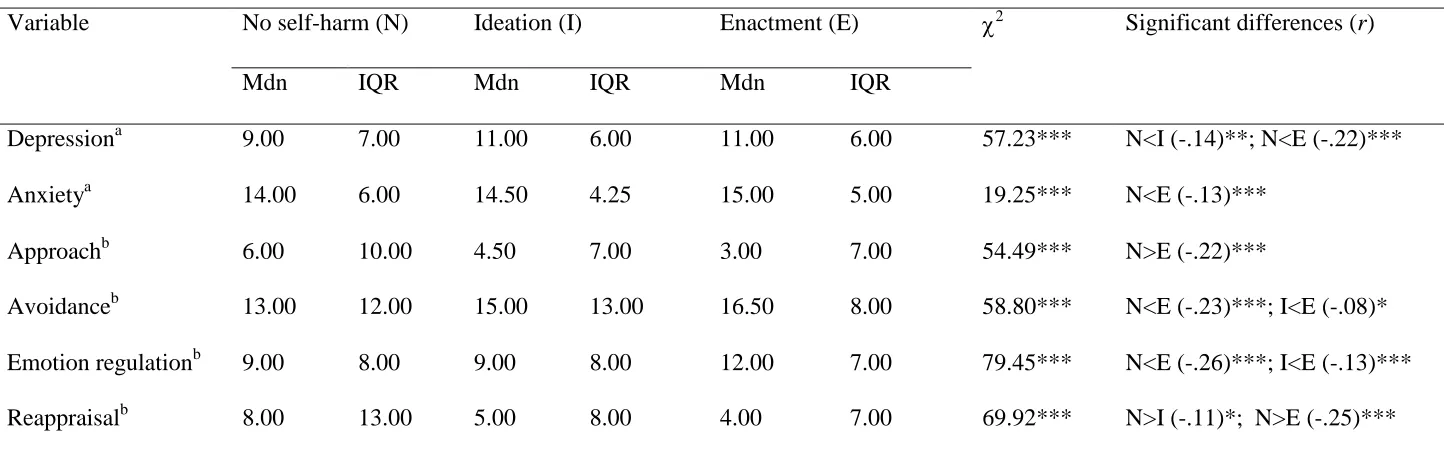
Do Coping Functions Differentiate Between Self-Harm Groups? <<Insert Table 1 about here>>
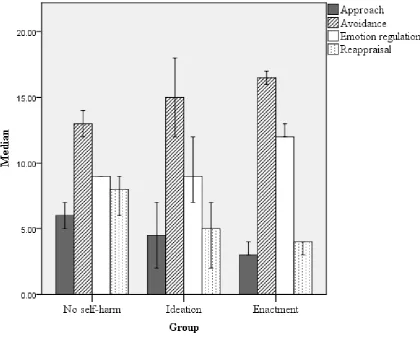
of Mann Whitney U tests were performed to establish where the differences were. The no self-harm group were lower in depressive symptoms and higher in reappraisal coping than those in the ideation group. The no self-harm group were also lower in depression, anxiety, avoidance and emotion regulation coping than the enactment group and higher in approach and reappraisal coping. Participants who self-harmed in response to the stressor they described (enactment) reported higher endorsement of emotion regulation and avoidance coping than those who thought of harming, but did not act (ideation) (see Figure 1).
<<Insert Figure 1 about here>>
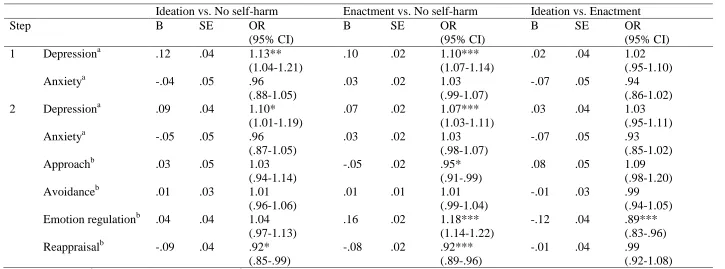
Hierarchical multinomial logistic regression. Results of the hierarchical multinomial logistic regression analyses are presented in Table 2. In step one, anxious and depressive symptomatology were entered. This model was statistically significant ( 2
(4) = 66.07, p
<.001), but explained only a small amount of variability (Pseudo R2; Cox and Snell = .06; Nagelkerke = .07; McFadden = .04). Both self-harm groups (ideation and enactment) were significantly different in depressive symptomatology to those who did not have self-harm thoughts or behaviours in response to the stressor described (no self-harm). There was no significant difference between the ideation and enactment group in level of depressive symptoms reported. The three groups were not significantly different in anxious symptomatology.
<<Insert Table 2 about here>>
In the second step, functional coping dynamics were added to the regression model. This resulted in a substantial Pseudo R2 increase (Cox and Snell = .21; Nagelkerke = .26; McFadden = .14; Model 2
significantly different from those in the no self-harm group in depressive symptomology and the endorsement of approach, emotion regulation and reappraisal coping. Those in the no self-harm group also differed from the ideation group in reappraisal coping. Emotion regulation coping distinguished ideation and enactment groups.1
Discussion
The present study is, to the best of our knowledge, the first exploration of functional coping dynamics in relation to self-harm ideation and enactment. Our results suggest that functional coping dynamics may be differentially associated with self-harm ideation and enactment in those with recent self-harm. This is important, given that understanding the transitions between ideation and enactment has been identified as a critical frontier in suicide prevention (Klonsky and May, 2014).
Results of the univariate analyses indicated that avoidance and emotion regulation coping functions differentiated ideation and enactment groups, as well as the enactment group from those with no self-harm experience in relation to the stressor described. Multivariate regressions indicate that functional coping dynamics make a significant contribution to variability explained, beyond anxious and depressive symptomology. Reappraisal coping distinguished those with self-harm experiences in relation to the
identified stressor (ideation and enactment groups) from those with no self-harm experience. Approach and emotion regulation coping distinguished those who self-harmed (enactment) from those with no self-harm experience in response to the stressor described. Importantly, the endorsement of emotion regulation coping also distinguished those who thought of
1 One thousand and thirty-eight participants indicated that they were aged 25 years or
harming (ideation) from those who acted (enactment). However, the observed odd ratios were small.
In addition to exploring whether functional coping dynamics differentiate self-harm experiences in response to the stressor, the study aimed to describe the frequency of harm ideation and enactment in response to recent stressors, in participants with recent self-harm. There is a paucity of research proving ‘basic’ information regarding the natural phenomenology of self-harmful thoughts and behaviours (Nock et al., 2009), including information as to when self-harm experiences are more likely to occur. That said, given that 1) self-harm represents a means of coping, 2) all participants had self-harmed in the last three months and 3) this study considered coping following the most stressful event within that 3 month timeframe, it could be anticipated that both self-harm thoughts and behaviours would be highly prevalent within the responses collated. Additionally, the sample comprised of relatively high frequency and established self-harm. This is pertinent given that theoretical accounts (Chapman et al., 2006) and empirical evidence (Wadman et al., 2016) suggest that self-harm can become habitual and ingrained with repetitive engagement, with the potential for perceived dependency to develop. However, despite the sample profile and high risk of repetition, 41 % of participants reported no self-harm experience(s) in response to their most significant stressor. That is to say, they did not report self-harming, nor did they report thinking about harming. Even with a recent history of self-harm, self-harming is not an inevitable outcome when an individual is exposed to a significant stressor.
This is an interesting finding, demonstrating that, for a significant minority, self-harm happened not in response to the identified major stressor but in response to an event they considered ‘less significant’. This could be taken to highlight the unpredictable nature of
suggest that, for many people, self-harm thoughts and behaviours may be a consequence of an endurance or accumulation of more minor day-to-day stressors, such that a seemingly less significant event serves as ‘the straw that broke the camel’s back’. This may be in line with theoretical accounts which posit distress tolerance as a key moderator in self-harmful
behaviour engagement (Chapman et al., 2006). This finding has practical implications; it may not be possible for an individual to anticipate more vulnerable periods, given that they may occur in response to day-to-day stressors as well as more ‘significant’ events. Therefore, it is of paramount importance that individuals have ready access to sources of support and that both informal and formal support networks are able to identify and respond appropriately to signs of distress. The co-production of a safety plan may aid in this, given that this facilitated process empowers individuals to explore alternative coping strategies, plan possible coping routes in advance and identify and utilise external sources of support in moments of
difficulty/crisis (Stanley and Brown, 2012). Limitations
While the study offers novel insight into the functional coping dynamics underpinning self-harm ideation and enactment in those with recent self-harm, it is important that a number of key limitations are noted. The primary limitation of the work is the cross-sectional nature of the study, precluding the ability to make inferences regarding causality; the collection of ‘real time’ data and longitudinal protocols would be optimally placed to explore these
dynamics more fully.
The study defined ‘recent’ self-harm as behaviours in the last 3 months. This timeframe was determined so as to minimise the biases associated with long-term
previous research has operationalised ‘recent’ using a range of arbitrarily defined cut-offs (Brown et al., 2007). It is unclear whether adopting an alternative recency threshold would affect the pattern of significant findings. Therefore, future research exploring these dynamics would make a novel contribution to the extant literature.
The study aimed to recruit a diverse community-based sample. While the study was advertised on a variety of platforms (e.g,, e-mail listings, social media, poster advertisements) it is not known what proportion of the sample were Psychology undergraduates. The age of participants ranged from 16 to 49 years, however the majority were young (18.21 years) and female (79.9%). This may reflect the disproportionate prevalence of self-harm in this age group (Hawton, Saunders, & O’Connor, 2012; Madge et al., 2008). However, it is important to explore the relationship between functional coping dynamics and self-harm ideation and enactment across other demographic groupings, not least as both gender (Avero and Calvo, 1999; Karekla and Panayiotou, 2011) and age (Nielsen et al., 2016) are associated with the endorsement of coping. Further, when considering the nature of the sample, it is pertinent to note that while the length of time since first episode self-harm provides useful descriptive information in so far as to typify the current sample, information was not collected about periods of abstinence or breaks in self-harm enactment within given histories. Indeed,
fluctuation and pauses within engagement histories are common. Moreover, there is a lack of consensus regarding how, or indeed whether, these fall within conceptualisations of recovery
(Wadman et al., 2016). Few participants in the current study reported a wish to die or a wish to be dead
have reported a marked difficulty in recruiting adequate numbers of participants who think about harming themselves, but have never acted (e.g., Hooley et al., 2010). It is therefore of interest to note that this difficulty is also apparent when considering those who have a lifetime history of self-harm, but are being recruited for their recent ideation. The small odds ratios observed in this current study, despite the large overall sample size, highlight the need for adequately powered research. Therefore, it is pertinent to consider why this difficulty in recruiting to ideation groups prevails.
While tentative, a number of potential explanations are noted. Firstly, the sample size may, in part, be a product of the definition of ‘recent’ employed. Research evidence suggests
that, if repeated, there is often a very short time period between self-harm episodes (Owens et al., 2015). Therefore, it could be suggested that the 3 month timeframe increases the
probability of capturing enactment. If true, an extended (e.g., 6 months, 12 months) definition of ‘recent’ self-harm may be more optimally placed to capture ideation.
Secondly, the sample characteristics may be attributable to self-selection biases. The questionnaire was advertised as, ‘part of an on-going project investigating coping function and self-harm’. While the information provided highlighted the aim to understand a range of
self-harm experiences, researchers conducting similar work may wish to explicitly state this in the study title. Employing a staged, more targeted advertising approach may also aid in the recruitment of participants with a range of self-harm related experiences e.g., (1) ‘general advertising’ (e.g., Research opportunity: Emotions and wellbeing), (ii) ‘mid-level
advertising’, aiming to recruit those with thoughts of harming (e.g., Research opportunity:
Finally, given the lack of conceptual clarity, participants may be less certain about what constitutes a self-harm ‘thought’ than an episode of self-harm behaviour, and
consequently be less confident in reporting these experiences. While anecdotal, in our experience it is not uncommon for participants in laboratory-based research to comment that they are not sure if an experience ‘counts’, when reporting self-harm thoughts and urges.
Often this apparent uncertainty appears rooted in the frequency or intensity of the experience. Therefore, increased conceptual clarity and the development of a more nuanced account of key constructs may be an important step in research aimed at understating the process underpinning, and transitions between, ideation and enactment.
The findings of the present study must be interpreted within the context of our operationalisations. The definition of ideation included participants who reported actively resisting an urge to engage and those who wanting to harm but were prevented by
circumstance (e.g., when access to means was restricted, when they were not alone, etc.). While the present study did not afford the possibility to explore these potential subgroups due to the small numbers reporting ideation, future research should consider whether divergent coping dynamics underpin these profiles.
Conclusion
Notwithstanding these limitations, this study offers novel insight into the relationship between the functional coping and self-harm, in those with recent self-harm. Additionally, and for the first time, the study explores these relationships in both self-harm ideation and self-harm enactment. Taken together, results indicate that functional coping dynamics may be differentially associated with self-harm thoughts and behaviour. This study also
contributes novel insights into the ‘whens’ of self-harm, suggesting that seemingly innocuous
References
Armey, M.F., Crowther, J.H., Miller, I.W., 2011. Changes in Ecological Momentary Assessment reported affect associated with episodes of nonsuicidal self-injury. Behav. Ther. 42, 579–588. doi:10.1016/j.beth.2011.01.002
Avero, P., Calvo, M.G., 1999. Emotional reactivity to social-evaluative stress: Gender differences in response systems concordance. Pers. Individ. Dif. 27, 155–170.
doi:10.1016/S0191-8869(98)00229-3
Brown, S.A., Williams, K., Collins, A., 2007. Past and recent deliberate self-harm: Emotion and coping strategy differences. J. Clin. Psychol. 63, 791–803. doi:10.1002/jclp.20380
Carver, C.S., Scheier, M.F., Weintraub, J.K., 1989. Assessing coping strategies: A theoretically based approach. J. Pers. Soc. Psychol. 56, 267–283. doi:10.1037/0022-3514.56.2.267
Chapman, A.L., Gratz, K.L., Brown, M.Z., 2006. Solving the puzzle of deliberate self-harm: The Experiential Avoidance Model. Behav. Res. Ther. 44, 371–394. doi:10.1016/j.brat.2005.03.005
Cox, T., Ferguson, E., 1991. Individual differences, stress and coping, in: Cooper, C., Payne, R. (Eds.), Personality and Stress: Individual Differences in the Stress Process. Wiley, Chicester, pp. 1–22.
Evans, E., Hawton, K., Rodham, K., 2005. In what ways are adolescents who engage in self-harm or experience thoughts of self-harm different in terms of help-seeking, communication and coping strategies? J. Adolesc. 28, 573–587. doi:10.1016/j.adolescence.2004.11.001
Ferguson, E., Cox, T., 1997. The Functional Dimensions of Coping scale: Theory, reliability and validity. Br. J. Health Psychol. 2, 109–129. doi:10.1111/j.2044-8287.1997.tb00528.x
Gelinas, B.L., Wright, K.D., 2013. The cessation of deliberate self-harm in a university sample: The reasons, barriers, and strategies involved. Arch. Suicide Res. 17, 373–386.
doi:10.1080/13811118.2013.777003
Glazebrook, K., Townsend, E., Sayal, K., 2015. Do coping strategies mediate the relationship between parental attachment and self-harm in young people? Arch. suicide Res. ePub, ePub–ePub. doi:10.1080/13811118.2015.1004495
Hasking, P., Momeni, R., Swannell, S., Chia, S., 2008. The nature and extent of non-suicidal self injury in a non-clinical sample of young adults. Arch. Suicide Res. 12, 208–218.
doi:10.1080/13811110802100957
Hawton, K., Rodham, K., Evans, E., Weatherall, R., 2002. Deliberate self harm in adolescents: self report survey in schools in England. BMJ 325, 1207–1211. doi:10.1136/bmj.325.7374.1207
Hawton, K., Saunders, K.E., O’Connor, R.C., 2012. Self-harm and suicide in adolescents. Lancet 379, 2373–2382. doi:10.1016/S0140-6736(12)60322-5
Hooley, J.M., Ho, D.T., Slater, J., Lockshin, A., 2010. Pain perception and nonsuicidal self-injury: A laboratory investigation. Personal. Disord. Theory, Res. Treat. 1, 170–179.
doi:10.1037/a0020106
Johnson, J.G., Cohen, P., Gould, M.S., Kasen, S., Brown, J., Brook, J.S., 2002. Childhood adversities, interpersonal difficulties, and risk for suicide attempts during late adolescence and early
adulthood. Arch. Gen. Psychiatry 59, 1174–1182. doi:10.1001/archpsyc.59.8.741
Kapur, N., Cooper, J., O’Connor, R.C., Hawton, K., 2013. Non-suicidal self-injury v. attempted suicide: New diagnosis or false dichotomy? Br. J. Psychiatry 202, 326–328.
doi:10.1192/bjp.bp.112.116111
Karekla, M., Panayiotou, G., 2011. Coping and experiential avoidance: Unique or overlapping constructs? J. Behav. Ther. Exp. Psychiatry 42, 163–170. doi:10.1016/j.jbtep.2010.10.002
Klonsky, E.D., Glenn, C.R., 2009. Assessing the functions of non-suicidal self-injury: Psychometric properties of the Inventory of Statements about Self-injury (ISAS). J. Psychopathol. Behav. Assess. 31, 215–219. doi:10.1007/s10862-008-9107-z
Klonsky, E.D., Glenn, C.R., 2008. Resisting urges to self-injure. Behav. Cogn. Psychother. 36, 211– 220. doi:10.1017/S1352465808004128
Klonsky, E.D., May, A.M., 2014. Differentiating suicide attempters from suicide ideators: A critical frontier for suicidology research. Suicide Life-Threatening Behav. 44, 1–5.
doi:10.1111/sltb.12068
Klonsky, E.D., Olino, T.M., 2008. Identifying clinically distinct subgroups of self-injurers among young adults: A latent class analysis. J. Consult. Clin. Psychol. 76, 22–27. doi:10.1037/0022-006X.76.1.22
Lloyd-richardson, E.E., Perrine, N., Dierker, L., Kelley, L., 2007. Characteristics and functions of non-suicidal self-injury in a community sample of adolescents. Psychol. Med. 37, 1183–1192. doi:10.1017/S003329170700027X.Characteristics
Lynch, T.R., Cozza, C., 2009. Behavior therapy for nonsuicidal self-injury, in: Nock, M.K. (Ed.), Understanding Nonsuicidal Self-Injury: Origins, Assessment, and Treatment. American Psychological Association, Washington, DC, pp. 221–249.
Madge, N., Hewitt, A., Hawton, K., Wilde, E.J. De, Corcoran, P., Fekete, S., Heeringen, K. Van, De Leo, D., Ystgaard, M., 2008. Deliberate self-harm within an international community sample of young people: Comparative findings from the Child & Adolescent Self-harm in Europe (CASE) Study. J. Child Psychol. Psychiatry Allied Discip. 49, 667–677.
doi:10.1111/j.1469-7610.2008.01879.x
McMahon, E.M., Keeley, H., Cannon, M., Arensman, E., Perry, I.J., Clarke, M., Chambers, D., Corcoran, P., 2014. The iceberg of suicide and self-harm in Irish adolescents: a population-based study. Soc. Psychiatry Psychiatr. Epidemiol. 49, 1929–1935. doi:10.1007/s00127-014-0907-z
National Institute for Clinical Excellence, 2011. National Collaborating Centre for Mental Health. Self-harm: Longer term management. National Clinical Guideline 133. London.
Nielsen, E., Sayal, K., Townsend, E., 2016. Exploring the relationship between experiential avoidance, coping functions and the recency and frequency of self-harm. PLoS One 11, e0159854.
Nixon, K., Heath, N., 2009. Introduction to non-suicidal self-injury in adolescents, in: Nixon, M.-K., Heath, N. (Eds.), Self-Injury in Youth: The Essential Guide to Assessment and Intervention. pp. 1–6.
Nock, M.K., Prinstein, M.J., Sterba, S.K., 2009. Revealing the form and function of self-injurious thoughts and behaviors: A real-time ecological assessment study among adolescents and young adults. J. Abnorm. Psychol. 118, 816–27. doi:10.1037/a0016948
Orlando, C.M., Broman-Fulks, J.J., Whitlock, J.L., Curtin, L., Michael, K.D., 2015. Nonsuicidal self-injury and suicidal self-self-injury: A taxometric investigation. Behav. Ther. In press.
doi:10.1016/j.beth.2015.01.002
Owens, D., Horrocks, J., House, A., 2002. Fatal and non-fatal repetition of self-harm. Systematic review. Br. J. Psychiatry 181, 193–199. doi:10.1192/bjp.181.3.193
Owens, D., Kelley, R., Munyombwe, T., Bergen, H., Hawton, K., Cooper, J., Ness, J., Waters, K., West, R., Kapur N., 2015. Switching methods of self-harm at repeat episodes: Findings from a multicentre cohort study. J. Affect. Disord. 180, 44–51. doi:10.1016/j.jad.2015.03.051
Shaw, S.N., 2006. Certainty, revision, and ambivalence: A qualitative investigation into women’s journeys to stop self-injuring. Women Ther. 29, 153–175. doi:10.1300/J015v29n01_08
Sourander, A., Helstelä, L., Haavisto, A., Bergroth, L., 2001. Suicidal thoughts and attempts among adolescents: A longitudinal 8-year follow-up study. J. Affect. Disord. 63, 59–66.
doi:10.1016/S0165-0327(00)00158-0
Stack, S., 2014. Differentiating suicide ideators from attempters: Violence - A research note. Suicide Life-Threatening Behav. 44, 46–57. doi:10.1111/sltb.12054
Stanley, B., Brown, G.K., 2012. Safety Planning Intervention: A brief intervention to mitigate suicide risk. Cogn. Behav. Pract. 19, 256–264. doi:10.1016/j.cbpra.2011.01.001
Suyemoto, K.L., 1998. The functions of self-mutilation. Clin. Psychol. Rev. 18, 531–554. doi:10.1016/S0272-7358(97)00105-0
Townsend, E., 2014. Self-harm in young people. Evid. Based. Ment. Health 17, 97–99. doi:10.1136/eb-2014-101840
Townsend, E., Ness, J., Waters, K., Kapur, N., Turnbull, P., Cooper, J., Bergen, H., Hawton, K., 2015. Self-harm and life problems: findings from the Multicentre Study of Self-harm in England. Soc. Psychiatry Psychiatr. Epidemiol. 51, 183–192. doi:10.1007/s00127-015-1136-9
Wadman, R., Clarke, D., Sayal, K., Vostanis, P., Armstrong, M., Harroe, C., Majumder, P.,
Townsend, E., 2016. An interpretative phenomenological analysis of the experience of self-harm repetition and recovery in young adults. J. Health Psychol. doi:10.1177/1359105316631405
Warm, A., Murray, C., Fox, J., 2003. Why do people self-harm? Psychol. Health Med. 8, 72–79. doi:10.1080/1354850021000059278
Washburn, J.J., Juzwin, K.R., Styer, D.M., Aldridge, D., 2010. Measuring the urge to self-injure: Preliminary data from a clinical sample. Psychiatry Res. 178, 540–544.
doi:10.1016/j.psychres.2010.05.018
Table 1. Descriptive statistics, Kruskal-Wallis and Mann Whitney U tests comparing anxious and depressive symptomatology and the endorsement of functional coping dynamics between no self-harm (n=457), ideation (n=50) and enactment (n=650) groups.
Note. Mdn = Median, IQR = Inter-Quartile Range, aDepressive and anxious symptomatology, as measured by the HADS, bFunctional coping dynamics, as measured by the FDC scale, * denotes significance at p <.05, **significance at p <.01,***significance at p <.001. All analyses survive Bonferroni correction for multiple comparisons ( = .017).
Variable No self-harm (N) Ideation (I) Enactment (E) 2 Significant differences (r)
Mdn IQR Mdn IQR Mdn IQR
Depressiona 9.00 7.00 11.00 6.00 11.00 6.00 57.23*** N<I (-.14)**; N<E (-.22)*** Anxietya 14.00 6.00 14.50 4.25 15.00 5.00 19.25*** N<E (-.13)***
Approachb 6.00 10.00 4.50 7.00 3.00 7.00 54.49*** N>E (-.22)***
Table 2. Hierarchical multinomial logistic regression exploring whether functional coping dynamics, anxious and depressive symptomatology predict self-harm experience, in response to a recent stressor.
Ideation vs. No self-harm Enactment vs. No self-harm Ideation vs. Enactment
Step B SE OR
(95% CI)
B SE OR
(95% CI)
B SE OR
(95% CI) 1 Depressiona .12 .04 1.13**
(1.04-1.21)
.10 .02 1.10*** (1.07-1.14)
.02 .04 1.02 (.95-1.10) Anxietya -.04 .05 .96
(.88-1.05)
.03 .02 1.03 (.99-1.07)
-.07 .05 .94 (.86-1.02) 2 Depressiona .09 .04 1.10*
(1.01-1.19)
.07 .02 1.07*** (1.03-1.11)
.03 .04 1.03 (.95-1.11) Anxietya -.05 .05 .96
(.87-1.05)
.03 .02 1.03 (.98-1.07)
-.07 .05 .93 (.85-1.02) Approachb .03 .05 1.03
(.94-1.14)
-.05 .02 .95* (.91-.99)
.08 .05 1.09 (.98-1.20) Avoidanceb .01 .03 1.01
(.96-1.06)
.01 .01 1.01 (.99-1.04)
-.01 .03 .99 (.94-1.05) Emotion regulationb .04 .04 1.04
(.97-1.13)
.16 .02 1.18*** (1.14-1.22)
-.12 .04 .89*** (.83-.96) Reappraisalb -.09 .04 .92*
(.85-.99)
-.08 .02 .92*** (.89-.96)
-.01 .04 .99 (.92-1.08) Step 1, Model 2
(4) = 66.07, p<.001, Pseudo R2 (Cox and Snell = .06, Nagelkerke = .07, McFadden = .04) Step 2, Model 2
(12) = 273.68, p <.001, Pseudo R2 (Cox and Snell = .21, Nagelkerke = .26, McFadden = .14)