Generating a Family of Byzantine-Fault-Tolerant Protocol Implementations
Using a Meta-Model Architecture
Graham NC Kirby, Alan Dearle & Stuart J Norcross
School of Computer Science, University of St Andrews, St Andrews, Fife KY16 9SX, Scotland
{graham, al, stuart}@cs.st-andrews.ac.uk
Abstract
We describe an approach to modelling a Byzantine-fault-tolerant distributed algorithm as a family of re-lated finite state machines, generated from a single meta-model. Various artefacts are generated from each state machine, including diagrams and source-level protocol implementations. The approach allows a state machine formulation to be applied to problems for which it would not otherwise be suitable, increasing confidence in correctness.
1.
Introduction
The finite state machine is a widely used abstraction for describing and reasoning about distributed algo-rithms [1]. Here we address the problem of developing a finite state machine formulation for an algorithm whose generality precludes its expression as a single state machine. Instead, the algorithm may be character-ised as a family of related state machines, each corre-sponding to particular values of some parameters to the general algorithm. Although family members differ in their individual states and transitions, they share a common structure dictated by the general algorithm.
Our approach is to develop a meta-model that cap-tures the common architecture of the family of state machines. This can be executed with chosen parameter values to generate any particular member of the state machine family. The output of the meta-model is a state machine representation, from which various con-crete artefacts may be generated. These include textual state machine descriptions, state machine diagrams and specialised source-level algorithm implementations.
We describe this approach via the example of a Byzantine-fault-tolerant (BFT) commit algorithm— originally motivating the work. We think that the tech-nique could also be applied to development of other fault-tolerant protocols, making it directly relevant to the area of architecting critical infrastructures.
2.
Background
The motivation for this work arose during develop-ment of a particular algorithm within a distributed stor-age system [2]. The aim of the ASA project is to de-velop a resilient, logically ubiquitous storage infra-structure with the following attributes:
data can be accessed efficiently and securely from any physical location
data is stored resiliently
an historical record of data is available The requirements include the following:
it must provide a logical file system that appears the same regardless of the physical machine from which it is accessed
files stored in the file system must be resilient to the failure and/or malicious behaviour of individ-ual machines
it must provide a historical record
The ASA infrastructure provides a single distributed abstract file system, which is built on a generic distrib-uted storage layer. For scalability, this storage layer is itself implemented on a peer-to-peer (P2P) key-based routing infrastructure. The storage layer provides resil-ience by replicating data and meta-data on multiple P2P nodes, and actively maintaining those replicas as nodes fail, misbehave or leave the P2P overlay.
The aspect of interest here is the commit algorithm used to record a new version of a logical data item in the distributed storage layer. The algorithm is executed by all members of the set of P2P nodes on which that data item’s version history is replicated. The member-ship of this set can change dynamically as the topology of the P2P network changes.
history is stored on each of the replica sites. Hence, a subsequent query over the history will yield a consis-tent response, regardless of which replica site is used.
The algorithm is also required to be BFT, meaning that it operates correctly in the face of faulty behaviour exhibited by some subset of the nodes storing the his-tory replicas. Faulty behaviour may include responding slowly, failing completely, or arbitrary malicious ac-tions. As is well known, the theoretical limit on all BFT schemes is that at least 3f+1 participants are needed to give tolerance to f failures [3]. Hence for a replication factor r, yielding r replicas of each version history, the algorithm tolerates at most floor((r-1)/3)
faulty participants.
Background processes run to regenerate missing replicas and to replace faulty nodes, thus here the limit applies to the duration of a particular execution of the algorithm, rather than to the lifetime of the system1.
Additional replicas need to be generated whenever the set of nodes storing replicas of a given data item is temporarily reduced. This may occur due to fail-stop faults, which are straightforwardly detected through timeouts, or due to the detection of malicious nodes. Such nodes are eventually detected with high probabil-ity using periodic cross-checks between replica nodes.
3.
General approach
Initially, we designed a single generic algorithm that appeared to meet the requirements outlined in the previous section, parameterised by the replication fac-tor. In an effort to gain greater insight into its opera-tion, we then developed a finite state machine model for a selected replication factor—four, being the sim-plest scheme to yield a BFT algorithm. Although nei-ther the algorithm (about 500 lines of pseudo-code) nor the state machine (33 states with 3-4 transitions from each) were especially complex, they were non-trivial. We then faced the problem that there was no strong correlation between the code and the state machine. Thus even though we were satisfied (informally) that the state machine was correct, its creation achieved little in terms of building confidence in the algorithm.
The main reason for the disparity between the state machine and the algorithm was that the former was specific to a fixed replication factor, while the algo-rithm was generic. The individual states in the state machine correspond to the counts of messages that have been sent and received at particular points during the algorithm’s execution. The maximum values of these counts vary with the replication factor, thus the number of states in the machine also varies. By the same argument, it is not possible to construct a single
1 Details are available at http://asa.cs.st-andrews.ac.uk/metamodel/.
state machine that captures the generic algorithm. Our goal at this point was to unify the state machine model and the generic algorithm, by generalising the state machine in some way. The key insight that made this possible was to identify how both the state space and the state transitions were determined by the repli-cation factor. The state space was defined straightfor-wardly by the various combinations of the possible message counts, themselves bounded by the replication factor. For transitions, the important point was that some denoted simple increments in message counts, whereas others denoted actions to be performed (termed phase transitions). By identifying where in the state diagram phase transitions occurred, and relating these to the replication factor, it was possible to pro-duce a generic description defining a family of related state machines. We then proceeded as follows:
We developed a meta-model that captured the com-mon structure acom-mong the members of the state ma-chine family.
We executed the meta-model with a replication fac-tor of four to generate an abstract representation of a specific state machine, which we then checked for consistency with the original state machine.
Once satisfied with the correctness of the meta-model, we developed tools to generate various state machine artefacts, including diagrams and source-level implementations.
3.1.
Generation process
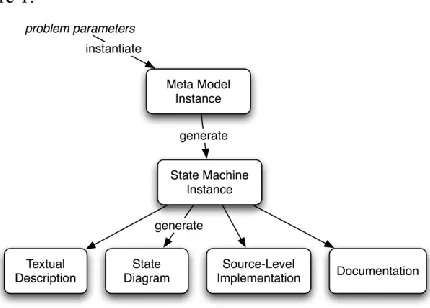
[image:2.612.323.538.454.608.2]The overall generation process is illustrated in Fig-ure 1.
Figure 1. State machine generation scheme
MetaModel is specialised to that replication factor. The method generateStateMachine() performs the genera-tion of the corresponding state machine. This returns an abstract state machine representation in the form of an instance of class StateMachine. The state machine contains a collection of states linked by transitions. Both states and transitions may be annotated for docu-mentation purposes. Transitions also refer to associated actions to be performed by the state machine. These classes are outlined in Figure 2.
class MetaModel {
MetaModel(int replication_factor) {… StateMachine generateStateMachine(); }
class StateMachine { String[] messages; State[] states; State start_state; State finish_state; }
class State {
String state_name; Transition[] transitions; String[] annotations; }
class Transition {
[image:3.612.67.301.173.360.2]State resultant_state; String[] actions; String[] annotations; }
Figure 2. Corresponding Java classes
Figure 3 shows how a particular state machine may be generated and rendered in a textual format.
MetaModel meta_model_4 = new MetaModel(4); StateMachine machine_4 =
meta_model.generateStateMachine();
[image:3.612.349.506.452.589.2]println(new TextRenderer().render(machine_4));
Figure 3. Generating a state machine
3.2.
Defining the meta-model
In general terms, the meta-model is a model of the structure common to all members of the state machine family. The steps involved in the generation of a par-ticular member of the family—an instance of State-Machine—are as follows:
1.generate a data structure containing representations of all possible states
2.for each state, generate the transitions resulting from all possible messages, and record in the data structure
3.prune any unreachable states 4.combine any sets of equivalent states
The final data structure forms the resulting State-Machine instance. Of these steps, 1, 3 and 4 can be performed fairly mechanically, whereas step 2 embod-ies the core logic of the algorithm.
3.2.1.Generating possible states. To generate all pos-sible states, the state space must be defined in terms of the problem parameters—in our case, the replication factor. The BFT commit algorithm involves five mes-sages that may be received by a participating node:
put, vote, commit, free, not free
In brief, the client sends a put message to each of the servers. A vote message is sent by a server to the others when it believes that this update should be next in the global ordering. A commit message is sent to indicate that enough votes have been received to pro-ceed with the update. The algorithm works by counting the messages sent and received, yielding a state com-prising the union of the following variables:
boolean put_received, vote_sent, commit_sent
int votes_received, commits_received
Two other boolean variables, could_choose and
has_chosen, are used by the algorithm to track the free
and not free messages. The upper bound on both
votes_received and commits_received is one less than the number of participants, which itself is given by the replication factor. Thus in total there are five boolean variables and two integer variables that range from 0 to
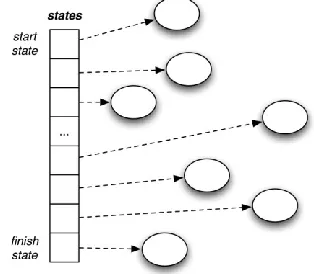
r-1 for replication factor r. Hence the space of possible states, containing all combinations of values, has the size 25r2. This gives 512 states for the smallest sensible value of r=4. The generateStateMachine() operation iterates through all of these combinations, generating a list of State objects. A simplified example of the data structure at this stage is shown in Figure 4.
categorised as either a simple state transition or a phase transition.
On a simple state transition, the sole effect is to in-crement one of the received message counts; no action is performed. A phase transition occurs when the re-ceipt of a message causes some threshold to be crossed, triggering an action. For example, in the commit algorithm, when the total number of votes sent and received reaches the number of non-faulty nodes, a
commit message is sent to all the nodes.
The second step in the generation of a state machine is to iterate over each of the state representations in the data structure generated during the first step. For each state, the meta-model determines which transitions would result from each of the possible messages, if received by the running state machine in that state. Each transition, along with any corresponding actions, is recorded in the state machine data structure.
Figure 5 shows the operation generateTransitio-nOnVote(), defined within the meta-model, determin-ing the transitions from any given state on receipt of a
vote message2. The control decisions that would be
taken dynamically in a generic algorithm are here be-ing taken at generation time.
generateTransitionOnVote(State s) { initialise state variables from s increment votes_received
if total votes >= threshold(r): if !vote_sent:
if could_choose: set has_chosen record action:
send not free message record action: send vote message set vote_sent
unset could_choose, if commit_sent:
record action: send commit message set commit_sent
derive new state s1 from state variables record transition s->s1 in data structure }
Figure 5. Meta-model for vote message
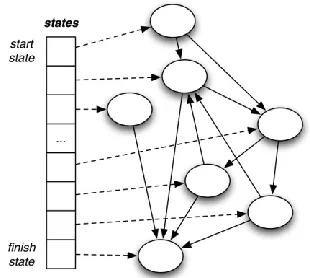
Figure 6 shows the data structure after representa-tions of the state transirepresenta-tions have been generated.
3.2.3.Pruning unreachable states. Once the complete transition graph has been generated, a reachability analysis is performed. Depending on the application, there may exist states that could never be reached via transitions from the start state. For example, the com-mit algorithm completes as soon as f+1 comcom-mit mes-sages have been received, thus there are no reachable states where the commit count exceeds f. For simplic-ity, such states are removed from the generated model. With a replication factor of 4, this step reduces the state space from its initial size of 512 to 48.
2Similar logic in the meta-model generates documentation
[image:4.612.351.506.73.212.2]describ-ing the states and the rationale for each transition.
[image:4.612.348.506.260.400.2]Figure 6. Data structure after step 2
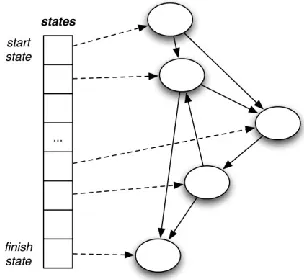
Figure 7 illustrates the result of pruning.
Figure 7. Data structure after step 3 3.2.4.Combining equivalent states. The generated state machine may be further simplified by identifying and combining sets of states that are equivalent, in the sense that the outgoing transitions from each perform the same actions and lead to the same destination state. Since this step may result in further states becoming unreachable, the previous step and this one are re-peated alternately until no further reduction in the state space occurs. With a replication factor of 4, this proc-ess eventually results in 33 states. Figure 8 illustrates the result of this step.
3.3.
State machine artefacts
The abstract representation of a state machine gen-erated by the meta-model can be rendered to yield various concrete artefacts, including:
a simple textual representation a state transition diagram
Figure 8. Data structure after step 4
Figure 9 shows the textual representation of a par-ticular state and its outgoing transitions. The name of the state encodes the variable values (put_received,
votes_sent etc) in that state. Note that the commentary describing the state in terms of the generic algorithm has been entirely automatically generated.
state: T/2/F/0/F/F/F
Have received initial put from client. Have not voted since another update has already been voted for. Have received 2 votes and no commits. Have not sent a commit since neither the vote threshold (3) nor the external commit threshold (2) has been reached. May not choose since another ongoing update has been voted for. Have not chosen this update since another ongoing update has been chosen. Wait-ing for 1 further vote (includWait-ing local vote if any) before sending commit. Waiting for 2 further exter-nal commits to finish.
Transitions:
message: VOTE
action: send vote message action: send commit message transition to: T/3/T/0/T/F/F
message: COMMIT
transition to: T/2/F/1/F/F/F
message: FREE
[image:5.612.107.259.74.214.2]action: send vote message action: send commit message action: send not free message transition to: T/2/T/0/T/T/T
Figure 9. Example generated state description
A state machine may be rendered as a state diagram by generating an XML diagram representation that can be imported into a diagramming tool (in this case, To-gether [4]). An example is available online at the ad-dress given previously.
Figure 10 shows a fragment of generated code, deal-ing with the receipt of a vote message. Each state is represented by a generated variable of the form S-F-0-F-0-F-F-F. Although the structure embodied in the generated code is equivalent to that shown in Figure 9, its organisation differs in that all possible states are grouped under each message, rather than vice-versa.
void receiveVote() {
switch (getState()) {
case (S-F-0-F-0-F-F-F) : { setState(S-F-1-F-0-F-F-F); }
case (S-F-0-F-0-F-F-T) : { setState(S-F-1-F-0-F-F-F); }
...
case (S-T-1-T-1-F-T-T) : { sendCommit();
setState(S-T-2-T-1-T-T-T); }
... }
Figure 10. Example generated source code
Commentary on states and transitions, as illustrated in Figure 9, is also included in the generated code.
4.
Use in practice
We have incorporated the meta-model for the dis-tributed commit algorithm into the ASA infrastructure. Since the replication factor is expected to change only rarely, we executed the meta-model with the default replication factor, generated source code from the re-sulting state machine, and copied that into the code-base. The benefit of this approach is that the imple-mentation is tightly coupled with its state machine de-scription, giving us confidence in its correctness.
Should we wish in future to support dynamic change to the replication factor, this may be achieved by dynamically generating implementations, compiling them and loading the resulting classes [5]. So long as new replication factors are not presented at high fre-quency, this approach is quite feasible; Table 1 shows approximate wall-clock times taken to generate state machines of various complexities on an Apple MacBook Pro (3GB, 2.33GHz Intel Core 2 Duo).
Table 1. Times to generate state machines
f r initial
states states final generation time (s)
1 4 512 33 0.10
[image:5.612.67.301.320.551.2]hard-wired definitions of the state components and mes-sages, these are now represented by a data structure with which the generic meta-model is initialised. Fig-ure 11 shows how the original meta-model is now con-figured. Each instance of IntComponent defines the maximum value of the corresponding state component.
StateComponent[] state_components = { new IntComponent("votes_received",
replication_factor - 1), new IntComponent("commits_received",
replication_factor - 1), new BooleanComponent("put_received"), new BooleanComponent("vote_sent"), new BooleanComponent("commit_sent"), new BooleanComponent("could_choose"), new BooleanComponent("has_chosen")};
String[] messages = {"put", "vote", "commit", "free", "not_free"};
initMetaModel(state_components, messages);
Figure 11. Initialising generic meta-model
5.
Related work
This work is obviously strongly related to the exten-sive literature on finite state machines, for example [1, 6]. Traditionally, state machines are used to model computations with fixed numbers of states, whereas our generative approach allows greater flexibility.
Architectural style languages [7, 8] allow families of related systems to be characterised in terms of their shared high level system structure, and specialised to produce particular instances. The work described here is less general since it focuses explicitly on the state machine paradigm; the generic meta-model could be thought of as one particular architectural style.
We have previously used generative techniques to build generic object browsers [9] and to support highly generic strongly typed code [5].
An alternative strategy is to apply formal specifica-tion and verificaspecifica-tion techniques to fault-tolerant algo-rithms. For example, in [10] a protocol is specified as logical assertions and verified using an interactive proof checker. In [11] an extended actor algebra is used to specify fault-tolerant software architectures. These approaches offer the possibility of formal proofs, whereas here we intend to provide a less formal aid to understanding, at significantly lower cost.
6.
Conclusions
We have outlined an approach to generating a fam-ily of related state machines and corresponding proto-col implementations from a unifying meta-model. In the ASA project this has allowed us to produce a state machine style description of our original BFT distrib-uted commit algorithm. This has increased our confi-dence in the correctness of the algorithm; indeed
sev-eral errors in the original version were identified dur-ing the process. We are currently investigatdur-ing possi-bilities for performing more rigorous checking on the state machine formulation.
Although we have applied this approach to a spe-cific BFT distributed algorithm, the approach should be applicable to other critical infrastructure problems involving protocols where the number of states is de-pendent on a set of parameters.
7.
Acknowledgments
This work was supported by EPSRC grant GR/S44501/01 and by a Royal Society of Edinburgh / Scottish Executive Support Research Fellowship. Mar-kus Tauber and Rob MacInnis contributed to the de-velopment of the distributed commit algorithm.
8.
References
[1] L. M. Minsky, Computation: Finite and Infinite Ma-chines: Prentice Hall, 1967.
[2] G. N. C. Kirby, A. Dearle, S. J. Norcross, M. Tauber, and R. Morrison, “Secure Location-Independent Sto-rage Architectures (ASA)”, 2004 http://www-systems.dcs.st-and.ac.uk/asa/
[3] L. Lamport, R. Shostak, and M. Pease, “The Byzantine Generals Problem”, ACM ToPLaS, vol. 4 no. 3, pp. 382-401, 1982.
[4] “Borland Together”, 2007 http://www.borland.com/ [5] G. N. C. Kirby, R. Morrison, and D. W. Stemple,
“Lin-guistic Reflection in Java”, Software - Practice & Ex-perience, vol. 28 no. 10, pp. 1045-1077, 1998. [6] D. Brand and P. Zafiropulo, “On Communicating
Fi-nite-State Machines”, Journal of the ACM, vol. 30 no. 2, pp. 323-342, 1983.
[7] D. Garlan, R. Allen, and J. Ockerbloom, “Exploiting Style in Architectural Design Environments”, Proc. 2nd SIGSOFT Symposium on Foundations of Software En-gineering, New Orleans, USA, pp. 175-188, 1994. [8] N. Medvidovic and R. N. Taylor, “A Classification and
Comparison Framework for Software Architecture De-scription Languages”, IEEE Transactions on Software Engineering, vol. 26 no. 1, pp. 70-93, 2000.
[9] A. Dearle and A. L. Brown, “Safe Browsing in a Strongly Typed Persistent Environment”, Computer Journal, vol. 31 no. 6, pp. 540-544, 1988.
[10] J. Hooman, “Verification of Distributed Real-Time and Fault-Tolerant Protocols”, in Lecture Notes in Com-puter Science 1349, Springer, pp. 261-275, 1997. [11] N. Dragoni and M. Gaspari, “An Object Based Algebra